ORTHOTIC ANKLE
JOINTS
- RUSHIKESH RAJGUDE
MPO, BATCH(2023-24)
DSMNRU Lucknow-226017
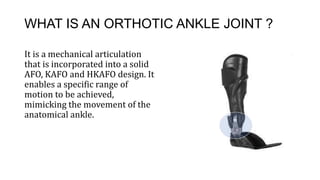
WHAT IS AN ORTHOTIC ANKLE JOINT ?
It is a mechanical articulation
that is incorporated into a solid
AFO, KAFO and HKAFO design. It
enables a specific range of
motion to be achieved,
mimicking the movement of the
anatomical ankle.
TYPES
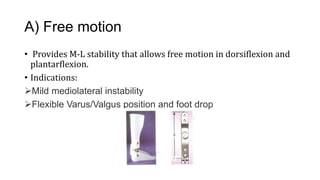
A) Free motion
• Provides M-L stability that allows free motion in dorsiflexion and
plantarflexion.
• Indications:
Mild mediolateral instability
Flexible Varus/Valgus position and foot drop
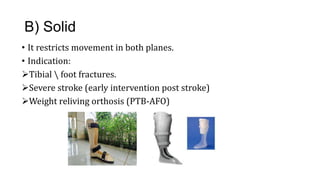
B) Solid
• It restricts movement in both planes.
• Indication:
Tibial  foot fractures.
Severe stroke (early intervention post stroke)
Weight reliving orthosis (PTB-AFO)
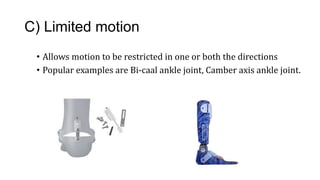
C) Limited motion
• Allows motion to be restricted in one or both the directions
• Popular examples are Bi-caal ankle joint, Camber axis ankle joint.
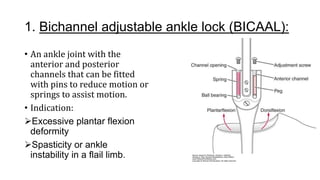
1. Bichannel adjustable ankle lock (BICAAL):
• An ankle joint with the
anterior and posterior
channels that can be fitted
with pins to reduce motion or
springs to assist motion.
• Indication:.
Excessive plantar flexion
deformity
Spasticity or ankle
instability in a flail limb.
CONTD:
Rod/pin in anterior channel
limits DF ROM
Rod/pin in posterior channel
limits PF ROM.
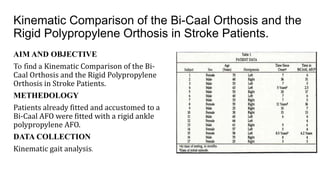
Kinematic Comparison of the Bi-Caal Orthosis and the
Rigid Polypropylene Orthosis in Stroke Patients.
AIM AND OBJECTIVE
To find a Kinematic Comparison of the Bi-
Caal Orthosis and the Rigid Polypropylene
Orthosis in Stroke Patients.
METHEDOLOGY
Patients already fitted and accustomed to a
Bi-Caal AFO were fitted with a rigid ankle
polypropylene AFO.
DATA COLLECTION
Kinematic gait analysis.
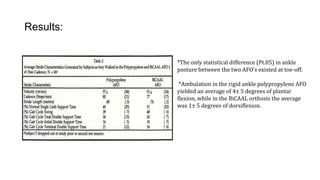
Results:
*The only statistical difference (Pt.05) in ankle
posture between the two AFO's existed at toe-off.
*Ambulation in the rigid ankle polypropylene AFO
yielded an average of 4± 5 degrees of plantar
flexion, while in the BiCAAL orthosis the average
was 1± 5 degrees of dorsiflexion.
Conclusion of the study:
• The rigid polypropylene AFO provided the same ankle
stability as the Bi-Caal AFO and had similar gait
characteristics in terms of velocity, cadence, and stride
length.
• The majority of stroke patients in this study preferred the
rigid polypropylene AFO due to its light weight, cosmesis,
and ability to interchange shoes.
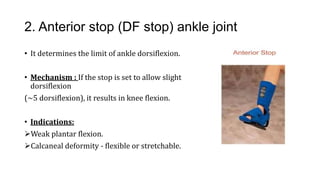
2. Anterior stop (DF stop) ankle joint
• It determines the limit of ankle dorsiflexion.
• Mechanism : If the stop is set to allow slight
dorsiflexion
(~5 dorsiflexion), it results in knee flexion.
• Indications:
Weak plantar flexion.
Calcaneal deformity - flexible or stretchable.
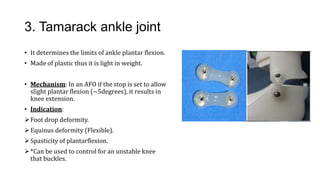
3. Tamarack ankle joint
• It determines the limits of ankle plantar flexion.
• Made of plastic thus it is light in weight.
• Mechanism: In an AFO if the stop is set to allow
slight plantar flexion (~5degrees), it results in
knee extension.
• Indication:
Foot drop deformity.
Equinus deformity (Flexible).
Spasticity of plantarflexion.
*Can be used to control for an unstable knee
that buckles.
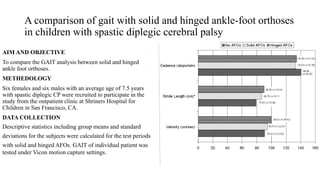
A comparison of gait with solid and hinged ankle-foot orthoses
in children with spastic diplegic cerebral palsy
AIM AND OBJECTIVE
To compare the GAIT analysis between solid and hinged
ankle foot orthoses.
METHEDOLOGY
Six females and six males with an average age of 7.5 years
with spastic diplegic CP were recruited to participate in the
study from the outpatient clinic at Shriners Hospital for
Children in San Francisco, CA.
DATA COLLECTION
Descriptive statistics including group means and standard
deviations for the subjects were calculated for the test periods
with solid and hinged AFOs. GAIT of individual patient was
tested under Vicon motion capture settings.
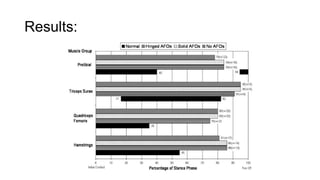
Results:
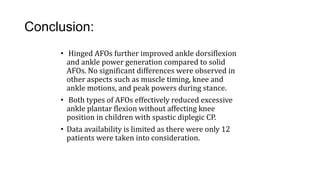
Conclusion:
• Hinged AFOs further improved ankle dorsiflexion
and ankle power generation compared to solid
AFOs. No significant differences were observed in
other aspects such as muscle timing, knee and
ankle motions, and peak powers during stance.
• Both types of AFOs effectively reduced excessive
ankle plantar flexion without affecting knee
position in children with spastic diplegic CP.
• Data availability is limited as there were only 12
patients were taken into consideration.
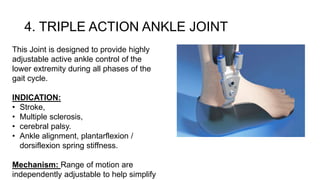
4. TRIPLE ACTION ANKLE JOINT
This Joint is designed to provide highly
adjustable active ankle control of the
lower extremity during all phases of the
gait cycle.
INDICATION:
• Stroke,
• Multiple sclerosis,
• cerebral palsy.
• Ankle alignment, plantarflexion /
dorsiflexion spring stiffness.
Mechanism: Range of motion are
independently adjustable to help simplify
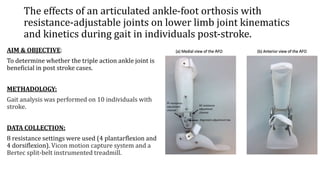
The effects of an articulated ankle-foot orthosis with
resistance-adjustable joints on lower limb joint kinematics
and kinetics during gait in individuals post-stroke.
AIM & OBJECTIVE:
To determine whether the triple action ankle joint is
beneficial in post stroke cases.
METHADOLOGY:
Gait analysis was performed on 10 individuals with
stroke.
DATA COLLECTION:
8 resistance settings were used (4 plantarflexion and
4 dorsiflexion). Vicon motion capture system and a
Bertec split-belt instrumented treadmill.
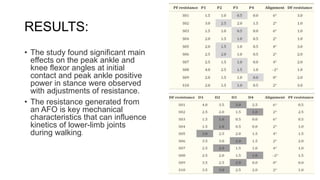
RESULTS:
• The study found significant main
effects on the peak ankle and
knee flexor angles at initial
contact and peak ankle positive
power in stance were observed
with adjustments of resistance.
• The resistance generated from
an AFO is key mechanical
characteristics that can influence
kinetics of lower-limb joints
during walking.
CONCLUSION:
• Triple Action joints allow for independent adjustment of
plantarflexion and dorsiflexion resistance.
• Adjustments in resistance had significant effects on ankle
and knee angles at initial contact and peak ankle positive
power in stance.
• Resistance generated from an AFO is a key mechanical
characteristic that can influence lower limb joints during
walking.
• Customary practice in orthotics relies heavily on clinician
experience and clinical intuition to specify and adjust orthotic
design to the specific needs of the patient.
• Further work is necessary to investigate the long-term
effects of AFO on gait.
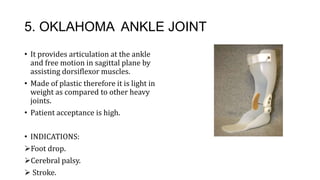
5. OKLAHOMA ANKLE JOINT
• It provides articulation at the ankle
and free motion in sagittal plane by
assisting dorsiflexor muscles.
• Made of plastic therefore it is light in
weight as compared to other heavy
joints.
• Patient acceptance is high.
• INDICATIONS:
Foot drop.
Cerebral palsy.
 Stroke.
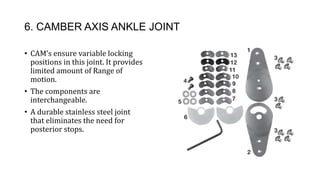
6. CAMBER AXIS ANKLE JOINT
• CAM’s ensure variable locking
positions in this joint. It provides
limited amount of Range of
motion.
• The components are
interchangeable.
• A durable stainless steel joint
that eliminates the need for
posterior stops.
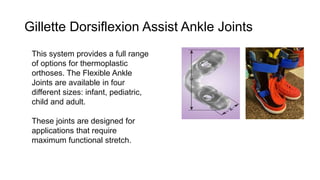
Gillette Dorsiflexion Assist Ankle Joints
This system provides a full range
of options for thermoplastic
orthoses. The Flexible Ankle
Joints are available in four
different sizes: infant, pediatric,
child and adult.
These joints are designed for
applications that require
maximum functional stretch.
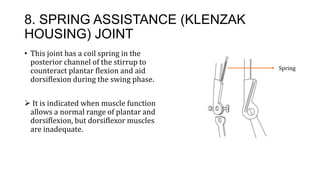
8. SPRING ASSISTANCE (KLENZAK
HOUSING) JOINT
• This joint has a coil spring in the
posterior channel of the stirrup to
counteract plantar flexion and aid
dorsiflexion during the swing phase.
 It is indicated when muscle function
allows a normal range of plantar and
dorsiflexion, but dorsiflexor muscles
are inadequate.
Spring
THANK YOU.

ORTHOTIC ANKLE JOINTS.pptx

  • 1.
    ORTHOTIC ANKLE JOINTS - RUSHIKESHRAJGUDE MPO, BATCH(2023-24) DSMNRU Lucknow-226017
  • 2.
    WHAT IS ANORTHOTIC ANKLE JOINT ? It is a mechanical articulation that is incorporated into a solid AFO, KAFO and HKAFO design. It enables a specific range of motion to be achieved, mimicking the movement of the anatomical ankle.
  • 3.
  • 4.
    A) Free motion •Provides M-L stability that allows free motion in dorsiflexion and plantarflexion. • Indications: Mild mediolateral instability Flexible Varus/Valgus position and foot drop
  • 5.
    B) Solid • Itrestricts movement in both planes. • Indication: Tibial foot fractures. Severe stroke (early intervention post stroke) Weight reliving orthosis (PTB-AFO)
  • 6.
    C) Limited motion •Allows motion to be restricted in one or both the directions • Popular examples are Bi-caal ankle joint, Camber axis ankle joint.
  • 7.
    1. Bichannel adjustableankle lock (BICAAL): • An ankle joint with the anterior and posterior channels that can be fitted with pins to reduce motion or springs to assist motion. • Indication:. Excessive plantar flexion deformity Spasticity or ankle instability in a flail limb.
  • 8.
    CONTD: Rod/pin in anteriorchannel limits DF ROM Rod/pin in posterior channel limits PF ROM.
  • 9.
    Kinematic Comparison ofthe Bi-Caal Orthosis and the Rigid Polypropylene Orthosis in Stroke Patients. AIM AND OBJECTIVE To find a Kinematic Comparison of the Bi- Caal Orthosis and the Rigid Polypropylene Orthosis in Stroke Patients. METHEDOLOGY Patients already fitted and accustomed to a Bi-Caal AFO were fitted with a rigid ankle polypropylene AFO. DATA COLLECTION Kinematic gait analysis.
  • 10.
    Results: *The only statisticaldifference (Pt.05) in ankle posture between the two AFO's existed at toe-off. *Ambulation in the rigid ankle polypropylene AFO yielded an average of 4± 5 degrees of plantar flexion, while in the BiCAAL orthosis the average was 1± 5 degrees of dorsiflexion.
  • 11.
    Conclusion of thestudy: • The rigid polypropylene AFO provided the same ankle stability as the Bi-Caal AFO and had similar gait characteristics in terms of velocity, cadence, and stride length. • The majority of stroke patients in this study preferred the rigid polypropylene AFO due to its light weight, cosmesis, and ability to interchange shoes.
  • 12.
    2. Anterior stop(DF stop) ankle joint • It determines the limit of ankle dorsiflexion. • Mechanism : If the stop is set to allow slight dorsiflexion (~5 dorsiflexion), it results in knee flexion. • Indications: Weak plantar flexion. Calcaneal deformity - flexible or stretchable.
  • 13.
    3. Tamarack anklejoint • It determines the limits of ankle plantar flexion. • Made of plastic thus it is light in weight. • Mechanism: In an AFO if the stop is set to allow slight plantar flexion (~5degrees), it results in knee extension. • Indication: Foot drop deformity. Equinus deformity (Flexible). Spasticity of plantarflexion. *Can be used to control for an unstable knee that buckles.
  • 14.
    A comparison ofgait with solid and hinged ankle-foot orthoses in children with spastic diplegic cerebral palsy AIM AND OBJECTIVE To compare the GAIT analysis between solid and hinged ankle foot orthoses. METHEDOLOGY Six females and six males with an average age of 7.5 years with spastic diplegic CP were recruited to participate in the study from the outpatient clinic at Shriners Hospital for Children in San Francisco, CA. DATA COLLECTION Descriptive statistics including group means and standard deviations for the subjects were calculated for the test periods with solid and hinged AFOs. GAIT of individual patient was tested under Vicon motion capture settings.
  • 15.
  • 16.
    Conclusion: • Hinged AFOsfurther improved ankle dorsiflexion and ankle power generation compared to solid AFOs. No significant differences were observed in other aspects such as muscle timing, knee and ankle motions, and peak powers during stance. • Both types of AFOs effectively reduced excessive ankle plantar flexion without affecting knee position in children with spastic diplegic CP. • Data availability is limited as there were only 12 patients were taken into consideration.
  • 17.
    4. TRIPLE ACTIONANKLE JOINT This Joint is designed to provide highly adjustable active ankle control of the lower extremity during all phases of the gait cycle. INDICATION: • Stroke, • Multiple sclerosis, • cerebral palsy. • Ankle alignment, plantarflexion / dorsiflexion spring stiffness. Mechanism: Range of motion are independently adjustable to help simplify
  • 18.
    The effects ofan articulated ankle-foot orthosis with resistance-adjustable joints on lower limb joint kinematics and kinetics during gait in individuals post-stroke. AIM & OBJECTIVE: To determine whether the triple action ankle joint is beneficial in post stroke cases. METHADOLOGY: Gait analysis was performed on 10 individuals with stroke. DATA COLLECTION: 8 resistance settings were used (4 plantarflexion and 4 dorsiflexion). Vicon motion capture system and a Bertec split-belt instrumented treadmill.
  • 19.
    RESULTS: • The studyfound significant main effects on the peak ankle and knee flexor angles at initial contact and peak ankle positive power in stance were observed with adjustments of resistance. • The resistance generated from an AFO is key mechanical characteristics that can influence kinetics of lower-limb joints during walking.
  • 20.
    CONCLUSION: • Triple Actionjoints allow for independent adjustment of plantarflexion and dorsiflexion resistance. • Adjustments in resistance had significant effects on ankle and knee angles at initial contact and peak ankle positive power in stance. • Resistance generated from an AFO is a key mechanical characteristic that can influence lower limb joints during walking. • Customary practice in orthotics relies heavily on clinician experience and clinical intuition to specify and adjust orthotic design to the specific needs of the patient. • Further work is necessary to investigate the long-term effects of AFO on gait.
  • 21.
    5. OKLAHOMA ANKLEJOINT • It provides articulation at the ankle and free motion in sagittal plane by assisting dorsiflexor muscles. • Made of plastic therefore it is light in weight as compared to other heavy joints. • Patient acceptance is high. • INDICATIONS: Foot drop. Cerebral palsy.  Stroke.
  • 22.
    6. CAMBER AXISANKLE JOINT • CAM’s ensure variable locking positions in this joint. It provides limited amount of Range of motion. • The components are interchangeable. • A durable stainless steel joint that eliminates the need for posterior stops.
  • 23.
    Gillette Dorsiflexion AssistAnkle Joints This system provides a full range of options for thermoplastic orthoses. The Flexible Ankle Joints are available in four different sizes: infant, pediatric, child and adult. These joints are designed for applications that require maximum functional stretch.
  • 24.
    8. SPRING ASSISTANCE(KLENZAK HOUSING) JOINT • This joint has a coil spring in the posterior channel of the stirrup to counteract plantar flexion and aid dorsiflexion during the swing phase.  It is indicated when muscle function allows a normal range of plantar and dorsiflexion, but dorsiflexor muscles are inadequate. Spring
  • 25.