1. Introduction
• Data centers are typically under-provisioned
 Expensive to build a 1:1 bi-section bandwidth
 Number of actual paths supported is actually small (even though ECMP is used)
• Under-provisioned nature of data centers is a problem for clouds or
hosting companies
 Cloud data centers are typically big
 Limit on multi-paths on the current network architecture
 Cloud is used by many people and organizations – opens doors for attacks
 Third, an application owner has no or little control over the underlying network in a
cloud data-center
• Under-provisioning not a problem in a corporate data center
 Data center managers have full control over the architecture and structure
1. Introduction
Introduction
• Solving this new type of DOS is difficult without human
intervention
• Damage is reduced if virtualized and self-service data centers are
used
• Contributions of this paper:
 Identify a new form of DOS attack in a cloud data-center, and verify that such
an attack could be carried out in a real cloud data-center
 Propose and evaluate a new mechanism for applications to dynamically
relocate to a different infrastructure when the desired Quality of Service (QoS)
could not be met
 Propose and evaluate a new available bandwidth detection technique which
can accurately determine the available bandwidth in a high speed network
2. A New Form of DOS Attack
• The gross under-provisioning and the public nature of a cloud
data-center open a potential venue for exploit
• Saturation of network bandwidth against other applications in the
same network is the key to this attack
• Aggregate capacity of hosts greatly exceeds the uplink capacity
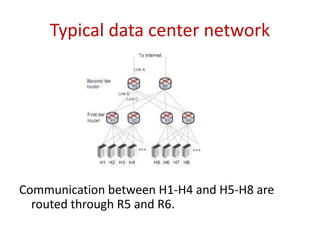
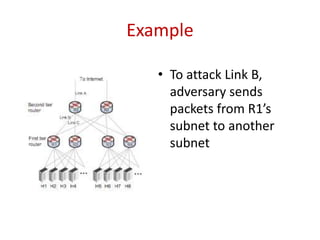
• In Fig. 1, Link A, B, and C are the uplinks of router R5, R1 and R2
respectively
• Transmission of enough traffic from hosts to hosts of different
subnets will ensure the saturation of the uplink
2. A New Form of DOS Attack
• Example:-
Let us consider Link B as a target, assuming Link B is the active link
and Link C is a fail-over link. To saturate Link B, an adversary
needs to send traffic from a host in R1’s subnet (e.g., H1) to another
host in a different subnet (e.g., H5). Due to under-provisioning, a
small number of hosts in R1’s subnet are sufficient to saturate link
B.
• Two types of attack:
• Targeted – attacking of a specific subnet
• Untargeted – attacking of any subnet
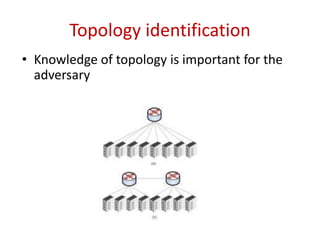
2.1 Topology Identification
• Topology information is important to launch an effective attack
• A naive approach is to gain access to a number of hosts in a cloud data-
center, then blindly send traffic to each other at the maximum rate (which
is not effective in many cases)
• Identification of network bottleneck is very crucial
• To carry out an attack:-
1. An adversary would first gain access to a set of hosts (e.g., by launching virtual
machines using the cloud API)
2. Learn the topology, and determine whether there is a bottleneck link to attack
3. If none found, the adversary can continue to gain access to more hosts and
repeat the steps above. In this section
2.1 Topology Identification
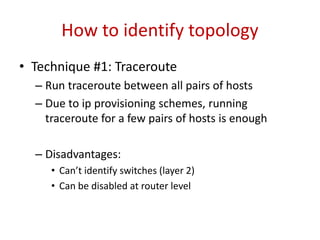
• Two approaches to topology identification:
1. Using a Debugging Tool
• Running Traceroute (debugging tool) among all pairs of nodes
• Data-center networks typically follow a regular structure and the IP
addresses are typically assigned based on a set naming convention.
• Running Traceroute from a few hosts is often enough to infer the
overall IP layer topology.
• Traceroute is a valuable tool for maintenance so many networks are
adaptive to this software
2.1 Topology Identification
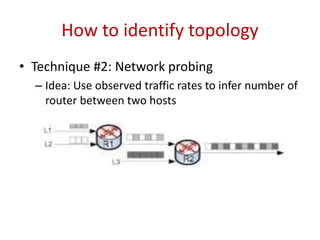
1. Exploiting Multiplexing Nature of Router
• We choose one host as the sink and the rest of hosts as sources
• From each source, we send a sequence of packets back-to-back to the sink
at the same time
• At the sink, we measure the number of packets that we received from
each source and based on the received traffic rate, we can derive how
many switches are between a source and the sink
• To build a complete topology, we need to choose all hosts as the sink
hosts and construct the view from each host’s perspective
• Detected topology may be different from the actual topology due to a
compression effect
2.1 Topology Identification
• This inaccurate view is not a problem for us, since we are only interested in
determining if we have enough critical mass in a router’s subnet to launch an
attack
• Send traffic at its maximum interface speed during probing, the load to the
network could be very high
• To minimize impact, we limit the probing length (the time to continuously send
packets from a host) and also to account for network latency
• The more hosts, the longer the probe length needs to be to maintain good
resolution
• This technique described above only works well when all the links have the same
capacity (1Gbps)
• But some links may have higher uplinks (10Gbps) then this method will identify
this link as a normal link but its latency time is very less, hence this link will not
be favourable as a bottleneck
2.1 Topology Identification
• The researchers did a preliminary evaluation of the second
proposed approach of topology detection in one cloud vendor
• Instead of evaluating whether the detected topology is exactly the
same as the real topology (e.g., as detected by the first Traceroute
approach),
• they check whether we can accuratelyfind the router whose subnet
contains the most number of hosts
• They were able to accurately identify the router with the most hosts
and a favourable bottleneck
2.2 Gaining Access to Hosts
• Access to sufficient number of hosts connected to a router is important
• Launching a large number of VMs is the key to this attack
• Experimentally, it was discovered that it was still economical and less time
consuming to launch a cluster (sufficient number of VMs) in the subnet
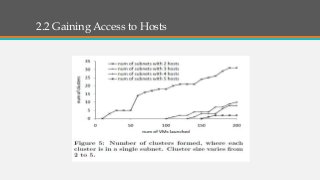
• To simulate a targeted attack, a subnet is randomly choosen in the cloud
provider’s network
• Then launch 10 VMs at a time to see how fast we can form a cluster in that
subnet.
• A 2-host cluster at 60 VMs, a 3-host cluster at 160 VMs, a 4-host cluster at 210
VMs, and a 5-host cluster at 320 VMs are formed
• Even though it takes more VMs to launch a targeted attack, it is still quite fast
and economical to do.
2.2 Gaining Access to Hosts
A New Form of Dos attack in Cloud

A New Form of Dos attack in Cloud

  • 2.
    1. Introduction • Datacenters are typically under-provisioned  Expensive to build a 1:1 bi-section bandwidth  Number of actual paths supported is actually small (even though ECMP is used) • Under-provisioned nature of data centers is a problem for clouds or hosting companies  Cloud data centers are typically big  Limit on multi-paths on the current network architecture  Cloud is used by many people and organizations – opens doors for attacks  Third, an application owner has no or little control over the underlying network in a cloud data-center • Under-provisioning not a problem in a corporate data center  Data center managers have full control over the architecture and structure
  • 3.
  • 4.
    Introduction • Solving thisnew type of DOS is difficult without human intervention • Damage is reduced if virtualized and self-service data centers are used • Contributions of this paper:  Identify a new form of DOS attack in a cloud data-center, and verify that such an attack could be carried out in a real cloud data-center  Propose and evaluate a new mechanism for applications to dynamically relocate to a different infrastructure when the desired Quality of Service (QoS) could not be met  Propose and evaluate a new available bandwidth detection technique which can accurately determine the available bandwidth in a high speed network
  • 5.
    2. A NewForm of DOS Attack • The gross under-provisioning and the public nature of a cloud data-center open a potential venue for exploit • Saturation of network bandwidth against other applications in the same network is the key to this attack • Aggregate capacity of hosts greatly exceeds the uplink capacity • In Fig. 1, Link A, B, and C are the uplinks of router R5, R1 and R2 respectively • Transmission of enough traffic from hosts to hosts of different subnets will ensure the saturation of the uplink
  • 6.
    2. A NewForm of DOS Attack • Example:- Let us consider Link B as a target, assuming Link B is the active link and Link C is a fail-over link. To saturate Link B, an adversary needs to send traffic from a host in R1’s subnet (e.g., H1) to another host in a different subnet (e.g., H5). Due to under-provisioning, a small number of hosts in R1’s subnet are sufficient to saturate link B. • Two types of attack: • Targeted – attacking of a specific subnet • Untargeted – attacking of any subnet
  • 7.
    2.1 Topology Identification •Topology information is important to launch an effective attack • A naive approach is to gain access to a number of hosts in a cloud data- center, then blindly send traffic to each other at the maximum rate (which is not effective in many cases) • Identification of network bottleneck is very crucial • To carry out an attack:- 1. An adversary would first gain access to a set of hosts (e.g., by launching virtual machines using the cloud API) 2. Learn the topology, and determine whether there is a bottleneck link to attack 3. If none found, the adversary can continue to gain access to more hosts and repeat the steps above. In this section
  • 8.
    2.1 Topology Identification •Two approaches to topology identification: 1. Using a Debugging Tool • Running Traceroute (debugging tool) among all pairs of nodes • Data-center networks typically follow a regular structure and the IP addresses are typically assigned based on a set naming convention. • Running Traceroute from a few hosts is often enough to infer the overall IP layer topology. • Traceroute is a valuable tool for maintenance so many networks are adaptive to this software
  • 9.
    2.1 Topology Identification 1.Exploiting Multiplexing Nature of Router • We choose one host as the sink and the rest of hosts as sources • From each source, we send a sequence of packets back-to-back to the sink at the same time • At the sink, we measure the number of packets that we received from each source and based on the received traffic rate, we can derive how many switches are between a source and the sink • To build a complete topology, we need to choose all hosts as the sink hosts and construct the view from each host’s perspective • Detected topology may be different from the actual topology due to a compression effect
  • 10.
  • 11.
    2.1 Topology Identification •This inaccurate view is not a problem for us, since we are only interested in determining if we have enough critical mass in a router’s subnet to launch an attack • Send traffic at its maximum interface speed during probing, the load to the network could be very high • To minimize impact, we limit the probing length (the time to continuously send packets from a host) and also to account for network latency • The more hosts, the longer the probe length needs to be to maintain good resolution • This technique described above only works well when all the links have the same capacity (1Gbps) • But some links may have higher uplinks (10Gbps) then this method will identify this link as a normal link but its latency time is very less, hence this link will not be favourable as a bottleneck
  • 12.
    2.1 Topology Identification •The researchers did a preliminary evaluation of the second proposed approach of topology detection in one cloud vendor • Instead of evaluating whether the detected topology is exactly the same as the real topology (e.g., as detected by the first Traceroute approach), • they check whether we can accuratelyfind the router whose subnet contains the most number of hosts • They were able to accurately identify the router with the most hosts and a favourable bottleneck
  • 13.
    2.2 Gaining Accessto Hosts • Access to sufficient number of hosts connected to a router is important • Launching a large number of VMs is the key to this attack • Experimentally, it was discovered that it was still economical and less time consuming to launch a cluster (sufficient number of VMs) in the subnet • To simulate a targeted attack, a subnet is randomly choosen in the cloud provider’s network • Then launch 10 VMs at a time to see how fast we can form a cluster in that subnet. • A 2-host cluster at 60 VMs, a 3-host cluster at 160 VMs, a 4-host cluster at 210 VMs, and a 5-host cluster at 320 VMs are formed • Even though it takes more VMs to launch a targeted attack, it is still quite fast and economical to do.
  • 14.