DIGITAL
SIGNATURES
PRESENTED BY
:S.K.D
Why Digital Signatures?
• To provide Authenticity,
Integrity and Non -
repudiation to electronic
documents
• To use the Internet as the
safe and secure medium
for e-Governance and e-
Commerce
What is Digital Signature?
 Mathematical scheme for demonstrating the
authenticity
 Easily transportable
 Signing key
 Verification key
 Asymmetric cryptography
The Scheme typically consists of
three Algorithms
 A key generation algorithm that selects a
private key uniformly at random from a
set of possible private keys. The
algorithm outputs the private key and a
corresponding public key.
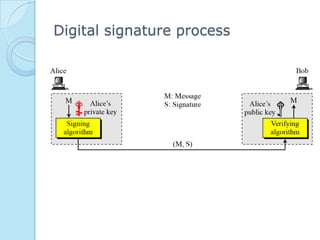
 A signing algorithm that, given a
message and a private key, produces a
signature.
 A signature verifying algorithm that,
given a message, public key and a
signature, either accepts or rejects the
message's claim to authenticity
Digital signature process
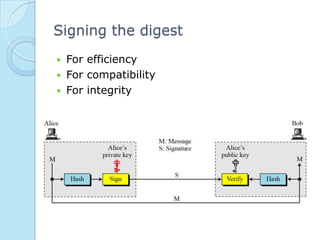
Signing the digest
 For efficiency
 For compatibility
 For integrity
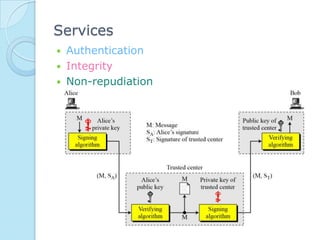
Services
 Authentication
 Integrity
 Non-repudiation
Attacks on digital signature
Key-Only Attack
the attacker is only given the public verification key
Known-Message Attack
the attacker is given valid signatures for a variety of
messages known by the attacker but not chosen by
the attacker.
Chosen-Message Attack
the attacker first learns signatures on arbitrary
messages of the attacker's choice.
Forgery types
Existential forgery
Existential forgery is the creation (by an adversary)
of any message/signature pair (m,σ), where σ was
not produced by the legitimate signer.
Selective forgery
Selective forgery is the creation (by an
adversary) of a message/signature pair (m,σ)
where m has been chosen by the adversary
prior to the attack.
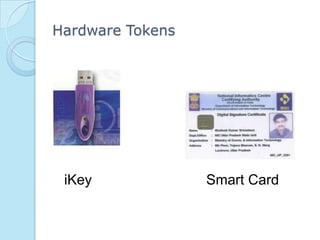
Hardware Tokens
iKey Smart Card

Digital signatures

  • 1.
  • 2.
    Why Digital Signatures? •To provide Authenticity, Integrity and Non - repudiation to electronic documents • To use the Internet as the safe and secure medium for e-Governance and e- Commerce
  • 3.
    What is DigitalSignature?  Mathematical scheme for demonstrating the authenticity  Easily transportable  Signing key  Verification key  Asymmetric cryptography
  • 4.
    The Scheme typicallyconsists of three Algorithms  A key generation algorithm that selects a private key uniformly at random from a set of possible private keys. The algorithm outputs the private key and a corresponding public key.  A signing algorithm that, given a message and a private key, produces a signature.  A signature verifying algorithm that, given a message, public key and a signature, either accepts or rejects the message's claim to authenticity
  • 5.
  • 6.
    Signing the digest For efficiency  For compatibility  For integrity
  • 7.
  • 8.
    Attacks on digitalsignature Key-Only Attack the attacker is only given the public verification key Known-Message Attack the attacker is given valid signatures for a variety of messages known by the attacker but not chosen by the attacker. Chosen-Message Attack the attacker first learns signatures on arbitrary messages of the attacker's choice.
  • 9.
    Forgery types Existential forgery Existentialforgery is the creation (by an adversary) of any message/signature pair (m,σ), where σ was not produced by the legitimate signer. Selective forgery Selective forgery is the creation (by an adversary) of a message/signature pair (m,σ) where m has been chosen by the adversary prior to the attack.
  • 10.