Inter-controller Traffic in ONOS
Clusters for SDN Networks
Abubakar Siddique Muqaddas,
Andrea Bianco, Paolo Giaccone
Guido Maier
13th Italian Networking Workshop: San Candido, Italy
January 13 - 15, 2016 1
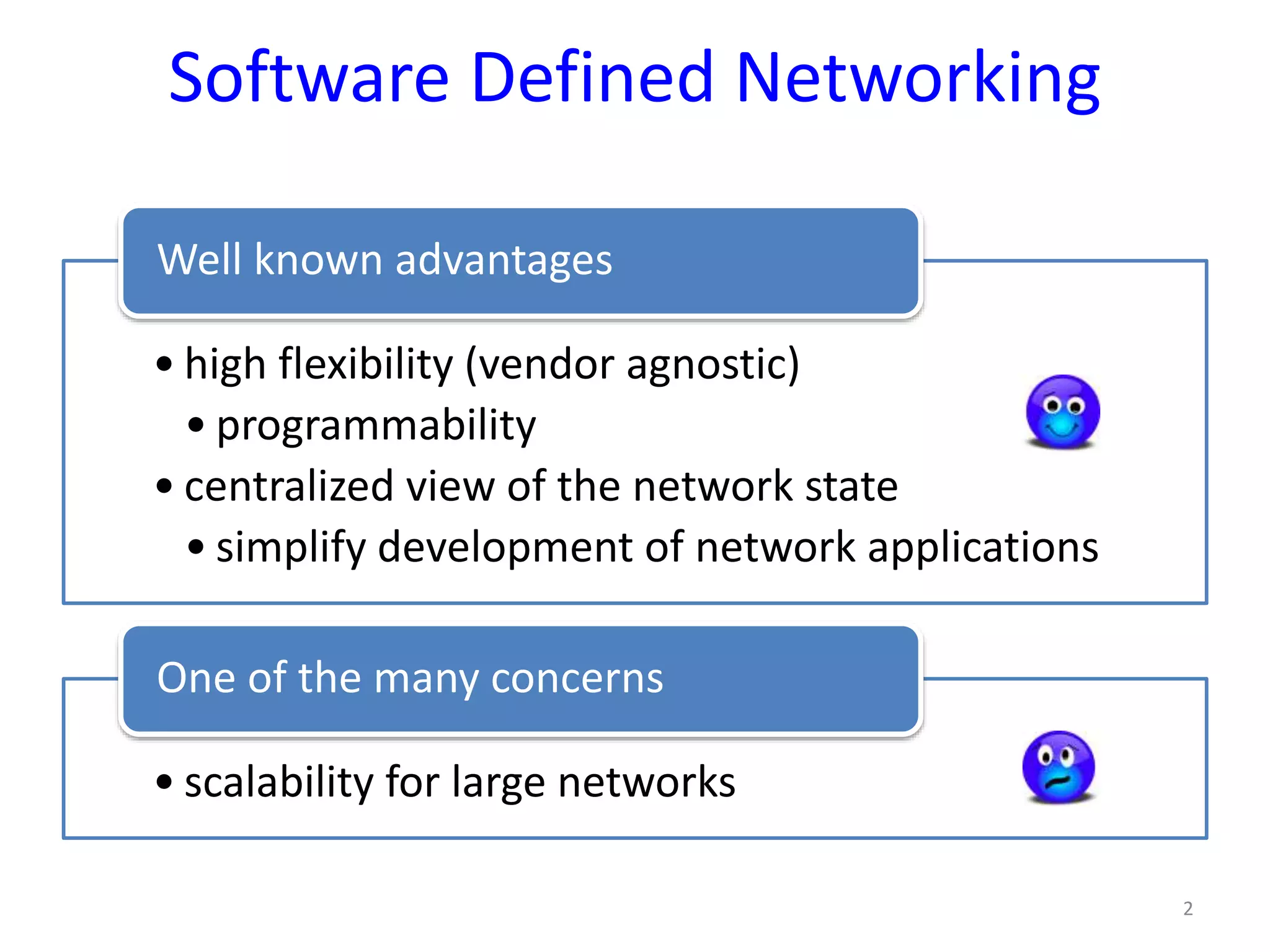
Software Defined Networking
• high flexibility (vendor agnostic)
• programmability
• centralized view of the network state
• simplify development of network applications
Well known advantages
• scalability for large networks
One of the many concerns
2
Distributed controllers
• fault-tolerance and resilience
• load balancing, thus higher scalability for large
networks
Motivation
• how the network state is distributed across the
controllers to allow a centralized logical view
Critical issue
3
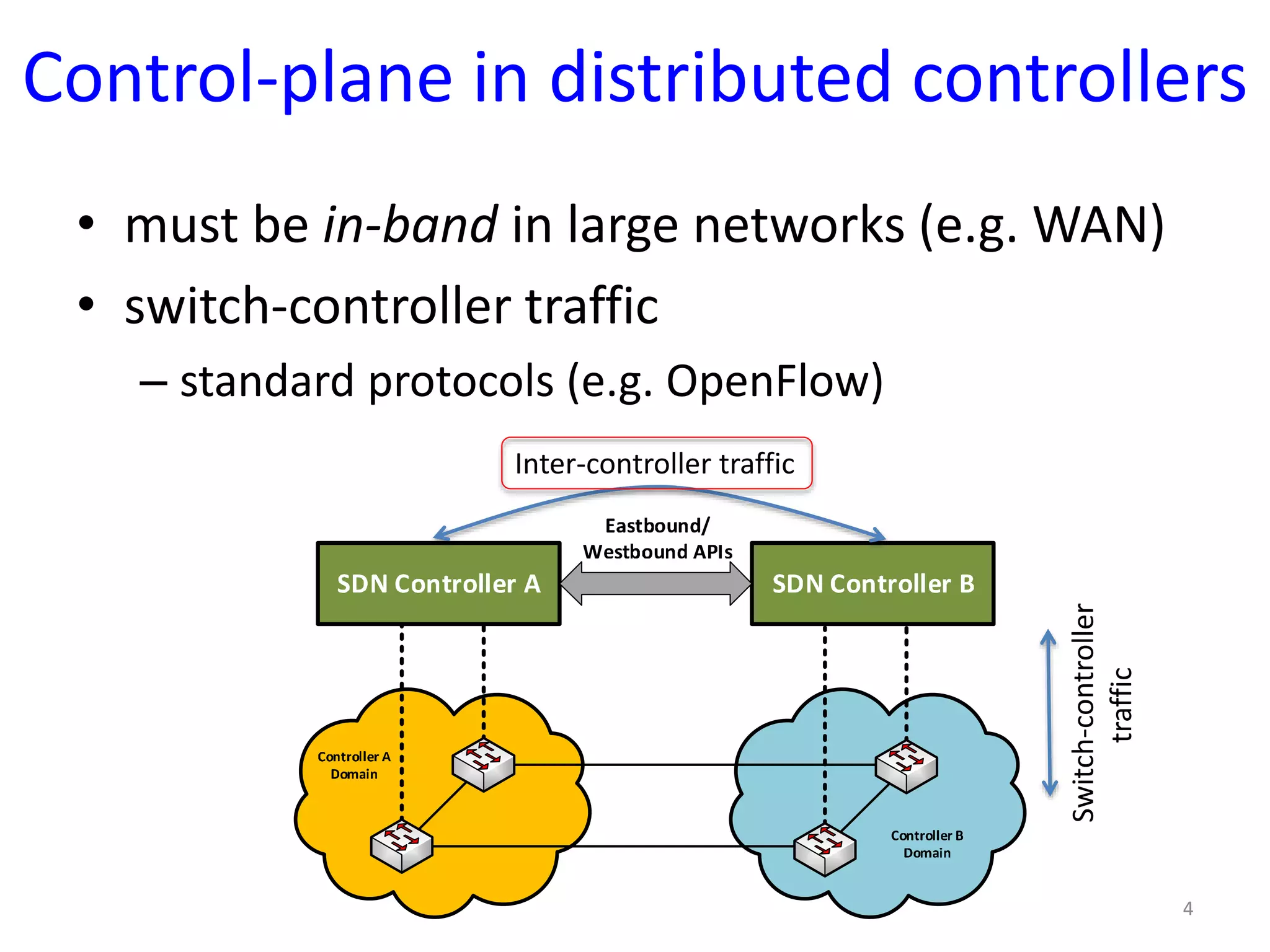
Control-plane in distributed controllers
• must be in-band in large networks (e.g. WAN)
• switch-controller traffic
– standard protocols (e.g. OpenFlow)
4
Switch-controller
traffic
Inter-controller traffic
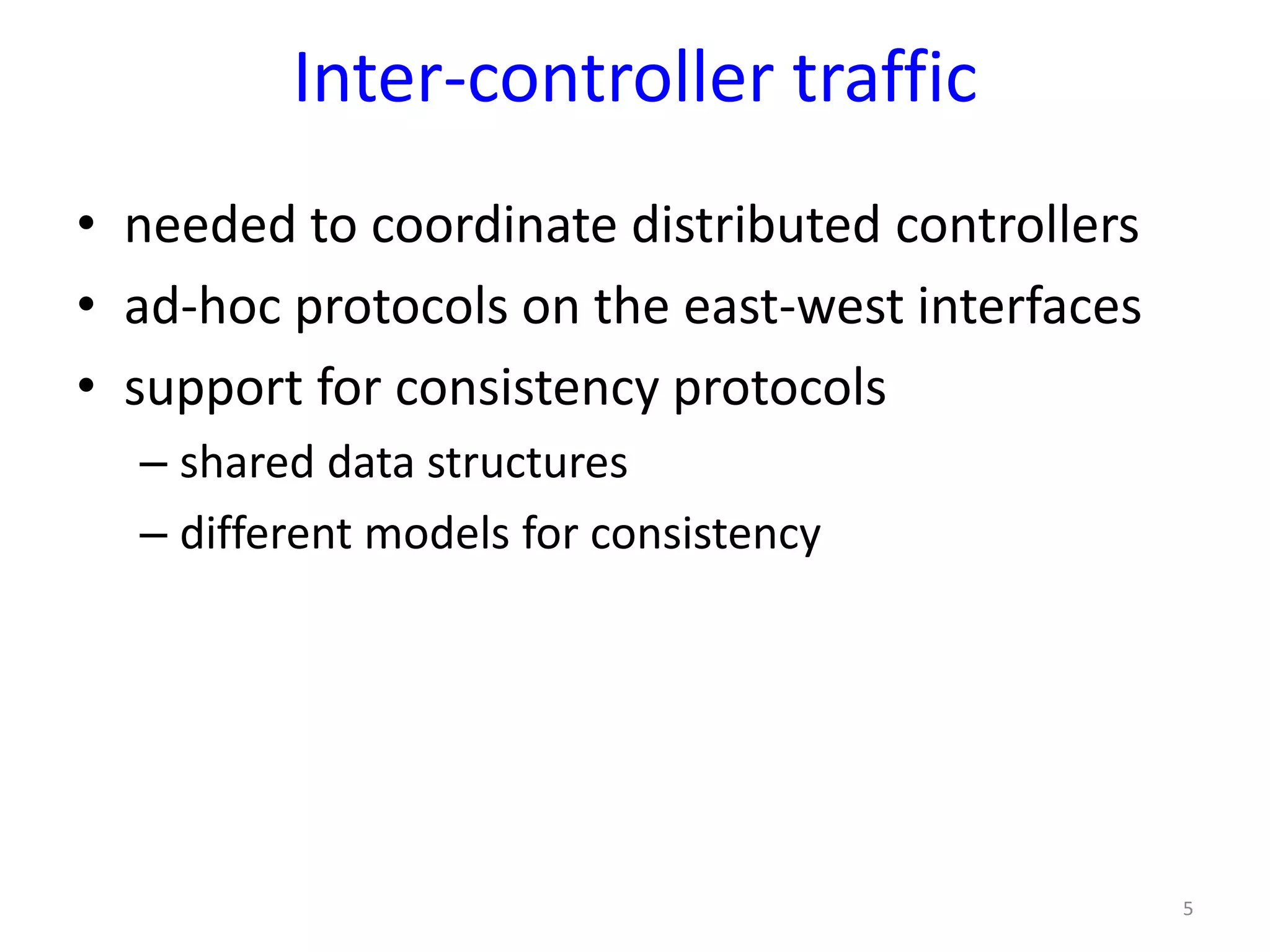
• needed to coordinate distributed controllers
• ad-hoc protocols on the east-west interfaces
• support for consistency protocols
– shared data structures
– different models for consistency
5
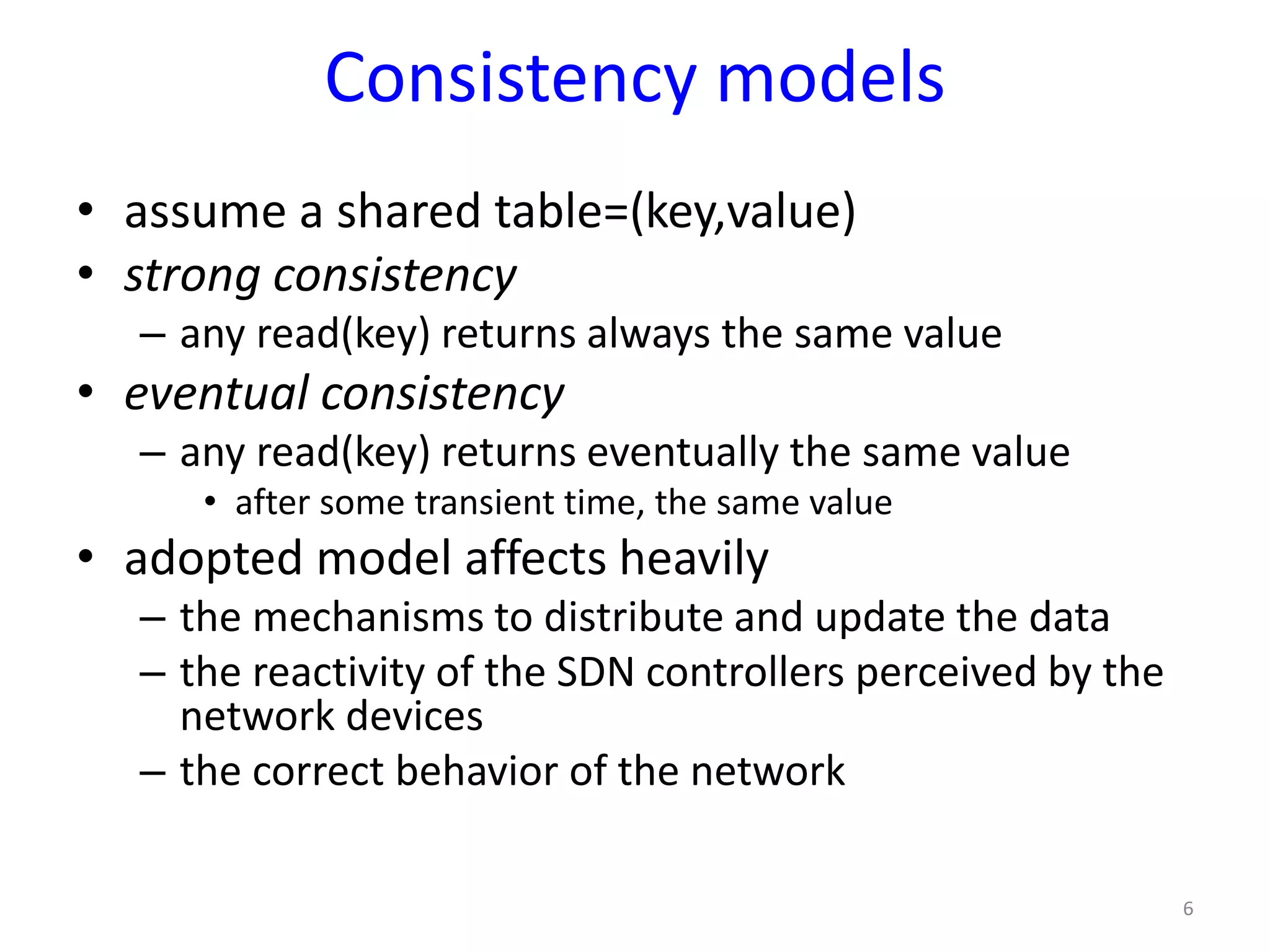
Consistency models
• assume a shared table=(key,value)
• strong consistency
– any read(key) returns always the same value
• eventual consistency
– any read(key) returns eventually the same value
• after some transient time, the same value
• adopted model affects heavily
– the mechanisms to distribute and update the data
– the reactivity of the SDN controllers perceived by the
network devices
– the correct behavior of the network
6
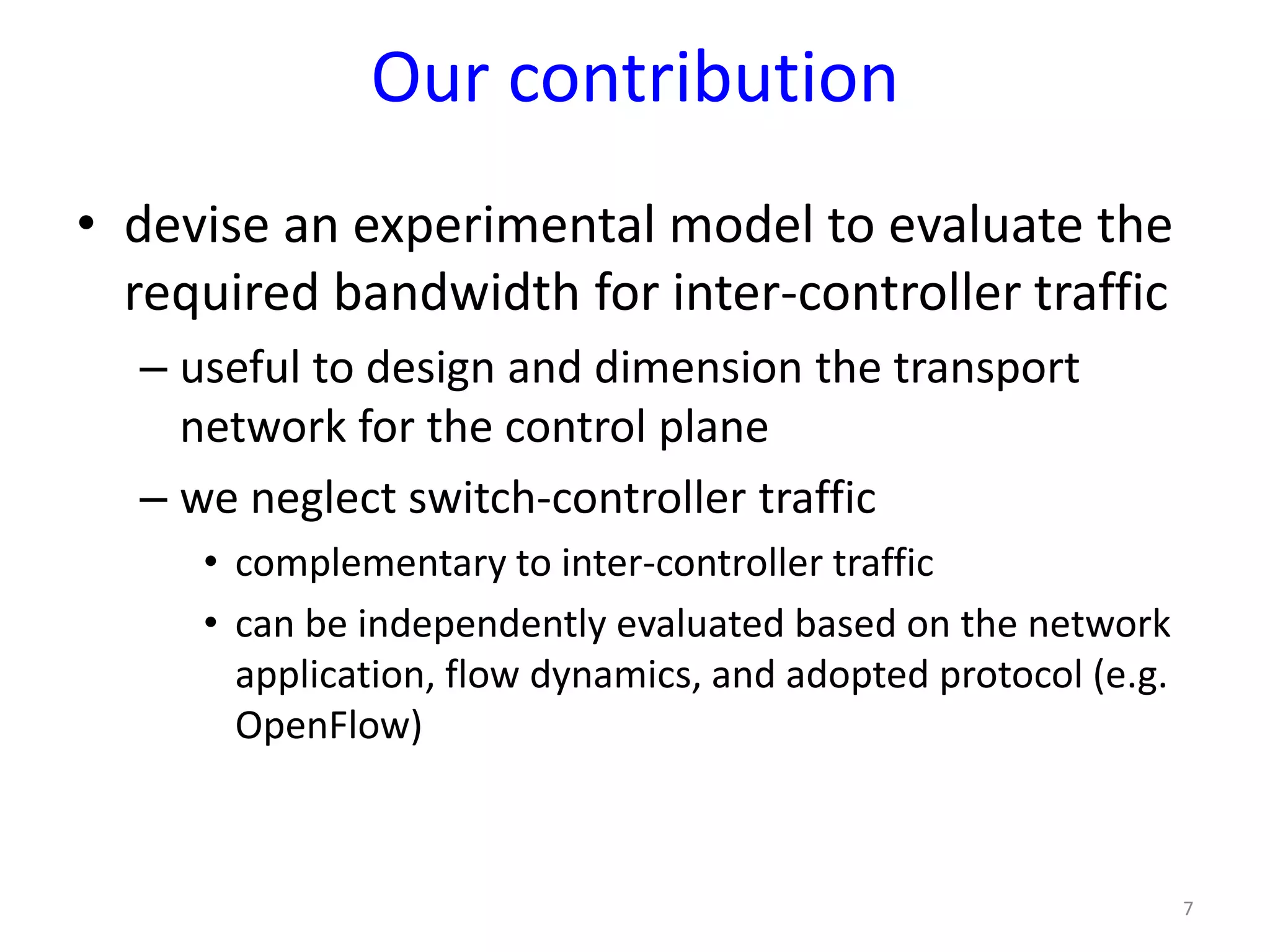
Our contribution
• devise an experimental model to evaluate the
required bandwidth for inter-controller traffic
– useful to design and dimension the transport
network for the control plane
– we neglect switch-controller traffic
• complementary to inter-controller traffic
• can be independently evaluated based on the network
application, flow dynamics, and adopted protocol (e.g.
OpenFlow)
7
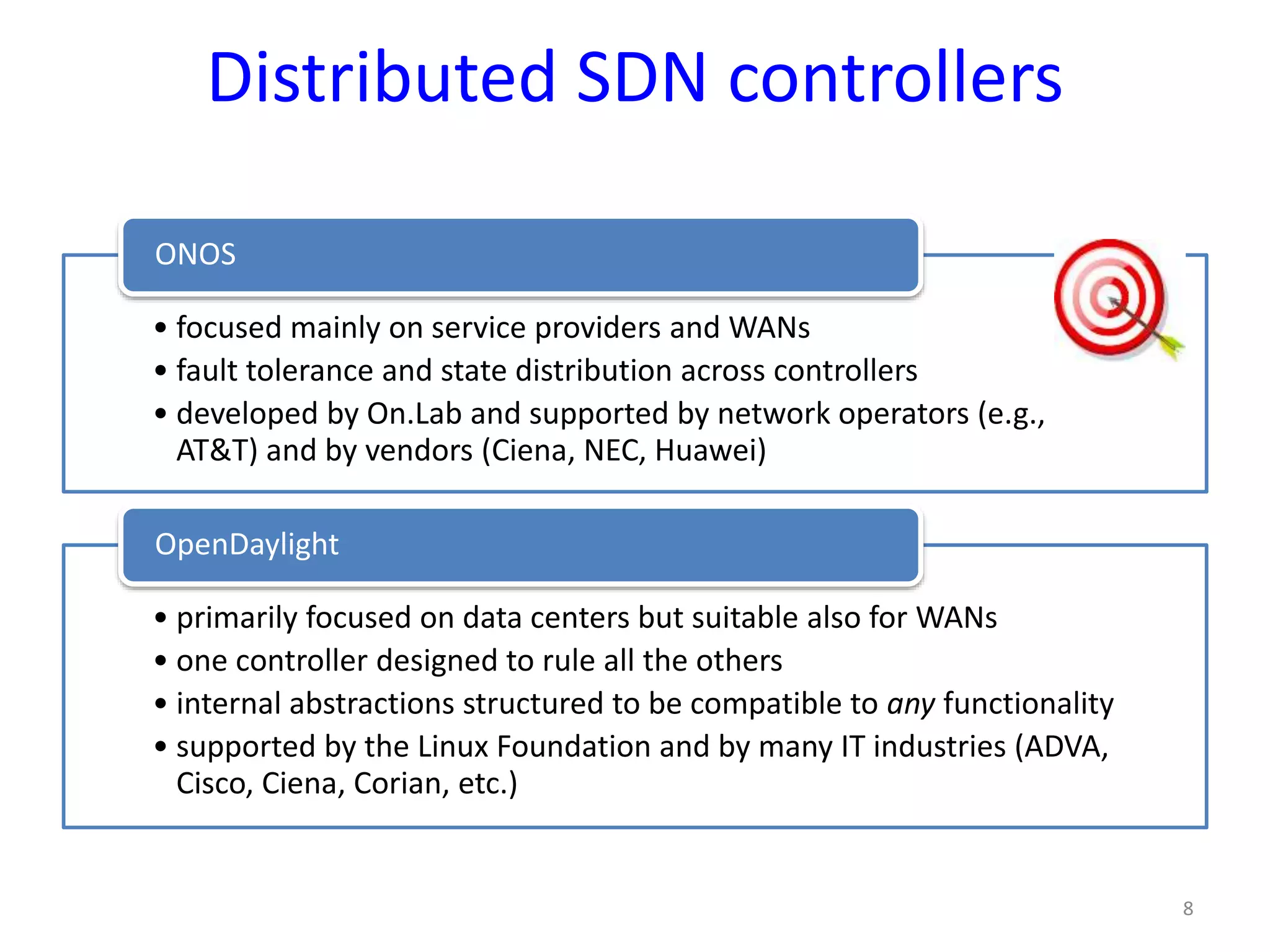
Distributed SDN controllers
• focused mainly on service providers and WANs
• fault tolerance and state distribution across controllers
• developed by On.Lab and supported by network operators (e.g.,
AT&T) and by vendors (Ciena, NEC, Huawei)
ONOS
• primarily focused on data centers but suitable also for WANs
• one controller designed to rule all the others
• internal abstractions structured to be compatible to any functionality
• supported by the Linux Foundation and by many IT industries (ADVA,
Cisco, Ciena, Corian, etc.)
OpenDaylight
8
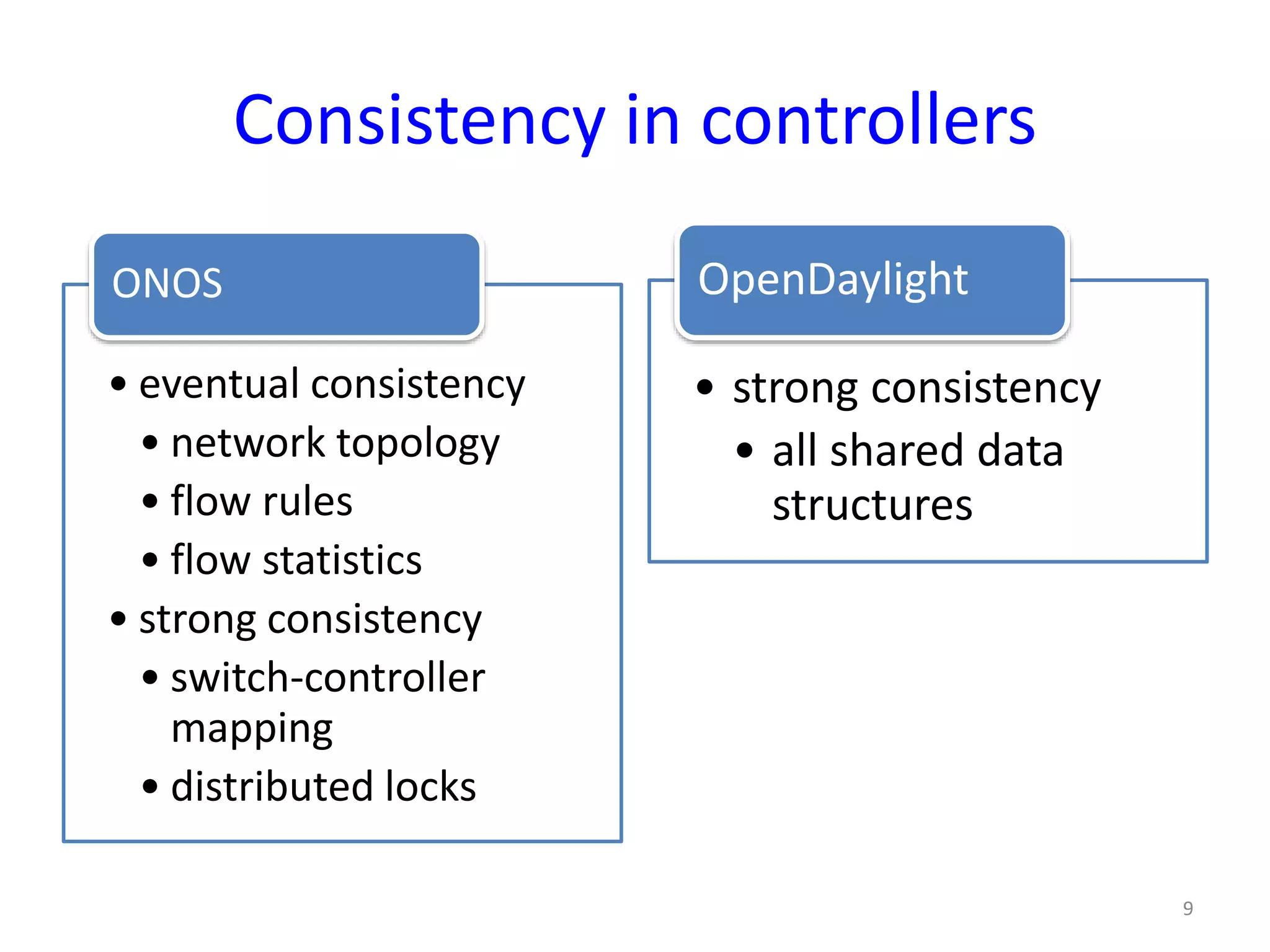
Consistency in controllers
• eventual consistency
• network topology
• flow rules
• flow statistics
• strong consistency
• switch-controller
mapping
• distributed locks
ONOS
• strong consistency
• all shared data
structures
OpenDaylight
9
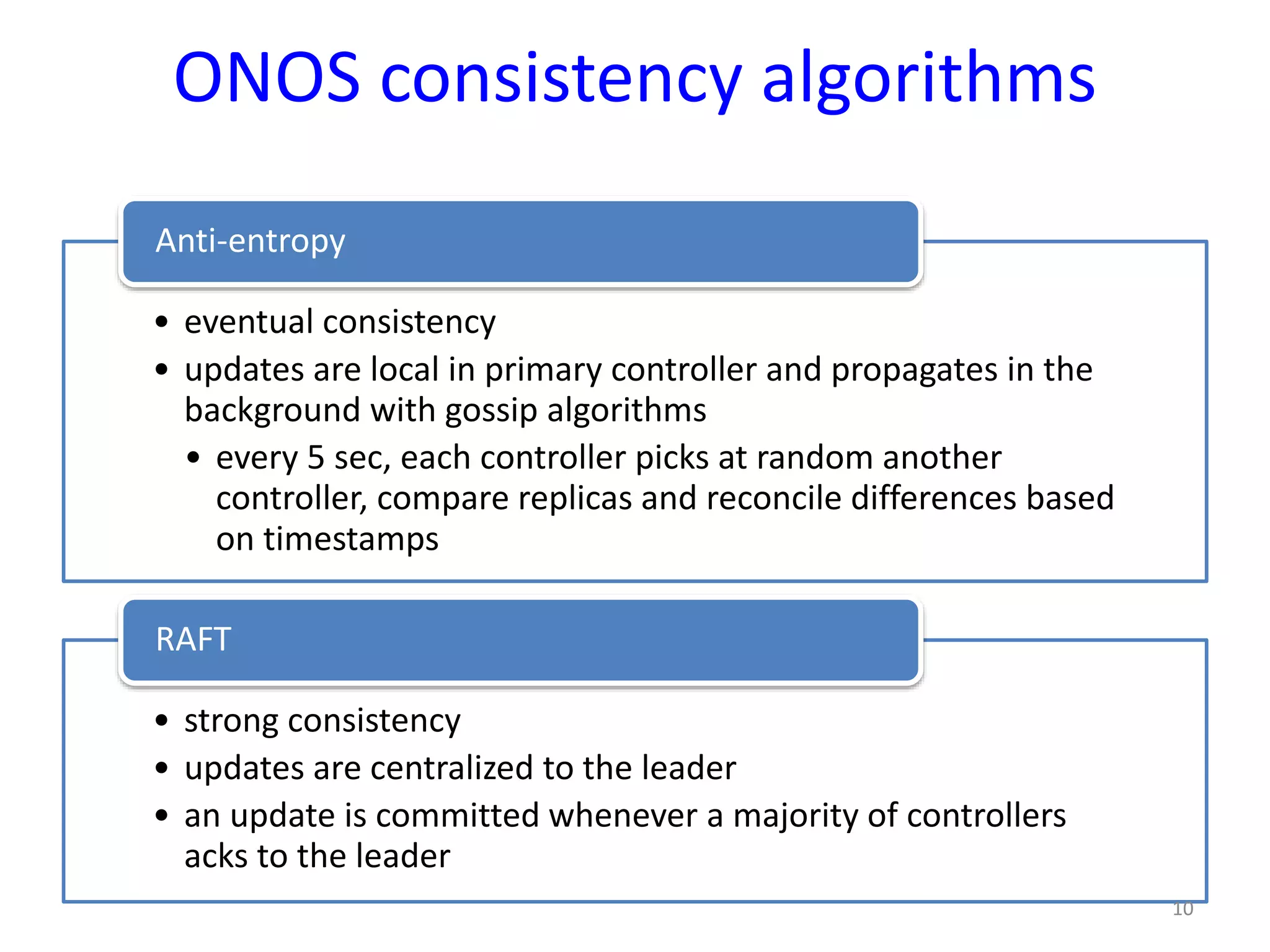
ONOS consistency algorithms
• eventual consistency
• updates are local in primary controller and propagates in the
background with gossip algorithms
• every 5 sec, each controller picks at random another
controller, compare replicas and reconcile differences based
on timestamps
Anti-entropy
• strong consistency
• updates are centralized to the leader
• an update is committed whenever a majority of controllers
acks to the leader
RAFT
10
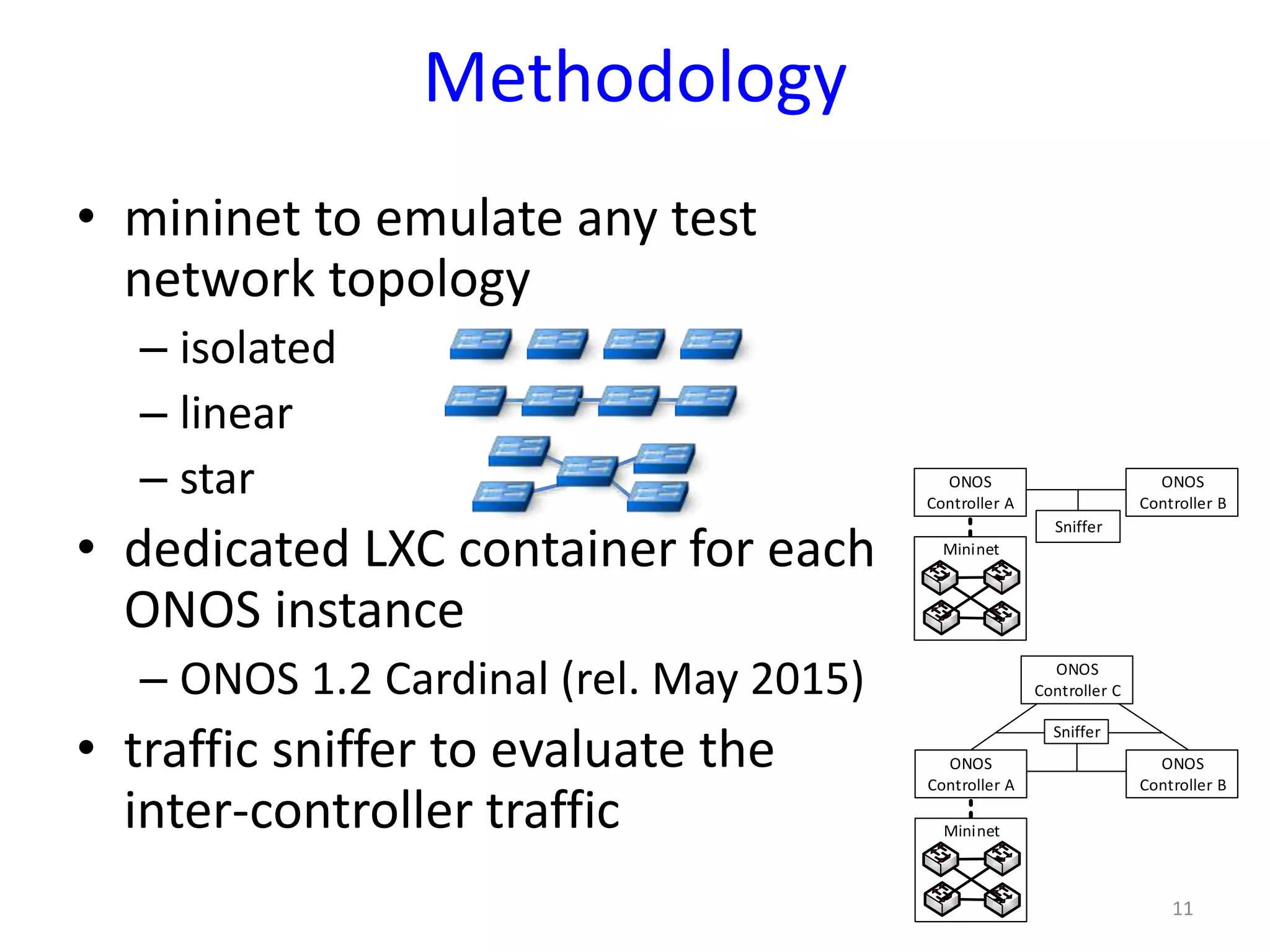
Methodology
• mininet to emulate any test
network topology
– isolated
– linear
– star
• dedicated LXC container for each
ONOS instance
– ONOS 1.2 Cardinal (rel. May 2015)
• traffic sniffer to evaluate the
inter-controller traffic
11
ONOS
Controller A
ONOS
Controller B
Mininet
Sniffer
ONOS
Controller A
ONOS
Controller B
Mininet
ONOS
Controller C
Sniffer
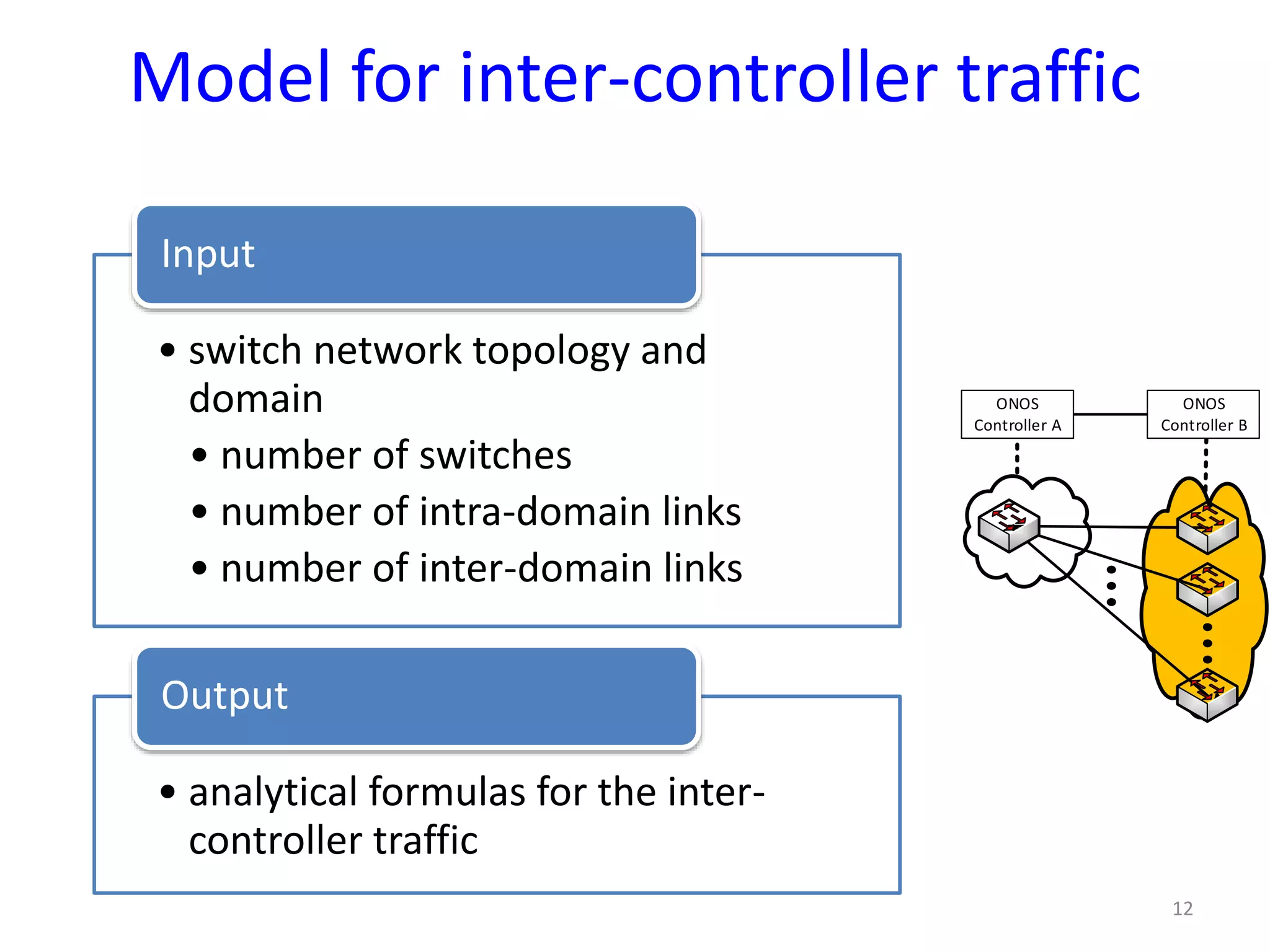
Model for inter-controller traffic
12
• switch network topology and
domain
• number of switches
• number of intra-domain links
• number of inter-domain links
Input
• analytical formulas for the inter-
controller traffic
Output
ONOS
Controller A
ONOS
Controller B
ONOS inter-controller traffic
• Memory of past network states
– add and removing switches changes the baseline bw
– due to ``tombstone’’ data kept for faster recovery in
case of failures
• Each experiment required to reboot the
containers to avoid tombstone traffic
13
40
50
60
70
80
90
100
110
120
130
0 50 100 150 200 250 300 350
Zero Bandwidth 1
Transient 1 Steady State
Zero Bandwidth 2
Transient 2
Bandwidth[kbps]
Time [s]
Scenario with 2 controllers
• linear topology connected to controller A
14
50
100
150
200
250
300
350
0 20 40 60 80 100
Bandwidth[kbps]
Number of switches (S)
A®B
Curve Fitted
Lower Conf
Mean
Upper Conf
50
100
150
200
250
300
350
0 20 40 60 80 100
Bandwidth[kbps]
Number of switches (S)
B®A
Curve Fitted
Lower Conf
Mean
Upper Conf
Scenario with 3 controllers
• linear topology connected to controller A
15
50
100
150
200
250
300
0 20 40 60 80 100
Bandwidth[kbps]
Number of switches (S)
A®B,C
Curve Fitted
Lower Conf
Mean
Upper Conf
50
100
150
200
250
300
0 20 40 60 80 100
Bandwidth[kbps]
Number of switches (S)
B,C®A
Curve Fitted
Lower Conf
Mean
Upper Conf
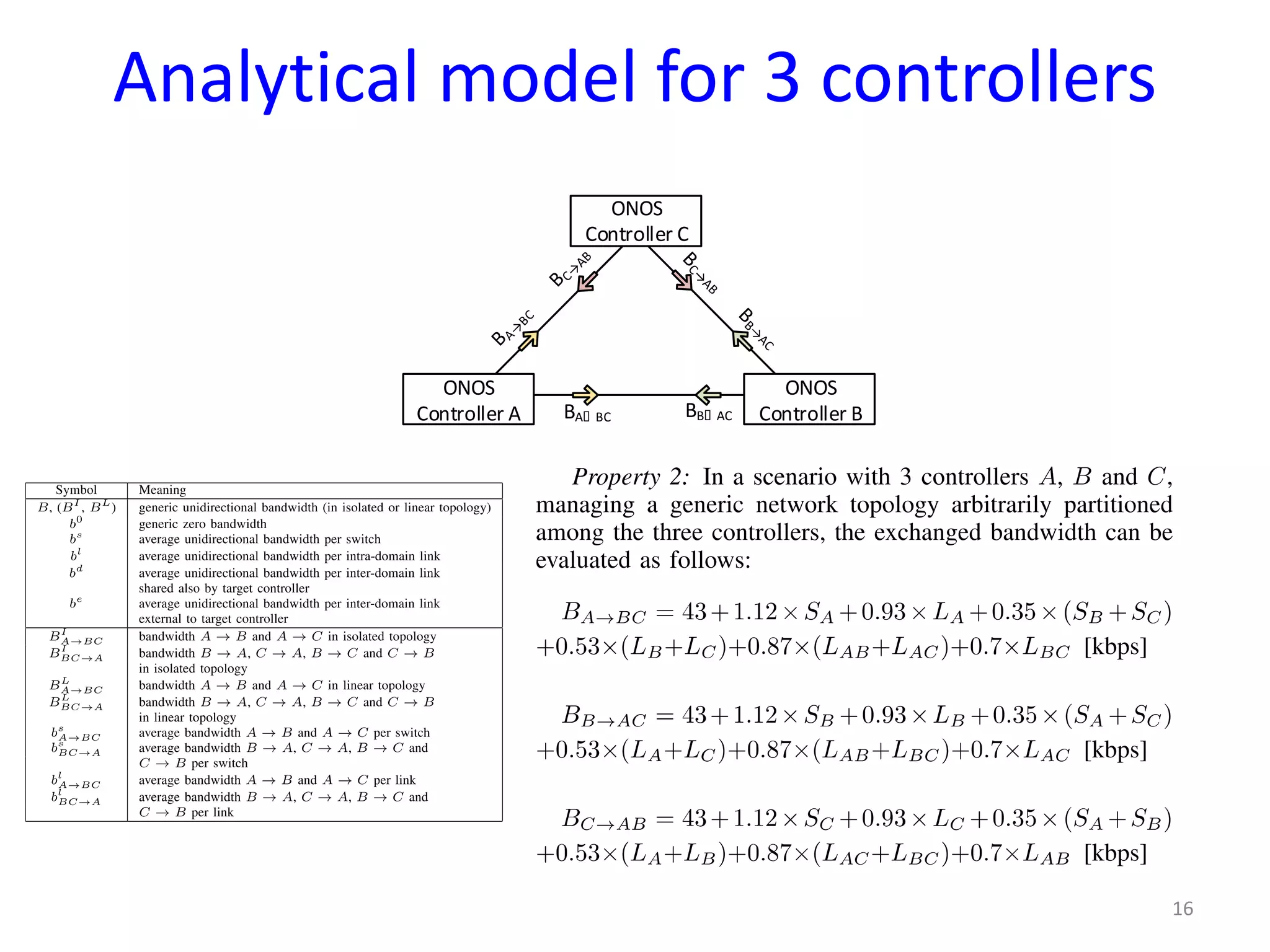
Analytical model for 3 controllers
16
ONOS
Controller C
BA→ BC BB→ AC
ONOS
Controller A
ONOS
Controller B
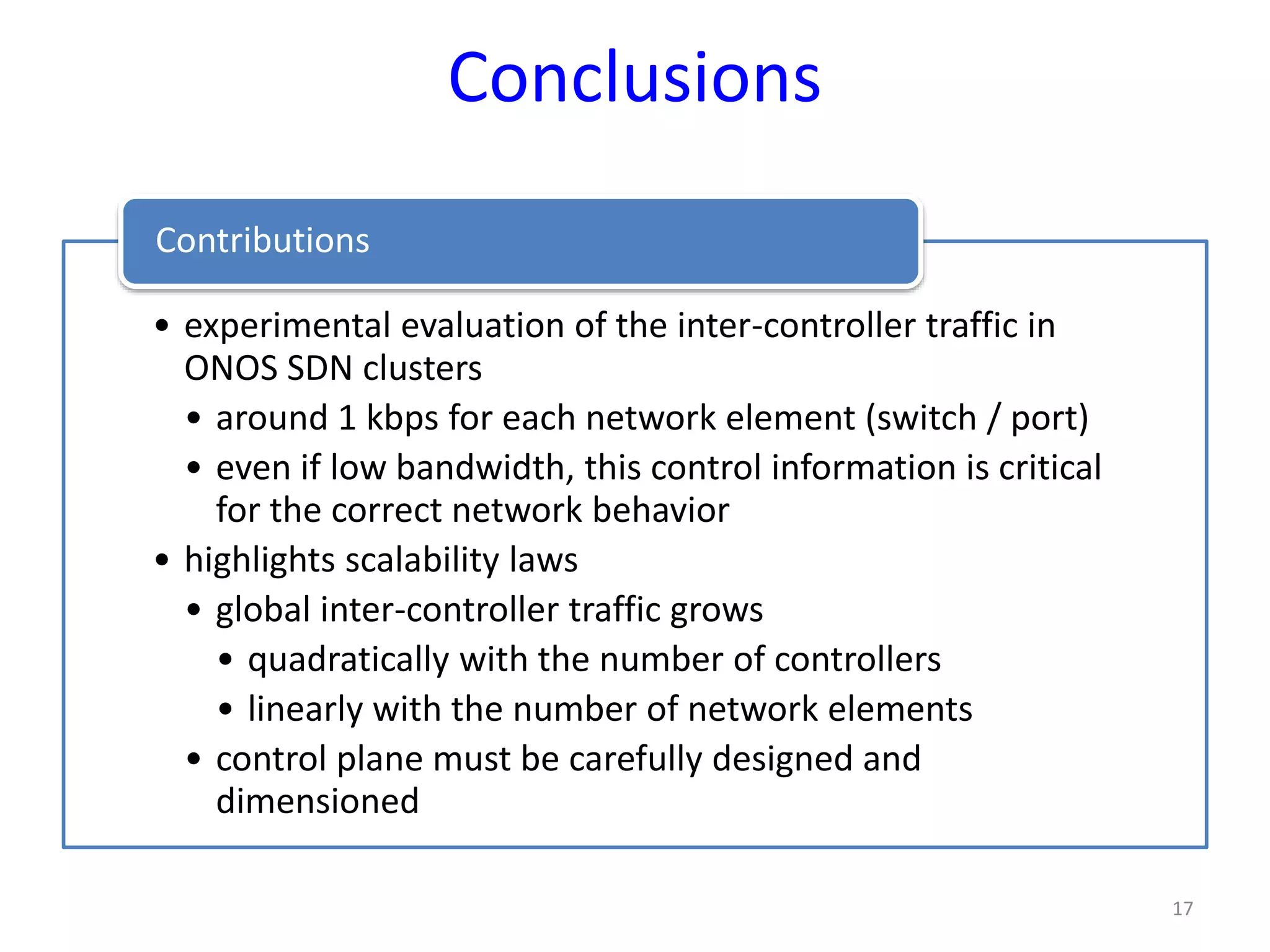
Conclusions
• experimental evaluation of the inter-controller traffic in
ONOS SDN clusters
• around 1 kbps for each network element (switch / port)
• even if low bandwidth, this control information is critical
for the correct network behavior
• highlights scalability laws
• global inter-controller traffic grows
• quadratically with the number of controllers
• linearly with the number of network elements
• control plane must be carefully designed and
dimensioned
Contributions
17

Inter-controller Traffic in ONOS Clusters for SDN Networks

  • 1.
    Inter-controller Traffic inONOS Clusters for SDN Networks Abubakar Siddique Muqaddas, Andrea Bianco, Paolo Giaccone Guido Maier 13th Italian Networking Workshop: San Candido, Italy January 13 - 15, 2016 1
  • 2.
    Software Defined Networking •high flexibility (vendor agnostic) • programmability • centralized view of the network state • simplify development of network applications Well known advantages • scalability for large networks One of the many concerns 2
  • 3.
    Distributed controllers • fault-toleranceand resilience • load balancing, thus higher scalability for large networks Motivation • how the network state is distributed across the controllers to allow a centralized logical view Critical issue 3
  • 4.
    Control-plane in distributedcontrollers • must be in-band in large networks (e.g. WAN) • switch-controller traffic – standard protocols (e.g. OpenFlow) 4 Switch-controller traffic Inter-controller traffic
  • 5.
    Inter-controller traffic • neededto coordinate distributed controllers • ad-hoc protocols on the east-west interfaces • support for consistency protocols – shared data structures – different models for consistency 5
  • 6.
    Consistency models • assumea shared table=(key,value) • strong consistency – any read(key) returns always the same value • eventual consistency – any read(key) returns eventually the same value • after some transient time, the same value • adopted model affects heavily – the mechanisms to distribute and update the data – the reactivity of the SDN controllers perceived by the network devices – the correct behavior of the network 6
  • 7.
    Our contribution • devisean experimental model to evaluate the required bandwidth for inter-controller traffic – useful to design and dimension the transport network for the control plane – we neglect switch-controller traffic • complementary to inter-controller traffic • can be independently evaluated based on the network application, flow dynamics, and adopted protocol (e.g. OpenFlow) 7
  • 8.
    Distributed SDN controllers •focused mainly on service providers and WANs • fault tolerance and state distribution across controllers • developed by On.Lab and supported by network operators (e.g., AT&T) and by vendors (Ciena, NEC, Huawei) ONOS • primarily focused on data centers but suitable also for WANs • one controller designed to rule all the others • internal abstractions structured to be compatible to any functionality • supported by the Linux Foundation and by many IT industries (ADVA, Cisco, Ciena, Corian, etc.) OpenDaylight 8
  • 9.
    Consistency in controllers •eventual consistency • network topology • flow rules • flow statistics • strong consistency • switch-controller mapping • distributed locks ONOS • strong consistency • all shared data structures OpenDaylight 9
  • 10.
    ONOS consistency algorithms •eventual consistency • updates are local in primary controller and propagates in the background with gossip algorithms • every 5 sec, each controller picks at random another controller, compare replicas and reconcile differences based on timestamps Anti-entropy • strong consistency • updates are centralized to the leader • an update is committed whenever a majority of controllers acks to the leader RAFT 10
  • 11.
    Methodology • mininet toemulate any test network topology – isolated – linear – star • dedicated LXC container for each ONOS instance – ONOS 1.2 Cardinal (rel. May 2015) • traffic sniffer to evaluate the inter-controller traffic 11 ONOS Controller A ONOS Controller B Mininet Sniffer ONOS Controller A ONOS Controller B Mininet ONOS Controller C Sniffer
  • 12.
    Model for inter-controllertraffic 12 • switch network topology and domain • number of switches • number of intra-domain links • number of inter-domain links Input • analytical formulas for the inter- controller traffic Output ONOS Controller A ONOS Controller B
  • 13.
    ONOS inter-controller traffic •Memory of past network states – add and removing switches changes the baseline bw – due to ``tombstone’’ data kept for faster recovery in case of failures • Each experiment required to reboot the containers to avoid tombstone traffic 13 40 50 60 70 80 90 100 110 120 130 0 50 100 150 200 250 300 350 Zero Bandwidth 1 Transient 1 Steady State Zero Bandwidth 2 Transient 2 Bandwidth[kbps] Time [s]
  • 14.
    Scenario with 2controllers • linear topology connected to controller A 14 50 100 150 200 250 300 350 0 20 40 60 80 100 Bandwidth[kbps] Number of switches (S) A®B Curve Fitted Lower Conf Mean Upper Conf 50 100 150 200 250 300 350 0 20 40 60 80 100 Bandwidth[kbps] Number of switches (S) B®A Curve Fitted Lower Conf Mean Upper Conf
  • 15.
    Scenario with 3controllers • linear topology connected to controller A 15 50 100 150 200 250 300 0 20 40 60 80 100 Bandwidth[kbps] Number of switches (S) A®B,C Curve Fitted Lower Conf Mean Upper Conf 50 100 150 200 250 300 0 20 40 60 80 100 Bandwidth[kbps] Number of switches (S) B,C®A Curve Fitted Lower Conf Mean Upper Conf
  • 16.
    Analytical model for3 controllers 16 ONOS Controller C BA→ BC BB→ AC ONOS Controller A ONOS Controller B
  • 17.
    Conclusions • experimental evaluationof the inter-controller traffic in ONOS SDN clusters • around 1 kbps for each network element (switch / port) • even if low bandwidth, this control information is critical for the correct network behavior • highlights scalability laws • global inter-controller traffic grows • quadratically with the number of controllers • linearly with the number of network elements • control plane must be carefully designed and dimensioned Contributions 17