APACHE FLUME
Data pipelining and loading with Flume
Agenda
1. What is Flume?
1. Overview
2. Architecture
2. Down the rabbit hole
1. Events
2. Sources
3. Channels
4. Sinks
5. Configuration
6. Data manipulation with interceptors
7. Multiplexing
8. Customer Serializers
3. Use Cases
1. What is Flume?
• Flume is a data collection and aggregation framework,
which operates in distributed topologies.
• It is stream - oriented, fault tolerant and offers linear
scalability.
• It offers low latency with high throughput
• Its configuration is declarative, yet allows easy
extensibility
• It is quite mature – it has been around for quite a while,
enjoys support from multiple vendors with thousands of
large scale deployments.
1. What is Flume?
Flume defines a simple pipeline structure with three roles:
• Source
• Channel
• Sinks
Sources define where data comes from, e.g. a file, a
message Queue (Kafka, JMS)
Channels are pipes connecting Sources with Sinks
Sinks are the destination of the data pipelined from
Sources
1. What is Flume?
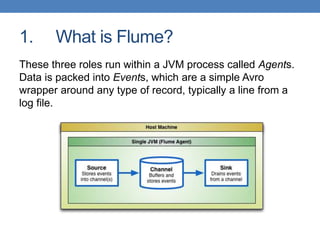
These three roles run within a JVM process called Agents.
Data is packed into Events, which are a simple Avro
wrapper around any type of record, typically a line from a
log file.
1. What is Flume?
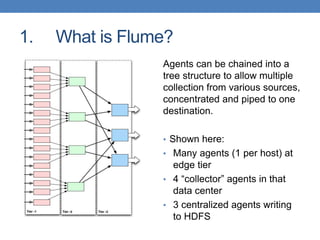
Agents can be chained into a
tree structure to allow multiple
collection from various sources,
concentrated and piped to one
destination.
• Shown here:
• Many agents (1 per host) at
edge tier
• 4 “collector” agents in that
data center
• 3 centralized agents writing
to HDFS
2. Down the rabbit hole - Sources
• Event-driven or polling-based
• Most sources can accept batches of events
• Stock source implementations:
• Spool Directory
• HTTP
• Kafka
• JMS
• Netcat
• AvroRPC
• AvroRPC is use by Flume to communicate between
Agents
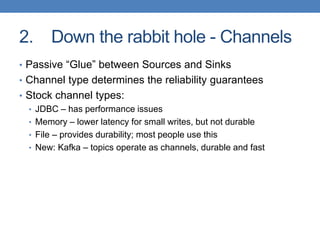
2. Down the rabbit hole - Channels
• Passive “Glue” between Sources and Sinks
• Channel type determines the reliability guarantees
• Stock channel types:
• JDBC – has performance issues
• Memory – lower latency for small writes, but not durable
• File – provides durability; most people use this
• New: Kafka – topics operate as channels, durable and fast
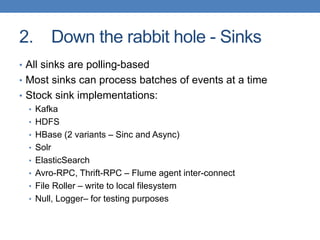
2. Down the rabbit hole - Sinks
• All sinks are polling-based
• Most sinks can process batches of events at a time
• Stock sink implementations:
• Kafka
• HDFS
• HBase (2 variants – Sinc and Async)
• Solr
• ElasticSearch
• Avro-RPC, Thrift-RPC – Flume agent inter-connect
• File Roller – write to local filesystem
• Null, Logger– for testing purposes
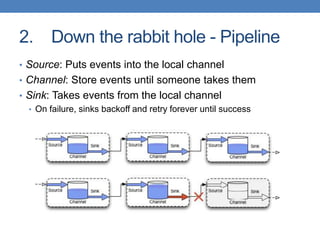
2. Down the rabbit hole - Pipeline
• Source: Puts events into the local channel
• Channel: Store events until someone takes them
• Sink: Takes events from the local channel
• On failure, sinks backoff and retry forever until success
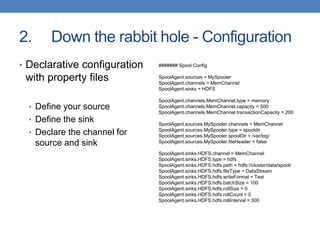
2. Down the rabbit hole - Configuration
• Declarative configuration
with property files
• Define your source
• Define the sink
• Declare the channel for
source and sink
####### Spool Config
SpoolAgent.sources = MySpooler
SpoolAgent.channels = MemChannel
SpoolAgent.sinks = HDFS
SpoolAgent.channels.MemChannel.type = memory
SpoolAgent.channels.MemChannel.capacity = 500
SpoolAgent.channels.MemChannel.transactionCapacity = 200
SpoolAgent.sources.MySpooler.channels = MemChannel
SpoolAgent.sources.MySpooler.type = spooldir
SpoolAgent.sources.MySpooler.spoolDir = /var/log/
SpoolAgent.sources.MySpooler.fileHeader = false
SpoolAgent.sinks.HDFS.channel = MemChannel
SpoolAgent.sinks.HDFS.type = hdfs
SpoolAgent.sinks.HDFS.hdfs.path = hdfs://cluster/data/spool/
SpoolAgent.sinks.HDFS.hdfs.fileType = DataStream
SpoolAgent.sinks.HDFS.hdfs.writeFormat = Text
SpoolAgent.sinks.HDFS.hdfs.batchSize = 100
SpoolAgent.sinks.HDFS.hdfs.rollSize = 0
SpoolAgent.sinks.HDFS.hdfs.rollCount = 0
SpoolAgent.sinks.HDFS.hdfs.rollInterval = 300
2. Down the rabbit hole - Interceptors
• Incoming data can be transformed and enriched at the
source
• One or more interceptors can modify your events and set
headers
• These headers can be used for sorting within sinks and
routing to different sinks
• Stock Interceptor Implementations
• Timestamp (adds a timestamp header)
• Hostname (adds the flume host as a header)
• Regex (extracts the applied regex to a header)
• Static (sets a static constant header)
2. Down the rabbit hole - Interceptors
• Custom Interceptors can be configured by implementing
• org.apache.flume.interceptor.Interceptor
• org.apache.flume.interceptor.Interceptor.Builder
• Pass config params through flume’s Context:
public void configure(Context context) {
context.getString(“prop”)
}
Use Cases:
• augment or change Event bodies, i.e. record conversion
• Add headers for routing or sorting
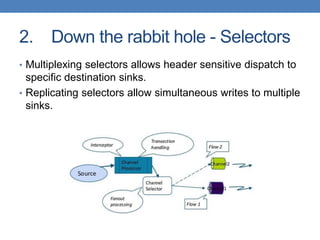
2. Down the rabbit hole - Selectors
• Multiplexing selectors allows header sensitive dispatch to
specific destination sinks.
• Replicating selectors allow simultaneous writes to multiple
sinks.
2. Down the rabbit hole - Serializers
• Serializers customize the format written to sink.
• Built-in serializers are generally fine for text
• More complicated use case such as Avro require
customer serializers
• HDFS, HBase and FileRoller Sinks support customer
Serializers.
• Custom Serializers implement specific interfaces / extend
abstract classes:
• AsyncHbaseEventSerializer (HBase)
• AbstractAvroEventSerializer (HDFS)
• EventSerializer (Generic)
2. Use Cases
Flume is great for:
• Continuous, sorted writing to HDFS from message queues
• Log aggregation from various sources
• On the fly format conversion – e.g. text -> Avro
• Elastic Search loading from upstream sources
• Automated Ingest from external providers
Keep in mind:
• Flume isn’t a stream processing framework – complex processing
is a no go
• Events are pipelined one to one – with some exceptions, you
generally can’t create several new events from one incoming event
Thanks!

Apache flume - an Introduction

  • 1.
    APACHE FLUME Data pipeliningand loading with Flume
  • 2.
    Agenda 1. What isFlume? 1. Overview 2. Architecture 2. Down the rabbit hole 1. Events 2. Sources 3. Channels 4. Sinks 5. Configuration 6. Data manipulation with interceptors 7. Multiplexing 8. Customer Serializers 3. Use Cases
  • 3.
    1. What isFlume? • Flume is a data collection and aggregation framework, which operates in distributed topologies. • It is stream - oriented, fault tolerant and offers linear scalability. • It offers low latency with high throughput • Its configuration is declarative, yet allows easy extensibility • It is quite mature – it has been around for quite a while, enjoys support from multiple vendors with thousands of large scale deployments.
  • 4.
    1. What isFlume? Flume defines a simple pipeline structure with three roles: • Source • Channel • Sinks Sources define where data comes from, e.g. a file, a message Queue (Kafka, JMS) Channels are pipes connecting Sources with Sinks Sinks are the destination of the data pipelined from Sources
  • 5.
    1. What isFlume? These three roles run within a JVM process called Agents. Data is packed into Events, which are a simple Avro wrapper around any type of record, typically a line from a log file.
  • 6.
    1. What isFlume? Agents can be chained into a tree structure to allow multiple collection from various sources, concentrated and piped to one destination. • Shown here: • Many agents (1 per host) at edge tier • 4 “collector” agents in that data center • 3 centralized agents writing to HDFS
  • 7.
    2. Down therabbit hole - Sources • Event-driven or polling-based • Most sources can accept batches of events • Stock source implementations: • Spool Directory • HTTP • Kafka • JMS • Netcat • AvroRPC • AvroRPC is use by Flume to communicate between Agents
  • 8.
    2. Down therabbit hole - Channels • Passive “Glue” between Sources and Sinks • Channel type determines the reliability guarantees • Stock channel types: • JDBC – has performance issues • Memory – lower latency for small writes, but not durable • File – provides durability; most people use this • New: Kafka – topics operate as channels, durable and fast
  • 9.
    2. Down therabbit hole - Sinks • All sinks are polling-based • Most sinks can process batches of events at a time • Stock sink implementations: • Kafka • HDFS • HBase (2 variants – Sinc and Async) • Solr • ElasticSearch • Avro-RPC, Thrift-RPC – Flume agent inter-connect • File Roller – write to local filesystem • Null, Logger– for testing purposes
  • 10.
    2. Down therabbit hole - Pipeline • Source: Puts events into the local channel • Channel: Store events until someone takes them • Sink: Takes events from the local channel • On failure, sinks backoff and retry forever until success
  • 11.
    2. Down therabbit hole - Configuration • Declarative configuration with property files • Define your source • Define the sink • Declare the channel for source and sink ####### Spool Config SpoolAgent.sources = MySpooler SpoolAgent.channels = MemChannel SpoolAgent.sinks = HDFS SpoolAgent.channels.MemChannel.type = memory SpoolAgent.channels.MemChannel.capacity = 500 SpoolAgent.channels.MemChannel.transactionCapacity = 200 SpoolAgent.sources.MySpooler.channels = MemChannel SpoolAgent.sources.MySpooler.type = spooldir SpoolAgent.sources.MySpooler.spoolDir = /var/log/ SpoolAgent.sources.MySpooler.fileHeader = false SpoolAgent.sinks.HDFS.channel = MemChannel SpoolAgent.sinks.HDFS.type = hdfs SpoolAgent.sinks.HDFS.hdfs.path = hdfs://cluster/data/spool/ SpoolAgent.sinks.HDFS.hdfs.fileType = DataStream SpoolAgent.sinks.HDFS.hdfs.writeFormat = Text SpoolAgent.sinks.HDFS.hdfs.batchSize = 100 SpoolAgent.sinks.HDFS.hdfs.rollSize = 0 SpoolAgent.sinks.HDFS.hdfs.rollCount = 0 SpoolAgent.sinks.HDFS.hdfs.rollInterval = 300
  • 12.
    2. Down therabbit hole - Interceptors • Incoming data can be transformed and enriched at the source • One or more interceptors can modify your events and set headers • These headers can be used for sorting within sinks and routing to different sinks • Stock Interceptor Implementations • Timestamp (adds a timestamp header) • Hostname (adds the flume host as a header) • Regex (extracts the applied regex to a header) • Static (sets a static constant header)
  • 13.
    2. Down therabbit hole - Interceptors • Custom Interceptors can be configured by implementing • org.apache.flume.interceptor.Interceptor • org.apache.flume.interceptor.Interceptor.Builder • Pass config params through flume’s Context: public void configure(Context context) { context.getString(“prop”) } Use Cases: • augment or change Event bodies, i.e. record conversion • Add headers for routing or sorting
  • 14.
    2. Down therabbit hole - Selectors • Multiplexing selectors allows header sensitive dispatch to specific destination sinks. • Replicating selectors allow simultaneous writes to multiple sinks.
  • 15.
    2. Down therabbit hole - Serializers • Serializers customize the format written to sink. • Built-in serializers are generally fine for text • More complicated use case such as Avro require customer serializers • HDFS, HBase and FileRoller Sinks support customer Serializers. • Custom Serializers implement specific interfaces / extend abstract classes: • AsyncHbaseEventSerializer (HBase) • AbstractAvroEventSerializer (HDFS) • EventSerializer (Generic)
  • 16.
    2. Use Cases Flumeis great for: • Continuous, sorted writing to HDFS from message queues • Log aggregation from various sources • On the fly format conversion – e.g. text -> Avro • Elastic Search loading from upstream sources • Automated Ingest from external providers Keep in mind: • Flume isn’t a stream processing framework – complex processing is a no go • Events are pipelined one to one – with some exceptions, you generally can’t create several new events from one incoming event
  • 17.