20CS501- MOBILE COMPUTING
Unit – II
INTERNET PROTOCOL AND
TRANSPORT LAYER Presented By
K.Karthick M.E(Ph.D.)
Assistant Professor/CSE,
Kongunadu College of Engineering And Technology.
UNIT I INTRODUCTION
Mobile Computing - Mobile Computing Vs wireless Networking - Mobile Computing Applications -
Characteristics of Mobile computing - Structure of Mobile Computing Application. MAC Protocols -
Wireless MAC Issues - Fixed Assignment Schemes - Random Assignment Schemes - Reservation
Based Schemes.
UNIT II INTERNET PROTOCOL AND TRANSPORT LAYER
Mobile IP- Packet Delivery- Overview of Mobile IP - Features of Mobile IP - Key Mechanism in
Mobile IP - Route Optimization. Dynamic Host Configuration Protocol- Overview of TCP/IP -
Architecture of TCP/IP- Adaptation of TCP Window - Improvement in TCP Performance.
UNIT III TELECOMMUNICATION SYSTEM
Cellular Mobile communication- Global System for Mobile Communication (GSM) - General Packet
Radio Service (GPRS) - Generation of Mobile communication - SDR.
UNIT IV AD-HOC NETWORKS
Ad-Hoc Basic Concepts - Characteristics - Applications - Design Issues - Routing - Essential of
Traditional Routing Protocols -Routing Protocols - Vehicular Ad Hoc networks (VANET) - MANET Vs
VANET - Security.
UNIT V PLATFORMS AND APPLICATIONS
Basic Concepts- Special Constraints & Requirements - Commercial Mobile Operating Systems -
Software Development Kit: iOS, Android, BlackBerry, Windows Phone - M-Commerce - Structure -
Pros & Cons - Mobile Payment System - Security Issues
• Mobile IP- Packet Delivery- Overview of
Mobile IP - Features of Mobile IP - Key
Mechanism in Mobile IP - Route Optimization.
Dynamic Host Configuration Protocol-
Overview of TCP/IP - Architecture of TCP/IP-
Adaptation of TCP Window - Improvement in
TCP Performance
Unit – II
INTERNET PROTOCOL AND TRANSPORT
LAYER
Mobile Internet Protocol (or Mobile IP)
• Mobile IP is a communication protocol (created by extending
Internet Protocol, IP) that allows the users to move from one
network to another with the same IP address.
• It ensures that the communication will continue without user’s
sessions or connections being dropped.
• This is an IETF (Internet Engineering Task Force) standard
communications protocol designed to allow mobile devices' (such
as laptop, PDA, mobile phone, etc.) users to move from one
network to another while maintaining their permanent IP (Internet
Protocol) address.
• Defined in RFC (Request for Comments) 2002, mobile IP is an
enhancement of the internet protocol (IP) that adds mechanisms
for forwarding internet traffic to mobile devices (known as mobile
nodes) when they are connecting through other than their home
network.
Components of Mobile IP
• The mobile IP has following three components
as follows:
• 1. Mobile Node (MN)
• The mobile node is an end system or device
such as a cell phone, PDA (Personal Digital
assistant), or laptop whose software enables
network roaming capabilities.
• Home Agent (HA)
• The home agent provides several services for
the mobile node and is located in the home
network. The tunnel for packets towards the
mobile node starts at home agent. The home
agent maintains a location registry, i.e. it is
informed of the mobile node's location by the
current COA (care of address). Following
alternatives for the implementation of an HA
exist.
• Home agent can be implemented on a router that
is responsible for the home network. This is
obviously the best position, because without
optimization to mobile IP, all packets for the MN
have to go through the router anyway.
• If changing the router's software is not possible,
the home agent could also be implemented on
an arbitrary node in the subset.
• One biggest disadvantage of this solution is the
double crossing of the router by the packet if the
MN is in a foreign network.
• A packet for the mobile node comes in via the
router; the HA sends it through the tunnel which
again crosses the router.
• Foreign Agent (FA)
• The foreign agent can provide several services
to the mobile node during its visit to the
foreign network.
• The FA can have the COA (care or address)
acting as a tunnel endpoint and forwarding
packets to the MN. The foreign agent can be
the default router for the MN.
• Foreign agent can also provide security
services because they belong to the foreign
network as opposed to the MN which is only
visiting.
• Care of Address (COA)
• The Care- of- address defines the current
location of the mobile node from an IP point
of view. All IP packets sent to the MN are
delivered to the COA, not directly to the IP
address of the MN.
• Packet delivery toward the mobile node is
done using a tunnel. To be more precise, the
COA marks the endpoint of the tunnel, i.e. the
address where packets exit the tunnel.
• Foreign Agent COA: The COA could be located at the
foreign agent, i.e. the COA is an IP address of the
foreign agent.
• The foreign agent is the tunnel endpoint and forwards
packets to the MN. Many MN using the FA can share
this COA as common COA.
• Co-located COA: The COA is co-located if the MN
temporarily acquired an additional IP address which
acts as a COA.
• This address is now topologically correct, and the
tunnel endpoint is at the mobile node. Co-located
address can be acquired using services such as DHCP.
One problem associated with this approach is need for
additional addresses if MNs request a COA. This is not
always a good idea considering the scarcity of IPv4
addresses.
• Correspondent Node (CN)
• At least one partner is needed for
communication. The correspondent node
represents this partner for the MN. The
correspondent node can be a fixed or mobile
node.
• Home Network
• The home network is the subset the MN belongs
to with respect to its IP address. No mobile IP
support is needed within this network.
• Foreign network
• The foreign network is the current subset the
MN visits and which is not the home network.
Packet Delivery
• The correspondent node sends the data to the mobile
node. Data packets contain the correspondent node’s
address (Source) and home address (Destination).
Packets reach the home agent.
• But now mobile node is not in the home network, it
has moved into the foreign network.
• The foreign agent sends the care-of-address to the
home agent to which all the packets should be sent.
• Now, a tunnel will be established between the home
agent and the foreign agent by the process of
tunneling.
• Tunneling establishes a virtual pipe for the packets
available between a tunnel entry and an endpoint.
• It is the process of sending a packet via a tunnel and it
is achieved by a mechanism called encapsulation.
• Now, the home agent encapsulates the data
packets into new packets in which the source
address is the home address and destination is
the care-of-address and sends it through the
tunnel to the foreign agent.
• Foreign agent, on another side of the tunnel,
receives the data packets, decapsulates them,
and sends them to the mobile node.
• The mobile node in response to the data packets
received sends a reply in response to the foreign
agent.
• The foreign agent directly sends the reply to the
correspondent node.
Requirements of Mobile IP
• Compatibility
• Transparency
• Scalability and efficiency
• Security
Key Mechanisms of IP
• Agent Discovery
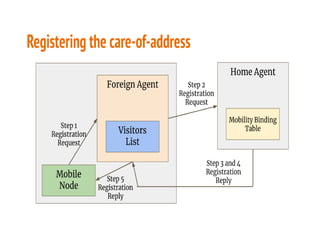
• Agent Registration
• Tunneling
Improving TCP Performance
• TCP enhancements for wireless protocols –
• Traditional TCP:
• Congestion control,
• fast retransmit/fast recovery,
• Implications of mobility
• Classical TCP improvements:
• Indirect TCP, Snooping TCP,
• Mobile TCP,
• Time out freezing,
• Selective retransmission
Congestion control
• During data transmission from sender to receiver, sometimes the
data packet may be lost.
• It is not because of hardware or software problem. Whenever the
packet loss is confirmed, the probable reason might be the
temporary overload at some point in the transmission path.
• This temporary overload is otherwise called as Congestion.
• Congestion is caused often even when the network is designed
perfectly.
• The transmission speed of receiver may not be equal to the
transmission speed of the sender. if the capacity of the sender is
more than the capacity of output link, then the packet buffer of a
router is filled and the router cannot forward the packets fast
enough.
• The only thing the router can do in this situation is to drop some
packets.
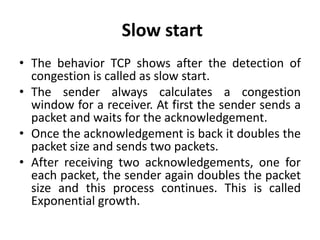
Slow start
• The behavior TCP shows after the detection of
congestion is called as slow start.
• The sender always calculates a congestion
window for a receiver. At first the sender sends a
packet and waits for the acknowledgement.
• Once the acknowledgement is back it doubles the
packet size and sends two packets.
• After receiving two acknowledgements, one for
each packet, the sender again doubles the packet
size and this process continues. This is called
Exponential growth.
Fast re-transmission:
• In TCP, two things lead to a reduction of the
congestion threshold. One of those is sender
receiving continuous acknowledgements for the
single packet.
• By this it can convey either of two things.
• One such thing is that the receiver received all
the packets up to the acknowledged one and the
other thing is the gap is due to packet loss.
• Now the sender immediately re-transmit the
missing packet before the given time expires. This
is called as Fast re-transmission.
Indirect TCP (I-TCP)
• Standard TCP is used between the fixed computer
and the access point. No computer in the internet
recognizes any changes to TCP.
• Instead of the mobile host, the access point now
terminates the standard TCP connection, acting
as a proxy.
• This means that the access point is now seen as
the mobile host for the fixed host and as the fixed
host for the mobile host. Between the access
point and the mobile host, a special TCP, adapted
to wireless links, is used.
• The foreign agent acts as a proxy and relays all data in
both directions.
• If CH (correspondent host) sends a packet to the MH,
the FA acknowledges it and forwards it to the MH. MH
acknowledges on successful reception, but this is only
used by the FA.
• If a packet is lost on the wireless link, CH doesn’t
observe it and FA tries to retransmit it locally to
maintain reliable data transport.
• If the MH sends a packet, the FA acknowledges it and
forwards it to CH.
• If the packet is lost on the wireless link, the mobile
hosts notice this much faster due to the lower round
trip time and can directly retransmit the packet.
• Packet loss in the wired network is now handled by the
foreign agent.
Snooping TCP
• The main function is to buffer data close to the mobile host to
perform fast local retransmission in case of packet loss.
• Here, the foreign agent buffers all packets with destination mobile
host and additionally ‘snoops’ the packet flow in both directions to
recognize acknowledgements.
• The foreign agent buffers every packet until it receives an
acknowledgement from the mobile host.
• If the FA does not receive an acknowledgement from the mobile
host within a certain amount of time, either the packet or the
acknowledgement has been lost.
• Alternatively, the foreign agent could receive a duplicate ACK which
also shows the loss of a packet.
• Now, the FA retransmits the packet directly from the buffer thus
performing a faster retransmission compared to the CH

MOBILE COMPUTING Unit 2.pptx

  • 1.
    20CS501- MOBILE COMPUTING Unit– II INTERNET PROTOCOL AND TRANSPORT LAYER Presented By K.Karthick M.E(Ph.D.) Assistant Professor/CSE, Kongunadu College of Engineering And Technology.
  • 2.
    UNIT I INTRODUCTION MobileComputing - Mobile Computing Vs wireless Networking - Mobile Computing Applications - Characteristics of Mobile computing - Structure of Mobile Computing Application. MAC Protocols - Wireless MAC Issues - Fixed Assignment Schemes - Random Assignment Schemes - Reservation Based Schemes. UNIT II INTERNET PROTOCOL AND TRANSPORT LAYER Mobile IP- Packet Delivery- Overview of Mobile IP - Features of Mobile IP - Key Mechanism in Mobile IP - Route Optimization. Dynamic Host Configuration Protocol- Overview of TCP/IP - Architecture of TCP/IP- Adaptation of TCP Window - Improvement in TCP Performance. UNIT III TELECOMMUNICATION SYSTEM Cellular Mobile communication- Global System for Mobile Communication (GSM) - General Packet Radio Service (GPRS) - Generation of Mobile communication - SDR. UNIT IV AD-HOC NETWORKS Ad-Hoc Basic Concepts - Characteristics - Applications - Design Issues - Routing - Essential of Traditional Routing Protocols -Routing Protocols - Vehicular Ad Hoc networks (VANET) - MANET Vs VANET - Security. UNIT V PLATFORMS AND APPLICATIONS Basic Concepts- Special Constraints & Requirements - Commercial Mobile Operating Systems - Software Development Kit: iOS, Android, BlackBerry, Windows Phone - M-Commerce - Structure - Pros & Cons - Mobile Payment System - Security Issues
  • 3.
    • Mobile IP-Packet Delivery- Overview of Mobile IP - Features of Mobile IP - Key Mechanism in Mobile IP - Route Optimization. Dynamic Host Configuration Protocol- Overview of TCP/IP - Architecture of TCP/IP- Adaptation of TCP Window - Improvement in TCP Performance Unit – II INTERNET PROTOCOL AND TRANSPORT LAYER
  • 4.
    Mobile Internet Protocol(or Mobile IP) • Mobile IP is a communication protocol (created by extending Internet Protocol, IP) that allows the users to move from one network to another with the same IP address. • It ensures that the communication will continue without user’s sessions or connections being dropped. • This is an IETF (Internet Engineering Task Force) standard communications protocol designed to allow mobile devices' (such as laptop, PDA, mobile phone, etc.) users to move from one network to another while maintaining their permanent IP (Internet Protocol) address. • Defined in RFC (Request for Comments) 2002, mobile IP is an enhancement of the internet protocol (IP) that adds mechanisms for forwarding internet traffic to mobile devices (known as mobile nodes) when they are connecting through other than their home network.
  • 5.
    Components of MobileIP • The mobile IP has following three components as follows: • 1. Mobile Node (MN) • The mobile node is an end system or device such as a cell phone, PDA (Personal Digital assistant), or laptop whose software enables network roaming capabilities.
  • 6.
    • Home Agent(HA) • The home agent provides several services for the mobile node and is located in the home network. The tunnel for packets towards the mobile node starts at home agent. The home agent maintains a location registry, i.e. it is informed of the mobile node's location by the current COA (care of address). Following alternatives for the implementation of an HA exist.
  • 7.
    • Home agentcan be implemented on a router that is responsible for the home network. This is obviously the best position, because without optimization to mobile IP, all packets for the MN have to go through the router anyway. • If changing the router's software is not possible, the home agent could also be implemented on an arbitrary node in the subset. • One biggest disadvantage of this solution is the double crossing of the router by the packet if the MN is in a foreign network. • A packet for the mobile node comes in via the router; the HA sends it through the tunnel which again crosses the router.
  • 8.
    • Foreign Agent(FA) • The foreign agent can provide several services to the mobile node during its visit to the foreign network. • The FA can have the COA (care or address) acting as a tunnel endpoint and forwarding packets to the MN. The foreign agent can be the default router for the MN. • Foreign agent can also provide security services because they belong to the foreign network as opposed to the MN which is only visiting.
  • 9.
    • Care ofAddress (COA) • The Care- of- address defines the current location of the mobile node from an IP point of view. All IP packets sent to the MN are delivered to the COA, not directly to the IP address of the MN. • Packet delivery toward the mobile node is done using a tunnel. To be more precise, the COA marks the endpoint of the tunnel, i.e. the address where packets exit the tunnel.
  • 10.
    • Foreign AgentCOA: The COA could be located at the foreign agent, i.e. the COA is an IP address of the foreign agent. • The foreign agent is the tunnel endpoint and forwards packets to the MN. Many MN using the FA can share this COA as common COA. • Co-located COA: The COA is co-located if the MN temporarily acquired an additional IP address which acts as a COA. • This address is now topologically correct, and the tunnel endpoint is at the mobile node. Co-located address can be acquired using services such as DHCP. One problem associated with this approach is need for additional addresses if MNs request a COA. This is not always a good idea considering the scarcity of IPv4 addresses.
  • 11.
    • Correspondent Node(CN) • At least one partner is needed for communication. The correspondent node represents this partner for the MN. The correspondent node can be a fixed or mobile node. • Home Network • The home network is the subset the MN belongs to with respect to its IP address. No mobile IP support is needed within this network.
  • 12.
    • Foreign network •The foreign network is the current subset the MN visits and which is not the home network.
  • 13.
  • 14.
    • The correspondentnode sends the data to the mobile node. Data packets contain the correspondent node’s address (Source) and home address (Destination). Packets reach the home agent. • But now mobile node is not in the home network, it has moved into the foreign network. • The foreign agent sends the care-of-address to the home agent to which all the packets should be sent. • Now, a tunnel will be established between the home agent and the foreign agent by the process of tunneling. • Tunneling establishes a virtual pipe for the packets available between a tunnel entry and an endpoint. • It is the process of sending a packet via a tunnel and it is achieved by a mechanism called encapsulation.
  • 15.
    • Now, thehome agent encapsulates the data packets into new packets in which the source address is the home address and destination is the care-of-address and sends it through the tunnel to the foreign agent. • Foreign agent, on another side of the tunnel, receives the data packets, decapsulates them, and sends them to the mobile node. • The mobile node in response to the data packets received sends a reply in response to the foreign agent. • The foreign agent directly sends the reply to the correspondent node.
  • 16.
    Requirements of MobileIP • Compatibility • Transparency • Scalability and efficiency • Security
  • 21.
    Key Mechanisms ofIP • Agent Discovery • Agent Registration • Tunneling
  • 62.
    Improving TCP Performance •TCP enhancements for wireless protocols – • Traditional TCP: • Congestion control, • fast retransmit/fast recovery, • Implications of mobility • Classical TCP improvements: • Indirect TCP, Snooping TCP, • Mobile TCP, • Time out freezing, • Selective retransmission
  • 63.
    Congestion control • Duringdata transmission from sender to receiver, sometimes the data packet may be lost. • It is not because of hardware or software problem. Whenever the packet loss is confirmed, the probable reason might be the temporary overload at some point in the transmission path. • This temporary overload is otherwise called as Congestion. • Congestion is caused often even when the network is designed perfectly. • The transmission speed of receiver may not be equal to the transmission speed of the sender. if the capacity of the sender is more than the capacity of output link, then the packet buffer of a router is filled and the router cannot forward the packets fast enough. • The only thing the router can do in this situation is to drop some packets.
  • 64.
    Slow start • Thebehavior TCP shows after the detection of congestion is called as slow start. • The sender always calculates a congestion window for a receiver. At first the sender sends a packet and waits for the acknowledgement. • Once the acknowledgement is back it doubles the packet size and sends two packets. • After receiving two acknowledgements, one for each packet, the sender again doubles the packet size and this process continues. This is called Exponential growth.
  • 65.
    Fast re-transmission: • InTCP, two things lead to a reduction of the congestion threshold. One of those is sender receiving continuous acknowledgements for the single packet. • By this it can convey either of two things. • One such thing is that the receiver received all the packets up to the acknowledged one and the other thing is the gap is due to packet loss. • Now the sender immediately re-transmit the missing packet before the given time expires. This is called as Fast re-transmission.
  • 66.
    Indirect TCP (I-TCP) •Standard TCP is used between the fixed computer and the access point. No computer in the internet recognizes any changes to TCP. • Instead of the mobile host, the access point now terminates the standard TCP connection, acting as a proxy. • This means that the access point is now seen as the mobile host for the fixed host and as the fixed host for the mobile host. Between the access point and the mobile host, a special TCP, adapted to wireless links, is used.
  • 68.
    • The foreignagent acts as a proxy and relays all data in both directions. • If CH (correspondent host) sends a packet to the MH, the FA acknowledges it and forwards it to the MH. MH acknowledges on successful reception, but this is only used by the FA. • If a packet is lost on the wireless link, CH doesn’t observe it and FA tries to retransmit it locally to maintain reliable data transport. • If the MH sends a packet, the FA acknowledges it and forwards it to CH. • If the packet is lost on the wireless link, the mobile hosts notice this much faster due to the lower round trip time and can directly retransmit the packet. • Packet loss in the wired network is now handled by the foreign agent.
  • 69.
    Snooping TCP • Themain function is to buffer data close to the mobile host to perform fast local retransmission in case of packet loss. • Here, the foreign agent buffers all packets with destination mobile host and additionally ‘snoops’ the packet flow in both directions to recognize acknowledgements. • The foreign agent buffers every packet until it receives an acknowledgement from the mobile host. • If the FA does not receive an acknowledgement from the mobile host within a certain amount of time, either the packet or the acknowledgement has been lost. • Alternatively, the foreign agent could receive a duplicate ACK which also shows the loss of a packet. • Now, the FA retransmits the packet directly from the buffer thus performing a faster retransmission compared to the CH