Big Data & Internet
Definition
• Big data is a catch-phrase, used to describe a
massive volume of both structured and
unstructured data that is so large that it's
difficult to process using traditional database
and software techniques.
• Traditional R-DBMS can’t work for big data.
Real life implementations
• Consumer product companies and retail organizations are monitoring
social media like Facebook and Twitter to get an unprecedented view into
customer behavior, preferences, and product perception.
• Advertising and marketing agencies are tracking social media to
understand responsiveness to campaigns, promotions, and other
advertising mediums.
• Insurance companies are using Big Data analysis to see which home
insurance applications can be immediately processed, and which ones
need a validating in-person visit from an agent.
• Hospitals are analyzing medical data and patient records to predict those
patients that are likely to seek readmission within a few months of
discharge. The hospital can then intervene in hopes of preventing another
costly hospital stay.
• Web-based businesses are developing information products that combine
data gathered from customers to offer more appealing recommendations
and more successful coupon programs.
• The government is making data public at both the national, state, and city
level for users to develop new applications that can generate public good.
11 Introduction: Explosion in Quantity of Data
Big Data Characteristics2
Usage Example in Big Data
3
4 Importance of Big Data
5
Cost Problem (example)
2
3
4
5
Contents 1
16 Some Challenges in Big Data
Other Aspects of Big Data2
Book Review
3
4 Zeta-Byte Horizon
5
7
8
9
10
Contents 2
Implementation of Big Data
Introduction: Explosion in Quantity of Data
3
Air Bus A380
- 1 billion line of code
- each engine generate 10 TB every
30 min
640TB per Flight
Twitter Generate approximately 12 TB of data per
day
New York Stock Exchange 1TB of data everyday
storage capacity has doubled roughly every three
years since the 1980s
4
Introduction: Explosion in Quantity of Data
• Science
– Data bases from astronomy, genomics, environmental data, transportation
data, …
• Humanities and Social Sciences
– Scanned books, historical documents, social interactions data, new technology
like GPS …
• Business & Commerce
– Corporate sales, stock market transactions, census, airline traffic, …
• Entertainment
– Internet images, Hollywood movies, MP3 files, …
• Medicine
– MRI & CT scans, patient records, …
Our Data-driven World
5
Introduction: Explosion in Quantity of Data
Our Data-driven World
What we do with these amount of data?
Ignore
- Fish and Oceans of Data
Big Data Characteristics 6
How big is the Big Data?
- What is big today maybe not big tomorrow, e.g. Orkut…
Big Data Vectors (3Vs)
- Any data that can challenge our current technology
in some manner can consider as Big Data
- Volume
- Communication
- Speed of Generating
- Meaningful Analysis
"Big Data are high-volume, high-velocity, and/or high-variety
information assets that require new forms of processing to enable
enhanced decision making, insight discovery and process
optimization”
Gartner 2012
Big Data Characteristics 7
Big Data Vectors (3Vs)
- high-volume
amount of data
- high-velocity
Speed rate in collecting or acquiring or generating or processing of data
- high-variety
different data type such as audio, video, image data (mostly unstructured data)
Cost Problem (example) 8
Cost of processing 1 Petabyte of data
with 1000 node ?
1 PB = 1015
B = 1 million gigabytes = 1 thousand terabytes
- 9 hours for each node to process 500GB at rate of 15MB/S
- 15*60*60*9 = 486000MB ~ 500 GB
- 1000 * 9 * 0.34$ = 3060$ for single run
- 1 PB = 1000000 / 500 = 2000 * 9 =
18000 h /24 = 750 Day
- The cost for 1000 cloud node each
processing 1PB
2000 * 3060$ = 6,120,000$
Importance of Big Data 9
- Government
In 2012, the Obama administration announced the Big Data Research
and Development Initiative
84 different big data programs spread across six departments
- Private Sector
- Walmart handles more than 1 million customer transactions every hour,
which is imported into databases estimated to contain more than
2.5 petabytes of data
- Facebook handles 40 billion photos from its user base.
- Falcon Credit Card Fraud Detection System protects 2.1 billion active
accounts world-wide
- Science
- Large Synoptic Survey Telescope will generate
140 Terabyte of data every 5 days.
- Large Hardon Colider 13 Petabyte data produced in 2010
- Medical computation like decoding human Genome
- Social science revolution
- New way of science (Microscope example)
Importance of Big Data
• Job
- The U.S. could face a shortage by 2018 of 140,000 to 190,000 people with "deep
analytical talent" and of 1.5 million people capable of analyzing data in ways that
enable business decisions. (McKinsey & Co)
- Big Data industry is worth more than $100 billion
growing at almost 10% a year (roughly twice as fast as the software business)
10
 Technology Player in this field
 Oracle
 Exadata (http://www.oracle.com/us/products/database/exadata/overview/index.html)
 Microsoft
 HDInsight Server
 IBM
 Netezza
Usage Example of Big Data 12
US 2012 Election
- data mining for
individualized ad targeting
- Orca big-data app
- YouTube channel( 23,700 subscribers
and 26 million page views)
- Ace of Spades HQ
- predictive modeling
- mybarackobama.com
- drive traffic to other campaign sites
Facebook page (33 million "likes")
YouTube channel (240,000 subscribers
and 246 million page views).
- a contest to dine with Sarah Jessica Parker
- Every single night, the team ran 66,000
computer simulations, Reddit!!!
- Amazon web services
Usage Example in Big Data 13
Data Analysis prediction for US 2012 Election
Drew Linzer, June 2012
332 for Obama,
206 for Romney
Nate Silver’s, Five thirty Eight blog
Predict Obama had a 86% chance of winning
Predicted all 50 state correctly
Sam Wang, the Princeton Election Consortium
The probability of Obama's re-election
at more than 98%
media continue reporting the race as very
tight
Some Challenges in Big Data 14
 Big Data Integration is Multidisciplinary
Less than 10% of Big Data world are genuinely relational
Meaningful data integration in the real, messy, schema-less
and complex Big Data world of database and semantic web
using multidisciplinary and multi-technology method
 The Billion Triple Challenge
Web of data contain 31 billion RDF triples, that 446million of
them are RDF links, 13 Billion government data, 6 Billion
geographic data, 4.6 Billion Publication and Media data, 3 Billion
life science data
BTC 2011, Sindice 2011
 The Linked Open Data Ripper
Mapping, Ranking, Visualization, Key Matching, Snappiness
 Demonstrate the Value of Semantics: let data integration drive
DBMS technology
Large volumes of heterogeneous data, like link data and RDF
(go through: http://www.w3schools.com/rdf/, http://www.w3.org/RDF/,
http://en.wikipedia.org/wiki/Linked_data)
Other Aspects of Big Data 15
1- Automating Research Changes the Definition of Knowledge
2- Claim to Objectively and Accuracy are Misleading
3- Bigger Data are not always Better data
4- Not all Data are equivalent
5- Just because it is accessible doesn’t make it ethical
6- Limited access to big data creates new digital divides
Six Provocations for Big Data
Other Aspects of Big Data
• Five Big Question about big Data:
1- What happens in a world of radical transparency, with data widely available?
2- If you could test all your decisions, how would that change the way you compete?
3- How would your business change if you used big data for widespread, real time
customization?
4- How can big data augment or even replace Management?
5-Could you create a new business model based on data?
16
Implementation of Big Data
• Parallel DBMS technologies
– Proposed in late eighties
– Matured over the last two decades
– Multi-billion dollar industry: Proprietary DBMS Engines intended as
Data Warehousing solutions for very large enterprises
• Map Reduce
– pioneered by Google
– popularized by Yahoo! (Hadoop)
17
Platforms for Large-scale Data Analysis
Implementation of Big Data
• Overview:
– Data-parallel programming model
– An associated parallel and distributed
implementation for commodity clusters
• Pioneered by Google
– Processes 20 PB of data per day
• Popularized by open-source Hadoop
– Used by Yahoo!, Facebook,
Amazon, and the list is growing …
18
MapReduce Parallel DBMS technologies
 Popularly used for more than two decades
 Research Projects: Gamma, Grace, …
 Commercial: Multi-billion dollar
industry but access to only a privileged
few
 Relational Data Model
 Indexing
 Familiar SQL interface
 Advanced query optimization
 Well understood and studied
Implementation of Big Data 19
MapReduce
Raw Input: <key, value>Raw Input: <key, value>
MAPMAP
<K2,V2><K2,V2><K1, V1><K1, V1> <K3,V3><K3,V3>
REDUCEREDUCE
Implementation of Big Data
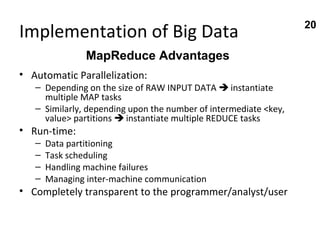
• Automatic Parallelization:
– Depending on the size of RAW INPUT DATA  instantiate
multiple MAP tasks
– Similarly, depending upon the number of intermediate <key,
value> partitions  instantiate multiple REDUCE tasks
• Run-time:
– Data partitioning
– Task scheduling
– Handling machine failures
– Managing inter-machine communication
• Completely transparent to the programmer/analyst/user
20
MapReduce Advantages
Implementation of Big Data
Parallel DBMS MapReduce
Schema Support  Not out of the box
Indexing  Not out of the box
Programming Model
Declarative
(SQL)
Imperative
(C/C++, Java, …)
Extensions through
Pig and Hive
Optimizations
(Compression,
Query Optimization)
 Not out of the box
Flexibility Not out of the box 
Fault Tolerance
Coarse grained
techniques

21
Map Reduce vs Parallel DBMS
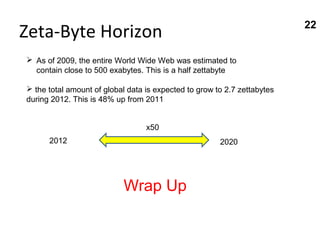
Zeta-Byte Horizon 22
 the total amount of global data is expected to grow to 2.7 zettabytes
during 2012. This is 48% up from 2011
Wrap Up
2012 2020
x50
 As of 2009, the entire World Wide Web was estimated to
contain close to 500 exabytes. This is a half zettabyte
The Fourth Paradigm
Data-Intensive Scientific Discovery
Toney Hey, Stwart Tansley and Kristin Tolle
Microsotf Press 2009
Book Review 23
References
1. B. Brown, M. Chuiu and J. Manyika, “Are you ready for the era of Big Data?” McKinsey Quarterly, Oct
2011, McKinsey Global Institute
2. C. Bizer, P. Bonez, M. L. Bordie and O. Erling, “The Meaningful Use of Big Data: Four Perspective –
Four Challenges” SIGMOD Vol. 40, No. 4, December 2011
3. D. Boyd and K. Crawford, “Six Provation for Big Data” A Decade in Internet Time: Symposium on the
Dynamics of the Internet and Society, September 2011, Oxford Internet Institute
4. D. Agrawal, S. Das and A. E. Abbadi, “Big Data and Cloud Computing: Current State and Future
Opportunities” ETDB 2011, Uppsala, Sweden
5. D. Agrawal, S. Das and A. E. Abbadi, “Big Data and Cloud Computing: New Wine or Just New Bottles?”
VLDB 2010, Vol. 3, No. 2
6. F. J. Alexander, A. Hoisie and A. Szalay, “Big Data” IEEE Computing in Science and Engineering
journal 2011
7. O. Trelles, P Prins, M. Snir and R. C. Jansen, “Big Data, but are we ready?” Nature Reviews, Feb 2011
8. K. Bakhshi, “Considerations for Big data: Architecture and approach” Aerospace Conference, 2012
IEEE
8. S. Lohr, “The Age of Big Data” Thr New York times Publication, February 2012
10. M. Nielsen, “Aguide to the day of big data”, Nature, vol. 462, December 2009
24
Keep your eye on
http://www.byteintobigdatasummit.com/

Big data and Internet

  • 1.
    Big Data &Internet
  • 2.
    Definition • Big datais a catch-phrase, used to describe a massive volume of both structured and unstructured data that is so large that it's difficult to process using traditional database and software techniques. • Traditional R-DBMS can’t work for big data.
  • 3.
    Real life implementations •Consumer product companies and retail organizations are monitoring social media like Facebook and Twitter to get an unprecedented view into customer behavior, preferences, and product perception. • Advertising and marketing agencies are tracking social media to understand responsiveness to campaigns, promotions, and other advertising mediums. • Insurance companies are using Big Data analysis to see which home insurance applications can be immediately processed, and which ones need a validating in-person visit from an agent. • Hospitals are analyzing medical data and patient records to predict those patients that are likely to seek readmission within a few months of discharge. The hospital can then intervene in hopes of preventing another costly hospital stay. • Web-based businesses are developing information products that combine data gathered from customers to offer more appealing recommendations and more successful coupon programs. • The government is making data public at both the national, state, and city level for users to develop new applications that can generate public good.
  • 4.
    11 Introduction: Explosionin Quantity of Data Big Data Characteristics2 Usage Example in Big Data 3 4 Importance of Big Data 5 Cost Problem (example) 2 3 4 5 Contents 1
  • 5.
    16 Some Challengesin Big Data Other Aspects of Big Data2 Book Review 3 4 Zeta-Byte Horizon 5 7 8 9 10 Contents 2 Implementation of Big Data
  • 6.
    Introduction: Explosion inQuantity of Data 3 Air Bus A380 - 1 billion line of code - each engine generate 10 TB every 30 min 640TB per Flight Twitter Generate approximately 12 TB of data per day New York Stock Exchange 1TB of data everyday storage capacity has doubled roughly every three years since the 1980s
  • 7.
    4 Introduction: Explosion inQuantity of Data • Science – Data bases from astronomy, genomics, environmental data, transportation data, … • Humanities and Social Sciences – Scanned books, historical documents, social interactions data, new technology like GPS … • Business & Commerce – Corporate sales, stock market transactions, census, airline traffic, … • Entertainment – Internet images, Hollywood movies, MP3 files, … • Medicine – MRI & CT scans, patient records, … Our Data-driven World
  • 8.
    5 Introduction: Explosion inQuantity of Data Our Data-driven World What we do with these amount of data? Ignore - Fish and Oceans of Data
  • 9.
    Big Data Characteristics6 How big is the Big Data? - What is big today maybe not big tomorrow, e.g. Orkut… Big Data Vectors (3Vs) - Any data that can challenge our current technology in some manner can consider as Big Data - Volume - Communication - Speed of Generating - Meaningful Analysis "Big Data are high-volume, high-velocity, and/or high-variety information assets that require new forms of processing to enable enhanced decision making, insight discovery and process optimization” Gartner 2012
  • 10.
    Big Data Characteristics7 Big Data Vectors (3Vs) - high-volume amount of data - high-velocity Speed rate in collecting or acquiring or generating or processing of data - high-variety different data type such as audio, video, image data (mostly unstructured data)
  • 11.
    Cost Problem (example)8 Cost of processing 1 Petabyte of data with 1000 node ? 1 PB = 1015 B = 1 million gigabytes = 1 thousand terabytes - 9 hours for each node to process 500GB at rate of 15MB/S - 15*60*60*9 = 486000MB ~ 500 GB - 1000 * 9 * 0.34$ = 3060$ for single run - 1 PB = 1000000 / 500 = 2000 * 9 = 18000 h /24 = 750 Day - The cost for 1000 cloud node each processing 1PB 2000 * 3060$ = 6,120,000$
  • 12.
    Importance of BigData 9 - Government In 2012, the Obama administration announced the Big Data Research and Development Initiative 84 different big data programs spread across six departments - Private Sector - Walmart handles more than 1 million customer transactions every hour, which is imported into databases estimated to contain more than 2.5 petabytes of data - Facebook handles 40 billion photos from its user base. - Falcon Credit Card Fraud Detection System protects 2.1 billion active accounts world-wide - Science - Large Synoptic Survey Telescope will generate 140 Terabyte of data every 5 days. - Large Hardon Colider 13 Petabyte data produced in 2010 - Medical computation like decoding human Genome - Social science revolution - New way of science (Microscope example)
  • 13.
    Importance of BigData • Job - The U.S. could face a shortage by 2018 of 140,000 to 190,000 people with "deep analytical talent" and of 1.5 million people capable of analyzing data in ways that enable business decisions. (McKinsey & Co) - Big Data industry is worth more than $100 billion growing at almost 10% a year (roughly twice as fast as the software business) 10  Technology Player in this field  Oracle  Exadata (http://www.oracle.com/us/products/database/exadata/overview/index.html)  Microsoft  HDInsight Server  IBM  Netezza
  • 14.
    Usage Example ofBig Data 12 US 2012 Election - data mining for individualized ad targeting - Orca big-data app - YouTube channel( 23,700 subscribers and 26 million page views) - Ace of Spades HQ - predictive modeling - mybarackobama.com - drive traffic to other campaign sites Facebook page (33 million "likes") YouTube channel (240,000 subscribers and 246 million page views). - a contest to dine with Sarah Jessica Parker - Every single night, the team ran 66,000 computer simulations, Reddit!!! - Amazon web services
  • 15.
    Usage Example inBig Data 13 Data Analysis prediction for US 2012 Election Drew Linzer, June 2012 332 for Obama, 206 for Romney Nate Silver’s, Five thirty Eight blog Predict Obama had a 86% chance of winning Predicted all 50 state correctly Sam Wang, the Princeton Election Consortium The probability of Obama's re-election at more than 98% media continue reporting the race as very tight
  • 16.
    Some Challenges inBig Data 14  Big Data Integration is Multidisciplinary Less than 10% of Big Data world are genuinely relational Meaningful data integration in the real, messy, schema-less and complex Big Data world of database and semantic web using multidisciplinary and multi-technology method  The Billion Triple Challenge Web of data contain 31 billion RDF triples, that 446million of them are RDF links, 13 Billion government data, 6 Billion geographic data, 4.6 Billion Publication and Media data, 3 Billion life science data BTC 2011, Sindice 2011  The Linked Open Data Ripper Mapping, Ranking, Visualization, Key Matching, Snappiness  Demonstrate the Value of Semantics: let data integration drive DBMS technology Large volumes of heterogeneous data, like link data and RDF (go through: http://www.w3schools.com/rdf/, http://www.w3.org/RDF/, http://en.wikipedia.org/wiki/Linked_data)
  • 17.
    Other Aspects ofBig Data 15 1- Automating Research Changes the Definition of Knowledge 2- Claim to Objectively and Accuracy are Misleading 3- Bigger Data are not always Better data 4- Not all Data are equivalent 5- Just because it is accessible doesn’t make it ethical 6- Limited access to big data creates new digital divides Six Provocations for Big Data
  • 18.
    Other Aspects ofBig Data • Five Big Question about big Data: 1- What happens in a world of radical transparency, with data widely available? 2- If you could test all your decisions, how would that change the way you compete? 3- How would your business change if you used big data for widespread, real time customization? 4- How can big data augment or even replace Management? 5-Could you create a new business model based on data? 16
  • 19.
    Implementation of BigData • Parallel DBMS technologies – Proposed in late eighties – Matured over the last two decades – Multi-billion dollar industry: Proprietary DBMS Engines intended as Data Warehousing solutions for very large enterprises • Map Reduce – pioneered by Google – popularized by Yahoo! (Hadoop) 17 Platforms for Large-scale Data Analysis
  • 20.
    Implementation of BigData • Overview: – Data-parallel programming model – An associated parallel and distributed implementation for commodity clusters • Pioneered by Google – Processes 20 PB of data per day • Popularized by open-source Hadoop – Used by Yahoo!, Facebook, Amazon, and the list is growing … 18 MapReduce Parallel DBMS technologies  Popularly used for more than two decades  Research Projects: Gamma, Grace, …  Commercial: Multi-billion dollar industry but access to only a privileged few  Relational Data Model  Indexing  Familiar SQL interface  Advanced query optimization  Well understood and studied
  • 21.
    Implementation of BigData 19 MapReduce Raw Input: <key, value>Raw Input: <key, value> MAPMAP <K2,V2><K2,V2><K1, V1><K1, V1> <K3,V3><K3,V3> REDUCEREDUCE
  • 22.
    Implementation of BigData • Automatic Parallelization: – Depending on the size of RAW INPUT DATA  instantiate multiple MAP tasks – Similarly, depending upon the number of intermediate <key, value> partitions  instantiate multiple REDUCE tasks • Run-time: – Data partitioning – Task scheduling – Handling machine failures – Managing inter-machine communication • Completely transparent to the programmer/analyst/user 20 MapReduce Advantages
  • 23.
    Implementation of BigData Parallel DBMS MapReduce Schema Support  Not out of the box Indexing  Not out of the box Programming Model Declarative (SQL) Imperative (C/C++, Java, …) Extensions through Pig and Hive Optimizations (Compression, Query Optimization)  Not out of the box Flexibility Not out of the box  Fault Tolerance Coarse grained techniques  21 Map Reduce vs Parallel DBMS
  • 24.
    Zeta-Byte Horizon 22 the total amount of global data is expected to grow to 2.7 zettabytes during 2012. This is 48% up from 2011 Wrap Up 2012 2020 x50  As of 2009, the entire World Wide Web was estimated to contain close to 500 exabytes. This is a half zettabyte
  • 25.
    The Fourth Paradigm Data-IntensiveScientific Discovery Toney Hey, Stwart Tansley and Kristin Tolle Microsotf Press 2009 Book Review 23
  • 26.
    References 1. B. Brown,M. Chuiu and J. Manyika, “Are you ready for the era of Big Data?” McKinsey Quarterly, Oct 2011, McKinsey Global Institute 2. C. Bizer, P. Bonez, M. L. Bordie and O. Erling, “The Meaningful Use of Big Data: Four Perspective – Four Challenges” SIGMOD Vol. 40, No. 4, December 2011 3. D. Boyd and K. Crawford, “Six Provation for Big Data” A Decade in Internet Time: Symposium on the Dynamics of the Internet and Society, September 2011, Oxford Internet Institute 4. D. Agrawal, S. Das and A. E. Abbadi, “Big Data and Cloud Computing: Current State and Future Opportunities” ETDB 2011, Uppsala, Sweden 5. D. Agrawal, S. Das and A. E. Abbadi, “Big Data and Cloud Computing: New Wine or Just New Bottles?” VLDB 2010, Vol. 3, No. 2 6. F. J. Alexander, A. Hoisie and A. Szalay, “Big Data” IEEE Computing in Science and Engineering journal 2011 7. O. Trelles, P Prins, M. Snir and R. C. Jansen, “Big Data, but are we ready?” Nature Reviews, Feb 2011 8. K. Bakhshi, “Considerations for Big data: Architecture and approach” Aerospace Conference, 2012 IEEE 8. S. Lohr, “The Age of Big Data” Thr New York times Publication, February 2012 10. M. Nielsen, “Aguide to the day of big data”, Nature, vol. 462, December 2009 24
  • 27.
    Keep your eyeon http://www.byteintobigdatasummit.com/