Prepared By
Prof. Karan S. Chauhan
Assistant Professor
Department Of Civil Engineering
@ Shri Labhubhai Trivedi Institute Of
Engineering And Technology,Rajkot
Shri Labhubhai Trivedi
Institute of Engineering &
Technology, Rajkot
Sub Surface InvestigationSub Surface Investigation
Subject :- Building Construction
Subject Code : 2130607
SUB-SURFACE INVESTIGATION
The surface and subsurface investigation
or site exploration is carried out to collect
the information about physical properties
and characteristics of the subsoil material
as well as the details of other geological
features of the site area.
Contents
 Purpose of site exploration
 Depth of exploration
 Methods of site exploration
 Soil samples and samplers
Purpose of Site Exploration
The site exploration or investigation is carried out to collect the complete
details of the site for the following purposes :
FOR NEW STRUCTURE:-
 The selection of type and depth of foundation.
 The determine of bearing capacity of the selected foundation.
 The prediction of settlement of the selected foundation.
 The determine of the ground water level.
 The evaluation of the earth pressure against walls, basement, abutments
etc.
 The provision against constructional difficulties.
 The suitability of soil and degree of compaction of soil.
For Existing Structure :-
 The investigation of the safety of the structure.
 The prediction of settlement.
 The determination of remedial measure if the structure is unsafe or
will suffer detrimental settlement.
Depth Of Exploration
 Exploration, in general, should be carried out to a depth up to which
the increase in pressure due to structural loading is likely to cause
perceptible settlement or shear failure of foundation a depth, known as
significant depth, depends upon the type of structure, its weight, size,
shape and disposition of the loaded areas, and the soil profile and its
properties. The significant depth may be assumed to be equal to one-
and-half to two time the width of the loaded area.
 National Buildind Code Of India (Sp 7-1983) Suggests...
 As a thumb rule , the depth should be one and half times the probable
width of the footing or 1.5 m whichever is more.
 In case of weak soils , however , the pits or the bore holes should be
taken to a depth at which the loads can be carried by the soil without
undesirable settlement.
 the number and spacing of the trail pits or bore holes to be adopted for
a site will depend upon the area of plot as well as type of structure to
be built.
Methods of Site Exploration
1) Trial pits OR Open Excavation
2) Subsurface soundings
3) Boring
 Auger boring
 Auger and shell boring
 Wash boring
 Percussion boring
 Rotary boring
4 ) Geo physical methods
 Seismic refraction method
 Electrical resistivity method
 Magnetic method
 Gravitational method
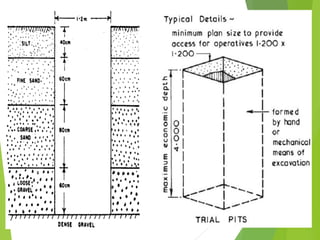
Trail Pits
The excavation of trial pits is a simple and reliable method.
The depth is limited to 4-5m only.
The biggest advantage of method is that soil strata can be inspected in
their natural condition and samples can be conveniently taken.
It is easy to obtain disturbed and undisturbed samples
Block samples can be cut by hand tools and tube samples can be taken
from the bottom of the pit.
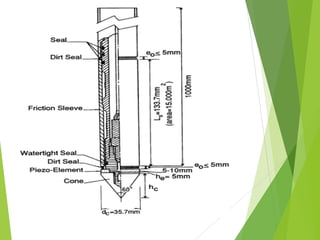
Subsurface Soundings
 This method consists of measuring the variation in the resistance
offered by the soil with the depth by means of a tool known as
penetrometer.
 The penetrometer may consist of a mild steel cone fitted loosely to a
steel rod or it may be a tool known as standard split spoon sampler.
 The resistance offered by the soil to penetration is co-related with
the engineering properties of soil , such as – density , consistency ,
permeability and bearing capacity.
Boring
 The various boring methods adopted for soil exploration are as
follows :
 Auger boring
 Auger and shell boring
 Wash boring
 Percussion boring
 Rotary boring
Auger Boring
 This type of augers are commonly used for soft clayey or sandy
soils or soft soils . It can be operated manually or mechanically .
The hand operated augers are used up to 6 m depth and the
mechanically operated augers are used for greater depth up to 15
m .
 The auger is vertically driven into the ground by rotating its
handle and is pressed down during the process of rotation .
 At every 30 cm depth of penetration , the auger is drawn out and
the samples of soils are collected separately for testing.
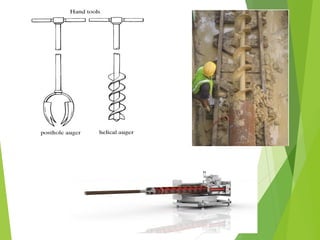
 Two types augers are used 1) Spiral/Helical ,
2) Post hole
 Samples collected from auger boring is badly disturbed sample.
Auger and Shell Boring
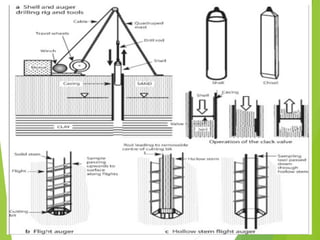
 In this method ,different types of tools are used for boring.
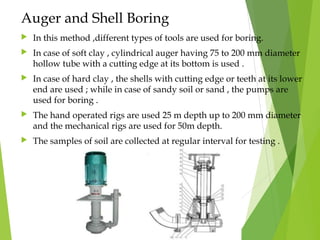
 In case of soft clay , cylindrical auger having 75 to 200 mm diameter
hollow tube with a cutting edge at its bottom is used .
 In case of hard clay , the shells with cutting edge or teeth at its lower
end are used ; while in case of sandy soil or sand , the pumps are
used for boring .
 The hand operated rigs are used 25 m depth up to 200 mm diameter
and the mechanical rigs are used for 50m depth.
 The samples of soil are collected at regular interval for testing .
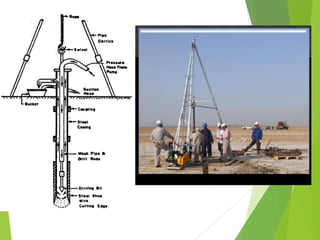
Wash Boring
 This method may be use in all types of soils except those mixed with
gravel and boulders, and rocky strata.
 Water jet under pressure is forced into the hole through the rod and the
bit, which is alternatively raised and dropped, and rotated as well
 The resulting chopping and jetting action of the bit and water loosens the
soil at the lower end and forces the water-slurry upwards through the
annular space between the drill rod and the casing. The soil water slurry
is led into a settling tank where the soil particles settle where the water
overflows into a sump
 The soil particles collected represent a very disturb sample and is not
very useful for the evaluation of the engineering properties of the soil.
The changes in soil strata may be indicated by the change in the rate of
progress and the change in the colour of the wash water
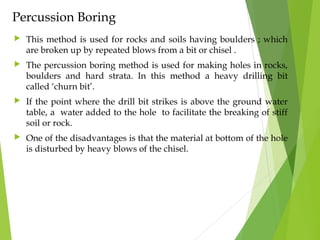
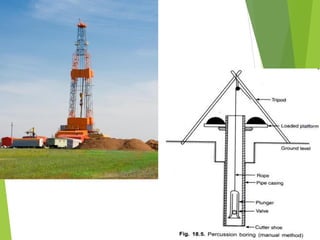
Percussion Boring
 This method is used for rocks and soils having boulders ; which
are broken up by repeated blows from a bit or chisel .
 The percussion boring method is used for making holes in rocks,
boulders and hard strata. In this method a heavy drilling bit
called ‘churn bit’.
 If the point where the drill bit strikes is above the ground water
table, a water added to the hole to facilitate the breaking of stiff
soil or rock.
 One of the disadvantages is that the material at bottom of the hole
is disturbed by heavy blows of the chisel.
Rotary Boring
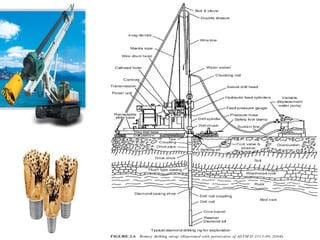
 This method is a of drilling holes in rock formations.
 A hollow drill bit, fixed to the lower end of a hollow drill rod, is rotated
by power while being kept in firm contact with the bottom of the hole.
 Drilling fluid usually bentonite clay slurry is force under pressure
through the drill rod and it comes up bringing the cuttings to the
surface.
 This method is then known as core drilling or core boring.
 This method is a fast method of drilling holes in rock formations.
 In this method by using suitable diamond studded drill bits or steel bits
with shots, the rock cores may be obtained. The method is then known
as core drilling or core boring
Geo-Physical Method
 It is the method used when the depth of exploration is very large, and
also when the speed of investigation is of primary importance.
 It involves the detection of significant difference in the physical
properties of geological formation.
 Major methods are…..
1. Seismic refraction method
2. Electrical resistivity method
3. Magnetic method
4. Gravitational method
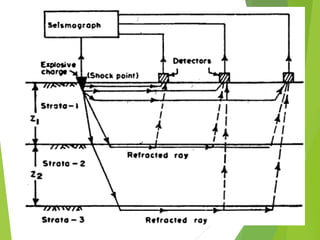
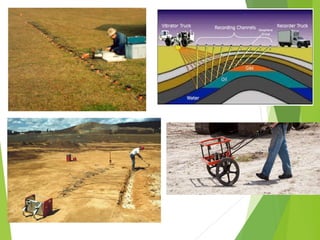
Seismic Refraction method
 Seismic refraction is a geophysical method used for
investigating subsurface ground conditions by utilizing
surface-sourced seismic waves. Data acquired on site is
computer processed and interpreted to produce models of
the seismic velocity and layer thickness of the subsurface
ground structure. The method is commonly used for
measuring the thickness of overburden in areas where
bedrock is at depth, and assessing ripability parameters.
Applications
 Measures Bedrock Depth & Overburden Thickness
 Determines Rippability Parameters
 Investigates Pipeline Routes
 Locates Geological Structures
 Evaluates Sand & Gravel Deposits
 Defines Ancient Landfill Sites
Electric Resistivity method
 The electric resistivity method is based on the measurement and
recording of changes in the mean resistivity of various soils.
 Each soil has its own resistivity depending upon its water content,
compaction and composition.
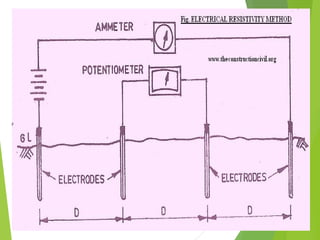
 The test is conducted by driving four metal spikes to serve as electrodes
into the ground along a straight line at equal distance. Direct voltage is
imposed between two outer electrodes, the potential drop is measured
between the inner electrodes.
Soil Samples
1. Disturbed samples
 A disturbed sample is a sample in which the natural structure of soil
gets partly or fully modified and destroyed . However , by taking
proper precautions , the natural water content in soil sample can be
preserved .
 This type of soil sample should maintain the original proportion of the
various particles .
2. Undisturbed samples
 An undisturbed sample is a sample which the natural structure and
properties remain preserved .
 The sample disturbance depends on the design of samplers and the
method of sampling .
 The sampling tube when forced into the ground should cause as little
remolding and disturbance as possible .
Types of soil sampler
Depending upon the area ratio
Thick wall sampler
Thin wall sampler
Main types are…
 1. Open drive sampler
 2. Piston sampler
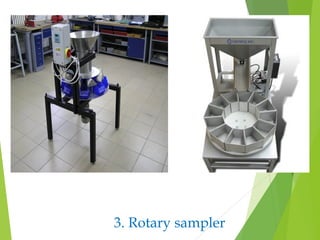
 3. Rotary sampler
2
1
3 4
1. Open drive sampler
2. Piston sampler
3. Rotary sampler
Bearing Capacity of soil
 The max. load per unit area which the soil or
rock can carry without yielding or
displacement is termed as the bearing capacity
of soil.
Methods for determining B.C. of soil
1.Plate load test
2.Penetration Test
3.SBC from IS code
4.Analytical Method
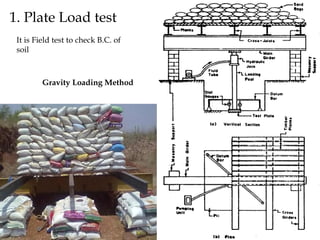
1. Plate Load test
It is Field test to check B.C. of
soil
Gravity Loading Method
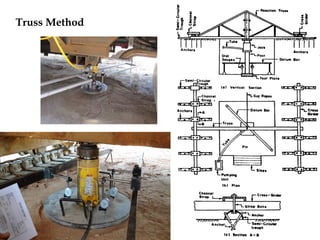
Truss Method
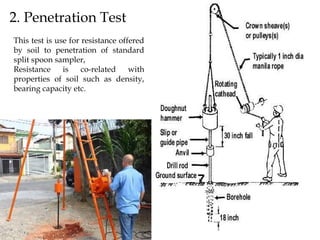
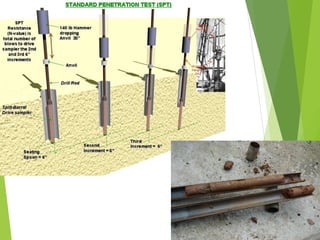
2. Penetration Test
This test is use for resistance offered
by soil to penetration of standard
split spoon sampler,
Resistance is co-related with
properties of soil such as density,
bearing capacity etc.
3. SBC based on I.S. codes
 I.S. 1904-1978
 Table-I
 Used for unimportant & lightly
loaded structure
Choice for select method of site exploration
 Nature of Soil
 Topography
 Cost of exploration
Methods for improving Bearing Capacity of
Soil :-
 Increasing Depth of Foundation
 Grouting
 Drainage of soil
 Compaction of soil
(Ramming, rubble compaction, flooding , vibration,
vibrofloatation, preloading compaction, use sand pile)
 Chemical treatment

Subsurface Investigation

  • 1.
    Prepared By Prof. KaranS. Chauhan Assistant Professor Department Of Civil Engineering @ Shri Labhubhai Trivedi Institute Of Engineering And Technology,Rajkot Shri Labhubhai Trivedi Institute of Engineering & Technology, Rajkot Sub Surface InvestigationSub Surface Investigation Subject :- Building Construction Subject Code : 2130607
  • 2.
    SUB-SURFACE INVESTIGATION The surfaceand subsurface investigation or site exploration is carried out to collect the information about physical properties and characteristics of the subsoil material as well as the details of other geological features of the site area.
  • 3.
    Contents  Purpose ofsite exploration  Depth of exploration  Methods of site exploration  Soil samples and samplers
  • 4.
    Purpose of SiteExploration The site exploration or investigation is carried out to collect the complete details of the site for the following purposes : FOR NEW STRUCTURE:-  The selection of type and depth of foundation.  The determine of bearing capacity of the selected foundation.  The prediction of settlement of the selected foundation.  The determine of the ground water level.  The evaluation of the earth pressure against walls, basement, abutments etc.  The provision against constructional difficulties.  The suitability of soil and degree of compaction of soil.
  • 5.
    For Existing Structure:-  The investigation of the safety of the structure.  The prediction of settlement.  The determination of remedial measure if the structure is unsafe or will suffer detrimental settlement.
  • 6.
    Depth Of Exploration Exploration, in general, should be carried out to a depth up to which the increase in pressure due to structural loading is likely to cause perceptible settlement or shear failure of foundation a depth, known as significant depth, depends upon the type of structure, its weight, size, shape and disposition of the loaded areas, and the soil profile and its properties. The significant depth may be assumed to be equal to one- and-half to two time the width of the loaded area.  National Buildind Code Of India (Sp 7-1983) Suggests...  As a thumb rule , the depth should be one and half times the probable width of the footing or 1.5 m whichever is more.  In case of weak soils , however , the pits or the bore holes should be taken to a depth at which the loads can be carried by the soil without undesirable settlement.  the number and spacing of the trail pits or bore holes to be adopted for a site will depend upon the area of plot as well as type of structure to be built.
  • 7.
    Methods of SiteExploration 1) Trial pits OR Open Excavation 2) Subsurface soundings 3) Boring  Auger boring  Auger and shell boring  Wash boring  Percussion boring  Rotary boring 4 ) Geo physical methods  Seismic refraction method  Electrical resistivity method  Magnetic method  Gravitational method
  • 8.
    Trail Pits The excavationof trial pits is a simple and reliable method. The depth is limited to 4-5m only. The biggest advantage of method is that soil strata can be inspected in their natural condition and samples can be conveniently taken. It is easy to obtain disturbed and undisturbed samples Block samples can be cut by hand tools and tube samples can be taken from the bottom of the pit.
  • 10.
    Subsurface Soundings  Thismethod consists of measuring the variation in the resistance offered by the soil with the depth by means of a tool known as penetrometer.  The penetrometer may consist of a mild steel cone fitted loosely to a steel rod or it may be a tool known as standard split spoon sampler.  The resistance offered by the soil to penetration is co-related with the engineering properties of soil , such as – density , consistency , permeability and bearing capacity.
  • 12.
    Boring  The variousboring methods adopted for soil exploration are as follows :  Auger boring  Auger and shell boring  Wash boring  Percussion boring  Rotary boring
  • 13.
    Auger Boring  Thistype of augers are commonly used for soft clayey or sandy soils or soft soils . It can be operated manually or mechanically . The hand operated augers are used up to 6 m depth and the mechanically operated augers are used for greater depth up to 15 m .  The auger is vertically driven into the ground by rotating its handle and is pressed down during the process of rotation .  At every 30 cm depth of penetration , the auger is drawn out and the samples of soils are collected separately for testing.  Two types augers are used 1) Spiral/Helical , 2) Post hole  Samples collected from auger boring is badly disturbed sample.
  • 15.
    Auger and ShellBoring  In this method ,different types of tools are used for boring.  In case of soft clay , cylindrical auger having 75 to 200 mm diameter hollow tube with a cutting edge at its bottom is used .  In case of hard clay , the shells with cutting edge or teeth at its lower end are used ; while in case of sandy soil or sand , the pumps are used for boring .  The hand operated rigs are used 25 m depth up to 200 mm diameter and the mechanical rigs are used for 50m depth.  The samples of soil are collected at regular interval for testing .
  • 17.
    Wash Boring  Thismethod may be use in all types of soils except those mixed with gravel and boulders, and rocky strata.  Water jet under pressure is forced into the hole through the rod and the bit, which is alternatively raised and dropped, and rotated as well  The resulting chopping and jetting action of the bit and water loosens the soil at the lower end and forces the water-slurry upwards through the annular space between the drill rod and the casing. The soil water slurry is led into a settling tank where the soil particles settle where the water overflows into a sump  The soil particles collected represent a very disturb sample and is not very useful for the evaluation of the engineering properties of the soil. The changes in soil strata may be indicated by the change in the rate of progress and the change in the colour of the wash water
  • 19.
    Percussion Boring  Thismethod is used for rocks and soils having boulders ; which are broken up by repeated blows from a bit or chisel .  The percussion boring method is used for making holes in rocks, boulders and hard strata. In this method a heavy drilling bit called ‘churn bit’.  If the point where the drill bit strikes is above the ground water table, a water added to the hole to facilitate the breaking of stiff soil or rock.  One of the disadvantages is that the material at bottom of the hole is disturbed by heavy blows of the chisel.
  • 21.
    Rotary Boring  Thismethod is a of drilling holes in rock formations.  A hollow drill bit, fixed to the lower end of a hollow drill rod, is rotated by power while being kept in firm contact with the bottom of the hole.  Drilling fluid usually bentonite clay slurry is force under pressure through the drill rod and it comes up bringing the cuttings to the surface.  This method is then known as core drilling or core boring.  This method is a fast method of drilling holes in rock formations.  In this method by using suitable diamond studded drill bits or steel bits with shots, the rock cores may be obtained. The method is then known as core drilling or core boring
  • 23.
    Geo-Physical Method  Itis the method used when the depth of exploration is very large, and also when the speed of investigation is of primary importance.  It involves the detection of significant difference in the physical properties of geological formation.  Major methods are….. 1. Seismic refraction method 2. Electrical resistivity method 3. Magnetic method 4. Gravitational method
  • 24.
    Seismic Refraction method Seismic refraction is a geophysical method used for investigating subsurface ground conditions by utilizing surface-sourced seismic waves. Data acquired on site is computer processed and interpreted to produce models of the seismic velocity and layer thickness of the subsurface ground structure. The method is commonly used for measuring the thickness of overburden in areas where bedrock is at depth, and assessing ripability parameters. Applications  Measures Bedrock Depth & Overburden Thickness  Determines Rippability Parameters  Investigates Pipeline Routes  Locates Geological Structures  Evaluates Sand & Gravel Deposits  Defines Ancient Landfill Sites
  • 27.
    Electric Resistivity method The electric resistivity method is based on the measurement and recording of changes in the mean resistivity of various soils.  Each soil has its own resistivity depending upon its water content, compaction and composition.  The test is conducted by driving four metal spikes to serve as electrodes into the ground along a straight line at equal distance. Direct voltage is imposed between two outer electrodes, the potential drop is measured between the inner electrodes.
  • 29.
    Soil Samples 1. Disturbedsamples  A disturbed sample is a sample in which the natural structure of soil gets partly or fully modified and destroyed . However , by taking proper precautions , the natural water content in soil sample can be preserved .  This type of soil sample should maintain the original proportion of the various particles . 2. Undisturbed samples  An undisturbed sample is a sample which the natural structure and properties remain preserved .  The sample disturbance depends on the design of samplers and the method of sampling .  The sampling tube when forced into the ground should cause as little remolding and disturbance as possible .
  • 30.
    Types of soilsampler Depending upon the area ratio Thick wall sampler Thin wall sampler Main types are…  1. Open drive sampler  2. Piston sampler  3. Rotary sampler
  • 31.
    2 1 3 4 1. Opendrive sampler
  • 32.
  • 33.
  • 34.
    Bearing Capacity ofsoil  The max. load per unit area which the soil or rock can carry without yielding or displacement is termed as the bearing capacity of soil. Methods for determining B.C. of soil 1.Plate load test 2.Penetration Test 3.SBC from IS code 4.Analytical Method
  • 35.
    1. Plate Loadtest It is Field test to check B.C. of soil Gravity Loading Method
  • 36.
  • 37.
    2. Penetration Test Thistest is use for resistance offered by soil to penetration of standard split spoon sampler, Resistance is co-related with properties of soil such as density, bearing capacity etc.
  • 39.
    3. SBC basedon I.S. codes  I.S. 1904-1978  Table-I  Used for unimportant & lightly loaded structure
  • 40.
    Choice for selectmethod of site exploration  Nature of Soil  Topography  Cost of exploration
  • 41.
    Methods for improvingBearing Capacity of Soil :-  Increasing Depth of Foundation  Grouting  Drainage of soil  Compaction of soil (Ramming, rubble compaction, flooding , vibration, vibrofloatation, preloading compaction, use sand pile)  Chemical treatment