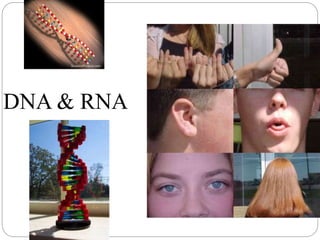
DNA & RNA
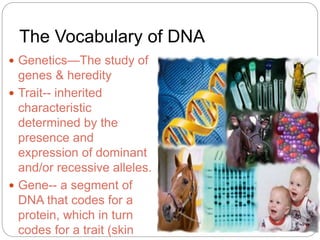
The Vocabulary of DNA
 Genetics—The study of
genes & heredity
 Trait-- inherited
characteristic
determined by the
presence and
expression of dominant
and/or recessive alleles.
 Gene-- a segment of
DNA that codes for a
protein, which in turn
codes for a trait (skin
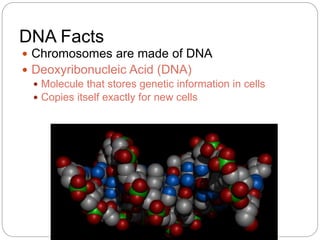
DNA Facts
 Chromosomes are made of DNA
 Deoxyribonucleic Acid (DNA)
 Molecule that stores genetic information in cells
 Copies itself exactly for new cells
DNA-Deoxyribonucleic Acid
 DNA is often called the
blueprint of life.
 In simple terms, DNA
contains the instructions for
making proteins within the
cell.
Proteins
 Responsible for all cell
structures and functions
 Made of long chains of
amino acids
 There are 20 amino acids in the
body
 Proteins are responsible for:
 Hair, skin, hormones, muscle
movement, antibodies, chemical
reactions, oxygenation of cells.
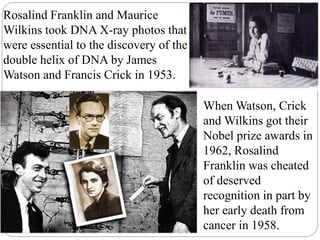
When Watson, Crick
and Wilkins got their
Nobel prize awards in
1962, Rosalind
Franklin was cheated
of deserved
recognition in part by
her early death from
cancer in 1958.
Rosalind Franklin and Maurice
Wilkins took DNA X-ray photos that
were essential to the discovery of the
double helix of DNA by James
Watson and Francis Crick in 1953.
Why is the Study of DNA
Important?
 It’s essential to all life on earth
 Medical Benefits—disease detection,
treatment, prevention
 Development of Crops
 Forensics
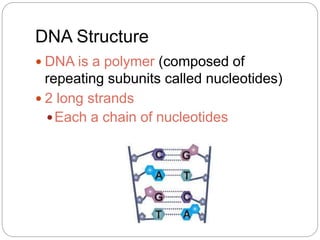
DNA Structure
 DNA is a polymer (composed of
repeating subunits called nucleotides)
 2 long strands
Each a chain of nucleotides
Nucleotides
 Consists of…
Phosphate
Carbon sugar (deoxyribose)
Nitrogen base
Adenine and Guanine are PURINES
 Adenine and guanine each have two rings
of carbon and nitrogen atoms.
C
C
C
C
N
N
N
Adenine N
N
C
C
C
C
C
N
N
O
N
Guanine N
N
C
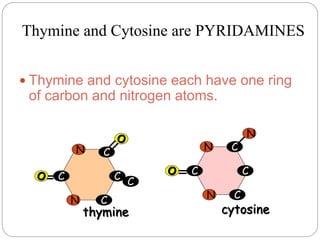
Thymine and Cytosine are PYRIDAMINES
 Thymine and cytosine each have one ring
of carbon and nitrogen atoms.
C
C
C
C
N
N
O
N
cytosine
C
C
C
C
N
N
O
O
thymine
C
Types of Nitrogenous Bases
 A = adenine
 T = thymine
 C = cytosine
 G = guanine
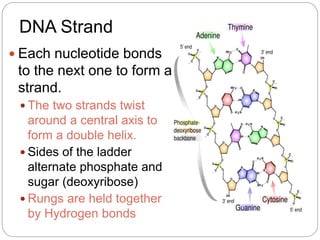
DNA Strand
 Each nucleotide bonds
to the next one to form a
strand.
 The two strands twist
around a central axis to
form a double helix.
 Sides of the ladder
alternate phosphate and
sugar (deoxyribose)
 Rungs are held together
by Hydrogen bonds
Base Pair Rule
 Adenine can bond
only with Thymine
A-T or T-A (2 H
bonds)
 Cytosine can bond
only with Guanine
C-G or G-C (3 H
bonds)
 This is called the
BASE PAIR RULE
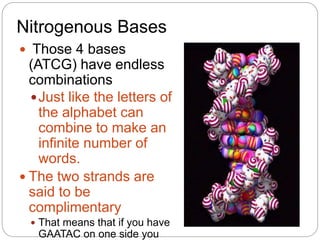
Nitrogenous Bases
 Those 4 bases
(ATCG) have endless
combinations
Just like the letters of
the alphabet can
combine to make an
infinite number of
words.
 The two strands are
said to be
complimentary
 That means that if you have
GAATAC on one side you
Replication
 The process by which DNA
makes a copy of itself
 Why does DNA need to copy?
 Cells divide for an organism to
grow or reproduce
 Every new cell needs a copy of
DNA
 In DNA replication enzymes
work to unwind and separate
the double helix and add
complimentary nucleotides to
the exposed strands
Replication
 DNA replication is semi-conservative.
 When it makes a copy, one half of the old
strand is ALWAYS kept in the new strand
 This helps reduce the number of copy errors.
DNA Replication
 DNA helicases—
break H-bonds
linking bases
 DNA
polymerases—
move along each of
the strands, adding
nucleotides,
according to base
pairing rules.
DNA Replication
 The result is two
exact copies of the
original DNA
 Each new double
helix is composed of
one original DNA
strand and one new
strand.
 Semi-conservative
Translation
 DNA is in the nucleus
To make proteins,
DNA must get its
instructions to the
ribosomes who make
proteins.
To transport its
instructions, it uses
Messenger RNA
(mRNA)
RNA
 Ribonucleic Acid
Consists only of
one strand of
nucleotides
Has ribose (a 5C
sugar) NOT
deoxyribose
Has uracil (U) as
a nitrogenous
base NOT
thymine
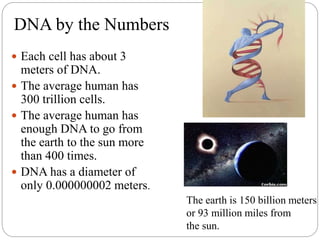
DNA by the Numbers
 Each cell has about 3
meters of DNA.
 The average human has
300 trillion cells.
 The average human has
enough DNA to go from
the earth to the sun more
than 400 times.
 DNA has a diameter of
only 0.000000002 meters.
The earth is 150 billion meters
or 93 million miles from
the sun.
Coming Soon

DNA and RNA.ppt

  • 1.
  • 2.
    The Vocabulary ofDNA  Genetics—The study of genes & heredity  Trait-- inherited characteristic determined by the presence and expression of dominant and/or recessive alleles.  Gene-- a segment of DNA that codes for a protein, which in turn codes for a trait (skin
  • 3.
    DNA Facts  Chromosomesare made of DNA  Deoxyribonucleic Acid (DNA)  Molecule that stores genetic information in cells  Copies itself exactly for new cells
  • 4.
    DNA-Deoxyribonucleic Acid  DNAis often called the blueprint of life.  In simple terms, DNA contains the instructions for making proteins within the cell.
  • 5.
    Proteins  Responsible forall cell structures and functions  Made of long chains of amino acids  There are 20 amino acids in the body  Proteins are responsible for:  Hair, skin, hormones, muscle movement, antibodies, chemical reactions, oxygenation of cells.
  • 6.
    When Watson, Crick andWilkins got their Nobel prize awards in 1962, Rosalind Franklin was cheated of deserved recognition in part by her early death from cancer in 1958. Rosalind Franklin and Maurice Wilkins took DNA X-ray photos that were essential to the discovery of the double helix of DNA by James Watson and Francis Crick in 1953.
  • 7.
    Why is theStudy of DNA Important?  It’s essential to all life on earth  Medical Benefits—disease detection, treatment, prevention  Development of Crops  Forensics
  • 8.
    DNA Structure  DNAis a polymer (composed of repeating subunits called nucleotides)  2 long strands Each a chain of nucleotides
  • 9.
    Nucleotides  Consists of… Phosphate Carbonsugar (deoxyribose) Nitrogen base
  • 10.
    Adenine and Guanineare PURINES  Adenine and guanine each have two rings of carbon and nitrogen atoms. C C C C N N N Adenine N N C C C C C N N O N Guanine N N C
  • 11.
    Thymine and Cytosineare PYRIDAMINES  Thymine and cytosine each have one ring of carbon and nitrogen atoms. C C C C N N O N cytosine C C C C N N O O thymine C
  • 12.
    Types of NitrogenousBases  A = adenine  T = thymine  C = cytosine  G = guanine
  • 13.
    DNA Strand  Eachnucleotide bonds to the next one to form a strand.  The two strands twist around a central axis to form a double helix.  Sides of the ladder alternate phosphate and sugar (deoxyribose)  Rungs are held together by Hydrogen bonds
  • 14.
    Base Pair Rule Adenine can bond only with Thymine A-T or T-A (2 H bonds)  Cytosine can bond only with Guanine C-G or G-C (3 H bonds)  This is called the BASE PAIR RULE
  • 15.
    Nitrogenous Bases  Those4 bases (ATCG) have endless combinations Just like the letters of the alphabet can combine to make an infinite number of words.  The two strands are said to be complimentary  That means that if you have GAATAC on one side you
  • 16.
    Replication  The processby which DNA makes a copy of itself  Why does DNA need to copy?  Cells divide for an organism to grow or reproduce  Every new cell needs a copy of DNA  In DNA replication enzymes work to unwind and separate the double helix and add complimentary nucleotides to the exposed strands
  • 17.
    Replication  DNA replicationis semi-conservative.  When it makes a copy, one half of the old strand is ALWAYS kept in the new strand  This helps reduce the number of copy errors.
  • 18.
    DNA Replication  DNAhelicases— break H-bonds linking bases  DNA polymerases— move along each of the strands, adding nucleotides, according to base pairing rules.
  • 19.
    DNA Replication  Theresult is two exact copies of the original DNA  Each new double helix is composed of one original DNA strand and one new strand.  Semi-conservative
  • 20.
    Translation  DNA isin the nucleus To make proteins, DNA must get its instructions to the ribosomes who make proteins. To transport its instructions, it uses Messenger RNA (mRNA)
  • 21.
    RNA  Ribonucleic Acid Consistsonly of one strand of nucleotides Has ribose (a 5C sugar) NOT deoxyribose Has uracil (U) as a nitrogenous base NOT thymine
  • 22.
    DNA by theNumbers  Each cell has about 3 meters of DNA.  The average human has 300 trillion cells.  The average human has enough DNA to go from the earth to the sun more than 400 times.  DNA has a diameter of only 0.000000002 meters. The earth is 150 billion meters or 93 million miles from the sun.
  • 23.