
Genetics
DNA structure, replication,
transcription and translation
Review
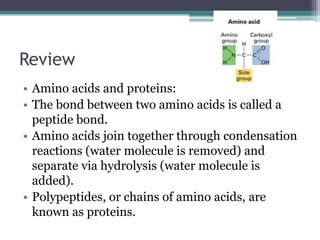
• Amino acids and proteins:
• The bond between two amino acids is called a
  peptide bond.
• Amino acids join together through condensation
  reactions (water molecule is removed) and
  separate via hydrolysis (water molecule is
  added).
• Polypeptides, or chains of amino acids, are
  known as proteins.
Proteins
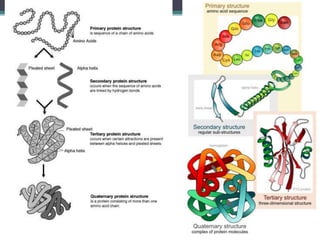
• Primary structure: The sequence of amino acids
  in a polypeptide.
• Secondary structure: The formation of patterns
  within the polypeptide due to the folding caused
  by hydrogen bonds. Examples: α-helix, β-
  pleated sheet.
• Tertiary structure: the overall three-dimensional
  shape of the protein.
• Quaternary structure: the way polypeptides fit
  together when there is more than one chain.
DNA, the origin
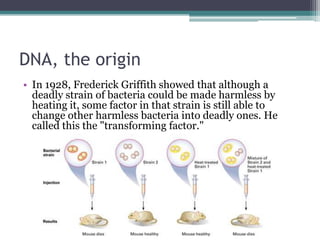
• In 1928, Frederick Griffith showed that although a
  deadly strain of bacteria could be made harmless by
  heating it, some factor in that strain is still able to
  change other harmless bacteria into deadly ones. He
  called this the "transforming factor."
• In 1944, American biologist Oswald Avery and
  his colleagues took Griffith's experiments one
  step further: they treated the mixture with DNA-
  destroying enzymes. This time the colonies
  failed to transform. Avery concluded that DNA is
  the genetic material of the cell.
4.1 DNA structure
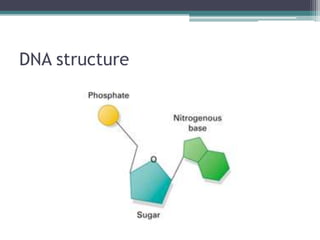
• Nucleotides and nucleic acids:
• Nucleic acid is a polymer of nucleotides, that are
  molecules that consist of 3 parts: a sugar, a
  phosphate group and a nitrogen-containing ring
  structure.
• RNA: ribonucleic acid, the sugar contained is
  ribose
• DNA: deoxyribonucleic acid, the sugar within is
  deoxyribose
DNA structure
DNA structure
• Nucleotides are joined to one another by
  covalent bonds that connect the sugar of one
  nucleotide to the phosphate group of the next.
• Nitrogenous bases: The bases that make up DNA
  are: adenine (A), cytosine (C), quanine (G), and
  thymine (T).
• In RNA uracil (U) is present instead of thymine.
• RNA is single stranded and DNA is double
  stranded
DNA structure
• Scientists James Watson and Francis Crick
  modeled DNA's structure with tin and wire.
  Their early models failed to explain DNA's
  chemical properties. Using X-ray
  crystallography photos of DNA, Watson and
  Crick created a new model in which two strands
  of nucleotides wound about each other. This
  formed a twisting shape called a double helix.
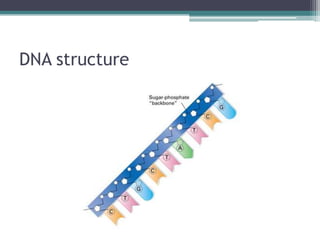
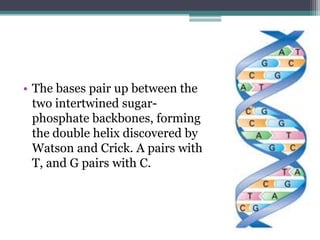
• The bases pair up between the
  two intertwined sugar-
  phosphate backbones, forming
  the double helix discovered by
  Watson and Crick. A pairs with
  T, and G pairs with C.
DNA structure
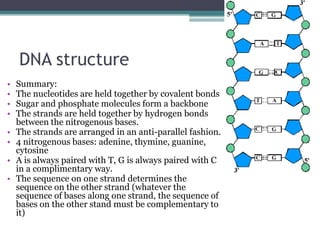
•   Summary:
•   The nucleotides are held together by covalent bonds
•   Sugar and phosphate molecules form a backbone
•   The strands are held together by hydrogen bonds
    between the nitrogenous bases.
•   The strands are arranged in an anti-parallel fashion.
•   4 nitrogenous bases: adenine, thymine, guanine,
    cytosine
•   A is always paired with T, G is always paired with C
    in a complimentary way.
•   The sequence on one strand determines the
    sequence on the other strand (whatever the
    sequence of bases along one strand, the sequence of
    bases on the other stand must be complementary to
    it)
4.2 Transcription and translation
• Reproduction is one of the basic properties of
  life.
• It involves the transmission of information from
  parents to offspring = heredity.
• A gene is a unit of heredity that consists of a
  sequence of DNA bases.
• Prokaryotic cells lack nuclei and many of the
  organelles found in eukaryotes = DNA is found
  in the cytoplasm.
• Eukaryotic cells have their DNA in the nucleus
  in the form of a number of chromosomes.
• In order to pass heredity information to
  daughter cells, a process of replication needs to
  take place.
DNA replication
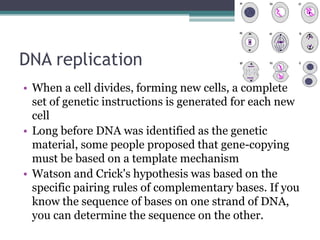
• When a cell divides, forming new cells, a complete
  set of genetic instructions is generated for each new
  cell
• Long before DNA was identified as the genetic
  material, some people proposed that gene-copying
  must be based on a template mechanism
• Watson and Crick's hypothesis was based on the
  specific pairing rules of complementary bases. If you
  know the sequence of bases on one strand of DNA,
  you can determine the sequence on the other.
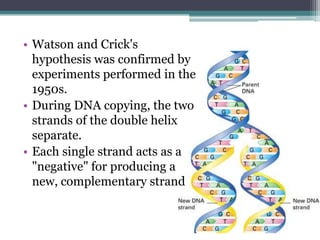
• Watson and Crick's
  hypothesis was confirmed by
  experiments performed in the
  1950s.
• During DNA copying, the two
  strands of the double helix
  separate.
• Each single strand acts as a
  "negative" for producing a
  new, complementary strand
Steps of DNA replication
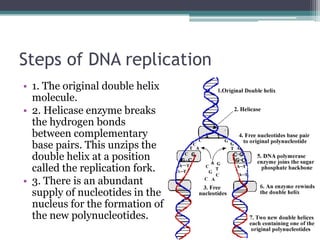
• 1. The original double helix
  molecule.
• 2. Helicase enzyme breaks
  the hydrogen bonds
  between complementary
  base pairs. This unzips the
  double helix at a position
  called the replication fork.
• 3. There is an abundant
  supply of nucleotides in the
  nucleus for the formation of
  the new polynucleotides.
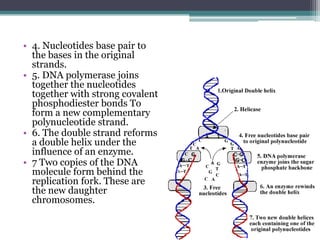
• 4. Nucleotides base pair to
  the bases in the original
  strands.
• 5. DNA polymerase joins
  together the nucleotides
  together with strong covalent
  phosphodiester bonds To
  form a new complementary
  polynucleotide strand.
• 6. The double strand reforms
  a double helix under the
  influence of an enzyme.
• 7 Two copies of the DNA
  molecule form behind the
  replication fork. These are
  the new daughter
  chromosomes.
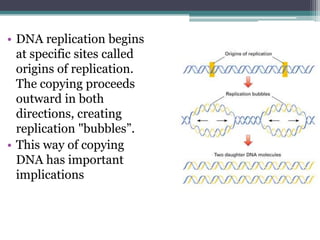
• DNA replication begins
  at specific sites called
  origins of replication.
  The copying proceeds
  outward in both
  directions, creating
  replication "bubbles”.
• This way of copying
  DNA has important
  implications
• A DNA molecule is copied precisely from one cell
  generation to the next.
• In a unicellular organism this means that the total
  genome is successfully copied into each new generation.
• In the multi-cellular organism all cells contain an exact
  copy of the total genome (even though not fully
  expressed).
• Genes (base sequences) are faithfully passed from one
  generation to the next.
• With minor and rare modification the base sequences
  copied by DNA replication and successfully passed on
  through sexual reproduction. Your base sequences have
  been copied for thousands of years.
DNA replication is semi-conservative
• Each of the original strands serves as a guide or
  template for the creation of a new strand.
• The result is 2 DNA molecules composed of an
  original and a copy strand.
4.1 DNA Structure

4.1 DNA Structure

  • 1.
  • 2.
    Review • Amino acidsand proteins: • The bond between two amino acids is called a peptide bond. • Amino acids join together through condensation reactions (water molecule is removed) and separate via hydrolysis (water molecule is added). • Polypeptides, or chains of amino acids, are known as proteins.
  • 3.
    Proteins • Primary structure:The sequence of amino acids in a polypeptide. • Secondary structure: The formation of patterns within the polypeptide due to the folding caused by hydrogen bonds. Examples: α-helix, β- pleated sheet. • Tertiary structure: the overall three-dimensional shape of the protein. • Quaternary structure: the way polypeptides fit together when there is more than one chain.
  • 5.
    DNA, the origin •In 1928, Frederick Griffith showed that although a deadly strain of bacteria could be made harmless by heating it, some factor in that strain is still able to change other harmless bacteria into deadly ones. He called this the "transforming factor."
  • 6.
    • In 1944,American biologist Oswald Avery and his colleagues took Griffith's experiments one step further: they treated the mixture with DNA- destroying enzymes. This time the colonies failed to transform. Avery concluded that DNA is the genetic material of the cell.
  • 7.
    4.1 DNA structure •Nucleotides and nucleic acids: • Nucleic acid is a polymer of nucleotides, that are molecules that consist of 3 parts: a sugar, a phosphate group and a nitrogen-containing ring structure. • RNA: ribonucleic acid, the sugar contained is ribose • DNA: deoxyribonucleic acid, the sugar within is deoxyribose
  • 8.
  • 9.
    DNA structure • Nucleotidesare joined to one another by covalent bonds that connect the sugar of one nucleotide to the phosphate group of the next. • Nitrogenous bases: The bases that make up DNA are: adenine (A), cytosine (C), quanine (G), and thymine (T). • In RNA uracil (U) is present instead of thymine. • RNA is single stranded and DNA is double stranded
  • 10.
  • 11.
    • Scientists JamesWatson and Francis Crick modeled DNA's structure with tin and wire. Their early models failed to explain DNA's chemical properties. Using X-ray crystallography photos of DNA, Watson and Crick created a new model in which two strands of nucleotides wound about each other. This formed a twisting shape called a double helix.
  • 12.
    • The basespair up between the two intertwined sugar- phosphate backbones, forming the double helix discovered by Watson and Crick. A pairs with T, and G pairs with C.
  • 13.
    DNA structure • Summary: • The nucleotides are held together by covalent bonds • Sugar and phosphate molecules form a backbone • The strands are held together by hydrogen bonds between the nitrogenous bases. • The strands are arranged in an anti-parallel fashion. • 4 nitrogenous bases: adenine, thymine, guanine, cytosine • A is always paired with T, G is always paired with C in a complimentary way. • The sequence on one strand determines the sequence on the other strand (whatever the sequence of bases along one strand, the sequence of bases on the other stand must be complementary to it)
  • 14.
    4.2 Transcription andtranslation • Reproduction is one of the basic properties of life. • It involves the transmission of information from parents to offspring = heredity. • A gene is a unit of heredity that consists of a sequence of DNA bases. • Prokaryotic cells lack nuclei and many of the organelles found in eukaryotes = DNA is found in the cytoplasm.
  • 15.
    • Eukaryotic cellshave their DNA in the nucleus in the form of a number of chromosomes. • In order to pass heredity information to daughter cells, a process of replication needs to take place.
  • 16.
    DNA replication • Whena cell divides, forming new cells, a complete set of genetic instructions is generated for each new cell • Long before DNA was identified as the genetic material, some people proposed that gene-copying must be based on a template mechanism • Watson and Crick's hypothesis was based on the specific pairing rules of complementary bases. If you know the sequence of bases on one strand of DNA, you can determine the sequence on the other.
  • 17.
    • Watson andCrick's hypothesis was confirmed by experiments performed in the 1950s. • During DNA copying, the two strands of the double helix separate. • Each single strand acts as a "negative" for producing a new, complementary strand
  • 18.
    Steps of DNAreplication • 1. The original double helix molecule. • 2. Helicase enzyme breaks the hydrogen bonds between complementary base pairs. This unzips the double helix at a position called the replication fork. • 3. There is an abundant supply of nucleotides in the nucleus for the formation of the new polynucleotides.
  • 19.
    • 4. Nucleotidesbase pair to the bases in the original strands. • 5. DNA polymerase joins together the nucleotides together with strong covalent phosphodiester bonds To form a new complementary polynucleotide strand. • 6. The double strand reforms a double helix under the influence of an enzyme. • 7 Two copies of the DNA molecule form behind the replication fork. These are the new daughter chromosomes.
  • 20.
    • DNA replicationbegins at specific sites called origins of replication. The copying proceeds outward in both directions, creating replication "bubbles”. • This way of copying DNA has important implications
  • 21.
    • A DNAmolecule is copied precisely from one cell generation to the next. • In a unicellular organism this means that the total genome is successfully copied into each new generation. • In the multi-cellular organism all cells contain an exact copy of the total genome (even though not fully expressed). • Genes (base sequences) are faithfully passed from one generation to the next. • With minor and rare modification the base sequences copied by DNA replication and successfully passed on through sexual reproduction. Your base sequences have been copied for thousands of years.
  • 22.
    DNA replication issemi-conservative • Each of the original strands serves as a guide or template for the creation of a new strand. • The result is 2 DNA molecules composed of an original and a copy strand.