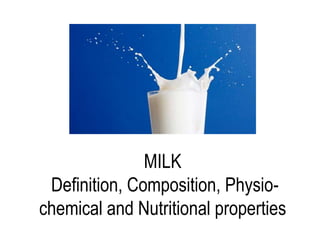
MILK
Definition, Composition, Physio-
chemical and Nutritional properties
WHAT IS MILK?
• A white liquid extracted from the mammary
gland of mammals.
• The first food and nutrition for the young.
• Produced after the gestation period
• A complete food.
• In India, milk is usually from cow or buffalo
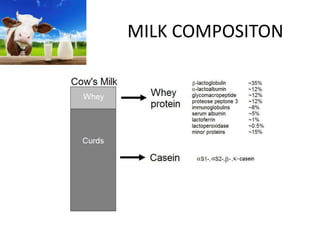
MILK COMPOSITON
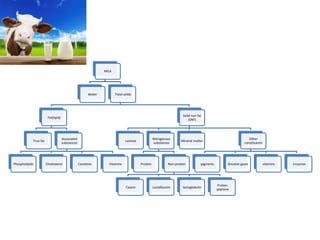
MILK
Water Total solids
Fat(lipid)
True fat
Associated
substances
Phospholipids Cholesterol Carotene Vitamins
Solid non fat
(SNF)
Lactose
Nitrogenous
substances
Protein Non-protein
Casein Lactalbumin lactoglobulin
Proteo-
peptone
Mineral matter
Other
constituents
pigments Dissolve gases vitamins Enzymes
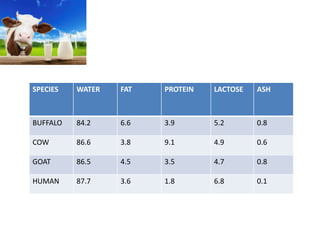
SPECIES WATER FAT PROTEIN LACTOSE ASH
BUFFALO 84.2 6.6 3.9 5.2 0.8
COW 86.6 3.8 9.1 4.9 0.6
GOAT 86.5 4.5 3.5 4.7 0.8
HUMAN 87.7 3.6 1.8 6.8 0.1
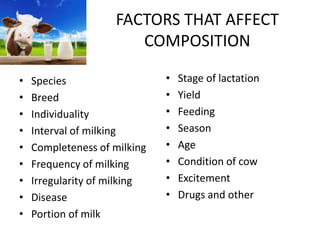
FACTORS THAT AFFECT
COMPOSITION
• Species
• Breed
• Individuality
• Interval of milking
• Completeness of milking
• Frequency of milking
• Irregularity of milking
• Disease
• Portion of milk
• Stage of lactation
• Yield
• Feeding
• Season
• Age
• Condition of cow
• Excitement
• Drugs and other
Properties of milk
• State of milk
– Continuous phase
• Acidity
– Amphoteric to litmus (red to blue; blue to red)
– Titratable acidity due to casein, citrates directly
proportional to SNF
Cow has 0.13 to 0.14 % (of lactic acid)
Buffalo has 0.14 to 0.15%
• pH
– Cow 6.4 to 6.6
– Buffalo 6.7 to 6.8
• Density and Specific gravity
– Cow milk SG 1.028 to 1.030
– Buffalo milk 1.030 to 1.032
– Skimmed milk 1.035 to 1.037
• Freezing point of milk
– Cow as 0.547 ◦C
– Buffalo as 0.549 ◦C
• Colour of milk
– Milk can be white or has yellowish
tint
– Produced by colloidal dispersion of
casein and fat
– Carotene gives yellow colour
– Cattle feeds can deepen the colour
• Flavour
– Odour and taste
– Lactose and salty minerals
– Proteins damps the flavour
– Sulfydryl compounds responsible
for the taste of heated milk
– Added flavours
PHYSIOCHEMICAL
PROPERTIES
• Water
– Dissolved of suspended
– Most free others bound to milk proteins
• Milk fat
– In small globules
– Has fat globule membrane
– Membrane contains phospholipds and protein
complex
– Rise up to surface when undisturbed
– Forms a cream layer
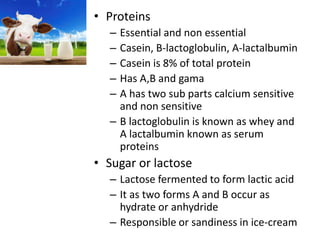
• Proteins
– Essential and non essential
– Casein, B-lactoglobulin, A-lactalbumin
– Casein is 8% of total protein
– Has A,B and gama
– A has two sub parts calcium sensitive
and non sensitive
– B lactoglobulin is known as whey and
A lactalbumin known as serum
proteins
• Sugar or lactose
– Lactose fermented to form lactic acid
– It as two forms A and B occur as
hydrate or anhydride
– Responsible or sandiness in ice-cream
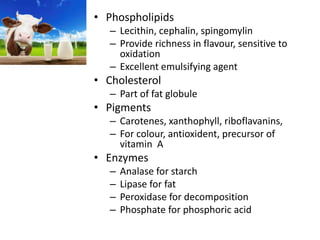
• Phospholipids
– Lecithin, cephalin, spingomylin
– Provide richness in flavour, sensitive to
oxidation
– Excellent emulsifying agent
• Cholesterol
– Part of fat globule
• Pigments
– Carotenes, xanthophyll, riboflavanins,
– For colour, antioxident, precursor of
vitamin A
• Enzymes
– Analase for starch
– Lipase for fat
– Peroxidase for decomposition
– Phosphate for phosphoric acid
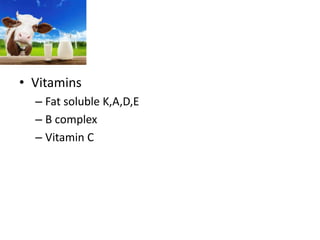
• Vitamins
– Fat soluble K,A,D,E
– B complex
– Vitamin C
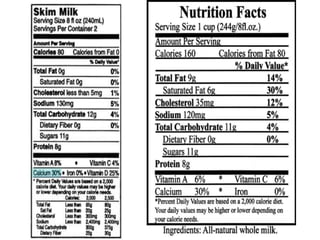
NUTRITIVE VALUE OF MILK
• Proteins
• Minerals
• Vitamins
• Fat
• Lactose
• Energy value
CONCLUSION
• Milk is necessary for growth and health
• Milk is a complete food
• An important factor for a balanced diet
Milk defination, properties and nutrition

Milk defination, properties and nutrition

  • 1.
  • 4.
    WHAT IS MILK? •A white liquid extracted from the mammary gland of mammals. • The first food and nutrition for the young. • Produced after the gestation period • A complete food. • In India, milk is usually from cow or buffalo
  • 5.
  • 6.
    MILK Water Total solids Fat(lipid) Truefat Associated substances Phospholipids Cholesterol Carotene Vitamins Solid non fat (SNF) Lactose Nitrogenous substances Protein Non-protein Casein Lactalbumin lactoglobulin Proteo- peptone Mineral matter Other constituents pigments Dissolve gases vitamins Enzymes
  • 7.
    SPECIES WATER FATPROTEIN LACTOSE ASH BUFFALO 84.2 6.6 3.9 5.2 0.8 COW 86.6 3.8 9.1 4.9 0.6 GOAT 86.5 4.5 3.5 4.7 0.8 HUMAN 87.7 3.6 1.8 6.8 0.1
  • 8.
    FACTORS THAT AFFECT COMPOSITION •Species • Breed • Individuality • Interval of milking • Completeness of milking • Frequency of milking • Irregularity of milking • Disease • Portion of milk • Stage of lactation • Yield • Feeding • Season • Age • Condition of cow • Excitement • Drugs and other
  • 9.
    Properties of milk •State of milk – Continuous phase • Acidity – Amphoteric to litmus (red to blue; blue to red) – Titratable acidity due to casein, citrates directly proportional to SNF Cow has 0.13 to 0.14 % (of lactic acid) Buffalo has 0.14 to 0.15% • pH – Cow 6.4 to 6.6 – Buffalo 6.7 to 6.8
  • 10.
    • Density andSpecific gravity – Cow milk SG 1.028 to 1.030 – Buffalo milk 1.030 to 1.032 – Skimmed milk 1.035 to 1.037 • Freezing point of milk – Cow as 0.547 ◦C – Buffalo as 0.549 ◦C • Colour of milk – Milk can be white or has yellowish tint – Produced by colloidal dispersion of casein and fat – Carotene gives yellow colour – Cattle feeds can deepen the colour
  • 11.
    • Flavour – Odourand taste – Lactose and salty minerals – Proteins damps the flavour – Sulfydryl compounds responsible for the taste of heated milk – Added flavours
  • 12.
    PHYSIOCHEMICAL PROPERTIES • Water – Dissolvedof suspended – Most free others bound to milk proteins • Milk fat – In small globules – Has fat globule membrane – Membrane contains phospholipds and protein complex – Rise up to surface when undisturbed – Forms a cream layer
  • 13.
    • Proteins – Essentialand non essential – Casein, B-lactoglobulin, A-lactalbumin – Casein is 8% of total protein – Has A,B and gama – A has two sub parts calcium sensitive and non sensitive – B lactoglobulin is known as whey and A lactalbumin known as serum proteins • Sugar or lactose – Lactose fermented to form lactic acid – It as two forms A and B occur as hydrate or anhydride – Responsible or sandiness in ice-cream
  • 14.
    • Phospholipids – Lecithin,cephalin, spingomylin – Provide richness in flavour, sensitive to oxidation – Excellent emulsifying agent • Cholesterol – Part of fat globule • Pigments – Carotenes, xanthophyll, riboflavanins, – For colour, antioxident, precursor of vitamin A • Enzymes – Analase for starch – Lipase for fat – Peroxidase for decomposition – Phosphate for phosphoric acid
  • 15.
    • Vitamins – Fatsoluble K,A,D,E – B complex – Vitamin C
  • 17.
    NUTRITIVE VALUE OFMILK • Proteins • Minerals • Vitamins • Fat • Lactose • Energy value
  • 19.
    CONCLUSION • Milk isnecessary for growth and health • Milk is a complete food • An important factor for a balanced diet