Name                                                      Period         Date


12.1 Identifying the Substance of Genes
Lesson Objectives
       Summarize the process of bacterial transformation.
       Describe the role of bacteriophages in identifying genetic material.
       Identify the role of DNA in heredity.
Lesson Summary
Bacterial TransformationIn 1928, Frederick Griffith found that some chemical factor from heat-killed
bacteria of one strain could change the inherited characteristics of another strain.
    He called the process transformation because one type of bacteria (a harmless form) had been changed
    permanently into another (a disease-carrying form).
    Because the ability to cause disease was inherited by the offspring of the transformed bacteria, he concluded
    that the transforming factor had to be a gene.
In 1944, Oswald Avery tested the transforming ability of many substances. Only DNA caused transformation.
By observing bacterial transformation, Avery and other scientists discovered that the nucleic acid DNA stores
and transmits genetic information from one generation of bacteria to the next.
Bacterial VirusesA bacteriophage is a kind of virus that infects bacteria. When a bacteriophage enters
a bacterium, it attaches to the surface of the bacterial cell and injects its genetic material into it.
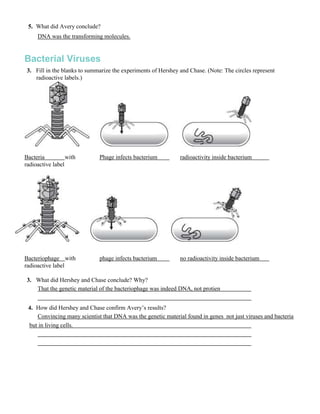
    In 1952, Alfred Hershey and Martha Chase used radioactive tracers to label proteins and DNA in
    bacteriophages.
    Only the DNA from the bacteriophage showed up in the infected bacterial cell.
    Hershey and Chase concluded that the genetic material of the bacteriophage was DNA.
    Their work confirmed Avery’s results, convincing many scientists that DNA was the genetic material found
    in genes—not just in viruses and bacteria, but in all living cells.
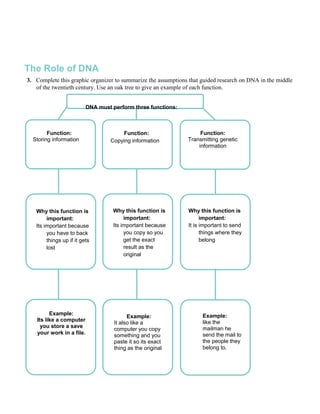
The Role of DNA The DNA that makes up genes must be capable of storing, copying, and transmitting the
genetic information in a cell.
Bacterial Transformation
 1. What happened when Griffith injected mice with the pneumonia-causing strain of bacteria that had been
    heat-killed?
    The mouse lived.
 2. What happened when Griffith injected mice with a mixture of heat-killed, pneumonia-causing bacteria and
    live bacteria of the harmless type?
     The mouse dies of pneumonia.
 3. What was the purpose of Oswald Avery’s experiments?
    He wanted to determined which molecules in the heat-killed bacteria was most important for
    transformation.
 4. What experiments did Avery do?
    He extracted a mixture of various molecules from the heat-killed bacteria that was carefully treated it with
 enzymes.
5. What did Avery conclude?
     DNA was the transforming molecules.


Bacterial Viruses
 3. Fill in the blanks to summarize the experiments of Hershey and Chase. (Note: The circles represent
    radioactive labels.)


Bacteria          with        Phage infects bacterium          radioactivity inside bacterium
radioactive label


Bacteriophage with            phage infects bacterium          no radioactivity inside bacterium
radioactive label

 3. What did Hershey and Chase conclude? Why?
    That the genetic material of the bacteriophage was indeed DNA, not protien


 4. How did Hershey and Chase confirm Avery’s results?
    Convincing many scientist that DNA was the genetic material found in genes not just viruses and bacteria
 but in living cells.
The Role of DNA
3. Complete this graphic organizer to summarize the assumptions that guided research on DNA in the middle
   of the twentieth century. Use an oak tree to give an example of each function.


                           DNA must perform three functions:


        Function:                       Function:                   Function:
  Storing information              Copying information         Transmitting genetic
                                                                   information


   Why this function is             Why this function is       Why this function is
        important:                       important:                  important:
   Its important because            Its important because      It is important to send
        you have to back                 you copy so you             things where they
        things up if it gets             get the exact               belong
        lost                             result as the
                                         original


          Example:                                                   Example:
                                           Example:
    Its like a computer                                              like the
                                     It also like a
      you store a save                                               mailman he
                                     computer you copy
    your work in a file.             something and you               send the mail to
                                     paste it so its exact           the people they
                                     thing as the original           belong to.
12.2The Structure of DNA
Lesson Objectives
     Identify the chemical components of DNA.
     Discuss the experiments leading to the identification of DNA as the molecule that carries the genetic code.
     Describe the steps leading to the development of the double-helix model of DNA.
Lesson Summary
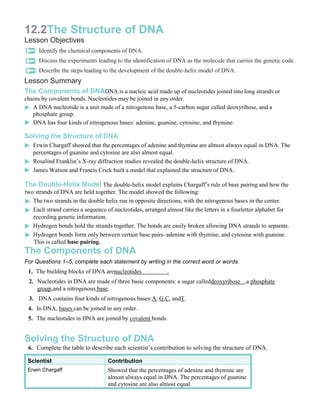
The Components of DNADNA is a nucleic acid made up of nucleotides joined into long strands or
chains by covalent bonds. Nucleotides may be joined in any order.
   A DNA nucleotide is a unit made of a nitrogenous base, a 5-carbon sugar called deoxyribose, and a
   phosphate group.
   DNA has four kinds of nitrogenous bases: adenine, guanine, cytosine, and thymine.

Solving the Structure of DNA
   Erwin Chargaff showed that the percentages of adenine and thymine are almost always equal in DNA. The
   percentages of guanine and cytosine are also almost equal.
   Rosalind Franklin’s X-ray diffraction studies revealed the double-helix structure of DNA.
   James Watson and Francis Crick built a model that explained the structure of DNA.

The Double-Helix Model The double-helix model explains Chargaff’s rule of base pairing and how the
two strands of DNA are held together. The model showed the following:
   The two strands in the double helix run in opposite directions, with the nitrogenous bases in the center.
   Each strand carries a sequence of nucleotides, arranged almost like the letters in a fourletter alphabet for
   recording genetic information.
   Hydrogen bonds hold the strands together. The bonds are easily broken allowing DNA strands to separate.
   Hydrogen bonds form only between certain base pairs–adenine with thymine, and cytosine with guanine.
   This is called base pairing.
The Components of DNA
For Questions 1–5, complete each statement by writing in the correct word or words.
 1. The building blocks of DNA arenucleotides              .
 2. Nucleotides in DNA are made of three basic components: a sugar calleddeoxyribose ,a phosphate
    group,and a nitrogenous base.
 3. DNA contains four kinds of nitrogenous bases:A, G,C, andT.
 4. In DNA, bases can be joined in any order.
 5. The nucleotides in DNA are joined by covalent bonds.


Solving the Structure of DNA
 6. Complete the table to describe each scientist’s contribution to solving the structure of DNA.

 Scientist                        Contribution
 Erwin Chargaff                   Showed that the percentages of adenine and thymine are
                                  almost always equal in DNA. The percentages of guanine
                                  and cytosine are also almost equal.
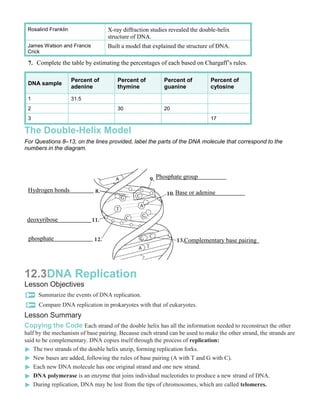
Rosalind Franklin                X-ray diffraction studies revealed the double-helix
                                  structure of DNA.
 James Watson and Francis         Built a model that explained the structure of DNA.
 Crick

 7. Complete the table by estimating the percentages of each based on Chargaff’s rules.

                     Percent of       Percent of         Percent of          Percent of
 DNA sample
                     adenine          thymine            guanine             cytosine

 1                   31.5
 2                                    30                 20
 3                                                                           17

The Double-Helix Model
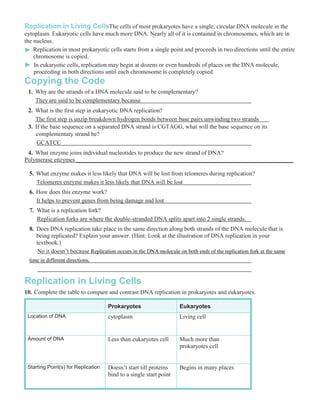
For Questions 8–13, on the lines provided, label the parts of the DNA molecule that correspond to the
numbers in the diagram.


                                                      Phosphate group

 Hydrogen bonds                                               Base or adenine


 deoxyribose


 phosphate                    phos                                Complementary base pairing


12.3DNA Replication
Lesson Objectives
     Summarize the events of DNA replication.
     Compare DNA replication in prokaryotes with that of eukaryotes.
Lesson Summary
Copying the Code Each strand of the double helix has all the information needed to reconstruct the other
half by the mechanism of base pairing. Because each strand can be used to make the other strand, the strands are
said to be complementary. DNA copies itself through the process of replication:
    The two strands of the double helix unzip, forming replication forks.
    New bases are added, following the rules of base pairing (A with T and G with C).
    Each new DNA molecule has one original strand and one new strand.
    DNA polymerase is an enzyme that joins individual nucleotides to produce a new strand of DNA.
    During replication, DNA may be lost from the tips of chromosomes, which are called telomeres.
Replication in Living CellsThe cells of most prokaryotes have a single, circular DNA molecule in the
cytoplasm. Eukaryotic cells have much more DNA. Nearly all of it is contained in chromosomes, which are in
the nucleus.
    Replication in most prokaryotic cells starts from a single point and proceeds in two directions until the entire
    chromosome is copied.
    In eukaryotic cells, replication may begin at dozens or even hundreds of places on the DNA molecule,
    proceeding in both directions until each chromosome is completely copied.
Copying the Code
 1. Why are the strands of a DNA molecule said to be complementary?
    They are said to be complementary because
 2. What is the first step in eukaryotic DNA replication?
    The first step is unzip breakdown hydrogen bonds between base pairs unwinding two strands
 3. If the base sequence on a separated DNA strand is CGTAGG, what will the base sequence on its
    complementary strand be?
     GCATCC
 4. What enzyme joins individual nucleotides to produce the new strand of DNA?
Polymerase enzymes ________________________________________________________________________

  5. What enzyme makes it less likely that DNA will be lost from telomeres during replication?
     Telomeres enzyme makes it less likely that DNA will be lost
  6. How does this enzyme work?
     It helps to prevent genes from being damage and lost
  7. What is a replication fork?
     Replication forks are where the double-stranded DNA splits apart into 2 single strands.
  8. Does DNA replication take place in the same direction along both strands of the DNA molecule that is
     being replicated? Explain your answer. (Hint: Look at the illustration of DNA replication in your
     textbook.)
     No it doesn’t because Replication occurs in the DNA molecule on both ends of the replication fork at the same
  time in different directions.


Replication in Living Cells
10. Complete the table to compare and contrast DNA replication in prokaryotes and eukaryotes.

                                     Prokaryotes                    Eukaryotes
 Location of DNA                     cytoplasm                      Living cell


 Amount of DNA                       Less than eukaryotes cell      Much more than
                                                                    prokaryotes cell


 Starting Point(s) for Replication   Doesn’t start till proteins    Begins in many places
                                     bind to a single start point
11. Is DNA replication always a foolproof process? Explain your answer.
    No because damage DNA get replication too.

Chapter12 packet

  • 1.
    Name Period Date 12.1 Identifying the Substance of Genes Lesson Objectives Summarize the process of bacterial transformation. Describe the role of bacteriophages in identifying genetic material. Identify the role of DNA in heredity. Lesson Summary Bacterial TransformationIn 1928, Frederick Griffith found that some chemical factor from heat-killed bacteria of one strain could change the inherited characteristics of another strain. He called the process transformation because one type of bacteria (a harmless form) had been changed permanently into another (a disease-carrying form). Because the ability to cause disease was inherited by the offspring of the transformed bacteria, he concluded that the transforming factor had to be a gene. In 1944, Oswald Avery tested the transforming ability of many substances. Only DNA caused transformation. By observing bacterial transformation, Avery and other scientists discovered that the nucleic acid DNA stores and transmits genetic information from one generation of bacteria to the next. Bacterial VirusesA bacteriophage is a kind of virus that infects bacteria. When a bacteriophage enters a bacterium, it attaches to the surface of the bacterial cell and injects its genetic material into it. In 1952, Alfred Hershey and Martha Chase used radioactive tracers to label proteins and DNA in bacteriophages. Only the DNA from the bacteriophage showed up in the infected bacterial cell. Hershey and Chase concluded that the genetic material of the bacteriophage was DNA. Their work confirmed Avery’s results, convincing many scientists that DNA was the genetic material found in genes—not just in viruses and bacteria, but in all living cells. The Role of DNA The DNA that makes up genes must be capable of storing, copying, and transmitting the genetic information in a cell. Bacterial Transformation 1. What happened when Griffith injected mice with the pneumonia-causing strain of bacteria that had been heat-killed? The mouse lived. 2. What happened when Griffith injected mice with a mixture of heat-killed, pneumonia-causing bacteria and live bacteria of the harmless type? The mouse dies of pneumonia. 3. What was the purpose of Oswald Avery’s experiments? He wanted to determined which molecules in the heat-killed bacteria was most important for transformation. 4. What experiments did Avery do? He extracted a mixture of various molecules from the heat-killed bacteria that was carefully treated it with enzymes.
  • 2.
    5. What didAvery conclude? DNA was the transforming molecules. Bacterial Viruses 3. Fill in the blanks to summarize the experiments of Hershey and Chase. (Note: The circles represent radioactive labels.) Bacteria with Phage infects bacterium radioactivity inside bacterium radioactive label Bacteriophage with phage infects bacterium no radioactivity inside bacterium radioactive label 3. What did Hershey and Chase conclude? Why? That the genetic material of the bacteriophage was indeed DNA, not protien 4. How did Hershey and Chase confirm Avery’s results? Convincing many scientist that DNA was the genetic material found in genes not just viruses and bacteria but in living cells.
  • 3.
    The Role ofDNA 3. Complete this graphic organizer to summarize the assumptions that guided research on DNA in the middle of the twentieth century. Use an oak tree to give an example of each function. DNA must perform three functions: Function: Function: Function: Storing information Copying information Transmitting genetic information Why this function is Why this function is Why this function is important: important: important: Its important because Its important because It is important to send you have to back you copy so you things where they things up if it gets get the exact belong lost result as the original Example: Example: Example: Its like a computer like the It also like a you store a save mailman he computer you copy your work in a file. something and you send the mail to paste it so its exact the people they thing as the original belong to.
  • 4.
    12.2The Structure ofDNA Lesson Objectives Identify the chemical components of DNA. Discuss the experiments leading to the identification of DNA as the molecule that carries the genetic code. Describe the steps leading to the development of the double-helix model of DNA. Lesson Summary The Components of DNADNA is a nucleic acid made up of nucleotides joined into long strands or chains by covalent bonds. Nucleotides may be joined in any order. A DNA nucleotide is a unit made of a nitrogenous base, a 5-carbon sugar called deoxyribose, and a phosphate group. DNA has four kinds of nitrogenous bases: adenine, guanine, cytosine, and thymine. Solving the Structure of DNA Erwin Chargaff showed that the percentages of adenine and thymine are almost always equal in DNA. The percentages of guanine and cytosine are also almost equal. Rosalind Franklin’s X-ray diffraction studies revealed the double-helix structure of DNA. James Watson and Francis Crick built a model that explained the structure of DNA. The Double-Helix Model The double-helix model explains Chargaff’s rule of base pairing and how the two strands of DNA are held together. The model showed the following: The two strands in the double helix run in opposite directions, with the nitrogenous bases in the center. Each strand carries a sequence of nucleotides, arranged almost like the letters in a fourletter alphabet for recording genetic information. Hydrogen bonds hold the strands together. The bonds are easily broken allowing DNA strands to separate. Hydrogen bonds form only between certain base pairs–adenine with thymine, and cytosine with guanine. This is called base pairing. The Components of DNA For Questions 1–5, complete each statement by writing in the correct word or words. 1. The building blocks of DNA arenucleotides . 2. Nucleotides in DNA are made of three basic components: a sugar calleddeoxyribose ,a phosphate group,and a nitrogenous base. 3. DNA contains four kinds of nitrogenous bases:A, G,C, andT. 4. In DNA, bases can be joined in any order. 5. The nucleotides in DNA are joined by covalent bonds. Solving the Structure of DNA 6. Complete the table to describe each scientist’s contribution to solving the structure of DNA. Scientist Contribution Erwin Chargaff Showed that the percentages of adenine and thymine are almost always equal in DNA. The percentages of guanine and cytosine are also almost equal.
  • 5.
    Rosalind Franklin X-ray diffraction studies revealed the double-helix structure of DNA. James Watson and Francis Built a model that explained the structure of DNA. Crick 7. Complete the table by estimating the percentages of each based on Chargaff’s rules. Percent of Percent of Percent of Percent of DNA sample adenine thymine guanine cytosine 1 31.5 2 30 20 3 17 The Double-Helix Model For Questions 8–13, on the lines provided, label the parts of the DNA molecule that correspond to the numbers in the diagram. Phosphate group Hydrogen bonds Base or adenine deoxyribose phosphate phos Complementary base pairing 12.3DNA Replication Lesson Objectives Summarize the events of DNA replication. Compare DNA replication in prokaryotes with that of eukaryotes. Lesson Summary Copying the Code Each strand of the double helix has all the information needed to reconstruct the other half by the mechanism of base pairing. Because each strand can be used to make the other strand, the strands are said to be complementary. DNA copies itself through the process of replication: The two strands of the double helix unzip, forming replication forks. New bases are added, following the rules of base pairing (A with T and G with C). Each new DNA molecule has one original strand and one new strand. DNA polymerase is an enzyme that joins individual nucleotides to produce a new strand of DNA. During replication, DNA may be lost from the tips of chromosomes, which are called telomeres.
  • 6.
    Replication in LivingCellsThe cells of most prokaryotes have a single, circular DNA molecule in the cytoplasm. Eukaryotic cells have much more DNA. Nearly all of it is contained in chromosomes, which are in the nucleus. Replication in most prokaryotic cells starts from a single point and proceeds in two directions until the entire chromosome is copied. In eukaryotic cells, replication may begin at dozens or even hundreds of places on the DNA molecule, proceeding in both directions until each chromosome is completely copied. Copying the Code 1. Why are the strands of a DNA molecule said to be complementary? They are said to be complementary because 2. What is the first step in eukaryotic DNA replication? The first step is unzip breakdown hydrogen bonds between base pairs unwinding two strands 3. If the base sequence on a separated DNA strand is CGTAGG, what will the base sequence on its complementary strand be? GCATCC 4. What enzyme joins individual nucleotides to produce the new strand of DNA? Polymerase enzymes ________________________________________________________________________ 5. What enzyme makes it less likely that DNA will be lost from telomeres during replication? Telomeres enzyme makes it less likely that DNA will be lost 6. How does this enzyme work? It helps to prevent genes from being damage and lost 7. What is a replication fork? Replication forks are where the double-stranded DNA splits apart into 2 single strands. 8. Does DNA replication take place in the same direction along both strands of the DNA molecule that is being replicated? Explain your answer. (Hint: Look at the illustration of DNA replication in your textbook.) No it doesn’t because Replication occurs in the DNA molecule on both ends of the replication fork at the same time in different directions. Replication in Living Cells 10. Complete the table to compare and contrast DNA replication in prokaryotes and eukaryotes. Prokaryotes Eukaryotes Location of DNA cytoplasm Living cell Amount of DNA Less than eukaryotes cell Much more than prokaryotes cell Starting Point(s) for Replication Doesn’t start till proteins Begins in many places bind to a single start point
  • 7.
    11. Is DNAreplication always a foolproof process? Explain your answer. No because damage DNA get replication too.