BIOLOGY: Today and TomorrowBIOLOGY: Today and Tomorrow, 4e, 4e
starrstarr eversevers starrstarr
Chapter 6
DNA Structure and Function
6.1 A Hero Dog’s Golden Clones
 Trakr, the search dog that located the final survivor of the
9/11 attacks, later died of toxic exposure
 Trakr’s DNA lives on in his genetic copies (clones)
 To make a clone from an adult cell, researchers must
reprogram its DNA to function like the DNA of an egg
 Cloning mammals is unpredictable; few implanted embryos
result in a live birth, and many have serious health problems
James Symington and Trakr at Ground Zero,
September 2001
6.2 Chromosomes
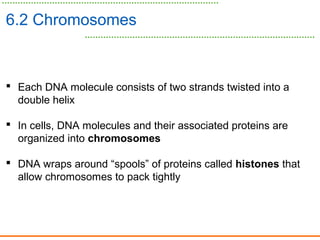
 Each DNA molecule consists of two strands twisted into a
double helix
 In cells, DNA molecules and their associated proteins are
organized into chromosomes
 DNA wraps around “spools” of proteins called histones that
allow chromosomes to pack tightly
Chromosome Structure
 When the cell prepares to divide, it duplicates all of its
chromosomes
 Sister chromatid
 One of two attached members of a duplicated eukaryotic
chromosome
 Centromere
 Constricted region in a eukaryotic chromosome where
sister chromatids are attached
A Duplicated Chromosome
centromere
one chromatid
its sister
chromatid
a chromosome
(unduplicated)
a chromosome
(duplicated)
Chromosome Structure
A) Proteins structurally organize DNA into chromosomes.
Chromosome and Uncondensed DNA
B) A human chromosome.
C) DNA, the substance,
extracted from human cells.
Chromosome Number
 A eukaryotic cell’s DNA is divided into a characteristic number
of chromosomes
 Chromosome number
 Sum of all chromosomes in a cell of a given type
 A human body cell has 46 chromosomes
 Diploid
 Cells having two of each type of chromosome
characteristic of the species (2n)
Two Types of Eukaryotic Chromosomes
 Autosomes
 Paired chromosomes with the same length, shape,
centromere location, and genes
 Any chromosome other than a sex chromosome
 Sex chromosomes
 Members of a pair of chromosomes that differ between
males and females
 In humans, XY and XX
Karyotype
 Karyotyping reveals characteristics of an individual’s
chromosomes
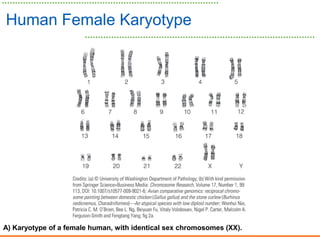
 Karyotype
 Image of an individual’s complement of chromosomes
arranged by size, length, shape, and centromere location
Human Female Karyotype
A) Karyotype of a female human, with identical sex chromosomes (XX).
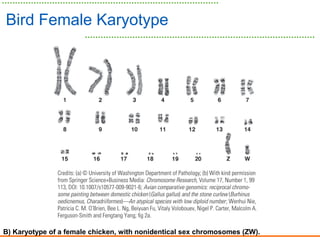
Bird Female Karyotype
B) Karyotype of a female chicken, with nonidentical sex chromosomes (ZW).
ANIMATED FIGURE: Chromosome
structural organization
ANIMATION: Karyotype preparation
6.3 Fame, Glory, and DNA Structure
 A DNA molecule consists of two strands of nucleotide
monomers running in opposite directions and coiled into a
double helix
 DNA nucleotide
 One five-carbon sugar (deoxyribose)
 Three phosphate groups
 One nitrogen-containing base (adenine, thymine, guanine,
or cytosine)
adenine (A)
deoxyadenosine
triphosphate
three
phosphate
groups
base
Four nucleotides in DNA
thymine (T)
deoxythymidine
triphosphate
Four nucleotides in DNA
cytosine (C)
deoxycytidine
triphosphate
Four nucleotides in DNA
guanine (G)
deoxyguanosine
triphosphate
Four nucleotides in DNA
Discovering DNA Structure
 Erwin Chargaff
 Discovered the relationships between DNA bases
 Rosalind Franklin
 Discovered structure of DNA by x-ray crystallography
 Maurice Wilkins
 Experimental evidence of DNA structure
 James Watson and Francis Crick
 Built the first accurate model of a DNA molecule
Chargaff’s Rules
 Two double-helix strands are held together by hydrogen
bonds between nucleotide bases
 Chargaff’s rules
 Bases of the two DNA strands in a double helix pair in a
consistent way: A – T and C – G
 Proportions of A and G vary among species
Rosalind Franklin’s x-ray diffraction image of
DNA
C) Maurice Wilkins.
Watson, Crick, and Wilkins
B) Watson (left) and Crick (right) with
their model of DNA.
The Double Helix
 Watson and Crick proposed that DNA consists of two strands
of nucleotides, running in opposite directions, coiled into a
double helix
 Hydrogen bonds between bases hold the two strands together
 Only two kinds of base pairings form: A to T, and G to C
(Chargaff’s rule)
DNA Structure
 Covalent bonds
between sugar and
phosphate form the
backbone of each chain
sugar–phosphate backbone
hydrogen bonds link
internally positioned
nucleotide bases
A) Structure of DNA, as illustrated by a
composite of three different models. The two
sugar–phosphate backbones coil in a helix
around internally positioned bases.
DNA’s Base-Pair Sequence
 The order of nucleotide bases in a DNA strand (DNA
sequence) is genetic information
 The order of bases varies among species and among
individuals
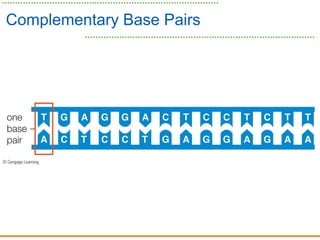
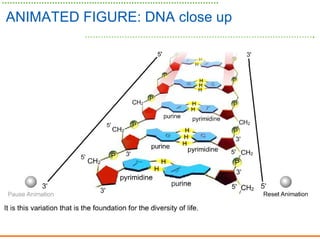
 The two strands of a DNA molecule are complementary
Complementary Base Pairs
ANIMATED FIGURE: DNA close up
ANIMATED FIGURE: Subunits of DNA
6.4 DNA Replication and Repair
 DNA replication
 Process by which a cell copies its DNA before it divides
 Each strand of the double helix serves as a template for
synthesis of a new, complementary strand of DNA
 Results in two double-stranded DNA molecules identical to
the parent
 Semiconservative replication
 One strand of each molecule is parental (old), and the
other is new
DNA Replication and Repair
 During DNA replication, the double-helix unwinds
 DNA polymerase uses each strand as a template to assemble
new, complementary strands of DNA from free nucleotides
 Each type of DNA polymerase requires a primer in order to
initiate DNA synthesis
 DNA ligase seals any gaps to form a continuous strand
DNA Replication and Repair
 DNA polymerase
 DNA replication enzyme; assembles a new strand of DNA
based on sequence of a DNA template
 Primer
 Short, single strand of DNA that base-pairs with a targeted
DNA sequence
 DNA ligase
 Enzyme that seals breaks in double-stranded DNA
DNA Replication
enzymes
primer
DNA
polymerase
DNA ligase
How Mutations Arise
 Proofreading by DNA polymerase corrects most base-pairing
errors during DNA replication
 Uncorrected errors in DNA replication may become mutations
 Mutation
 A permanent change in DNA sequence
How Mutations Arise
 Ionizing radiation (x-rays, most UV light, and gamma rays)
can knock electrons out of atoms, breaking DNA
 Non ionizing radiation (UV light 320–380 nm) forms nucleotide
dimers that kink DNA and increase mutation rate
 Chemicals in tobacco smoke transfer methyl groups (CH3) to
nucleotide bases in DNA, causing mispairs during replication
 Breakdown products of many environmental pollutants bind
irreversibly to DNA, causing replication errors
Effects of Ionizing Radiation
A) Major breaks (red arrows) in chromosomes of a human white blood cell after exposure to
ionizing radiation. Pieces of broken chromosomes often become lost during DNA replication.
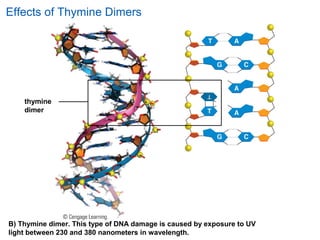
thymine
dimer
B) Thymine dimer. This type of DNA damage is caused by exposure to UV
light between 230 and 380 nanometers in wavelength.
Effects of Thymine Dimers
ANIMATED FIGURE: DNA replication details
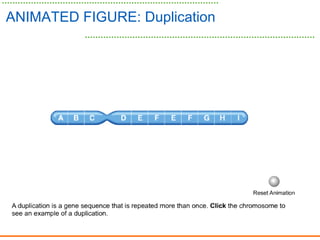
ANIMATED FIGURE: Duplication
ANIMATED FIGURE: Translocation
6.5 Cloning Adult Animals
 Reproductive cloning
 Technology that produces an exact genetic copy of an
individual (clone)
 Somatic cell nuclear transfer (SCNT)
 Nuclear DNA from an adult somatic cell is transferred into
an unfertilized, enucleated egg
 Common in livestock breeding
A) A cow egg is held in place by suction through a hollow glass tube called a
micropipette. DNA is identified by a purple stain.
Somatic Cell Nuclear Transfer
B) Another micropipette punctures the egg and sucks out the DNA. All that remains inside
the egg’s plasma membrane is cytoplasm.
Somatic Cell Nuclear Transfer
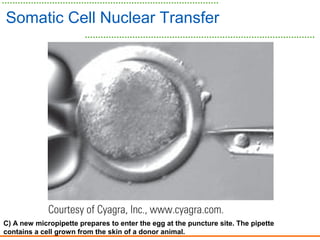
C) A new micropipette prepares to enter the egg at the puncture site. The pipette
contains a cell grown from the skin of a donor animal.
Somatic Cell Nuclear Transfer
D) The micropipette enters the egg and delivers the skin cell to a region between the
cytoplasm and the plasma membrane.
Somatic Cell Nuclear Transfer
E) After the pipette is withdrawn, the donor’s skin cell is visible next to the cytoplasm of the
egg. The transfer is now complete.
Somatic Cell Nuclear Transfer
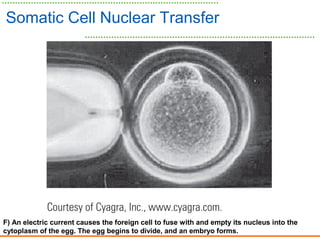
F) An electric current causes the foreign cell to fuse with and empty its nucleus into the
cytoplasm of the egg. The egg begins to divide, and an embryo forms.
Somatic Cell Nuclear Transfer
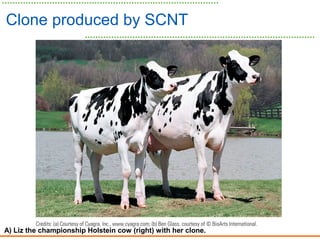
Clone produced by SCNT
A) Liz the championship Holstein cow (right) with her clone.
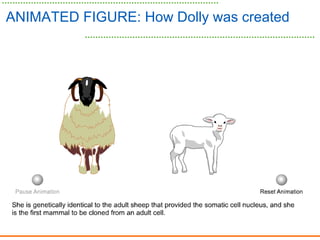
ANIMATED FIGURE: How Dolly was created
6.6 A Hero Dog’s Golden Clones (revisited)
B) Trakr’s clones with James Symington. Today, the clones are search and rescue dogs for
Team Trakr Foundation, an international humanitarian organization that Symington
established.
Digging into Data:
The Hershey Chase Experiments
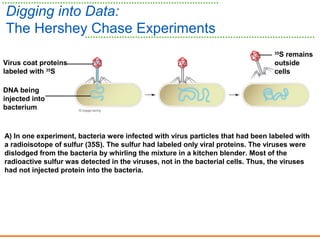
Virus coat proteins
labeled with 35
S
35
S remains
outside
cells
DNA being
injected into
bacterium
A) In one experiment, bacteria were infected with virus particles that had been labeled with
a radioisotope of sulfur (35S). The sulfur had labeled only viral proteins. The viruses were
dislodged from the bacteria by whirling the mixture in a kitchen blender. Most of the
radioactive sulfur was detected in the viruses, not in the bacterial cells. Thus, the viruses
had not injected protein into the bacteria.
Hershey Chase Experiments
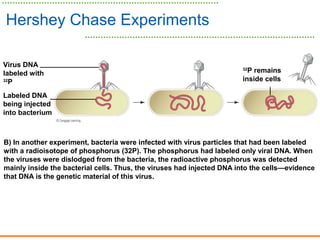
Virus DNA
labeled with
32
P
Labeled DNA
being injected
into bacterium
32
P remains
inside cells
B) In another experiment, bacteria were infected with virus particles that had been labeled
with a radioisotope of phosphorus (32P). The phosphorus had labeled only viral DNA. When
the viruses were dislodged from the bacteria, the radioactive phosphorus was detected
mainly inside the bacterial cells. Thus, the viruses had injected DNA into the cells—evidence
that DNA is the genetic material of this virus.
Hershey Chase Experiments
C) Detail of Alfred Hershey and Martha Chase’s publication describing their experiments with
bacteriophage. “Infected bacteria” refers to the percentage of bacteria that survived the blender. The
micrograph on the right shows three bacteriophage particles injecting DNA into an E. coli bacterium.

Chapter6

  • 1.
    BIOLOGY: Today andTomorrowBIOLOGY: Today and Tomorrow, 4e, 4e starrstarr eversevers starrstarr Chapter 6 DNA Structure and Function
  • 2.
    6.1 A HeroDog’s Golden Clones  Trakr, the search dog that located the final survivor of the 9/11 attacks, later died of toxic exposure  Trakr’s DNA lives on in his genetic copies (clones)  To make a clone from an adult cell, researchers must reprogram its DNA to function like the DNA of an egg  Cloning mammals is unpredictable; few implanted embryos result in a live birth, and many have serious health problems
  • 3.
    James Symington andTrakr at Ground Zero, September 2001
  • 4.
    6.2 Chromosomes  EachDNA molecule consists of two strands twisted into a double helix  In cells, DNA molecules and their associated proteins are organized into chromosomes  DNA wraps around “spools” of proteins called histones that allow chromosomes to pack tightly
  • 5.
    Chromosome Structure  Whenthe cell prepares to divide, it duplicates all of its chromosomes  Sister chromatid  One of two attached members of a duplicated eukaryotic chromosome  Centromere  Constricted region in a eukaryotic chromosome where sister chromatids are attached
  • 6.
    A Duplicated Chromosome centromere onechromatid its sister chromatid a chromosome (unduplicated) a chromosome (duplicated)
  • 7.
    Chromosome Structure A) Proteinsstructurally organize DNA into chromosomes.
  • 8.
    Chromosome and UncondensedDNA B) A human chromosome. C) DNA, the substance, extracted from human cells.
  • 9.
    Chromosome Number  Aeukaryotic cell’s DNA is divided into a characteristic number of chromosomes  Chromosome number  Sum of all chromosomes in a cell of a given type  A human body cell has 46 chromosomes  Diploid  Cells having two of each type of chromosome characteristic of the species (2n)
  • 10.
    Two Types ofEukaryotic Chromosomes  Autosomes  Paired chromosomes with the same length, shape, centromere location, and genes  Any chromosome other than a sex chromosome  Sex chromosomes  Members of a pair of chromosomes that differ between males and females  In humans, XY and XX
  • 11.
    Karyotype  Karyotyping revealscharacteristics of an individual’s chromosomes  Karyotype  Image of an individual’s complement of chromosomes arranged by size, length, shape, and centromere location
  • 12.
    Human Female Karyotype A)Karyotype of a female human, with identical sex chromosomes (XX).
  • 13.
    Bird Female Karyotype B)Karyotype of a female chicken, with nonidentical sex chromosomes (ZW).
  • 14.
  • 15.
  • 16.
    6.3 Fame, Glory,and DNA Structure  A DNA molecule consists of two strands of nucleotide monomers running in opposite directions and coiled into a double helix  DNA nucleotide  One five-carbon sugar (deoxyribose)  Three phosphate groups  One nitrogen-containing base (adenine, thymine, guanine, or cytosine)
  • 17.
  • 18.
  • 19.
  • 20.
  • 21.
    Discovering DNA Structure Erwin Chargaff  Discovered the relationships between DNA bases  Rosalind Franklin  Discovered structure of DNA by x-ray crystallography  Maurice Wilkins  Experimental evidence of DNA structure  James Watson and Francis Crick  Built the first accurate model of a DNA molecule
  • 22.
    Chargaff’s Rules  Twodouble-helix strands are held together by hydrogen bonds between nucleotide bases  Chargaff’s rules  Bases of the two DNA strands in a double helix pair in a consistent way: A – T and C – G  Proportions of A and G vary among species
  • 23.
    Rosalind Franklin’s x-raydiffraction image of DNA
  • 24.
    C) Maurice Wilkins. Watson,Crick, and Wilkins B) Watson (left) and Crick (right) with their model of DNA.
  • 25.
    The Double Helix Watson and Crick proposed that DNA consists of two strands of nucleotides, running in opposite directions, coiled into a double helix  Hydrogen bonds between bases hold the two strands together  Only two kinds of base pairings form: A to T, and G to C (Chargaff’s rule)
  • 26.
    DNA Structure  Covalentbonds between sugar and phosphate form the backbone of each chain sugar–phosphate backbone hydrogen bonds link internally positioned nucleotide bases A) Structure of DNA, as illustrated by a composite of three different models. The two sugar–phosphate backbones coil in a helix around internally positioned bases.
  • 27.
    DNA’s Base-Pair Sequence The order of nucleotide bases in a DNA strand (DNA sequence) is genetic information  The order of bases varies among species and among individuals  The two strands of a DNA molecule are complementary
  • 28.
  • 29.
  • 30.
  • 31.
    6.4 DNA Replicationand Repair  DNA replication  Process by which a cell copies its DNA before it divides  Each strand of the double helix serves as a template for synthesis of a new, complementary strand of DNA  Results in two double-stranded DNA molecules identical to the parent  Semiconservative replication  One strand of each molecule is parental (old), and the other is new
  • 32.
    DNA Replication andRepair  During DNA replication, the double-helix unwinds  DNA polymerase uses each strand as a template to assemble new, complementary strands of DNA from free nucleotides  Each type of DNA polymerase requires a primer in order to initiate DNA synthesis  DNA ligase seals any gaps to form a continuous strand
  • 33.
    DNA Replication andRepair  DNA polymerase  DNA replication enzyme; assembles a new strand of DNA based on sequence of a DNA template  Primer  Short, single strand of DNA that base-pairs with a targeted DNA sequence  DNA ligase  Enzyme that seals breaks in double-stranded DNA
  • 34.
  • 35.
    How Mutations Arise Proofreading by DNA polymerase corrects most base-pairing errors during DNA replication  Uncorrected errors in DNA replication may become mutations  Mutation  A permanent change in DNA sequence
  • 36.
    How Mutations Arise Ionizing radiation (x-rays, most UV light, and gamma rays) can knock electrons out of atoms, breaking DNA  Non ionizing radiation (UV light 320–380 nm) forms nucleotide dimers that kink DNA and increase mutation rate  Chemicals in tobacco smoke transfer methyl groups (CH3) to nucleotide bases in DNA, causing mispairs during replication  Breakdown products of many environmental pollutants bind irreversibly to DNA, causing replication errors
  • 37.
    Effects of IonizingRadiation A) Major breaks (red arrows) in chromosomes of a human white blood cell after exposure to ionizing radiation. Pieces of broken chromosomes often become lost during DNA replication.
  • 38.
    thymine dimer B) Thymine dimer.This type of DNA damage is caused by exposure to UV light between 230 and 380 nanometers in wavelength. Effects of Thymine Dimers
  • 39.
    ANIMATED FIGURE: DNAreplication details
  • 40.
  • 41.
  • 42.
    6.5 Cloning AdultAnimals  Reproductive cloning  Technology that produces an exact genetic copy of an individual (clone)  Somatic cell nuclear transfer (SCNT)  Nuclear DNA from an adult somatic cell is transferred into an unfertilized, enucleated egg  Common in livestock breeding
  • 43.
    A) A cowegg is held in place by suction through a hollow glass tube called a micropipette. DNA is identified by a purple stain. Somatic Cell Nuclear Transfer
  • 44.
    B) Another micropipettepunctures the egg and sucks out the DNA. All that remains inside the egg’s plasma membrane is cytoplasm. Somatic Cell Nuclear Transfer
  • 45.
    C) A newmicropipette prepares to enter the egg at the puncture site. The pipette contains a cell grown from the skin of a donor animal. Somatic Cell Nuclear Transfer
  • 46.
    D) The micropipetteenters the egg and delivers the skin cell to a region between the cytoplasm and the plasma membrane. Somatic Cell Nuclear Transfer
  • 47.
    E) After thepipette is withdrawn, the donor’s skin cell is visible next to the cytoplasm of the egg. The transfer is now complete. Somatic Cell Nuclear Transfer
  • 48.
    F) An electriccurrent causes the foreign cell to fuse with and empty its nucleus into the cytoplasm of the egg. The egg begins to divide, and an embryo forms. Somatic Cell Nuclear Transfer
  • 49.
    Clone produced bySCNT A) Liz the championship Holstein cow (right) with her clone.
  • 50.
    ANIMATED FIGURE: HowDolly was created
  • 51.
    6.6 A HeroDog’s Golden Clones (revisited) B) Trakr’s clones with James Symington. Today, the clones are search and rescue dogs for Team Trakr Foundation, an international humanitarian organization that Symington established.
  • 52.
    Digging into Data: TheHershey Chase Experiments Virus coat proteins labeled with 35 S 35 S remains outside cells DNA being injected into bacterium A) In one experiment, bacteria were infected with virus particles that had been labeled with a radioisotope of sulfur (35S). The sulfur had labeled only viral proteins. The viruses were dislodged from the bacteria by whirling the mixture in a kitchen blender. Most of the radioactive sulfur was detected in the viruses, not in the bacterial cells. Thus, the viruses had not injected protein into the bacteria.
  • 53.
    Hershey Chase Experiments VirusDNA labeled with 32 P Labeled DNA being injected into bacterium 32 P remains inside cells B) In another experiment, bacteria were infected with virus particles that had been labeled with a radioisotope of phosphorus (32P). The phosphorus had labeled only viral DNA. When the viruses were dislodged from the bacteria, the radioactive phosphorus was detected mainly inside the bacterial cells. Thus, the viruses had injected DNA into the cells—evidence that DNA is the genetic material of this virus.
  • 54.
    Hershey Chase Experiments C)Detail of Alfred Hershey and Martha Chase’s publication describing their experiments with bacteriophage. “Infected bacteria” refers to the percentage of bacteria that survived the blender. The micrograph on the right shows three bacteriophage particles injecting DNA into an E. coli bacterium.

Editor's Notes

  • #4 Figure 6.1 James Symington and his dog Trakr at Ground Zero, September 2001.
  • #8 Figure 6.2 Animated! Chromosome structure. 1 The DNA molecule itself has two strands twisted into a double helix. 2 At regular intervals, the DNA molecule (blue) wraps around a core of histone proteins (purple). 3 The DNA and proteins associated with it twist tightly into a fiber. 4 The fiber coils and then coils again to form a hollow cylinder. 5 At its most condensed, a duplicated chromosome has an X shape.
  • #9 Figure 6.2 Animated! Chromosome structure. 1 The DNA molecule itself has two strands twisted into a double helix. 2 At regular intervals, the DNA molecule (blue) wraps around a core of histone proteins (purple). 3 The DNA and proteins associated with it twist tightly into a fiber. 4 The fiber coils and then coils again to form a hollow cylinder. 5 At its most condensed, a duplicated chromosome has an X shape.
  • #13 Figure 6.3 Animated! Karyotypes.
  • #14 Figure 6.3 Animated! Karyotypes.
  • #18 Figure 6.4 Animated! The four nucleotides that make up DNA. Each kind has three phosphate groups, a deoxyribose sugar (orange), and a nitrogen-containing base (blue) after which it is named.
  • #19 Figure 6.4 Animated! The four nucleotides that make up DNA. Each kind has three phosphate groups, a deoxyribose sugar (orange), and a nitrogen-containing base (blue) after which it is named.
  • #20 Figure 6.4 Animated! The four nucleotides that make up DNA. Each kind has three phosphate groups, a deoxyribose sugar (orange), and a nitrogen-containing base (blue) after which it is named.
  • #21 Figure 6.4 Animated! The four nucleotides that make up DNA. Each kind has three phosphate groups, a deoxyribose sugar (orange), and a nitrogen-containing base (blue) after which it is named.
  • #24 Figure 6.5 Rosalind Franklin and her x-ray diffraction image of DNA. This image was the final link in a long chain of clues that led to the discovery of DNA’s structure.
  • #25 Figure 6.6 Animated! DNA structure.
  • #27 Figure 6.6 Animated! DNA structure.
  • #35 Figure 6.7 Animated! DNA replication, in which a doublestranded molecule of DNA is copied in entirety. Two double-stranded DNA molecules form; one strand of each is parental (old), and the other is new, so DNA replication is said to be semiconservative. 1 As replication begins, enzymes begin to unwind and separate the two strands of DNA. 2 Primers base-pair with the exposed single DNA strands. 3 Starting at primers, DNA polymerases (green boxes) assemble new strands of DNA from nucleotides, using the parent strands as templates. 4 DNA ligase seals any gaps that remain between bases of the “new” DNA, so a continuous strand forms. 5 Each parental DNA strand (blue) serves as a template for assembly of a new strand of DNA (magenta). Both strands of the double helix serve as templates, so two double-stranded DNA molecules result.
  • #38 Figure 6.8 Two types of DNA damage that can lead to mutations.
  • #39 Figure 6.8 Two types of DNA damage that can lead to mutations.
  • #44 Figure 6.9 Animated! Somatic cell nuclear transfer, using cattle cells. This series of micrographs was taken by scientists at Cyagra, a company that specializes in cloning livestock.
  • #45 Figure 6.9 Animated! Somatic cell nuclear transfer, using cattle cells. This series of micrographs was taken by scientists at Cyagra, a company that specializes in cloning livestock.
  • #46 Figure 6.9 Animated! Somatic cell nuclear transfer, using cattle cells. This series of micrographs was taken by scientists at Cyagra, a company that specializes in cloning livestock.
  • #47 Figure 6.9 Animated! Somatic cell nuclear transfer, using cattle cells. This series of micrographs was taken by scientists at Cyagra, a company that specializes in cloning livestock.
  • #48 Figure 6.9 Animated! Somatic cell nuclear transfer, using cattle cells. This series of micrographs was taken by scientists at Cyagra, a company that specializes in cloning livestock.
  • #49 Figure 6.9 Animated! Somatic cell nuclear transfer, using cattle cells. This series of micrographs was taken by scientists at Cyagra, a company that specializes in cloning livestock.
  • #50 Figure 6.10 Examples of animal clones.
  • #52 Figure 6.10 Examples of animal clones.
  • #53 Figure 6.11 Animated! The Hershey–Chase experiments.
  • #54 Figure 6.11 Animated! The Hershey–Chase experiments.
  • #55 Figure 6.11 Animated! The Hershey–Chase experiments.