DNA Sequencing Methods
Basics of
Dr. Prafulla Katkar
M.Sc. Ph.D(Italy), Post Doc
Assistant Professor
Department of Microbiology
Guru Nanak College of Science,
Ballarpur MS- 442701
Maxam-Gilbert’s sequencing
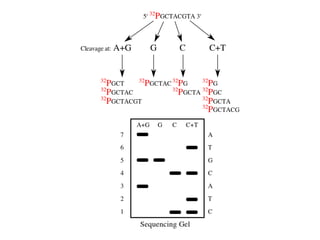
In this method DNA molecule can be radiolabled at either 5’ end by using
polynucleotide kinase
The mixture is prepared in four sets, each set is prepared with different
reagents which degrades G or A. DNA is treated with acid followed by dimethyl
sulphate. This causes methylation of A and G. Subsequent addition of alkali and
piperidine results in the cleavage of DNA and removal of purine either A or G.
Cleavage of Pyrimidine
The pyrimidine (C or T) is cleaved in presence of 1-2 molar NaCl solution. It
cleaves only C. The difference between these two indicates the presence of T in
the DNA sequence.
Sequencing process
Partial chemical cleavage of DNA fragments as done above produce the
different fragment of radiolabled DNA. These fragments are then separated by
gel electrophoresis
Cleavage of Purine
Sanger’s sequencing method
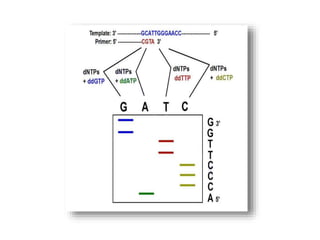
Fredrick sanger (1977) developed the method for DNA sequencing that utilises
single stranded DNA as a template. This method is also called as
dedeoxynucleotide chain termination method. The method requires a single-
stranded DNA template, a DNA primer, a DNA polymerase, normal
deoxynucleoside triphosphates (dNTPs), and modified di-deoxynucleotide
triphosphates (ddNTPs), the ddNTPs terminate DNA strand elongation. Because
ddNTPs nucleotides lack a 3'-OH group required for the formation of a
phosphodiester bond between two nucleotides, causing DNA polymerase to
stop extension of DNA when a modified ddNTP is incorporated.
Automated DNA sequencing

DNA sequencing

  • 1.
    DNA Sequencing Methods Basicsof Dr. Prafulla Katkar M.Sc. Ph.D(Italy), Post Doc Assistant Professor Department of Microbiology Guru Nanak College of Science, Ballarpur MS- 442701
  • 2.
    Maxam-Gilbert’s sequencing In thismethod DNA molecule can be radiolabled at either 5’ end by using polynucleotide kinase The mixture is prepared in four sets, each set is prepared with different reagents which degrades G or A. DNA is treated with acid followed by dimethyl sulphate. This causes methylation of A and G. Subsequent addition of alkali and piperidine results in the cleavage of DNA and removal of purine either A or G. Cleavage of Pyrimidine The pyrimidine (C or T) is cleaved in presence of 1-2 molar NaCl solution. It cleaves only C. The difference between these two indicates the presence of T in the DNA sequence. Sequencing process Partial chemical cleavage of DNA fragments as done above produce the different fragment of radiolabled DNA. These fragments are then separated by gel electrophoresis Cleavage of Purine
  • 4.
    Sanger’s sequencing method Fredricksanger (1977) developed the method for DNA sequencing that utilises single stranded DNA as a template. This method is also called as dedeoxynucleotide chain termination method. The method requires a single- stranded DNA template, a DNA primer, a DNA polymerase, normal deoxynucleoside triphosphates (dNTPs), and modified di-deoxynucleotide triphosphates (ddNTPs), the ddNTPs terminate DNA strand elongation. Because ddNTPs nucleotides lack a 3'-OH group required for the formation of a phosphodiester bond between two nucleotides, causing DNA polymerase to stop extension of DNA when a modified ddNTP is incorporated.
  • 6.