DNA Replication
Blake Bizousky
5’

3’

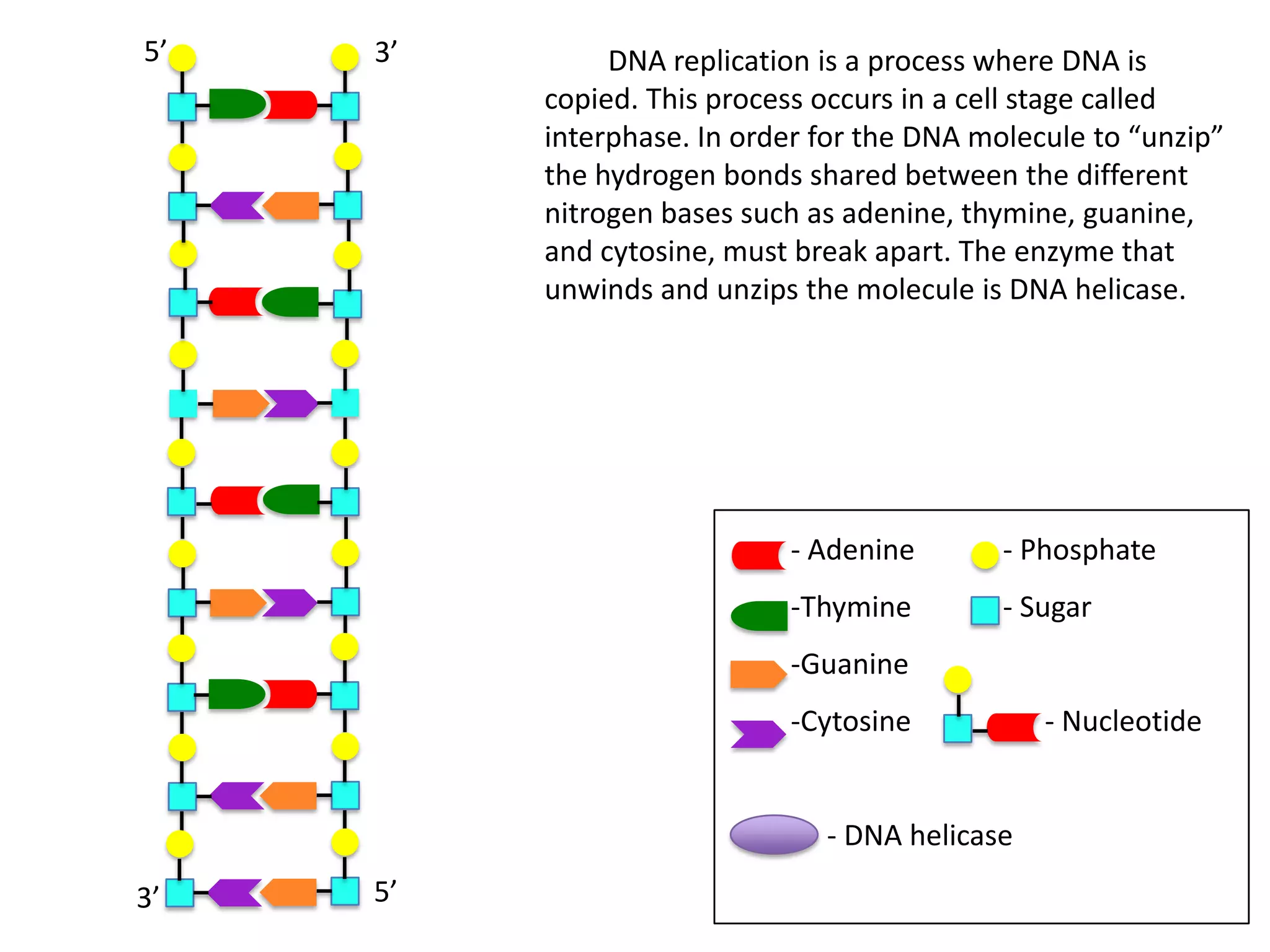
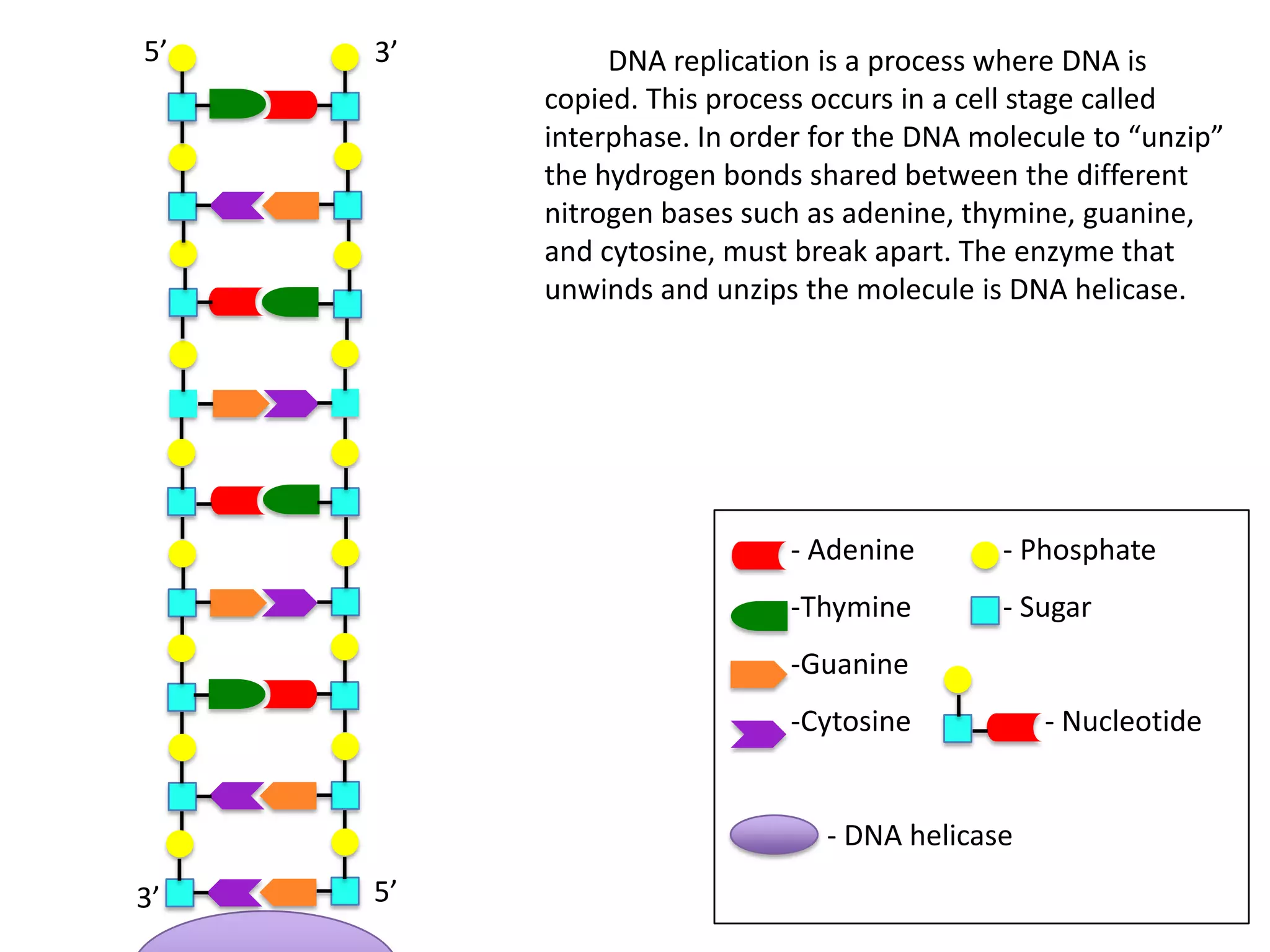
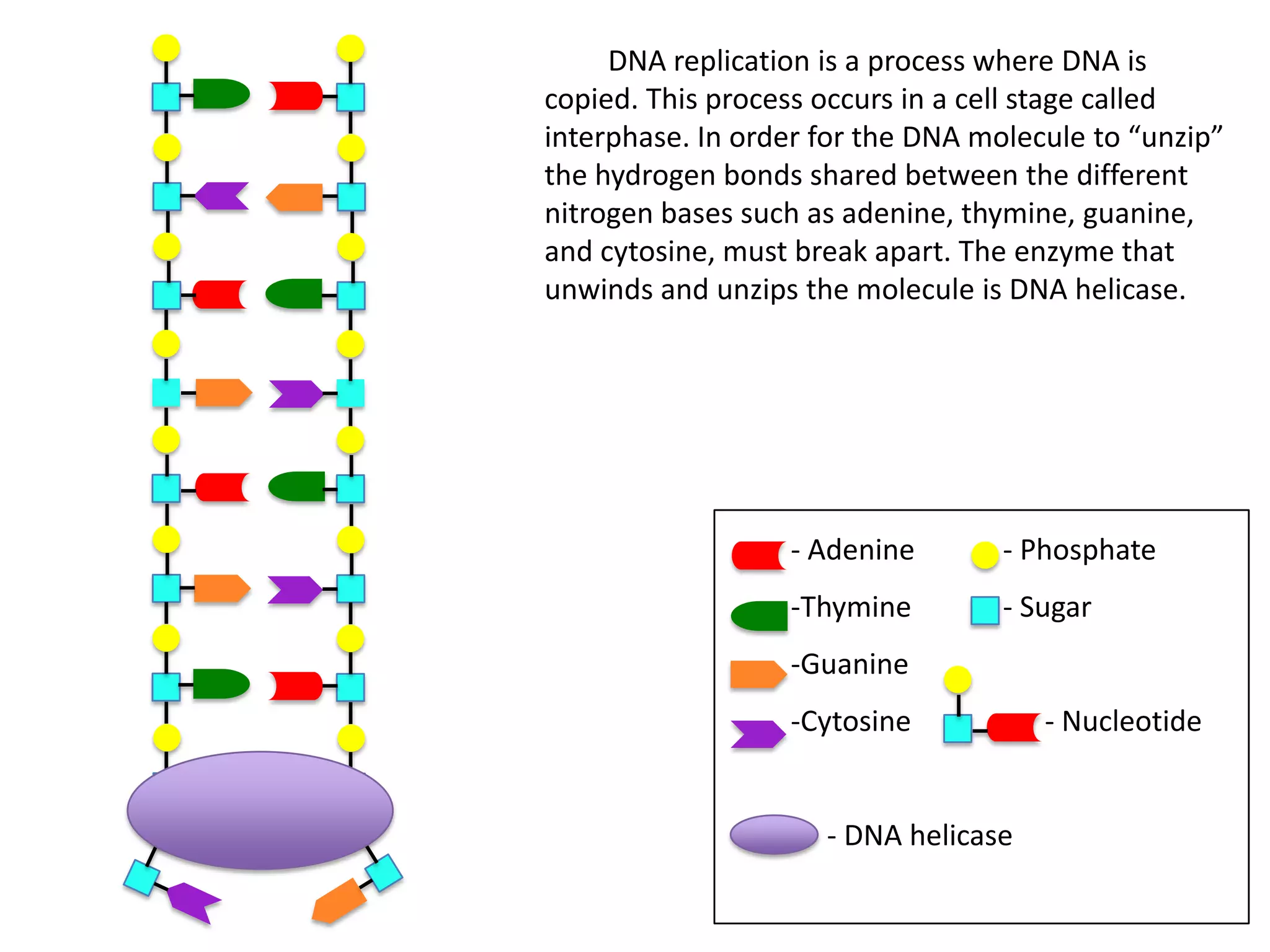
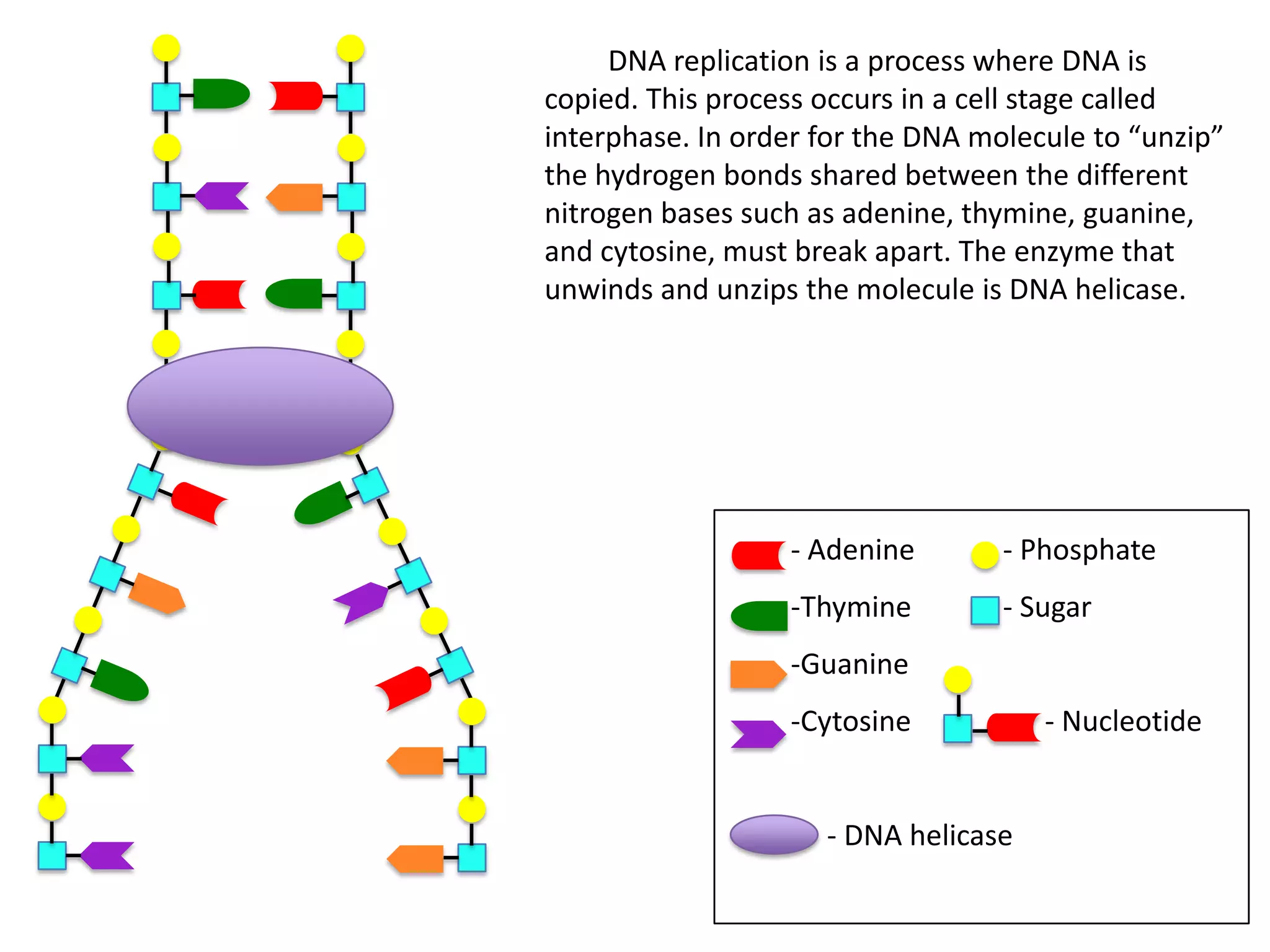
DNA replication is a process where DNA is
copied. This process occurs in a cell stage called
interphase. In order for the DNA molecule to “unzip”
the hydrogen bonds shared between the different
nitrogen bases such as adenine, thymine, guanine,
and cytosine, must break apart. The enzyme that
unwinds and unzips the molecule is DNA helicase.

- Adenine

- Phosphate

-Thymine

- Sugar

-Guanine
-Cytosine

- DNA helicase
3’

5’

- Nucleotide
5’

3’

DNA replication is a process where DNA is
copied. This process occurs in a cell stage called
interphase. In order for the DNA molecule to “unzip”
the hydrogen bonds shared between the different
nitrogen bases such as adenine, thymine, guanine,
and cytosine, must break apart. The enzyme that
unwinds and unzips the molecule is DNA helicase.

- Adenine

- Phosphate

-Thymine

- Sugar

-Guanine
-Cytosine

- DNA helicase
3’

5’

- Nucleotide
5’

3’

DNA replication is a process where DNA is
copied. This process occurs in a cell stage called
interphase. In order for the DNA molecule to “unzip”
the hydrogen bonds shared between the different
nitrogen bases such as adenine, thymine, guanine,
and cytosine, must break apart. The enzyme that
unwinds and unzips the molecule is DNA helicase.

- Adenine

- Phosphate

-Thymine

- Sugar

-Guanine
-Cytosine

- DNA helicase
3’

5’

- Nucleotide
DNA replication is a process where DNA is
copied. This process occurs in a cell stage called
interphase. In order for the DNA molecule to “unzip”
the hydrogen bonds shared between the different
nitrogen bases such as adenine, thymine, guanine,
and cytosine, must break apart. The enzyme that
unwinds and unzips the molecule is DNA helicase.

- Adenine

- Phosphate

-Thymine

- Sugar

-Guanine
-Cytosine

- DNA helicase

- Nucleotide
DNA replication is a process where DNA is
copied. This process occurs in a cell stage called
interphase. In order for the DNA molecule to “unzip”
the hydrogen bonds shared between the different
nitrogen bases such as adenine, thymine, guanine,
and cytosine, must break apart. The enzyme that
unwinds and unzips the molecule is DNA helicase.

- Adenine

- Phosphate

-Thymine

- Sugar

-Guanine
-Cytosine

- DNA helicase

- Nucleotide
DNA replication is a process where DNA is
copied. This process occurs in a cell stage called
interphase. In order for the DNA molecule to “unzip”
the hydrogen bonds shared between the different
nitrogen bases such as adenine, thymine, guanine,
and cytosine, must break apart. The enzyme that
unwinds and unzips the molecule is DNA helicase.

- Adenine

- Phosphate

-Thymine

- Sugar

-Guanine
-Cytosine

- DNA helicase

- Nucleotide
DNA replication is a process where DNA is
copied. This process occurs in a cell stage called
interphase. In order for the DNA molecule to “unzip”
the hydrogen bonds shared between the different
nitrogen bases such as adenine, thymine, guanine,
and cytosine, must break apart. The enzyme that
unwinds and unzips the molecule is DNA helicase.

- Adenine

- Phosphate

-Thymine

- Sugar

-Guanine
-Cytosine

- DNA helicase

- Nucleotide
DNA replication is a process where DNA is
copied. This process occurs in a cell stage called
interphase. In order for the DNA molecule to “unzip”
the hydrogen bonds shared between the different
nitrogen bases such as adenine, thymine, guanine,
and cytosine, must break apart. The enzyme that
unwinds and unzips the molecule is DNA helicase.

- Adenine

- Phosphate

-Thymine

- Sugar

-Guanine
-Cytosine

- DNA helicase

- Nucleotide
DNA replication is a process where DNA is
copied. This process occurs in a cell stage called
interphase. In order for the DNA molecule to “unzip”
the hydrogen bonds shared between the different
nitrogen bases such as adenine, thymine, guanine,
and cytosine, must break apart. The enzyme that
unwinds and unzips the molecule is DNA helicase.

- Adenine

- Phosphate

-Thymine

- Sugar

-Guanine
-Cytosine

- DNA helicase

- Nucleotide
DNA replication is a process where DNA is
copied. This process occurs in a cell stage called
interphase. In order for the DNA molecule to “unzip”
the hydrogen bonds shared between the different
nitrogen bases such as adenine, thymine, guanine,
and cytosine, must break apart. The enzyme that
unwinds and unzips the molecule is DNA helicase.

- Adenine

- Phosphate

-Thymine

- Sugar

-Guanine
-Cytosine

- DNA helicase

- Nucleotide
DNA replication is a process where DNA is
copied. This process occurs in a cell stage called
interphase. In order for the DNA molecule to “unzip”
the hydrogen bonds shared between the different
nitrogen bases such as adenine, thymine, guanine,
and cytosine, must break apart. The enzyme that
unwinds and unzips the molecule is DNA helicase.

- Adenine

- Phosphate

-Thymine

- Sugar

-Guanine
-Cytosine

- DNA helicase

- Nucleotide
DNA replication is a process where DNA is
copied. This process occurs in a cell stage called
interphase. In order for the DNA molecule to “unzip”
the hydrogen bonds shared between the different
nitrogen bases such as adenine, thymine, guanine,
and cytosine, must break apart. The enzyme that
unwinds and unzips the molecule is DNA helicase.

- Adenine

- Phosphate

-Thymine

- Sugar

-Guanine
-Cytosine

- DNA helicase

- Nucleotide
DNA replication is a process where DNA is
copied. This process occurs in a cell stage called
interphase. In order for the DNA molecule to “unzip”
the hydrogen bonds shared between the different
nitrogen bases such as adenine, thymine, guanine,
and cytosine, must break apart. The enzyme that
unwinds and unzips the molecule is DNA helicase.

- Adenine

- Phosphate

-Thymine

- Sugar

-Guanine
-Cytosine

- DNA helicase

- Nucleotide
DNA replication is a process where DNA is
copied. This process occurs in a cell stage called
interphase. In order for the DNA molecule to “unzip”
the hydrogen bonds shared between the different
nitrogen bases such as adenine, thymine, guanine,
and cytosine, must break apart. The enzyme that
unwinds and unzips the molecule is DNA helicase.

- Adenine

- Phosphate

-Thymine

- Sugar

-Guanine
-Cytosine

- DNA helicase

- Nucleotide
Once the DNA molecule is completely
“unzipped”, new nucleotides are linked together to
make exact copies of the DNA. The strand on the left
is strand 1 and the strand on the right is strand 2. This
strand coming into the DNA would be a
complementary strand to strand 1. Only certain bases
can bond together. Mutations can occur during this
process, though they can only happen few times.

- Adenine

- Phosphate

-Thymine

- Sugar

-Guanine
-Cytosine

- Nucleotide

-DNA Polymerase III
Once the DNA molecule is completely
“unzipped”, new nucleotides are linked together to
make exact copies of the DNA. The strand on the left
is strand 1 and the strand on the right is strand 2. This
strand coming into the DNA would be a
complementary strand to strand 1. Only certain bases
can bond together. Mutations can occur during this
process, though they can only happen few times.

- Adenine

- Phosphate

-Thymine

- Sugar

-Guanine
-Cytosine

- Nucleotide

-DNA Polymerase III
Once the DNA molecule is completely
“unzipped”, new nucleotides are linked together to
make exact copies of the DNA. The strand on the left
is strand 1 and the strand on the right is strand 2. This
strand coming into the DNA would be a
complementary strand to strand 1. Only certain bases
can bond together. Mutations can occur during this
process, though they can only happen few times.

- Adenine

- Phosphate

-Thymine

- Sugar

-Guanine
-Cytosine

- Nucleotide

-DNA Polymerase III
Once the DNA molecule is completely
“unzipped”, new nucleotides are linked together to
make exact copies of the DNA. The strand on the left
is strand 1 and the strand on the right is strand 2. This
strand coming into the DNA would be a
complementary strand to strand 1. Only certain bases
can bond together. Mutations can occur during this
process, though they can only happen few times.

- Adenine

- Phosphate

-Thymine

- Sugar

-Guanine
-Cytosine

- Nucleotide

-DNA Polymerase III
Once the DNA molecule is completely
“unzipped”, new nucleotides are linked together to
make exact copies of the DNA. The strand on the left
is strand 1 and the strand on the right is strand 2. This
strand coming into the DNA would be a
complementary strand to strand 1. Only certain bases
can bond together. Mutations can occur during this
process, though they can only happen few times.

- Adenine

- Phosphate

-Thymine

- Sugar

-Guanine
-Cytosine

- Nucleotide

-DNA Polymerase III
Once the DNA molecule is completely
“unzipped”, new nucleotides are linked together to
make exact copies of the DNA. The strand on the left
is strand 1 and the strand on the right is strand 2. This
strand coming into the DNA would be a
complementary strand to strand 1. Only certain bases
can bond together. Mutations can occur during this
process, though they can only happen few times.

- Adenine

- Phosphate

-Thymine

- Sugar

-Guanine
-Cytosine

- Nucleotide

-DNA Polymerase III
Once the DNA molecule is completely
“unzipped”, new nucleotides are linked together to
make exact copies of the DNA. The strand on the left
is strand 1 and the strand on the right is strand 2. This
strand coming into the DNA would be a
complementary strand to strand 1. Only certain bases
can bond together. Mutations can occur during this
process, though they can only happen few times.

- Adenine

- Phosphate

-Thymine

- Sugar

-Guanine
-Cytosine

- Nucleotide

-DNA Polymerase III
Once the DNA molecule is completely
“unzipped”, new nucleotides are linked together to
make exact copies of the DNA. The strand on the left
is strand 1 and the strand on the right is strand 2. This
strand coming into the DNA would be a
complementary strand to strand 1. Only certain bases
can bond together. Mutations can occur during this
process, though they can only happen few times.

- Adenine

- Phosphate

-Thymine

- Sugar

-Guanine
-Cytosine

- Nucleotide

-DNA Polymerase III
Once the DNA molecule is completely
“unzipped”, new nucleotides are linked together to
make exact copies of the DNA. The strand on the left
is strand 1 and the strand on the right is strand 2. This
strand coming into the DNA would be a
complementary strand to strand 1. Only certain bases
can bond together. Mutations can occur during this
process, though they can only happen few times.

- Adenine

- Phosphate

-Thymine

- Sugar

-Guanine
-Cytosine

- Nucleotide

-DNA Polymerase III
Once the DNA molecule is completely
“unzipped”, new nucleotides are linked together to
make exact copies of the DNA. The strand on the left
is strand 1 and the strand on the right is strand 2. This
strand coming into the DNA would be a
complementary strand to strand 1. Only certain bases
can bond together. Mutations can occur during this
process, though they can only happen few times.

- Adenine

- Phosphate

-Thymine

- Sugar

-Guanine
-Cytosine

- Nucleotide

-DNA Polymerase III
Once the DNA molecule is completely
“unzipped”, new nucleotides are linked together to
make exact copies of the DNA. The strand on the left
is strand 1 and the strand on the right is strand 2. This
strand coming into the DNA would be a
complementary strand to strand 1. Only certain bases
can bond together. Mutations can occur during this
process, though they can only happen few times.

- Adenine

- Phosphate

-Thymine

- Sugar

-Guanine
-Cytosine

- Nucleotide

-DNA Polymerase III
Once the DNA molecule is completely
“unzipped”, new nucleotides are linked together to
make exact copies of the DNA. The strand on the left
is strand 1 and the strand on the right is strand 2. This
strand coming into the DNA would be a
complementary strand to strand 1. Only certain bases
can bond together. Mutations can occur during this
process, though they can only happen few times.

- Adenine

- Phosphate

-Thymine

- Sugar

-Guanine
-Cytosine

- Nucleotide

-DNA Polymerase III
Once the DNA molecule is completely
“unzipped”, new nucleotides are linked together to
make exact copies of the DNA. The strand on the left
is strand 1 and the strand on the right is strand 2. This
strand coming into the DNA would be a
complementary strand to strand 1. Only certain bases
can bond together. Mutations can occur during this
process, though they can only happen few times.

- Adenine

- Phosphate

-Thymine

- Sugar

-Guanine
-Cytosine

- Nucleotide

-DNA Polymerase III
Once the DNA molecule is completely
“unzipped”, new nucleotides are linked together to
make exact copies of the DNA. The strand on the left
is strand 1 and the strand on the right is strand 2. This
strand coming into the DNA would be a
complementary strand to strand 1. Only certain bases
can bond together. Mutations can occur during this
process, though they can only happen few times.

- Adenine

- Phosphate

-Thymine

- Sugar

-Guanine
-Cytosine

- Nucleotide

-DNA Polymerase III
Once the DNA molecule is completely
“unzipped”, new nucleotides are linked together to
make exact copies of the DNA. The strand on the left
is strand 1 and the strand on the right is strand 2. This
strand coming into the DNA would be a
complementary strand to strand 1. Only certain bases
can bond together. Mutations can occur during this
process, though they can only happen few times.

- Adenine

- Phosphate

-Thymine

- Sugar

-Guanine
-Cytosine

- Nucleotide

-DNA Polymerase III
Once the DNA molecule is completely
“unzipped”, new nucleotides are linked together to
make exact copies of the DNA. The strand on the left
is strand 1 and the strand on the right is strand 2. This
strand coming into the DNA would be a
complementary strand to strand 1. Only certain bases
can bond together. Mutations can occur during this
process, though they can only happen few times.

- Adenine

- Phosphate

-Thymine

- Sugar

-Guanine
-Cytosine

- Nucleotide

-DNA Polymerase III
Once the DNA molecule is completely
“unzipped”, new nucleotides are linked together to
make exact copies of the DNA. The strand on the left
is strand 1 and the strand on the right is strand 2. This
strand coming into the DNA would be a
complementary strand to strand 1. Only certain bases
can bond together. Mutations can occur during this
process, though they can only happen few times.

- Adenine

- Phosphate

-Thymine

- Sugar

-Guanine
-Cytosine

- Nucleotide

-DNA Polymerase III
Once the DNA molecule is completely
“unzipped”, new nucleotides are linked together to
make exact copies of the DNA. The strand on the left
is strand 1 and the strand on the right is strand 2. This
strand coming into the DNA would be a
complementary strand to strand 1. Only certain bases
can bond together. Mutations can occur during this
process, though they can only happen few times.

- Adenine

- Phosphate

-Thymine

- Sugar

-Guanine
-Cytosine

- Nucleotide

-DNA Polymerase III
Once the DNA molecule is completely
“unzipped”, new nucleotides are linked together to
make exact copies of the DNA. The strand on the left
is strand 1 and the strand on the right is strand 2. This
strand coming into the DNA would be a
complementary strand to strand 1. Only certain bases
can bond together. Mutations can occur during this
process, though they can only happen few times.

- Adenine

- Phosphate

-Thymine

- Sugar

-Guanine
-Cytosine

- Nucleotide

-DNA Polymerase III
Once the DNA molecule is completely
“unzipped”, new nucleotides are linked together to
make exact copies of the DNA. The strand on the left
is strand 1 and the strand on the right is strand 2. This
strand coming into the DNA would be a
complementary strand to strand 1. Only certain bases
can bond together. Mutations can occur during this
process, though they can only happen few times.

- Adenine

- Phosphate

-Thymine

- Sugar

-Guanine
-Cytosine

- Nucleotide

-DNA Polymerase III
Once the DNA molecule is completely
“unzipped”, new nucleotides are linked together to
make exact copies of the DNA. The strand on the left
is strand 1 and the strand on the right is strand 2. This
strand coming into the DNA would be a
complementary strand to strand 1. Only certain bases
can bond together. Mutations can occur during this
process, though they can only happen few times.

- Adenine

- Phosphate

-Thymine

- Sugar

-Guanine
-Cytosine

- Nucleotide

-DNA Polymerase III
Once the DNA molecule is completely
“unzipped”, new nucleotides are linked together to
make exact copies of the DNA. The strand on the left
is strand 1 and the strand on the right is strand 2. This
strand coming into the DNA would be a
complementary strand to strand 1. Only certain bases
can bond together. Mutations can occur during this
process, though they can only happen few times.

- Adenine

- Phosphate

-Thymine

- Sugar

-Guanine
-Cytosine

- Nucleotide

-DNA Polymerase III
Once the DNA molecule is completely
“unzipped”, new nucleotides are linked together to
make exact copies of the DNA. The strand on the left
is strand 1 and the strand on the right is strand 2. This
strand coming into the DNA would be a
complementary strand to strand 1. Only certain bases
can bond together. Mutations can occur during this
process, though they can only happen few times.

- Adenine

- Phosphate

-Thymine

- Sugar

-Guanine
-Cytosine

- Nucleotide

-DNA Polymerase III
Strand 1 is now zipped up in a continuous way.
The strand zips from a 5’ prime to 3’ prime. These two
stands are paired together by DNA polymerase III in
complete part these strands are called the leading
strand.

- Adenine

- Phosphate

-Thymine

- Sugar

-Guanine
-Cytosine

- Nucleotide

-DNA Polymerase III
Strand 1 is now zipped up in a continuous way.
The strand zips from a 5’ prime to 3’ prime. These two
stands are paired together by DNA polymerase III in
complete part these strands are called the leading
strand.

- Adenine

- Phosphate

-Thymine

- Sugar

-Guanine
-Cytosine

- Nucleotide

-DNA Polymerase III
Strand 1 is now zipped up in a continuous way.
The strand zips from a 5’ prime to 3’ prime. These two
stands are paired together by DNA polymerase III in
complete part these strands are called the leading
strand.

- Adenine

- Phosphate

-Thymine

- Sugar

-Guanine
-Cytosine

- Nucleotide

-DNA Polymerase III
Strand 1 is now zipped up in a continuous way.
The strand zips from a 5’ prime to 3’ prime. These two
stands are paired together by DNA polymerase III in
complete part these strands are called the leading
strand.

- Adenine

- Phosphate

-Thymine

- Sugar

-Guanine
-Cytosine

- Nucleotide

-DNA Polymerase III
Strand 1 is now zipped up in a continuous way.
The strand zips from a 5’ prime to 3’ prime. These two
stands are paired together by DNA polymerase III in
complete part these strands are called the leading
strand.

- Adenine

- Phosphate

-Thymine

- Sugar

-Guanine
-Cytosine

- Nucleotide

-DNA Polymerase III
Strand 1 is now zipped up in a continuous way.
The strand zips from a 5’ prime to 3’ prime. These two
stands are paired together by DNA polymerase III in
complete part these strands are called the leading
strand.

- Adenine

- Phosphate

-Thymine

- Sugar

-Guanine
-Cytosine

- Nucleotide

-DNA Polymerase III
Strand 1 is now zipped up in a continuous way.
The strand zips from a 5’ prime to 3’ prime. These two
stands are paired together by DNA polymerase III in
complete part these strands are called the leading
strand.

- Adenine

- Phosphate

-Thymine

- Sugar

-Guanine
-Cytosine

- Nucleotide

-DNA Polymerase III
Strand 1 is now zipped up in a continuous way.
The strand zips from a 5’ prime to 3’ prime. These two
stands are paired together by DNA polymerase III in
complete part these strands are called the leading
strand.

- Adenine

- Phosphate

-Thymine

- Sugar

-Guanine
-Cytosine

- Nucleotide

-DNA Polymerase III
Strand 1 is now zipped up in a continuous way.
The strand zips from a 5’ prime to 3’ prime. These two
stands are paired together by DNA polymerase III in
complete part these strands are called the leading
strand.

- Adenine

- Phosphate

-Thymine

- Sugar

-Guanine
-Cytosine

- Nucleotide

-DNA Polymerase III
Strand 1 is now zipped up in a continuous way.
The strand zips from a 5’ prime to 3’ prime. These two
stands are paired together by DNA polymerase III in
complete part these strands are called the leading
strand.

- Adenine

- Phosphate

-Thymine

- Sugar

-Guanine
-Cytosine

- Nucleotide

-DNA Polymerase III
Strand 1 is now zipped up in a continuous way.
The strand zips from a 5’ prime to 3’ prime. These two
stands are paired together by DNA polymerase III in
complete part these strands are called the leading
strand.

- Adenine

- Phosphate

-Thymine

- Sugar

-Guanine
-Cytosine

- Nucleotide

-DNA Polymerase III
Strand 1 is now zipped up in a continuous way.
The strand zips from a 5’ prime to 3’ prime. These two
stands are paired together by DNA polymerase III in
complete part these strands are called the leading
strand.

- Adenine

- Phosphate

-Thymine

- Sugar

-Guanine
-Cytosine

- Nucleotide

-DNA Polymerase III
Now that one DNA molecule has been copied the
other strand must be paired with it’s complementary
strand too.

- Adenine

- Phosphate

-Thymine

- Sugar

-Guanine
-Cytosine

- Nucleotide

-DNA Polymerase III
Now that one DNA molecule has been copied the
other strand must be paired with it’s complementary
strand too.

- Adenine

- Phosphate

-Thymine

- Sugar

-Guanine
-Cytosine

- Nucleotide

-DNA Polymerase III
Now that one DNA molecule has been copied the
other strand must be paired with it’s complementary
strand too.

- Adenine

- Phosphate

-Thymine

- Sugar

-Guanine
-Cytosine

- Nucleotide

-DNA Polymerase III
Now that one DNA molecule has been copied the
other strand must be paired with it’s complementary
strand too.

- Adenine

- Phosphate

-Thymine

- Sugar

-Guanine
-Cytosine

- Nucleotide

-DNA Polymerase III
Now that one DNA molecule has been copied the
other strand must be paired with it’s complementary
strand too.

- Adenine

- Phosphate

-Thymine

- Sugar

-Guanine
-Cytosine

- Nucleotide

-DNA Polymerase III
Now that one DNA molecule has been copied the
other strand must be paired with it’s complementary
strand too.

- Adenine

- Phosphate

-Thymine

- Sugar

-Guanine
-Cytosine

- Nucleotide

-DNA Polymerase III
Now that one DNA molecule has been copied the
other strand must be paired with it’s complementary
strand too.

- Adenine

- Phosphate

-Thymine

- Sugar

-Guanine
-Cytosine

- Nucleotide

-DNA Polymerase III
Now that one DNA molecule has been copied the
other strand must be paired with it’s complementary
strand too.

- Adenine

- Phosphate

-Thymine

- Sugar

-Guanine
-Cytosine

- Nucleotide

-DNA Polymerase III
Now that one DNA molecule has been copied the
other strand must be paired with it’s complementary
strand too.

- Adenine

- Phosphate

-Thymine

- Sugar

-Guanine
-Cytosine

- Nucleotide

-DNA Polymerase III
Strand 2 from the original DNA molecule must
still be paired together with complementary
nucleotides to form the second copy of the DNA.

- Adenine

- Phosphate

-Thymine

- Sugar

-Guanine
-Cytosine

- Nucleotide

-DNA Polymerase III
Strand 2 from the original DNA molecule must
still be paired together with complementary
nucleotides to form the second copy of the DNA.

- Adenine

- Phosphate

-Thymine

- Sugar

-Guanine
-Cytosine

- Nucleotide

-DNA Polymerase III
Strand 2 from the original DNA molecule must
still be paired together with complementary
nucleotides to form the second copy of the DNA.

- Adenine

- Phosphate

-Thymine

- Sugar

-Guanine
-Cytosine

- Nucleotide

-DNA Polymerase III
Strand 2 from the original DNA molecule must
still be paired together with complementary
nucleotides to form the second copy of the DNA.

- Adenine

- Phosphate

-Thymine

- Sugar

-Guanine
-Cytosine

- Nucleotide

-DNA Polymerase III
Strand 2 from the original DNA molecule must
still be paired together with complementary
nucleotides to form the second copy of the DNA.

- Adenine

- Phosphate

-Thymine

- Sugar

-Guanine
-Cytosine

- Nucleotide

-DNA Polymerase III
Strand 2 from the original DNA molecule must
still be paired together with complementary
nucleotides to form the second copy of the DNA.

- Adenine

- Phosphate

-Thymine

- Sugar

-Guanine
-Cytosine

- Nucleotide

-DNA Polymerase III
Strand 2 from the original DNA molecule must
still be paired together with complementary
nucleotides to form the second copy of the DNA.

- Adenine

- Phosphate

-Thymine

- Sugar

-Guanine
-Cytosine

- Nucleotide

-DNA Polymerase III
Strand 2 from the original DNA molecule must
still be paired together with complementary
nucleotides to form the second copy of the DNA.

- Adenine

- Phosphate

-Thymine

- Sugar

-Guanine
-Cytosine

- Nucleotide

-DNA Polymerase III
This DNA molecule will be pair together in 3’ to
5’. This strand is the lagging strand and is paired up in
small segments called Okazaki fragments. Once a
starting point is given by Primase, DNA polymerase III
then finishes pairing the nucleotides with the help of
DNA ligase and DNA polymerase I.
- Adenine

- Phosphate

-Thymine

- Sugar

-Guanine
-Cytosine

- Nucleotide

-DNA Polymerase III

-DNA Ligase

- DNA Polymerase I
This DNA molecule will be pair together in 3’ to
5’. This strand is the lagging strand and is paired up in
small segments called Okazaki fragments. Once a
starting point is given by Primase, DNA polymerase III
then finishes pairing the nucleotides with the help of
DNA ligase and DNA polymerase I.
- Adenine

- Phosphate

-Thymine

- Sugar

-Guanine
-Cytosine

- Nucleotide

-DNA Polymerase III

-DNA Ligase

- DNA Polymerase I
This DNA molecule will be pair together in 3’ to
5’. This strand is the lagging strand and is paired up in
small segments called Okazaki fragments. Once a
starting point is given by Primase, DNA polymerase III
then finishes pairing the nucleotides with the help of
DNA ligase and DNA polymerase I.
- Adenine

- Phosphate

-Thymine

- Sugar

-Guanine
-Cytosine

- Nucleotide

-DNA Polymerase III

-DNA Ligase

- DNA Polymerase I
This DNA molecule will be pair together in 3’ to
5’. This strand is the lagging strand and is paired up in
small segments called Okazaki fragments. Once a
starting point is given by Primase, DNA polymerase III
then finishes pairing the nucleotides with the help of
DNA ligase and DNA polymerase I.
- Adenine

- Phosphate

-Thymine

- Sugar

-Guanine
-Cytosine

- Nucleotide

-DNA Polymerase III

-DNA Ligase

- DNA Polymerase I
This DNA molecule will be pair together in 3’ to
5’. This strand is the lagging strand and is paired up in
small segments called Okazaki fragments. Once a
starting point is given by Primase, DNA polymerase III
then finishes pairing the nucleotides with the help of
DNA ligase and DNA polymerase I.
- Adenine

- Phosphate

-Thymine

- Sugar

-Guanine
-Cytosine

- Nucleotide

-DNA Polymerase III

-DNA Ligase

- DNA Polymerase I
This DNA molecule will be pair together in 3’ to
5’. This strand is the lagging strand and is paired up in
small segments called Okazaki fragments. Once a
starting point is given by Primase, DNA polymerase III
then finishes pairing the nucleotides with the help of
DNA ligase and DNA polymerase I.
- Adenine

- Phosphate

-Thymine

- Sugar

-Guanine
-Cytosine

- Nucleotide

-DNA Polymerase III

-DNA Ligase

- DNA Polymerase I
This DNA molecule will be pair together in 3’ to
5’. This strand is the lagging strand and is paired up in
small segments called Okazaki fragments. Once a
starting point is given by Primase, DNA polymerase III
then finishes pairing the nucleotides with the help of
DNA ligase and DNA polymerase I.
- Adenine

- Phosphate

-Thymine

- Sugar

-Guanine
-Cytosine

- Nucleotide

-DNA Polymerase III

-DNA Ligase

- DNA Polymerase I
This DNA molecule will be pair together in 3’ to
5’. This strand is the lagging strand and is paired up in
small segments called Okazaki fragments. Once a
starting point is given by Primase, DNA polymerase III
then finishes pairing the nucleotides with the help of
DNA ligase and DNA polymerase I.
- Adenine

- Phosphate

-Thymine

- Sugar

-Guanine
-Cytosine

- Nucleotide

-DNA Polymerase III

-DNA Ligase

- DNA Polymerase I
This DNA molecule will be pair together in 3’ to
5’. This strand is the lagging strand and is paired up in
small segments called Okazaki fragments. Once a
starting point is given by Primase, DNA polymerase III
then finishes pairing the nucleotides with the help of
DNA ligase and DNA polymerase I.
- Adenine

- Phosphate

-Thymine

- Sugar

-Guanine
-Cytosine

- Nucleotide

-DNA Polymerase III

-DNA Ligase

- DNA Polymerase I
This DNA molecule will be pair together in 3’ to
5’. This strand is the lagging strand and is paired up in
small segments called Okazaki fragments. Once a
starting point is given by Primase, DNA polymerase III
then finishes pairing the nucleotides with the help of
DNA ligase and DNA polymerase I.
- Adenine

- Phosphate

-Thymine

- Sugar

-Guanine
-Cytosine

- Nucleotide

-DNA Polymerase III

-DNA Ligase

- DNA Polymerase I
This DNA molecule will be pair together in 3’ to
5’. This strand is the lagging strand and is paired up in
small segments called Okazaki fragments. Once a
starting point is given by Primase, DNA polymerase III
then finishes pairing the nucleotides with the help of
DNA ligase and DNA polymerase I.
- Adenine

- Phosphate

-Thymine

- Sugar

-Guanine
-Cytosine

- Nucleotide

-DNA Polymerase III

-DNA Ligase

- DNA Polymerase I
This DNA molecule will be pair together in 3’ to
5’. This strand is the lagging strand and is paired up in
small segments called Okazaki fragments. Once a
starting point is given by Primase, DNA polymerase III
then finishes pairing the nucleotides with the help of
DNA ligase and DNA polymerase I.
- Adenine

- Phosphate

-Thymine

- Sugar

-Guanine
-Cytosine

- Nucleotide

-DNA Polymerase III

-DNA Ligase

- DNA Polymerase I
This DNA molecule will be pair together in 3’ to
5’. This strand is the lagging strand and is paired up in
small segments called Okazaki fragments. Once a
starting point is given by Primase, DNA polymerase III
then finishes pairing the nucleotides with the help of
DNA ligase and DNA polymerase I.
- Adenine

- Phosphate

-Thymine

- Sugar

-Guanine
-Cytosine

- Nucleotide

-DNA Polymerase III

-DNA Ligase

- DNA Polymerase I
This DNA molecule will be pair together in 3’ to
5’. This strand is the lagging strand and is paired up in
small segments called Okazaki fragments. Once a
starting point is given by Primase, DNA polymerase III
then finishes pairing the nucleotides with the help of
DNA ligase and DNA polymerase I.
- Adenine

- Phosphate

-Thymine

- Sugar

-Guanine
-Cytosine

- Nucleotide

-DNA Polymerase III

-DNA Ligase

- DNA Polymerase I
This DNA molecule will be pair together in 3’ to
5’. This strand is the lagging strand and is paired up in
small segments called Okazaki fragments. Once a
starting point is given by Primase, DNA polymerase III
then finishes pairing the nucleotides with the help of
DNA ligase and DNA polymerase I.
- Adenine

- Phosphate

-Thymine

- Sugar

-Guanine
-Cytosine

- Nucleotide

-DNA Polymerase III

-DNA Ligase

- DNA Polymerase I
This DNA molecule will be pair together in 3’ to
5’. This strand is the lagging strand and is paired up in
small segments called Okazaki fragments. Once a
starting point is given by Primase, DNA polymerase III
then finishes pairing the nucleotides with the help of
DNA ligase and DNA polymerase I.
- Adenine

- Phosphate

-Thymine

- Sugar

-Guanine
-Cytosine

- Nucleotide

-DNA Polymerase III

-DNA Ligase

- DNA Polymerase I
This DNA molecule will be pair together in 3’ to
5’. This strand is the lagging strand and is paired up in
small segments called Okazaki fragments. Once a
starting point is given by Primase, DNA polymerase III
then finishes pairing the nucleotides with the help of
DNA ligase and DNA polymerase I.
- Adenine

- Phosphate

-Thymine

- Sugar

-Guanine
-Cytosine

- Nucleotide

-DNA Polymerase III

-DNA Ligase

- DNA Polymerase I
This DNA molecule will be pair together in 3’ to
5’. This strand is the lagging strand and is paired up in
small segments called Okazaki fragments. Once a
starting point is given by Primase, DNA polymerase III
then finishes pairing the nucleotides with the help of
DNA ligase and DNA polymerase I.
- Adenine

- Phosphate

-Thymine

- Sugar

-Guanine
-Cytosine

- Nucleotide

-DNA Polymerase III

-DNA Ligase

- DNA Polymerase I
This DNA molecule will be pair together in 3’ to
5’. This strand is the lagging strand and is paired up in
small segments called Okazaki fragments. Once a
starting point is given by Primase, DNA polymerase III
then finishes pairing the nucleotides with the help of
DNA ligase and DNA polymerase I.
- Adenine

- Phosphate

-Thymine

- Sugar

-Guanine
-Cytosine

- Nucleotide

-DNA Polymerase III

-DNA Ligase

- DNA Polymerase I
This DNA molecule will be pair together in 3’ to
5’. This strand is the lagging strand and is paired up in
small segments called Okazaki fragments. Once a
starting point is given by Primase, DNA polymerase III
then finishes pairing the nucleotides with the help of
DNA ligase and DNA polymerase I.
- Adenine

- Phosphate

-Thymine

- Sugar

-Guanine
-Cytosine

- Nucleotide

-DNA Polymerase III

-DNA Ligase

- DNA Polymerase I
This DNA molecule will be pair together in 3’ to
5’. This strand is the lagging strand and is paired up in
small segments called Okazaki fragments. Once a
starting point is given by Primase, DNA polymerase III
then finishes pairing the nucleotides with the help of
DNA ligase and DNA polymerase I.
- Adenine

- Phosphate

-Thymine

- Sugar

-Guanine
-Cytosine

- Nucleotide

-DNA Polymerase III

-DNA Ligase

- DNA Polymerase I
This DNA molecule will be pair together in 3’ to
5’. This strand is the lagging strand and is paired up in
small segments called Okazaki fragments. Once a
starting point is given by Primase, DNA polymerase III
then finishes pairing the nucleotides with the help of
DNA ligase and DNA polymerase I.
- Adenine

- Phosphate

-Thymine

- Sugar

-Guanine
-Cytosine

- Nucleotide

-DNA Polymerase III

-DNA Ligase

- DNA Polymerase I
This DNA molecule will be pair together in 3’ to
5’. This strand is the lagging strand and is paired up in
small segments called Okazaki fragments. Once a
starting point is given by Primase, DNA polymerase III
then finishes pairing the nucleotides with the help of
DNA ligase and DNA polymerase I.
- Adenine

- Phosphate

-Thymine

- Sugar

-Guanine
-Cytosine

- Nucleotide

-DNA Polymerase III

-DNA Ligase

- DNA Polymerase I
This DNA molecule will be pair together in 3’ to
5’. This strand is the lagging strand and is paired up in
small segments called Okazaki fragments. Once a
starting point is given by Primase, DNA polymerase III
then finishes pairing the nucleotides with the help of
DNA ligase and DNA polymerase I.
- Adenine

- Phosphate

-Thymine

- Sugar

-Guanine
-Cytosine

- Nucleotide

-DNA Polymerase III

-DNA Ligase

- DNA Polymerase I
This DNA molecule will be pair together in 3’ to
5’. This strand is the lagging strand and is paired up in
small segments called Okazaki fragments. Once a
starting point is given by Primase, DNA polymerase III
then finishes pairing the nucleotides with the help of
DNA ligase and DNA polymerase I.
- Adenine

- Phosphate

-Thymine

- Sugar

-Guanine
-Cytosine

- Nucleotide

-DNA Polymerase III

-DNA Ligase

- DNA Polymerase I
This DNA molecule will be pair together in 3’ to
5’. This strand is the lagging strand and is paired up in
small segments called Okazaki fragments. Once a
starting point is given by Primase, DNA polymerase III
then finishes pairing the nucleotides with the help of
DNA ligase and DNA polymerase I.
- Adenine

- Phosphate

-Thymine

- Sugar

-Guanine
-Cytosine

- Nucleotide

-DNA Polymerase III

-DNA Ligase

- DNA Polymerase I
This DNA molecule will be pair together in 3’ to
5’. This strand is the lagging strand and is paired up in
small segments called Okazaki fragments. Once a
starting point is given by Primase, DNA polymerase III
then finishes pairing the nucleotides with the help of
DNA ligase and DNA polymerase I.
- Adenine

- Phosphate

-Thymine

- Sugar

-Guanine
-Cytosine

- Nucleotide

-DNA Polymerase III

-DNA Ligase

- DNA Polymerase I
This DNA molecule will be pair together in 3’ to
5’. This strand is the lagging strand and is paired up in
small segments called Okazaki fragments. Once a
starting point is given by Primase, DNA polymerase III
then finishes pairing the nucleotides with the help of
DNA ligase and DNA polymerase I.
- Adenine

- Phosphate

-Thymine

- Sugar

-Guanine
-Cytosine

- Nucleotide

-DNA Polymerase III

-DNA Ligase

- DNA Polymerase I
This DNA molecule will be pair together in 3’ to
5’. This strand is the lagging strand and is paired up in
small segments called Okazaki fragments. Once a
starting point is given by Primase, DNA polymerase III
then finishes pairing the nucleotides with the help of
DNA ligase and DNA polymerase I.
- Adenine

- Phosphate

-Thymine

- Sugar

-Guanine
-Cytosine

- Nucleotide

-DNA Polymerase III

-DNA Ligase

- DNA Polymerase I
This DNA molecule will be pair together in 3’ to
5’. This strand is the lagging strand and is paired up in
small segments called Okazaki fragments. Once a
starting point is given by Primase, DNA polymerase III
then finishes pairing the nucleotides with the help of
DNA ligase and DNA polymerase I.
- Adenine

- Phosphate

-Thymine

- Sugar

-Guanine
-Cytosine

- Nucleotide

-DNA Polymerase III

-DNA Ligase

- DNA Polymerase I
This DNA molecule will be pair together in 3’ to
5’. This strand is the lagging strand and is paired up in
small segments called Okazaki fragments. Once a
starting point is given by Primase, DNA polymerase III
then finishes pairing the nucleotides with the help of
DNA ligase and DNA polymerase I.
- Adenine

- Phosphate

-Thymine

- Sugar

-Guanine
-Cytosine

- Nucleotide

-DNA Polymerase III

-DNA Ligase

- DNA Polymerase I
This DNA molecule will be pair together in 3’ to
5’. This strand is the lagging strand and is paired up in
small segments called Okazaki fragments. Once a
starting point is given by Primase, DNA polymerase III
then finishes pairing the nucleotides with the help of
DNA ligase and DNA polymerase I.
- Adenine

- Phosphate

-Thymine

- Sugar

-Guanine
-Cytosine

- Nucleotide

-DNA Polymerase III

-DNA Ligase

- DNA Polymerase I
This DNA molecule will be pair together in 3’ to
5’. This strand is the lagging strand and is paired up in
small segments called Okazaki fragments. Once a
starting point is given by Primase, DNA polymerase III
then finishes pairing the nucleotides with the help of
DNA ligase and DNA polymerase I.
- Adenine

- Phosphate

-Thymine

- Sugar

-Guanine
-Cytosine

- Nucleotide

-DNA Polymerase III

-DNA Ligase

- DNA Polymerase I
This DNA molecule will be pair together in 3’ to
5’. This strand is the lagging strand and is paired up in
small segments called Okazaki fragments. Once a
starting point is given by Primase, DNA polymerase III
then finishes pairing the nucleotides with the help of
DNA ligase and DNA polymerase I.
- Adenine

- Phosphate

-Thymine

- Sugar

-Guanine
-Cytosine

- Nucleotide

-DNA Polymerase III

-DNA Ligase

- DNA Polymerase I
This DNA molecule will be pair together in 3’ to
5’. This strand is the lagging strand and is paired up in
small segments called Okazaki fragments. Once a
starting point is given by Primase, DNA polymerase III
then finishes pairing the nucleotides with the help of
DNA ligase and DNA polymerase I.
- Adenine

- Phosphate

-Thymine

- Sugar

-Guanine
-Cytosine

- Nucleotide

-DNA Polymerase III

-DNA Ligase

- DNA Polymerase I
This DNA molecule will be pair together in 3’ to
5’. This strand is the lagging strand and is paired up in
small segments called Okazaki fragments. Once a
starting point is given by Primase, DNA polymerase III
then finishes pairing the nucleotides with the help of
DNA ligase and DNA polymerase I.
- Adenine

- Phosphate

-Thymine

- Sugar

-Guanine
-Cytosine

- Nucleotide

-DNA Polymerase III

-DNA Ligase

- DNA Polymerase I
This DNA molecule will be pair together in 3’ to
5’. This strand is the lagging strand and is paired up in
small segments called Okazaki fragments. Once a
starting point is given by Primase, DNA polymerase III
then finishes pairing the nucleotides with the help of
DNA ligase and DNA polymerase I.
- Adenine

- Phosphate

-Thymine

- Sugar

-Guanine
-Cytosine

- Nucleotide

-DNA Polymerase III

-DNA Ligase

- DNA Polymerase I
This DNA molecule will be pair together in 3’ to
5’. This strand is the lagging strand and is paired up in
small segments called Okazaki fragments. Once a
starting point is given by Primase, DNA polymerase III
then finishes pairing the nucleotides with the help of
DNA ligase and DNA polymerase I.
- Adenine

- Phosphate

-Thymine

- Sugar

-Guanine
-Cytosine

- Nucleotide

-DNA Polymerase III

-DNA Ligase

- DNA Polymerase I
We now have two identical DNA molecule!

- Adenine

- Phosphate

-Thymine

- Sugar

-Guanine
-Cytosine

- Nucleotide

-DNA Polymerase III

-DNA Ligase

- DNA Polymerase I
We now have two identical DNA molecule!

- Adenine

- Phosphate

-Thymine

- Sugar

-Guanine
-Cytosine

- Nucleotide

-DNA Polymerase III

-DNA Ligase

- DNA Polymerase I
We now have two identical DNA molecule!

- Adenine

- Phosphate

-Thymine

- Sugar

-Guanine
-Cytosine

- Nucleotide

-DNA Polymerase III

-DNA Ligase

- DNA Polymerase I
We now have two identical DNA molecule!

- Adenine

- Phosphate

-Thymine

- Sugar

-Guanine
-Cytosine

- Nucleotide

-DNA Polymerase III

-DNA Ligase

- DNA Polymerase I
5’

3’

5’

3’

We now have two identical DNA molecule!

- Adenine

- Phosphate

-Thymine

- Sugar

-Guanine
-Cytosine

- Nucleotide

-DNA Polymerase III

-DNA Ligase

- DNA Polymerase I
3’

5’

3’

5’

BBizousky_DNA_Replication_Animation

  • 1.
  • 2.
    5’ 3’ DNA replication isa process where DNA is copied. This process occurs in a cell stage called interphase. In order for the DNA molecule to “unzip” the hydrogen bonds shared between the different nitrogen bases such as adenine, thymine, guanine, and cytosine, must break apart. The enzyme that unwinds and unzips the molecule is DNA helicase. - Adenine - Phosphate -Thymine - Sugar -Guanine -Cytosine - DNA helicase 3’ 5’ - Nucleotide
  • 3.
    5’ 3’ DNA replication isa process where DNA is copied. This process occurs in a cell stage called interphase. In order for the DNA molecule to “unzip” the hydrogen bonds shared between the different nitrogen bases such as adenine, thymine, guanine, and cytosine, must break apart. The enzyme that unwinds and unzips the molecule is DNA helicase. - Adenine - Phosphate -Thymine - Sugar -Guanine -Cytosine - DNA helicase 3’ 5’ - Nucleotide
  • 4.
    5’ 3’ DNA replication isa process where DNA is copied. This process occurs in a cell stage called interphase. In order for the DNA molecule to “unzip” the hydrogen bonds shared between the different nitrogen bases such as adenine, thymine, guanine, and cytosine, must break apart. The enzyme that unwinds and unzips the molecule is DNA helicase. - Adenine - Phosphate -Thymine - Sugar -Guanine -Cytosine - DNA helicase 3’ 5’ - Nucleotide
  • 5.
    DNA replication isa process where DNA is copied. This process occurs in a cell stage called interphase. In order for the DNA molecule to “unzip” the hydrogen bonds shared between the different nitrogen bases such as adenine, thymine, guanine, and cytosine, must break apart. The enzyme that unwinds and unzips the molecule is DNA helicase. - Adenine - Phosphate -Thymine - Sugar -Guanine -Cytosine - DNA helicase - Nucleotide
  • 6.
    DNA replication isa process where DNA is copied. This process occurs in a cell stage called interphase. In order for the DNA molecule to “unzip” the hydrogen bonds shared between the different nitrogen bases such as adenine, thymine, guanine, and cytosine, must break apart. The enzyme that unwinds and unzips the molecule is DNA helicase. - Adenine - Phosphate -Thymine - Sugar -Guanine -Cytosine - DNA helicase - Nucleotide
  • 7.
    DNA replication isa process where DNA is copied. This process occurs in a cell stage called interphase. In order for the DNA molecule to “unzip” the hydrogen bonds shared between the different nitrogen bases such as adenine, thymine, guanine, and cytosine, must break apart. The enzyme that unwinds and unzips the molecule is DNA helicase. - Adenine - Phosphate -Thymine - Sugar -Guanine -Cytosine - DNA helicase - Nucleotide
  • 8.
    DNA replication isa process where DNA is copied. This process occurs in a cell stage called interphase. In order for the DNA molecule to “unzip” the hydrogen bonds shared between the different nitrogen bases such as adenine, thymine, guanine, and cytosine, must break apart. The enzyme that unwinds and unzips the molecule is DNA helicase. - Adenine - Phosphate -Thymine - Sugar -Guanine -Cytosine - DNA helicase - Nucleotide
  • 9.
    DNA replication isa process where DNA is copied. This process occurs in a cell stage called interphase. In order for the DNA molecule to “unzip” the hydrogen bonds shared between the different nitrogen bases such as adenine, thymine, guanine, and cytosine, must break apart. The enzyme that unwinds and unzips the molecule is DNA helicase. - Adenine - Phosphate -Thymine - Sugar -Guanine -Cytosine - DNA helicase - Nucleotide
  • 10.
    DNA replication isa process where DNA is copied. This process occurs in a cell stage called interphase. In order for the DNA molecule to “unzip” the hydrogen bonds shared between the different nitrogen bases such as adenine, thymine, guanine, and cytosine, must break apart. The enzyme that unwinds and unzips the molecule is DNA helicase. - Adenine - Phosphate -Thymine - Sugar -Guanine -Cytosine - DNA helicase - Nucleotide
  • 11.
    DNA replication isa process where DNA is copied. This process occurs in a cell stage called interphase. In order for the DNA molecule to “unzip” the hydrogen bonds shared between the different nitrogen bases such as adenine, thymine, guanine, and cytosine, must break apart. The enzyme that unwinds and unzips the molecule is DNA helicase. - Adenine - Phosphate -Thymine - Sugar -Guanine -Cytosine - DNA helicase - Nucleotide
  • 12.
    DNA replication isa process where DNA is copied. This process occurs in a cell stage called interphase. In order for the DNA molecule to “unzip” the hydrogen bonds shared between the different nitrogen bases such as adenine, thymine, guanine, and cytosine, must break apart. The enzyme that unwinds and unzips the molecule is DNA helicase. - Adenine - Phosphate -Thymine - Sugar -Guanine -Cytosine - DNA helicase - Nucleotide
  • 13.
    DNA replication isa process where DNA is copied. This process occurs in a cell stage called interphase. In order for the DNA molecule to “unzip” the hydrogen bonds shared between the different nitrogen bases such as adenine, thymine, guanine, and cytosine, must break apart. The enzyme that unwinds and unzips the molecule is DNA helicase. - Adenine - Phosphate -Thymine - Sugar -Guanine -Cytosine - DNA helicase - Nucleotide
  • 14.
    DNA replication isa process where DNA is copied. This process occurs in a cell stage called interphase. In order for the DNA molecule to “unzip” the hydrogen bonds shared between the different nitrogen bases such as adenine, thymine, guanine, and cytosine, must break apart. The enzyme that unwinds and unzips the molecule is DNA helicase. - Adenine - Phosphate -Thymine - Sugar -Guanine -Cytosine - DNA helicase - Nucleotide
  • 15.
    DNA replication isa process where DNA is copied. This process occurs in a cell stage called interphase. In order for the DNA molecule to “unzip” the hydrogen bonds shared between the different nitrogen bases such as adenine, thymine, guanine, and cytosine, must break apart. The enzyme that unwinds and unzips the molecule is DNA helicase. - Adenine - Phosphate -Thymine - Sugar -Guanine -Cytosine - DNA helicase - Nucleotide
  • 16.
    Once the DNAmolecule is completely “unzipped”, new nucleotides are linked together to make exact copies of the DNA. The strand on the left is strand 1 and the strand on the right is strand 2. This strand coming into the DNA would be a complementary strand to strand 1. Only certain bases can bond together. Mutations can occur during this process, though they can only happen few times. - Adenine - Phosphate -Thymine - Sugar -Guanine -Cytosine - Nucleotide -DNA Polymerase III
  • 17.
    Once the DNAmolecule is completely “unzipped”, new nucleotides are linked together to make exact copies of the DNA. The strand on the left is strand 1 and the strand on the right is strand 2. This strand coming into the DNA would be a complementary strand to strand 1. Only certain bases can bond together. Mutations can occur during this process, though they can only happen few times. - Adenine - Phosphate -Thymine - Sugar -Guanine -Cytosine - Nucleotide -DNA Polymerase III
  • 18.
    Once the DNAmolecule is completely “unzipped”, new nucleotides are linked together to make exact copies of the DNA. The strand on the left is strand 1 and the strand on the right is strand 2. This strand coming into the DNA would be a complementary strand to strand 1. Only certain bases can bond together. Mutations can occur during this process, though they can only happen few times. - Adenine - Phosphate -Thymine - Sugar -Guanine -Cytosine - Nucleotide -DNA Polymerase III
  • 19.
    Once the DNAmolecule is completely “unzipped”, new nucleotides are linked together to make exact copies of the DNA. The strand on the left is strand 1 and the strand on the right is strand 2. This strand coming into the DNA would be a complementary strand to strand 1. Only certain bases can bond together. Mutations can occur during this process, though they can only happen few times. - Adenine - Phosphate -Thymine - Sugar -Guanine -Cytosine - Nucleotide -DNA Polymerase III
  • 20.
    Once the DNAmolecule is completely “unzipped”, new nucleotides are linked together to make exact copies of the DNA. The strand on the left is strand 1 and the strand on the right is strand 2. This strand coming into the DNA would be a complementary strand to strand 1. Only certain bases can bond together. Mutations can occur during this process, though they can only happen few times. - Adenine - Phosphate -Thymine - Sugar -Guanine -Cytosine - Nucleotide -DNA Polymerase III
  • 21.
    Once the DNAmolecule is completely “unzipped”, new nucleotides are linked together to make exact copies of the DNA. The strand on the left is strand 1 and the strand on the right is strand 2. This strand coming into the DNA would be a complementary strand to strand 1. Only certain bases can bond together. Mutations can occur during this process, though they can only happen few times. - Adenine - Phosphate -Thymine - Sugar -Guanine -Cytosine - Nucleotide -DNA Polymerase III
  • 22.
    Once the DNAmolecule is completely “unzipped”, new nucleotides are linked together to make exact copies of the DNA. The strand on the left is strand 1 and the strand on the right is strand 2. This strand coming into the DNA would be a complementary strand to strand 1. Only certain bases can bond together. Mutations can occur during this process, though they can only happen few times. - Adenine - Phosphate -Thymine - Sugar -Guanine -Cytosine - Nucleotide -DNA Polymerase III
  • 23.
    Once the DNAmolecule is completely “unzipped”, new nucleotides are linked together to make exact copies of the DNA. The strand on the left is strand 1 and the strand on the right is strand 2. This strand coming into the DNA would be a complementary strand to strand 1. Only certain bases can bond together. Mutations can occur during this process, though they can only happen few times. - Adenine - Phosphate -Thymine - Sugar -Guanine -Cytosine - Nucleotide -DNA Polymerase III
  • 24.
    Once the DNAmolecule is completely “unzipped”, new nucleotides are linked together to make exact copies of the DNA. The strand on the left is strand 1 and the strand on the right is strand 2. This strand coming into the DNA would be a complementary strand to strand 1. Only certain bases can bond together. Mutations can occur during this process, though they can only happen few times. - Adenine - Phosphate -Thymine - Sugar -Guanine -Cytosine - Nucleotide -DNA Polymerase III
  • 25.
    Once the DNAmolecule is completely “unzipped”, new nucleotides are linked together to make exact copies of the DNA. The strand on the left is strand 1 and the strand on the right is strand 2. This strand coming into the DNA would be a complementary strand to strand 1. Only certain bases can bond together. Mutations can occur during this process, though they can only happen few times. - Adenine - Phosphate -Thymine - Sugar -Guanine -Cytosine - Nucleotide -DNA Polymerase III
  • 26.
    Once the DNAmolecule is completely “unzipped”, new nucleotides are linked together to make exact copies of the DNA. The strand on the left is strand 1 and the strand on the right is strand 2. This strand coming into the DNA would be a complementary strand to strand 1. Only certain bases can bond together. Mutations can occur during this process, though they can only happen few times. - Adenine - Phosphate -Thymine - Sugar -Guanine -Cytosine - Nucleotide -DNA Polymerase III
  • 27.
    Once the DNAmolecule is completely “unzipped”, new nucleotides are linked together to make exact copies of the DNA. The strand on the left is strand 1 and the strand on the right is strand 2. This strand coming into the DNA would be a complementary strand to strand 1. Only certain bases can bond together. Mutations can occur during this process, though they can only happen few times. - Adenine - Phosphate -Thymine - Sugar -Guanine -Cytosine - Nucleotide -DNA Polymerase III
  • 28.
    Once the DNAmolecule is completely “unzipped”, new nucleotides are linked together to make exact copies of the DNA. The strand on the left is strand 1 and the strand on the right is strand 2. This strand coming into the DNA would be a complementary strand to strand 1. Only certain bases can bond together. Mutations can occur during this process, though they can only happen few times. - Adenine - Phosphate -Thymine - Sugar -Guanine -Cytosine - Nucleotide -DNA Polymerase III
  • 29.
    Once the DNAmolecule is completely “unzipped”, new nucleotides are linked together to make exact copies of the DNA. The strand on the left is strand 1 and the strand on the right is strand 2. This strand coming into the DNA would be a complementary strand to strand 1. Only certain bases can bond together. Mutations can occur during this process, though they can only happen few times. - Adenine - Phosphate -Thymine - Sugar -Guanine -Cytosine - Nucleotide -DNA Polymerase III
  • 30.
    Once the DNAmolecule is completely “unzipped”, new nucleotides are linked together to make exact copies of the DNA. The strand on the left is strand 1 and the strand on the right is strand 2. This strand coming into the DNA would be a complementary strand to strand 1. Only certain bases can bond together. Mutations can occur during this process, though they can only happen few times. - Adenine - Phosphate -Thymine - Sugar -Guanine -Cytosine - Nucleotide -DNA Polymerase III
  • 31.
    Once the DNAmolecule is completely “unzipped”, new nucleotides are linked together to make exact copies of the DNA. The strand on the left is strand 1 and the strand on the right is strand 2. This strand coming into the DNA would be a complementary strand to strand 1. Only certain bases can bond together. Mutations can occur during this process, though they can only happen few times. - Adenine - Phosphate -Thymine - Sugar -Guanine -Cytosine - Nucleotide -DNA Polymerase III
  • 32.
    Once the DNAmolecule is completely “unzipped”, new nucleotides are linked together to make exact copies of the DNA. The strand on the left is strand 1 and the strand on the right is strand 2. This strand coming into the DNA would be a complementary strand to strand 1. Only certain bases can bond together. Mutations can occur during this process, though they can only happen few times. - Adenine - Phosphate -Thymine - Sugar -Guanine -Cytosine - Nucleotide -DNA Polymerase III
  • 33.
    Once the DNAmolecule is completely “unzipped”, new nucleotides are linked together to make exact copies of the DNA. The strand on the left is strand 1 and the strand on the right is strand 2. This strand coming into the DNA would be a complementary strand to strand 1. Only certain bases can bond together. Mutations can occur during this process, though they can only happen few times. - Adenine - Phosphate -Thymine - Sugar -Guanine -Cytosine - Nucleotide -DNA Polymerase III
  • 34.
    Once the DNAmolecule is completely “unzipped”, new nucleotides are linked together to make exact copies of the DNA. The strand on the left is strand 1 and the strand on the right is strand 2. This strand coming into the DNA would be a complementary strand to strand 1. Only certain bases can bond together. Mutations can occur during this process, though they can only happen few times. - Adenine - Phosphate -Thymine - Sugar -Guanine -Cytosine - Nucleotide -DNA Polymerase III
  • 35.
    Once the DNAmolecule is completely “unzipped”, new nucleotides are linked together to make exact copies of the DNA. The strand on the left is strand 1 and the strand on the right is strand 2. This strand coming into the DNA would be a complementary strand to strand 1. Only certain bases can bond together. Mutations can occur during this process, though they can only happen few times. - Adenine - Phosphate -Thymine - Sugar -Guanine -Cytosine - Nucleotide -DNA Polymerase III
  • 36.
    Once the DNAmolecule is completely “unzipped”, new nucleotides are linked together to make exact copies of the DNA. The strand on the left is strand 1 and the strand on the right is strand 2. This strand coming into the DNA would be a complementary strand to strand 1. Only certain bases can bond together. Mutations can occur during this process, though they can only happen few times. - Adenine - Phosphate -Thymine - Sugar -Guanine -Cytosine - Nucleotide -DNA Polymerase III
  • 37.
    Once the DNAmolecule is completely “unzipped”, new nucleotides are linked together to make exact copies of the DNA. The strand on the left is strand 1 and the strand on the right is strand 2. This strand coming into the DNA would be a complementary strand to strand 1. Only certain bases can bond together. Mutations can occur during this process, though they can only happen few times. - Adenine - Phosphate -Thymine - Sugar -Guanine -Cytosine - Nucleotide -DNA Polymerase III
  • 38.
    Once the DNAmolecule is completely “unzipped”, new nucleotides are linked together to make exact copies of the DNA. The strand on the left is strand 1 and the strand on the right is strand 2. This strand coming into the DNA would be a complementary strand to strand 1. Only certain bases can bond together. Mutations can occur during this process, though they can only happen few times. - Adenine - Phosphate -Thymine - Sugar -Guanine -Cytosine - Nucleotide -DNA Polymerase III
  • 39.
    Strand 1 isnow zipped up in a continuous way. The strand zips from a 5’ prime to 3’ prime. These two stands are paired together by DNA polymerase III in complete part these strands are called the leading strand. - Adenine - Phosphate -Thymine - Sugar -Guanine -Cytosine - Nucleotide -DNA Polymerase III
  • 40.
    Strand 1 isnow zipped up in a continuous way. The strand zips from a 5’ prime to 3’ prime. These two stands are paired together by DNA polymerase III in complete part these strands are called the leading strand. - Adenine - Phosphate -Thymine - Sugar -Guanine -Cytosine - Nucleotide -DNA Polymerase III
  • 41.
    Strand 1 isnow zipped up in a continuous way. The strand zips from a 5’ prime to 3’ prime. These two stands are paired together by DNA polymerase III in complete part these strands are called the leading strand. - Adenine - Phosphate -Thymine - Sugar -Guanine -Cytosine - Nucleotide -DNA Polymerase III
  • 42.
    Strand 1 isnow zipped up in a continuous way. The strand zips from a 5’ prime to 3’ prime. These two stands are paired together by DNA polymerase III in complete part these strands are called the leading strand. - Adenine - Phosphate -Thymine - Sugar -Guanine -Cytosine - Nucleotide -DNA Polymerase III
  • 43.
    Strand 1 isnow zipped up in a continuous way. The strand zips from a 5’ prime to 3’ prime. These two stands are paired together by DNA polymerase III in complete part these strands are called the leading strand. - Adenine - Phosphate -Thymine - Sugar -Guanine -Cytosine - Nucleotide -DNA Polymerase III
  • 44.
    Strand 1 isnow zipped up in a continuous way. The strand zips from a 5’ prime to 3’ prime. These two stands are paired together by DNA polymerase III in complete part these strands are called the leading strand. - Adenine - Phosphate -Thymine - Sugar -Guanine -Cytosine - Nucleotide -DNA Polymerase III
  • 45.
    Strand 1 isnow zipped up in a continuous way. The strand zips from a 5’ prime to 3’ prime. These two stands are paired together by DNA polymerase III in complete part these strands are called the leading strand. - Adenine - Phosphate -Thymine - Sugar -Guanine -Cytosine - Nucleotide -DNA Polymerase III
  • 46.
    Strand 1 isnow zipped up in a continuous way. The strand zips from a 5’ prime to 3’ prime. These two stands are paired together by DNA polymerase III in complete part these strands are called the leading strand. - Adenine - Phosphate -Thymine - Sugar -Guanine -Cytosine - Nucleotide -DNA Polymerase III
  • 47.
    Strand 1 isnow zipped up in a continuous way. The strand zips from a 5’ prime to 3’ prime. These two stands are paired together by DNA polymerase III in complete part these strands are called the leading strand. - Adenine - Phosphate -Thymine - Sugar -Guanine -Cytosine - Nucleotide -DNA Polymerase III
  • 48.
    Strand 1 isnow zipped up in a continuous way. The strand zips from a 5’ prime to 3’ prime. These two stands are paired together by DNA polymerase III in complete part these strands are called the leading strand. - Adenine - Phosphate -Thymine - Sugar -Guanine -Cytosine - Nucleotide -DNA Polymerase III
  • 49.
    Strand 1 isnow zipped up in a continuous way. The strand zips from a 5’ prime to 3’ prime. These two stands are paired together by DNA polymerase III in complete part these strands are called the leading strand. - Adenine - Phosphate -Thymine - Sugar -Guanine -Cytosine - Nucleotide -DNA Polymerase III
  • 50.
    Strand 1 isnow zipped up in a continuous way. The strand zips from a 5’ prime to 3’ prime. These two stands are paired together by DNA polymerase III in complete part these strands are called the leading strand. - Adenine - Phosphate -Thymine - Sugar -Guanine -Cytosine - Nucleotide -DNA Polymerase III
  • 51.
    Now that oneDNA molecule has been copied the other strand must be paired with it’s complementary strand too. - Adenine - Phosphate -Thymine - Sugar -Guanine -Cytosine - Nucleotide -DNA Polymerase III
  • 52.
    Now that oneDNA molecule has been copied the other strand must be paired with it’s complementary strand too. - Adenine - Phosphate -Thymine - Sugar -Guanine -Cytosine - Nucleotide -DNA Polymerase III
  • 53.
    Now that oneDNA molecule has been copied the other strand must be paired with it’s complementary strand too. - Adenine - Phosphate -Thymine - Sugar -Guanine -Cytosine - Nucleotide -DNA Polymerase III
  • 54.
    Now that oneDNA molecule has been copied the other strand must be paired with it’s complementary strand too. - Adenine - Phosphate -Thymine - Sugar -Guanine -Cytosine - Nucleotide -DNA Polymerase III
  • 55.
    Now that oneDNA molecule has been copied the other strand must be paired with it’s complementary strand too. - Adenine - Phosphate -Thymine - Sugar -Guanine -Cytosine - Nucleotide -DNA Polymerase III
  • 56.
    Now that oneDNA molecule has been copied the other strand must be paired with it’s complementary strand too. - Adenine - Phosphate -Thymine - Sugar -Guanine -Cytosine - Nucleotide -DNA Polymerase III
  • 57.
    Now that oneDNA molecule has been copied the other strand must be paired with it’s complementary strand too. - Adenine - Phosphate -Thymine - Sugar -Guanine -Cytosine - Nucleotide -DNA Polymerase III
  • 58.
    Now that oneDNA molecule has been copied the other strand must be paired with it’s complementary strand too. - Adenine - Phosphate -Thymine - Sugar -Guanine -Cytosine - Nucleotide -DNA Polymerase III
  • 59.
    Now that oneDNA molecule has been copied the other strand must be paired with it’s complementary strand too. - Adenine - Phosphate -Thymine - Sugar -Guanine -Cytosine - Nucleotide -DNA Polymerase III
  • 60.
    Strand 2 fromthe original DNA molecule must still be paired together with complementary nucleotides to form the second copy of the DNA. - Adenine - Phosphate -Thymine - Sugar -Guanine -Cytosine - Nucleotide -DNA Polymerase III
  • 61.
    Strand 2 fromthe original DNA molecule must still be paired together with complementary nucleotides to form the second copy of the DNA. - Adenine - Phosphate -Thymine - Sugar -Guanine -Cytosine - Nucleotide -DNA Polymerase III
  • 62.
    Strand 2 fromthe original DNA molecule must still be paired together with complementary nucleotides to form the second copy of the DNA. - Adenine - Phosphate -Thymine - Sugar -Guanine -Cytosine - Nucleotide -DNA Polymerase III
  • 63.
    Strand 2 fromthe original DNA molecule must still be paired together with complementary nucleotides to form the second copy of the DNA. - Adenine - Phosphate -Thymine - Sugar -Guanine -Cytosine - Nucleotide -DNA Polymerase III
  • 64.
    Strand 2 fromthe original DNA molecule must still be paired together with complementary nucleotides to form the second copy of the DNA. - Adenine - Phosphate -Thymine - Sugar -Guanine -Cytosine - Nucleotide -DNA Polymerase III
  • 65.
    Strand 2 fromthe original DNA molecule must still be paired together with complementary nucleotides to form the second copy of the DNA. - Adenine - Phosphate -Thymine - Sugar -Guanine -Cytosine - Nucleotide -DNA Polymerase III
  • 66.
    Strand 2 fromthe original DNA molecule must still be paired together with complementary nucleotides to form the second copy of the DNA. - Adenine - Phosphate -Thymine - Sugar -Guanine -Cytosine - Nucleotide -DNA Polymerase III
  • 67.
    Strand 2 fromthe original DNA molecule must still be paired together with complementary nucleotides to form the second copy of the DNA. - Adenine - Phosphate -Thymine - Sugar -Guanine -Cytosine - Nucleotide -DNA Polymerase III
  • 68.
    This DNA moleculewill be pair together in 3’ to 5’. This strand is the lagging strand and is paired up in small segments called Okazaki fragments. Once a starting point is given by Primase, DNA polymerase III then finishes pairing the nucleotides with the help of DNA ligase and DNA polymerase I. - Adenine - Phosphate -Thymine - Sugar -Guanine -Cytosine - Nucleotide -DNA Polymerase III -DNA Ligase - DNA Polymerase I
  • 69.
    This DNA moleculewill be pair together in 3’ to 5’. This strand is the lagging strand and is paired up in small segments called Okazaki fragments. Once a starting point is given by Primase, DNA polymerase III then finishes pairing the nucleotides with the help of DNA ligase and DNA polymerase I. - Adenine - Phosphate -Thymine - Sugar -Guanine -Cytosine - Nucleotide -DNA Polymerase III -DNA Ligase - DNA Polymerase I
  • 70.
    This DNA moleculewill be pair together in 3’ to 5’. This strand is the lagging strand and is paired up in small segments called Okazaki fragments. Once a starting point is given by Primase, DNA polymerase III then finishes pairing the nucleotides with the help of DNA ligase and DNA polymerase I. - Adenine - Phosphate -Thymine - Sugar -Guanine -Cytosine - Nucleotide -DNA Polymerase III -DNA Ligase - DNA Polymerase I
  • 71.
    This DNA moleculewill be pair together in 3’ to 5’. This strand is the lagging strand and is paired up in small segments called Okazaki fragments. Once a starting point is given by Primase, DNA polymerase III then finishes pairing the nucleotides with the help of DNA ligase and DNA polymerase I. - Adenine - Phosphate -Thymine - Sugar -Guanine -Cytosine - Nucleotide -DNA Polymerase III -DNA Ligase - DNA Polymerase I
  • 72.
    This DNA moleculewill be pair together in 3’ to 5’. This strand is the lagging strand and is paired up in small segments called Okazaki fragments. Once a starting point is given by Primase, DNA polymerase III then finishes pairing the nucleotides with the help of DNA ligase and DNA polymerase I. - Adenine - Phosphate -Thymine - Sugar -Guanine -Cytosine - Nucleotide -DNA Polymerase III -DNA Ligase - DNA Polymerase I
  • 73.
    This DNA moleculewill be pair together in 3’ to 5’. This strand is the lagging strand and is paired up in small segments called Okazaki fragments. Once a starting point is given by Primase, DNA polymerase III then finishes pairing the nucleotides with the help of DNA ligase and DNA polymerase I. - Adenine - Phosphate -Thymine - Sugar -Guanine -Cytosine - Nucleotide -DNA Polymerase III -DNA Ligase - DNA Polymerase I
  • 74.
    This DNA moleculewill be pair together in 3’ to 5’. This strand is the lagging strand and is paired up in small segments called Okazaki fragments. Once a starting point is given by Primase, DNA polymerase III then finishes pairing the nucleotides with the help of DNA ligase and DNA polymerase I. - Adenine - Phosphate -Thymine - Sugar -Guanine -Cytosine - Nucleotide -DNA Polymerase III -DNA Ligase - DNA Polymerase I
  • 75.
    This DNA moleculewill be pair together in 3’ to 5’. This strand is the lagging strand and is paired up in small segments called Okazaki fragments. Once a starting point is given by Primase, DNA polymerase III then finishes pairing the nucleotides with the help of DNA ligase and DNA polymerase I. - Adenine - Phosphate -Thymine - Sugar -Guanine -Cytosine - Nucleotide -DNA Polymerase III -DNA Ligase - DNA Polymerase I
  • 76.
    This DNA moleculewill be pair together in 3’ to 5’. This strand is the lagging strand and is paired up in small segments called Okazaki fragments. Once a starting point is given by Primase, DNA polymerase III then finishes pairing the nucleotides with the help of DNA ligase and DNA polymerase I. - Adenine - Phosphate -Thymine - Sugar -Guanine -Cytosine - Nucleotide -DNA Polymerase III -DNA Ligase - DNA Polymerase I
  • 77.
    This DNA moleculewill be pair together in 3’ to 5’. This strand is the lagging strand and is paired up in small segments called Okazaki fragments. Once a starting point is given by Primase, DNA polymerase III then finishes pairing the nucleotides with the help of DNA ligase and DNA polymerase I. - Adenine - Phosphate -Thymine - Sugar -Guanine -Cytosine - Nucleotide -DNA Polymerase III -DNA Ligase - DNA Polymerase I
  • 78.
    This DNA moleculewill be pair together in 3’ to 5’. This strand is the lagging strand and is paired up in small segments called Okazaki fragments. Once a starting point is given by Primase, DNA polymerase III then finishes pairing the nucleotides with the help of DNA ligase and DNA polymerase I. - Adenine - Phosphate -Thymine - Sugar -Guanine -Cytosine - Nucleotide -DNA Polymerase III -DNA Ligase - DNA Polymerase I
  • 79.
    This DNA moleculewill be pair together in 3’ to 5’. This strand is the lagging strand and is paired up in small segments called Okazaki fragments. Once a starting point is given by Primase, DNA polymerase III then finishes pairing the nucleotides with the help of DNA ligase and DNA polymerase I. - Adenine - Phosphate -Thymine - Sugar -Guanine -Cytosine - Nucleotide -DNA Polymerase III -DNA Ligase - DNA Polymerase I
  • 80.
    This DNA moleculewill be pair together in 3’ to 5’. This strand is the lagging strand and is paired up in small segments called Okazaki fragments. Once a starting point is given by Primase, DNA polymerase III then finishes pairing the nucleotides with the help of DNA ligase and DNA polymerase I. - Adenine - Phosphate -Thymine - Sugar -Guanine -Cytosine - Nucleotide -DNA Polymerase III -DNA Ligase - DNA Polymerase I
  • 81.
    This DNA moleculewill be pair together in 3’ to 5’. This strand is the lagging strand and is paired up in small segments called Okazaki fragments. Once a starting point is given by Primase, DNA polymerase III then finishes pairing the nucleotides with the help of DNA ligase and DNA polymerase I. - Adenine - Phosphate -Thymine - Sugar -Guanine -Cytosine - Nucleotide -DNA Polymerase III -DNA Ligase - DNA Polymerase I
  • 82.
    This DNA moleculewill be pair together in 3’ to 5’. This strand is the lagging strand and is paired up in small segments called Okazaki fragments. Once a starting point is given by Primase, DNA polymerase III then finishes pairing the nucleotides with the help of DNA ligase and DNA polymerase I. - Adenine - Phosphate -Thymine - Sugar -Guanine -Cytosine - Nucleotide -DNA Polymerase III -DNA Ligase - DNA Polymerase I
  • 83.
    This DNA moleculewill be pair together in 3’ to 5’. This strand is the lagging strand and is paired up in small segments called Okazaki fragments. Once a starting point is given by Primase, DNA polymerase III then finishes pairing the nucleotides with the help of DNA ligase and DNA polymerase I. - Adenine - Phosphate -Thymine - Sugar -Guanine -Cytosine - Nucleotide -DNA Polymerase III -DNA Ligase - DNA Polymerase I
  • 84.
    This DNA moleculewill be pair together in 3’ to 5’. This strand is the lagging strand and is paired up in small segments called Okazaki fragments. Once a starting point is given by Primase, DNA polymerase III then finishes pairing the nucleotides with the help of DNA ligase and DNA polymerase I. - Adenine - Phosphate -Thymine - Sugar -Guanine -Cytosine - Nucleotide -DNA Polymerase III -DNA Ligase - DNA Polymerase I
  • 85.
    This DNA moleculewill be pair together in 3’ to 5’. This strand is the lagging strand and is paired up in small segments called Okazaki fragments. Once a starting point is given by Primase, DNA polymerase III then finishes pairing the nucleotides with the help of DNA ligase and DNA polymerase I. - Adenine - Phosphate -Thymine - Sugar -Guanine -Cytosine - Nucleotide -DNA Polymerase III -DNA Ligase - DNA Polymerase I
  • 86.
    This DNA moleculewill be pair together in 3’ to 5’. This strand is the lagging strand and is paired up in small segments called Okazaki fragments. Once a starting point is given by Primase, DNA polymerase III then finishes pairing the nucleotides with the help of DNA ligase and DNA polymerase I. - Adenine - Phosphate -Thymine - Sugar -Guanine -Cytosine - Nucleotide -DNA Polymerase III -DNA Ligase - DNA Polymerase I
  • 87.
    This DNA moleculewill be pair together in 3’ to 5’. This strand is the lagging strand and is paired up in small segments called Okazaki fragments. Once a starting point is given by Primase, DNA polymerase III then finishes pairing the nucleotides with the help of DNA ligase and DNA polymerase I. - Adenine - Phosphate -Thymine - Sugar -Guanine -Cytosine - Nucleotide -DNA Polymerase III -DNA Ligase - DNA Polymerase I
  • 88.
    This DNA moleculewill be pair together in 3’ to 5’. This strand is the lagging strand and is paired up in small segments called Okazaki fragments. Once a starting point is given by Primase, DNA polymerase III then finishes pairing the nucleotides with the help of DNA ligase and DNA polymerase I. - Adenine - Phosphate -Thymine - Sugar -Guanine -Cytosine - Nucleotide -DNA Polymerase III -DNA Ligase - DNA Polymerase I
  • 89.
    This DNA moleculewill be pair together in 3’ to 5’. This strand is the lagging strand and is paired up in small segments called Okazaki fragments. Once a starting point is given by Primase, DNA polymerase III then finishes pairing the nucleotides with the help of DNA ligase and DNA polymerase I. - Adenine - Phosphate -Thymine - Sugar -Guanine -Cytosine - Nucleotide -DNA Polymerase III -DNA Ligase - DNA Polymerase I
  • 90.
    This DNA moleculewill be pair together in 3’ to 5’. This strand is the lagging strand and is paired up in small segments called Okazaki fragments. Once a starting point is given by Primase, DNA polymerase III then finishes pairing the nucleotides with the help of DNA ligase and DNA polymerase I. - Adenine - Phosphate -Thymine - Sugar -Guanine -Cytosine - Nucleotide -DNA Polymerase III -DNA Ligase - DNA Polymerase I
  • 91.
    This DNA moleculewill be pair together in 3’ to 5’. This strand is the lagging strand and is paired up in small segments called Okazaki fragments. Once a starting point is given by Primase, DNA polymerase III then finishes pairing the nucleotides with the help of DNA ligase and DNA polymerase I. - Adenine - Phosphate -Thymine - Sugar -Guanine -Cytosine - Nucleotide -DNA Polymerase III -DNA Ligase - DNA Polymerase I
  • 92.
    This DNA moleculewill be pair together in 3’ to 5’. This strand is the lagging strand and is paired up in small segments called Okazaki fragments. Once a starting point is given by Primase, DNA polymerase III then finishes pairing the nucleotides with the help of DNA ligase and DNA polymerase I. - Adenine - Phosphate -Thymine - Sugar -Guanine -Cytosine - Nucleotide -DNA Polymerase III -DNA Ligase - DNA Polymerase I
  • 93.
    This DNA moleculewill be pair together in 3’ to 5’. This strand is the lagging strand and is paired up in small segments called Okazaki fragments. Once a starting point is given by Primase, DNA polymerase III then finishes pairing the nucleotides with the help of DNA ligase and DNA polymerase I. - Adenine - Phosphate -Thymine - Sugar -Guanine -Cytosine - Nucleotide -DNA Polymerase III -DNA Ligase - DNA Polymerase I
  • 94.
    This DNA moleculewill be pair together in 3’ to 5’. This strand is the lagging strand and is paired up in small segments called Okazaki fragments. Once a starting point is given by Primase, DNA polymerase III then finishes pairing the nucleotides with the help of DNA ligase and DNA polymerase I. - Adenine - Phosphate -Thymine - Sugar -Guanine -Cytosine - Nucleotide -DNA Polymerase III -DNA Ligase - DNA Polymerase I
  • 95.
    This DNA moleculewill be pair together in 3’ to 5’. This strand is the lagging strand and is paired up in small segments called Okazaki fragments. Once a starting point is given by Primase, DNA polymerase III then finishes pairing the nucleotides with the help of DNA ligase and DNA polymerase I. - Adenine - Phosphate -Thymine - Sugar -Guanine -Cytosine - Nucleotide -DNA Polymerase III -DNA Ligase - DNA Polymerase I
  • 96.
    This DNA moleculewill be pair together in 3’ to 5’. This strand is the lagging strand and is paired up in small segments called Okazaki fragments. Once a starting point is given by Primase, DNA polymerase III then finishes pairing the nucleotides with the help of DNA ligase and DNA polymerase I. - Adenine - Phosphate -Thymine - Sugar -Guanine -Cytosine - Nucleotide -DNA Polymerase III -DNA Ligase - DNA Polymerase I
  • 97.
    This DNA moleculewill be pair together in 3’ to 5’. This strand is the lagging strand and is paired up in small segments called Okazaki fragments. Once a starting point is given by Primase, DNA polymerase III then finishes pairing the nucleotides with the help of DNA ligase and DNA polymerase I. - Adenine - Phosphate -Thymine - Sugar -Guanine -Cytosine - Nucleotide -DNA Polymerase III -DNA Ligase - DNA Polymerase I
  • 98.
    This DNA moleculewill be pair together in 3’ to 5’. This strand is the lagging strand and is paired up in small segments called Okazaki fragments. Once a starting point is given by Primase, DNA polymerase III then finishes pairing the nucleotides with the help of DNA ligase and DNA polymerase I. - Adenine - Phosphate -Thymine - Sugar -Guanine -Cytosine - Nucleotide -DNA Polymerase III -DNA Ligase - DNA Polymerase I
  • 99.
    This DNA moleculewill be pair together in 3’ to 5’. This strand is the lagging strand and is paired up in small segments called Okazaki fragments. Once a starting point is given by Primase, DNA polymerase III then finishes pairing the nucleotides with the help of DNA ligase and DNA polymerase I. - Adenine - Phosphate -Thymine - Sugar -Guanine -Cytosine - Nucleotide -DNA Polymerase III -DNA Ligase - DNA Polymerase I
  • 100.
    This DNA moleculewill be pair together in 3’ to 5’. This strand is the lagging strand and is paired up in small segments called Okazaki fragments. Once a starting point is given by Primase, DNA polymerase III then finishes pairing the nucleotides with the help of DNA ligase and DNA polymerase I. - Adenine - Phosphate -Thymine - Sugar -Guanine -Cytosine - Nucleotide -DNA Polymerase III -DNA Ligase - DNA Polymerase I
  • 101.
    This DNA moleculewill be pair together in 3’ to 5’. This strand is the lagging strand and is paired up in small segments called Okazaki fragments. Once a starting point is given by Primase, DNA polymerase III then finishes pairing the nucleotides with the help of DNA ligase and DNA polymerase I. - Adenine - Phosphate -Thymine - Sugar -Guanine -Cytosine - Nucleotide -DNA Polymerase III -DNA Ligase - DNA Polymerase I
  • 102.
    This DNA moleculewill be pair together in 3’ to 5’. This strand is the lagging strand and is paired up in small segments called Okazaki fragments. Once a starting point is given by Primase, DNA polymerase III then finishes pairing the nucleotides with the help of DNA ligase and DNA polymerase I. - Adenine - Phosphate -Thymine - Sugar -Guanine -Cytosine - Nucleotide -DNA Polymerase III -DNA Ligase - DNA Polymerase I
  • 103.
    This DNA moleculewill be pair together in 3’ to 5’. This strand is the lagging strand and is paired up in small segments called Okazaki fragments. Once a starting point is given by Primase, DNA polymerase III then finishes pairing the nucleotides with the help of DNA ligase and DNA polymerase I. - Adenine - Phosphate -Thymine - Sugar -Guanine -Cytosine - Nucleotide -DNA Polymerase III -DNA Ligase - DNA Polymerase I
  • 104.
    This DNA moleculewill be pair together in 3’ to 5’. This strand is the lagging strand and is paired up in small segments called Okazaki fragments. Once a starting point is given by Primase, DNA polymerase III then finishes pairing the nucleotides with the help of DNA ligase and DNA polymerase I. - Adenine - Phosphate -Thymine - Sugar -Guanine -Cytosine - Nucleotide -DNA Polymerase III -DNA Ligase - DNA Polymerase I
  • 105.
    This DNA moleculewill be pair together in 3’ to 5’. This strand is the lagging strand and is paired up in small segments called Okazaki fragments. Once a starting point is given by Primase, DNA polymerase III then finishes pairing the nucleotides with the help of DNA ligase and DNA polymerase I. - Adenine - Phosphate -Thymine - Sugar -Guanine -Cytosine - Nucleotide -DNA Polymerase III -DNA Ligase - DNA Polymerase I
  • 106.
    We now havetwo identical DNA molecule! - Adenine - Phosphate -Thymine - Sugar -Guanine -Cytosine - Nucleotide -DNA Polymerase III -DNA Ligase - DNA Polymerase I
  • 107.
    We now havetwo identical DNA molecule! - Adenine - Phosphate -Thymine - Sugar -Guanine -Cytosine - Nucleotide -DNA Polymerase III -DNA Ligase - DNA Polymerase I
  • 108.
    We now havetwo identical DNA molecule! - Adenine - Phosphate -Thymine - Sugar -Guanine -Cytosine - Nucleotide -DNA Polymerase III -DNA Ligase - DNA Polymerase I
  • 109.
    We now havetwo identical DNA molecule! - Adenine - Phosphate -Thymine - Sugar -Guanine -Cytosine - Nucleotide -DNA Polymerase III -DNA Ligase - DNA Polymerase I
  • 110.
    5’ 3’ 5’ 3’ We now havetwo identical DNA molecule! - Adenine - Phosphate -Thymine - Sugar -Guanine -Cytosine - Nucleotide -DNA Polymerase III -DNA Ligase - DNA Polymerase I 3’ 5’ 3’ 5’

Editor's Notes

  • #17 Put in the DNA polymerase III
  • #54 Change the key and put in the different enzymes