DNA Replication Model
By: Jessica Kerr
Pd. 1+2
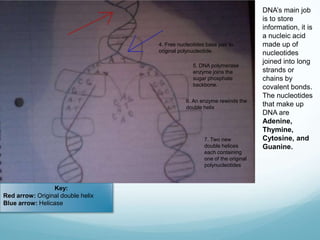
4. Free nucleotides base pair to
original polynucleotide.
5. DNA polymerase
enzyme joins the
sugar phosphate
backbone.
6. An enzyme rewinds the
double helix

7. Two new
double helices
each containing
one of the original
polynucleotides

Key:
Red arrow: Original double helix
Blue arrow: Helicase

DNA’s main job
is to store
information, it is
a nucleic acid
made up of
nucleotides
joined into long
strands or
chains by
covalent bonds.
The nucleotides
that make up
DNA are
Adenine,
Thymine,
Cytosine, and
Guanine.
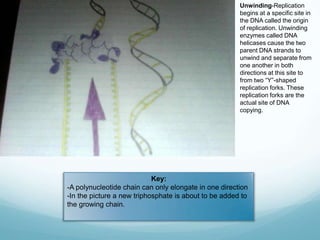
Unwinding-Replication
begins at a specific site in
the DNA called the origin
of replication. Unwinding
enzymes called DNA
helicases cause the two
parent DNA strands to
unwind and separate from
one another in both
directions at this site to
from two “Y”-shaped
replication forks. These
replication forks are the
actual site of DNA
copying.

Key:
-A polynucleotide chain can only elongate in one direction
-In the picture a new triphosphate is about to be added to
the growing chain.
Key:
-one of the new
polynucleotide chains can
elongate continuously.
-the other growing chain
does so in short lengths
which must later be joined
together.

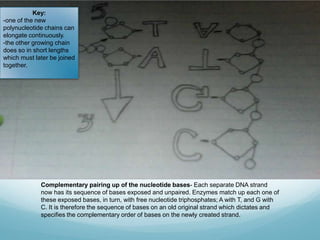
Complementary pairing up of the nucleotide bases- Each separate DNA strand
now has its sequence of bases exposed and unpaired. Enzymes match up each one of
these exposed bases, in turn, with free nucleotide triphosphates; A with T, and G with
C. It is therefore the sequence of bases on an old original strand which dictates and
specifies the complementary order of bases on the newly created strand.
Key:
-One of the new
polynucleotide chains can
elongate continuously
-the other growing chain does
so in short lengths which
must later be joined together.

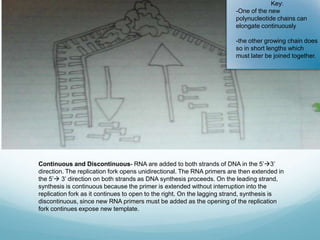
Continuous and Discontinuous- RNA are added to both strands of DNA in the 5’3’
direction. The replication fork opens unidirectional. The RNA primers are then extended in
the 5’ 3’ direction on both strands as DNA synthesis proceeds. On the leading strand,
synthesis is continuous because the primer is extended without interruption into the
replication fork as it continues to open to the right. On the lagging strand, synthesis is
discontinuous, since new RNA primers must be added as the opening of the replication
fork continues expose new template.
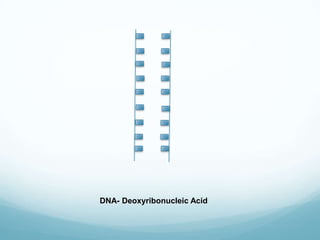
DNA- Deoxyribonucleic Acid
A-T

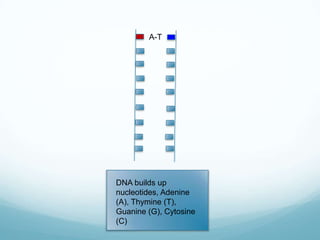
DNA builds up
nucleotides, Adenine
(A), Thymine (T),
Guanine (G), Cytosine
(C)
A-T
G-C

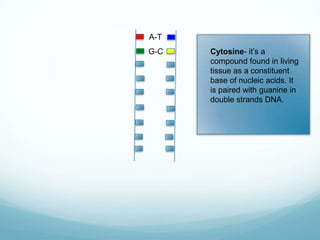
Cytosine- it’s a
compound found in living
tissue as a constituent
base of nucleic acids. It
is paired with guanine in
double strands DNA.
A-T
G-C
C-G

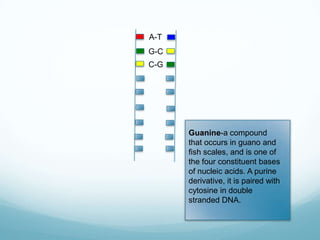
Guanine-a compound
that occurs in guano and
fish scales, and is one of
the four constituent bases
of nucleic acids. A purine
derivative, it is paired with
cytosine in double
stranded DNA.
A-T
G-C
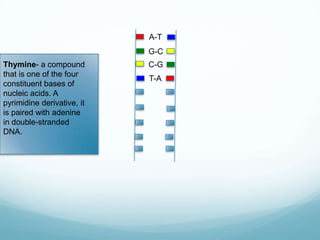
Thymine- a compound
that is one of the four
constituent bases of
nucleic acids. A
pyrimidine derivative, it
is paired with adenine
in double-stranded
DNA.

C-G

T-A
A-T
G-C
C-G

T-A
C-G

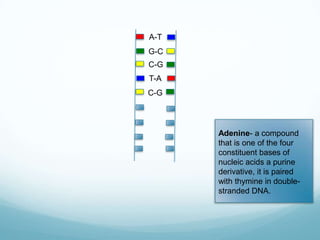
Adenine- a compound
that is one of the four
constituent bases of
nucleic acids a purine
derivative, it is paired
with thymine in doublestranded DNA.
A-T
G-C
C-G

T-A
C-G
G-C

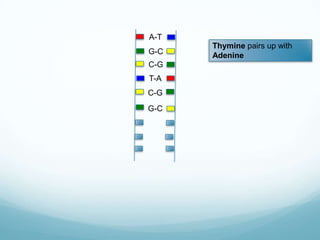
Thymine pairs up with
Adenine
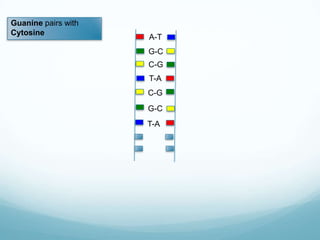
Guanine pairs with
Cytosine

A-T
G-C
C-G

T-A
C-G
G-C
T-A
A-T
G-C
C-G

T-A
C-G
G-C
T-A

A-t
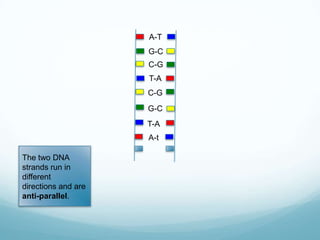
The two DNA
strands run in
different
directions and are
anti-parallel.
A-T
G-C
C-G

T-A
C-G
G-C
T-A

A-t
A-t

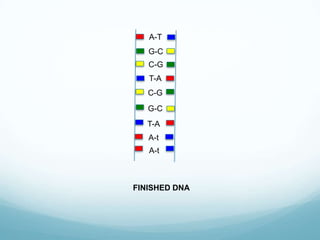
FINISHED DNA
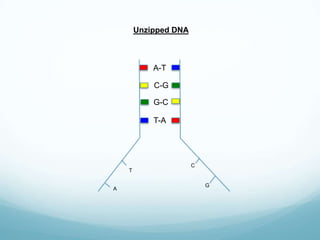
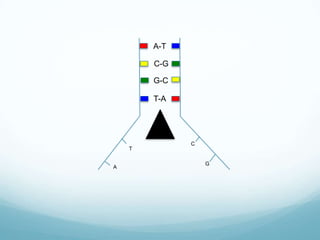
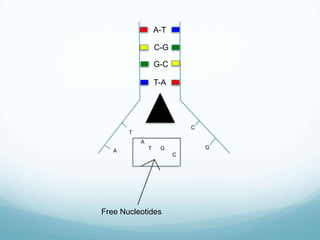
Unzipped DNA

A-T
C-G
G-C
T-A

T

A

C

G
A-T
C-G

G-C
T-A

T

A

C

G
A-T
C-G

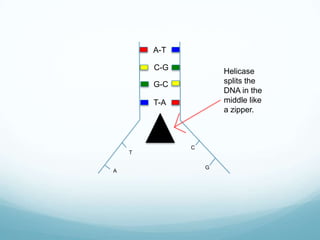
Helicase
splits the
DNA in the
middle like
a zipper.

G-C
T-A

T

A

C

G
A-T
C-G
G-C

T-A

C

T
A
A

T

G

G
C
A-T
C-G
G-C
T-A

C

T

A
A

T

G

G

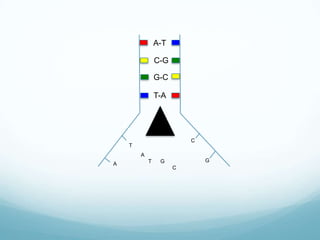
Free Nucleotides

C
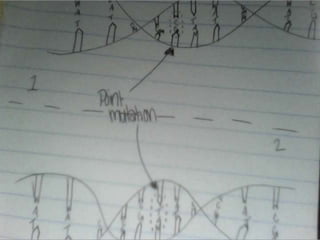
Mutations
In genetics, a mutation is a change of the nucleotide
sequence of the genome of an organism, virus, or extra
chromosomal genetic element.
Mutations result from unrepaired damage to DNA or to
RNA genomes (typically caused by radiation or chemical
mutagens)
Errors in the process of replication, or form the insertion
or deletion of segments of DNA by mobile genetic
elements.
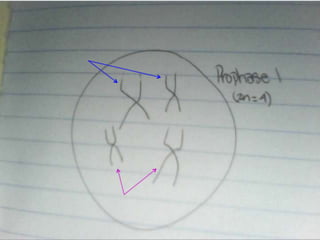
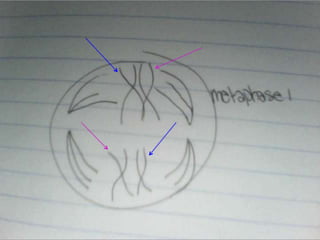
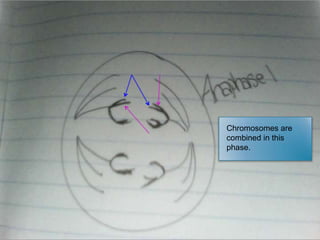
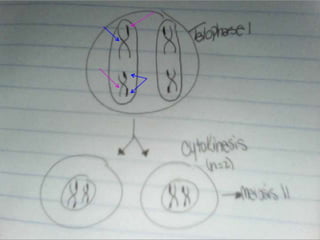
Meiosis
Meiosis is a special type of cell division necessary for
sexual reproduction in eukaryotes, such as animals,
plants and fungi.

The number of sets of chromosomes in the cell
undergoing meiosis is reduced to half the original number.
Chromosomes are
combined in this
phase.
Mitosis
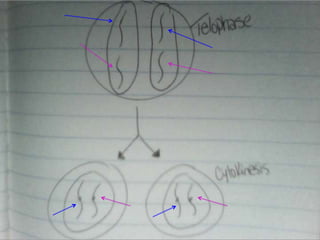
Mitosis is the process, in the cell cycle, by which a cell
duplicates into two genetically alike daughter cells.
In mitosis, chromosomes in the cell nucleus are separated
into two identical sets of chromosomes, each in its own
nucleus.

It is a form of nuclear division.
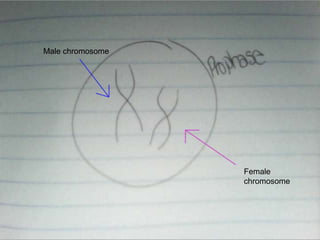
Male chromosome

Female
chromosome
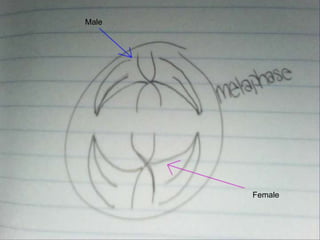
Male

Female
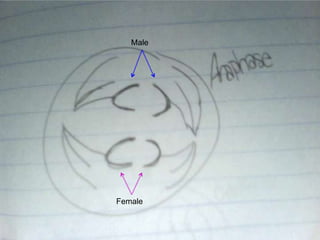
Male

Female
Citations/sources
 http://www.brooklyn.cuny.edu/bc/ahp/LAD/C4/C4_Stag
esReplication.html

Kerrreplicationmodel

  • 1.
    DNA Replication Model By:Jessica Kerr Pd. 1+2
  • 2.
    4. Free nucleotidesbase pair to original polynucleotide. 5. DNA polymerase enzyme joins the sugar phosphate backbone. 6. An enzyme rewinds the double helix 7. Two new double helices each containing one of the original polynucleotides Key: Red arrow: Original double helix Blue arrow: Helicase DNA’s main job is to store information, it is a nucleic acid made up of nucleotides joined into long strands or chains by covalent bonds. The nucleotides that make up DNA are Adenine, Thymine, Cytosine, and Guanine.
  • 3.
    Unwinding-Replication begins at aspecific site in the DNA called the origin of replication. Unwinding enzymes called DNA helicases cause the two parent DNA strands to unwind and separate from one another in both directions at this site to from two “Y”-shaped replication forks. These replication forks are the actual site of DNA copying. Key: -A polynucleotide chain can only elongate in one direction -In the picture a new triphosphate is about to be added to the growing chain.
  • 4.
    Key: -one of thenew polynucleotide chains can elongate continuously. -the other growing chain does so in short lengths which must later be joined together. Complementary pairing up of the nucleotide bases- Each separate DNA strand now has its sequence of bases exposed and unpaired. Enzymes match up each one of these exposed bases, in turn, with free nucleotide triphosphates; A with T, and G with C. It is therefore the sequence of bases on an old original strand which dictates and specifies the complementary order of bases on the newly created strand.
  • 5.
    Key: -One of thenew polynucleotide chains can elongate continuously -the other growing chain does so in short lengths which must later be joined together. Continuous and Discontinuous- RNA are added to both strands of DNA in the 5’3’ direction. The replication fork opens unidirectional. The RNA primers are then extended in the 5’ 3’ direction on both strands as DNA synthesis proceeds. On the leading strand, synthesis is continuous because the primer is extended without interruption into the replication fork as it continues to open to the right. On the lagging strand, synthesis is discontinuous, since new RNA primers must be added as the opening of the replication fork continues expose new template.
  • 6.
  • 7.
    A-T DNA builds up nucleotides,Adenine (A), Thymine (T), Guanine (G), Cytosine (C)
  • 8.
    A-T G-C Cytosine- it’s a compoundfound in living tissue as a constituent base of nucleic acids. It is paired with guanine in double strands DNA.
  • 9.
    A-T G-C C-G Guanine-a compound that occursin guano and fish scales, and is one of the four constituent bases of nucleic acids. A purine derivative, it is paired with cytosine in double stranded DNA.
  • 10.
    A-T G-C Thymine- a compound thatis one of the four constituent bases of nucleic acids. A pyrimidine derivative, it is paired with adenine in double-stranded DNA. C-G T-A
  • 11.
    A-T G-C C-G T-A C-G Adenine- a compound thatis one of the four constituent bases of nucleic acids a purine derivative, it is paired with thymine in doublestranded DNA.
  • 12.
  • 13.
  • 14.
    A-T G-C C-G T-A C-G G-C T-A A-t The two DNA strandsrun in different directions and are anti-parallel.
  • 15.
  • 16.
  • 17.
  • 18.
    A-T C-G Helicase splits the DNA inthe middle like a zipper. G-C T-A T A C G
  • 19.
  • 20.
  • 21.
    Mutations In genetics, amutation is a change of the nucleotide sequence of the genome of an organism, virus, or extra chromosomal genetic element. Mutations result from unrepaired damage to DNA or to RNA genomes (typically caused by radiation or chemical mutagens) Errors in the process of replication, or form the insertion or deletion of segments of DNA by mobile genetic elements.
  • 23.
    Meiosis Meiosis is aspecial type of cell division necessary for sexual reproduction in eukaryotes, such as animals, plants and fungi. The number of sets of chromosomes in the cell undergoing meiosis is reduced to half the original number.
  • 26.
  • 28.
    Mitosis Mitosis is theprocess, in the cell cycle, by which a cell duplicates into two genetically alike daughter cells. In mitosis, chromosomes in the cell nucleus are separated into two identical sets of chromosomes, each in its own nucleus. It is a form of nuclear division.
  • 29.
  • 30.
  • 31.
  • 33.