DNA
REPLICATIO
N
Name: Baco, Bea O.
Program&Section: BSED-SCI
2A
Schedule: TT (8:30-11:30)
Date: 11/07/24
Objectives:
Explain the importance of DNA
replication.
Describe the steps involved in the
process of DNA replication.
• Identify the functions of the key
enzymes involved in DNA replication.
What is DNA Replication?
DNA replication is the process in
which a cell makes an identical
copy of its DNA. It is vital for cell
growth, repair, and reproduction
in organisms as it helps with the
transmission of genetic
information.
DNA
Is a molecule made up of two
strands twisted around each
other in a double helix shape.
FOUR BASES OF DNA
A (Adenine)
always pairs with
T (Thymine)
G (Guanine) always
pairs with C
(Cytosine)
A T G C
ADENINE
THYMINE
GUANINE
CYTOSINE
When does DNA Replication
Happen?
DNA is replicated during the S
phase of the cell cycle.
Where does DNA Replication
Occur?
DNA replication occurs in the
cytoplasm of prokaryotes and
in the nucleus of eukaryotes
Three Theories of DNA
Replication
1. Conservative Replication Model
In the conservative model, the original DNA
molecule remains completely intact, and an
entirely new, separate DNA molecule is
synthesized. After replication, one daughter
molecule would consist of both original
strands, while the other would consist of
two new strands.
Three Theories of DNA
Replication
2. Semi- Conservative Replication Model
The semi-conservative model proposes
that each of the two strands of the original
DNA molecule serves as a template for a
new strand. After replication, each
daughter DNA molecule has one original
strand (from the parent molecule) and one
newly synthesized strand.
Three Theories of DNA
Replication
3. Dispersive Model
In the dispersive model, DNA replication is
thought to occur in a fragmented way,
where each resulting strand is a mixture of
old and new DNA segments. The parent
DNA is broken into segments, and the new
DNA is interspersed with the old segments
within each strand.
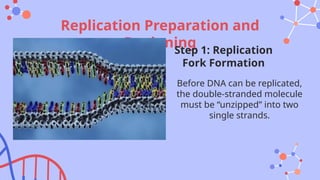
Replication Preparation and
Beginning
Before DNA can be replicated,
the double-stranded molecule
must be “unzipped” into two
single strands.
Step 1: Replication
Fork Formation
DNA HELICASE
DNA helicase disrupts the hydrogen bonding
between base pairs to separate the strands
into a Y shape known as the replication fork.
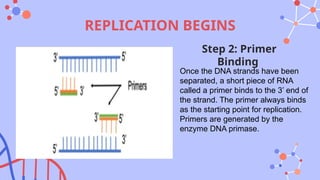
REPLICATION BEGINS
Step 2: Primer
Binding
Once the DNA strands have been
separated, a short piece of RNA
called a primer binds to the 3’ end of
the strand. The primer always binds
as the starting point for replication.
Primers are generated by the
enzyme DNA primase.
REPLICATION BEGINS
Step 2: Primer
Binding
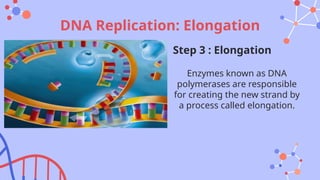
DNA Replication: Elongation
Enzymes known as DNA
polymerases are responsible
for creating the new strand by
a process called elongation.
Step 3 : Elongation
DNA
REPLICATION
FORK
DNA REPLICATION: ELONGATION
Step 3: Elongation
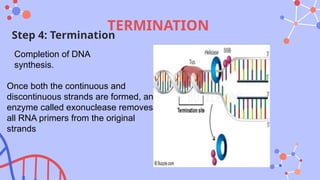
TERMINATION
Step 4: Termination
Completion of DNA
synthesis.
Once both the continuous and
discontinuous strands are formed, an
enzyme called exonuclease removes
all RNA primers from the original
strands
TERMINATION
Step 4: Termination
Completion of DNA
synthesis.
Another exonuclease “proofreads”
the newly formed DNA to check,
remove, and replace any errors.
Another enzyme called DNA ligase
joins Okazaki fragments together
forming a single unified strand
References
Cells can replicate their DNA precisely | Learn science at Scitable. (n.d.).
https://www.nature.com/scitable/topicpage/cells-can-replicate-their-dna-
precisely-6524830/
Khan Academy. (n.d.).
https://www.khanacademy.org/science/ap-biology/gene-expression-and-
regulation/replication/a/molecular-mechanism-of-dna-replication
Alberts, B., Johnson, A., Lewis, J., Raff, M., Roberts, K., & Walter, P. (2002).
DNA replication mechanisms. Molecular Biology of the Cell – NCBI
Bookshelf. https://www.ncbi.nlm.nih.gov/books/NBK26850/
Admin. (2024, July 2). DNA Replication Process with Diagrams Class 12 –
Prokaryotic & Eukaryotic DNA Replication. BYJUS.
https://byjus.com/biology/dna-replication-machinery-enzymes/

DNA REPLICATION. Bsed science PowerPoint

  • 1.
    DNA REPLICATIO N Name: Baco, BeaO. Program&Section: BSED-SCI 2A Schedule: TT (8:30-11:30) Date: 11/07/24
  • 2.
    Objectives: Explain the importanceof DNA replication. Describe the steps involved in the process of DNA replication. • Identify the functions of the key enzymes involved in DNA replication.
  • 3.
    What is DNAReplication? DNA replication is the process in which a cell makes an identical copy of its DNA. It is vital for cell growth, repair, and reproduction in organisms as it helps with the transmission of genetic information.
  • 4.
    DNA Is a moleculemade up of two strands twisted around each other in a double helix shape.
  • 5.
    FOUR BASES OFDNA A (Adenine) always pairs with T (Thymine) G (Guanine) always pairs with C (Cytosine) A T G C ADENINE THYMINE GUANINE CYTOSINE
  • 6.
    When does DNAReplication Happen? DNA is replicated during the S phase of the cell cycle.
  • 7.
    Where does DNAReplication Occur? DNA replication occurs in the cytoplasm of prokaryotes and in the nucleus of eukaryotes
  • 8.
    Three Theories ofDNA Replication 1. Conservative Replication Model In the conservative model, the original DNA molecule remains completely intact, and an entirely new, separate DNA molecule is synthesized. After replication, one daughter molecule would consist of both original strands, while the other would consist of two new strands.
  • 9.
    Three Theories ofDNA Replication 2. Semi- Conservative Replication Model The semi-conservative model proposes that each of the two strands of the original DNA molecule serves as a template for a new strand. After replication, each daughter DNA molecule has one original strand (from the parent molecule) and one newly synthesized strand.
  • 10.
    Three Theories ofDNA Replication 3. Dispersive Model In the dispersive model, DNA replication is thought to occur in a fragmented way, where each resulting strand is a mixture of old and new DNA segments. The parent DNA is broken into segments, and the new DNA is interspersed with the old segments within each strand.
  • 11.
    Replication Preparation and Beginning BeforeDNA can be replicated, the double-stranded molecule must be “unzipped” into two single strands. Step 1: Replication Fork Formation
  • 12.
    DNA HELICASE DNA helicasedisrupts the hydrogen bonding between base pairs to separate the strands into a Y shape known as the replication fork.
  • 13.
    REPLICATION BEGINS Step 2:Primer Binding Once the DNA strands have been separated, a short piece of RNA called a primer binds to the 3’ end of the strand. The primer always binds as the starting point for replication. Primers are generated by the enzyme DNA primase.
  • 14.
  • 15.
    DNA Replication: Elongation Enzymesknown as DNA polymerases are responsible for creating the new strand by a process called elongation. Step 3 : Elongation
  • 16.
  • 17.
  • 18.
    TERMINATION Step 4: Termination Completionof DNA synthesis. Once both the continuous and discontinuous strands are formed, an enzyme called exonuclease removes all RNA primers from the original strands
  • 19.
    TERMINATION Step 4: Termination Completionof DNA synthesis. Another exonuclease “proofreads” the newly formed DNA to check, remove, and replace any errors. Another enzyme called DNA ligase joins Okazaki fragments together forming a single unified strand
  • 20.
    References Cells can replicatetheir DNA precisely | Learn science at Scitable. (n.d.). https://www.nature.com/scitable/topicpage/cells-can-replicate-their-dna- precisely-6524830/ Khan Academy. (n.d.). https://www.khanacademy.org/science/ap-biology/gene-expression-and- regulation/replication/a/molecular-mechanism-of-dna-replication Alberts, B., Johnson, A., Lewis, J., Raff, M., Roberts, K., & Walter, P. (2002). DNA replication mechanisms. Molecular Biology of the Cell – NCBI Bookshelf. https://www.ncbi.nlm.nih.gov/books/NBK26850/ Admin. (2024, July 2). DNA Replication Process with Diagrams Class 12 – Prokaryotic & Eukaryotic DNA Replication. BYJUS. https://byjus.com/biology/dna-replication-machinery-enzymes/