DNA REPLICATION
BY
AVINASH TIWARI
M. Tech
Biotechnology
201710902010002
INTRODUCTION
• All organisms must duplicate their DNA accurately
before every cell division.
• producing two identical replicas of DNA from one
original DNA molecule.
• SEMI CONSRVATIVE & initiated at unique origins, and
usually proceeds bidirectional
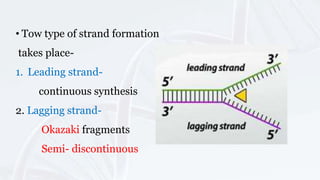
• Tow type of strand formation
takes place-
1. Leading strand-
continuous synthesis
2. Lagging strand-
Okazaki fragments
Semi- discontinuous
Overview of DNA replication
COMPONENT OF DNA
REPLICATION
• HELICASE -Process unwinding of DNA
• TOPOISOMERASE Relieve torsional strain that results from
helicase-induced unwinding
• RNA PRIMASE Initiates synthesis of RNA primers
• DNA POLYMERASE- Deoxy nucleotide polymerization
• SINGLE STRANDED BINDING PROTEIN Prevent premature
reannealing of dsDNA
• DNA LIGASE Seals the single strand nick between the nascent
chain and Okazaki fragments on lagging strand
Primer
• A short segment of DNA or RNA (18-22 bp) – RNA
primer by Primase
• Give a starting point on the growing DNA strands
• It has free 3’ OH group to which the first nucleotide is
bound
• Strands only grow in 5’-3’
• Only one primer is require on
leading strands
• on lagging strand- depends
upon Okazaki fragments
STEPS IN DNA REPLICATION
• Identification of the origins of replication
• Unwinding (denaturation) of dsDNA to provide an
ssDNA template
• Formation of the replication fork
• Initiation of DNA synthesis and elongation
• Primer removal and ligation of the newly synthesized
DNA segments
• Reconstitution of chromatin structure
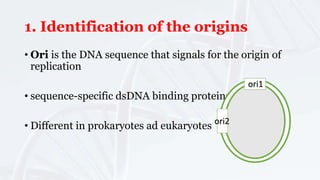
1. Identification of the origins
• Ori is the DNA sequence that signals for the origin of
replication
• sequence-specific dsDNA binding proteins.
• Different in prokaryotes ad eukaryotes
ori1
ori2
For Prokaryotes
• complex is formed consisting
of 150–250 bp of DNA and
multimers of the DNAbinding
protein.
• This leads to the local
denaturation and unwinding
of an adjacent A+T-rich
region of DNA.
For Eukaryotes
• Functionally similar
autonomously
replicating
sequences (ARS) or
replicators have been
identified in yeast cells.
• The ARS contains a
somewhat degenerate 11-bp
sequence called the origin
replication element
(ORE).
2. Unwinding of
DNA
Principles of Cell Biology (Department of Biology Memorial
University of Newfoundland)
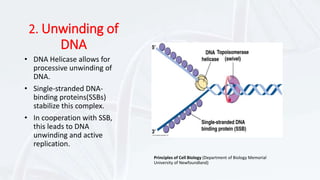
• DNA Helicase allows for
processive unwinding of
DNA.
• Single-stranded DNA-
binding proteins(SSBs)
stabilize this complex.
• In cooperation with SSB,
this leads to DNA
unwinding and active
replication.
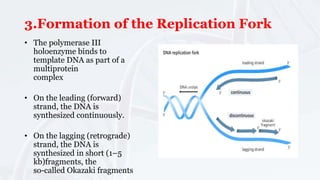
3.Formation of the Replication Fork
• The polymerase III
holoenzyme binds to
template DNA as part of a
multiprotein
complex
• On the leading (forward)
strand, the DNA is
synthesized continuously.
• On the lagging (retrograde)
strand, the DNA is
synthesized in short (1–5
kb)fragments, the
so-called Okazaki fragments
Differences between DNA Polymerase
I, II and III
4.Initiation of DNA synthesis and
elongation
• Selection of the proper deoxy ribonucleotide
whose terminal 3'-hydroxyl group is to be
attacked is dependent upon proper base
pairing with the other strand of the DNA
molecule according to the rules proposed
originally by Watson and Crick
4.Primer removal
• Primers are removed by DNA polymerase I by replacing
ribonucleotides with deoxy Ribonucleotides
• Nicks are sealed by DNA ligase
• Multiple primers on the Lagging strand
while single primer on the leading
strand.
5. Reconstitution of Chromatin Structure
• chromatin structure must be re-formed after
replication.
• Newly replicated DNA is rapidly assembled into
nucleosomes,
&
• the preexisting and newly assembled histone octamers
are
randomly distributed to each arm of the replication
fork.
Reference
• Smita rastogi & Neelam Pathak, Genetic engineering, Oxford press
• Molecular Cell Biology, Lodish, 5Th Ed.
• Watson J.D., et al. (5th edition, 2004) Molecular Biology of the Gene
Principles of Cell Biology (Department of Biology Memorial University of
Newfoundland
• https://www.youtube.com/watch?v=G1rIUVSjR3A
• https://www.quora.com/What-is-a-replication-fork
• http://www.onlinebiologynotes.com/dna-replication/
• https://www.researchgate.net/figure/a-A-DNA-primer-anneals-to-the-
template-sequence-of-DNA-DNA-polymerase-binds_fig1_233826856
Dna  replication

Dna replication

  • 1.
    DNA REPLICATION BY AVINASH TIWARI M.Tech Biotechnology 201710902010002
  • 2.
    INTRODUCTION • All organismsmust duplicate their DNA accurately before every cell division. • producing two identical replicas of DNA from one original DNA molecule. • SEMI CONSRVATIVE & initiated at unique origins, and usually proceeds bidirectional
  • 3.
    • Tow typeof strand formation takes place- 1. Leading strand- continuous synthesis 2. Lagging strand- Okazaki fragments Semi- discontinuous
  • 4.
    Overview of DNAreplication
  • 5.
    COMPONENT OF DNA REPLICATION •HELICASE -Process unwinding of DNA • TOPOISOMERASE Relieve torsional strain that results from helicase-induced unwinding • RNA PRIMASE Initiates synthesis of RNA primers • DNA POLYMERASE- Deoxy nucleotide polymerization • SINGLE STRANDED BINDING PROTEIN Prevent premature reannealing of dsDNA • DNA LIGASE Seals the single strand nick between the nascent chain and Okazaki fragments on lagging strand
  • 6.
    Primer • A shortsegment of DNA or RNA (18-22 bp) – RNA primer by Primase • Give a starting point on the growing DNA strands • It has free 3’ OH group to which the first nucleotide is bound
  • 7.
    • Strands onlygrow in 5’-3’ • Only one primer is require on leading strands • on lagging strand- depends upon Okazaki fragments
  • 8.
    STEPS IN DNAREPLICATION • Identification of the origins of replication • Unwinding (denaturation) of dsDNA to provide an ssDNA template • Formation of the replication fork • Initiation of DNA synthesis and elongation • Primer removal and ligation of the newly synthesized DNA segments • Reconstitution of chromatin structure
  • 9.
    1. Identification ofthe origins • Ori is the DNA sequence that signals for the origin of replication • sequence-specific dsDNA binding proteins. • Different in prokaryotes ad eukaryotes ori1 ori2
  • 10.
    For Prokaryotes • complexis formed consisting of 150–250 bp of DNA and multimers of the DNAbinding protein. • This leads to the local denaturation and unwinding of an adjacent A+T-rich region of DNA. For Eukaryotes • Functionally similar autonomously replicating sequences (ARS) or replicators have been identified in yeast cells. • The ARS contains a somewhat degenerate 11-bp sequence called the origin replication element (ORE).
  • 11.
    2. Unwinding of DNA Principlesof Cell Biology (Department of Biology Memorial University of Newfoundland) • DNA Helicase allows for processive unwinding of DNA. • Single-stranded DNA- binding proteins(SSBs) stabilize this complex. • In cooperation with SSB, this leads to DNA unwinding and active replication.
  • 12.
    3.Formation of theReplication Fork • The polymerase III holoenzyme binds to template DNA as part of a multiprotein complex • On the leading (forward) strand, the DNA is synthesized continuously. • On the lagging (retrograde) strand, the DNA is synthesized in short (1–5 kb)fragments, the so-called Okazaki fragments
  • 13.
    Differences between DNAPolymerase I, II and III
  • 14.
    4.Initiation of DNAsynthesis and elongation • Selection of the proper deoxy ribonucleotide whose terminal 3'-hydroxyl group is to be attacked is dependent upon proper base pairing with the other strand of the DNA molecule according to the rules proposed originally by Watson and Crick
  • 15.
    4.Primer removal • Primersare removed by DNA polymerase I by replacing ribonucleotides with deoxy Ribonucleotides • Nicks are sealed by DNA ligase • Multiple primers on the Lagging strand while single primer on the leading strand.
  • 16.
    5. Reconstitution ofChromatin Structure • chromatin structure must be re-formed after replication. • Newly replicated DNA is rapidly assembled into nucleosomes, & • the preexisting and newly assembled histone octamers are randomly distributed to each arm of the replication fork.
  • 17.
    Reference • Smita rastogi& Neelam Pathak, Genetic engineering, Oxford press • Molecular Cell Biology, Lodish, 5Th Ed. • Watson J.D., et al. (5th edition, 2004) Molecular Biology of the Gene Principles of Cell Biology (Department of Biology Memorial University of Newfoundland • https://www.youtube.com/watch?v=G1rIUVSjR3A • https://www.quora.com/What-is-a-replication-fork • http://www.onlinebiologynotes.com/dna-replication/ • https://www.researchgate.net/figure/a-A-DNA-primer-anneals-to-the- template-sequence-of-DNA-DNA-polymerase-binds_fig1_233826856