Transcription factor
By
Avinash Tiwari
M. Tech 1st year
1st semester
201710902010002
CONTENT
1. Introduction
2. Classification
3. Activity
4. Some examples of transcription factors
Introduction:
• The process of transcription is the first stage of gene expression
resulting in the production of a primary RNA transcript from the DNA
of a particular gene.
• This step of gene expression which is followed by a number of post-
transcriptional processes such as RNA splicing and translation.
• These lead ultimately to the production of a functional protein and
this process is highly regulated.
• Both basal transcription and its regulation are dependent upon
specific protein factors known as transcription factors.
• These highly specific protein bind to the specific regulatory gene of
DNA sequence and control the transcription process and regulate it.
• For example- enzyme RNA polymerase catalyzes the chemical
reaction that synthesize RNA, using the DNA gene as a template, the
transcription factor control when, where, and how efficiency RNA
polymerase function.
• Play a important role in the normal development and routine of
cellular function.
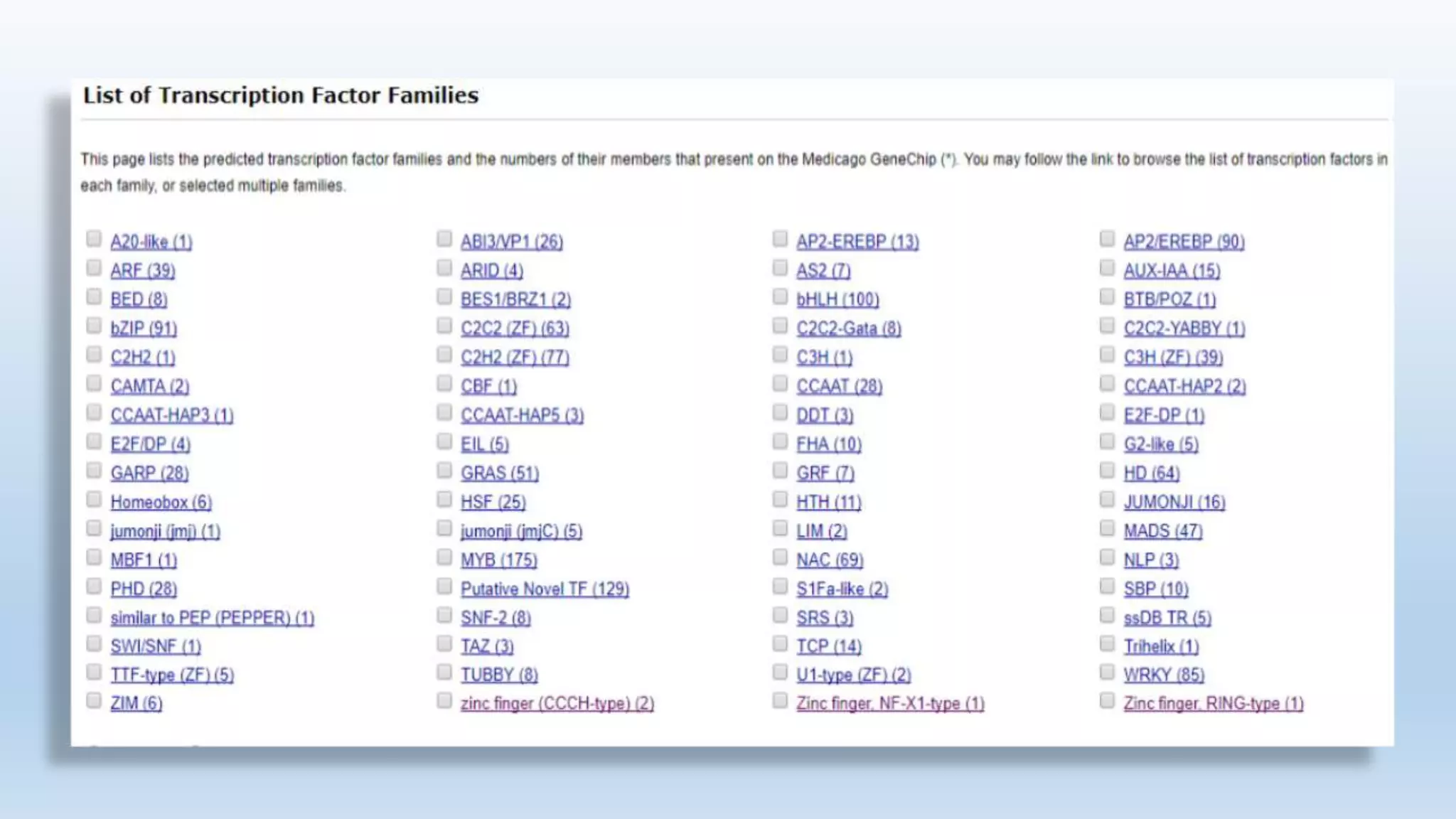
Classification:
• transcription factors are commonly classified into families on the
basis of the precise protein structure which they use to mediate
binding to DNA or to cause factor dimerization which is often
essential for DNA binding.
Activity of transcription factor:
Transcription
factor
(a). Activation:
• Some transcription factors activate transcription. For instance, they
may help the general transcription factors and/or RNA polymerase
bind to the promoter, as shown in the diagram
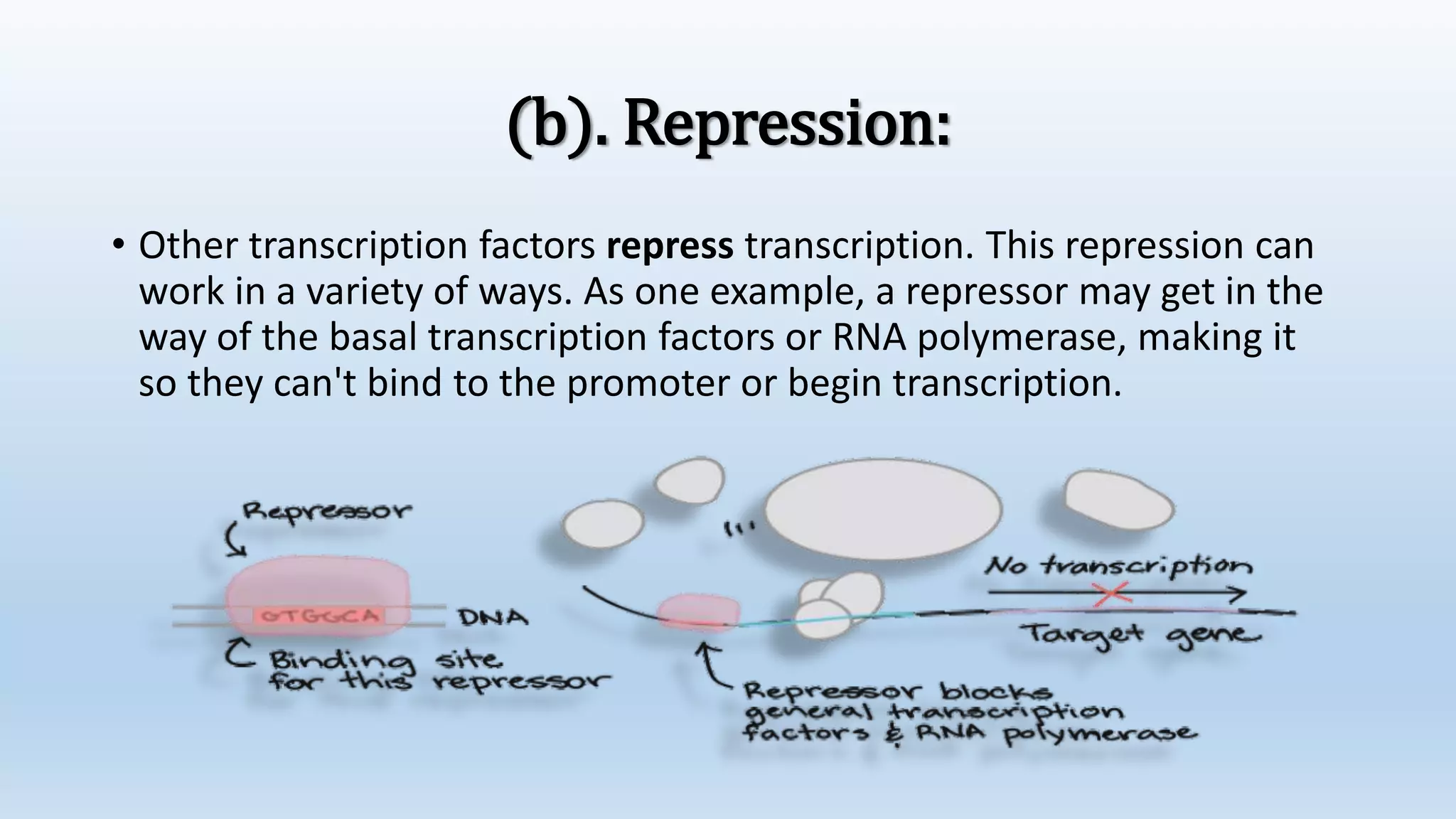
(b). Repression:
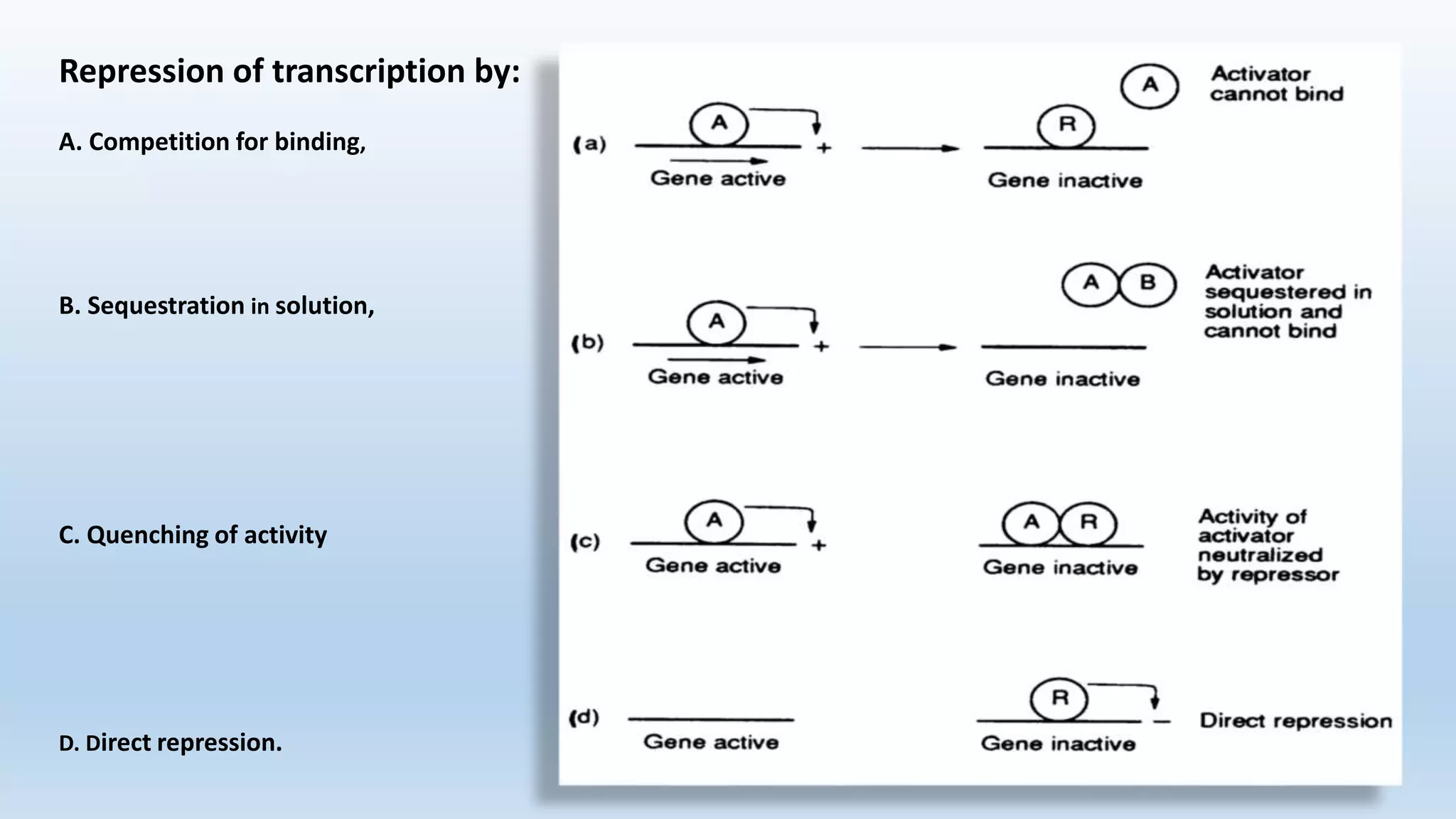
• Other transcription factors repress transcription. This repression can
work in a variety of ways. As one example, a repressor may get in the
way of the basal transcription factors or RNA polymerase, making it
so they can't bind to the promoter or begin transcription.
Repression of transcription by:
A. Competition for binding,
B. Sequestration in solution,
C. Quenching of activity
D. Direct repression.
Some example of Transcription Factor
Kruppel-like factor 4 (KLF-4):
• Kru¨ppel-like factor 4 (KLF-4) is family of zinc finger containing
transcription factor
• Highly expressed in epithelial of gastrointestinal tract, skin and
vascular endothelial cells.
• Play a important roll during the differentiation of gut epithelial cell.
• KLF4 activates the promoter of the negative cell-cycle-regulatory
cyclin-dependent kinase inhibitor p21WAF/Cip1 gene in a p53-
dependent manner
• Induces cell cycle arrest at the transition from G1 to S phase
• Altered expression of KLF4 may be involved in the tumorigenesis of
several kinds of human cancers, including-
• Colon cancer
• Breast cancer
• Gastric cancer
• Esophageal cancer
• bladder cancers cancer
Kruppel-like factor 7 (KLF-7):
• Krüppel-like factor 7 (KLF7), a member of Krüppel-like transcription
factors (KLFs), also known as ubiquitous Krüppel like factor (UKLF)
• ubiquitously expressed in various tissues of adult human beings.
• Genetics reports showed that the genetic polymorphism of KLF7 is
associated with obesity, type 2 diabetes, mental development in
human beings.
• KLF7 methylation is associated with the development of diffuse
gastric cancer (gastric adenocarcinoma).
• KLF7 is one of the key transcription factors in the regulatory networks
of serum markers change during the cardiovascular disease.
• involved in the regulation of the development and function of the
nervous system and adipose tissue, blood diseases, as well as
pluripotent cells maintenance.
Transcription factor

Transcription factor

  • 1.
    Transcription factor By Avinash Tiwari M.Tech 1st year 1st semester 201710902010002
  • 2.
    CONTENT 1. Introduction 2. Classification 3.Activity 4. Some examples of transcription factors
  • 3.
    Introduction: • The processof transcription is the first stage of gene expression resulting in the production of a primary RNA transcript from the DNA of a particular gene. • This step of gene expression which is followed by a number of post- transcriptional processes such as RNA splicing and translation. • These lead ultimately to the production of a functional protein and this process is highly regulated. • Both basal transcription and its regulation are dependent upon specific protein factors known as transcription factors.
  • 4.
    • These highlyspecific protein bind to the specific regulatory gene of DNA sequence and control the transcription process and regulate it. • For example- enzyme RNA polymerase catalyzes the chemical reaction that synthesize RNA, using the DNA gene as a template, the transcription factor control when, where, and how efficiency RNA polymerase function. • Play a important role in the normal development and routine of cellular function.
  • 6.
    Classification: • transcription factorsare commonly classified into families on the basis of the precise protein structure which they use to mediate binding to DNA or to cause factor dimerization which is often essential for DNA binding.
  • 8.
    Activity of transcriptionfactor: Transcription factor
  • 9.
    (a). Activation: • Sometranscription factors activate transcription. For instance, they may help the general transcription factors and/or RNA polymerase bind to the promoter, as shown in the diagram
  • 10.
    (b). Repression: • Othertranscription factors repress transcription. This repression can work in a variety of ways. As one example, a repressor may get in the way of the basal transcription factors or RNA polymerase, making it so they can't bind to the promoter or begin transcription.
  • 11.
    Repression of transcriptionby: A. Competition for binding, B. Sequestration in solution, C. Quenching of activity D. Direct repression.
  • 12.
    Some example ofTranscription Factor
  • 13.
    Kruppel-like factor 4(KLF-4): • Kru¨ppel-like factor 4 (KLF-4) is family of zinc finger containing transcription factor • Highly expressed in epithelial of gastrointestinal tract, skin and vascular endothelial cells. • Play a important roll during the differentiation of gut epithelial cell. • KLF4 activates the promoter of the negative cell-cycle-regulatory cyclin-dependent kinase inhibitor p21WAF/Cip1 gene in a p53- dependent manner
  • 14.
    • Induces cellcycle arrest at the transition from G1 to S phase • Altered expression of KLF4 may be involved in the tumorigenesis of several kinds of human cancers, including- • Colon cancer • Breast cancer • Gastric cancer • Esophageal cancer • bladder cancers cancer
  • 15.
    Kruppel-like factor 7(KLF-7): • Krüppel-like factor 7 (KLF7), a member of Krüppel-like transcription factors (KLFs), also known as ubiquitous Krüppel like factor (UKLF) • ubiquitously expressed in various tissues of adult human beings. • Genetics reports showed that the genetic polymorphism of KLF7 is associated with obesity, type 2 diabetes, mental development in human beings. • KLF7 methylation is associated with the development of diffuse gastric cancer (gastric adenocarcinoma).
  • 16.
    • KLF7 isone of the key transcription factors in the regulatory networks of serum markers change during the cardiovascular disease. • involved in the regulation of the development and function of the nervous system and adipose tissue, blood diseases, as well as pluripotent cells maintenance.

Editor's Notes

  • #14 KLF 4 is also known as the gut enriched KLF of epithelial zinc finger Post mitotic terminally differentiated cells…..reported in middle layer to upper region of the crypt