Ministry of Higher
education & scientific
Research
Al-Mustaqbal University
Collage
Department of Medical
lab. Techniques
• Structure of the Y Chromosome
• Advantages of Y Chromosome Markers
• Commonly Used of Y Chromosome Markers
• Y STR Multiplex Assays
• Applications of Y STR in forensic medicine
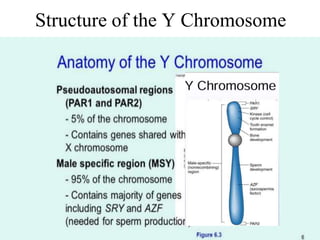
Structure of the Y Chromosome
p
q
•forensic investigations
•genealogical purposes
•evolutionary studies
•Advantages to human identity
testing
•paternal lineages
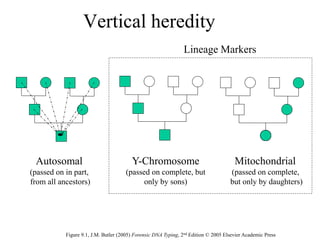
Autosomal
(passed on in part,
from all ancestors)
Y-Chromosome
(passed on complete, but
only by sons)
Mitochondrial
(passed on complete,
but only by daughters)
Lineage Markers
Figure 9.1, J.M. Butler (2005) Forensic DNA Typing, 2nd Edition © 2005 Elsevier Academic Press
Vertical heredity
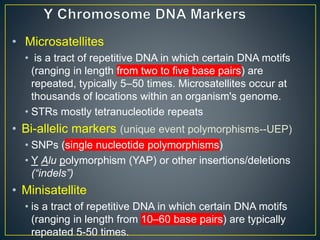
• Microsatellites
• is a tract of repetitive DNA in which certain DNA motifs
(ranging in length from two to five base pairs) are
repeated, typically 5–50 times. Microsatellites occur at
thousands of locations within an organism's genome.
• STRs mostly tetranucleotide repeats
• Bi-allelic markers (unique event polymorphisms--UEP)
• SNPs (single nucleotide polymorphisms)
• Y Alu polymorphism (YAP) or other insertions/deletions
(“indels”)
• Minisatellite
• is a tract of repetitive DNA in which certain DNA motifs
(ranging in length from 10–60 base pairs) are typically
repeated 5-50 times.
• short tandem repeat (STR) in DNA occurs when:
• a pattern of two or more nucleotides are repeated
• the repeated sequences are directly adjacent to each
other.
• The pattern can range in length from 2 to 5 base pairs
(bp)
• is typically located in the non-coding intron region.
• A short tandem repeat polymorphism (STRP) occurs
when homologous STR loci differ in the number of
repeats between individuals.
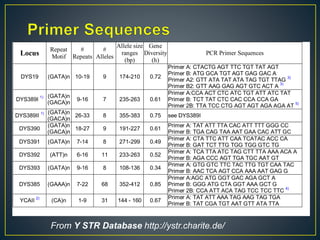
Locus
Repeat
Motif
#
Repeats
#
Alleles
Allele size
ranges
(bp)
Gene
Diversity
(h)
PCR Primer Sequences
DYS19 (GATA)n 10-19 9 174-210 0.72
Primer A: CTACTG AGT TTC TGT TAT AGT
Primer B: ATG GCA TGT AGT GAG GAC A
Primer A2: GTT ATA TAT ATA TAG TGT TTAG
3)
Primer B2: GTT AAG GAG AGT GTC ACT A 3)
DYS389I 1) (GATA)n
(GACA)n
9-16 7 235-263 0.61
Primer A:CCA ACT CTC ATC TGT ATT ATC TAT
Primer B: TCT TAT CTC CAC CCA CCA GA
Primer 2B: TTA TCC CTG AGT AGT AGA AGA AT 5)
DYS389II
1) (GATA)n
(GACA)n
26-33 8 355-383 0.75 see DYS389I
DYS390
(GATA)n
(GACA)n
18-27 9 191-227 0.61
Primer A: TAT ATT TTA CAC ATT TTT GGG CC
Primer B: TGA CAG TAA AAT GAA CAC ATT GC
DYS391 (GATA)n 7-14 8 271-299 0.49
Primer A: CTA TTC ATT CAA TCATAC ACC CA
Primer B: GAT TCT TTG TGG TGG GTC TG
DYS392 (ATT)n 6-16 11 233-263 0.52
Primer A: TCA TTA ATC TAG CTT TTA AAA ACA A
Primer B: AGA CCC AGT TGA TGC AAT GT
DYS393 (GATA)n 9-16 8 108-136 0.34
Primer A: GTG GTC TTC TAC TTG TGT CAA TAC
Primer B: AAC TCA AGT CCA AAA AAT GAG G
DYS385 (GAAA)n 7-22 68 352-412 0.85
Primer A:AGC ATG GGT GAC AGA GCT A
Primer B: GGG ATG CTA GGT AAA GCT G
Primer 2B: CCA ATT ACA TAG TCC TCC TTC 4)
YCAII
2)
(CA)n 1-9 31 144 - 160 0.67
Primer A: TAT ATT AAA TAG AAG TAG TGA
Primer B: TAT CGA TGT AAT GTT ATA TTA
From Y STR Database http://ystr.charite.de/
Y Chromosomal Adam
Applications of Y STR in forensic
medicine
Sources of Biological Evidence
• Blood
• Semen
• Saliva
• Urine
• Hair
• Teeth
• Bone
• Tissue
Blood stain
Only a very small
amount of blood is
needed to obtain a
DNA profile
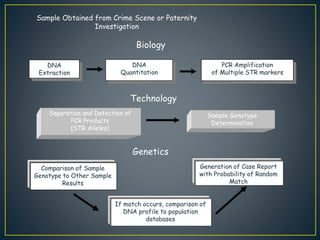
Sample Obtained from Crime Scene or Paternity
Investigation
DNA
Extraction
DNA
Quantitation
PCR Amplification
of Multiple STR markers
Biology
Separation and Detection of
PCR Products
(STR Alleles)
Technology
Sample Genotype
Determination
Genetics
Comparison of Sample
Genotype to Other Sample
Results
If match occurs, comparison of
DNA profile to population
databases
Generation of Case Report
with Probability of Random
Match
DNA Database
STR Typing
DNA
Extraction
Multiplex PCR Amplification
Male: 13,14-15,16-12,13-10,13-15,16
Interpretation of Results
Sample Collection
& Storage
Buccal swab
Blood Stain
DNA
Quantitation
Slot Blot
1 ng
0.3 ng
1 ng
1 ng
0.7 ng
0.5 ng
0.5 ng
No DNA
Capillaries
Electrodes for Injection
Figure 14.4, J.M. Butler (2005) Forensic DNA Typing, 2nd Edition © 2005 Elsevier Academic Press
Scanned
Gel
Image
Capillary Electropherogram
8 repeats
9 repeats
AMEL
D3S1358
TH01
TPOX
D2S1338
D19S433
FGA
D21S11
D18S51
CSF1PO
D16S539
D7S820
D13S317
D5S818
VWA
D8S1179
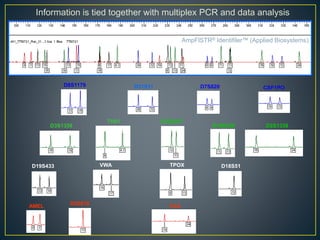
Information is tied together with multiplex PCR and data analysis
AmpFlSTR® Identifiler™ (Applied Biosystems)
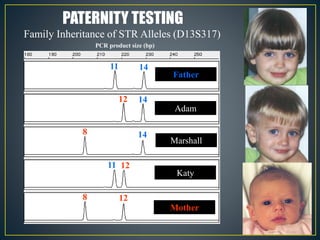
Family Inheritance of STR Alleles (D13S317)
Father
Child #1
Child #2
Child #3
Mother
PCR product size (bp)
11 14
11
12 14
8 14
12
12
8
Adam
Marshall
Katy
Father
Mother
PATERNITY TESTING
Chiaroni 2009
Al-Zahery 2011 Tofanelli 2009
“We got him!”
Saddam Hussein’s
capture verified with
DNA testing
December 14, 2003
DNA Profile
Source: www.cnn.com; The Scientist Dec 19, 2003
Captured December 13, 2003
Is this man really
Sadaam Hussein?
Uday and Qusay Hussein
Killed July 22, 2003
Matching Y-STR
Haplotype Used to
Confirm Identity
(along with allele sharing
from autosomal STRs)
Butler, J.M. (2005) Forensic DNA Typing, 2nd Edition, Box 23.1, p. 534
Uday and Qusay Hussein
Killed
July 22, 2003
Captured December 13, 2003
Source: www.cnn.com
Suspected
Saddam
Portion of DNA Profile
“A Forensic Paternity Test”
Y-chromosome tests were also
used to verify male lineage…
DNA Used as the Ultimate Biometric
for Confirming Saddam’s Identity
Armed Forces DNA
Identification Laboratory
(Rockville, MD)
Identification of Skeletal Remains from
Previous Military Conflicts
Identification of
Michael J. Blassie - Vietnam Tomb of the
Unknown
>2100 Unaccounted for
from Southeast Asia
>8000 Unaccounted for
from Korea
>75,000 Unaccounted for
from WWII
30
THANK YOU FOR ATTENTION

y str markers

  • 1.
    Ministry of Higher education& scientific Research Al-Mustaqbal University Collage Department of Medical lab. Techniques
  • 2.
    • Structure ofthe Y Chromosome • Advantages of Y Chromosome Markers • Commonly Used of Y Chromosome Markers • Y STR Multiplex Assays • Applications of Y STR in forensic medicine
  • 3.
    Structure of theY Chromosome p q
  • 5.
    •forensic investigations •genealogical purposes •evolutionarystudies •Advantages to human identity testing •paternal lineages
  • 6.
    Autosomal (passed on inpart, from all ancestors) Y-Chromosome (passed on complete, but only by sons) Mitochondrial (passed on complete, but only by daughters) Lineage Markers Figure 9.1, J.M. Butler (2005) Forensic DNA Typing, 2nd Edition © 2005 Elsevier Academic Press Vertical heredity
  • 7.
    • Microsatellites • isa tract of repetitive DNA in which certain DNA motifs (ranging in length from two to five base pairs) are repeated, typically 5–50 times. Microsatellites occur at thousands of locations within an organism's genome. • STRs mostly tetranucleotide repeats • Bi-allelic markers (unique event polymorphisms--UEP) • SNPs (single nucleotide polymorphisms) • Y Alu polymorphism (YAP) or other insertions/deletions (“indels”) • Minisatellite • is a tract of repetitive DNA in which certain DNA motifs (ranging in length from 10–60 base pairs) are typically repeated 5-50 times.
  • 8.
    • short tandemrepeat (STR) in DNA occurs when: • a pattern of two or more nucleotides are repeated • the repeated sequences are directly adjacent to each other. • The pattern can range in length from 2 to 5 base pairs (bp) • is typically located in the non-coding intron region. • A short tandem repeat polymorphism (STRP) occurs when homologous STR loci differ in the number of repeats between individuals.
  • 14.
    Locus Repeat Motif # Repeats # Alleles Allele size ranges (bp) Gene Diversity (h) PCR PrimerSequences DYS19 (GATA)n 10-19 9 174-210 0.72 Primer A: CTACTG AGT TTC TGT TAT AGT Primer B: ATG GCA TGT AGT GAG GAC A Primer A2: GTT ATA TAT ATA TAG TGT TTAG 3) Primer B2: GTT AAG GAG AGT GTC ACT A 3) DYS389I 1) (GATA)n (GACA)n 9-16 7 235-263 0.61 Primer A:CCA ACT CTC ATC TGT ATT ATC TAT Primer B: TCT TAT CTC CAC CCA CCA GA Primer 2B: TTA TCC CTG AGT AGT AGA AGA AT 5) DYS389II 1) (GATA)n (GACA)n 26-33 8 355-383 0.75 see DYS389I DYS390 (GATA)n (GACA)n 18-27 9 191-227 0.61 Primer A: TAT ATT TTA CAC ATT TTT GGG CC Primer B: TGA CAG TAA AAT GAA CAC ATT GC DYS391 (GATA)n 7-14 8 271-299 0.49 Primer A: CTA TTC ATT CAA TCATAC ACC CA Primer B: GAT TCT TTG TGG TGG GTC TG DYS392 (ATT)n 6-16 11 233-263 0.52 Primer A: TCA TTA ATC TAG CTT TTA AAA ACA A Primer B: AGA CCC AGT TGA TGC AAT GT DYS393 (GATA)n 9-16 8 108-136 0.34 Primer A: GTG GTC TTC TAC TTG TGT CAA TAC Primer B: AAC TCA AGT CCA AAA AAT GAG G DYS385 (GAAA)n 7-22 68 352-412 0.85 Primer A:AGC ATG GGT GAC AGA GCT A Primer B: GGG ATG CTA GGT AAA GCT G Primer 2B: CCA ATT ACA TAG TCC TCC TTC 4) YCAII 2) (CA)n 1-9 31 144 - 160 0.67 Primer A: TAT ATT AAA TAG AAG TAG TGA Primer B: TAT CGA TGT AAT GTT ATA TTA From Y STR Database http://ystr.charite.de/
  • 16.
  • 17.
    Applications of YSTR in forensic medicine Sources of Biological Evidence • Blood • Semen • Saliva • Urine • Hair • Teeth • Bone • Tissue Blood stain Only a very small amount of blood is needed to obtain a DNA profile
  • 18.
    Sample Obtained fromCrime Scene or Paternity Investigation DNA Extraction DNA Quantitation PCR Amplification of Multiple STR markers Biology Separation and Detection of PCR Products (STR Alleles) Technology Sample Genotype Determination Genetics Comparison of Sample Genotype to Other Sample Results If match occurs, comparison of DNA profile to population databases Generation of Case Report with Probability of Random Match
  • 19.
    DNA Database STR Typing DNA Extraction MultiplexPCR Amplification Male: 13,14-15,16-12,13-10,13-15,16 Interpretation of Results Sample Collection & Storage Buccal swab Blood Stain DNA Quantitation Slot Blot 1 ng 0.3 ng 1 ng 1 ng 0.7 ng 0.5 ng 0.5 ng No DNA
  • 20.
    Capillaries Electrodes for Injection Figure14.4, J.M. Butler (2005) Forensic DNA Typing, 2nd Edition © 2005 Elsevier Academic Press
  • 21.
  • 22.
    AMEL D3S1358 TH01 TPOX D2S1338 D19S433 FGA D21S11 D18S51 CSF1PO D16S539 D7S820 D13S317 D5S818 VWA D8S1179 Information is tiedtogether with multiplex PCR and data analysis AmpFlSTR® Identifiler™ (Applied Biosystems)
  • 23.
    Family Inheritance ofSTR Alleles (D13S317) Father Child #1 Child #2 Child #3 Mother PCR product size (bp) 11 14 11 12 14 8 14 12 12 8 Adam Marshall Katy Father Mother PATERNITY TESTING
  • 24.
  • 25.
    “We got him!” SaddamHussein’s capture verified with DNA testing December 14, 2003 DNA Profile Source: www.cnn.com; The Scientist Dec 19, 2003
  • 26.
    Captured December 13,2003 Is this man really Sadaam Hussein? Uday and Qusay Hussein Killed July 22, 2003 Matching Y-STR Haplotype Used to Confirm Identity (along with allele sharing from autosomal STRs) Butler, J.M. (2005) Forensic DNA Typing, 2nd Edition, Box 23.1, p. 534
  • 27.
    Uday and QusayHussein Killed July 22, 2003 Captured December 13, 2003 Source: www.cnn.com Suspected Saddam Portion of DNA Profile “A Forensic Paternity Test” Y-chromosome tests were also used to verify male lineage… DNA Used as the Ultimate Biometric for Confirming Saddam’s Identity
  • 29.
    Armed Forces DNA IdentificationLaboratory (Rockville, MD) Identification of Skeletal Remains from Previous Military Conflicts Identification of Michael J. Blassie - Vietnam Tomb of the Unknown >2100 Unaccounted for from Southeast Asia >8000 Unaccounted for from Korea >75,000 Unaccounted for from WWII
  • 30.