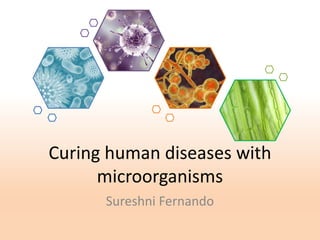
Curing human diseases with
microorganisms
Sureshni Fernando
Outline
1. Introduction to microorganisms.
2. Medical advantages of microorganisms.
Production of
– antibiotics
– probiotics
– vaccines
– hormones
– vitamins
– enzymes
Introduction
• Microorganisms consists of bacteria, virus, fungi, algae and
protozoa.
• Mostly unicellular and thus invisible to the naked eye.
• Found in every environment, including hot water springs,
snow capped mountains and deep sea trenches.
Figure 1: Structure of a generalized A-bacteria, B-virus and C-fungi (Goering et al., 2013).
A
B
C
• Multiply rapidly, requires less
space to grow, high yield,
cheap and easy to grow.
• Provides protection from
pathogenic microorganisms -
gut flora, skin flora.
• Useful in producing treatment
against infections – antibiotics.
• Useful in preventing infections
– vaccines.
Disadvantages
• Causes disease in both plants
and animals.
• Causes food spoilage.
• Develop antibiotic resistance.
Advantages
Antibiotics
Natural metabolic products of
microbes that kill or inhibit the
growth of other invading microbes.
Figure 2: Antibiotic
production (Moon, 2019).
Antibacterials
- Bactericidal
- Bacteriostatic
Antimicrobials
- Antifungals
- Antivirals
• Sir Alexander Fleming in 1928
discovered penicillin.
Antibiotic resistance
• Innately resistant - lack a susceptible target,
- impermeable to the antibiotic,
- enzymatically inactivates the antibiotic.
• Develop resistance.
Figure 3: Antibiotic target sites (Madigan and Martinko, 2006).
Probiotics
• Live organisms that, when ingested in adequate amounts, exert
a health benefit on the host.
• Probiotics are taken during antibiotic treatment to reduce the
risk of diarrhoea.
• As antibiotics disrupt the gut flora, probiotics can restore it with
non-pathogenic organisms.
• The most widely available probiotics are lactic acid bacteria and
non pathogenic yeasts.
Figure 4: Sources of probiotics (Kerry et al., 2018).
Vaccines
• Vaccines protect individuals
– directly by making them more immune.
– indirectly through herd immunity.
• They provide long-term protection and
most vaccines do not require repetitive
treatment.
• Primes the immune system to the
antigens of a microbe so that on first
contact with the live organism, a rapid
and effective secondary immune response
will be induced by memory T and B cells.
Figure 5: Types of
vaccines (WHO, 2019).
Hormones / Vitamins / Enzymes
• Genetically engineering microorganisms to obtain the desired
product.
• Production of human insulin in GM Escherichia coli and
Saccharomyces cerevisiae, has been approved for therapeutic
applications by the FDA.
• Production of vitamins to prevent and treat diseases due to
vitamin deficiencies.
Eg: Scurvy – Vitamin C (Acetobacter species)
Rickets – Vitamin D
• For enzyme replacement therapy (ERT) to treat metabolic
disorders such an enzyme deficiencies.
Eg: Human gastric lipase
Summary
• Produced using fermentation in bioreactors.
– Substrate, type of microbe and other conditions vary according to the
product.
• These treatment options are proven to be much more
effective when compared to local or herbal medicines.
Natural or semi-synthetic
products
Synthetic products
Antibiotics Hormones
Probiotics Vitamins
Vaccines Enzymes
References
Aminov, R. I. (2010) ‘A brief history of the antibiotic era: lessons learned and challenges for the future’,
Frontiers in Microbiology [Online]. DOI: 10.3389/fmicb.2010.00134 (Accessed: 19 March 2020).
Baeshen, N. A., Baeshen, M. N., Sheikh, A., Bora, R. S., Ahmed, M.R. M., Ramadan, H. A. I., Saini, K. S. S.
and Redwan, E. M. (2014) ‘Cell factories for insulin production’, Microbial Cell Factories, 13, pp.
141 [Online]. DOI: 10.1186/s12934-014-0141-0 (Accessed: 20 March 2020).
Delany, I., Rappuoli, R. and De Gregorio E. (2014) ‘Vaccines for the 21st century’, European Molecular
Biology Organization Molecular Medicine, 6(6), pp 708–720 [Online].
DOI: 10.1002/emmm.201403876 (Accessed: 25 March 2020).
Goering, R. V., Dockrell, H. M., Zuckerman, M., Roitt, I. M. and Chiodini, P. L. (2013) Mims Medical
Microbiology. 5th edn. China: Elsevier Saunders.
Greenwood, B. (2014) ‘The contribution of vaccination to global health: past, present and future’,
Philosophical Transactions of the Royal Society of London Series B, Biological Sciences, 369(1645),
pp. 20130433 [Online]. DOI: 10.1098/rstb.2013.0433 (Accessed: 25 March 2020).
Gurung, N., Ray, S., Bose, S. and Rai, V. (2013) ‘A broader view: microbial enzymes and their relevance
in industries, medicine, and beyond’, Biomed Research International, pp. 329121 [Online].
DOI: 10.1155/2013/329121 (Accessed: 13 April 2020).
Kerry, R. G., Patra, J. K., Gouda, S., Park, Y., Shin, H. and Das, G. (2018) ‘Benefaction of probiotics for
human health: A review’, Journal of Food and Drug Analysis, 26(3), pp. 927-939 [Online]. DOI:
10.1016/j.jfda.2018.01.002 (Accessed: 25 March 2020).
Leitzmann, C. (2003) ‘Protein Deficiency’, Encyclopedia of Food Sciences and Nutrition, pp. 4864–4867
[Online]. DOI: 10.1016/b0-12-227055-x/00987-1 (Accessed: 26 March 2020).
References
Moon, M. (2019) ‘Essential basic bacteriology in managing musculoarticuloskeletal infection: bacterial
anatomy, their behavior, host phagocytic activity, immune system, nutrition, and antibiotics’,
Asian Spine Journal, 13(2), pp. 343–356 [Online]. DOI: 10.31616/asj.2017.0239 (Accessed: 9 April
2020).
Quigley, E. M. M. and Quera, R. (2006) ‘Small intestinal bacterial overgrowth: roles of antibiotics,
prebiotics, and probiotics’, Gastroenterology, 130(2), pp. S78 –S90 [Online]. DOI:
10.1053/j.gastro.2005.11.046 (Accessed: 18 March 2020).
Revuelta, J. L., Buey, R. M., Ledesma‐Amaro, R. and Vandamme, E. J. (2016) ‘Microbial biotechnology
for the synthesis of (pro)vitamins, biopigments and antioxidants: challenges and opportunities’,
Microbial Biotechnology, 9(5), pp. 564–567 [Online]. DOI: 10.1111/1751-7915.12379 (Accessed:
25 March 2020).
Rodgers, B., Kirley, K. and Mounsey, A. (2013) ‘Prescribing an antibiotic? Pair it with probiotics’, Journal
of Family Practice, 62(3), pp. 148–150 [Online]. Available at:
https://www.ncbi.nlm.nih.gov/pmc/articles/PMC3601687/ (Accessed: 25 March 2020).
Subramaniyam, R. and Vimala, R. (2012) ‘Solid state and submerged fermentation for the production of
bioactive substances: a comparative study’, International Journal of Science and Nature, 3(3), pp.
480-486 [Online]. Available at:
https://www.researchgate.net/publication/232041875_Solid_state_and_submerged_fermentatio
n_for_the_production_of_bioactive_substances_a_comparative_study (Accessed: 27 March
2020).
World Health Organization (2019) Vaccine safety basics. Available at: https://vaccine-safety-
training.org/types-of-vaccine-overview.html (Accessed: 27 March 2020).
Curing human diseases using microorganisms

Curing human diseases using microorganisms

  • 1.
    Curing human diseaseswith microorganisms Sureshni Fernando
  • 2.
    Outline 1. Introduction tomicroorganisms. 2. Medical advantages of microorganisms. Production of – antibiotics – probiotics – vaccines – hormones – vitamins – enzymes
  • 3.
    Introduction • Microorganisms consistsof bacteria, virus, fungi, algae and protozoa. • Mostly unicellular and thus invisible to the naked eye. • Found in every environment, including hot water springs, snow capped mountains and deep sea trenches. Figure 1: Structure of a generalized A-bacteria, B-virus and C-fungi (Goering et al., 2013). A B C
  • 4.
    • Multiply rapidly,requires less space to grow, high yield, cheap and easy to grow. • Provides protection from pathogenic microorganisms - gut flora, skin flora. • Useful in producing treatment against infections – antibiotics. • Useful in preventing infections – vaccines. Disadvantages • Causes disease in both plants and animals. • Causes food spoilage. • Develop antibiotic resistance. Advantages
  • 5.
    Antibiotics Natural metabolic productsof microbes that kill or inhibit the growth of other invading microbes. Figure 2: Antibiotic production (Moon, 2019). Antibacterials - Bactericidal - Bacteriostatic Antimicrobials - Antifungals - Antivirals • Sir Alexander Fleming in 1928 discovered penicillin.
  • 6.
    Antibiotic resistance • Innatelyresistant - lack a susceptible target, - impermeable to the antibiotic, - enzymatically inactivates the antibiotic. • Develop resistance. Figure 3: Antibiotic target sites (Madigan and Martinko, 2006).
  • 7.
    Probiotics • Live organismsthat, when ingested in adequate amounts, exert a health benefit on the host. • Probiotics are taken during antibiotic treatment to reduce the risk of diarrhoea. • As antibiotics disrupt the gut flora, probiotics can restore it with non-pathogenic organisms. • The most widely available probiotics are lactic acid bacteria and non pathogenic yeasts. Figure 4: Sources of probiotics (Kerry et al., 2018).
  • 8.
    Vaccines • Vaccines protectindividuals – directly by making them more immune. – indirectly through herd immunity. • They provide long-term protection and most vaccines do not require repetitive treatment. • Primes the immune system to the antigens of a microbe so that on first contact with the live organism, a rapid and effective secondary immune response will be induced by memory T and B cells. Figure 5: Types of vaccines (WHO, 2019).
  • 9.
    Hormones / Vitamins/ Enzymes • Genetically engineering microorganisms to obtain the desired product. • Production of human insulin in GM Escherichia coli and Saccharomyces cerevisiae, has been approved for therapeutic applications by the FDA. • Production of vitamins to prevent and treat diseases due to vitamin deficiencies. Eg: Scurvy – Vitamin C (Acetobacter species) Rickets – Vitamin D • For enzyme replacement therapy (ERT) to treat metabolic disorders such an enzyme deficiencies. Eg: Human gastric lipase
  • 10.
    Summary • Produced usingfermentation in bioreactors. – Substrate, type of microbe and other conditions vary according to the product. • These treatment options are proven to be much more effective when compared to local or herbal medicines. Natural or semi-synthetic products Synthetic products Antibiotics Hormones Probiotics Vitamins Vaccines Enzymes
  • 11.
    References Aminov, R. I.(2010) ‘A brief history of the antibiotic era: lessons learned and challenges for the future’, Frontiers in Microbiology [Online]. DOI: 10.3389/fmicb.2010.00134 (Accessed: 19 March 2020). Baeshen, N. A., Baeshen, M. N., Sheikh, A., Bora, R. S., Ahmed, M.R. M., Ramadan, H. A. I., Saini, K. S. S. and Redwan, E. M. (2014) ‘Cell factories for insulin production’, Microbial Cell Factories, 13, pp. 141 [Online]. DOI: 10.1186/s12934-014-0141-0 (Accessed: 20 March 2020). Delany, I., Rappuoli, R. and De Gregorio E. (2014) ‘Vaccines for the 21st century’, European Molecular Biology Organization Molecular Medicine, 6(6), pp 708–720 [Online]. DOI: 10.1002/emmm.201403876 (Accessed: 25 March 2020). Goering, R. V., Dockrell, H. M., Zuckerman, M., Roitt, I. M. and Chiodini, P. L. (2013) Mims Medical Microbiology. 5th edn. China: Elsevier Saunders. Greenwood, B. (2014) ‘The contribution of vaccination to global health: past, present and future’, Philosophical Transactions of the Royal Society of London Series B, Biological Sciences, 369(1645), pp. 20130433 [Online]. DOI: 10.1098/rstb.2013.0433 (Accessed: 25 March 2020). Gurung, N., Ray, S., Bose, S. and Rai, V. (2013) ‘A broader view: microbial enzymes and their relevance in industries, medicine, and beyond’, Biomed Research International, pp. 329121 [Online]. DOI: 10.1155/2013/329121 (Accessed: 13 April 2020). Kerry, R. G., Patra, J. K., Gouda, S., Park, Y., Shin, H. and Das, G. (2018) ‘Benefaction of probiotics for human health: A review’, Journal of Food and Drug Analysis, 26(3), pp. 927-939 [Online]. DOI: 10.1016/j.jfda.2018.01.002 (Accessed: 25 March 2020). Leitzmann, C. (2003) ‘Protein Deficiency’, Encyclopedia of Food Sciences and Nutrition, pp. 4864–4867 [Online]. DOI: 10.1016/b0-12-227055-x/00987-1 (Accessed: 26 March 2020).
  • 12.
    References Moon, M. (2019)‘Essential basic bacteriology in managing musculoarticuloskeletal infection: bacterial anatomy, their behavior, host phagocytic activity, immune system, nutrition, and antibiotics’, Asian Spine Journal, 13(2), pp. 343–356 [Online]. DOI: 10.31616/asj.2017.0239 (Accessed: 9 April 2020). Quigley, E. M. M. and Quera, R. (2006) ‘Small intestinal bacterial overgrowth: roles of antibiotics, prebiotics, and probiotics’, Gastroenterology, 130(2), pp. S78 –S90 [Online]. DOI: 10.1053/j.gastro.2005.11.046 (Accessed: 18 March 2020). Revuelta, J. L., Buey, R. M., Ledesma‐Amaro, R. and Vandamme, E. J. (2016) ‘Microbial biotechnology for the synthesis of (pro)vitamins, biopigments and antioxidants: challenges and opportunities’, Microbial Biotechnology, 9(5), pp. 564–567 [Online]. DOI: 10.1111/1751-7915.12379 (Accessed: 25 March 2020). Rodgers, B., Kirley, K. and Mounsey, A. (2013) ‘Prescribing an antibiotic? Pair it with probiotics’, Journal of Family Practice, 62(3), pp. 148–150 [Online]. Available at: https://www.ncbi.nlm.nih.gov/pmc/articles/PMC3601687/ (Accessed: 25 March 2020). Subramaniyam, R. and Vimala, R. (2012) ‘Solid state and submerged fermentation for the production of bioactive substances: a comparative study’, International Journal of Science and Nature, 3(3), pp. 480-486 [Online]. Available at: https://www.researchgate.net/publication/232041875_Solid_state_and_submerged_fermentatio n_for_the_production_of_bioactive_substances_a_comparative_study (Accessed: 27 March 2020). World Health Organization (2019) Vaccine safety basics. Available at: https://vaccine-safety- training.org/types-of-vaccine-overview.html (Accessed: 27 March 2020).