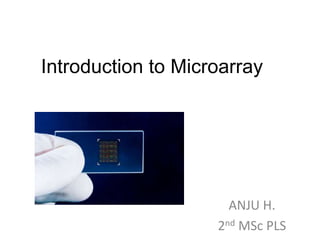
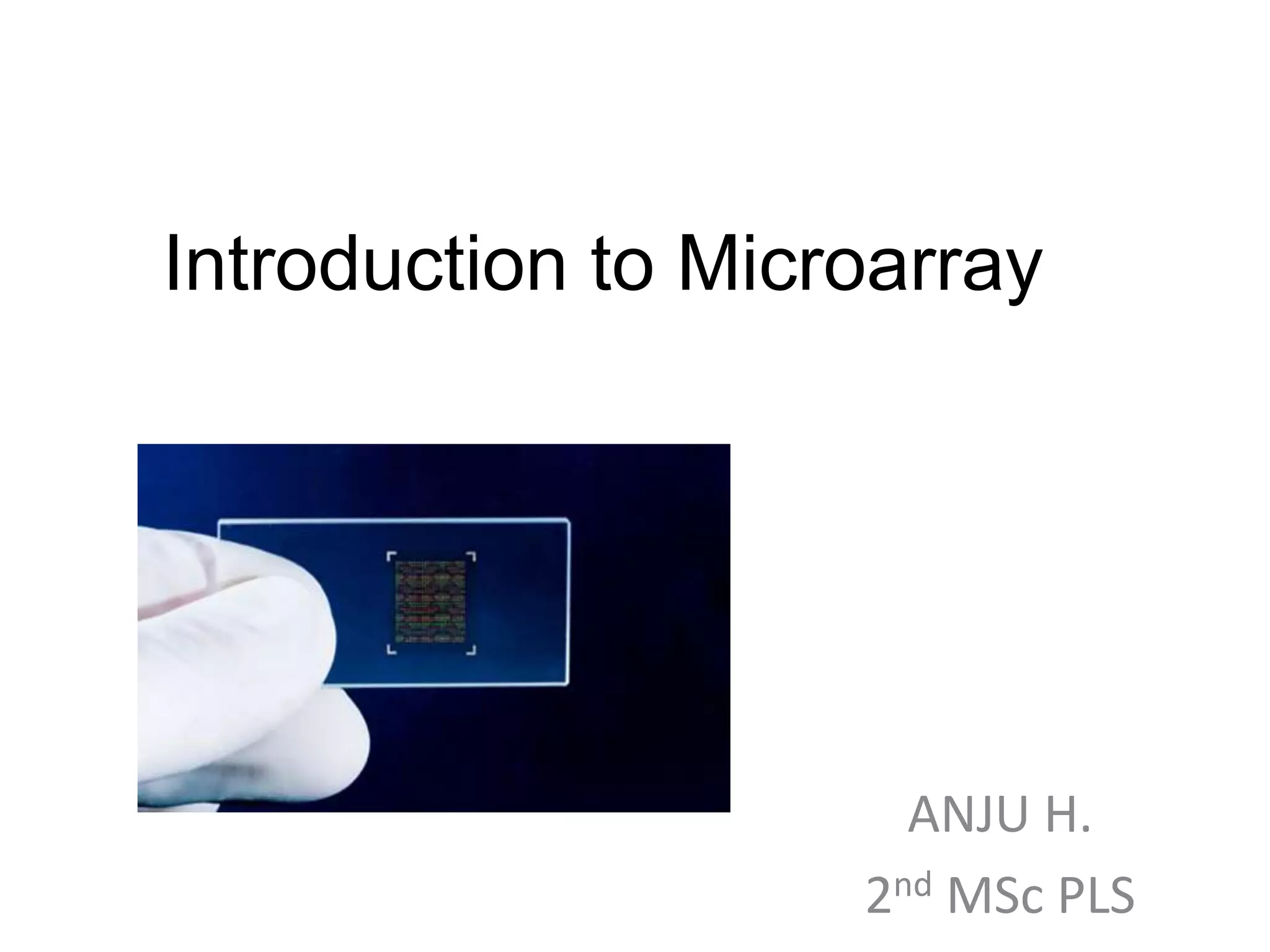
Introduction to Microarray
ANJU H.
2nd MSc PLS
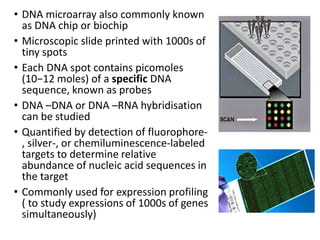
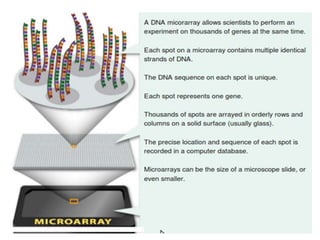
• DNA microarray also commonly known
as DNA chip or biochip
• Microscopic slide printed with 1000s of
tiny spots
• Each DNA spot contains picomoles
(10−12 moles) of a specific DNA
sequence, known as probes
• DNA –DNA or DNA –RNA hybridisation
can be studied
• Quantified by detection of fluorophore-
, silver-, or chemiluminescence-labeled
targets to determine relative
abundance of nucleic acid sequences in
the target
• Commonly used for expression profiling
( to study expressions of 1000s of genes
simultaneously)
Fabrication
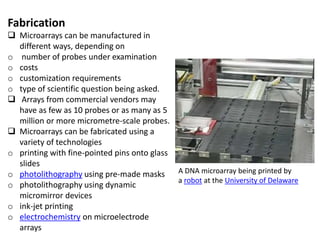
 Microarrays can be manufactured in
different ways, depending on
o number of probes under examination
o costs
o customization requirements
o type of scientific question being asked.
 Arrays from commercial vendors may
have as few as 10 probes or as many as 5
million or more micrometre-scale probes.
 Microarrays can be fabricated using a
variety of technologies
o printing with fine-pointed pins onto glass
slides
o photolithography using pre-made masks
o photolithography using dynamic
micromirror devices
o ink-jet printing
o electrochemistry on microelectrode
arrays
A DNA microarray being printed by
a robot at the University of Delaware
PRINCIPLE
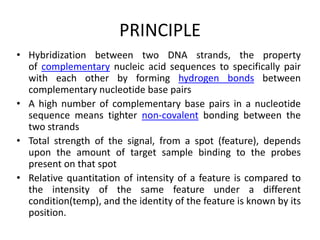
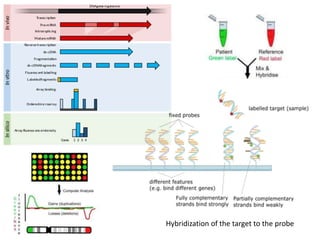
• Hybridization between two DNA strands, the property
of complementary nucleic acid sequences to specifically pair
with each other by forming hydrogen bonds between
complementary nucleotide base pairs
• A high number of complementary base pairs in a nucleotide
sequence means tighter non-covalent bonding between the
two strands
• Total strength of the signal, from a spot (feature), depends
upon the amount of target sample binding to the probes
present on that spot
• Relative quantitation of intensity of a feature is compared to
the intensity of the same feature under a different
condition(temp), and the identity of the feature is known by its
position.
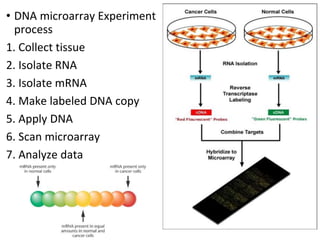
• DNA microarray Experiment
process
1. Collect tissue
2. Isolate RNA
3. Isolate mRNA
4. Make labeled DNA copy
5. Apply DNA
6. Scan microarray
7. Analyze data
Hybridization of the target to the probe
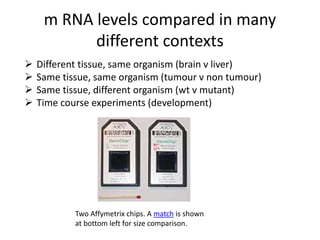
m RNA levels compared in many
different contexts
 Different tissue, same organism (brain v liver)
 Same tissue, same organism (tumour v non tumour)
 Same tissue, different organism (wt v mutant)
 Time course experiments (development)
Two Affymetrix chips. A match is shown
at bottom left for size comparison.
Applications
Gene expression profiling
• in different cells /tissues
• During course of development
• Under different environmental/chemical stimuli
• In disease versus healthy
Drug development
• Identification of new targets
Pharmacogenomics
• Individualized medicine
Comparative genomic hybridisation
• Assessing genomic content in closely related
organisms
SNP detection
• Identifying SNPs among populations
ChIP studies(Chromatin immunoprecipitation)
• Determining protein binding site occupancy
throughout genome by ChIP on chip technology
GeneID
• Small microarrays to check IDs of organisms in food
and feed or pathogens for disease detection
Applications in crop improvement
DNA microarrays: a powerful genomic
tool for biomedical and clinical research.
Trevino V1, Falciani F, Barrera-Saldaña HA.
• Microarrays initially designed to measure gene transcriptional level and for
comparing other genome features among individuals and their tissues and
cells.
• Results provide valuable information on disease subcategories, disease prognosis,
and treatment outcome.
• Microarray reveal differences in genetic makeup, regulatory mechanisms
o Relating Gene Expression to Physiology:
o Biomarker Detection: Supervised Classification
o Describing the Relationship between the Molecular State of Biological Samples
o Identification of Prognostic Genes Associated to Risk and Survival
o Association of Genes to disease surrogate markers
o Genetic Disorders: Gene Copy Number and Comparative Genomic Hybridization
o Genetic Disorders: Epigenetics and Methylation
o Genetic Disorders and Variability: Gene Polymorphism and Single Nucleotide
Polymorphism
o Chromatin Immunoprecipitation: Genetic Control and Transcriptional Regulation
o Pathogen detection
 DNA microarrays are a powerful, mature versatile and easy-to-use genomic tool
that can be applied for biomedical and clinical research
 The main advantage is the genomic-wide information provided at reasonable
costs
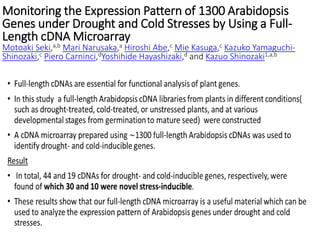
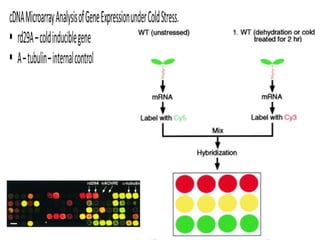
Monitoring the Expression Pattern of 1300 Arabidopsis
Genes under Drought and Cold Stresses by Using a Full-
Length cDNA Microarray
Motoaki Seki,a,b Mari Narusaka,a Hiroshi Abe,c Mie Kasuga,c Kazuko Yamaguchi-
Shinozaki,c Piero Carninci,dYoshihide Hayashizaki,d and Kazuo Shinozaki1,a,b
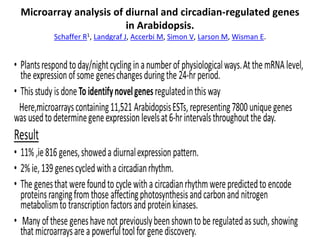
Microarray analysis of diurnal and circadian-regulated genes
in Arabidopsis.
Schaffer R1, Landgraf J, Accerbi M, Simon V, Larson M, Wisman E.
The next generation of microarray research:
applications in evolutionary and ecological
genomics
Analysis of microarray experiments of gene
expression profiling
thankyou

MICROARRAY.pptx

  • 1.
  • 2.
    • DNA microarrayalso commonly known as DNA chip or biochip • Microscopic slide printed with 1000s of tiny spots • Each DNA spot contains picomoles (10−12 moles) of a specific DNA sequence, known as probes • DNA –DNA or DNA –RNA hybridisation can be studied • Quantified by detection of fluorophore- , silver-, or chemiluminescence-labeled targets to determine relative abundance of nucleic acid sequences in the target • Commonly used for expression profiling ( to study expressions of 1000s of genes simultaneously)
  • 4.
    Fabrication  Microarrays canbe manufactured in different ways, depending on o number of probes under examination o costs o customization requirements o type of scientific question being asked.  Arrays from commercial vendors may have as few as 10 probes or as many as 5 million or more micrometre-scale probes.  Microarrays can be fabricated using a variety of technologies o printing with fine-pointed pins onto glass slides o photolithography using pre-made masks o photolithography using dynamic micromirror devices o ink-jet printing o electrochemistry on microelectrode arrays A DNA microarray being printed by a robot at the University of Delaware
  • 5.
    PRINCIPLE • Hybridization betweentwo DNA strands, the property of complementary nucleic acid sequences to specifically pair with each other by forming hydrogen bonds between complementary nucleotide base pairs • A high number of complementary base pairs in a nucleotide sequence means tighter non-covalent bonding between the two strands • Total strength of the signal, from a spot (feature), depends upon the amount of target sample binding to the probes present on that spot • Relative quantitation of intensity of a feature is compared to the intensity of the same feature under a different condition(temp), and the identity of the feature is known by its position.
  • 6.
    • DNA microarrayExperiment process 1. Collect tissue 2. Isolate RNA 3. Isolate mRNA 4. Make labeled DNA copy 5. Apply DNA 6. Scan microarray 7. Analyze data
  • 7.
    Hybridization of thetarget to the probe
  • 8.
    m RNA levelscompared in many different contexts  Different tissue, same organism (brain v liver)  Same tissue, same organism (tumour v non tumour)  Same tissue, different organism (wt v mutant)  Time course experiments (development) Two Affymetrix chips. A match is shown at bottom left for size comparison.
  • 9.
    Applications Gene expression profiling •in different cells /tissues • During course of development • Under different environmental/chemical stimuli • In disease versus healthy Drug development • Identification of new targets Pharmacogenomics • Individualized medicine
  • 10.
    Comparative genomic hybridisation •Assessing genomic content in closely related organisms SNP detection • Identifying SNPs among populations ChIP studies(Chromatin immunoprecipitation) • Determining protein binding site occupancy throughout genome by ChIP on chip technology GeneID • Small microarrays to check IDs of organisms in food and feed or pathogens for disease detection
  • 11.
  • 12.
    DNA microarrays: apowerful genomic tool for biomedical and clinical research. Trevino V1, Falciani F, Barrera-Saldaña HA. • Microarrays initially designed to measure gene transcriptional level and for comparing other genome features among individuals and their tissues and cells. • Results provide valuable information on disease subcategories, disease prognosis, and treatment outcome. • Microarray reveal differences in genetic makeup, regulatory mechanisms o Relating Gene Expression to Physiology: o Biomarker Detection: Supervised Classification o Describing the Relationship between the Molecular State of Biological Samples
  • 13.
    o Identification ofPrognostic Genes Associated to Risk and Survival o Association of Genes to disease surrogate markers o Genetic Disorders: Gene Copy Number and Comparative Genomic Hybridization o Genetic Disorders: Epigenetics and Methylation o Genetic Disorders and Variability: Gene Polymorphism and Single Nucleotide Polymorphism o Chromatin Immunoprecipitation: Genetic Control and Transcriptional Regulation o Pathogen detection  DNA microarrays are a powerful, mature versatile and easy-to-use genomic tool that can be applied for biomedical and clinical research  The main advantage is the genomic-wide information provided at reasonable costs
  • 14.
    Monitoring the ExpressionPattern of 1300 Arabidopsis Genes under Drought and Cold Stresses by Using a Full- Length cDNA Microarray Motoaki Seki,a,b Mari Narusaka,a Hiroshi Abe,c Mie Kasuga,c Kazuko Yamaguchi- Shinozaki,c Piero Carninci,dYoshihide Hayashizaki,d and Kazuo Shinozaki1,a,b
  • 16.
    Microarray analysis ofdiurnal and circadian-regulated genes in Arabidopsis. Schaffer R1, Landgraf J, Accerbi M, Simon V, Larson M, Wisman E.
  • 17.
    The next generationof microarray research: applications in evolutionary and ecological genomics Analysis of microarray experiments of gene expression profiling
  • 18.