SISTER NIVEDITA
UNIVERSITY
NAME:- MD SAQLAIN UMAR
ENROLLEMENT ID:- 2311225005028
REGISTERATION ID:-230050281771
STREAM:- BACHLOR SCIENCE IN OPERATION THEATRE TECHNOLOGY
DEPARTEMENT:- ALLIED HEALTH SCIENCE
TOPIC:- DNA STRUCTURE & IT’S FUNCTIONS.
DATE:-30/04/2024
DNA STRUCTURE
AND
IT’S FUNCTIONS
Cont
ents:
-
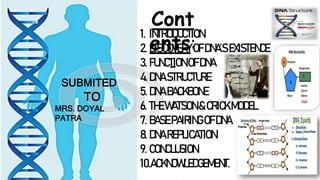
1. INTRODUCTION
2. DISCOVERYOFDNA’SEXISTENCE
3. FUNCTIONOFDNA
4. DNASTRUCTURE
5. DNABACKBONE
6. THEWATSON&CRICKMODEL
7. BASEPAIRINGOFDNA
8. DNAREPLICATION
9. CONCLUSION
10.ACKNOWLEDGEMENT.
SUBMITED
TO
MRS. DOYAL
PATRA
INTRODUCTION:-
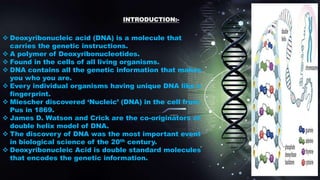
 Deoxyribonucleic acid (DNA) is a molecule that
carries the genetic instructions.
 A polymer of Deoxyribonucleotides.
 Found in the cells of all living organisms.
 DNA contains all the genetic information that makes
you who you are.
 Every individual organisms having unique DNA like a
fingerprint.
 Miescher discovered ‘Nucleic’ (DNA) in the cell from
Pus in 1869.
 James D. Watson and Crick are the co-originators of
double helix model of DNA.
 The discovery of DNA was the most important event
in biological science of the 20th century.
 Deoxyribonucleic Acid is double standard molecules
that encodes the genetic information.
DISCOVERY OF DNA’S
EXISTENCE
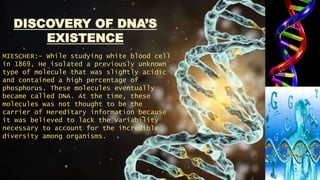
MIESCHER:- While studying white blood cell
in 1869, He isolated a previously unknown
type of molecule that was slightly acidic
and contained a high percentage of
phosphorus. These molecules eventually
became called DNA. At the time, these
molecules was not thought to be the
carrier of Hereditary information because
it was believed to lack the variability
necessary to account for the incredible
diversity among organisms.
FUNCTION OF DNA:-
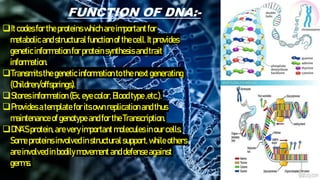
Itcodesfortheproteins whichareimportantfor
metabolicandstructuralfunctionofthe cell.Itprovides
geneticinformationfor proteinsynthesis andtrait
information.
Transmitsthegenetic informationtothe next generating
(Children/offsprings).
Stores information (Ex, eye color, Bloodtype ,etc.).
Provides atemplate foritsownreplicationandthus
maintenanceofgenotype andforthe Transcription.
DNA’Sprotein, areveryimportantmolecules inourcells.
Some proteins involved instructuralsupport, whileothers
areinvolved inbodilymovement anddefense against
germs.
DNA STRUCTURE :-
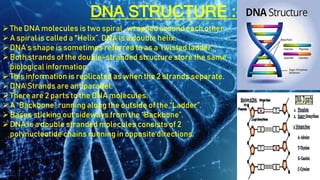
The DNA molecules is two spiral , wrapped around each other.
A spiral is called a "Helix”. DNA is a double helix.
DNA’s shape is sometimes referred to as a ‘twisted ladder’.
Both strands of the double-stranded structure store the same
biological information.
This information is replicated as when the 2 strands separate.
DNA Strands are antiparallel.
There are 2 parts to the DNA molecules.
A “Backbone” running along the outside of the “Ladder”.
Bases sticking out sideways from the “Backbone”.
DNA is a double stranded molecules consists of 2
polynucleotide chains running in opposite directions.
DNA BACKBONE:-
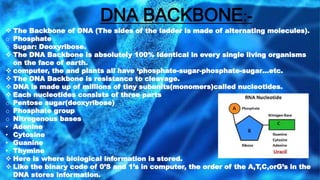
 The Backbone of DNA (The sides of the ladder is made of alternating molecules).
o Phosphate
o Sugar: Deoxyribose.
 The DNA Backbone is absolutely 100% Identical in every single living organisms
on the face of earth.
 computer, the and plants all have ‘phosphate-sugar-phosphate-sugar…etc.
 The DNA Backbone is resistance to cleavage.
 DNA is made up of millions of tiny subunits(monomers)called nucleotides.
 Each nucleotides consists of three parts
o Pentose sugar(deoxyribose)
o Phosphate group
o Nitrogenous bases
• Adenine
• Cytosine
• Guanine
• Thymine
 Here is where biological information is stored.
 Like the binary code of 0’S and 1’s in computer, the order of the A,T,C,orG’s in the
DNA stores information.
THE WATSON &CRICK DNA MODEL:-
Watson & Crick:-Made physical models to narrow down the possibilities and
eventually creates an accurate model of the DNA molecules.Propeosed the
double helical structure of the DNA in 1953 using Franklins Pictures.
DNA is composed of 2 chains of nucleotides that from a double helix shape.
The backbone is formed by covalent bonds between the sugar of one
nucleotides and the phosphate group of the next.
The backbone has directly directionality (polarity).
5’ end :- Phosphate end
3’ end :-Sugar end.
 The two strands are antiparallel (the run side by side in opposite direction).
 Each base will only bond with other specific bases(A=T,C=G).Hydrogen bonds
are formed between the bases. These are fairly weak bonds. Having just
enough force to hold the two strands of DNA together. DNA strands have to
be able to separate easily to functions.
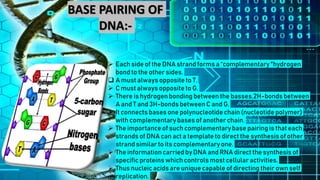
BASE PAIRING OF
DNA:-
 Each side of the DNA strand forms a “complementary"hydrogen
bond to the other sides.
 A must always oppositeto T.
 C must always opposite to G.
 There is hydrogenbonding between the basses.2H-bonds between
A and T and 3H-bonds between C and G.
 It connects bases one polynucleotidechain (nucleotide polymer)
with complementary bases of another chain.
 The importance of such complementarybase pairing is that each
strands of DNA can act a template to direct the synthesis of other
strand similar to its complementaryone.
 The informationcarried by DNA and RNA direct the synthesis of
specific proteins which controls most cellular activities.
 Thus nucleic acids are unique capable of directing their own self
replication.
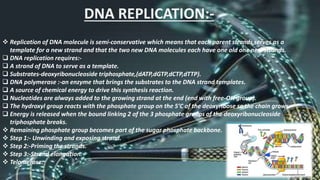
DNA REPLICATION:-
 Replication of DNA molecule is semi-conservative which means that each parent strands serves as a
template for a new strand and that the two new DNA molecules each have one old one new strands.
 DNA replication requires:-
 A strand of DNA to serve as a template.
 Substrates-deoxyribonucleoside triphosphate,(dATP,dGTP,dCTP,dTTP).
 DNA polymerase :-an enzyme that brings the substrates to the DNA strand templates.
 A source of chemical energy to drive this synthesis reaction.
 Nucleotides are always added to the growing strand at the end (end with free-OH group).
 The hydroxyl group reacts with the phosphate group on the 5’C of the deoxyribose so the chain grows.
 Energy is released when the bound linking 2 of the 3 phosphate groups of the deoxyribonucleoside
triphosphate breaks.
 Remaining phosphate group becomes part of the sugar phosphate backbone.
 Step 1:- Unwinding and exposing strand.
 Step 2:-Priming the strands.
 Step 3:-Strand elongation.
 Telomerase.
CONCLUSION:-
Each strands of a DNA molecules is composed of a long chain
of monomer nucleotides. The nucleotides of DNA consists of a
deoxyribose sugar molecule to which is attached a phosphate
group and one of four nitrogenous bases:- two purines
(Adenine and Guanine) and two pyrimidines (Cytosine and
Thymine). The nucleotides are joined together by covalent
bonds between the phosphate of one nucleotides and the
sugar of the next, forming a phosphate-sugar backbone from
which the nitrogenous bases produce.one strand is held to
another by hydrogen bonds between the
bases.Recombination which leads to rearrangement of genes
takes advantages of the ability to form an unusual structure
called a Holliday’s structure.Also different kind of mutations
occur as a result of specific DNA structure etc.
ACKNOWLEDGEME
NT:-
I am very much pleased to submit my seminar topic on DNA
STUCTURE &IT’S FUNCTIONS for Bachelor science honor in
Operation Theatre Technology 2nd year semester. I sincerely thanks
to our Mentors Mrs. Dayal Patra to give me opportunity for
preparing the seminar topic and our (HOD)Mr. Sanjay Das and
Ankita Chakraborty(Bio Chembion microbiology). department of
Allied Health Science. And also Mr. Siddhartha Dutta of Biology
Department of our university for guiding properly the same.
I also thankful to our other respected teachers of the department of
Allied Health Science and our friends and parents for supporting me
to help to make the seminar on the above topic.
THANK YOU
MD SAQLAIN UMAR
BY

DNA STRUCTURE AND ITS FUNCTIONS BY MD SAQLAIN UMAR.pptx

  • 1.
    SISTER NIVEDITA UNIVERSITY NAME:- MDSAQLAIN UMAR ENROLLEMENT ID:- 2311225005028 REGISTERATION ID:-230050281771 STREAM:- BACHLOR SCIENCE IN OPERATION THEATRE TECHNOLOGY DEPARTEMENT:- ALLIED HEALTH SCIENCE TOPIC:- DNA STRUCTURE & IT’S FUNCTIONS. DATE:-30/04/2024
  • 2.
  • 3.
    Cont ents: - 1. INTRODUCTION 2. DISCOVERYOFDNA’SEXISTENCE 3.FUNCTIONOFDNA 4. DNASTRUCTURE 5. DNABACKBONE 6. THEWATSON&CRICKMODEL 7. BASEPAIRINGOFDNA 8. DNAREPLICATION 9. CONCLUSION 10.ACKNOWLEDGEMENT. SUBMITED TO MRS. DOYAL PATRA
  • 4.
    INTRODUCTION:-  Deoxyribonucleic acid(DNA) is a molecule that carries the genetic instructions.  A polymer of Deoxyribonucleotides.  Found in the cells of all living organisms.  DNA contains all the genetic information that makes you who you are.  Every individual organisms having unique DNA like a fingerprint.  Miescher discovered ‘Nucleic’ (DNA) in the cell from Pus in 1869.  James D. Watson and Crick are the co-originators of double helix model of DNA.  The discovery of DNA was the most important event in biological science of the 20th century.  Deoxyribonucleic Acid is double standard molecules that encodes the genetic information.
  • 5.
    DISCOVERY OF DNA’S EXISTENCE MIESCHER:-While studying white blood cell in 1869, He isolated a previously unknown type of molecule that was slightly acidic and contained a high percentage of phosphorus. These molecules eventually became called DNA. At the time, these molecules was not thought to be the carrier of Hereditary information because it was believed to lack the variability necessary to account for the incredible diversity among organisms.
  • 6.
    FUNCTION OF DNA:- Itcodesfortheproteinswhichareimportantfor metabolicandstructuralfunctionofthe cell.Itprovides geneticinformationfor proteinsynthesis andtrait information. Transmitsthegenetic informationtothe next generating (Children/offsprings). Stores information (Ex, eye color, Bloodtype ,etc.). Provides atemplate foritsownreplicationandthus maintenanceofgenotype andforthe Transcription. DNA’Sprotein, areveryimportantmolecules inourcells. Some proteins involved instructuralsupport, whileothers areinvolved inbodilymovement anddefense against germs.
  • 7.
    DNA STRUCTURE :- TheDNA molecules is two spiral , wrapped around each other. A spiral is called a "Helix”. DNA is a double helix. DNA’s shape is sometimes referred to as a ‘twisted ladder’. Both strands of the double-stranded structure store the same biological information. This information is replicated as when the 2 strands separate. DNA Strands are antiparallel. There are 2 parts to the DNA molecules. A “Backbone” running along the outside of the “Ladder”. Bases sticking out sideways from the “Backbone”. DNA is a double stranded molecules consists of 2 polynucleotide chains running in opposite directions.
  • 8.
    DNA BACKBONE:-  TheBackbone of DNA (The sides of the ladder is made of alternating molecules). o Phosphate o Sugar: Deoxyribose.  The DNA Backbone is absolutely 100% Identical in every single living organisms on the face of earth.  computer, the and plants all have ‘phosphate-sugar-phosphate-sugar…etc.  The DNA Backbone is resistance to cleavage.  DNA is made up of millions of tiny subunits(monomers)called nucleotides.  Each nucleotides consists of three parts o Pentose sugar(deoxyribose) o Phosphate group o Nitrogenous bases • Adenine • Cytosine • Guanine • Thymine  Here is where biological information is stored.  Like the binary code of 0’S and 1’s in computer, the order of the A,T,C,orG’s in the DNA stores information.
  • 9.
    THE WATSON &CRICKDNA MODEL:- Watson & Crick:-Made physical models to narrow down the possibilities and eventually creates an accurate model of the DNA molecules.Propeosed the double helical structure of the DNA in 1953 using Franklins Pictures. DNA is composed of 2 chains of nucleotides that from a double helix shape. The backbone is formed by covalent bonds between the sugar of one nucleotides and the phosphate group of the next. The backbone has directly directionality (polarity). 5’ end :- Phosphate end 3’ end :-Sugar end.  The two strands are antiparallel (the run side by side in opposite direction).  Each base will only bond with other specific bases(A=T,C=G).Hydrogen bonds are formed between the bases. These are fairly weak bonds. Having just enough force to hold the two strands of DNA together. DNA strands have to be able to separate easily to functions.
  • 10.
    BASE PAIRING OF DNA:- Each side of the DNA strand forms a “complementary"hydrogen bond to the other sides.  A must always oppositeto T.  C must always opposite to G.  There is hydrogenbonding between the basses.2H-bonds between A and T and 3H-bonds between C and G.  It connects bases one polynucleotidechain (nucleotide polymer) with complementary bases of another chain.  The importance of such complementarybase pairing is that each strands of DNA can act a template to direct the synthesis of other strand similar to its complementaryone.  The informationcarried by DNA and RNA direct the synthesis of specific proteins which controls most cellular activities.  Thus nucleic acids are unique capable of directing their own self replication.
  • 11.
    DNA REPLICATION:-  Replicationof DNA molecule is semi-conservative which means that each parent strands serves as a template for a new strand and that the two new DNA molecules each have one old one new strands.  DNA replication requires:-  A strand of DNA to serve as a template.  Substrates-deoxyribonucleoside triphosphate,(dATP,dGTP,dCTP,dTTP).  DNA polymerase :-an enzyme that brings the substrates to the DNA strand templates.  A source of chemical energy to drive this synthesis reaction.  Nucleotides are always added to the growing strand at the end (end with free-OH group).  The hydroxyl group reacts with the phosphate group on the 5’C of the deoxyribose so the chain grows.  Energy is released when the bound linking 2 of the 3 phosphate groups of the deoxyribonucleoside triphosphate breaks.  Remaining phosphate group becomes part of the sugar phosphate backbone.  Step 1:- Unwinding and exposing strand.  Step 2:-Priming the strands.  Step 3:-Strand elongation.  Telomerase.
  • 12.
    CONCLUSION:- Each strands ofa DNA molecules is composed of a long chain of monomer nucleotides. The nucleotides of DNA consists of a deoxyribose sugar molecule to which is attached a phosphate group and one of four nitrogenous bases:- two purines (Adenine and Guanine) and two pyrimidines (Cytosine and Thymine). The nucleotides are joined together by covalent bonds between the phosphate of one nucleotides and the sugar of the next, forming a phosphate-sugar backbone from which the nitrogenous bases produce.one strand is held to another by hydrogen bonds between the bases.Recombination which leads to rearrangement of genes takes advantages of the ability to form an unusual structure called a Holliday’s structure.Also different kind of mutations occur as a result of specific DNA structure etc.
  • 13.
    ACKNOWLEDGEME NT:- I am verymuch pleased to submit my seminar topic on DNA STUCTURE &IT’S FUNCTIONS for Bachelor science honor in Operation Theatre Technology 2nd year semester. I sincerely thanks to our Mentors Mrs. Dayal Patra to give me opportunity for preparing the seminar topic and our (HOD)Mr. Sanjay Das and Ankita Chakraborty(Bio Chembion microbiology). department of Allied Health Science. And also Mr. Siddhartha Dutta of Biology Department of our university for guiding properly the same. I also thankful to our other respected teachers of the department of Allied Health Science and our friends and parents for supporting me to help to make the seminar on the above topic.
  • 14.