Your Logo
Slide 1
By
KAUSHAL KUMAR SAHU
Assistant Professor (Ad Hoc)
Department of Biotechnology
Govt. Digvijay Autonomous P. G. College
Raj-Nandgaon ( C. G. )
SYNOPSIS
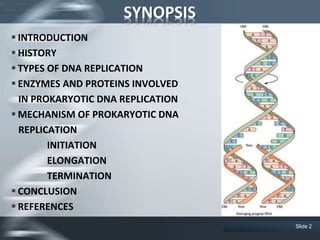
 INTRODUCTION
 HISTORY
 TYPES OF DNA REPLICATION
 ENZYMES AND PROTEINS INVOLVED
IN PROKARYOTIC DNA REPLICATION
 MECHANISM OF PROKARYOTIC DNA
REPLICATION
INITIATION
ELONGATION
TERMINATION
 CONCLUSION
 REFERENCES
Slide 2
INTRODUCTION
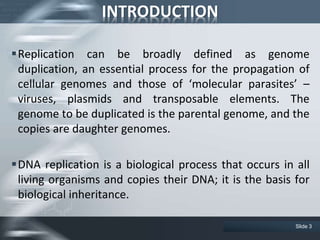
Replication can be broadly defined as genome
duplication, an essential process for the propagation of
cellular genomes and those of ‘molecular parasites’ –
viruses, plasmids and transposable elements. The
genome to be duplicated is the parental genome, and the
copies are daughter genomes.
DNA replication is a biological process that occurs in all
living organisms and copies their DNA; it is the basis for
biological inheritance.
Slide 3
HISTORY
Slide 4
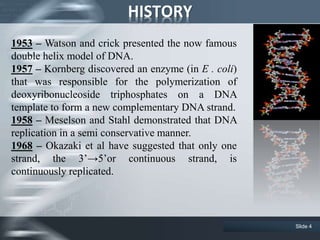
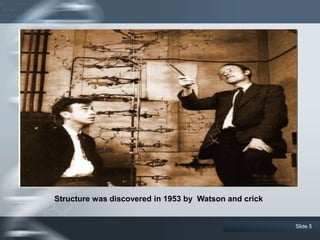
1953 – Watson and crick presented the now famous
double helix model of DNA.
1957 – Kornberg discovered an enzyme (in E . coli)
that was responsible for the polymerization of
deoxyribonucleoside triphosphates on a DNA
template to form a new complementary DNA strand.
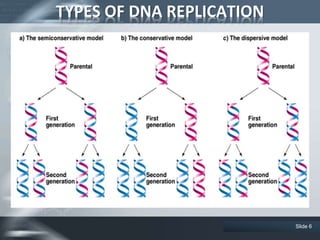
1958 – Meselson and Stahl demonstrated that DNA
replication in a semi conservative manner.
1968 – Okazaki et al have suggested that only one
strand, the 3’→5’or continuous strand, is
continuously replicated.
Slide 5
Structure was discovered in 1953 by Watson and crick
TYPES OF DNA REPLICATION
Slide 6
ENZYMES AND PROTEINS INVOLVED IN PROKARYOTIC DNA REPLICATION
 DNA polymerase
The enzyme that extends the primer;
Pol III –
Produces new stands of complementary DNA
Pol I –
Fills in gaps between newly synthesized Okazaki segments
 Additional enzymes/proteins
DNA helicase-
Unwinds double helix
Single-stranded binding proteins-
Keep helix open
Primase-
Creates RNA primers to initiate synthesis
Ligase-
Welds together Okazaki fragments
Slide 7
MECHANISM OF PROKARYOTIC DNA REPLICATION
 Tightly controlled process,
– occurs at specific times during the cell cycle
 Requires:
– A set of proteins and enzymes,
– And requires energy in the form of ATP.
 Three basic steps:
– Initiation
– Elongation
– Termination
 Two basic components:
– Template
– Primer
Slide 8
REPLICATION FORK
 The replication fork is a structure that
forms within the nucleus during DNA
replication. It is created by helicases,
which break the hydrogen bonds holding
the two DNA strands together.
 The resulting structure has two
branching "prongs", each one made up
of a single strand of DNA. These two
strands serve as the template for the
leading and lagging strands, which will
be created as DNA polymerase matches
complementary nucleotides to the
templates; the templates may be
properly referred to as the leading
strand template and the lagging strand
template.
Slide 9
REPLICATION OF THE E. COLI
 Replication of the E. coli chromosome begins at a single replication origin
and proceeds bidirectionally until the two replication forks meet. At each
replication fork, both leading and lagging strand syntheses are catalyzed
by a single multiprotein replication machine, the so-
called replisome, which consists of DNA-unwinding proteins; the priming
apparatus, or primosome, which is needed to initiate, or “prime,” DNA
replication; and DNA polymerase III holoenzyme with two equivalents of
“core” polymerase, one for the leading strand and one for the lagging
strand.
 As this replisome follows the replication fork, the template for lagging
strand synthesis (the strand running 5' → 3' in the direction of fork
movement) must be looped around so that it can be read in the 3' → 5'
direction.
Slide 10
INITIATION
Slide 11
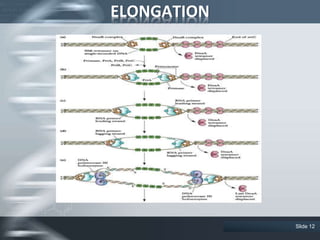
ELONGATION
Slide 12
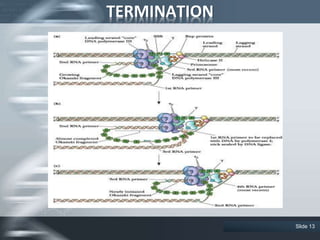
TERMINATION
Slide 13
CONCLUSION
DNA replication can also be performed in vitro
(artificially, outside a cell). DNA polymerases, isolated
from cells, and artificial DNA primers are used to initiate
DNA synthesis at known sequences in a template
molecule. The polymerase chain reaction (PCR), a
common laboratory technique, employs such artificial
synthesis in a cyclic manner to amplify a specific target
DNA fragment from a pool of DNA.
Slide 14
REFERENCES
 J.D. WATSON – Molecular biology of gene (6th edition)
 GERALD KARP – cell and molecular biology (5th edition)
 NELSON AND COX – principles of biochemistry (4th edition)
 NET SOURCE
 www.wikipedia.com
 http://staff.jccc.net/pdecell/proteinsynthesis/dnareprokary.html
 http://web.virginia.edu/Heidi/chapter30/chp30frameset.html
 http://en.wikipedia.org/wiki/DNA_replication
Slide 15

Prokaryotic dna replication by kk sahu

  • 1.
    Your Logo Slide 1 By KAUSHALKUMAR SAHU Assistant Professor (Ad Hoc) Department of Biotechnology Govt. Digvijay Autonomous P. G. College Raj-Nandgaon ( C. G. )
  • 2.
    SYNOPSIS  INTRODUCTION  HISTORY TYPES OF DNA REPLICATION  ENZYMES AND PROTEINS INVOLVED IN PROKARYOTIC DNA REPLICATION  MECHANISM OF PROKARYOTIC DNA REPLICATION INITIATION ELONGATION TERMINATION  CONCLUSION  REFERENCES Slide 2
  • 3.
    INTRODUCTION Replication can bebroadly defined as genome duplication, an essential process for the propagation of cellular genomes and those of ‘molecular parasites’ – viruses, plasmids and transposable elements. The genome to be duplicated is the parental genome, and the copies are daughter genomes. DNA replication is a biological process that occurs in all living organisms and copies their DNA; it is the basis for biological inheritance. Slide 3
  • 4.
    HISTORY Slide 4 1953 –Watson and crick presented the now famous double helix model of DNA. 1957 – Kornberg discovered an enzyme (in E . coli) that was responsible for the polymerization of deoxyribonucleoside triphosphates on a DNA template to form a new complementary DNA strand. 1958 – Meselson and Stahl demonstrated that DNA replication in a semi conservative manner. 1968 – Okazaki et al have suggested that only one strand, the 3’→5’or continuous strand, is continuously replicated.
  • 5.
    Slide 5 Structure wasdiscovered in 1953 by Watson and crick
  • 6.
    TYPES OF DNAREPLICATION Slide 6
  • 7.
    ENZYMES AND PROTEINSINVOLVED IN PROKARYOTIC DNA REPLICATION  DNA polymerase The enzyme that extends the primer; Pol III – Produces new stands of complementary DNA Pol I – Fills in gaps between newly synthesized Okazaki segments  Additional enzymes/proteins DNA helicase- Unwinds double helix Single-stranded binding proteins- Keep helix open Primase- Creates RNA primers to initiate synthesis Ligase- Welds together Okazaki fragments Slide 7
  • 8.
    MECHANISM OF PROKARYOTICDNA REPLICATION  Tightly controlled process, – occurs at specific times during the cell cycle  Requires: – A set of proteins and enzymes, – And requires energy in the form of ATP.  Three basic steps: – Initiation – Elongation – Termination  Two basic components: – Template – Primer Slide 8
  • 9.
    REPLICATION FORK  Thereplication fork is a structure that forms within the nucleus during DNA replication. It is created by helicases, which break the hydrogen bonds holding the two DNA strands together.  The resulting structure has two branching "prongs", each one made up of a single strand of DNA. These two strands serve as the template for the leading and lagging strands, which will be created as DNA polymerase matches complementary nucleotides to the templates; the templates may be properly referred to as the leading strand template and the lagging strand template. Slide 9
  • 10.
    REPLICATION OF THEE. COLI  Replication of the E. coli chromosome begins at a single replication origin and proceeds bidirectionally until the two replication forks meet. At each replication fork, both leading and lagging strand syntheses are catalyzed by a single multiprotein replication machine, the so- called replisome, which consists of DNA-unwinding proteins; the priming apparatus, or primosome, which is needed to initiate, or “prime,” DNA replication; and DNA polymerase III holoenzyme with two equivalents of “core” polymerase, one for the leading strand and one for the lagging strand.  As this replisome follows the replication fork, the template for lagging strand synthesis (the strand running 5' → 3' in the direction of fork movement) must be looped around so that it can be read in the 3' → 5' direction. Slide 10
  • 11.
  • 12.
  • 13.
  • 14.
    CONCLUSION DNA replication canalso be performed in vitro (artificially, outside a cell). DNA polymerases, isolated from cells, and artificial DNA primers are used to initiate DNA synthesis at known sequences in a template molecule. The polymerase chain reaction (PCR), a common laboratory technique, employs such artificial synthesis in a cyclic manner to amplify a specific target DNA fragment from a pool of DNA. Slide 14
  • 15.
    REFERENCES  J.D. WATSON– Molecular biology of gene (6th edition)  GERALD KARP – cell and molecular biology (5th edition)  NELSON AND COX – principles of biochemistry (4th edition)  NET SOURCE  www.wikipedia.com  http://staff.jccc.net/pdecell/proteinsynthesis/dnareprokary.html  http://web.virginia.edu/Heidi/chapter30/chp30frameset.html  http://en.wikipedia.org/wiki/DNA_replication Slide 15