Structure and Function of
DNA
Presented by:-
Akansh Goel
Structure of DNA
(deoxyribonucleic acid)
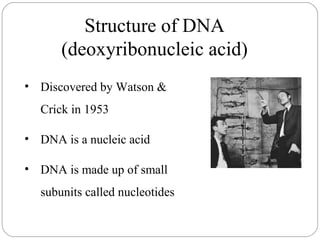
• Discovered by Watson &
Crick in 1953
• DNA is a nucleic acid
• DNA is made up of small
subunits called nucleotides
The nucleotides are made up of:
• Deoxyribose (sugar)
• Phosphate group
• Nitrogen bases - 4 types
1. Adenine - A
2. Guanine - G
3. Cytosine - C
4. Thymine -T
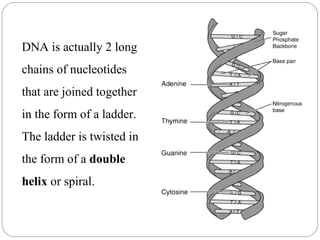
DNA is actually 2 long
chains of nucleotides
that are joined together
in the form of a ladder.
The ladder is twisted in
the form of a double
helix or spiral.
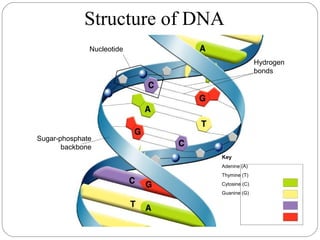
Hydrogen
bonds
Nucleotide
Sugar-phosphate
backbone
Key
Adenine (A)
Thymine (T)
Cytosine (C)
Guanine (G)
Structure of DNA
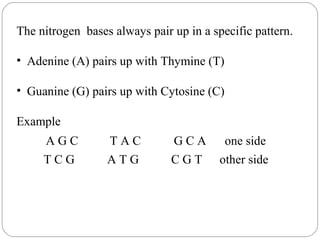
The nitrogen bases always pair up in a specific pattern.
• Adenine (A) pairs up with Thymine (T)
• Guanine (G) pairs up with Cytosine (C)
Example
A G C T A C G C A one side
T C G A T G C G T other side
All organisms have the same type of nucleotides.
The nucleotide arrangement provides for all the
different types..
Ex- A mouse and a rosebush have the same
nucleotides . However, they are different
because their nucleotides are in different
orders.
* This sequence of nucleotides forms the genetic
information(code) of an organism.
Replication of DNA
This DNA copy is made through a process known as
replication.
• During meiosis and mitosis a copy of DNA must
be
made so that when the new cells are formed, they
each get an exact copy of the genetic information.
Steps of Replication
During replication, each strand serves as a pattern to
make new DNA molecule.
• First step: DNA unzips into 2 strands.
(H bonds are broken)
• Second step: Free nucleotides join onto “unzipped”
strands to form 2 new strands of DNA.
• 2 complete strands will result, these will be
exactly alike.
Figure:- DNA ReplicationSection 12-2
Growth
Growth
Replication
fork
DNA
polymerase
New strand
Original
strand DNA
polymerase
Nitrogenous
bases
Replication
fork
Original
strand
New strand
THANK YOU

DNA - deoxyribonucleic acid

  • 1.
    Structure and Functionof DNA Presented by:- Akansh Goel
  • 2.
    Structure of DNA (deoxyribonucleicacid) • Discovered by Watson & Crick in 1953 • DNA is a nucleic acid • DNA is made up of small subunits called nucleotides
  • 3.
    The nucleotides aremade up of: • Deoxyribose (sugar) • Phosphate group • Nitrogen bases - 4 types 1. Adenine - A 2. Guanine - G 3. Cytosine - C 4. Thymine -T
  • 4.
    DNA is actually2 long chains of nucleotides that are joined together in the form of a ladder. The ladder is twisted in the form of a double helix or spiral.
  • 5.
  • 6.
    The nitrogen basesalways pair up in a specific pattern. • Adenine (A) pairs up with Thymine (T) • Guanine (G) pairs up with Cytosine (C) Example A G C T A C G C A one side T C G A T G C G T other side
  • 7.
    All organisms havethe same type of nucleotides. The nucleotide arrangement provides for all the different types.. Ex- A mouse and a rosebush have the same nucleotides . However, they are different because their nucleotides are in different orders. * This sequence of nucleotides forms the genetic information(code) of an organism.
  • 8.
    Replication of DNA ThisDNA copy is made through a process known as replication. • During meiosis and mitosis a copy of DNA must be made so that when the new cells are formed, they each get an exact copy of the genetic information.
  • 9.
    Steps of Replication Duringreplication, each strand serves as a pattern to make new DNA molecule. • First step: DNA unzips into 2 strands. (H bonds are broken) • Second step: Free nucleotides join onto “unzipped” strands to form 2 new strands of DNA. • 2 complete strands will result, these will be exactly alike.
  • 10.
    Figure:- DNA ReplicationSection 12-2 Growth Growth Replication fork DNA polymerase New strand Original strandDNA polymerase Nitrogenous bases Replication fork Original strand New strand
  • 11.