感想
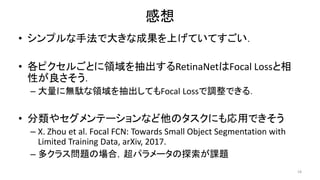
• シンプルな手法で大きな成果を上げていてすごい.
• 各ピクセルごとに領域を抽出するRetinaNetはFocalLossと相
性が良さそう.
– 大量に無駄な領域を抽出してもFocal Lossで調整できる.
• 分類やセグメンテーションなど他のタスクにも応用できそう
– X. Zhou et al. Focal FCN: Towards Small Object Segmentation with
Limited Training Data, arXiv, 2017.
– 多クラス問題の場合,超パラメータの探索が課題
18
19.
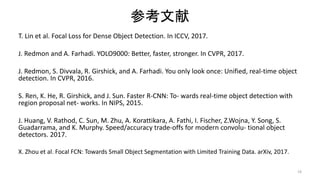
参考文献
T. Lin etal. Focal Loss for Dense Object Detection. In ICCV, 2017.
J. Redmon and A. Farhadi. YOLO9000: Better, faster, stronger. In CVPR, 2017.
J. Redmon, S. Divvala, R. Girshick, and A. Farhadi. You only look once: Unified, real-time object
detection. In CVPR, 2016.
S. Ren, K. He, R. Girshick, and J. Sun. Faster R-CNN: To- wards real-time object detection with
region proposal net- works. In NIPS, 2015.
J. Huang, V. Rathod, C. Sun, M. Zhu, A. Korattikara, A. Fathi, I. Fischer, Z.Wojna, Y. Song, S.
Guadarrama, and K. Murphy. Speed/accuracy trade-offs for modern convolu- tional object
detectors. 2017.
X. Zhou et al. Focal FCN: Towards Small Object Segmentation with Limited Training Data. arXiv, 2017.
19
![1
DEEP LEARNING JP
[DL Papers]
http://deeplearning.jp/
“Focal Loss for Dense Object Detection (ICCV 2017)”
土居健人, 岩崎研](https://image.slidesharecdn.com/focalloss-180208092846/85/DL-Focal-Loss-for-Dense-Object-Detection-1-320.jpg)
![1
DEEP LEARNING JP
[DL Papers]
http://deeplearning.jp/
“Focal Loss for Dense Object Detection (ICCV 2017)”
土居健人, 岩崎研](https://image.slidesharecdn.com/focalloss-180208092846/75/DL-Focal-Loss-for-Dense-Object-Detection-1-2048.jpg)


![[DL輪読会]相互情報量最大化による表現学習](https://cdn.slidesharecdn.com/ss_thumbnails/20190913iwasawa-190913002312-thumbnail.jpg?width=640&height=640&fit=bounds)

![[DL輪読会]GLIDE: Guided Language to Image Diffusion for Generation and Editing](https://cdn.slidesharecdn.com/ss_thumbnails/glide2-220107030326-thumbnail.jpg?width=640&height=640&fit=bounds)
![[DL輪読会]Pay Attention to MLPs (gMLP)](https://cdn.slidesharecdn.com/ss_thumbnails/kobayashi-210528032327-thumbnail.jpg?width=640&height=640&fit=bounds)


![[DL輪読会] Spectral Norm Regularization for Improving the Generalizability of De...](https://cdn.slidesharecdn.com/ss_thumbnails/dlhackspectralnorm1-170907072536-thumbnail.jpg?width=640&height=640&fit=bounds)
![[DL輪読会]Vision Transformer with Deformable Attention (Deformable Attention Tra...](https://cdn.slidesharecdn.com/ss_thumbnails/dl0114-220114032933-thumbnail.jpg?width=640&height=640&fit=bounds)

![SSII2021 [OS2-02] 深層学習におけるデータ拡張の原理と最新動向](https://cdn.slidesharecdn.com/ss_thumbnails/os2-03latest-210610045610-thumbnail.jpg?width=640&height=640&fit=bounds)


![[DL輪読会]Graph R-CNN for Scene Graph Generation](https://cdn.slidesharecdn.com/ss_thumbnails/graphr-cnnforscenegraphgenerationkobayashi1130-181130001547-thumbnail.jpg?width=640&height=640&fit=bounds)


![[DL輪読会]YOLO9000: Better, Faster, Stronger](https://cdn.slidesharecdn.com/ss_thumbnails/dlreadingpaper20170804-170803075138-thumbnail.jpg?width=640&height=640&fit=bounds)
![[DL輪読会]End-to-End Object Detection with Transformers](https://cdn.slidesharecdn.com/ss_thumbnails/200529dlseminardetr-200529061512-thumbnail.jpg?width=640&height=640&fit=bounds)


![[DL輪読会]YOLOv4: Optimal Speed and Accuracy of Object Detection](https://cdn.slidesharecdn.com/ss_thumbnails/200515dlseminar-200515082345-thumbnail.jpg?width=640&height=640&fit=bounds)
![明日使えるかもしれないLoss Functionsのアイディアと実装 [GO株式会社 AI技術共有会資料]](https://cdn.slidesharecdn.com/ss_thumbnails/lossfunctions-240618001834-3f3034ab-thumbnail.jpg?width=640&height=640&fit=bounds)


![[DL輪読会]Objects as Points](https://cdn.slidesharecdn.com/ss_thumbnails/20190614centernetkuboshizuma-190614004246-thumbnail.jpg?width=640&height=640&fit=bounds)


