株式会社 Mobility Technologies 内田祐介 (@yu4u)
近年の
Vision Transformer
〜全部同じじゃないですか〜
本資料はDeNA+MoTでの
輪講資料を加筆したものです
2
▪ ViT [1] の流行
▪ 画像もTransformer!でも大量データ(JFT-300M)必要
▪ DeiT [2]
▪ ViTの学習方法の確立、ImageNetだけでもCNN相当に
▪ MLP-Mixer [3]
▪ AttentionではなくMLPでもいいよ!
▪ ViTの改良やattentionの代替(MLP, pool, shift, LSTM) 乱立
背景
[1] A. Dosovitskiy, et al., "An Image is Worth 16x16 Words: Transformers for Image Recognition at
Scale," in Proc. of ICLR, 2021.
[2] H. Touvron, et al., "Training Data-efficient Image Transformers & Distillation Through Attention," in
Proc. of ICLR'21.
[3] I. Tolstikhin, et al., "MLP-Mixer: An all-MLP Architecture for Vision," in Proc. of NeurIPS'21.
3
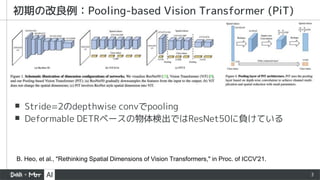
▪ Stride=2のdepthwise convでpooling
▪ Deformable DETRベースの物体検出ではResNet50に負けている
初期の改良例:Pooling-based Vision Transformer (PiT)
B. Heo, et al., "Rethinking Spatial Dimensions of Vision Transformers," in Proc. of ICCV'21.
4
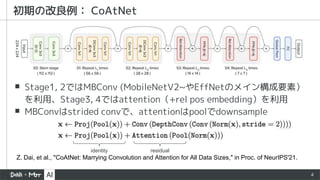
▪ Stage1, 2ではMBConv (MobileNetV2~やEffNetのメイン構成要素)
を利用、Stage3, 4ではattention(+rel pos embedding)を利用
▪ MBConvはstrided convで、attentionはpoolでdownsample
初期の改良例: CoAtNet
Z. Dai, et al., "CoAtNet: Marrying Convolution and Attention for All Data Sizes," in Proc. of NeurIPS'21.
identity residual
5
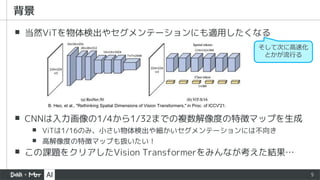
▪ 当然ViTを物体検出やセグメンテーションにも適用したくなる
▪ CNNは入力画像の1/4から1/32までの複数解像度の特徴マップを生成
▪ ViTは1/16のみ、小さい物体検出や細かいセグメンテーションには不向き
▪ 高解像度の特徴マップも扱いたい!
▪ この課題をクリアしたVision Transformerをみんなが考えた結果…
背景
B. Heo, et al., "Rethinking Spatial Dimensions of Vision Transformers," in Proc. of ICCV'21.
そして次に高速化
とかが流行る
6
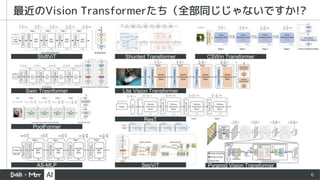
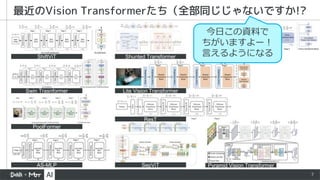
最近のVision Transformerたち(全部同じじゃないですか!?
Swin Trasnformer
PoolFormer
ShiftViT
AS-MLP
Shunted Transformer CSWin Transformer
ResT
SepViT
Lite Vision Transformer
Pyramid Vision Transformer
7
最近のVision Transformerたち(全部同じじゃないですか!?
Swin Trasnformer
PoolFormer
ShiftViT
AS-MLP
Shunted Transformer CSWin Transformer
ResT
SepViT
Lite Vision Transformer
Pyramid Vision Transformer
今日この資料で
ちがいますよー!
言えるようになる
8
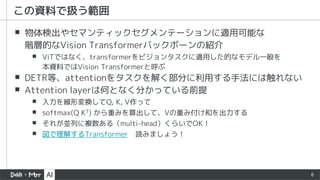
▪ 物体検出やセマンティックセグメンテーションに適用可能な
階層的なVision Transformerバックボーンの紹介
▪ ViTではなく、transformerをビジョンタスクに適用した的なモデル一般を
本資料ではVision Transformerと呼ぶ
▪ DETR等、attentionをタスクを解く部分に利用する手法には触れない
▪ Attention layerは何となく分かっている前提
▪ 入力を線形変換してQ, K, V作って
▪ softmax(Q KT) から重みを算出して、Vの重み付け和を出力する
▪ それが並列に複数ある(multi-head)くらいでOK!
▪ 図で理解するTransformer 読みましょう!
この資料で扱う範囲
9
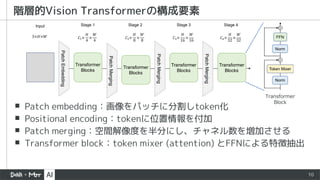
▪ 紹介するVision Transformerはほぼこの形で表現可能
▪ Transformer blockのtoken mixerが主な違い
▪ MLP-Mixer, PoolFormer, ShiftViT等のattentionを使わないモデルも
token mixerが違うだけのViTと言える
▪ この構造を [1] ではMetaFormerと呼び、この構造が性能に寄与していると主張
階層的Vision Transformerの一般系(CNN的な階層構造)
Transformer
Block
[1] W. Yu, et al., "MetaFormer is Actually What You Need for Vision," in Proc. of CVPR’22.
10
▪ Patch embedding:画像をパッチに分割しtoken化
▪ Positional encoding:tokenに位置情報を付加
▪ Patch merging:空間解像度を半分にし、チャネル数を増加させる
▪ Transformer block:token mixer (attention) とFFNによる特徴抽出
階層的Vision Transformerの構成要素
Transformer
Block
11
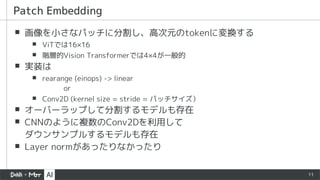
▪ 画像を小さなパッチに分割し、高次元のtokenに変換する
▪ ViTでは16×16
▪ 階層的Vision Transformerでは4×4が一般的
▪ 実装は
▪ rearange (einops) -> linear
or
▪ Conv2D (kernel size = stride = パッチサイズ)
▪ オーバーラップして分割するモデルも存在
▪ CNNのように複数のConv2Dを利用して
ダウンサンプルするモデルも存在
▪ Layer normがあったりなかったり
Patch Embedding
12
▪ Transformer (attention) 自体は集合のencoder (decoder)
▪ Positional encodingにより各tokenに位置情報を付加する必要がある
▪ 色々なアプローチがある
▪ Relative or absolute × 固定(sinusoidal) or learnable [1]
▪ Conditional positional encodings [2](面白いので本資料のappendixで紹介)
▪ FFNのconvで暗にembedする [3]
▪ Absolute positional encodingは入力のtokenに付加する
▪ オリジナルのViTはこれ
▪ Relative positional encodingはattentionの内積部分に付加
Positional Encoding
[1] K. Wu, et al., "Rethinking and Improving Relative Position Encoding for Vision Transformer," in Proc. of ICCV'21.
[2] X. Chu, et al., "Conditional Positional Encodings for Vision Transformers," in arXiv:2102.10882.
[3] Enze Xie, et a., "SegFormer: Simple and Efficient Design for Semantic Segmentation with Transformers," in Proc. of
NeurIPS'21.
13
▪ 近傍2×2のtokenを統合することで空間解像度を半分にしつつ
tokenの次元数を増加(2倍が多い)させる
▪ Patch embeddingと同じ実装が多い
▪ Patch embeddingと同様にオーバーラップさせるケースも
Patch Merging
14
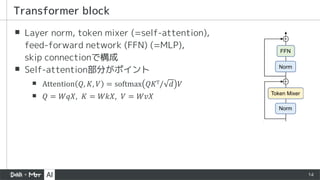
▪ Layer norm, token mixer (=self-attention),
feed-forward network (FFN) (=MLP),
skip connectionで構成
▪ Self-attention部分がポイント
▪ Attention 𝑄, 𝐾, 𝑉 = softmax 𝑄𝐾T/ 𝑑 𝑉
▪ 𝑄 = 𝑊𝑞𝑋, 𝐾 = 𝑊𝑘𝑋, 𝑉 = 𝑊𝑣𝑋
Transformer block
15
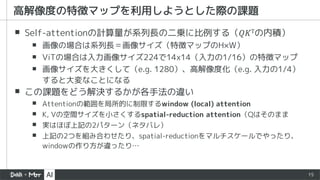
▪ Self-attentionの計算量が系列長の二乗に比例する(𝑄𝐾Tの内積)
▪ 画像の場合は系列長=画像サイズ(特徴マップのH×W)
▪ ViTの場合は入力画像サイズ224で14x14(入力の1/16)の特徴マップ
▪ 画像サイズを大きくして(e.g. 1280)、高解像度化(e.g. 入力の1/4)
すると大変なことになる
▪ この課題をどう解決するかが各手法の違い
▪ Attentionの範囲を局所的に制限するwindow (local) attention
▪ K, Vの空間サイズを小さくするspatial-reduction attention(Qはそのまま
▪ 実はほぼ上記の2パターン(ネタバレ)
▪ 上記の2つを組み合わせたり、spatial-reductionをマルチスケールでやったり、
windowの作り方が違ったり…
高解像度の特徴マップを利用しようとした際の課題
16
▪ Vision Transformerを物体検出やセグメンテーションタスクの
バックボーンとすべく階層的なVision Transformerが提案されている
▪ これらは共通の構造を持っており下記のモジュールから構成
▪ Patch embedding:画像をパッチに分割しtoken化
▪ Positional encoding:tokenに位置情報を付加
▪ Patch merging:空間解像度を半分にし、チャネル数を増加させる
▪ Transformer block:token mixer (attention) とFFNによる特徴抽出
▪ Transformer blockのattention部分の計算量削減がポイント
▪ Window (local) attentionとspatial-reduction attentionに大別される
▪ 以降では各モデルのtoken mixer (attention) 部分をメインに
雑に解説!
ここまでのまとめ
17
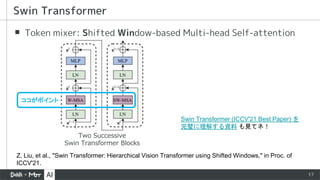
▪ Token mixer: Shifted Window-based Multi-head Self-attention
Swin Transformer
Two Successive
Swin Transformer Blocks
ココがポイント
Z. Liu, et al., "Swin Transformer: Hierarchical Vision Transformer using Shifted Windows," in Proc. of
ICCV'21.
Swin Transformer (ICCV'21 Best Paper) を
完璧に理解する資料 も見てネ!
18
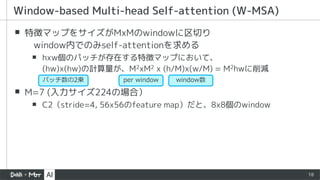
▪ 特徴マップをサイズがMxMのwindowに区切り
window内でのみself-attentionを求める
▪ hxw個のパッチが存在する特徴マップにおいて、
(hw)x(hw)の計算量が、M2xM2 x (h/M)x(w/M) = M2hwに削減
▪ M=7 (入力サイズ224の場合)
▪ C2(stride=4, 56x56のfeature map)だと、8x8個のwindow
Window-based Multi-head Self-attention (W-MSA)
per window window数
パッチ数の2乗
19
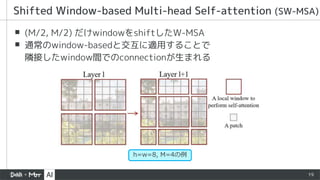
▪ (M/2, M/2) だけwindowをshiftしたW-MSA
▪ 通常のwindow-basedと交互に適用することで
隣接したwindow間でのconnectionが生まれる
Shifted Window-based Multi-head Self-attention (SW-MSA)
h=w=8, M=4の例
20
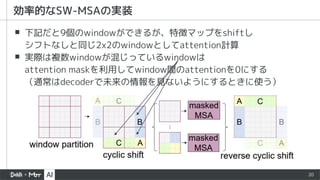
▪ 下記だと9個のwindowができるが、特徴マップをshiftし
シフトなしと同じ2x2のwindowとしてattention計算
▪ 実際は複数windowが混じっているwindowは
attention maskを利用してwindow間のattentionを0にする
(通常はdecoderで未来の情報を見ないようにするときに使う)
効率的なSW-MSAの実装
21
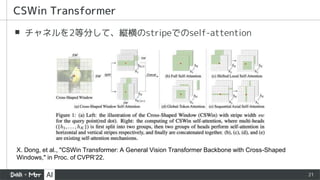
▪ チャネルを2等分して、縦横のstripeでのself-attention
CSWin Transformer
X. Dong, et al., "CSWin Transformer: A General Vision Transformer Backbone with Cross-Shaped
Windows," in Proc. of CVPR’22.
22
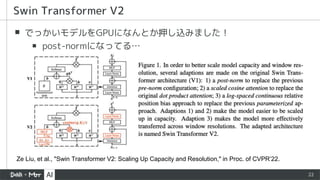
▪ でっかいモデルをGPUになんとか押し込みました!
▪ post-normになってる…
Swin Transformer V2
Ze Liu, et al., "Swin Transformer V2: Scaling Up Capacity and Resolution," in Proc. of CVPR’22.
23
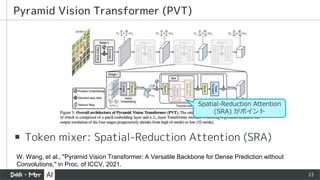
▪ Token mixer: Spatial-Reduction Attention (SRA)
Pyramid Vision Transformer (PVT)
W. Wang, et al., "Pyramid Vision Transformer: A Versatile Backbone for Dense Prediction without
Convolutions," in Proc. of ICCV, 2021.
Spatial-Reduction Attention
(SRA) がポイント
24
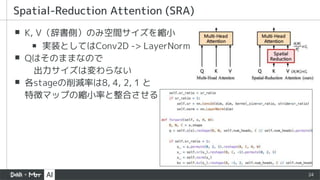
▪ K, V(辞書側)のみ空間サイズを縮小
▪ 実装としてはConv2D -> LayerNorm
▪ Qはそのままなので
出力サイズは変わらない
▪ 各stageの削減率は8, 4, 2, 1 と
特徴マップの縮小率と整合させる
Spatial-Reduction Attention (SRA)
25
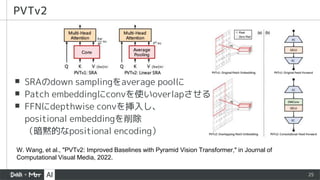
▪ SRAのdown samplingをaverage poolに
▪ Patch embeddingにconvを使いoverlapさせる
▪ FFNにdepthwise convを挿入し、
positional embeddingを削除
(暗黙的なpositional encoding)
PVTv2
W. Wang, et al., "PVTv2: Improved Baselines with Pyramid Vision Transformer," in Journal of
Computational Visual Media, 2022.
26
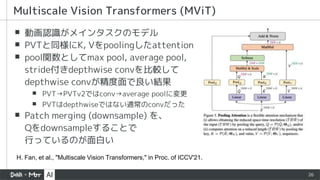
▪ 動画認識がメインタスクのモデル
▪ PVTと同様にK, Vをpoolingしたattention
▪ pool関数としてmax pool, average pool,
stride付きdepthwise convを比較して
depthwise convが精度面で良い結果
▪ PVT→PVTv2ではconv→average poolに変更
▪ PVTはdepthwiseではない通常のconvだった
▪ Patch merging (downsample) を、
Qをdownsampleすることで
行っているのが面白い
Multiscale Vision Transformers (MViT)
H. Fan, et al., "Multiscale Vision Transformers," in Proc. of ICCV'21.
27
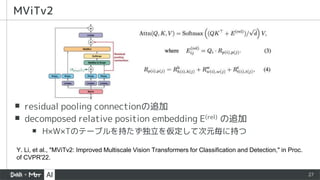
▪ residual pooling connectionの追加
▪ decomposed relative position embedding E(rel) の追加
▪ H×W×Tのテーブルを持たず独立を仮定して次元毎に持つ
MViTv2
Y. Li, et al., "MViTv2: Improved Multiscale Vision Transformers for Classification and Detection," in Proc.
of CVPR'22.
28
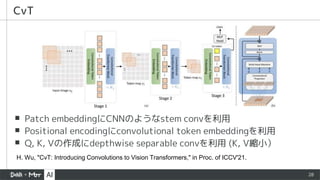
▪ Patch embeddingにCNNのようなstem convを利用
▪ Positional encodingにconvolutional token embeddingを利用
▪ Q, K, Vの作成にdepthwise separable convを利用 (K, V縮小)
CvT
H. Wu, "CvT: Introducing Convolutions to Vision Transformers," in Proc. of ICCV'21.
29
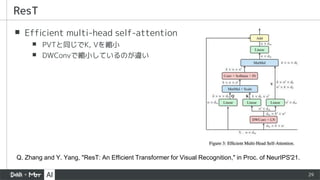
▪ Efficient multi-head self-attention
▪ PVTと同じでK, Vを縮小
▪ DWConvで縮小しているのが違い
ResT
Q. Zhang and Y. Yang, "ResT: An Efficient Transformer for Visual Recognition," in Proc. of NeurIPS'21.
30
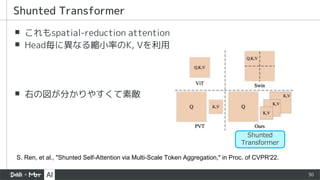
▪ これもspatial-reduction attention
▪ Head毎に異なる縮小率のK, Vを利用
▪ 右の図が分かりやすくて素敵
Shunted Transformer
S. Ren, et al., "Shunted Self-Attention via Multi-Scale Token Aggregation," in Proc. of CVPR'22.
Shunted
Transformer
31
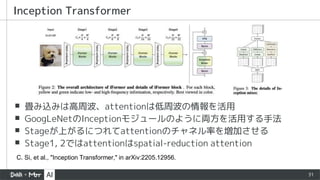
▪ 畳み込みは高周波、attentionは低周波の情報を活用
▪ GoogLeNetのInceptionモジュールのように両方を活用する手法
▪ Stageが上がるにつれてattentionのチャネル率を増加させる
▪ Stage1, 2ではattentionはspatial-reduction attention
Inception Transformer
C. Si, et al., "Inception Transformer," in arXiv:2205.12956.
32
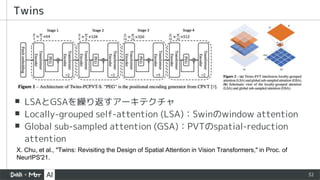
▪ LSAとGSAを繰り返すアーキテクチャ
▪ Locally-grouped self-attention (LSA):Swinのwindow attention
▪ Global sub-sampled attention (GSA):PVTのspatial-reduction
attention
Twins
X. Chu, et al., "Twins: Revisiting the Design of Spatial Attention in Vision Transformers," in Proc. of
NeurIPS'21.
33
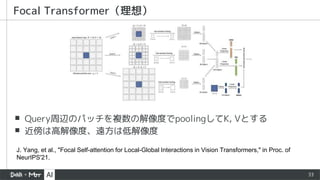
▪ Query周辺のパッチを複数の解像度でpoolingしてK, Vとする
▪ 近傍は高解像度、遠方は低解像度
Focal Transformer(理想)
J. Yang, et al., "Focal Self-attention for Local-Global Interactions in Vision Transformers," in Proc. of
NeurIPS'21.
34
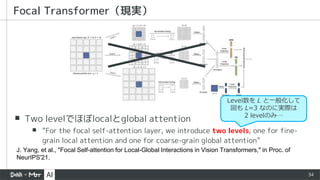
▪ Two levelでほぼlocalとglobal attention
▪ “For the focal self-attention layer, we introduce two levels, one for fine-
grain local attention and one for coarse-grain global attention”
Focal Transformer(現実)
J. Yang, et al., "Focal Self-attention for Local-Global Interactions in Vision Transformers," in Proc. of
NeurIPS'21.
Level数を L と一般化して
図も L=3 なのに実際は
2 levelのみ…
35
▪ SDA (window attention) と、特徴マップを空間的にshuffleしてから
window attentionするLDAの組み合わせ
▪ 空間shuffleは [2] でも利用されている
▪ 古くはCNNにShuffleNetというものがあってじゃな…
CrossFormer [1]
[1] W. Wang, et al., "CrossFormer: A Versatile Vision Transformer Based on Cross-scale Attention," in
Proc. of ICLR'22.
[2] Z. Huang, et al., "Shuffle Transformer: Rethinking Spatial Shuffle for Vision Transformer," in
arXiv:2106.03650.
36
▪ Attention(がメイン)じゃないやつとか
おまけ
37
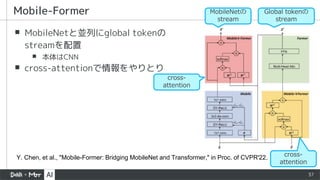
▪ MobileNetと並列にglobal tokenの
streamを配置
▪ 本体はCNN
▪ cross-attentionで情報をやりとり
Mobile-Former
Y. Chen, et al., "Mobile-Former: Bridging MobileNet and Transformer," in Proc. of CVPR'22.
MobileNetの
stream
Global tokenの
stream
cross-
attention
cross-
attention
38
▪ Attentionの代わりにshift operation
▪ 空間方向(上下左右)に1 pixelずらす
▪ なのでZERO FLOPs!!!
▪ S2-MLP [2] や AS-MLP [3] といった
先行手法が存在するが
ShiftViTは本当にshiftだけ
ShiftViT [1]
[1] G. Wang, et al., "When Shift Operation Meets Vision Transformer: An Extremely Simple Alternative to
Attention Mechanism," in Proc. of AAAI'22.
[2] T. Yu, et al., "S2-MLP: Spatial-Shift MLP Architecture for Vision," in Proc. of WACV'22.
[3] D. Lian, et al., "AS-MLP: An Axial Shifted MLP Architecture for Vision," in Proc. of ICLR'22.
39
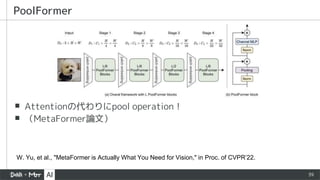
▪ Attentionの代わりにpool operation!
▪ (MetaFormer論文)
PoolFormer
W. Yu, et al., "MetaFormer is Actually What You Need for Vision," in Proc. of CVPR’22.
40
▪ 近年の階層的なVision Transformerを紹介した
▪ これらは共通の構造を持っており下記のモジュールから構成
▪ Patch embedding:画像をパッチに分割しtoken化
▪ Positional encoding:tokenに位置情報を付加
▪ Patch merging:空間解像度を半分にし、チャネル数を増加させる
▪ Transformer block:token mixer (attention) とFFNによる特徴抽出
▪ Transformer blockのattention部分の計算量削減がポイント
▪ Window (local) attentionとspatial-reduction attentionに大別される
▪ これらの組み合わせもある。1 blockで両方 or 連続したblockで個別に
▪ Position encodingはなくしてFFNにDWConvが良さそう(個人の意見です
▪ cls tokenはなくしてglobal average poolingを使う流れ
まとめ
41
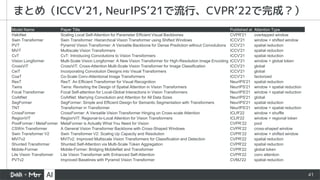
まとめ(ICCV‘21, NeurIPS’21で流行、CVPR’22で完成?)
Model Name Paper Title Published at Attention Type
HaloNet Scaling Local Self-Attention for Parameter Efficient Visual Backbones CVPR'21 overlapped window
Swin Transformer Swin Transformer: Hierarchical Vision Transformer using Shifted Windows ICCV'21 window + shifted window
PVT Pyramid Vision Transformer: A Versatile Backbone for Dense Prediction without Convolutions ICCV'21 spatial reduction
MViT Multiscale Vision Transformers ICCV'21 spatial reduction
CvT CvT: Introducing Convolutions to Vision Transformers ICCV'21 spatial reduction
Vision Longformer Multi-Scale Vision Longformer: A New Vision Transformer for High-Resolution Image Encoding ICCV'21 window + global token
CrossViT CrossViT: Cross-Attention Multi-Scale Vision Transformer for Image Classification ICCV'21 global
CeiT Incorporating Convolution Designs into Visual Transformers ICCV'21 global
CoaT Co-Scale Conv-Attentional Image Transformers ICCV'21 factorized
ResT ResT: An Efficient Transformer for Visual Recognition NeurIPS'21 spatial reduction
Twins Twins: Revisiting the Design of Spatial Attention in Vision Transformers NeurIPS'21 window + spatial reduction
Focal Transformer Focal Self-attention for Local-Global Interactions in Vision Transformers NeurIPS'21 window + spatial reduction
CoAtNet CoAtNet: Marrying Convolution and Attention for All Data Sizes NeurIPS'21 global
SegFormer SegFormer: Simple and Efficient Design for Semantic Segmentation with Transformers NeurIPS'21 spatial reduction
TNT Transformer in Transformer NeurIPS'21 window + spatial reduction
CrossFormer CrossFormer: A Versatile Vision Transformer Hinging on Cross-scale Attention ICLR'22 window + shuffle
RegionViT RegionViT: Regional-to-Local Attention for Vision Transformers ICLR'22 window + regional token
PoolFormer / MetaFormer MetaFormer is Actually What You Need for Vision CVPR’22 pool
CSWin Transformer A General Vision Transformer Backbone with Cross-Shaped Windows CVPR’22 cross-shaped window
Swin Transformer V2 Swin Transformer V2: Scaling Up Capacity and Resolution CVPR’22 window + shifted window
MViTv2 MViTv2: Improved Multiscale Vision Transformers for Classification and Detection CVPR'22 spatial reduction
Shunted Transformer Shunted Self-Attention via Multi-Scale Token Aggregation CVPR'22 spatial reduction
Mobile-Former Mobile-Former: Bridging MobileNet and Transformer CVPR'22 global token
Lite Vision Transformer Lite Vision Transformer with Enhanced Self-Attention CVPR'22 conv attention
PVTv2 Improved Baselines with Pyramid Vision Transformer CVMJ'22 spatial reduction
42
Appendix
43
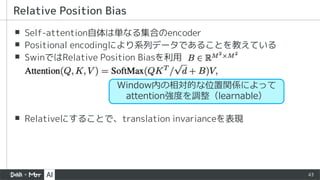
▪ Self-attention自体は単なる集合のencoder
▪ Positional encodingにより系列データであることを教えている
▪ SwinではRelative Position Biasを利用
▪ Relativeにすることで、translation invarianceを表現
Relative Position Bias
Window内の相対的な位置関係によって
attention強度を調整(learnable)
44
▪ 相対位置関係は縦横[−M + 1, M −1]のrangeで(2M-1)2パターン
▪ このbiasとindexの関係を保持しておき、使うときに引く
実装
45
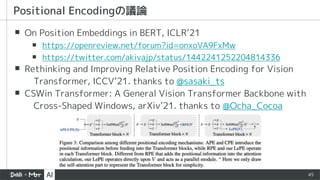
▪ On Position Embeddings in BERT, ICLR’21
▪ https://openreview.net/forum?id=onxoVA9FxMw
▪ https://twitter.com/akivajp/status/1442241252204814336
▪ Rethinking and Improving Relative Position Encoding for Vision
Transformer, ICCV’21. thanks to @sasaki_ts
▪ CSWin Transformer: A General Vision Transformer Backbone with
Cross-Shaped Windows, arXiv’21. thanks to @Ocha_Cocoa
Positional Encodingの議論
46
▪ 入力token依存、画像入力サイズに依存しない、translation-
invariance、絶対座標も何となく加味できるposition encoding (PE)
▪ 実装は単に特徴マップを2次元に再構築してzero padding付きのconvするだけ
▪ Zero pad付きconvによりCNNが絶対座標を特徴マップに保持するという報告 [2]
▪ これにinspireされ、PVTv2ではFFNにDWConvを挿入、PE削除
Conditional Positional Encoding (CPE) [1]
[1] X. Chu, et al., "Conditional Positional Encodings for Vision Transformers," in arXiv:2102.10882.
[2] M. Islam, et al., "How Much Position Information Do Convolutional Neural Networks Encode?," in
Proc. of ICLR'20.

近年のHierarchical Vision Transformer

  • 1.
    株式会社 Mobility Technologies内田祐介 (@yu4u) 近年の Vision Transformer 〜全部同じじゃないですか〜 本資料はDeNA+MoTでの 輪講資料を加筆したものです
  • 2.
    2 ▪ ViT [1]の流行 ▪ 画像もTransformer!でも大量データ(JFT-300M)必要 ▪ DeiT [2] ▪ ViTの学習方法の確立、ImageNetだけでもCNN相当に ▪ MLP-Mixer [3] ▪ AttentionではなくMLPでもいいよ! ▪ ViTの改良やattentionの代替(MLP, pool, shift, LSTM) 乱立 背景 [1] A. Dosovitskiy, et al., "An Image is Worth 16x16 Words: Transformers for Image Recognition at Scale," in Proc. of ICLR, 2021. [2] H. Touvron, et al., "Training Data-efficient Image Transformers & Distillation Through Attention," in Proc. of ICLR'21. [3] I. Tolstikhin, et al., "MLP-Mixer: An all-MLP Architecture for Vision," in Proc. of NeurIPS'21.
  • 3.
    3 ▪ Stride=2のdepthwise convでpooling ▪Deformable DETRベースの物体検出ではResNet50に負けている 初期の改良例:Pooling-based Vision Transformer (PiT) B. Heo, et al., "Rethinking Spatial Dimensions of Vision Transformers," in Proc. of ICCV'21.
  • 4.
    4 ▪ Stage1, 2ではMBConv(MobileNetV2~やEffNetのメイン構成要素) を利用、Stage3, 4ではattention(+rel pos embedding)を利用 ▪ MBConvはstrided convで、attentionはpoolでdownsample 初期の改良例: CoAtNet Z. Dai, et al., "CoAtNet: Marrying Convolution and Attention for All Data Sizes," in Proc. of NeurIPS'21. identity residual
  • 5.
    5 ▪ 当然ViTを物体検出やセグメンテーションにも適用したくなる ▪ CNNは入力画像の1/4から1/32までの複数解像度の特徴マップを生成 ▪ViTは1/16のみ、小さい物体検出や細かいセグメンテーションには不向き ▪ 高解像度の特徴マップも扱いたい! ▪ この課題をクリアしたVision Transformerをみんなが考えた結果… 背景 B. Heo, et al., "Rethinking Spatial Dimensions of Vision Transformers," in Proc. of ICCV'21. そして次に高速化 とかが流行る
  • 6.
    6 最近のVision Transformerたち(全部同じじゃないですか!? Swin Trasnformer PoolFormer ShiftViT AS-MLP ShuntedTransformer CSWin Transformer ResT SepViT Lite Vision Transformer Pyramid Vision Transformer
  • 7.
    7 最近のVision Transformerたち(全部同じじゃないですか!? Swin Trasnformer PoolFormer ShiftViT AS-MLP ShuntedTransformer CSWin Transformer ResT SepViT Lite Vision Transformer Pyramid Vision Transformer 今日この資料で ちがいますよー! 言えるようになる
  • 8.
    8 ▪ 物体検出やセマンティックセグメンテーションに適用可能な 階層的なVision Transformerバックボーンの紹介 ▪ViTではなく、transformerをビジョンタスクに適用した的なモデル一般を 本資料ではVision Transformerと呼ぶ ▪ DETR等、attentionをタスクを解く部分に利用する手法には触れない ▪ Attention layerは何となく分かっている前提 ▪ 入力を線形変換してQ, K, V作って ▪ softmax(Q KT) から重みを算出して、Vの重み付け和を出力する ▪ それが並列に複数ある(multi-head)くらいでOK! ▪ 図で理解するTransformer 読みましょう! この資料で扱う範囲
  • 9.
    9 ▪ 紹介するVision Transformerはほぼこの形で表現可能 ▪Transformer blockのtoken mixerが主な違い ▪ MLP-Mixer, PoolFormer, ShiftViT等のattentionを使わないモデルも token mixerが違うだけのViTと言える ▪ この構造を [1] ではMetaFormerと呼び、この構造が性能に寄与していると主張 階層的Vision Transformerの一般系(CNN的な階層構造) Transformer Block [1] W. Yu, et al., "MetaFormer is Actually What You Need for Vision," in Proc. of CVPR’22.
  • 10.
    10 ▪ Patch embedding:画像をパッチに分割しtoken化 ▪Positional encoding:tokenに位置情報を付加 ▪ Patch merging:空間解像度を半分にし、チャネル数を増加させる ▪ Transformer block:token mixer (attention) とFFNによる特徴抽出 階層的Vision Transformerの構成要素 Transformer Block
  • 11.
    11 ▪ 画像を小さなパッチに分割し、高次元のtokenに変換する ▪ ViTでは16×16 ▪階層的Vision Transformerでは4×4が一般的 ▪ 実装は ▪ rearange (einops) -> linear or ▪ Conv2D (kernel size = stride = パッチサイズ) ▪ オーバーラップして分割するモデルも存在 ▪ CNNのように複数のConv2Dを利用して ダウンサンプルするモデルも存在 ▪ Layer normがあったりなかったり Patch Embedding
  • 12.
    12 ▪ Transformer (attention)自体は集合のencoder (decoder) ▪ Positional encodingにより各tokenに位置情報を付加する必要がある ▪ 色々なアプローチがある ▪ Relative or absolute × 固定(sinusoidal) or learnable [1] ▪ Conditional positional encodings [2](面白いので本資料のappendixで紹介) ▪ FFNのconvで暗にembedする [3] ▪ Absolute positional encodingは入力のtokenに付加する ▪ オリジナルのViTはこれ ▪ Relative positional encodingはattentionの内積部分に付加 Positional Encoding [1] K. Wu, et al., "Rethinking and Improving Relative Position Encoding for Vision Transformer," in Proc. of ICCV'21. [2] X. Chu, et al., "Conditional Positional Encodings for Vision Transformers," in arXiv:2102.10882. [3] Enze Xie, et a., "SegFormer: Simple and Efficient Design for Semantic Segmentation with Transformers," in Proc. of NeurIPS'21.
  • 13.
    13 ▪ 近傍2×2のtokenを統合することで空間解像度を半分にしつつ tokenの次元数を増加(2倍が多い)させる ▪ Patchembeddingと同じ実装が多い ▪ Patch embeddingと同様にオーバーラップさせるケースも Patch Merging
  • 14.
    14 ▪ Layer norm,token mixer (=self-attention), feed-forward network (FFN) (=MLP), skip connectionで構成 ▪ Self-attention部分がポイント ▪ Attention 𝑄, 𝐾, 𝑉 = softmax 𝑄𝐾T/ 𝑑 𝑉 ▪ 𝑄 = 𝑊𝑞𝑋, 𝐾 = 𝑊𝑘𝑋, 𝑉 = 𝑊𝑣𝑋 Transformer block
  • 15.
    15 ▪ Self-attentionの計算量が系列長の二乗に比例する(𝑄𝐾Tの内積) ▪ 画像の場合は系列長=画像サイズ(特徴マップのH×W) ▪ViTの場合は入力画像サイズ224で14x14(入力の1/16)の特徴マップ ▪ 画像サイズを大きくして(e.g. 1280)、高解像度化(e.g. 入力の1/4) すると大変なことになる ▪ この課題をどう解決するかが各手法の違い ▪ Attentionの範囲を局所的に制限するwindow (local) attention ▪ K, Vの空間サイズを小さくするspatial-reduction attention(Qはそのまま ▪ 実はほぼ上記の2パターン(ネタバレ) ▪ 上記の2つを組み合わせたり、spatial-reductionをマルチスケールでやったり、 windowの作り方が違ったり… 高解像度の特徴マップを利用しようとした際の課題
  • 16.
    16 ▪ Vision Transformerを物体検出やセグメンテーションタスクの バックボーンとすべく階層的なVisionTransformerが提案されている ▪ これらは共通の構造を持っており下記のモジュールから構成 ▪ Patch embedding:画像をパッチに分割しtoken化 ▪ Positional encoding:tokenに位置情報を付加 ▪ Patch merging:空間解像度を半分にし、チャネル数を増加させる ▪ Transformer block:token mixer (attention) とFFNによる特徴抽出 ▪ Transformer blockのattention部分の計算量削減がポイント ▪ Window (local) attentionとspatial-reduction attentionに大別される ▪ 以降では各モデルのtoken mixer (attention) 部分をメインに 雑に解説! ここまでのまとめ
  • 17.
    17 ▪ Token mixer:Shifted Window-based Multi-head Self-attention Swin Transformer Two Successive Swin Transformer Blocks ココがポイント Z. Liu, et al., "Swin Transformer: Hierarchical Vision Transformer using Shifted Windows," in Proc. of ICCV'21. Swin Transformer (ICCV'21 Best Paper) を 完璧に理解する資料 も見てネ!
  • 18.
    18 ▪ 特徴マップをサイズがMxMのwindowに区切り window内でのみself-attentionを求める ▪ hxw個のパッチが存在する特徴マップにおいて、 (hw)x(hw)の計算量が、M2xM2x (h/M)x(w/M) = M2hwに削減 ▪ M=7 (入力サイズ224の場合) ▪ C2(stride=4, 56x56のfeature map)だと、8x8個のwindow Window-based Multi-head Self-attention (W-MSA) per window window数 パッチ数の2乗
  • 19.
    19 ▪ (M/2, M/2)だけwindowをshiftしたW-MSA ▪ 通常のwindow-basedと交互に適用することで 隣接したwindow間でのconnectionが生まれる Shifted Window-based Multi-head Self-attention (SW-MSA) h=w=8, M=4の例
  • 20.
    20 ▪ 下記だと9個のwindowができるが、特徴マップをshiftし シフトなしと同じ2x2のwindowとしてattention計算 ▪ 実際は複数windowが混じっているwindowは attentionmaskを利用してwindow間のattentionを0にする (通常はdecoderで未来の情報を見ないようにするときに使う) 効率的なSW-MSAの実装
  • 21.
    21 ▪ チャネルを2等分して、縦横のstripeでのself-attention CSWin Transformer X.Dong, et al., "CSWin Transformer: A General Vision Transformer Backbone with Cross-Shaped Windows," in Proc. of CVPR’22.
  • 22.
    22 ▪ でっかいモデルをGPUになんとか押し込みました! ▪ post-normになってる… SwinTransformer V2 Ze Liu, et al., "Swin Transformer V2: Scaling Up Capacity and Resolution," in Proc. of CVPR’22.
  • 23.
    23 ▪ Token mixer:Spatial-Reduction Attention (SRA) Pyramid Vision Transformer (PVT) W. Wang, et al., "Pyramid Vision Transformer: A Versatile Backbone for Dense Prediction without Convolutions," in Proc. of ICCV, 2021. Spatial-Reduction Attention (SRA) がポイント
  • 24.
    24 ▪ K, V(辞書側)のみ空間サイズを縮小 ▪実装としてはConv2D -> LayerNorm ▪ Qはそのままなので 出力サイズは変わらない ▪ 各stageの削減率は8, 4, 2, 1 と 特徴マップの縮小率と整合させる Spatial-Reduction Attention (SRA)
  • 25.
    25 ▪ SRAのdown samplingをaveragepoolに ▪ Patch embeddingにconvを使いoverlapさせる ▪ FFNにdepthwise convを挿入し、 positional embeddingを削除 (暗黙的なpositional encoding) PVTv2 W. Wang, et al., "PVTv2: Improved Baselines with Pyramid Vision Transformer," in Journal of Computational Visual Media, 2022.
  • 26.
    26 ▪ 動画認識がメインタスクのモデル ▪ PVTと同様にK,Vをpoolingしたattention ▪ pool関数としてmax pool, average pool, stride付きdepthwise convを比較して depthwise convが精度面で良い結果 ▪ PVT→PVTv2ではconv→average poolに変更 ▪ PVTはdepthwiseではない通常のconvだった ▪ Patch merging (downsample) を、 Qをdownsampleすることで 行っているのが面白い Multiscale Vision Transformers (MViT) H. Fan, et al., "Multiscale Vision Transformers," in Proc. of ICCV'21.
  • 27.
    27 ▪ residual poolingconnectionの追加 ▪ decomposed relative position embedding E(rel) の追加 ▪ H×W×Tのテーブルを持たず独立を仮定して次元毎に持つ MViTv2 Y. Li, et al., "MViTv2: Improved Multiscale Vision Transformers for Classification and Detection," in Proc. of CVPR'22.
  • 28.
    28 ▪ Patch embeddingにCNNのようなstemconvを利用 ▪ Positional encodingにconvolutional token embeddingを利用 ▪ Q, K, Vの作成にdepthwise separable convを利用 (K, V縮小) CvT H. Wu, "CvT: Introducing Convolutions to Vision Transformers," in Proc. of ICCV'21.
  • 29.
    29 ▪ Efficient multi-headself-attention ▪ PVTと同じでK, Vを縮小 ▪ DWConvで縮小しているのが違い ResT Q. Zhang and Y. Yang, "ResT: An Efficient Transformer for Visual Recognition," in Proc. of NeurIPS'21.
  • 30.
    30 ▪ これもspatial-reduction attention ▪Head毎に異なる縮小率のK, Vを利用 ▪ 右の図が分かりやすくて素敵 Shunted Transformer S. Ren, et al., "Shunted Self-Attention via Multi-Scale Token Aggregation," in Proc. of CVPR'22. Shunted Transformer
  • 31.
    31 ▪ 畳み込みは高周波、attentionは低周波の情報を活用 ▪ GoogLeNetのInceptionモジュールのように両方を活用する手法 ▪Stageが上がるにつれてattentionのチャネル率を増加させる ▪ Stage1, 2ではattentionはspatial-reduction attention Inception Transformer C. Si, et al., "Inception Transformer," in arXiv:2205.12956.
  • 32.
    32 ▪ LSAとGSAを繰り返すアーキテクチャ ▪ Locally-groupedself-attention (LSA):Swinのwindow attention ▪ Global sub-sampled attention (GSA):PVTのspatial-reduction attention Twins X. Chu, et al., "Twins: Revisiting the Design of Spatial Attention in Vision Transformers," in Proc. of NeurIPS'21.
  • 33.
    33 ▪ Query周辺のパッチを複数の解像度でpoolingしてK, Vとする ▪近傍は高解像度、遠方は低解像度 Focal Transformer(理想) J. Yang, et al., "Focal Self-attention for Local-Global Interactions in Vision Transformers," in Proc. of NeurIPS'21.
  • 34.
    34 ▪ Two levelでほぼlocalとglobalattention ▪ “For the focal self-attention layer, we introduce two levels, one for fine- grain local attention and one for coarse-grain global attention” Focal Transformer(現実) J. Yang, et al., "Focal Self-attention for Local-Global Interactions in Vision Transformers," in Proc. of NeurIPS'21. Level数を L と一般化して 図も L=3 なのに実際は 2 levelのみ…
  • 35.
    35 ▪ SDA (windowattention) と、特徴マップを空間的にshuffleしてから window attentionするLDAの組み合わせ ▪ 空間shuffleは [2] でも利用されている ▪ 古くはCNNにShuffleNetというものがあってじゃな… CrossFormer [1] [1] W. Wang, et al., "CrossFormer: A Versatile Vision Transformer Based on Cross-scale Attention," in Proc. of ICLR'22. [2] Z. Huang, et al., "Shuffle Transformer: Rethinking Spatial Shuffle for Vision Transformer," in arXiv:2106.03650.
  • 36.
  • 37.
    37 ▪ MobileNetと並列にglobal tokenの streamを配置 ▪本体はCNN ▪ cross-attentionで情報をやりとり Mobile-Former Y. Chen, et al., "Mobile-Former: Bridging MobileNet and Transformer," in Proc. of CVPR'22. MobileNetの stream Global tokenの stream cross- attention cross- attention
  • 38.
    38 ▪ Attentionの代わりにshift operation ▪空間方向(上下左右)に1 pixelずらす ▪ なのでZERO FLOPs!!! ▪ S2-MLP [2] や AS-MLP [3] といった 先行手法が存在するが ShiftViTは本当にshiftだけ ShiftViT [1] [1] G. Wang, et al., "When Shift Operation Meets Vision Transformer: An Extremely Simple Alternative to Attention Mechanism," in Proc. of AAAI'22. [2] T. Yu, et al., "S2-MLP: Spatial-Shift MLP Architecture for Vision," in Proc. of WACV'22. [3] D. Lian, et al., "AS-MLP: An Axial Shifted MLP Architecture for Vision," in Proc. of ICLR'22.
  • 39.
    39 ▪ Attentionの代わりにpool operation! ▪(MetaFormer論文) PoolFormer W. Yu, et al., "MetaFormer is Actually What You Need for Vision," in Proc. of CVPR’22.
  • 40.
    40 ▪ 近年の階層的なVision Transformerを紹介した ▪これらは共通の構造を持っており下記のモジュールから構成 ▪ Patch embedding:画像をパッチに分割しtoken化 ▪ Positional encoding:tokenに位置情報を付加 ▪ Patch merging:空間解像度を半分にし、チャネル数を増加させる ▪ Transformer block:token mixer (attention) とFFNによる特徴抽出 ▪ Transformer blockのattention部分の計算量削減がポイント ▪ Window (local) attentionとspatial-reduction attentionに大別される ▪ これらの組み合わせもある。1 blockで両方 or 連続したblockで個別に ▪ Position encodingはなくしてFFNにDWConvが良さそう(個人の意見です ▪ cls tokenはなくしてglobal average poolingを使う流れ まとめ
  • 41.
    41 まとめ(ICCV‘21, NeurIPS’21で流行、CVPR’22で完成?) Model NamePaper Title Published at Attention Type HaloNet Scaling Local Self-Attention for Parameter Efficient Visual Backbones CVPR'21 overlapped window Swin Transformer Swin Transformer: Hierarchical Vision Transformer using Shifted Windows ICCV'21 window + shifted window PVT Pyramid Vision Transformer: A Versatile Backbone for Dense Prediction without Convolutions ICCV'21 spatial reduction MViT Multiscale Vision Transformers ICCV'21 spatial reduction CvT CvT: Introducing Convolutions to Vision Transformers ICCV'21 spatial reduction Vision Longformer Multi-Scale Vision Longformer: A New Vision Transformer for High-Resolution Image Encoding ICCV'21 window + global token CrossViT CrossViT: Cross-Attention Multi-Scale Vision Transformer for Image Classification ICCV'21 global CeiT Incorporating Convolution Designs into Visual Transformers ICCV'21 global CoaT Co-Scale Conv-Attentional Image Transformers ICCV'21 factorized ResT ResT: An Efficient Transformer for Visual Recognition NeurIPS'21 spatial reduction Twins Twins: Revisiting the Design of Spatial Attention in Vision Transformers NeurIPS'21 window + spatial reduction Focal Transformer Focal Self-attention for Local-Global Interactions in Vision Transformers NeurIPS'21 window + spatial reduction CoAtNet CoAtNet: Marrying Convolution and Attention for All Data Sizes NeurIPS'21 global SegFormer SegFormer: Simple and Efficient Design for Semantic Segmentation with Transformers NeurIPS'21 spatial reduction TNT Transformer in Transformer NeurIPS'21 window + spatial reduction CrossFormer CrossFormer: A Versatile Vision Transformer Hinging on Cross-scale Attention ICLR'22 window + shuffle RegionViT RegionViT: Regional-to-Local Attention for Vision Transformers ICLR'22 window + regional token PoolFormer / MetaFormer MetaFormer is Actually What You Need for Vision CVPR’22 pool CSWin Transformer A General Vision Transformer Backbone with Cross-Shaped Windows CVPR’22 cross-shaped window Swin Transformer V2 Swin Transformer V2: Scaling Up Capacity and Resolution CVPR’22 window + shifted window MViTv2 MViTv2: Improved Multiscale Vision Transformers for Classification and Detection CVPR'22 spatial reduction Shunted Transformer Shunted Self-Attention via Multi-Scale Token Aggregation CVPR'22 spatial reduction Mobile-Former Mobile-Former: Bridging MobileNet and Transformer CVPR'22 global token Lite Vision Transformer Lite Vision Transformer with Enhanced Self-Attention CVPR'22 conv attention PVTv2 Improved Baselines with Pyramid Vision Transformer CVMJ'22 spatial reduction
  • 42.
  • 43.
    43 ▪ Self-attention自体は単なる集合のencoder ▪ Positionalencodingにより系列データであることを教えている ▪ SwinではRelative Position Biasを利用 ▪ Relativeにすることで、translation invarianceを表現 Relative Position Bias Window内の相対的な位置関係によって attention強度を調整(learnable)
  • 44.
    44 ▪ 相対位置関係は縦横[−M +1, M −1]のrangeで(2M-1)2パターン ▪ このbiasとindexの関係を保持しておき、使うときに引く 実装
  • 45.
    45 ▪ On PositionEmbeddings in BERT, ICLR’21 ▪ https://openreview.net/forum?id=onxoVA9FxMw ▪ https://twitter.com/akivajp/status/1442241252204814336 ▪ Rethinking and Improving Relative Position Encoding for Vision Transformer, ICCV’21. thanks to @sasaki_ts ▪ CSWin Transformer: A General Vision Transformer Backbone with Cross-Shaped Windows, arXiv’21. thanks to @Ocha_Cocoa Positional Encodingの議論
  • 46.
    46 ▪ 入力token依存、画像入力サイズに依存しない、translation- invariance、絶対座標も何となく加味できるposition encoding(PE) ▪ 実装は単に特徴マップを2次元に再構築してzero padding付きのconvするだけ ▪ Zero pad付きconvによりCNNが絶対座標を特徴マップに保持するという報告 [2] ▪ これにinspireされ、PVTv2ではFFNにDWConvを挿入、PE削除 Conditional Positional Encoding (CPE) [1] [1] X. Chu, et al., "Conditional Positional Encodings for Vision Transformers," in arXiv:2102.10882. [2] M. Islam, et al., "How Much Position Information Do Convolutional Neural Networks Encode?," in Proc. of ICLR'20.