What is
Dividend?
“A dividend is a distribution to
shareholders out of profit or
reserve available for this purpose”.
- Institute of Chartered Accountants
of India
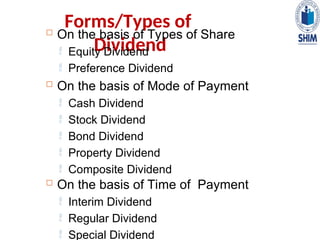
Forms/Types of
Dividend
 On the basis of Types of Share
 Equity Dividend
 Preference Dividend
 On the basis of Mode of Payment
 Cash Dividend
 Stock Dividend
 Bond Dividend
 Property Dividend
 Composite Dividend
 On the basis of Time of Payment
 Interim Dividend
 Regular Dividend
 Special Dividend
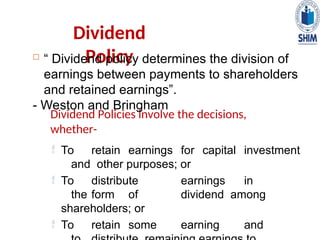
Dividend
Policy
 “ Dividend policy determines the division of
earnings between payments to shareholders
and retained earnings”.
- Weston and Bringham
Dividend Policies involve the decisions,
whether-
 To retain earnings for capital investment
and other purposes; or
 To distribute earnings in
the form of dividend among
shareholders; or
 To retain some earning and
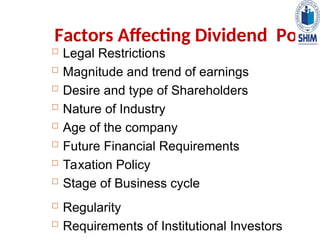
Factors Affecting Dividend Policy
 Legal Restrictions
 Magnitude and trend of earnings
 Desire and type of Shareholders
 Nature of Industry
 Age of the company
 Future Financial Requirements
 Taxation Policy
 Stage of Business cycle
 Regularity
 Requirements of Institutional Investors
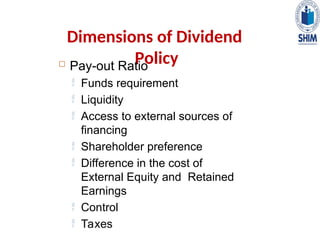
Dimensions of Dividend
Policy
 Pay-out Ratio
 Funds requirement
 Liquidity
 Access to external sources of
financing
 Shareholder preference
 Difference in the cost of
External Equity and Retained
Earnings
 Control
 Taxes
C
o
n
t
d
.

t
a
b
i
l
i
t
y
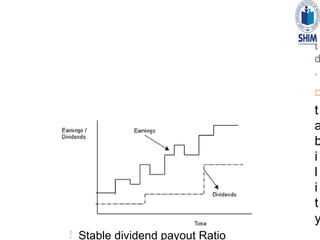
 Stable dividend payout Ratio
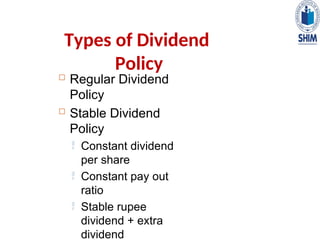
Types of Dividend
Policy
 Regular Dividend
Policy
 Stable Dividend
Policy
 Constant dividend
per share
 Constant pay out
ratio
 Stable rupee
dividend + extra
dividend
Dividend
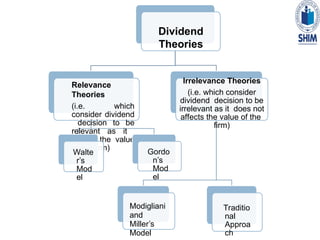
Theories
Relevance
Theories
(i.e. which
consider dividend
decision to be
relevant as it
affects the value
of the firm)
Walte
r’s
Mod
el
Gordo
n’s
Mod
el
Irrelevance Theories
(i.e. which consider
dividend decision to be
irrelevant as it does not
affects the value of the
firm)
Modigliani
and
Miller’s
Model
Traditio
nal
Approa
ch
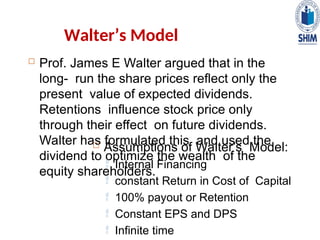
 Prof. James E Walter argued that in the
long- run the share prices reflect only the
present value of expected dividends.
Retentions influence stock price only
through their effect on future dividends.
Walter has formulated this and used the
dividend to optimize the wealth of the
equity shareholders.
Walter’s Model
 Assumptions of Walter’s Model:
 Internal Financing
 constant Return in Cost of Capital
 100% payout or Retention
 Constant EPS and DPS
 Infinite time
Formula of Walter’s
Model
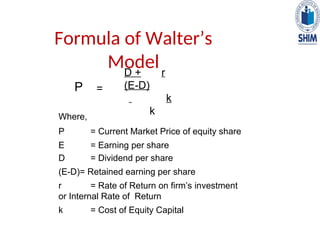
Where,
P = Current Market Price of equity share
E = Earning per share
D = Dividend per share
(E-D)= Retained earning per share
r = Rate of Return on firm’s investment
or Internal Rate of Return
k = Cost of Equity Capital
P
D + r
(E-D)
k
k
=
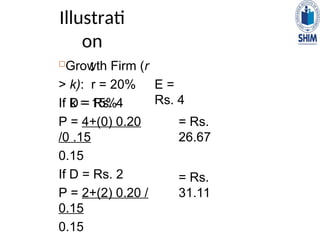
Growth Firm (r
> k): r = 20%
k = 15%
E =
Rs. 4
If D = Rs. 4
P = 4+(0) 0.20
/0 .15
0.15
If D = Rs. 2
P = 2+(2) 0.20 /
0.15
0.15
= Rs.
26.67
= Rs.
31.11
Illustrati
on
:
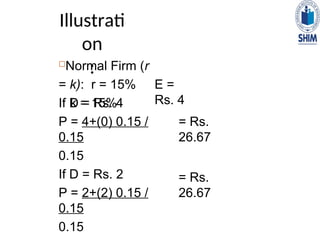
Normal Firm (r
= k): r = 15%
k = 15%
E =
Rs. 4
If D = Rs. 4
P = 4+(0) 0.15 /
0.15
0.15
If D = Rs. 2
P = 2+(2) 0.15 /
0.15
0.15
= Rs.
26.67
= Rs.
26.67
Illustrati
on
:
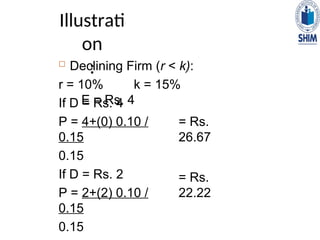
 Declining Firm (r < k):
r = 10% k = 15%
E = Rs. 4
If D = Rs. 4
P = 4+(0) 0.10 /
0.15
0.15
If D = Rs. 2
P = 2+(2) 0.10 /
0.15
0.15
= Rs.
26.67
= Rs.
22.22
Illustrati
on
:
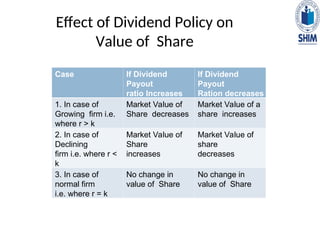
Effect of Dividend Policy on
Value of Share
Case If Dividend
Payout
ratio Increases
If Dividend
Payout
Ration decreases
1. In case of
Growing firm i.e.
where r > k
Market Value of
Share decreases
Market Value of a
share increases
2. In case of
Declining
firm i.e. where r <
k
Market Value of
Share
increases
Market Value of
share
decreases
3. In case of
normal firm
i.e. where r = k
No change in
value of Share
No change in
value of Share
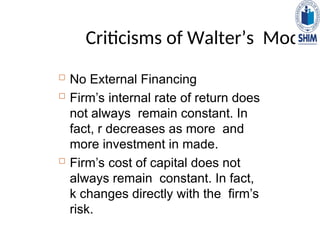
Criticisms of Walter’s Model
 No External Financing
 Firm’s internal rate of return does
not always remain constant. In
fact, r decreases as more and
more investment in made.
 Firm’s cost of capital does not
always remain constant. In fact,
k changes directly with the firm’s
risk.
Gordo
n’s
Model
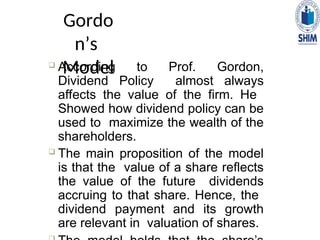
 According to Prof. Gordon,
Dividend Policy almost always
affects the value of the firm. He
Showed how dividend policy can be
used to maximize the wealth of the
shareholders.
 The main proposition of the model
is that the value of a share reflects
the value of the future dividends
accruing to that share. Hence, the
dividend payment and its growth
are relevant in valuation of shares.
 Assumptions:
 All equity firm
 No external Financing
 Constant Returns
 Constant Cost of Capital
 Perpetual Earnings
 No taxes
 Constant Retention
 Cost of Capital is greater then
growth rate (k>br=g)
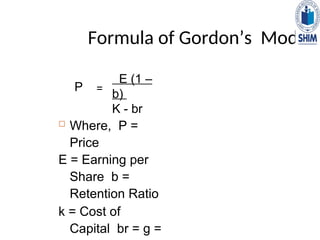
Formula of Gordon’s Model
 Where, P =
Price
E = Earning per
Share b =
Retention Ratio
k = Cost of
Capital br = g =
P =
E (1 –
b)
K - br
Criticisms of Gordon’s model
 As the assumptions of Walter’s Model
and Gordon’s Model are same so the
Gordon’s model suffers from the same
limitations as the Walter’s Model.
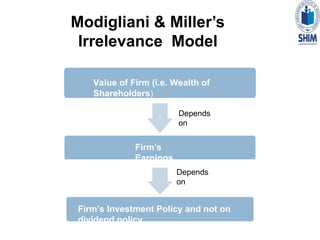
Modigliani & Miller’s
Irrelevance Model
Value of Firm (i.e. Wealth of
Shareholders)
Firm’s
Earnings
Firm’s Investment Policy and not on
dividend policy
Depends
on
Depends
on
Modigliani and Miller’s Approac
 Assumption
 Capital Markets are Perfect and
people are Rational
 No taxes
 Floating Costs are nil
 Investment opportunities and
future profits of firms are known
with certainty (This assumption
was dropped later)
 Investment and Dividend
Decisions are independent
M-M’s
Argument
 If a company retains earnings instead of
giving it out as dividends, the shareholder
enjoy capital appreciation equal to the
amount of earnings retained.
 If it distributes earnings by the way of
dividends instead of retaining it,
shareholder enjoys dividends equal in
value to the amount by which his capital
would have appreciated had the
company chosen to retain its earning.
 Hence,
the division of earnings between dividends and
retained earnings is IRRELEVANT from the
point of view of shareholders.
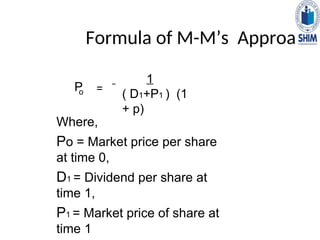
Formula of M-M’s Approach
P
o =
1
( D1+P1 ) (1
+ p)
Where,
Po = Market price per share
at time 0,
D1 = Dividend per share at
time 1,
P1 = Market price of share at
time 1
Criticism of
M-M Model
 No perfect Capital
Market
 Existence of
Transaction Cost
 Existence of Floatation
Cost
 Lack of Relevant
Information
 Differential rates of
Taxes
curre
nt
Traditional
Approach
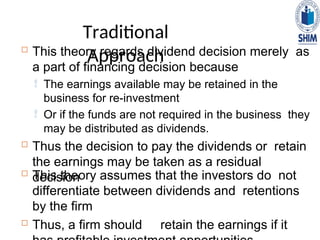
 This theory regards dividend decision merely as
a part of financing decision because
 The earnings available may be retained in the
business for re-investment
 Or if the funds are not required in the business they
may be distributed as dividends.
 Thus the decision to pay the dividends or retain
the earnings may be taken as a residual
decision
 This theory assumes that the investors do not
differentiate between dividends and retentions
by the firm
 Thus, a firm should retain the earnings if it

Dividend Decision, Models and theories and forms

  • 1.
    What is Dividend? “A dividendis a distribution to shareholders out of profit or reserve available for this purpose”. - Institute of Chartered Accountants of India
  • 2.
    Forms/Types of Dividend  Onthe basis of Types of Share  Equity Dividend  Preference Dividend  On the basis of Mode of Payment  Cash Dividend  Stock Dividend  Bond Dividend  Property Dividend  Composite Dividend  On the basis of Time of Payment  Interim Dividend  Regular Dividend  Special Dividend
  • 3.
    Dividend Policy  “ Dividendpolicy determines the division of earnings between payments to shareholders and retained earnings”. - Weston and Bringham Dividend Policies involve the decisions, whether-  To retain earnings for capital investment and other purposes; or  To distribute earnings in the form of dividend among shareholders; or  To retain some earning and
  • 4.
    Factors Affecting DividendPolicy  Legal Restrictions  Magnitude and trend of earnings  Desire and type of Shareholders  Nature of Industry  Age of the company  Future Financial Requirements  Taxation Policy  Stage of Business cycle  Regularity  Requirements of Institutional Investors
  • 5.
    Dimensions of Dividend Policy Pay-out Ratio  Funds requirement  Liquidity  Access to external sources of financing  Shareholder preference  Difference in the cost of External Equity and Retained Earnings  Control  Taxes
  • 6.
  • 7.
    Types of Dividend Policy Regular Dividend Policy  Stable Dividend Policy  Constant dividend per share  Constant pay out ratio  Stable rupee dividend + extra dividend
  • 8.
    Dividend Theories Relevance Theories (i.e. which consider dividend decisionto be relevant as it affects the value of the firm) Walte r’s Mod el Gordo n’s Mod el Irrelevance Theories (i.e. which consider dividend decision to be irrelevant as it does not affects the value of the firm) Modigliani and Miller’s Model Traditio nal Approa ch
  • 9.
     Prof. JamesE Walter argued that in the long- run the share prices reflect only the present value of expected dividends. Retentions influence stock price only through their effect on future dividends. Walter has formulated this and used the dividend to optimize the wealth of the equity shareholders. Walter’s Model  Assumptions of Walter’s Model:  Internal Financing  constant Return in Cost of Capital  100% payout or Retention  Constant EPS and DPS  Infinite time
  • 10.
    Formula of Walter’s Model Where, P= Current Market Price of equity share E = Earning per share D = Dividend per share (E-D)= Retained earning per share r = Rate of Return on firm’s investment or Internal Rate of Return k = Cost of Equity Capital P D + r (E-D) k k =
  • 11.
    Growth Firm (r >k): r = 20% k = 15% E = Rs. 4 If D = Rs. 4 P = 4+(0) 0.20 /0 .15 0.15 If D = Rs. 2 P = 2+(2) 0.20 / 0.15 0.15 = Rs. 26.67 = Rs. 31.11 Illustrati on :
  • 12.
    Normal Firm (r =k): r = 15% k = 15% E = Rs. 4 If D = Rs. 4 P = 4+(0) 0.15 / 0.15 0.15 If D = Rs. 2 P = 2+(2) 0.15 / 0.15 0.15 = Rs. 26.67 = Rs. 26.67 Illustrati on :
  • 13.
     Declining Firm(r < k): r = 10% k = 15% E = Rs. 4 If D = Rs. 4 P = 4+(0) 0.10 / 0.15 0.15 If D = Rs. 2 P = 2+(2) 0.10 / 0.15 0.15 = Rs. 26.67 = Rs. 22.22 Illustrati on :
  • 14.
    Effect of DividendPolicy on Value of Share Case If Dividend Payout ratio Increases If Dividend Payout Ration decreases 1. In case of Growing firm i.e. where r > k Market Value of Share decreases Market Value of a share increases 2. In case of Declining firm i.e. where r < k Market Value of Share increases Market Value of share decreases 3. In case of normal firm i.e. where r = k No change in value of Share No change in value of Share
  • 15.
    Criticisms of Walter’sModel  No External Financing  Firm’s internal rate of return does not always remain constant. In fact, r decreases as more and more investment in made.  Firm’s cost of capital does not always remain constant. In fact, k changes directly with the firm’s risk.
  • 16.
    Gordo n’s Model  According toProf. Gordon, Dividend Policy almost always affects the value of the firm. He Showed how dividend policy can be used to maximize the wealth of the shareholders.  The main proposition of the model is that the value of a share reflects the value of the future dividends accruing to that share. Hence, the dividend payment and its growth are relevant in valuation of shares.
  • 17.
     Assumptions:  Allequity firm  No external Financing  Constant Returns  Constant Cost of Capital  Perpetual Earnings  No taxes  Constant Retention  Cost of Capital is greater then growth rate (k>br=g)
  • 18.
    Formula of Gordon’sModel  Where, P = Price E = Earning per Share b = Retention Ratio k = Cost of Capital br = g = P = E (1 – b) K - br
  • 19.
    Criticisms of Gordon’smodel  As the assumptions of Walter’s Model and Gordon’s Model are same so the Gordon’s model suffers from the same limitations as the Walter’s Model.
  • 21.
    Modigliani & Miller’s IrrelevanceModel Value of Firm (i.e. Wealth of Shareholders) Firm’s Earnings Firm’s Investment Policy and not on dividend policy Depends on Depends on
  • 22.
    Modigliani and Miller’sApproac  Assumption  Capital Markets are Perfect and people are Rational  No taxes  Floating Costs are nil  Investment opportunities and future profits of firms are known with certainty (This assumption was dropped later)  Investment and Dividend Decisions are independent
  • 23.
    M-M’s Argument  If acompany retains earnings instead of giving it out as dividends, the shareholder enjoy capital appreciation equal to the amount of earnings retained.  If it distributes earnings by the way of dividends instead of retaining it, shareholder enjoys dividends equal in value to the amount by which his capital would have appreciated had the company chosen to retain its earning.  Hence, the division of earnings between dividends and retained earnings is IRRELEVANT from the point of view of shareholders.
  • 24.
    Formula of M-M’sApproach P o = 1 ( D1+P1 ) (1 + p) Where, Po = Market price per share at time 0, D1 = Dividend per share at time 1, P1 = Market price of share at time 1
  • 25.
    Criticism of M-M Model No perfect Capital Market  Existence of Transaction Cost  Existence of Floatation Cost  Lack of Relevant Information  Differential rates of Taxes curre nt
  • 26.
    Traditional Approach  This theoryregards dividend decision merely as a part of financing decision because  The earnings available may be retained in the business for re-investment  Or if the funds are not required in the business they may be distributed as dividends.  Thus the decision to pay the dividends or retain the earnings may be taken as a residual decision  This theory assumes that the investors do not differentiate between dividends and retentions by the firm  Thus, a firm should retain the earnings if it