DIURETICS
For BSc Nursing
Dr. Pravin Prasad
MD Resident, 1st Yr
Maharajgunj Medical Campus
12th Shrawan, 2072 (31st July, 2015), Friday
Preliminaries
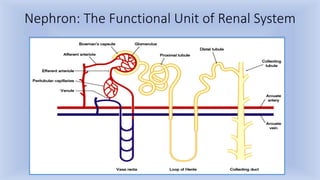
Nephron: The Functional Unit of Renal System
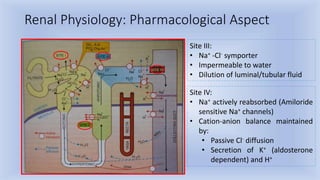
Renal Physiology: Pharmacological Aspect
Site I:
Movement of Na+ is by:
• Direct Entry of Na+
• Coupled to active reabsorption of
organic anions via specific
symporters
• Exchange with H+ ions
• Diffusion through paracellular
pathways (along with Cl- ions)
Site II:
Medullary Portion:
• Na+K+2Cl- and Na+ K+ ATPase;
• Na+-Cl- symporter
Renal Physiology: Pharmacological Aspect
Site III:
• Na+ -Cl- symporter
• Impermeable to water
• Dilution of luminal/tubular fluid
Site IV:
• Na+ actively reabsorbed (Amiloride
sensitive Na+ channels)
• Cation-anion balance maintained
by:
• Passive Cl- diffusion
• Secretion of K+ (aldosterone
dependent) and H+
Net Movement of Potassium
• Movement of Potassium:
• Reabsorbed in Proximal Tubule (PT) and thick ascending limb of Loop of Henle
(Asc LH)
• Secreted in the Distal Tubule (DT) and Collecting Duct (CD)
• Net K+ loss depends on:
• Na+ load delivered to DT and CD
• Presence or Absence of Aldosterone
• Availability of H+
• Intracellular K+ stores
Role of Anti Diuretic Hormone (ADH)
• Cells lining CD are sensitive to ADH
• ADH absent:
• Hypotonic fluid entering CD passes as such: dilute urine passed.
• High ADH levels:
• CD cells fully permeable to water
• Tubular fluid gets equilibrate with hyperosmotic medulla
• Concentrated urine passed
Diuretics
Drugs that cause net loss of Na+ and water in urine
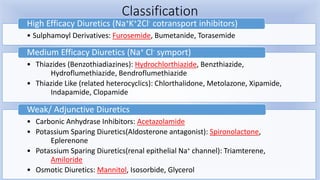
Classification
• Sulphamoyl Derivatives: Furosemide, Bumetanide, Torasemide
High Efficacy Diuretics (Na+K+2Cl- cotransport inhibitors)
• Thiazides (Benzothiadiazines): Hydrochlorthiazide, Benzthiazide,
Hydroflumethiazide, Bendroflumethiazide
• Thiazide Like (related heterocyclics): Chlorthalidone, Metolazone, Xipamide,
Indapamide, Clopamide
Medium Efficacy Diuretics (Na+ Cl- symport)
• Carbonic Anhydrase Inhibitors: Acetazolamide
• Potassium Sparing Diuretics(Aldosterone antagonist): Spironolactone,
Eplerenone
• Potassium Sparing Diuretics(renal epithelial Na+ channel): Triamterene,
Amiloride
• Osmotic Diuretics: Mannitol, Isosorbide, Glycerol
Weak/ Adjunctive Diuretics
High Ceiling Diuretics(Loop Diuretics):
Furosemide
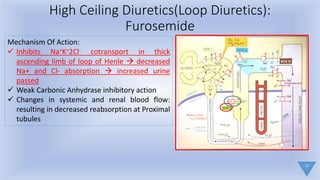
Mechanism Of Action:
 Inhibits Na+K+2Cl- cotransport in thick
ascending limb of loop of Henle  decreased
Na+ and Cl- absorption  increased urine
passed
 Weak Carbonic Anhydrase inhibitory action
 Changes in systemic and renal blood flow:
resulting in decreased reabsorption at Proximal
tubules
12
High Ceiling Diuretics: Uses
• Edema
• Preferred in CHF
• Nephrotic syndrome, chronic renal failure, resistant edema
• Impending acute renal failure
• Acute pulmonary edema (acute Left Ventricular Failure, following Myocardial
Infarction)
• Hypertension
• Co-existing renal insufficiency, CHF, resistant cases, hypertensive emergencies
• Along with Blood Transfusion
• Hypercalcemia of malignancy
• Cerebral edema
• Combined with osmotic diuretics to improve efficacy
Medium Efficacy Diuretics: Thiazide and
Thiazide like diuretics
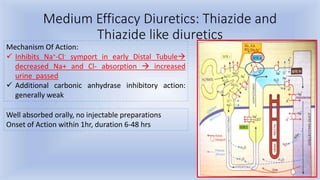
Mechanism Of Action:
 Inhibits Na+-Cl- symport in early Distal Tubule
decreased Na+ and Cl- absorption  increased
urine passed
 Additional carbonic anhydrase inhibitory action:
generally weak
Well absorbed orally, no injectable preparations
Onset of Action within 1hr, duration 6-48 hrs
Thiazide and Thiazide like diuretics: Uses
• Hypertension
• One of the First line drugs (Chlorthalidone)
• Edema
• Diabetes Insipidus (DI)
• Nephrogenic DI
• Hypercalciuria with recurrent calcium stones in the kidney
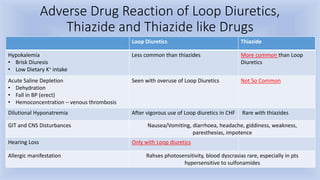
Adverse Drug Reaction of Loop Diuretics,
Thiazide and Thiazide like Drugs
Loop Diuretics Thiazide
Hypokalemia
• Brisk Diuresis
• Low Dietary K+ intake
Less common than thiazides More common than Loop
Diuretics
Acute Saline Depletion
• Dehydration
• Fall in BP (erect)
• Hemoconcentration – venous thrombosis
Seen with overuse of Loop Diuretics Not So Common
Dilutional Hyponatremia After vigorous use of Loop diuretics in CHF Rare with thiazides
GIT and CNS Disturbances Nausea/Vomiting, diarrhoea, headache, giddiness, weakness,
paresthesias, impotence
Hearing Loss Only with Loop diuretics
Allergic manifestation Rahses photosensitivity, blood dyscrasias rare, especially in pts
hypersensitive to sulfonamides
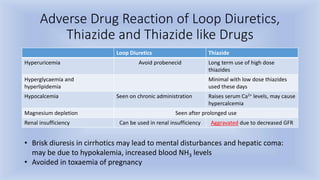
Loop Diuretics Thiazide
Hyperuricemia Avoid probenecid Long term use of high dose
thiazides
Hyperglycaemia and
hyperlipidemia
Minimal with low dose thiazides
used these days
Hypocalcemia Seen on chronic administration Raises serum Ca2+ levels, may cause
hypercalcemia
Magnesium depletion Seen after prolonged use
Renal insufficiency Can be used in renal insufficiency Aggravated due to decreased GFR
• Brisk diuresis in cirrhotics may lead to mental disturbances and hepatic coma:
may be due to hypokalemia, increased blood NH3 levels
• Avoided in toxaemia of pregnancy
Adverse Drug Reaction of Loop Diuretics,
Thiazide and Thiazide like Drugs
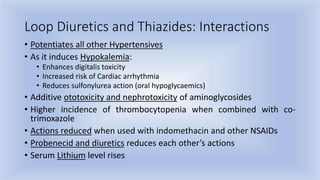
Loop Diuretics and Thiazides: Interactions
• Potentiates all other Hypertensives
• As it induces Hypokalemia:
• Enhances digitalis toxicity
• Increased risk of Cardiac arrhythmia
• Reduces sulfonylurea action (oral hypoglycaemics)
• Additive ototoxicity and nephrotoxicity of aminoglycosides
• Higher incidence of thrombocytopenia when combined with co-
trimoxazole
• Actions reduced when used with indomethacin and other NSAIDs
• Probenecid and diuretics reduces each other’s actions
• Serum Lithium level rises
Carbonic Anhydrase (CAse) inhibitors:
Acetazolamide
 Reversibly inhibits CAse (type II) in PT cells decreased H2CO3 formation  decreased H+
concentration  Na+-H+ antiport cannot function: Mild alkaline diuresis
 Secretion of H+ in DT and CD also interfered
 Causes marked kaliuresis
Acetazolamide
Uses
Glaucoma: as an adjuvant
Acute Mountain Sickness
Other uses:
• Periodic Paralysis
• Alkalinise urine
• Epilepsy: adjuvant
Adverse Effects
• Acidosis
• Hypokalemia
• Drowsiness
• Paresthesias
• Fatigue
• Abdominal Discomfort
• Hypersensitivity reactions
• Bone marrow depression (rare)
Contraindicated in liver disease: potential to induce hepatic coma
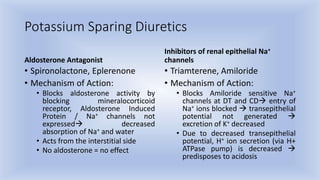
Potassium Sparing Diuretics
Aldosterone Antagonist
• Spironolactone, Eplerenone
• Mechanism of Action:
• Blocks aldosterone activity by
blocking mineralocorticoid
receptor, Aldosterone Induced
Protein / Na+ channels not
expressed decreased
absorption of Na+ and water
• Acts from the interstitial side
• No aldosterone = no effect
Inhibitors of renal epithelial Na+
channels
• Triamterene, Amiloride
• Mechanism of Action:
• Blocks Amiloride sensitive Na+
channels at DT and CD entry of
Na+ ions blocked  transepithelial
potential not generated 
excretion of K+ decreased
• Due to decreased transepithelial
potential, H+ ion secretion (via H+
ATPase pump) is decreased 
predisposes to acidosis
Uses
Aldosterone Antagonist
• Weak diuretic, always used in
combination
1. Hypertension: adjuvant to
thiazide
2. Edema (cirrhotic/nephrotic,
refractory)
3. Congestive Heart Failure
Inhibitors of renal epithelial Na+
channels
• Used in conjunction with other
diuretics
1. Hypertension: prevent
hypokalemia, increase
natriuretic response
Aldosterone Antagonist: Spironolactone
• Interactions
• K+ supplements: dangerous hyperkalemia
• Aspirin: decreases potency of Spironolactone
• ACE inhibitors/ARB: pronounced hyperkalemia
• Digoxin: increased levels of plasma digoxin
• Adverse Effects
• Hyperkalemia
• Drowsiness, mental confusion, ataxia, epigastric discomfort, loose motions
• Gynaecomastia, erectile dysfunction, loss of libido
• Breast tenderness, menstrual irregularities
• Acidosis in cirrhotics
Contraindicated in Peptic ulcer patient : may aggravate ulcers
Inhibitors of renal epithelial Na+ channels:
Amiloride
• Adverse Effects
• Hyperkalemia
• Should not be given with K+ supplements
• More likely in patients receiving ACE inhibitors/ARBs, β- blockers, NSAIDs,
• More likely in patients with renal impairment
• Elevated Plasma Digoxin levels
• Nausea, Dizziness, Muscle cramps, rise in blood urea
• Impaired glucose tolerance, photosensitivity
Osmotic Diuretics: Mannitol
• Pharmacologically inert
• Mechanism of Action:
• Retains water isoosmotically in PT
• Inhibits transport process in thick Asc LH
• Expands extracellular fluid volume
• Increased renal blood flow
• Increases urinary output, excretion of all cations and anions also
enhanced
• Given as intravenous drip
Osmotic Diuretics: Mannitol
• Uses
• Increased intracranial and intraocular tension
• To maintain glomerular filtration rate and urine flow in impending acute renal
failure: prognostic benefits not proven
• Counteract low osmolality of plasma/e.c.f.
• Contraindications
• Acute tubular necrosis
• Anuria
• Pulmonary Edema, acute left ventricular failure, CHF, cerebral haemorrhage
• Side Effects
• Headache, nausea/vomiting, hypersensitive reactions
Thank you!!!

Diuretics

  • 1.
    DIURETICS For BSc Nursing Dr.Pravin Prasad MD Resident, 1st Yr Maharajgunj Medical Campus 12th Shrawan, 2072 (31st July, 2015), Friday
  • 2.
  • 3.
    Nephron: The FunctionalUnit of Renal System
  • 4.
    Renal Physiology: PharmacologicalAspect Site I: Movement of Na+ is by: • Direct Entry of Na+ • Coupled to active reabsorption of organic anions via specific symporters • Exchange with H+ ions • Diffusion through paracellular pathways (along with Cl- ions) Site II: Medullary Portion: • Na+K+2Cl- and Na+ K+ ATPase; • Na+-Cl- symporter
  • 5.
    Renal Physiology: PharmacologicalAspect Site III: • Na+ -Cl- symporter • Impermeable to water • Dilution of luminal/tubular fluid Site IV: • Na+ actively reabsorbed (Amiloride sensitive Na+ channels) • Cation-anion balance maintained by: • Passive Cl- diffusion • Secretion of K+ (aldosterone dependent) and H+
  • 6.
    Net Movement ofPotassium • Movement of Potassium: • Reabsorbed in Proximal Tubule (PT) and thick ascending limb of Loop of Henle (Asc LH) • Secreted in the Distal Tubule (DT) and Collecting Duct (CD) • Net K+ loss depends on: • Na+ load delivered to DT and CD • Presence or Absence of Aldosterone • Availability of H+ • Intracellular K+ stores
  • 7.
    Role of AntiDiuretic Hormone (ADH) • Cells lining CD are sensitive to ADH • ADH absent: • Hypotonic fluid entering CD passes as such: dilute urine passed. • High ADH levels: • CD cells fully permeable to water • Tubular fluid gets equilibrate with hyperosmotic medulla • Concentrated urine passed
  • 8.
    Diuretics Drugs that causenet loss of Na+ and water in urine
  • 9.
    Classification • Sulphamoyl Derivatives:Furosemide, Bumetanide, Torasemide High Efficacy Diuretics (Na+K+2Cl- cotransport inhibitors) • Thiazides (Benzothiadiazines): Hydrochlorthiazide, Benzthiazide, Hydroflumethiazide, Bendroflumethiazide • Thiazide Like (related heterocyclics): Chlorthalidone, Metolazone, Xipamide, Indapamide, Clopamide Medium Efficacy Diuretics (Na+ Cl- symport) • Carbonic Anhydrase Inhibitors: Acetazolamide • Potassium Sparing Diuretics(Aldosterone antagonist): Spironolactone, Eplerenone • Potassium Sparing Diuretics(renal epithelial Na+ channel): Triamterene, Amiloride • Osmotic Diuretics: Mannitol, Isosorbide, Glycerol Weak/ Adjunctive Diuretics
  • 10.
    High Ceiling Diuretics(LoopDiuretics): Furosemide Mechanism Of Action:  Inhibits Na+K+2Cl- cotransport in thick ascending limb of loop of Henle  decreased Na+ and Cl- absorption  increased urine passed  Weak Carbonic Anhydrase inhibitory action  Changes in systemic and renal blood flow: resulting in decreased reabsorption at Proximal tubules 12
  • 11.
    High Ceiling Diuretics:Uses • Edema • Preferred in CHF • Nephrotic syndrome, chronic renal failure, resistant edema • Impending acute renal failure • Acute pulmonary edema (acute Left Ventricular Failure, following Myocardial Infarction) • Hypertension • Co-existing renal insufficiency, CHF, resistant cases, hypertensive emergencies • Along with Blood Transfusion • Hypercalcemia of malignancy • Cerebral edema • Combined with osmotic diuretics to improve efficacy
  • 12.
    Medium Efficacy Diuretics:Thiazide and Thiazide like diuretics Mechanism Of Action:  Inhibits Na+-Cl- symport in early Distal Tubule decreased Na+ and Cl- absorption  increased urine passed  Additional carbonic anhydrase inhibitory action: generally weak Well absorbed orally, no injectable preparations Onset of Action within 1hr, duration 6-48 hrs
  • 13.
    Thiazide and Thiazidelike diuretics: Uses • Hypertension • One of the First line drugs (Chlorthalidone) • Edema • Diabetes Insipidus (DI) • Nephrogenic DI • Hypercalciuria with recurrent calcium stones in the kidney
  • 14.
    Adverse Drug Reactionof Loop Diuretics, Thiazide and Thiazide like Drugs Loop Diuretics Thiazide Hypokalemia • Brisk Diuresis • Low Dietary K+ intake Less common than thiazides More common than Loop Diuretics Acute Saline Depletion • Dehydration • Fall in BP (erect) • Hemoconcentration – venous thrombosis Seen with overuse of Loop Diuretics Not So Common Dilutional Hyponatremia After vigorous use of Loop diuretics in CHF Rare with thiazides GIT and CNS Disturbances Nausea/Vomiting, diarrhoea, headache, giddiness, weakness, paresthesias, impotence Hearing Loss Only with Loop diuretics Allergic manifestation Rahses photosensitivity, blood dyscrasias rare, especially in pts hypersensitive to sulfonamides
  • 15.
    Loop Diuretics Thiazide HyperuricemiaAvoid probenecid Long term use of high dose thiazides Hyperglycaemia and hyperlipidemia Minimal with low dose thiazides used these days Hypocalcemia Seen on chronic administration Raises serum Ca2+ levels, may cause hypercalcemia Magnesium depletion Seen after prolonged use Renal insufficiency Can be used in renal insufficiency Aggravated due to decreased GFR • Brisk diuresis in cirrhotics may lead to mental disturbances and hepatic coma: may be due to hypokalemia, increased blood NH3 levels • Avoided in toxaemia of pregnancy Adverse Drug Reaction of Loop Diuretics, Thiazide and Thiazide like Drugs
  • 16.
    Loop Diuretics andThiazides: Interactions • Potentiates all other Hypertensives • As it induces Hypokalemia: • Enhances digitalis toxicity • Increased risk of Cardiac arrhythmia • Reduces sulfonylurea action (oral hypoglycaemics) • Additive ototoxicity and nephrotoxicity of aminoglycosides • Higher incidence of thrombocytopenia when combined with co- trimoxazole • Actions reduced when used with indomethacin and other NSAIDs • Probenecid and diuretics reduces each other’s actions • Serum Lithium level rises
  • 17.
    Carbonic Anhydrase (CAse)inhibitors: Acetazolamide  Reversibly inhibits CAse (type II) in PT cells decreased H2CO3 formation  decreased H+ concentration  Na+-H+ antiport cannot function: Mild alkaline diuresis  Secretion of H+ in DT and CD also interfered  Causes marked kaliuresis
  • 18.
    Acetazolamide Uses Glaucoma: as anadjuvant Acute Mountain Sickness Other uses: • Periodic Paralysis • Alkalinise urine • Epilepsy: adjuvant Adverse Effects • Acidosis • Hypokalemia • Drowsiness • Paresthesias • Fatigue • Abdominal Discomfort • Hypersensitivity reactions • Bone marrow depression (rare) Contraindicated in liver disease: potential to induce hepatic coma
  • 19.
    Potassium Sparing Diuretics AldosteroneAntagonist • Spironolactone, Eplerenone • Mechanism of Action: • Blocks aldosterone activity by blocking mineralocorticoid receptor, Aldosterone Induced Protein / Na+ channels not expressed decreased absorption of Na+ and water • Acts from the interstitial side • No aldosterone = no effect Inhibitors of renal epithelial Na+ channels • Triamterene, Amiloride • Mechanism of Action: • Blocks Amiloride sensitive Na+ channels at DT and CD entry of Na+ ions blocked  transepithelial potential not generated  excretion of K+ decreased • Due to decreased transepithelial potential, H+ ion secretion (via H+ ATPase pump) is decreased  predisposes to acidosis
  • 20.
    Uses Aldosterone Antagonist • Weakdiuretic, always used in combination 1. Hypertension: adjuvant to thiazide 2. Edema (cirrhotic/nephrotic, refractory) 3. Congestive Heart Failure Inhibitors of renal epithelial Na+ channels • Used in conjunction with other diuretics 1. Hypertension: prevent hypokalemia, increase natriuretic response
  • 21.
    Aldosterone Antagonist: Spironolactone •Interactions • K+ supplements: dangerous hyperkalemia • Aspirin: decreases potency of Spironolactone • ACE inhibitors/ARB: pronounced hyperkalemia • Digoxin: increased levels of plasma digoxin • Adverse Effects • Hyperkalemia • Drowsiness, mental confusion, ataxia, epigastric discomfort, loose motions • Gynaecomastia, erectile dysfunction, loss of libido • Breast tenderness, menstrual irregularities • Acidosis in cirrhotics Contraindicated in Peptic ulcer patient : may aggravate ulcers
  • 22.
    Inhibitors of renalepithelial Na+ channels: Amiloride • Adverse Effects • Hyperkalemia • Should not be given with K+ supplements • More likely in patients receiving ACE inhibitors/ARBs, β- blockers, NSAIDs, • More likely in patients with renal impairment • Elevated Plasma Digoxin levels • Nausea, Dizziness, Muscle cramps, rise in blood urea • Impaired glucose tolerance, photosensitivity
  • 23.
    Osmotic Diuretics: Mannitol •Pharmacologically inert • Mechanism of Action: • Retains water isoosmotically in PT • Inhibits transport process in thick Asc LH • Expands extracellular fluid volume • Increased renal blood flow • Increases urinary output, excretion of all cations and anions also enhanced • Given as intravenous drip
  • 24.
    Osmotic Diuretics: Mannitol •Uses • Increased intracranial and intraocular tension • To maintain glomerular filtration rate and urine flow in impending acute renal failure: prognostic benefits not proven • Counteract low osmolality of plasma/e.c.f. • Contraindications • Acute tubular necrosis • Anuria • Pulmonary Edema, acute left ventricular failure, CHF, cerebral haemorrhage • Side Effects • Headache, nausea/vomiting, hypersensitive reactions
  • 25.

Editor's Notes

  • #5 Thick Asc LH: Relatively impermeable to water medullary (cuboidal cells) and cortical part (flattened cells) Medullary portion:- Luminal membrane carrier NaKCl; Basolateral carrier NaKATPase; fluid gets hypotonic as it passes through AscLH & interstitium hypertonic: corticomedullary osmotic gradient is established:- draws water from descending limb LH, resulting in hypertonic fluid being delivered to Asc LH
  • #6 Cells of DT and CD rich in K+, chemical gradient responsible for diffusion into tubular lumen
  • #10 Uses: Management of Hypertension Edema
  • #12 Most Commonly Used Diuretics Much greater natriuretic effect Diuretic response proportional to dose: upto 10L/day urine can be produced. Prompt onset of action: i.v. 2-5 min, oral 20-40 min Secreted in PT by organic anion transport and reaches AscLH where it acts from luminal side Increased K+ excretion because of high load of Na delivered to DT, K+ loss less than thiazide at euqinatriuretic doses Weak Carbonic Anhydrase inhibitory action: HCO3- excretion increased, slightly alkaline urine passed. Predominant urinay anion Cl-; so acidosis does not develop. Acid-base balance not disturbed. Mild alkalosis at high doses. Increases systemic venous capacitance and decreases left ventricular filling pressure (PG mediated): quick relief in LVF & Pulmonary edema Increases Ca2+ & Mg2+ excretion by abolishing trasnepithelial potential difference in thick AscLH Rises blood uric acid levels by competitng with its proximal tubular secretion as well as by increasing reabsorption in PT. (increased reabsorption is due to reduced ecf volume).
  • #14 Acute pulmonary edema (acute Left Ventricular Failure, following Myocardial Infarction): initial due to vasodilator effect, then decrease in blood volume and venous return
  • #15 Does not affect corticomedullary osmotic gradient Reaches its site of action via organic acid secretory pathway in PT and then along the tubular fluid to early DT Additional carbonic anhydrase inhibitory action: increase HCO3 and PO43- excretion Increased Na+ load to DT, more of it exchanges with K+  urinary K+ excretion is increased in parallel to natriuretic response Flat dose response curve; little additional diuresis occurs when the dose is increased beyond 100 mg of hydrochlorothiazide or equivalent Do not cause significant alteration in acid-base balance. Reduces gfr: not effective in patient with low gfr. Decrease Ca2+ excretion, increase Mg2+ excretion Greater reduction in urate excretion than furosemide Extra-renal actions: slowly developing fall in BP in hypertensives; elevation of blood sugar due to decreased insulin release which is probably a consequence of hypokalemia
  • #16 Edema May be considered for maintenance therapy Act best in cardiac Edema; less effective in hepatic or renal edema Cannot be used in renal failure Cirrhotics develop refractoriness to thiazides due to development of secondary hyperaldosternism
  • #17 Longer acting drugs cause more K+ loss Symptoms- weakness, fatigue, muscle cramps, cardiac arrhythmias Prevented/ treated by- high dietary intake, (KCl supplements, concurrent use of K+ sparing agents- ACE inhibitors/ AT1 antagonists: cirrhotics, cardiac pts-post MI, receiving digitalis, antiarrhythmics, TCA, elderly pts) Acute saline infusion: treat with saline infusion Dilutional Hyponatremia: water retained due to compensatory mechanism of kidney, Na not rertained due to diuretics, ecf gets diluted, pt thirsty, t/t: withhold diuretics, restrict water intake, give glucocorticoids, treat co-existing hypokalemia
  • #18 Hyperuricemia: counteracted by allopurinol, probenecid better avoided
  • #20 Carbonic Anhydrase functions in CO2 and HCO3- transport and in H+ ions Sites of presence of Case: renal tubular cell (Proximal tubule), gastric mucosa, exocrine pancreas, ciliary body of eye, brain and RBC Inhibition of brush border CAse-IV: less CO2 diffuses into the cell, inhibition of HCO3- (and Na+) resorption in PT Most of the Na+ rejected in the PT is reabsorbed at the high capacity AscLH H+ secreted at DT and CD by H+ ATPase, H+ generated by CAse Na+ in DT is exchanged with K+ if CAse is given; excess K+ is lost. Urine passed under the action of acetazolamide: alkaline rich in HCO3-, with equal no of Na+ and K+ ions Continuous action: depletes HCO3- leading to acidosis; less HCO3- filtered at glomerulus; less diuretic action (self limiting diuretic action)
  • #24 Aldosterone: mineralcorticoid; retains water and salt Reverses resistance to other diuretics due to secondary aldosteronism Mild saluteric Antagonises K+ loss due to other diuretics Adds to natriuretic response Amiloride: mild increase in Na+ excretion, conserves K+ and H+ Higher dose- inhibits Na reabsorption in PT Decreased Ca2+ and Mg2+ excretion (augments hypercalcaemic effect of thiazide), increases urate excretion (hyperuricaemic action partly annulled)
  • #26 Eplerenone: newer, more selective. Low affinity for steroidal receptors, long term use in HTN, moderate to severe CHF, post-infarction LV dysfunction S/E: hyperkalemia, g.i. s/e
  • #27 Amiloride 10x more potent than Triamterene Blocks Li+ entry: mitigates DI induced by lithium.
  • #28 Low molecular weight non electrolyte Minimally metabolised Can be given in large quantity sufficient to raise osmolarity of plasma and tubular fluid. Freely filtered at glomerulus, limited reabsorption