


Pharmacology: An
Introduction
Dr. Pravin Prasad
MBBS, MD Clinical Pharmacology
Assistant Professor, Department of Clinical Pharmacology
Maharajgunj Medical Campus, Maharajgunj, Kathmandu
12 December 2021 (26 Mangsir 2078), Sunday
By the end of this session, BNS 1st year
students will be able to:
Define Clinical Pharmacology
Explain the terminologies and abbreviations used in
Pharmacology
List and compare the different drug nomenclature
commonly used
Before being organised….
Goats after consuming coffee berries
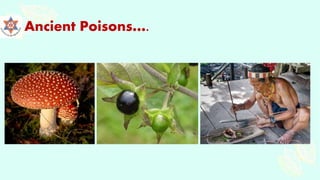
Ancient Poisons….
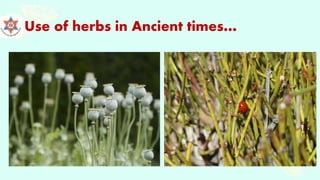
Use of herbs in Ancient times…
Before being organised..
Gambolling and frisking of coffee berries (caffeine)
consumed goats through the night
Poisoners using mushroom or deadly nightshade plant
(containing belladonna alkaloids atropine and
scopolamine)
Used by ladies to dilate their pupils as eyedrops
(belladonna compounds) “beautiful ladies”
Before being organised..
Chinese herb ma huang (ephedrine) as circulatory
stimulant
Poisoned arrows (curare) by South American Indians
for hunting
Poppy juice (opium) for pain relief and control of
dysentries and recreational purposes
Then…
Drug invention/discovery became more allied with
synthetic organic chemistry.
Paul Ehrlich postulation about dyes
►Invention of arsphenamine in 1907; patented as
“salvarsan”
Gerhard Domagk
►Prontosil
“ERA OF ANTIMICROBIAL THERAPY”
Introduction: Defining pharmacology
Pharmacology is a science of drugs.
►Pharmacon – drug
►logos – discourse in
The subject of pharmacology is a broad
►Source, physical and chemical properties, compounding
►Physiological actions, absorption, fate and excretion, and
►Therapeutic uses
Introduction: Defining pharmacology
Pharmacology is a science of drugs.
►Pharmacon – drug
►logos – discourse in
Can be defined as:
►The study of substances that interact with living systems
through chemical processes, especially by binding to
regulatory molecules and activating or inhibiting normal
body processes
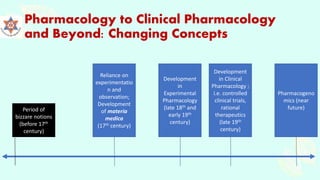
Pharmacology to Clinical Pharmacology
and Beyond: Changing Concepts
Period of
bizzare notions
(before 17th
century)
Reliance on
experimentatio
n and
observation;
Development
of materia
medica
(17th century)
Development
in
Experimental
Pharmacology
(late 18th and
early 19th
century)
Development
in Clinical
Pharmacology ;
i.e. controlled
clinical trials,
rational
therapeutics
(late 19th
century)
Pharmacogeno
mics (near
future)
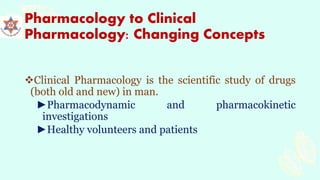
Pharmacology to Clinical
Pharmacology: Changing Concepts
Clinical Pharmacology is the scientific study of drugs
(both old and new) in man.
►Pharmacodynamic and pharmacokinetic
investigations
►Healthy volunteers and patients
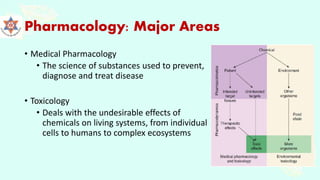
Pharmacology: Major Areas
• Medical Pharmacology
• The science of substances used to prevent,
diagnose and treat disease
• Toxicology
• Deals with the undesirable effects of
chemicals on living systems, from individual
cells to humans to complex ecosystems
Terminologies
Pharmacokinetics
―Refers to the movement of the drug in and alteration of
the drug by body
―Includes absorption, distribution,
binding/localization/storage, biotransformation and
excretion of the drug
Pharmacodynamics
―Physiological and biochemical effects of drugs, and
―Their mechanism of action at various levels
Pharmacotherapeutics
―Application of pharmacological information together
with knowledge of disease for its prevention, mitigation
or cure
Terminologies
Drug
―French: Drougue-a dry herb
―Drug is any substance or product that is used or is
intended to be used to modify or explore
physiological systems or pathological states for the
benefit of the recipient
Chemotherapy
―Treatment of systemic infection/malignancy with
specific drugs that have selective toxicity for the
infective organism/malignant cell with no/minimal
effects on the host cells
Terminologies
Pharmacy
―It is the art and science of compounding and
dispensing drugs or preparing suitable dosage forms
for administration of drugs to man or animals
Abbreviations ??
Time to Brainstorm!!!
A 32 year male patient came to ENT OPD with
complains of sore throat for 2 days, fever, high grade for
2 days, difficulty in swallowing; was examined by doctor
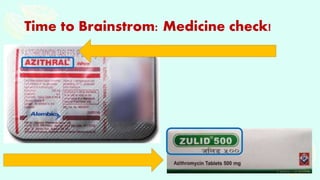
on duty, diagnosed as Acute pharyngitis and Azithral,
with other drugs, was prescribed.
He went to pharmacy and was dispensed Zulid, stating
Azithral is out of stock
The patient is worried that the pharmacist changed the
medicine and came to you.
►What will you do?
Time to Brainstrom: Medicine check!
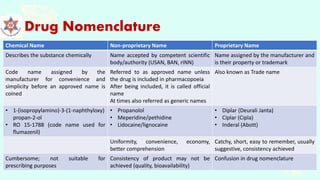
Drug Nomenclature
Chemical Name Non-proprietary Name Proprietary Name
Describes the substance chemically Name accepted by competent scientific
body/authority (USAN, BAN, rINN)
Name assigned by the manufacturer and
is their property or trademark
Code name assigned by the
manufacturer for convenience and
simplicity before an approved name is
coined
Referred to as approved name unless
the drug is included in pharmacopoeia
After being included, it is called official
name
At times also referred as generic names
Also known as Trade name
• 1-(isopropylamino)-3-(1-naphthyloxy)
propan-2-ol
• RO 15-1788 (code name used for
flumazenil)
• Propanolol
• Meperidine/pethidine
• Lidocaine/lignocaine
• Diplar (Deurali Janta)
• Ciplar (Cipla)
• Inderal (Abott)
Uniformity, convenience, economy,
better comprehension
Catchy, short, easy to remember, usually
suggestive, consistency achieved
Cumbersome; not suitable for
prescribing purposes
Consistency of product may not be
achieved (quality, bioavailability)
Confusion in drug nomenclature
With that lets wrap up for today!!
Next class we will discuss about:
►Essential Medicine (Drugs) Concept
►Rational Use of Medicine (Drugs)
And, You will be interacting about Abbreviations used
in Pharmacology!!!
Thank you!

Pharmacology an introduction 2021

  • 1.
    Pharmacology: An Introduction Dr. PravinPrasad MBBS, MD Clinical Pharmacology Assistant Professor, Department of Clinical Pharmacology Maharajgunj Medical Campus, Maharajgunj, Kathmandu 12 December 2021 (26 Mangsir 2078), Sunday
  • 2.
    By the endof this session, BNS 1st year students will be able to: Define Clinical Pharmacology Explain the terminologies and abbreviations used in Pharmacology List and compare the different drug nomenclature commonly used
  • 3.
  • 4.
    Goats after consumingcoffee berries
  • 5.
  • 6.
    Use of herbsin Ancient times…
  • 7.
    Before being organised.. Gambollingand frisking of coffee berries (caffeine) consumed goats through the night Poisoners using mushroom or deadly nightshade plant (containing belladonna alkaloids atropine and scopolamine) Used by ladies to dilate their pupils as eyedrops (belladonna compounds) “beautiful ladies”
  • 8.
    Before being organised.. Chineseherb ma huang (ephedrine) as circulatory stimulant Poisoned arrows (curare) by South American Indians for hunting Poppy juice (opium) for pain relief and control of dysentries and recreational purposes
  • 9.
    Then… Drug invention/discovery becamemore allied with synthetic organic chemistry. Paul Ehrlich postulation about dyes ►Invention of arsphenamine in 1907; patented as “salvarsan” Gerhard Domagk ►Prontosil “ERA OF ANTIMICROBIAL THERAPY”
  • 10.
    Introduction: Defining pharmacology Pharmacologyis a science of drugs. ►Pharmacon – drug ►logos – discourse in The subject of pharmacology is a broad ►Source, physical and chemical properties, compounding ►Physiological actions, absorption, fate and excretion, and ►Therapeutic uses
  • 11.
    Introduction: Defining pharmacology Pharmacologyis a science of drugs. ►Pharmacon – drug ►logos – discourse in Can be defined as: ►The study of substances that interact with living systems through chemical processes, especially by binding to regulatory molecules and activating or inhibiting normal body processes
  • 12.
    Pharmacology to ClinicalPharmacology and Beyond: Changing Concepts Period of bizzare notions (before 17th century) Reliance on experimentatio n and observation; Development of materia medica (17th century) Development in Experimental Pharmacology (late 18th and early 19th century) Development in Clinical Pharmacology ; i.e. controlled clinical trials, rational therapeutics (late 19th century) Pharmacogeno mics (near future)
  • 13.
    Pharmacology to Clinical Pharmacology:Changing Concepts Clinical Pharmacology is the scientific study of drugs (both old and new) in man. ►Pharmacodynamic and pharmacokinetic investigations ►Healthy volunteers and patients
  • 14.
    Pharmacology: Major Areas •Medical Pharmacology • The science of substances used to prevent, diagnose and treat disease • Toxicology • Deals with the undesirable effects of chemicals on living systems, from individual cells to humans to complex ecosystems
  • 15.
    Terminologies Pharmacokinetics ―Refers to themovement of the drug in and alteration of the drug by body ―Includes absorption, distribution, binding/localization/storage, biotransformation and excretion of the drug Pharmacodynamics ―Physiological and biochemical effects of drugs, and ―Their mechanism of action at various levels Pharmacotherapeutics ―Application of pharmacological information together with knowledge of disease for its prevention, mitigation or cure
  • 16.
    Terminologies Drug ―French: Drougue-a dryherb ―Drug is any substance or product that is used or is intended to be used to modify or explore physiological systems or pathological states for the benefit of the recipient Chemotherapy ―Treatment of systemic infection/malignancy with specific drugs that have selective toxicity for the infective organism/malignant cell with no/minimal effects on the host cells
  • 17.
    Terminologies Pharmacy ―It is theart and science of compounding and dispensing drugs or preparing suitable dosage forms for administration of drugs to man or animals Abbreviations ??
  • 18.
    Time to Brainstorm!!! A32 year male patient came to ENT OPD with complains of sore throat for 2 days, fever, high grade for 2 days, difficulty in swallowing; was examined by doctor on duty, diagnosed as Acute pharyngitis and Azithral, with other drugs, was prescribed. He went to pharmacy and was dispensed Zulid, stating Azithral is out of stock The patient is worried that the pharmacist changed the medicine and came to you. ►What will you do?
  • 19.
    Time to Brainstrom:Medicine check!
  • 20.
    Drug Nomenclature Chemical NameNon-proprietary Name Proprietary Name Describes the substance chemically Name accepted by competent scientific body/authority (USAN, BAN, rINN) Name assigned by the manufacturer and is their property or trademark Code name assigned by the manufacturer for convenience and simplicity before an approved name is coined Referred to as approved name unless the drug is included in pharmacopoeia After being included, it is called official name At times also referred as generic names Also known as Trade name • 1-(isopropylamino)-3-(1-naphthyloxy) propan-2-ol • RO 15-1788 (code name used for flumazenil) • Propanolol • Meperidine/pethidine • Lidocaine/lignocaine • Diplar (Deurali Janta) • Ciplar (Cipla) • Inderal (Abott) Uniformity, convenience, economy, better comprehension Catchy, short, easy to remember, usually suggestive, consistency achieved Cumbersome; not suitable for prescribing purposes Consistency of product may not be achieved (quality, bioavailability) Confusion in drug nomenclature
  • 21.
    With that letswrap up for today!! Next class we will discuss about: ►Essential Medicine (Drugs) Concept ►Rational Use of Medicine (Drugs) And, You will be interacting about Abbreviations used in Pharmacology!!! Thank you!

Editor's Notes

  • #6 Pic 1: Mushroom Pic 2: Nightshade plant (containing atropine, scopolamine) Pic 3: Curare poisoning of arrows
  • #7 Pic 1: Poppy plant for dysentery, pain relief Pic 2: ma huang, Ephedra Plant (Circulatory stimulant)