DIURETICS IN CKD
  DM SEMINAR
  22/12/10
  Vishal Golay
Diuretics

   Agents which promote the formation of
    urine by the kidney

   Greek "dia-", thoroughly +
          "ourein", to urinate
        = to urinate thoroughly.
ALLHAT trial (JAMA. 2002;288:2981-
2997)
 randomized, double-blind, active-
  controlled clinical trial
 February 1994 through March 2002.
 Inclusion:
    ◦   33357 participants
    ◦   55 years or older with hypertension
    ◦   at least 1 other CHD risk factor
    ◦   623 North American centers.
ALLHAT trial
   Intervention: Randomised to receive
    ◦ chlorthalidone, 12.5 to 25 mg/d (n=15255);
    ◦ amlodipine, 2.5 to 10 mg/d (n=9048);
    ◦ lisinopril, 10 to 40 mg/d (n=9054)
 Doxazosin arm was prematurely terminated
 Follow-up of approximately 4 to 8 years.
 Primary outcome: combined fatal CHD or
  nonfatal MI
 Secondary outcomes: all cause
  mortality, stroke, combined CHD (primary
  outcome, coronary revascularization, or
  angina with hospitalization), and combined
  CVD (combined CHD, stroke, treated angina
  without hospitalization, heart failure [HF], and
  peripheral arterial disease).
ALLHAT trial-Results
 Primary end points: no difference
 All cause mortality: no difference
 Five-year systolic blood pressures were
  significantly higher in the amlodipine
  (P=.03) and lisinopril (P.001) groups
  compared with chlorthalidone
 Amlodipine vs chlorthalidone: secondary
  outcomes were similar except for a
  higher 6-year rate of HF with amlodipine
 Lisinopril vs chlorthalidone : lisinopril had
  higher 6-year rates of combined CVD
ALLHAT trial
            Conclusion:
“Thiazide-type diuretics are superior in
  preventing 1 or more major forms of
  CVD and are less expensive. They
  should be preferred for first-step
  antihypertensive therapy.”
                Fallout:
JNC 7 hypertension guidelines
  recommended that thiazides should
  be the first line antihypertensive
Hypertension in CKD

   50% to 75% of individuals with GFR
    60 mL/min/1.73 m2 (CKD Stages 3-5)
    have hypertension.

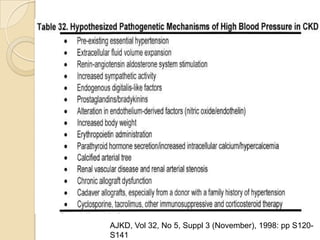
   Central role of kidney in BP
    homeostasis: Guyton’s Hypothesis
AJKD, Vol 32, No 5, Suppl 3 (November), 1998: pp S120-
S141
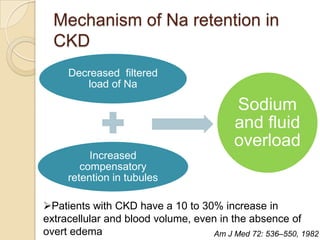
Mechanism of Na retention in
  CKD
     Decreased filtered
        load of Na

                                          Sodium
                                          and fluid
                                          overload
          Increased
        compensatory
     retention in tubules

Patients with CKD have a 10 to 30% increase in
extracellular and blood volume, even in the absence of
overt edema                        Am J Med 72: 536–550, 1982
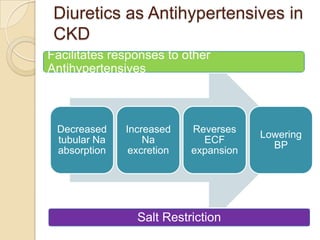
Diuretics as Antihypertensives in
 CKD
Facilitates responses to other
Antihypertensives


 Decreased    Increased    Reverses
                                       Lowering
 tubular Na       Na         ECF
                                         BP
 absorption    excretion   expansion


                Salt Restriction
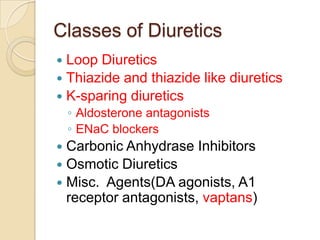
Classes of Diuretics
 Loop Diuretics
 Thiazide and thiazide like diuretics
 K-sparing diuretics
    ◦ Aldosterone antagonists
    ◦ ENaC blockers
 Carbonic Anhydrase Inhibitors
 Osmotic Diuretics
 Misc. Agents(DA agonists, A1
  receptor antagonists, vaptans)
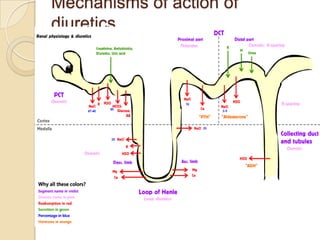
Mechanisms of action of
diuretics
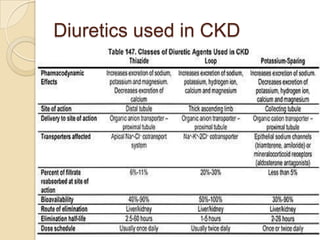
Diuretics used in CKD
Loop diuretics
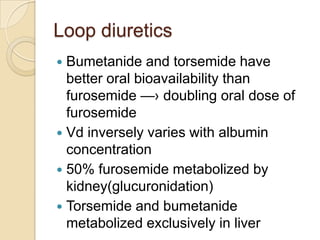
 Bumetanide and torsemide have
  better oral bioavailability than
  furosemide —› doubling oral dose of
  furosemide
 Vd inversely varies with albumin
  concentration
 50% furosemide metabolized by
  kidney(glucuronidation)
 Torsemide and bumetanide
  metabolized exclusively in liver
Loop diuretics
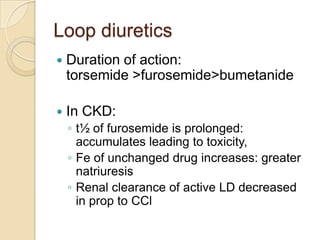
   Duration of action:
    torsemide >furosemide>bumetanide

   In CKD:
    ◦ t½ of furosemide is prolonged:
      accumulates leading to toxicity,
    ◦ Fe of unchanged drug increases: greater
      natriuresis
    ◦ Renal clearance of active LD decreased
      in prop to CCl
Loop diuretics
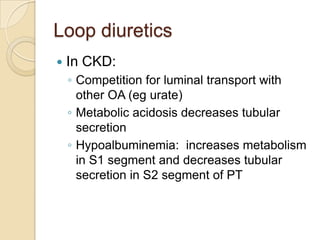
   In CKD:
    ◦ Competition for luminal transport with
      other OA (eg urate)
    ◦ Metabolic acidosis decreases tubular
      secretion
    ◦ Hypoalbuminemia: increases metabolism
      in S1 segment and decreases tubular
      secretion in S2 segment of PT
•
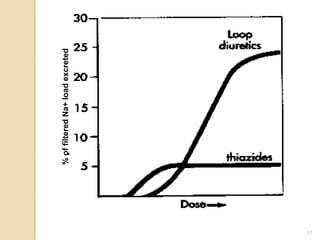
     % of filtered Na+ load excreted


17
Thiazide and thiazide like
diuretics
   ?Class effect as antihypertensives

   Decreases Ca excretion

   Decreases urate clearance

   Impairs maximal urinary dilution but not
    maximal concentration, along with
    increases AQP2 expression, makes
    hyponatremia 12 times more common
    than loop diuretics.
Thiazide and thiazide like
diuretics
   In CKD:
    ◦ Poor diuretics when CCl <30ml/min
    ◦ Indapamide and bendroflumethiazide are
      metabolized in the liver: limits
      accumulation in renal failure
    ◦ Metolazone found to have synergistic
      action with loop diuretics in very low GFR
      even where other thiazides are not very
      effective
Potassium Sparing Diuretics
 Amiloride and triamterine are organic
  cations
 AR antagonists are competitive
  antagonists
 These drugs produce only modest
  natriuresis
 More effective than furosemide in
  cirrhotic ascites
Potassium Sparing Diuretics
   In CKD:
    ◦ Not very useful as primary drugs
    ◦ Can be of adjunctive use in resistant
      hypertension
    ◦ Hyperkalemia is a dreaded complication
    ◦ May reduce proteinuria in CKD (?retards
      disease progression)
                  Kidney Int. 2006 Dec;70(12):2116-23.

    ◦ Has role in preventing cardiac remodeling
Misc. diuretics
   Osmotic Diuretics:
    ◦ have been tried in ARF
    ◦ In CKD-can cause expansion of
      ECV, hemodilution, MA, can ppt ARF in
      high doses

   CAI:
    ◦ Development of life threatening MA limits
      use in CKD
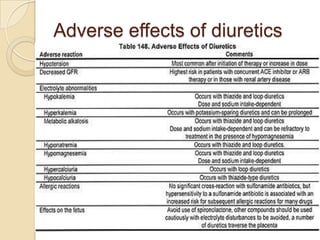
Adverse effects of diuretics
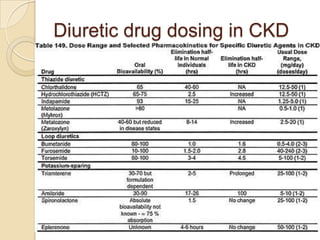
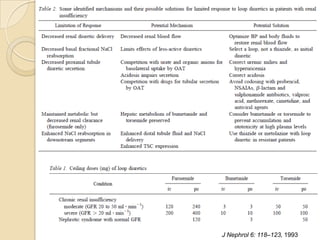
Diuretic drug dosing in CKD
Diuretic Resistance in CKD
 Highdietary intake of sodium (i.e.
 Urinary Na >100mmol/day)

Pharmacokinetics:
 Decreased delivery
 Decreased secretion in PT by OAT-1
 Intratubular binding of secreted
  diuretic to filtered albumin.
Diuretic Resistance in CKD
Pharmacodynamics:

   Reduced number of functioning
    nephrons and decreased Na filtered
    load

   Diuretic Braking phenomenon
Braking Phenomenon
   Postdiuretic fluid and Na retention

   Compensation by Na retaining
    hormones/ upregulation of ion
    transporters along the TALH/
    Structural and functional changes in
    the distal nephron segments

   Co-administration with thiazide-
    supraadditive (sequential duiretic
Braking Phenomenon
   Clinical implications of this
    phenomenon:
    ◦ Salt retention should always be advised in
      all patients who are on diuretics
    ◦ Addition of a second diuretic increases
      natriuresis
    ◦ Use of a long acting drug /more frequent
      /iv administration has more effect
    ◦ Diuretic therapy should not be stopped
      abruptly unless Na intake is curtailed
J Nephrol 6: 118–123, 1993
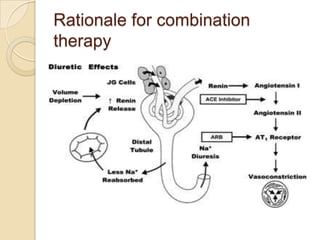
Rationale for combination
therapy
Newer agents
   Adenosine type I receptor antagonists:
    ◦ Disrupts TGF and GTF and thus decreases
      proximal resorption and increases GFR
    ◦ Used in diuretic resistant CHF
    ◦ Use in CKD is equivocal

   Vasopressin Antagonists:
    ◦ Vaptans(conivaptan, tolvaptan, lixivaptan)
    ◦ Allows free water loss without natriuresis
    ◦ Predominantly used to treat eu/hypervolemic
      hyponatremia
KDOQI GUIDELINE 12: USE OF DIURETICS
IN CKD

   12.1 Most patients with CKD should be
    treated with a diuretic (A).

   12.1.a Thiazide diuretics given once daily
    are recommended in patients with GFR
    ≥30 mL/min/1.73 m2 (CKD Stages 1-3) (A);

   12.1.b Loop diuretics given once or twice
    daily are recommended in patients with
    GFR <30 mL/min/1.73 m2 (CKD Stages 4-5)
    (A);
KDOQI GUIDELINE 12: USE OF
DIURETICS IN CKD
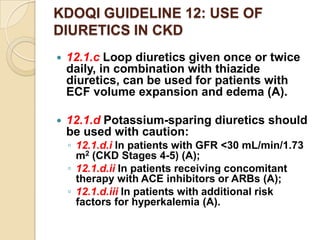
   12.1.c Loop diuretics given once or twice
    daily, in combination with thiazide
    diuretics, can be used for patients with
    ECF volume expansion and edema (A).

   12.1.d Potassium-sparing diuretics should
    be used with caution:
    ◦ 12.1.d.i In patients with GFR <30 mL/min/1.73
      m2 (CKD Stages 4-5) (A);
    ◦ 12.1.d.ii In patients receiving concomitant
      therapy with ACE inhibitors or ARBs (A);
    ◦ 12.1.d.iii In patients with additional risk
      factors for hyperkalemia (A).
KDOQI GUIDELINE 12: USE OF
DIURETICS IN CKD
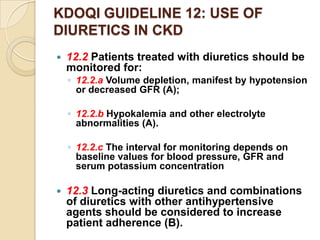
   12.2 Patients treated with diuretics should be
    monitored for:
    ◦ 12.2.a Volume depletion, manifest by hypotension
      or decreased GFR (A);

    ◦ 12.2.b Hypokalemia and other electrolyte
      abnormalities (A).

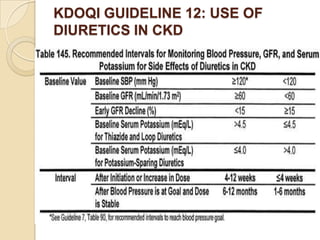
    ◦ 12.2.c The interval for monitoring depends on
      baseline values for blood pressure, GFR and
      serum potassium concentration

   12.3 Long-acting diuretics and combinations
    of diuretics with other antihypertensive
    agents should be considered to increase
    patient adherence (B).
KDOQI GUIDELINE 12: USE OF
DIURETICS IN CKD
THANK YOU

Diuretics in CKD

  • 1.
    DIURETICS IN CKD DM SEMINAR 22/12/10 Vishal Golay
  • 2.
    Diuretics  Agents which promote the formation of urine by the kidney  Greek "dia-", thoroughly + "ourein", to urinate = to urinate thoroughly.
  • 3.
    ALLHAT trial (JAMA.2002;288:2981- 2997)  randomized, double-blind, active- controlled clinical trial  February 1994 through March 2002.  Inclusion: ◦ 33357 participants ◦ 55 years or older with hypertension ◦ at least 1 other CHD risk factor ◦ 623 North American centers.
  • 4.
    ALLHAT trial  Intervention: Randomised to receive ◦ chlorthalidone, 12.5 to 25 mg/d (n=15255); ◦ amlodipine, 2.5 to 10 mg/d (n=9048); ◦ lisinopril, 10 to 40 mg/d (n=9054)  Doxazosin arm was prematurely terminated  Follow-up of approximately 4 to 8 years.  Primary outcome: combined fatal CHD or nonfatal MI  Secondary outcomes: all cause mortality, stroke, combined CHD (primary outcome, coronary revascularization, or angina with hospitalization), and combined CVD (combined CHD, stroke, treated angina without hospitalization, heart failure [HF], and peripheral arterial disease).
  • 5.
    ALLHAT trial-Results  Primaryend points: no difference  All cause mortality: no difference  Five-year systolic blood pressures were significantly higher in the amlodipine (P=.03) and lisinopril (P.001) groups compared with chlorthalidone  Amlodipine vs chlorthalidone: secondary outcomes were similar except for a higher 6-year rate of HF with amlodipine  Lisinopril vs chlorthalidone : lisinopril had higher 6-year rates of combined CVD
  • 6.
    ALLHAT trial Conclusion: “Thiazide-type diuretics are superior in preventing 1 or more major forms of CVD and are less expensive. They should be preferred for first-step antihypertensive therapy.” Fallout: JNC 7 hypertension guidelines recommended that thiazides should be the first line antihypertensive
  • 7.
    Hypertension in CKD  50% to 75% of individuals with GFR 60 mL/min/1.73 m2 (CKD Stages 3-5) have hypertension.  Central role of kidney in BP homeostasis: Guyton’s Hypothesis
  • 8.
    AJKD, Vol 32,No 5, Suppl 3 (November), 1998: pp S120- S141
  • 9.
    Mechanism of Naretention in CKD Decreased filtered load of Na Sodium and fluid overload Increased compensatory retention in tubules Patients with CKD have a 10 to 30% increase in extracellular and blood volume, even in the absence of overt edema Am J Med 72: 536–550, 1982
  • 10.
    Diuretics as Antihypertensivesin CKD Facilitates responses to other Antihypertensives Decreased Increased Reverses Lowering tubular Na Na ECF BP absorption excretion expansion Salt Restriction
  • 11.
    Classes of Diuretics Loop Diuretics  Thiazide and thiazide like diuretics  K-sparing diuretics ◦ Aldosterone antagonists ◦ ENaC blockers  Carbonic Anhydrase Inhibitors  Osmotic Diuretics  Misc. Agents(DA agonists, A1 receptor antagonists, vaptans)
  • 12.
  • 13.
  • 14.
    Loop diuretics  Bumetanideand torsemide have better oral bioavailability than furosemide —› doubling oral dose of furosemide  Vd inversely varies with albumin concentration  50% furosemide metabolized by kidney(glucuronidation)  Torsemide and bumetanide metabolized exclusively in liver
  • 15.
    Loop diuretics  Duration of action: torsemide >furosemide>bumetanide  In CKD: ◦ t½ of furosemide is prolonged: accumulates leading to toxicity, ◦ Fe of unchanged drug increases: greater natriuresis ◦ Renal clearance of active LD decreased in prop to CCl
  • 16.
    Loop diuretics  In CKD: ◦ Competition for luminal transport with other OA (eg urate) ◦ Metabolic acidosis decreases tubular secretion ◦ Hypoalbuminemia: increases metabolism in S1 segment and decreases tubular secretion in S2 segment of PT
  • 17.
    % of filtered Na+ load excreted 17
  • 18.
    Thiazide and thiazidelike diuretics  ?Class effect as antihypertensives  Decreases Ca excretion  Decreases urate clearance  Impairs maximal urinary dilution but not maximal concentration, along with increases AQP2 expression, makes hyponatremia 12 times more common than loop diuretics.
  • 19.
    Thiazide and thiazidelike diuretics  In CKD: ◦ Poor diuretics when CCl <30ml/min ◦ Indapamide and bendroflumethiazide are metabolized in the liver: limits accumulation in renal failure ◦ Metolazone found to have synergistic action with loop diuretics in very low GFR even where other thiazides are not very effective
  • 20.
    Potassium Sparing Diuretics Amiloride and triamterine are organic cations  AR antagonists are competitive antagonists  These drugs produce only modest natriuresis  More effective than furosemide in cirrhotic ascites
  • 21.
    Potassium Sparing Diuretics  In CKD: ◦ Not very useful as primary drugs ◦ Can be of adjunctive use in resistant hypertension ◦ Hyperkalemia is a dreaded complication ◦ May reduce proteinuria in CKD (?retards disease progression) Kidney Int. 2006 Dec;70(12):2116-23. ◦ Has role in preventing cardiac remodeling
  • 22.
    Misc. diuretics  Osmotic Diuretics: ◦ have been tried in ARF ◦ In CKD-can cause expansion of ECV, hemodilution, MA, can ppt ARF in high doses  CAI: ◦ Development of life threatening MA limits use in CKD
  • 23.
  • 24.
  • 25.
    Diuretic Resistance inCKD  Highdietary intake of sodium (i.e. Urinary Na >100mmol/day) Pharmacokinetics:  Decreased delivery  Decreased secretion in PT by OAT-1  Intratubular binding of secreted diuretic to filtered albumin.
  • 26.
    Diuretic Resistance inCKD Pharmacodynamics:  Reduced number of functioning nephrons and decreased Na filtered load  Diuretic Braking phenomenon
  • 27.
    Braking Phenomenon  Postdiuretic fluid and Na retention  Compensation by Na retaining hormones/ upregulation of ion transporters along the TALH/ Structural and functional changes in the distal nephron segments  Co-administration with thiazide- supraadditive (sequential duiretic
  • 28.
    Braking Phenomenon  Clinical implications of this phenomenon: ◦ Salt retention should always be advised in all patients who are on diuretics ◦ Addition of a second diuretic increases natriuresis ◦ Use of a long acting drug /more frequent /iv administration has more effect ◦ Diuretic therapy should not be stopped abruptly unless Na intake is curtailed
  • 29.
    J Nephrol 6:118–123, 1993
  • 30.
  • 31.
    Newer agents  Adenosine type I receptor antagonists: ◦ Disrupts TGF and GTF and thus decreases proximal resorption and increases GFR ◦ Used in diuretic resistant CHF ◦ Use in CKD is equivocal  Vasopressin Antagonists: ◦ Vaptans(conivaptan, tolvaptan, lixivaptan) ◦ Allows free water loss without natriuresis ◦ Predominantly used to treat eu/hypervolemic hyponatremia
  • 32.
    KDOQI GUIDELINE 12:USE OF DIURETICS IN CKD  12.1 Most patients with CKD should be treated with a diuretic (A).  12.1.a Thiazide diuretics given once daily are recommended in patients with GFR ≥30 mL/min/1.73 m2 (CKD Stages 1-3) (A);  12.1.b Loop diuretics given once or twice daily are recommended in patients with GFR <30 mL/min/1.73 m2 (CKD Stages 4-5) (A);
  • 33.
    KDOQI GUIDELINE 12:USE OF DIURETICS IN CKD  12.1.c Loop diuretics given once or twice daily, in combination with thiazide diuretics, can be used for patients with ECF volume expansion and edema (A).  12.1.d Potassium-sparing diuretics should be used with caution: ◦ 12.1.d.i In patients with GFR <30 mL/min/1.73 m2 (CKD Stages 4-5) (A); ◦ 12.1.d.ii In patients receiving concomitant therapy with ACE inhibitors or ARBs (A); ◦ 12.1.d.iii In patients with additional risk factors for hyperkalemia (A).
  • 34.
    KDOQI GUIDELINE 12:USE OF DIURETICS IN CKD  12.2 Patients treated with diuretics should be monitored for: ◦ 12.2.a Volume depletion, manifest by hypotension or decreased GFR (A); ◦ 12.2.b Hypokalemia and other electrolyte abnormalities (A). ◦ 12.2.c The interval for monitoring depends on baseline values for blood pressure, GFR and serum potassium concentration  12.3 Long-acting diuretics and combinations of diuretics with other antihypertensive agents should be considered to increase patient adherence (B).
  • 35.
    KDOQI GUIDELINE 12:USE OF DIURETICS IN CKD
  • 36.

Editor's Notes

  • #8 Guytons hypothesis; all mechanisms are one way or the other linked to decreasing the filtered load of Na which causes a secondary increase in SVR and hypertension
  • #15 91-99% bound to albumin
  • #17 Met acidosis causesdepolarisation of memb potential of PT cells which decreases OA transport.
  • #19 Na decreases intracellularly, increases Na-Ca exchange in the basolateralDecreasedClintracellularly, increase abs of Ca via TRPV5Increased prox abs of Ca due to Ecv depletionLoop causes Ca loss due to decrease lumen positivityUratecl is dec due to ECV depletion and competition for tubular uptake: loop initially causes increase excretion due to decrease abs initially from prox but later causes decreased clearance due to volume depletion
  • #23 ARF ppt by vasoconstriction,
  • #26 Decreased delivery is due to decreased blood flow (renal perfusion) and wider Vd due to hypoalbuminemiaDecreased secretion is due to competition due to metabolic acidosis and accumulated organic anions(urates)
  • #28 To overcome this compensation loop Diu must be administered continuouslyCell hypertrophy of the DCT and CD in presence of aldosterone, increased no of thiazide sensitive co-transporters in the apical membrane and Na-K ATPase in basolateral
  • #32 Caffeine and theophylline causes diuresis