
DIURETICS
A Seminar as a part of curricular requirement
for I year M.Pharm I Semester
Presented by
Ms. Mary Vishali Boreddy
(Reg.No.20L81S0104)
Under the guidance/Mentorship of
Mr.Sudheer Kumar.,M.Pharm
Assistant professor
Dept.of Pharmacology
DIURETICS:
• Also known as water pills.
• These are the substances used to increase the formation of urine.
• They excrete more water and salts.
• Used to treat hypertension and oedema generally.
• They increase formation of urine by increasing in glomerular filtration,
tubular secretion and decrease in tubular reabsorption.
Classification:(based of efficacy)
• I –High ceiling diuretics/Loop diuretics:
eg: a. Sulphonyl derivatives- Furosemide
Torsemide
Bumetanide
b. Phenoxy aceticacid derivatives- Ethacrynic acid
c. Organomercurials- Mesamyl
• II ‐ Medium efficacy diuretics:
eg: a. Thiazide derivatives- Benzthiazide
Hydroxy thiazide
b. Thiazide like derivatives- chlorthalidone
Indapamide
• III – Weak diuretics/Low efficacy/Adjuvant diuretics:
eg: a. Carbonic anhydrous inhibitors – Acetazolamide
b. Potassium sparing diuretics :
i- aldosterone antagonists – Spiranolactone
ii – directly acting – Amioloride, Triampterene
c. Osmotic diuretics – Mannitol,glycerol,Isosorbide
d. Xanthines – Theophylline, caffeine
Pharmacology of Loop diuretics :
• MOA:
Loop diuretics acts on NKCC2 (Na+-K+-2Cl-)symporter in
ascending loop of henle
By competitively binding to Cl- binding site
They inhibit sodium,potassium, chlorine
reabsorption and thus causes their elimination
in urine along with water and other ions
Pharmacokinetics:
• Oral route of administration.
• Bio availability- 60 percent.
• Low lipid solubility ,so low volume of distribution.
• Partially undergoes glucoronide conjugation.
• T ½ -3-6 hrs.
• Maximum drug is excreted in unchanged form.
USES :
• Hypertension
• Oedema like pulmonary oedema,cardiac oedema, pedal oedema.
• Hyper calcemia.
• Renal caliculi.
SIDE EFFECTS:
• Hypokalemia.
• Goute.
• Hyponatremia.
• Hypocalcemia.
Pharmacology of Thiazides:
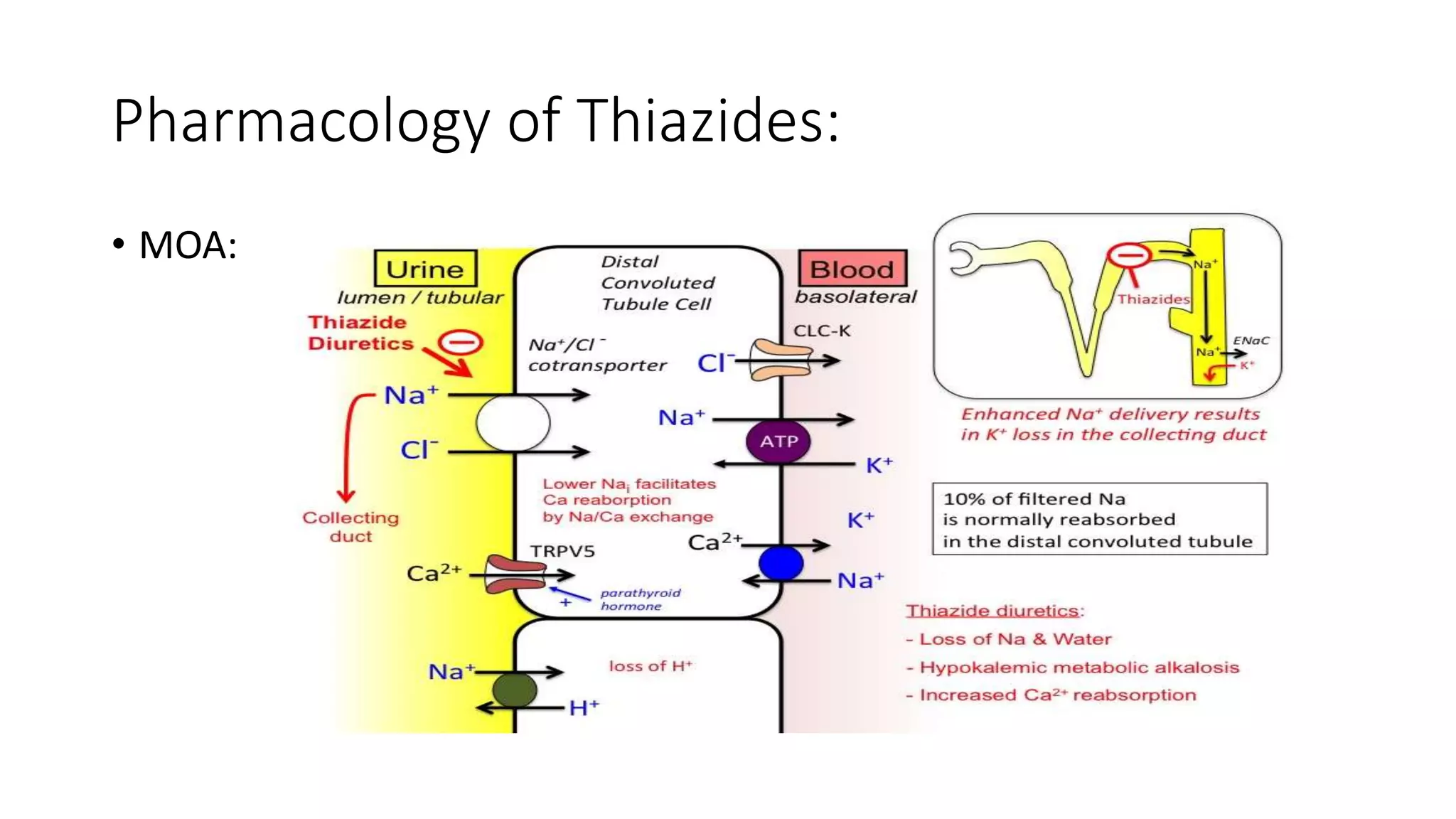
• MOA:
• Thiazides blocks Na+-Cl- symporter in
distal convoluted tubules
inhibits reabsorption of sodium&chloride
• By lowering of Na+ concentration in distal tubules
indirectly increase the activity
of basolateral Na+/Ca2+ antidote
increase in Ca+2 reabsorption
Pharmacokinetics:
• Rapid GI absorption.
• Distributed in extracellular space.
• Elimination unchanged in kidney.
• Various elimination kinetics so various half lifes ranging for hours to
days.
USES:
• Hypertension.
• Oedema.
• Diabetes insipidus.
SIDE EFFECTS:
• Hyper calcemia.
• Hypokalemia.
• Hyponatremia.
• Ototoxicity.
• Nephrotoxicity.
Pharmacology of Potassium sparing diuretics:
• A. Antagonists for aldosterone:
Aldosterone binds to aldosterone
receptor in cytoplasm then it moves to nucleus
spironolactone inhibits
and causes conformational changes
and produces Na+ channel
for Na+ reabsorption
Thus spironolactone increases sodium elimination in urine
PHARMACOKINETICS:
• Oral route of absorption.
• Low volume of distribution.
• 75 percent of spironolactone is converted into carenone(metabolite).
• T ½ of spironolactone-1-2 hrs.
• T ½ of Carenone – 18hrs.
USES:
• Hypertension.
• Hypokalemia.
SIDE EFFECTS:
• Hyperkalemia.
• Gynecomasteia in women and loss of sexual desire in men.
• Peptic ulcers.
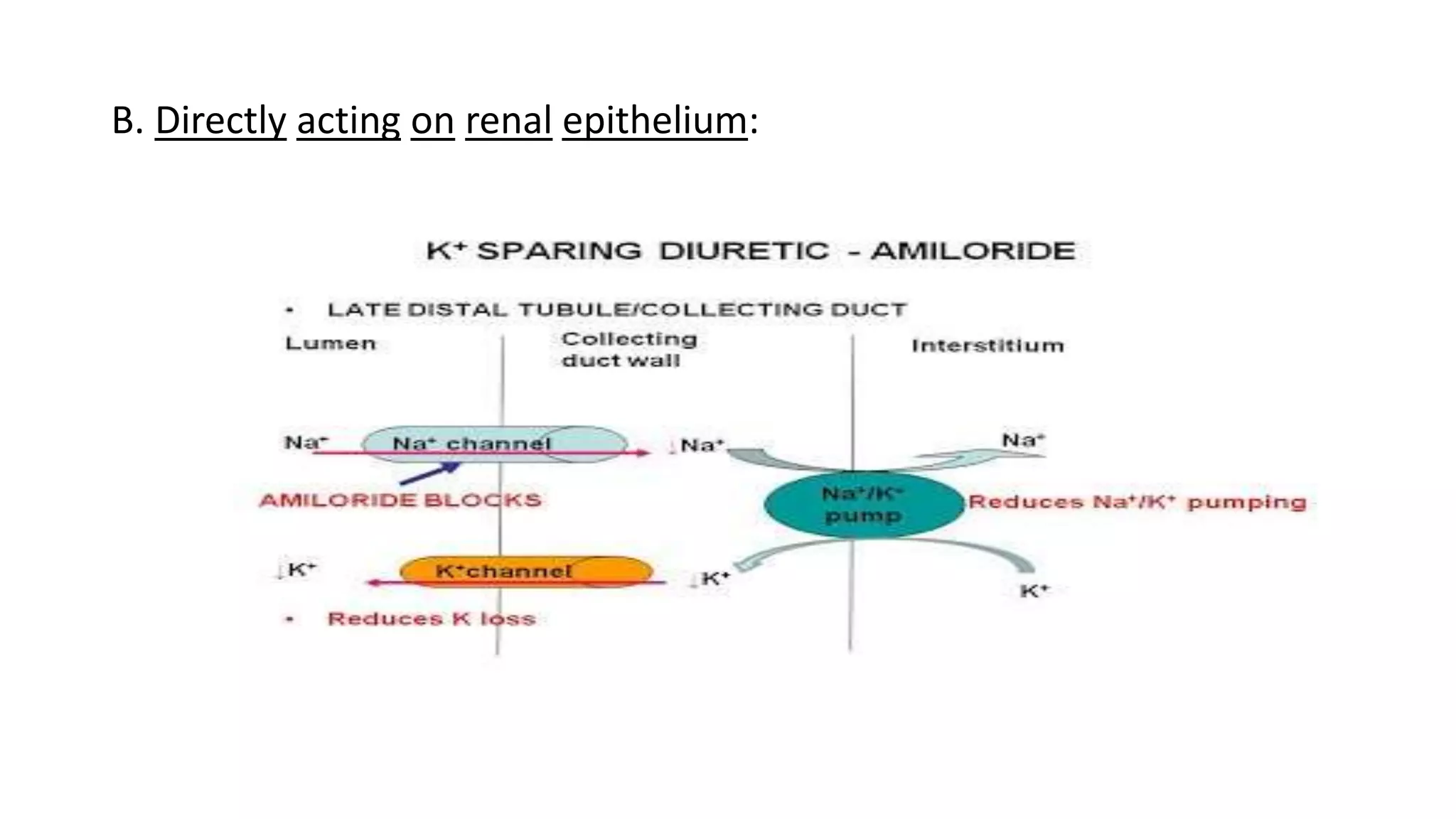
B. Directly acting on renal epithelium:
Amiloride blocks the epithelial sodium
channel(ENaC) in late distal tubules,
connecting tubules and collecting duct of nephron
which reduces absorption of sodium from the lumen of nephron
and also reduces excretion of potassium ion into the lumen
PHARMACOKINETICS:
• Orally administered
• Not metabolized by liver enzymes
• Excreted in unchanged form
• T1/2- 6 hrs
USES :
• Hypertension
• Oedema due to heart failure
• Cirrhosis of liver
SIDE EFFECTS:
• Nausea, vomiting, decreased appetite, flatulence
• Unusual skin interactions, fatigue, flaccid paralysis
• Slow heart rate, shock
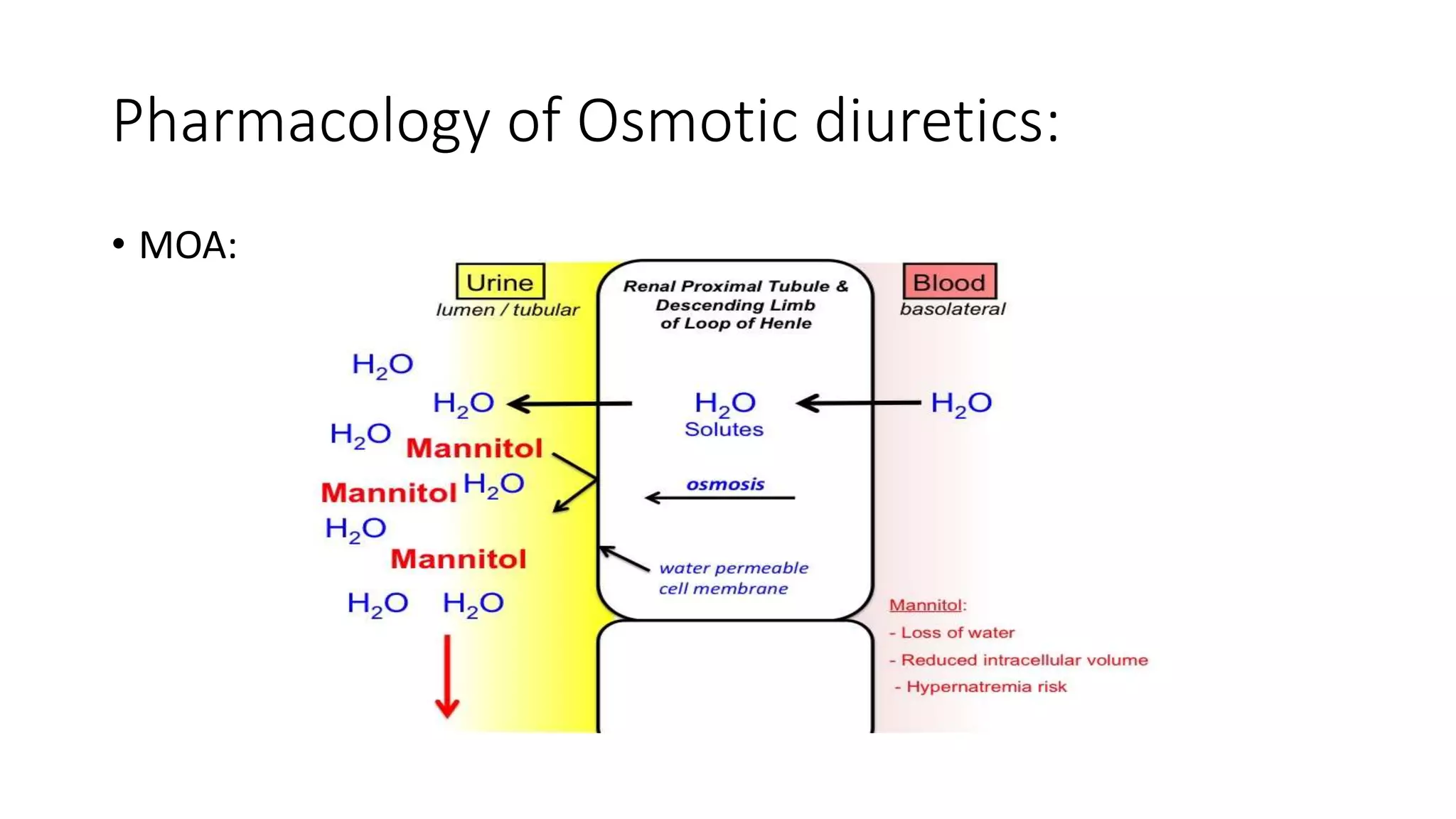
Pharmacology of Osmotic diuretics:
• MOA:
Osmotic diuretics prevents the normal
absorption of water in proximal convoluted
tubules and descending Loop of henle
by enterprising a countervailing osmotic force
As a result urine volume increases
PHARMACOKINETICS:
• If given oral route of administration it cause osmotic diarrhea.
• Mannitol is given through i/v route.
• T ½ -1 ½ -2 hrs.
• Excreted in unchanged form.
USES:
• Chronic renal failure.
• Cerebral oedema.
• Glaucoma.
SIDE EFFECTS:
• Diarrhea.
• Pulmonary oedema.
Pharmacology of carbonic anhydrase
inhibitors:
MOA:
Acetazolamide inhibits carbonic anhydrase
enzyme in proximal tubule of kidney
Inhibits the reabsorption of Na+,
Cl- and bicarbonate ions
Increases their excretion in urine
PHARMACOKINETICS:
• Orally administered
• Not metabolized by liver enzymes
• Excreted in unchanged form through urine
• T1/2 -8 hrs
USES:
• Preoperative therapy in closed angle glaucoma and as adjuvant in open
angle glaucoma
• Drug induced oedema, heart failure
• Epilepsy
SIDE EFFECTS:
• Blood disorders, skin reactions, renal stone formation
• Dizziness, fatigue, headache, ataxia etc.
DIURETICS

DIURETICS

  • 1.
    DIURETICS A Seminar asa part of curricular requirement for I year M.Pharm I Semester Presented by Ms. Mary Vishali Boreddy (Reg.No.20L81S0104) Under the guidance/Mentorship of Mr.Sudheer Kumar.,M.Pharm Assistant professor Dept.of Pharmacology
  • 2.
    DIURETICS: • Also knownas water pills. • These are the substances used to increase the formation of urine. • They excrete more water and salts. • Used to treat hypertension and oedema generally. • They increase formation of urine by increasing in glomerular filtration, tubular secretion and decrease in tubular reabsorption.
  • 3.
    Classification:(based of efficacy) •I –High ceiling diuretics/Loop diuretics: eg: a. Sulphonyl derivatives- Furosemide Torsemide Bumetanide b. Phenoxy aceticacid derivatives- Ethacrynic acid c. Organomercurials- Mesamyl • II ‐ Medium efficacy diuretics: eg: a. Thiazide derivatives- Benzthiazide Hydroxy thiazide
  • 4.
    b. Thiazide likederivatives- chlorthalidone Indapamide • III – Weak diuretics/Low efficacy/Adjuvant diuretics: eg: a. Carbonic anhydrous inhibitors – Acetazolamide b. Potassium sparing diuretics : i- aldosterone antagonists – Spiranolactone ii – directly acting – Amioloride, Triampterene c. Osmotic diuretics – Mannitol,glycerol,Isosorbide d. Xanthines – Theophylline, caffeine
  • 5.
    Pharmacology of Loopdiuretics : • MOA:
  • 6.
    Loop diuretics actson NKCC2 (Na+-K+-2Cl-)symporter in ascending loop of henle By competitively binding to Cl- binding site They inhibit sodium,potassium, chlorine reabsorption and thus causes their elimination in urine along with water and other ions
  • 7.
    Pharmacokinetics: • Oral routeof administration. • Bio availability- 60 percent. • Low lipid solubility ,so low volume of distribution. • Partially undergoes glucoronide conjugation. • T ½ -3-6 hrs. • Maximum drug is excreted in unchanged form.
  • 8.
    USES : • Hypertension •Oedema like pulmonary oedema,cardiac oedema, pedal oedema. • Hyper calcemia. • Renal caliculi. SIDE EFFECTS: • Hypokalemia. • Goute. • Hyponatremia. • Hypocalcemia.
  • 9.
  • 10.
    • Thiazides blocksNa+-Cl- symporter in distal convoluted tubules inhibits reabsorption of sodium&chloride • By lowering of Na+ concentration in distal tubules indirectly increase the activity of basolateral Na+/Ca2+ antidote increase in Ca+2 reabsorption
  • 11.
    Pharmacokinetics: • Rapid GIabsorption. • Distributed in extracellular space. • Elimination unchanged in kidney. • Various elimination kinetics so various half lifes ranging for hours to days.
  • 12.
    USES: • Hypertension. • Oedema. •Diabetes insipidus. SIDE EFFECTS: • Hyper calcemia. • Hypokalemia. • Hyponatremia. • Ototoxicity. • Nephrotoxicity.
  • 13.
    Pharmacology of Potassiumsparing diuretics: • A. Antagonists for aldosterone:
  • 14.
    Aldosterone binds toaldosterone receptor in cytoplasm then it moves to nucleus spironolactone inhibits and causes conformational changes and produces Na+ channel for Na+ reabsorption Thus spironolactone increases sodium elimination in urine
  • 15.
    PHARMACOKINETICS: • Oral routeof absorption. • Low volume of distribution. • 75 percent of spironolactone is converted into carenone(metabolite). • T ½ of spironolactone-1-2 hrs. • T ½ of Carenone – 18hrs. USES: • Hypertension. • Hypokalemia. SIDE EFFECTS: • Hyperkalemia. • Gynecomasteia in women and loss of sexual desire in men. • Peptic ulcers.
  • 16.
    B. Directly actingon renal epithelium:
  • 17.
    Amiloride blocks theepithelial sodium channel(ENaC) in late distal tubules, connecting tubules and collecting duct of nephron which reduces absorption of sodium from the lumen of nephron and also reduces excretion of potassium ion into the lumen
  • 18.
    PHARMACOKINETICS: • Orally administered •Not metabolized by liver enzymes • Excreted in unchanged form • T1/2- 6 hrs USES : • Hypertension • Oedema due to heart failure • Cirrhosis of liver SIDE EFFECTS: • Nausea, vomiting, decreased appetite, flatulence • Unusual skin interactions, fatigue, flaccid paralysis • Slow heart rate, shock
  • 19.
    Pharmacology of Osmoticdiuretics: • MOA:
  • 20.
    Osmotic diuretics preventsthe normal absorption of water in proximal convoluted tubules and descending Loop of henle by enterprising a countervailing osmotic force As a result urine volume increases
  • 21.
    PHARMACOKINETICS: • If givenoral route of administration it cause osmotic diarrhea. • Mannitol is given through i/v route. • T ½ -1 ½ -2 hrs. • Excreted in unchanged form. USES: • Chronic renal failure. • Cerebral oedema. • Glaucoma. SIDE EFFECTS: • Diarrhea. • Pulmonary oedema.
  • 22.
    Pharmacology of carbonicanhydrase inhibitors: MOA:
  • 23.
    Acetazolamide inhibits carbonicanhydrase enzyme in proximal tubule of kidney Inhibits the reabsorption of Na+, Cl- and bicarbonate ions Increases their excretion in urine
  • 24.
    PHARMACOKINETICS: • Orally administered •Not metabolized by liver enzymes • Excreted in unchanged form through urine • T1/2 -8 hrs USES: • Preoperative therapy in closed angle glaucoma and as adjuvant in open angle glaucoma • Drug induced oedema, heart failure • Epilepsy SIDE EFFECTS: • Blood disorders, skin reactions, renal stone formation • Dizziness, fatigue, headache, ataxia etc.