Diabetes Mellitus
Diabetes Mellitus
It is a metabolic disorder
characterized by
characterized by
hyperglycaemia.
hyperglycaemia.
Classification of Diabetes mellitus
Type 1 diabetes mellitus
Type 1 diabetes mellitus
insulin dependent diabetes mellitus (IDDM) ,
juvenile onset
juvenile onset
there is bita cell destruction in pancreatic
islet. Majority of the cases are autoimmune.
anti beta cell antibody is demonstrable in
serum
serum
.
.
Classification (contd.)
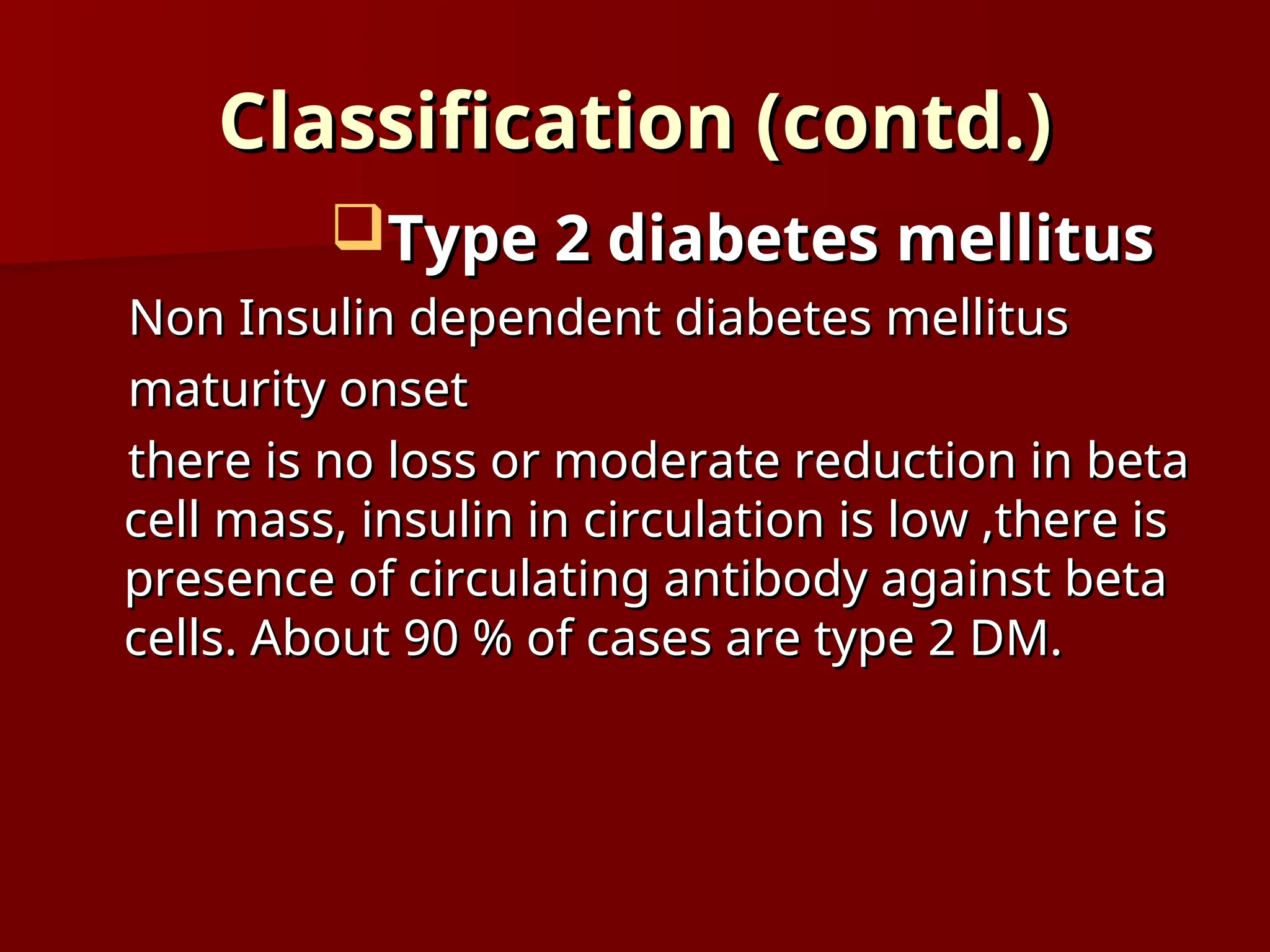
Type 2 diabetes mellitus
Type 2 diabetes mellitus
Non Insulin dependent diabetes mellitus
maturity onset
maturity onset
there is no loss or moderate reduction in beta
cell mass, insulin in circulation is low ,there is
presence of circulating antibody against beta
cells. About 90 % of cases are type 2 DM.
Causes of type 2 DM
Causes of type 2 DM
• abnormality in gluco receptors of beta
abnormality in gluco receptors of beta
cells
cells
• insulin resistance to peripheral tissues
insulin resistance to peripheral tissues
• excess of hyperglycemic hormones,
excess of hyperglycemic hormones,
eg., glucagons
eg., glucagons
Classification (contd.)
 Type 3 Diabetes mellitus
Type 3 Diabetes mellitus: it refers to
: it refers to
multiple other specific causes of an
elevated blood glucose: non pancreatic
diseases, drug therapy( vinblastine,
cholchicine, phenytoin)
 Type 4 Diabetes Mellitus
Type 4 Diabetes Mellitus: Gestational
: Gestational
Diabetes Mellitus
Diabetes Mellitus
Classification of drugs used in
DM
DM
• Insulin
Insulin
• Oral hypoglycaemic drugs
Oral hypoglycaemic drugs
Sulfonylureas
Sulfonylureas
-First genaration
First genaration : Tolbutamide,
: Tolbutamide,
Chlorpropamide
Chlorpropamide
-Second generation
Second generation : Glibenclamide ,
: Glibenclamide ,
Glipizide ,
Glipizide ,
Gliclazide ,Glimiperide,Glyburide
-
OHA( CONTD.)
OHA( CONTD.)
• Biguanides
Biguanides : Metformin ,
: Metformin ,
phenformin
phenformin
• Meglitinide analogues
Meglitinide analogues : rapaglinide
: rapaglinide
• Thiazolidinediones
Thiazolidinediones :
:
rosiglitazone,pioglitazone
• Alpha glucosidase inhibitors
Alpha glucosidase inhibitors :
:
acarbose
acarbose
Insulin
Insulin
Actions of insulin
Actions of insulin
• Liver
Liver : increase glucose uptake and
: increase glucose uptake and
glycogenesis, inhibit glycogenolysis,
inhibits gluconeogenesis from protein
and other precursors, increase
triglyceride synthesis and very low density
lipoprotein formation
• Muscle
Muscle : increase glucose uptake and
: increase glucose uptake and
utilization,increase protein
synthesis( increase aminoacid transport,
increases ribosomal protein synthesis)
• Adipose
Adipose tissues : increase glucose uptake
tissues : increase glucose uptake
and storage as fat and glycogen , inhibits
lipolysis
lipolysis
Conventional preparation of
insulin
insulin
 Rapid acting insulin
Rapid acting insulin
Human analog
Human analog
preparation
preparation: Insulin Lispro(Lilly), Insulin Aspart
: Insulin Lispro(Lilly), Insulin Aspart
 short acting
short acting :
:
regular, semi lente, Human Insulin
Preparation
Preparation: regular Novolin, Regular HumalinR
: regular Novolin, Regular HumalinR
duration of action : 6-8 hours
 intermediate acting
intermediate acting
lente ,isophane, Human insulin
Preparation
Preparation: NPH Humulin N, NPH Novolin N
: NPH Humulin N, NPH Novolin N
duration of action : 20-24 hours
Conventional preparation of
insulin…..
insulin…..
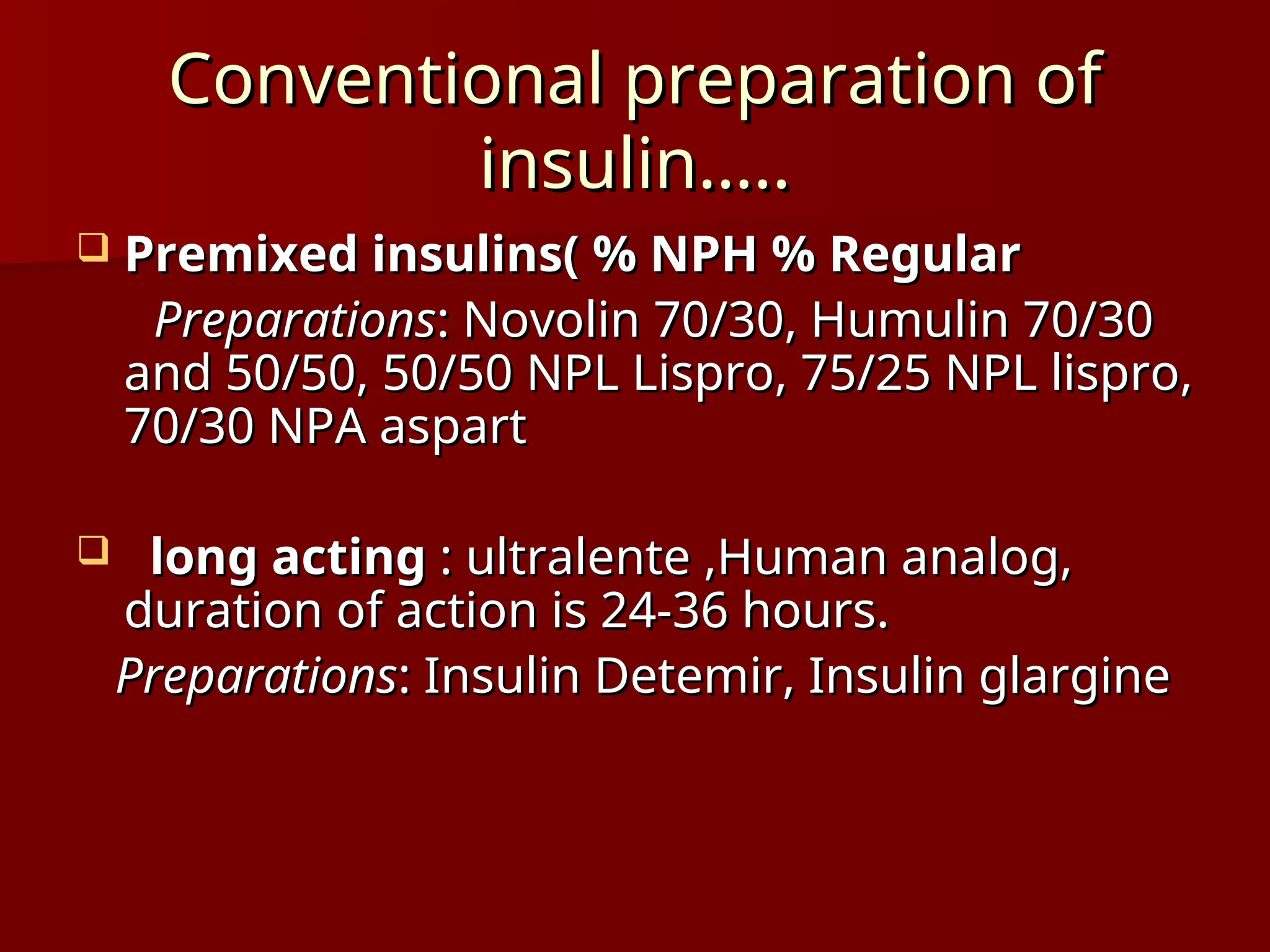
 Premixed insulins( % NPH % Regular
Premixed insulins( % NPH % Regular
Preparations
Preparations: Novolin 70/30, Humulin 70/30
: Novolin 70/30, Humulin 70/30
and 50/50, 50/50 NPL Lispro, 75/25 NPL lispro,
70/30 NPA aspart
70/30 NPA aspart
 long acting
long acting : ultralente ,Human analog,
: ultralente ,Human analog,
duration of action is 24-36 hours.
Preparations
Preparations: Insulin Detemir, Insulin glargine
: Insulin Detemir, Insulin glargine
Adverse effects of insulin
• Hypoglycaemia
Hypoglycaemia
• Local reactions : swelling , erythema
Local reactions : swelling , erythema
• Allergy : urticaria ,angioedema ,
Allergy : urticaria ,angioedema ,
anaphylaxis
anaphylaxis
• Edema : short lived dependent edema
Edema : short lived dependent edema
Uses of insulin
Uses of insulin
• Diabetes mellitus
Diabetes mellitus
• Diabetic ketoacidosis( diabetic coma )
Diabetic ketoacidosis( diabetic coma )
• Hyperosmolar coma ( nonketotic
Hyperosmolar coma ( nonketotic
hyperglycaemic)
hyperglycaemic)
Sulfonylureas
Sulfonylureas
Mechanism of action
Mechanism of action : They act on
: They act on
the sulfonylurea receptors on the
pancreatic beta cell membrane –
cause depolarization by reducing
conductance of ATP sensitive
potassium channels – calcium influx
– degranulation – release of insulin.
Adverse effects of
Adverse effects of
sulfonylureas
sulfonylureas
• Hypoglycaemia
Hypoglycaemia
• Nonspecific : nausea ,
Nonspecific : nausea ,
vomiting ,flatulence , diarrhoea
• Hypersensitivity :
Hypersensitivity :
rashes ,photosensitivity ,purpura etc.
• Chlorpropamide can cause cholestatic
Chlorpropamide can cause cholestatic
jaundice ,hyponatraemia
Biguanides
Biguanides
Mechanism of action
Mechanism of action : not
: not
clearly understood. They do not release
the insulin , supress hepatic
gluconeogenesis and glucose output
from liver , enhance insulin mediated
glucose disposal in muscle and
fat ,interfere with mitochondrial
respiratory chain- promote peripheral
glucose utilization by enhancing
anaerobic glycolysis ,inhibit intestinal
absorption of glucose.
Adverse effects of
Adverse effects of
biguanides
biguanides
•Abdominal pain,
Abdominal pain,
anorexia ,nausea ,metallic taste ,mild
diarrhoea ,tiredness .`
•Metformin does not cause hypoglycaemia
Metformin does not cause hypoglycaemia
except in high doses
•Lactic acidosis : most serious
Lactic acidosis : most serious
complication, common with phenformin
•Vit b12 deficiency
Vit b12 deficiency

Diabetes Mellitus Medicines for Treatment

  • 1.
    Diabetes Mellitus Diabetes Mellitus Itis a metabolic disorder It is a metabolic disorder characterized by characterized by hyperglycaemia. hyperglycaemia.
  • 2.
    Classification of Diabetesmellitus Classification of Diabetes mellitus Type 1 diabetes mellitus Type 1 diabetes mellitus insulin dependent diabetes mellitus (IDDM) , insulin dependent diabetes mellitus (IDDM) , juvenile onset juvenile onset there is bita cell destruction in pancreatic there is bita cell destruction in pancreatic islet. Majority of the cases are autoimmune. islet. Majority of the cases are autoimmune. anti beta cell antibody is demonstrable in anti beta cell antibody is demonstrable in serum serum . .
  • 3.
    Classification (contd.) Classification (contd.) Type2 diabetes mellitus Type 2 diabetes mellitus Non Insulin dependent diabetes mellitus Non Insulin dependent diabetes mellitus maturity onset maturity onset there is no loss or moderate reduction in beta there is no loss or moderate reduction in beta cell mass, insulin in circulation is low ,there is cell mass, insulin in circulation is low ,there is presence of circulating antibody against beta presence of circulating antibody against beta cells. About 90 % of cases are type 2 DM. cells. About 90 % of cases are type 2 DM.
  • 4.
    Causes of type2 DM Causes of type 2 DM • abnormality in gluco receptors of beta abnormality in gluco receptors of beta cells cells • insulin resistance to peripheral tissues insulin resistance to peripheral tissues • excess of hyperglycemic hormones, excess of hyperglycemic hormones, eg., glucagons eg., glucagons
  • 5.
    Classification (contd.) Classification (contd.) Type 3 Diabetes mellitus Type 3 Diabetes mellitus: it refers to : it refers to multiple other specific causes of an multiple other specific causes of an elevated blood glucose: non pancreatic elevated blood glucose: non pancreatic diseases, drug therapy( vinblastine, diseases, drug therapy( vinblastine, cholchicine, phenytoin) cholchicine, phenytoin)  Type 4 Diabetes Mellitus Type 4 Diabetes Mellitus: Gestational : Gestational Diabetes Mellitus Diabetes Mellitus
  • 6.
    Classification of drugsused in Classification of drugs used in DM DM • Insulin Insulin • Oral hypoglycaemic drugs Oral hypoglycaemic drugs
  • 7.
    Oral hypoglycaemic drugs Oralhypoglycaemic drugs Sulfonylureas Sulfonylureas -First genaration First genaration : Tolbutamide, : Tolbutamide, Chlorpropamide Chlorpropamide -Second generation Second generation : Glibenclamide , : Glibenclamide , Glipizide , Glipizide , Gliclazide ,Glimiperide,Glyburide Gliclazide ,Glimiperide,Glyburide -
  • 8.
    OHA( CONTD.) OHA( CONTD.) •Biguanides Biguanides : Metformin , : Metformin , phenformin phenformin • Meglitinide analogues Meglitinide analogues : rapaglinide : rapaglinide • Thiazolidinediones Thiazolidinediones : : rosiglitazone,pioglitazone rosiglitazone,pioglitazone • Alpha glucosidase inhibitors Alpha glucosidase inhibitors : : acarbose acarbose
  • 9.
    Insulin Insulin Actions of insulin Actionsof insulin • Liver Liver : increase glucose uptake and : increase glucose uptake and glycogenesis, inhibit glycogenolysis, glycogenesis, inhibit glycogenolysis, inhibits gluconeogenesis from protein inhibits gluconeogenesis from protein and other precursors, increase and other precursors, increase triglyceride synthesis and very low density triglyceride synthesis and very low density lipoprotein formation lipoprotein formation • Muscle Muscle : increase glucose uptake and : increase glucose uptake and utilization,increase protein utilization,increase protein synthesis( increase aminoacid transport, synthesis( increase aminoacid transport, increases ribosomal protein synthesis) increases ribosomal protein synthesis) • Adipose Adipose tissues : increase glucose uptake tissues : increase glucose uptake and storage as fat and glycogen , inhibits and storage as fat and glycogen , inhibits lipolysis lipolysis
  • 10.
    Conventional preparation of Conventionalpreparation of insulin insulin  Rapid acting insulin Rapid acting insulin Human analog Human analog preparation preparation: Insulin Lispro(Lilly), Insulin Aspart : Insulin Lispro(Lilly), Insulin Aspart  short acting short acting : : regular, semi lente, Human Insulin regular, semi lente, Human Insulin Preparation Preparation: regular Novolin, Regular HumalinR : regular Novolin, Regular HumalinR duration of action : 6-8 hours duration of action : 6-8 hours  intermediate acting intermediate acting lente ,isophane, Human insulin lente ,isophane, Human insulin Preparation Preparation: NPH Humulin N, NPH Novolin N : NPH Humulin N, NPH Novolin N duration of action : 20-24 hours duration of action : 20-24 hours
  • 11.
    Conventional preparation of Conventionalpreparation of insulin….. insulin…..  Premixed insulins( % NPH % Regular Premixed insulins( % NPH % Regular Preparations Preparations: Novolin 70/30, Humulin 70/30 : Novolin 70/30, Humulin 70/30 and 50/50, 50/50 NPL Lispro, 75/25 NPL lispro, and 50/50, 50/50 NPL Lispro, 75/25 NPL lispro, 70/30 NPA aspart 70/30 NPA aspart  long acting long acting : ultralente ,Human analog, : ultralente ,Human analog, duration of action is 24-36 hours. duration of action is 24-36 hours. Preparations Preparations: Insulin Detemir, Insulin glargine : Insulin Detemir, Insulin glargine
  • 12.
    Adverse effects ofinsulin Adverse effects of insulin • Hypoglycaemia Hypoglycaemia • Local reactions : swelling , erythema Local reactions : swelling , erythema • Allergy : urticaria ,angioedema , Allergy : urticaria ,angioedema , anaphylaxis anaphylaxis • Edema : short lived dependent edema Edema : short lived dependent edema
  • 13.
    Uses of insulin Usesof insulin • Diabetes mellitus Diabetes mellitus • Diabetic ketoacidosis( diabetic coma ) Diabetic ketoacidosis( diabetic coma ) • Hyperosmolar coma ( nonketotic Hyperosmolar coma ( nonketotic hyperglycaemic) hyperglycaemic)
  • 14.
    Sulfonylureas Sulfonylureas Mechanism of action Mechanismof action : They act on : They act on the sulfonylurea receptors on the the sulfonylurea receptors on the pancreatic beta cell membrane – pancreatic beta cell membrane – cause depolarization by reducing cause depolarization by reducing conductance of ATP sensitive conductance of ATP sensitive potassium channels – calcium influx potassium channels – calcium influx – degranulation – release of insulin. – degranulation – release of insulin.
  • 15.
    Adverse effects of Adverseeffects of sulfonylureas sulfonylureas • Hypoglycaemia Hypoglycaemia • Nonspecific : nausea , Nonspecific : nausea , vomiting ,flatulence , diarrhoea vomiting ,flatulence , diarrhoea • Hypersensitivity : Hypersensitivity : rashes ,photosensitivity ,purpura etc. rashes ,photosensitivity ,purpura etc. • Chlorpropamide can cause cholestatic Chlorpropamide can cause cholestatic jaundice ,hyponatraemia jaundice ,hyponatraemia
  • 16.
    Biguanides Biguanides Mechanism of action Mechanismof action : not : not clearly understood. They do not release clearly understood. They do not release the insulin , supress hepatic the insulin , supress hepatic gluconeogenesis and glucose output gluconeogenesis and glucose output from liver , enhance insulin mediated from liver , enhance insulin mediated glucose disposal in muscle and glucose disposal in muscle and fat ,interfere with mitochondrial fat ,interfere with mitochondrial respiratory chain- promote peripheral respiratory chain- promote peripheral glucose utilization by enhancing glucose utilization by enhancing anaerobic glycolysis ,inhibit intestinal anaerobic glycolysis ,inhibit intestinal absorption of glucose. absorption of glucose.
  • 17.
    Adverse effects of Adverseeffects of biguanides biguanides •Abdominal pain, Abdominal pain, anorexia ,nausea ,metallic taste ,mild anorexia ,nausea ,metallic taste ,mild diarrhoea ,tiredness .` diarrhoea ,tiredness .` •Metformin does not cause hypoglycaemia Metformin does not cause hypoglycaemia except in high doses except in high doses •Lactic acidosis : most serious Lactic acidosis : most serious complication, common with phenformin complication, common with phenformin •Vit b12 deficiency Vit b12 deficiency