




DIURETIC DRUGS
      Clarise Elefante
       Shirley Garay
    Daniel Alexei Garcia
Diuretic Drugs
• Medications that augments “Diuresis”
• Commonly known as Water Pills
• Homeopathic remedies or foods that
  help to prevent or treat fluid retention
• Used to treat heart failure, liver
  cirrhosis, hypertension and
  certain kidney diseases.
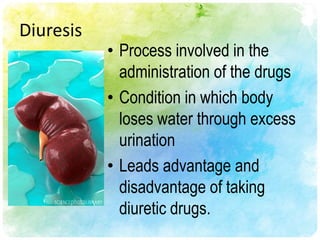
Diuresis
           • Process involved in the
             administration of the drugs
           • Condition in which body
             loses water through excess
             urination
           • Leads advantage and
             disadvantage of taking
             diuretic drugs.
Why the need to lose fluids?

• Failure to excrete excess fluid from the body.
• If there are renal, cardiovascular, or
  metabolic disorders
• Congestive Heart Failure Patients- reduction
  of fluid in blood, reduces pressure on the
  heart, so that its efficiency of pumping blood
  is increased.
Why the need to lose fluids?
• Hypertensive Patients- the loss of sodium,
  chlorine and water which helps in lowering of
  blood pressure.
• To ease the discomfort of patients suffering
  from edema
• Get rid of the body’s excess salts
• May reduce blood volume.
Side Effects
• Frequent urination      • Blurred vision
• Dehydration             • Unusual bleeding or
• Severe potassium          bruising
deficiencies              • Loss of appetite
• Electrolyte imbalance   • Weight loss
• Extreme weakness        • May induce breast
• Fatigue                   enlargement in men
                           (Pot. Sparing Diuretics)
Mechanism of action
• Most diuretics produce diuresis by
  inhibiting the reabsorption of sodium at
  different segments of the renal tubular
  system
• This is accomplished by altering how the
  kidney handles sodium.
• If the kidney excretes more sodium, then
  water excretion will also increase
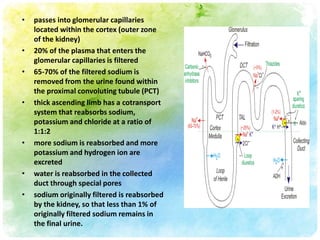
•   passes into glomerular capillaries
    located within the cortex (outer zone
    of the kidney)
•   20% of the plasma that enters the
    glomerular capillaries is filtered
•   65-70% of the filtered sodium is
    removed from the urine found within
    the proximal convoluting tubule (PCT)
•   thick ascending limb has a cotransport
    system that reabsorbs sodium,
    potassium and chloride at a ratio of
    1:1:2
•   more sodium is reabsorbed and more
    potassium and hydrogen ion are
    excreted
•   water is reabsorbed in the collected
    duct through special pores
•   sodium originally filtered is reabsorbed
    by the kidney, so that less than 1% of
    originally filtered sodium remains in
    the final urine.
Types of Diuretic Drugs

Osmotic Diuretics
Carbonic Anhydrse Inhibitor
Benzothiazide
Loop Diuretics
Potassium Sparing Diuretics
Osmotic Diuretics
• Helps to prevent the reabsorption of
  water and sodium in the body
• Increase the amount of blood
  flowing into the kidneys
• Prevent the urine to get
  concentrated
• Used during heart problems
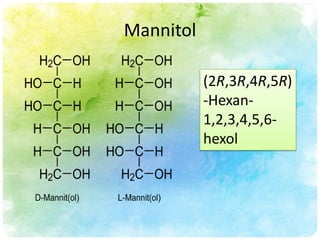
Mannitol

           (2R,3R,4R,5R)
           -Hexan-
           1,2,3,4,5,6-
           hexol
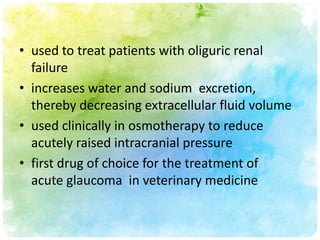
• used to treat patients with oliguric renal
  failure
• increases water and sodium excretion,
  thereby decreasing extracellular fluid volume
• used clinically in osmotherapy to reduce
  acutely raised intracranial pressure
• first drug of choice for the treatment of
  acute glaucoma in veterinary medicine
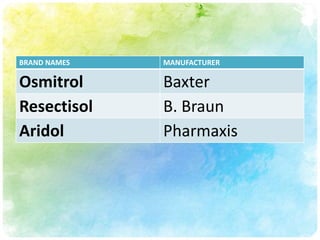
BRAND NAMES   MANUFACTURER

Osmitrol      Baxter
Resectisol    B. Braun
Aridol        Pharmaxis
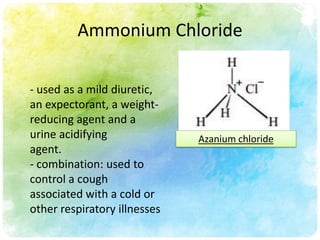
Ammonium Chloride

- used as a mild diuretic,
an expectorant, a weight-
reducing agent and a
urine acidifying              Azanium chloride
agent.
- combination: used to
control a cough
associated with a cold or
other respiratory illnesses
Brand Name                 Manufacturer
Summer’s Eve Feminine      Blooming Fields
Powder, Feminine Wash,
Feminine Bath and
Feminine Cleansing Cloth
Carbonic Anhydrase Inhibitor
• decrease bicarbonate (HCO3-) reabsorption in
  the proximal tubule by decreasing the amount
  of H+ secreted into the lumen.
• inhibitors are established as hypotensive
  agents, diuretics and antiepileptics, with
  additional use in the management of gastric
  and duodenal ulcers, neurological disorders
  and osteoporosis.
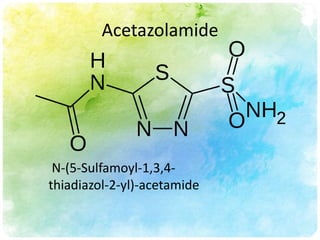
Acetazolamide


 N-(5-Sulfamoyl-1,3,4-
thiadiazol-2-yl)-acetamide
• used to treat glaucoma
• used with other medicines to reduce edema (excess
  water retention) and to help control seizures in
  certain types of epilepsy
• also used to reduce the severity and duration of
  symptoms

     Brand names         Manufacturer
     Cetamid             Sea Pharmacom
     Zolmide             Vista Pharma (Dist.)
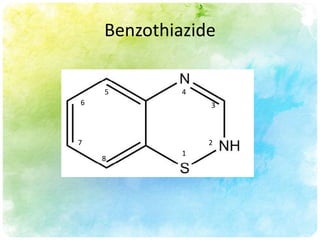
Benzothiazide
• Frequently are first line drugs for treating mild to
  moderate hypertension
• Mainly inhibit reabsorption of Na+ and Cl- via action at
  the Na+-Cl- symporter
• Used extensively to treat edema associated with
  congestive heart failure (CHF) and cirrhosis of the liver.
• Very often combined with other antihypertensive
  agents
• Usually given orally
• Most thiazides are excreted unchanged.
Benzothiazide

    5        4
6                3


7                2
             1
    8
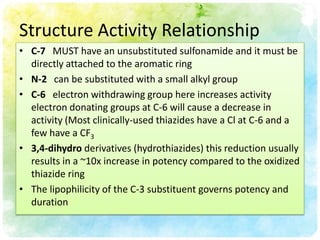
Structure Activity Relationship
• C-7 MUST have an unsubstituted sulfonamide and it must be
  directly attached to the aromatic ring
• N-2 can be substituted with a small alkyl group
• C-6 electron withdrawing group here increases activity
  electron donating groups at C-6 will cause a decrease in
  activity (Most clinically-used thiazides have a Cl at C-6 and a
  few have a CF3
• 3,4-dihydro derivatives (hydrothiazides) this reduction usually
  results in a ~10x increase in potency compared to the oxidized
  thiazide ring
• The lipophilicity of the C-3 substituent governs potency and
  duration
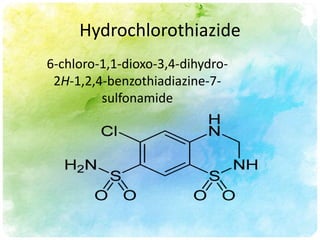
Hydrochlorothiazide
6-chloro-1,1-dioxo-3,4-dihydro-
 2H-1,2,4-benzothiadiazine-7-
         sulfonamide
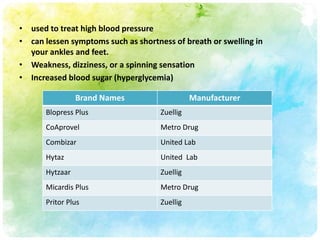
• used to treat high blood pressure
• can lessen symptoms such as shortness of breath or swelling in
  your ankles and feet.
• Weakness, dizziness, or a spinning sensation
• Increased blood sugar (hyperglycemia)

                 Brand Names                   Manufacturer
       Blopress Plus                 Zuellig
       CoAprovel                     Metro Drug
       Combizar                      United Lab
       Hytaz                         United Lab
       Hytzaar                       Zuellig
       Micardis Plus                 Metro Drug
       Pritor Plus                   Zuellig
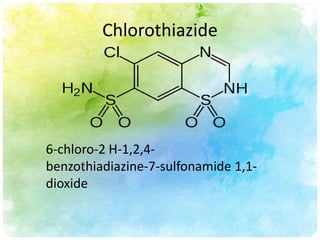
Chlorothiazide


6-chloro-2 H-1,2,4-
benzothiadiazine-7-sulfonamide 1,1-
dioxide
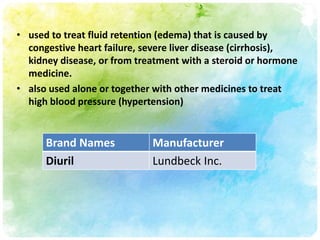
• used to treat fluid retention (edema) that is caused by
  congestive heart failure, severe liver disease (cirrhosis),
  kidney disease, or from treatment with a steroid or hormone
  medicine.
• also used alone or together with other medicines to treat
  high blood pressure (hypertension)


      Brand Names            Manufacturer
      Diuril                 Lundbeck Inc.
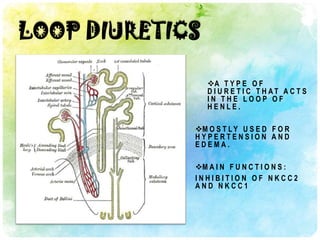
LOOP DIURETICS

                 A T Y P E O F
                 D I U R E T I C T H AT A C T S
                 IN THE LOOP OF
                 HENLE.

             M O S T L Y U S E D F O R
             HYPERTENSION AND
             EDEMA.

             M A I N F U N C T I O N S :
             INHIBITION OF NKCC2
             AND NKCC1
Loop
I. Anthranilic Acid derivative with Sulfanilamide
   Substance
      - Furosemide
      - Bumetanide
II. Potassium Sparing Diuretics
      - Ethacrynic Acid
Loop Diuretics
• Adverse Effect:
•     Hypokalemia
•     Metabolic alkalosis
•     Hypomagnesemia
•     Hyperuricemia
•     Dehydration (hypovolemia), leading to hypotension
•     Dose-related hearing loss (ototoxicity)
• Drug Interaction Effects:
•     Hypokalemia potentiates digitalis toxicity
•     Non-steroidal Anti-inflammatory Drugs: reduced diuretic efficacy
•     Corticosteroids: Enhance Hypokalemia
• Aminoglycosides: enhance ototoxicity, nephrotoxicity
FUROSEMIDE
 Also known as frusemide
 Most popular brand is Lasix® by Sanofi-Aventis
 Banned by the World’s Anti-doping Agency in sports
  due to being a masking agent.
 It has also been used to
  prevent Thoroughbred and Standard bred race horses
  from bleeding through the nose during races.
MECHANISM OF ACTION

• It acts by inhibiting NKCC2,
  the luminal Na-K-2Cl
  symporter in the thick
  ascending limb of the loop of
  Henle
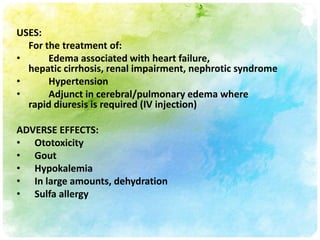
USES:
  For the treatment of:
•      Edema associated with heart failure,
  hepatic cirrhosis, renal impairment, nephrotic syndrome
•      Hypertension
•      Adjunct in cerebral/pulmonary edema where
  rapid diuresis is required (IV injection)

ADVERSE EFFECTS:
• Ototoxicity
• Gout
• Hypokalemia
• In large amounts, dehydration
• Sulfa allergy
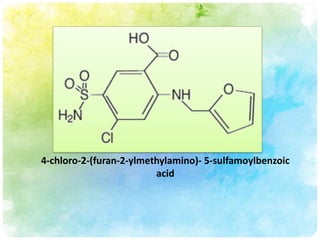
4-chloro-2-(furan-2-ylmethylamino)- 5-sulfamoylbenzoic
                         acid
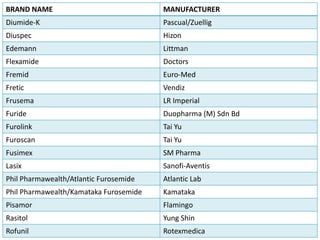
BRAND NAME                              MANUFACTURER
Diumide-K                               Pascual/Zuellig
Diuspec                                 Hizon
Edemann                                 Littman
Flexamide                               Doctors
Fremid                                  Euro-Med
Fretic                                  Vendiz
Frusema                                 LR Imperial
Furide                                  Duopharma (M) Sdn Bd
Furolink                                Tai Yu
Furoscan                                Tai Yu
Fusimex                                 SM Pharma
Lasix                                   Sanofi-Aventis
Phil Pharmawealth/Atlantic Furosemide   Atlantic Lab
Phil Pharmawealth/Kamataka Furosemide   Kamataka
Pisamor                                 Flamingo
Rasitol                                 Yung Shin
Rofunil                                 Rotexmedica
BUMETANIDE
• Known under the brand name Burinex™ by LEO
  Pharma/Zuellig
• 40 times more potent than furosemide
• Once used as a weight loss agent.
MECHANISM OF ACTION

In the brain, bumetanide blocks
the NKCC1 cation-chloride co-
transporter
OTHER USES:
    Possible anti-epileptic


ADVERSE EFFECTS:
•   In large amounts, dehydration
•   Dizziness
•   Sulfa allergies
MECHANISM OF ACTION


It acts by inhibiting NKCC2, the luminal Na-K-
2Cl symporter in the thick ascending limb of
the loop of Henle
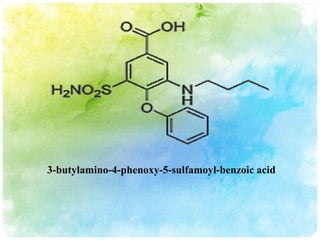
3-butylamino-4-phenoxy-5-sulfamoyl-benzoic acid
ETHACRYNIC ACID

•    - Etacrynic acid is a phenoxyacetic acid derivative
    containing a ketone and a methylene group

•    - Known under the tradename Edecrin™

•    - Not a sulfonamide
USES:
    For the treatment of:
•     Edema associated with heart failure, hepatic cirrhosis, renal
•     impairment, nephrotic syndrome
•     Hypertension
•     Potent inhibitors of glutathione S-transferase family members


ADVERSE EFFECTS:
•   Ototoxicity
•   Hypokalemia
•   In large amounts, dehydration
•   Diarrhea
•   In high doses, causes intestinal bleeding
[2,3-dichloro-4-(2-
methylenebutanoyl)phenoxy]acetic acid

Diuretic drugs

  • 1.
    DIURETIC DRUGS Clarise Elefante Shirley Garay Daniel Alexei Garcia
  • 2.
    Diuretic Drugs • Medicationsthat augments “Diuresis” • Commonly known as Water Pills • Homeopathic remedies or foods that help to prevent or treat fluid retention • Used to treat heart failure, liver cirrhosis, hypertension and certain kidney diseases.
  • 3.
    Diuresis • Process involved in the administration of the drugs • Condition in which body loses water through excess urination • Leads advantage and disadvantage of taking diuretic drugs.
  • 4.
    Why the needto lose fluids? • Failure to excrete excess fluid from the body. • If there are renal, cardiovascular, or metabolic disorders • Congestive Heart Failure Patients- reduction of fluid in blood, reduces pressure on the heart, so that its efficiency of pumping blood is increased.
  • 5.
    Why the needto lose fluids? • Hypertensive Patients- the loss of sodium, chlorine and water which helps in lowering of blood pressure. • To ease the discomfort of patients suffering from edema • Get rid of the body’s excess salts • May reduce blood volume.
  • 6.
    Side Effects • Frequenturination • Blurred vision • Dehydration • Unusual bleeding or • Severe potassium bruising deficiencies • Loss of appetite • Electrolyte imbalance • Weight loss • Extreme weakness • May induce breast • Fatigue enlargement in men (Pot. Sparing Diuretics)
  • 7.
    Mechanism of action •Most diuretics produce diuresis by inhibiting the reabsorption of sodium at different segments of the renal tubular system • This is accomplished by altering how the kidney handles sodium. • If the kidney excretes more sodium, then water excretion will also increase
  • 8.
    passes into glomerular capillaries located within the cortex (outer zone of the kidney) • 20% of the plasma that enters the glomerular capillaries is filtered • 65-70% of the filtered sodium is removed from the urine found within the proximal convoluting tubule (PCT) • thick ascending limb has a cotransport system that reabsorbs sodium, potassium and chloride at a ratio of 1:1:2 • more sodium is reabsorbed and more potassium and hydrogen ion are excreted • water is reabsorbed in the collected duct through special pores • sodium originally filtered is reabsorbed by the kidney, so that less than 1% of originally filtered sodium remains in the final urine.
  • 9.
    Types of DiureticDrugs Osmotic Diuretics Carbonic Anhydrse Inhibitor Benzothiazide Loop Diuretics Potassium Sparing Diuretics
  • 10.
    Osmotic Diuretics • Helpsto prevent the reabsorption of water and sodium in the body • Increase the amount of blood flowing into the kidneys • Prevent the urine to get concentrated • Used during heart problems
  • 11.
    Mannitol (2R,3R,4R,5R) -Hexan- 1,2,3,4,5,6- hexol
  • 12.
    • used totreat patients with oliguric renal failure • increases water and sodium excretion, thereby decreasing extracellular fluid volume • used clinically in osmotherapy to reduce acutely raised intracranial pressure • first drug of choice for the treatment of acute glaucoma in veterinary medicine
  • 13.
    BRAND NAMES MANUFACTURER Osmitrol Baxter Resectisol B. Braun Aridol Pharmaxis
  • 14.
    Ammonium Chloride - usedas a mild diuretic, an expectorant, a weight- reducing agent and a urine acidifying Azanium chloride agent. - combination: used to control a cough associated with a cold or other respiratory illnesses
  • 15.
    Brand Name Manufacturer Summer’s Eve Feminine Blooming Fields Powder, Feminine Wash, Feminine Bath and Feminine Cleansing Cloth
  • 16.
    Carbonic Anhydrase Inhibitor •decrease bicarbonate (HCO3-) reabsorption in the proximal tubule by decreasing the amount of H+ secreted into the lumen. • inhibitors are established as hypotensive agents, diuretics and antiepileptics, with additional use in the management of gastric and duodenal ulcers, neurological disorders and osteoporosis.
  • 17.
  • 18.
    • used totreat glaucoma • used with other medicines to reduce edema (excess water retention) and to help control seizures in certain types of epilepsy • also used to reduce the severity and duration of symptoms Brand names Manufacturer Cetamid Sea Pharmacom Zolmide Vista Pharma (Dist.)
  • 19.
    Benzothiazide • Frequently arefirst line drugs for treating mild to moderate hypertension • Mainly inhibit reabsorption of Na+ and Cl- via action at the Na+-Cl- symporter • Used extensively to treat edema associated with congestive heart failure (CHF) and cirrhosis of the liver. • Very often combined with other antihypertensive agents • Usually given orally • Most thiazides are excreted unchanged.
  • 20.
    Benzothiazide 5 4 6 3 7 2 1 8
  • 21.
    Structure Activity Relationship •C-7 MUST have an unsubstituted sulfonamide and it must be directly attached to the aromatic ring • N-2 can be substituted with a small alkyl group • C-6 electron withdrawing group here increases activity electron donating groups at C-6 will cause a decrease in activity (Most clinically-used thiazides have a Cl at C-6 and a few have a CF3 • 3,4-dihydro derivatives (hydrothiazides) this reduction usually results in a ~10x increase in potency compared to the oxidized thiazide ring • The lipophilicity of the C-3 substituent governs potency and duration
  • 22.
  • 23.
    • used totreat high blood pressure • can lessen symptoms such as shortness of breath or swelling in your ankles and feet. • Weakness, dizziness, or a spinning sensation • Increased blood sugar (hyperglycemia) Brand Names Manufacturer Blopress Plus Zuellig CoAprovel Metro Drug Combizar United Lab Hytaz United Lab Hytzaar Zuellig Micardis Plus Metro Drug Pritor Plus Zuellig
  • 24.
  • 25.
    • used totreat fluid retention (edema) that is caused by congestive heart failure, severe liver disease (cirrhosis), kidney disease, or from treatment with a steroid or hormone medicine. • also used alone or together with other medicines to treat high blood pressure (hypertension) Brand Names Manufacturer Diuril Lundbeck Inc.
  • 26.
    LOOP DIURETICS A T Y P E O F D I U R E T I C T H AT A C T S IN THE LOOP OF HENLE. M O S T L Y U S E D F O R HYPERTENSION AND EDEMA. M A I N F U N C T I O N S : INHIBITION OF NKCC2 AND NKCC1
  • 27.
    Loop I. Anthranilic Acidderivative with Sulfanilamide Substance - Furosemide - Bumetanide II. Potassium Sparing Diuretics - Ethacrynic Acid
  • 28.
    Loop Diuretics • AdverseEffect: • Hypokalemia • Metabolic alkalosis • Hypomagnesemia • Hyperuricemia • Dehydration (hypovolemia), leading to hypotension • Dose-related hearing loss (ototoxicity) • Drug Interaction Effects: • Hypokalemia potentiates digitalis toxicity • Non-steroidal Anti-inflammatory Drugs: reduced diuretic efficacy • Corticosteroids: Enhance Hypokalemia • Aminoglycosides: enhance ototoxicity, nephrotoxicity
  • 29.
    FUROSEMIDE  Also knownas frusemide  Most popular brand is Lasix® by Sanofi-Aventis  Banned by the World’s Anti-doping Agency in sports due to being a masking agent.  It has also been used to prevent Thoroughbred and Standard bred race horses from bleeding through the nose during races.
  • 30.
    MECHANISM OF ACTION •It acts by inhibiting NKCC2, the luminal Na-K-2Cl symporter in the thick ascending limb of the loop of Henle
  • 31.
    USES: Forthe treatment of: • Edema associated with heart failure, hepatic cirrhosis, renal impairment, nephrotic syndrome • Hypertension • Adjunct in cerebral/pulmonary edema where rapid diuresis is required (IV injection) ADVERSE EFFECTS: • Ototoxicity • Gout • Hypokalemia • In large amounts, dehydration • Sulfa allergy
  • 32.
  • 33.
    BRAND NAME MANUFACTURER Diumide-K Pascual/Zuellig Diuspec Hizon Edemann Littman Flexamide Doctors Fremid Euro-Med Fretic Vendiz Frusema LR Imperial Furide Duopharma (M) Sdn Bd Furolink Tai Yu Furoscan Tai Yu Fusimex SM Pharma Lasix Sanofi-Aventis Phil Pharmawealth/Atlantic Furosemide Atlantic Lab Phil Pharmawealth/Kamataka Furosemide Kamataka Pisamor Flamingo Rasitol Yung Shin Rofunil Rotexmedica
  • 34.
    BUMETANIDE • Known underthe brand name Burinex™ by LEO Pharma/Zuellig • 40 times more potent than furosemide • Once used as a weight loss agent.
  • 35.
    MECHANISM OF ACTION Inthe brain, bumetanide blocks the NKCC1 cation-chloride co- transporter
  • 36.
    OTHER USES: Possible anti-epileptic ADVERSE EFFECTS: • In large amounts, dehydration • Dizziness • Sulfa allergies
  • 37.
    MECHANISM OF ACTION Itacts by inhibiting NKCC2, the luminal Na-K- 2Cl symporter in the thick ascending limb of the loop of Henle
  • 38.
  • 39.
    ETHACRYNIC ACID • - Etacrynic acid is a phenoxyacetic acid derivative containing a ketone and a methylene group • - Known under the tradename Edecrin™ • - Not a sulfonamide
  • 40.
    USES: For the treatment of: • Edema associated with heart failure, hepatic cirrhosis, renal • impairment, nephrotic syndrome • Hypertension • Potent inhibitors of glutathione S-transferase family members ADVERSE EFFECTS: • Ototoxicity • Hypokalemia • In large amounts, dehydration • Diarrhea • In high doses, causes intestinal bleeding
  • 41.