Drugs used in Cardiac
Arrhythmias
Dr. Pravin Prasad
MBBS, MD Clinical Pharmacology
Assistant Professor, Department of Clinical Pharmacology
Maharajgunj Medical Campus, Kathmandu
12 November 2021 (26 Kartik 2078), Friday
By the end of this class, BDS 2nd year students
will be able to:
• Define the term arrhythmia
• Explain the basic mechanism of arrhythmias
• Classify the drugs used for treatment of arrhythmias
• Explain the pharmacology of Class IA antiarrhythmic agents
Introduction
• Arrhythmia is loss of cardiac rhythm, especially irregularity of heartbeat
• Can be physiological as well as pathological
• Arrhythmias may require treatment if:
• Rhythms that are too rapid, too slow, or asynchronous leading to reduced cardiac
output
• Has potential to precipitate more serious or even lethal rhythm disturbances
• Asymptomatic or minimally symptomatic arrhythmias should not be treated with
drugs
• Anti-arrhythmic drugs can precipitate lethal arrhythmias
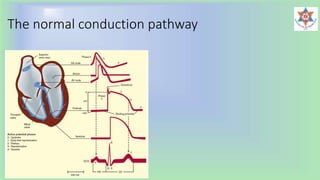
The normal conduction pathway
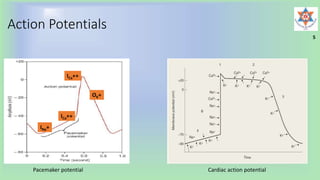
Action Potentials
5
INa+
ICa++
ICa++
OK+
Pacemaker potential Cardiac action potential
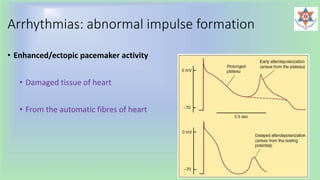
Arrhythmias: abnormal impulse formation
• Enhanced/ectopic pacemaker activity
• Damaged tissue of heart
• From the automatic fibres of heart
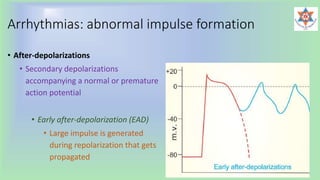
Arrhythmias: abnormal impulse formation
• After-depolarizations
• Secondary depolarizations
accompanying a normal or premature
action potential
• Early after-depolarization (EAD)
• Large impulse is generated
during repolarization that gets
propagated
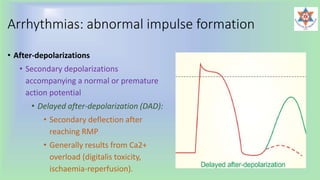
Arrhythmias: abnormal impulse formation
• After-depolarizations
• Secondary depolarizations
accompanying a normal or premature
action potential
• Delayed after-depolarization (DAD):
• Secondary deflection after
reaching RMP
• Generally results from Ca2+
overload (digitalis toxicity,
ischaemia-reperfusion).
Arrhythmias: Abnormal impulse transmission
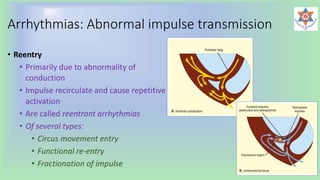
• Reentry
• Primarily due to abnormality of
conduction
• Impulse recirculate and cause repetitive
activation
• Are called reentrant arrhythmias
• Of several types:
• Circus movement entry
• Functional re-entry
• Fractionation of impulse
Classification
Vaughan Williams Classification of anti-dysrhythmic drugs
Class Actions Drugs
I Membrane Stabilizing Agents (Na+ channel blockers)
IA. Moderately decrease dv/dt of phase 0 Quinidine, Procainamide, Disopyramide
IB. Little decrease in dv/dt of phase 0 Lidocaine, Mexiletine
IC. Marked decrease in dv/dt of phase 0 Propafenone, Flecainide
II Antiadrenergic agents (β blockers) Propanolol, Esmolol, Sotalol (also class III)
III Agents widening Action Potential (prolong
repolarization and Effective refractory period)
Amiodarone, Dronedarone, Dofetilide, Ibutilide
IV Calcium channel blockers Verapamil, Diltiazem
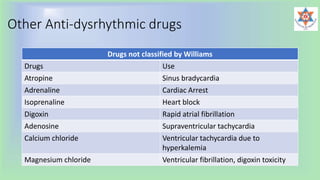
Other Anti-dysrhythmic drugs
Drugs not classified by Williams
Drugs Use
Atropine Sinus bradycardia
Adrenaline Cardiac Arrest
Isoprenaline Heart block
Digoxin Rapid atrial fibrillation
Adenosine Supraventricular tachycardia
Calcium chloride Ventricular tachycardia due to
hyperkalemia
Magnesium chloride Ventricular fibrillation, digoxin toxicity
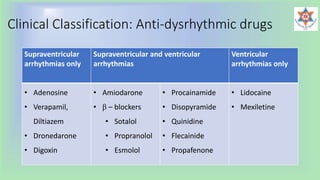
Clinical Classification: Anti-dysrhythmic drugs
Supraventricular
arrhythmias only
Supraventricular and ventricular
arrhythmias
Ventricular
arrhythmias only
• Adenosine
• Verapamil,
Diltiazem
• Dronedarone
• Digoxin
• Amiodarone
• β – blockers
• Sotalol
• Propranolol
• Esmolol
• Procainamide
• Disopyramide
• Quinidine
• Flecainide
• Propafenone
• Lidocaine
• Mexiletine
Mechanism of Action: Class I agents
• 3 distinct functional states of Na+ channels: resting, open and inactivated
• Resting
• Open (activation)
• Inactivated
• Class I drugs binds most strongly to Na+ channels in open or inactivated state
• Use dependent blockade
Mechanism of Action: Class I
• Blocks Na+ channels
• Limit the conductance of Na+ across cell membrane
• Decrease the slope of phase 0
• Reduces maximum rate of depolarization
• Blocks only high frequency excitation of myocardial cells
• Conducting tissues:
• Reduce rate of phase 4 depolarization  reduced automaticity
• Further divided into Ia, Ib, Ic:
• Characteristics of the sodium-channel block
Mechanism of action: Class I
• Class Ia (quinine, procainamide, disopyramide):
• Open state Na+ channel blocker: Intermediate association and dissociation
• Greater at higher frequency (premature ectopics affected more)
• Useful in triggered arrhythmias due to ectopic pacemakers
• Abolishes re-entry by converting unidirectional to bidirectional block
• Prolongs recovery: prolongs repolarization
• Supresses A-V conduction: prolonged refractoriness
Subclass Ia: Quinidine
• Acts by prolonging atrial effective refractory period
• A-V node: inconsistent effect
• Depresses myocardial contractility
• May precipitate failure in damaged heart
• ECG changes
• Broad QRS, increased PR, QT intervals, T wave changes
Subclass Ia: Quinidine
• Mechanism of Action:
• Blocks myocardial Na+ channels in open state
• Reduced automaticity
• Reduced maximal rate of phase 0 depolarization
• Blocks K+ channels
• Prolonged action potential duration (APD)
• Delayed recovery of Na+ and K+ channels
• Prolonged Effective Refractory Period (ERP)
Subclass Ia: Quinidine
• Side Effects:
• Torsades de pointes (TdP)
• Sudden cardiac arrest
• Ventricular Fibrillation (VF)
• Idiosyncratic angioedema
• Vascular collapse
• Thrombocytopenia
• Use:
• Atrial and ventricular arrhythmia
• To maintain sinus rhythm after termination of Atrial Fibrillation (AF) or Atrial Flutter (AFl)
Subclass Ia: Procainamide
• Orally active amide derivative of procaine
• Action similar to quinidine:
• Slowing of phase 0 depolarization and impulse conduction
• Prolonged APD, ERP
• Broad QRS, prolonged QT interval
• Difference form quinidine:
• Less effective in suppressing ectopic automaticity
• Less marked depression of contractility and A-V conduction
• No anti-vagal action
• Less fall in BP (no α blockade; ganglion blockade at high doses)
Subclass Ia: Procainamide
• Use:
• Occasionally used i.v. to terminate monomorphic VT and SVTs
• WPW reciprocal VTs
• Prevent recurrences of VF
• Not suitable for prolonged long term oral thrapy:
• Poor efficacy
• High risk of lupus
Subclass Ia: Procainamide
• Adverse Effects
• GI intolerance: nausea/vomiting (lesser than quinidine)
• CNS: weakness, mental confusion, hallucination (higher doses)
• Cardiac toxicity: potential to cause TdP
• Hypersensitivity reaction: rashes, fever, angioedema, agranulocytosis and anaemia
(rare)
• Long term high dose: SLE in slow acetylators
Subclass Ia: Disopyramide
• Prominent cardiac depressant and anticholinergic activity; no α blocking property
• No effect on sinus rate
• Prolonged PR and QRS broadening: less marked
• Use:
• Second line drug for prevention of recurrences of VT
• Maintenance therapy after cardioversion of AF or AFl
Subclass Ia: Disopyramide
• Adverse Effects:
• Less GI effects
• Anticholinergics side effects
• Depression of cardiac contractility: cardiac decompensation, hypotension
• Contra-indications:
• Sick sinus
• Cardiac failure
• Prostate hypertrophy
Drugs used in Cardiac
Arrhythmias-II
Dr. Pravin Prasad
MBBS, MD Clinical Pharmacology
Assistant Professor, Department of Clinical Pharmacology
Maharajgunj Medical Campus, Kathmandu
15 November 2021 (29 Kartik 2078), Monday
Mechanism of Action: Class I
• Class Ib:
• Associate and dissociate rapidly within the timeframe of the normal heartbeat
• Association:
• Binds to open channels during phase 0 of the action potential
• Leaves many of the channels blocked by the time AP reaches peak
• Dissociation:
• Occurs in time for the next AP
• Ectopics / premature beats blocked
• Further selectivity for inactivated channels: blocks arrhythmia during ischaemia
Subclass Ib: Lidocaine
• Acts by:
• Blocks inactivated Na+ channels preferentially
• Relatively selective for partially depolarized cells, with longer APD
• Supresses automaticity in ectopic foci (phase 4)
• Automaticity/After depolarization of Purkinje Fibres (PF) antagonised
• Can suppress re-entrant ventricular arrhythmia by:
• Abolishing one way block
• Producing two way block
Subclass Ib: Lidocaine
• Intravenous doses lasts only for 10-20 mins
• Initial t1/2 8 hrs, later 2 hrs
• Adverse Effects:
• Dose related neurological effects: drowsiness, paresthesia, nausea, blurred vision,
disorientation, nystagmus, twitching and fits
• NO anti-arrhythmic potential, least cardiotoxic
• Use: (slow i.v. injection)
• Supress VT, prevent VF
• Supress VT due to digitalis toxicity
Class II: Propanolol
• Acts by:
• Blocking cardiac adrenergic stimulation
• Marked decrease in the slope of phase 4 depolarization and automaticity in SA
node, PF and other ectopic foci
• Better action when higher adrenergic tone on heart present
• Prolong ERP of A-V node:
• Impedes A-V conduction
• No paradoxical tachycardia when rate reduced in AF or AFl
Class II: Propanolol
• Use:
• Inappropriate sinus tachycardia (esp. emotionally/exercise provoked)
• ONLY IF symptomatic and disturbing
• Prevent recurrences of PSVT
• Control ventricular rate in AF or AFl
• Arrhythmias due to pheochromocytoma, during anaesthesia with halothane
• Digitalis induced tachyarrhythmia
• Non-sustained VT, prevent recurrence of VT
• Prophylactic treatment in post-MI patients
• Terminate torsades de pointes
• WPW reciprocal rhythms
Class II: Atenolol
• Cardioselective beta blocker
• Lower propensity to cause bronchospasm
• Lesser metabolic derangements
• No/ less deleterious effect o n blood lipid profile
• Less chances of precipitating Raynaud's phenomenon
• Less liable to impair exercise capacity
• Less lipid soluble
• Less likely to produce CNS side effects
• Favourable pharmacokinetic profile
• Uses:
• Atrial
fibrillation/flutter
• Supraventricular
tachycardia
• Maintenance of
ventricular rate control
• Ventricular
arrhythmia, VPCs
Class IV: Verapamil
• Acts by blocking as well as delaying recovery of L-type Ca2+ channels:
• Depresses Ca2+ mediated depolarization
• Suppressed automaticity and re-entry dependent on slow channel response
• Reduced phase 4 depolarization in SA node:
• Bradycardia
• Prolonged A-V nodal ERP:
• Re-entry involving AVN terminated
• Dampens delayed after depolarization in PFs
• Negative inotropic action
Class IV: Verapamil
• Uses and precaution:
• PSVT-to terminate attacks, prevent recurrences
• DO NOT USE if PSVT accompanied with hypotension or CHF
• Control ventricular rate in AF or AFl: first line of drug
• Contraindicated in:
• Broad QRS complex WPW syndrome
• Myocardial Infarction
• Digitalis toxicity
• Partial Heart block and sick sinus
Drugs for AV block
• Sympathomimetics (Isoprenaline):
• Acts by:
• Stimulates beta-1 receptors of heart
• Also stimulates beta-2 and beta-3 receptors
• Facilitating AV conduction
• Shortening of ERP of conducting tissues
• Use:
• To maintain idioventricular rate in complete heart block till external pacemaker
can be implanted
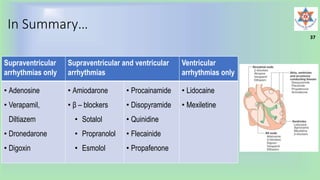
In Summary…
Supraventricular
arrhythmias only
Supraventricular and ventricular
arrhythmias
Ventricular
arrhythmias only
• Adenosine
• Verapamil,
Diltiazem
• Dronedarone
• Digoxin
• Amiodarone
• β – blockers
• Sotalol
• Propranolol
• Esmolol
• Procainamide
• Disopyramide
• Quinidine
• Flecainide
• Propafenone
• Lidocaine
• Mexiletine
37
PLEASE READ!!
• Questions??
• Thank you!