Presented by 
B.RAVALI 
Reg.no:11AB1R0008 
Under the guidance of 
Mr. P.RAVI SANKAR M. Pharm 
Department of Pharmaceutical chemistry 
Vadlamudi, Guntur Dt, A.P, INDIA. 
PIN:522213 
9/13/2014 1
CONTENTS 
 Introduction to diuretics. 
 Therapeutic approaches. 
 Normal physiology of urine formation. 
 Classification of drugs . 
 Mechanism of action of Acetazolamide. 
 Mechanism of action of Thiazides. 
 Mechanism of action of Loop diuretics. 
 Mechanism of action of potassium sparing diuretics &aldosterone 
antagonists.
Diuretics (“water pills”) are the drugs which 
increase the urine out put (or) urine volume . 
What is natreuretic agent ? 
Any drug when introduce into the body 
increases the out put of sodium 
ie., loss of sodium in urine.
Therapeutic approaches 
Diuretics are very effective in the treatment of conditions like:- 
 chronic heart failure 
 nephrotic syndrome 
 chronic hepatic diseases 
 hypertension 
 Pregnancy associated oedema 
 Cirrhosis of the liver.
 Two important functions of the kidney are:- 
 To maintain a homeostatis balance of electrolytes and water. 
 To excrete water soluble end products of metabolites. 
 Each kidney contains approximately one million nephrons and is 
capable of forming urine independently. 
 The nephrons are composed of glomerulus, proximal tubule, loop of 
henle, distal tubule.
 Approximately 1200 ml of blood per minute flows through both 
kidneys. 
 Ions such as sodium, chloride,calcium are reabsorbed. 
 Total amount of glucose, amino acids, vitamins, proteins are 
reabsorbed. 
 If the urine contains above it represents the disorders. 
 For example proteins such as albumin in higher amounts causes 
albuminaria.
Types of 
urine 
Normal Polyuria
CLASSIFICATION OF 
DRUGS 
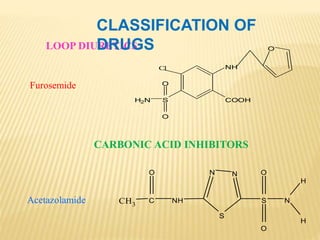
LOOP DIURETICS 
Furosemide 
Cl 
O 
H2N S 
COOH 
O 
NH 
O 
CARBONIC ACID INHIBITORS 
Acetazolamide CH3 
C NH 
N N 
S 
O 
S 
O 
N 
H 
H 
O
POTASSIUM SPARING DIURETICS 
Aldosterone antagonist 
O 
O 
H3C 
H3C 
O 
O 
S C CH3 
N 
N 
O NH 
N 
H NH2 
Cl 
H2N NH2 
Spironolactone 
Amiloride
THIAZIDE DIURETICS 
Hydrochlor thaizide 
H2NO2S 
Cl 
O O 
N 
H 
NH 
S 
H2NO2S 
Cl 
O O 
N 
NH 
S 
Chlorothiazide
THIAZIDE LIKE DIURETICS 
Chlor thalidone 
OH 
NH 
Cl 
SO2NH2 
O 
N 
H 
N 
CH3 
CH3 
Cl 
H2NO2S 
O 
Metolazone
 1 cardiac output -5 lit/min. 
 Out of that 20% goes to kidneys i.e.1 lit/min. 
 1 lit of blood of has 40%of cells and 60%of plasma. 
 600 ml of plasma is not entered into glomerulus only a part of plasma 
can enter into it and the rest pass through the efferent arteriole. 
 Only 20% can enter into glomerelus that is 120 ml. 
 This 120 ml/min makes glomerular filtrate.
 It is a sulfonamide derivative which is a non competitive 
reversible inhibitor of “carbonic anhydrase enzyme”. 
 This enzyme is responsible for catalytic reversible hydration of 
carbon dioxide and dehydration of carbonic acid. 
 ADVERSE EFFECTS: 
 Hypo kalaemia. 
 Renal calculi. 
 Nausea,loss of hearing,loss of apetite.
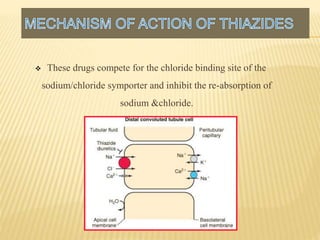
 These drugs compete for the chloride binding site of the 
sodium/chloride symporter and inhibit the re-absorption of 
sodium &chloride.
Uses 
 Treatment of glaucoma. 
 Reduces the intra occular pressure. 
 Alkalizing the urine. 
 These are given in combination with 
amiloride,allopurinol to prevent the formation of calcium stones 
in hyper calciuric patients.
ADVERSE EFFECTS 
 GI effects -Anorexia 
 CNS effects -Dizziness, vertigo. 
 CVS effects-Ortho static hypotension.
6 
The position 2 can tolerate the presence of small alkyl 
groups such as methyl. 
Substituents in 3 position determines the potency,duration 
of action. 
S 
N 
R N 1 
SO2NH 
2 
R 
O 
O 
4 
3 
2 
1 
8 
7 
5
Loss of c-c double bond between 3&4 positions of nucleus 
increases diuretic potency approximately three to ten fold. 
Direct substitution of the 4,5 or 8 position with an alkyl group 
usually results in diminished diuretic activity. 
Substitution of the 6-position with an activating group is 
essential for diuretic activity . The best substituent's include 
Cl,Br,CF3 and No2 groups. 
The sulphamoyl group in the7-position is a prerequisite for 
diuretic activity.
DRUGS SUBSTITUEN 
TS 
chlorothiazide R1 =H 
hydrochlorothiazide R1=H,R=Cl 
trichlormethiazide R1=CHCl2,R=Cl 
methyclothiazide R1=CH2Cl,R=Cl 
hydroflumethiazide R1=H,R=CF3
MECHANISM OF ACTION OF LOOP DIURETICS 
 These agents produce a peak diuresis much greater than observed 
with other commonly used diuretics. 
 They act by inhibiting the luminal Na/K/2Cl symporter.
Furosemide is preferred usually to ethacrynic acid for a 
number of reasons: 
 It is less ototoxic. 
 It has broader dose response curve. 
 It is more convenient for i.v. use. 
 It causes fewer git side effects.
SYNTHESIS OF FUROSEMIDE
LOOP DIURETICS THIAZIDE DIURETICS 
 They inhibit Na/K/2Cl symporetr. 
 Acts at thick ascending loop of 
henle. 
 These are Ca wasting drugs. 
 They cause heavy diuresis. 
 Para thyroid hormone 
independent Ca absorption. 
 It can reabsorb 25%to 30% of Na. 
 They act by inhibiting Na/Cl 
symporter. 
 Acts at distal convoluted tubule. 
 These are Ca retaining drugs. 
 They cause mild diuresis. 
 Para thyroid hormone dependent 
Ca absorption. 
 It can reabsorb 8% of Na.
MECHANISM OF ACTION OF OSMOTIC 
DIURETICS. 
 Osmotic agents such as Mannitol are low molecular weight 
compounds that are freely filtered through bowmans capsule. 
 They have limited reabsorption because of high water solubility. 
 Osmotic diuretics increase the volume of water and almost all of 
the electrolytes.
They act by inhibiting sodium reabsorption in the late distal tubule and thus 
indirectly spare potassium excretion. 
USES:- 
Liddle’s syndrome(pseudo-hyper aldosteronism). 
Amiloride is used to treat lithium induced nephrogenic diabetes insipidus.
 Aldosterone,by binding to its receptor in the cytoplasm increases 
expression &function of Na channel and sodium pump. 
 Spironolactone competitively inhibits the binding of aldosterone and 
abolishes its biological effect.
O 
O 
H3C 
CH3 
O 
O 
S C CH3 
Spironolactone- 
17-hydroxy-7-α-mercapto-3-oxo-17αpreg-4-ene-21-carboxlic acid-ϒ-lactone 
acetate
Generic name Trade name 
Chlorothiazide Diuril 
Metalazone Zaroxylon 
Furosemide Lasix 
Chlorthalidone Thalitone 
Indapamide Lozol 
Hydroflumethiazide Saluron
CONCLUSION 
Diuretics are the first line agents to treat hypertension. When it 
is not controlled it can be given in the form of combinations 
with other anti hypertensive's. 
Some of these agents has the capacity to reabsorb more 
calcium so they can be prescribed for the patients suffering 
from osteoporosis.
REFERENCES 
Thomas L Lemke /David A Williams –Foye’s principles of 
Medicinal chemistry 6th edition pg.no:722-735. 
Lippincott Williams & Wilkins – Remington The science &practice 
of pharmacy 21st edition pg.no:1422-1431. 
D. Sriram, P.Yogeeswari –Medicinal chemistry pg.no:171-181.
REFERENCES 
 Wilson & Gisvold’s Text book of Organic Medicinal & 
Pharmaceutical chemistry 11th edition pg. no:596-621. 
 Bertram G.Katzung –Basic & Clinical pharmacology 12th 
edition pg.no:251-269.
ACKNOWLEDGEMENTS 
I oblige to pay my deep gratitude for the patience hearing 
of my presentation delivered by me with reference to 
power point. 
I thank one and all. 
 I would like to thank my guide Mr. P.RAVI SANKAR for his 
extreme support & guidance. 
 I would like to thank our principal Dr.P.SRINIVAS BABU 
I also would like to thank our organizing committee.
36

Diuretics by P.Ravisankar

  • 1.
    Presented by B.RAVALI Reg.no:11AB1R0008 Under the guidance of Mr. P.RAVI SANKAR M. Pharm Department of Pharmaceutical chemistry Vadlamudi, Guntur Dt, A.P, INDIA. PIN:522213 9/13/2014 1
  • 2.
    CONTENTS  Introductionto diuretics.  Therapeutic approaches.  Normal physiology of urine formation.  Classification of drugs .  Mechanism of action of Acetazolamide.  Mechanism of action of Thiazides.  Mechanism of action of Loop diuretics.  Mechanism of action of potassium sparing diuretics &aldosterone antagonists.
  • 3.
    Diuretics (“water pills”)are the drugs which increase the urine out put (or) urine volume . What is natreuretic agent ? Any drug when introduce into the body increases the out put of sodium ie., loss of sodium in urine.
  • 4.
    Therapeutic approaches Diureticsare very effective in the treatment of conditions like:-  chronic heart failure  nephrotic syndrome  chronic hepatic diseases  hypertension  Pregnancy associated oedema  Cirrhosis of the liver.
  • 5.
     Two importantfunctions of the kidney are:-  To maintain a homeostatis balance of electrolytes and water.  To excrete water soluble end products of metabolites.  Each kidney contains approximately one million nephrons and is capable of forming urine independently.  The nephrons are composed of glomerulus, proximal tubule, loop of henle, distal tubule.
  • 6.
     Approximately 1200ml of blood per minute flows through both kidneys.  Ions such as sodium, chloride,calcium are reabsorbed.  Total amount of glucose, amino acids, vitamins, proteins are reabsorbed.  If the urine contains above it represents the disorders.  For example proteins such as albumin in higher amounts causes albuminaria.
  • 7.
    Types of urine Normal Polyuria
  • 8.
    CLASSIFICATION OF DRUGS LOOP DIURETICS Furosemide Cl O H2N S COOH O NH O CARBONIC ACID INHIBITORS Acetazolamide CH3 C NH N N S O S O N H H O
  • 9.
    POTASSIUM SPARING DIURETICS Aldosterone antagonist O O H3C H3C O O S C CH3 N N O NH N H NH2 Cl H2N NH2 Spironolactone Amiloride
  • 10.
    THIAZIDE DIURETICS Hydrochlorthaizide H2NO2S Cl O O N H NH S H2NO2S Cl O O N NH S Chlorothiazide
  • 11.
    THIAZIDE LIKE DIURETICS Chlor thalidone OH NH Cl SO2NH2 O N H N CH3 CH3 Cl H2NO2S O Metolazone
  • 12.
     1 cardiacoutput -5 lit/min.  Out of that 20% goes to kidneys i.e.1 lit/min.  1 lit of blood of has 40%of cells and 60%of plasma.  600 ml of plasma is not entered into glomerulus only a part of plasma can enter into it and the rest pass through the efferent arteriole.  Only 20% can enter into glomerelus that is 120 ml.  This 120 ml/min makes glomerular filtrate.
  • 16.
     It isa sulfonamide derivative which is a non competitive reversible inhibitor of “carbonic anhydrase enzyme”.  This enzyme is responsible for catalytic reversible hydration of carbon dioxide and dehydration of carbonic acid.  ADVERSE EFFECTS:  Hypo kalaemia.  Renal calculi.  Nausea,loss of hearing,loss of apetite.
  • 17.
     These drugscompete for the chloride binding site of the sodium/chloride symporter and inhibit the re-absorption of sodium &chloride.
  • 18.
    Uses  Treatmentof glaucoma.  Reduces the intra occular pressure.  Alkalizing the urine.  These are given in combination with amiloride,allopurinol to prevent the formation of calcium stones in hyper calciuric patients.
  • 19.
    ADVERSE EFFECTS GI effects -Anorexia  CNS effects -Dizziness, vertigo.  CVS effects-Ortho static hypotension.
  • 20.
    6 The position2 can tolerate the presence of small alkyl groups such as methyl. Substituents in 3 position determines the potency,duration of action. S N R N 1 SO2NH 2 R O O 4 3 2 1 8 7 5
  • 21.
    Loss of c-cdouble bond between 3&4 positions of nucleus increases diuretic potency approximately three to ten fold. Direct substitution of the 4,5 or 8 position with an alkyl group usually results in diminished diuretic activity. Substitution of the 6-position with an activating group is essential for diuretic activity . The best substituent's include Cl,Br,CF3 and No2 groups. The sulphamoyl group in the7-position is a prerequisite for diuretic activity.
  • 22.
    DRUGS SUBSTITUEN TS chlorothiazide R1 =H hydrochlorothiazide R1=H,R=Cl trichlormethiazide R1=CHCl2,R=Cl methyclothiazide R1=CH2Cl,R=Cl hydroflumethiazide R1=H,R=CF3
  • 23.
    MECHANISM OF ACTIONOF LOOP DIURETICS  These agents produce a peak diuresis much greater than observed with other commonly used diuretics.  They act by inhibiting the luminal Na/K/2Cl symporter.
  • 24.
    Furosemide is preferredusually to ethacrynic acid for a number of reasons:  It is less ototoxic.  It has broader dose response curve.  It is more convenient for i.v. use.  It causes fewer git side effects.
  • 25.
  • 26.
    LOOP DIURETICS THIAZIDEDIURETICS  They inhibit Na/K/2Cl symporetr.  Acts at thick ascending loop of henle.  These are Ca wasting drugs.  They cause heavy diuresis.  Para thyroid hormone independent Ca absorption.  It can reabsorb 25%to 30% of Na.  They act by inhibiting Na/Cl symporter.  Acts at distal convoluted tubule.  These are Ca retaining drugs.  They cause mild diuresis.  Para thyroid hormone dependent Ca absorption.  It can reabsorb 8% of Na.
  • 27.
    MECHANISM OF ACTIONOF OSMOTIC DIURETICS.  Osmotic agents such as Mannitol are low molecular weight compounds that are freely filtered through bowmans capsule.  They have limited reabsorption because of high water solubility.  Osmotic diuretics increase the volume of water and almost all of the electrolytes.
  • 28.
    They act byinhibiting sodium reabsorption in the late distal tubule and thus indirectly spare potassium excretion. USES:- Liddle’s syndrome(pseudo-hyper aldosteronism). Amiloride is used to treat lithium induced nephrogenic diabetes insipidus.
  • 29.
     Aldosterone,by bindingto its receptor in the cytoplasm increases expression &function of Na channel and sodium pump.  Spironolactone competitively inhibits the binding of aldosterone and abolishes its biological effect.
  • 30.
    O O H3C CH3 O O S C CH3 Spironolactone- 17-hydroxy-7-α-mercapto-3-oxo-17αpreg-4-ene-21-carboxlic acid-ϒ-lactone acetate
  • 31.
    Generic name Tradename Chlorothiazide Diuril Metalazone Zaroxylon Furosemide Lasix Chlorthalidone Thalitone Indapamide Lozol Hydroflumethiazide Saluron
  • 32.
    CONCLUSION Diuretics arethe first line agents to treat hypertension. When it is not controlled it can be given in the form of combinations with other anti hypertensive's. Some of these agents has the capacity to reabsorb more calcium so they can be prescribed for the patients suffering from osteoporosis.
  • 33.
    REFERENCES Thomas LLemke /David A Williams –Foye’s principles of Medicinal chemistry 6th edition pg.no:722-735. Lippincott Williams & Wilkins – Remington The science &practice of pharmacy 21st edition pg.no:1422-1431. D. Sriram, P.Yogeeswari –Medicinal chemistry pg.no:171-181.
  • 34.
    REFERENCES  Wilson& Gisvold’s Text book of Organic Medicinal & Pharmaceutical chemistry 11th edition pg. no:596-621.  Bertram G.Katzung –Basic & Clinical pharmacology 12th edition pg.no:251-269.
  • 35.
    ACKNOWLEDGEMENTS I obligeto pay my deep gratitude for the patience hearing of my presentation delivered by me with reference to power point. I thank one and all.  I would like to thank my guide Mr. P.RAVI SANKAR for his extreme support & guidance.  I would like to thank our principal Dr.P.SRINIVAS BABU I also would like to thank our organizing committee.
  • 36.