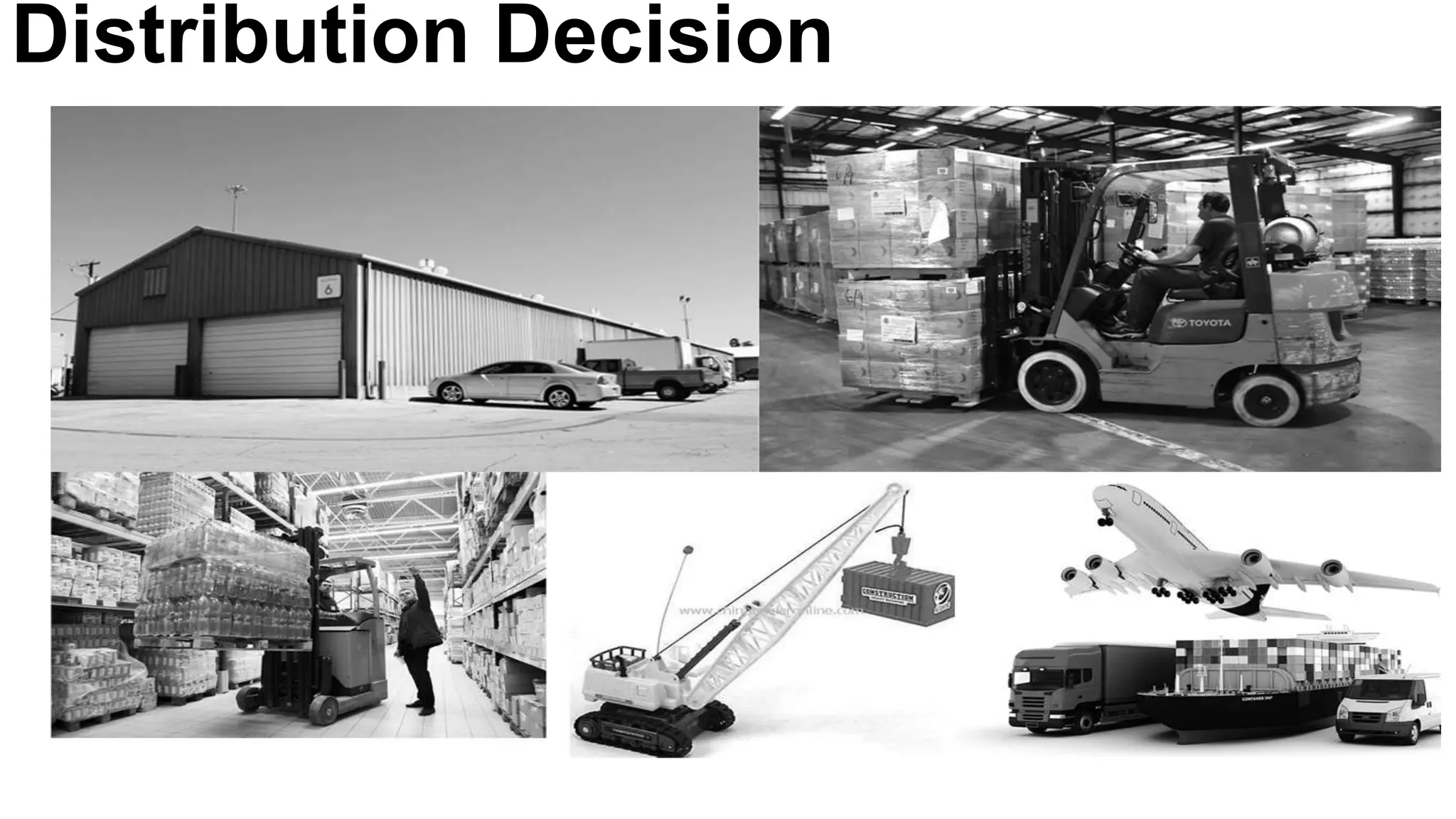

Distribution Decision
Concept of Distribution
Distribution is the route or means through which the ownership of products and
services move from the manufacturer to the ultimate users or consumers at a
right time, to the right place through right means. Distribution includes two
components. They are channels of distribution and physical distribution.
• Channel of Distribution: Channel of distribution refers to the various
intermediaries who help in moving the product from the producer to the
consumer. The channel of distribution involves several individuals and
institutions such as producers, suppliers, industrial users, brokers, agents,
wholesalers, retailers and consumers.
• Physical Distribution: physical distribution is the management of physical flow
of goods and establishment and operation of flow systems. Physical distribution
creates time and place utility which maximizes the value of goods "by delivering
them to right customer at the right time and right place.” It includes; materials
handling, inventory management and control, order processing, transportation
and warehouse.
Objectives of Distribution
•Minimization of total cost
•Transfer of product ownership
•Regular supply of goods
•Availability of goods
•Promotion of goods and services
•Utility creation
•Customer satisfaction
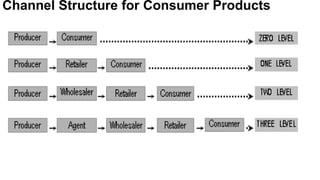
Channel Structure for Consumer Products
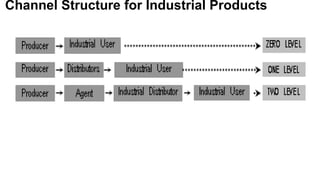
Channel Structure for Industrial Products
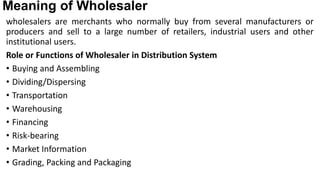
Meaning of Wholesaler
wholesalers are merchants who normally buy from several manufacturers or
producers and sell to a large number of retailers, industrial users and other
institutional users.
Role or Functions of Wholesaler in Distribution System
• Buying and Assembling
• Dividing/Dispersing
• Transportation
• Warehousing
• Financing
• Risk-bearing
• Market Information
• Grading, Packing and Packaging
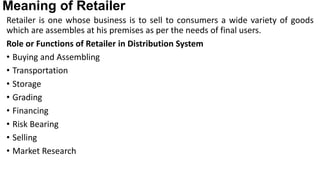
Meaning of Retailer
Retailer is one whose business is to sell to consumers a wide variety of goods
which are assembles at his premises as per the needs of final users.
Role or Functions of Retailer in Distribution System
• Buying and Assembling
• Transportation
• Storage
• Grading
• Financing
• Risk Bearing
• Selling
• Market Research
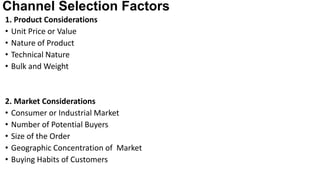
Channel Selection Factors
1. Product Considerations
• Unit Price or Value
• Nature of Product
• Technical Nature
• Bulk and Weight
2. Market Considerations
• Consumer or Industrial Market
• Number of Potential Buyers
• Size of the Order
• Geographic Concentration of Market
• Buying Habits of Customers
Cont’ed
3. Company/ Manufacturer Considerations
• Size of Manufacturer
• Reputation and Financial Resources
• Managerial ability and Experience
• Services Provided by the Channels
• Goodwill
• Desire to Control the Channels
4. Middlemen Considerations
• Availability of Desired Middlemen
• Services Provided by the Middlemen
• Attitude of Middlemen
• Cost of Distribution
• Reputation and Financial ability
Cont’ed
5. Environmental Considerations
• Government Rules and Regulations
• Economic Condition
• Social Environment
Channel Conflicts
Channel conflict exists when one channel member perceives another channel
member to be acting in a way that prevents the first member from achieving its
distribution objectives.
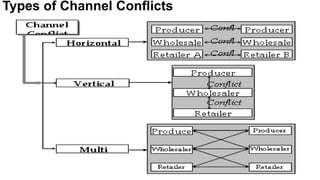
Types of Channel Conflicts
•Goal Incompatibility
•Unclear Role
•Poor Communication
•Perceptual Difference
•Ideological Difference
•Terms and Condition
•By–passing Channel
Causes of Channel Conflict
Channel Conflict Resolution
•Problem solving
•Goal modification
•Persuasion
•Bargaining
•Diplomacy
•Improvement in communication
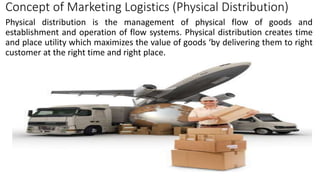
Concept of Marketing Logistics (Physical Distribution)
Physical distribution is the management of physical flow of goods and
establishment and operation of flow systems. Physical distribution creates time
and place utility which maximizes the value of goods ‘by delivering them to right
customer at the right time and right place.
Objective of Marketing Logistics
•To provide better customer service
•To increase sales
•To reduce cost
•To establish differential advantage over rivals
•Developing good and effective communication
system
Major Logistics Functions
•Transportation
•Warehousing
•Order processing
•Inventory management
•Material handling
•Customer services
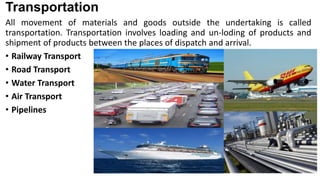
Transportation
All movement of materials and goods outside the undertaking is called
transportation. Transportation involves loading and un-loding of products and
shipment of products between the places of dispatch and arrival.
• Railway Transport
• Road Transport
• Water Transport
• Air Transport
• Pipelines
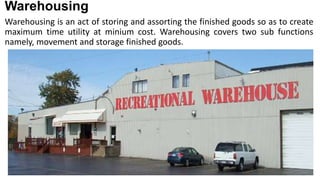
Warehousing
Warehousing is an act of storing and assorting the finished goods so as to create
maximum time utility at minium cost. Warehousing covers two sub functions
namely, movement and storage finished goods.
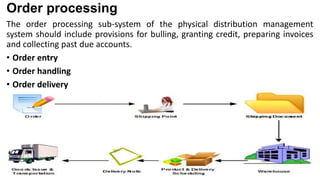
Order processing
The order processing sub-system of the physical distribution management
system should include provisions for bulling, granting credit, preparing invoices
and collecting past due accounts.
• Order entry
• Order handling
• Order delivery
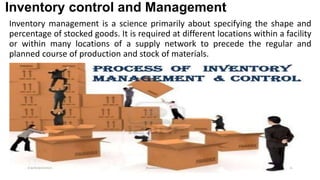
Inventory control and Management
Inventory management is a science primarily about specifying the shape and
percentage of stocked goods. It is required at different locations within a facility
or within many locations of a supply network to precede the regular and
planned course of production and stock of materials.
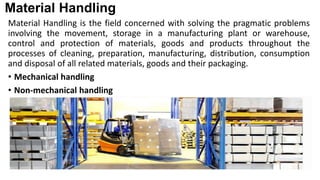
Material Handling
Material Handling is the field concerned with solving the pragmatic problems
involving the movement, storage in a manufacturing plant or warehouse,
control and protection of materials, goods and products throughout the
processes of cleaning, preparation, manufacturing, distribution, consumption
and disposal of all related materials, goods and their packaging.
• Mechanical handling
• Non-mechanical handling
Customer services
Customer service is the act of taking care of the customer's needs by providing
and delivering professional, helpful, high quality service and assistance before,
during, and after the customer's requirements are met.

Distribution Decision concept by sandesh acharya (1).pptx

  • 1.
  • 2.
    Concept of Distribution Distributionis the route or means through which the ownership of products and services move from the manufacturer to the ultimate users or consumers at a right time, to the right place through right means. Distribution includes two components. They are channels of distribution and physical distribution. • Channel of Distribution: Channel of distribution refers to the various intermediaries who help in moving the product from the producer to the consumer. The channel of distribution involves several individuals and institutions such as producers, suppliers, industrial users, brokers, agents, wholesalers, retailers and consumers. • Physical Distribution: physical distribution is the management of physical flow of goods and establishment and operation of flow systems. Physical distribution creates time and place utility which maximizes the value of goods "by delivering them to right customer at the right time and right place.” It includes; materials handling, inventory management and control, order processing, transportation and warehouse.
  • 3.
    Objectives of Distribution •Minimizationof total cost •Transfer of product ownership •Regular supply of goods •Availability of goods •Promotion of goods and services •Utility creation •Customer satisfaction
  • 4.
    Channel Structure forConsumer Products
  • 5.
    Channel Structure forIndustrial Products
  • 6.
    Meaning of Wholesaler wholesalersare merchants who normally buy from several manufacturers or producers and sell to a large number of retailers, industrial users and other institutional users. Role or Functions of Wholesaler in Distribution System • Buying and Assembling • Dividing/Dispersing • Transportation • Warehousing • Financing • Risk-bearing • Market Information • Grading, Packing and Packaging
  • 7.
    Meaning of Retailer Retaileris one whose business is to sell to consumers a wide variety of goods which are assembles at his premises as per the needs of final users. Role or Functions of Retailer in Distribution System • Buying and Assembling • Transportation • Storage • Grading • Financing • Risk Bearing • Selling • Market Research
  • 8.
    Channel Selection Factors 1.Product Considerations • Unit Price or Value • Nature of Product • Technical Nature • Bulk and Weight 2. Market Considerations • Consumer or Industrial Market • Number of Potential Buyers • Size of the Order • Geographic Concentration of Market • Buying Habits of Customers
  • 9.
    Cont’ed 3. Company/ ManufacturerConsiderations • Size of Manufacturer • Reputation and Financial Resources • Managerial ability and Experience • Services Provided by the Channels • Goodwill • Desire to Control the Channels 4. Middlemen Considerations • Availability of Desired Middlemen • Services Provided by the Middlemen • Attitude of Middlemen • Cost of Distribution • Reputation and Financial ability
  • 10.
    Cont’ed 5. Environmental Considerations •Government Rules and Regulations • Economic Condition • Social Environment
  • 11.
    Channel Conflicts Channel conflictexists when one channel member perceives another channel member to be acting in a way that prevents the first member from achieving its distribution objectives.
  • 12.
  • 13.
    •Goal Incompatibility •Unclear Role •PoorCommunication •Perceptual Difference •Ideological Difference •Terms and Condition •By–passing Channel Causes of Channel Conflict
  • 14.
    Channel Conflict Resolution •Problemsolving •Goal modification •Persuasion •Bargaining •Diplomacy •Improvement in communication
  • 15.
    Concept of MarketingLogistics (Physical Distribution) Physical distribution is the management of physical flow of goods and establishment and operation of flow systems. Physical distribution creates time and place utility which maximizes the value of goods ‘by delivering them to right customer at the right time and right place.
  • 16.
    Objective of MarketingLogistics •To provide better customer service •To increase sales •To reduce cost •To establish differential advantage over rivals •Developing good and effective communication system
  • 17.
    Major Logistics Functions •Transportation •Warehousing •Orderprocessing •Inventory management •Material handling •Customer services
  • 18.
    Transportation All movement ofmaterials and goods outside the undertaking is called transportation. Transportation involves loading and un-loding of products and shipment of products between the places of dispatch and arrival. • Railway Transport • Road Transport • Water Transport • Air Transport • Pipelines
  • 19.
    Warehousing Warehousing is anact of storing and assorting the finished goods so as to create maximum time utility at minium cost. Warehousing covers two sub functions namely, movement and storage finished goods.
  • 20.
    Order processing The orderprocessing sub-system of the physical distribution management system should include provisions for bulling, granting credit, preparing invoices and collecting past due accounts. • Order entry • Order handling • Order delivery
  • 21.
    Inventory control andManagement Inventory management is a science primarily about specifying the shape and percentage of stocked goods. It is required at different locations within a facility or within many locations of a supply network to precede the regular and planned course of production and stock of materials.
  • 22.
    Material Handling Material Handlingis the field concerned with solving the pragmatic problems involving the movement, storage in a manufacturing plant or warehouse, control and protection of materials, goods and products throughout the processes of cleaning, preparation, manufacturing, distribution, consumption and disposal of all related materials, goods and their packaging. • Mechanical handling • Non-mechanical handling
  • 23.
    Customer services Customer serviceis the act of taking care of the customer's needs by providing and delivering professional, helpful, high quality service and assistance before, during, and after the customer's requirements are met.