Shah Aafreen Mohammed
Amin,mcom(business management)-
1,marketing strategies and plans,roll no-
109.
Meaning-Logistics is the management of the flow of goods between the point of origin
and the point of consumption in order to meet some requirements of customers or
corporationsThe resources managed in logistics can include physical items, such as food,
materials, animals, equipment and liquids, as well as abstract items, such as time,
information, particles, and energy. The logistics of physical items usually involves the
integration of information flow, material handling, production, packaging, inventory,
transportation, warehousing, and often security. The complexity of logistics can be
modeled, analyzed, visualized, and optimized by dedicated simulation software. The
minimization of the use of resources is a common motivation in logistics for import and
export.
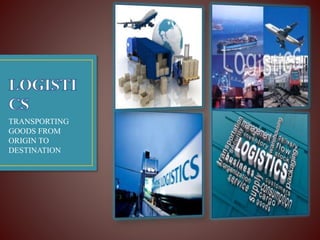
TRANSPORTING
GOODS FROM
ORIGIN TO
DESTINATION
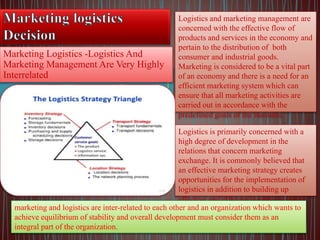
Marketing Logistics -Logistics And
Marketing Management Are Very Highly
Interrelated
Logistics and marketing management are
concerned with the effective flow of
products and services in the economy and
pertain to the distribution of both
consumer and industrial goods.
Marketing is considered to be a vital part
of an economy and there is a need for an
efficient marketing system which can
ensure that all marketing activities are
carried out in accordance with the
predefined goals of the business.
Logistics is primarily concerned with a
high degree of development in the
relations that concern marketing
exchange. It is commonly believed that
an effective marketing strategy creates
opportunities for the implementation of
logistics in addition to building up
effective and efficient logistics systems.
marketing and logistics are inter-related to each other and an organization which wants to
achieve equilibrium of stability and overall development must consider them as an
integral part of the organization.
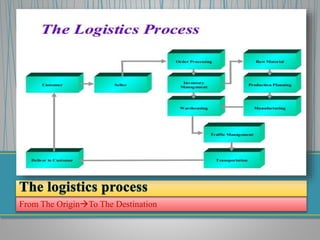
From The OriginTo The Destination
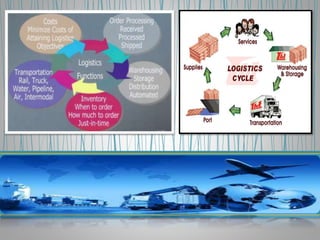
• Order processing:
Order processing starts with the
receipt of an order from a customer
As soon as a customer places an
order with a company, numerous
processes are set in motion to fill it.
For example, the completeness of the
order must be checked, and the
creditworthiness of the customer
must be examined The duration of
order processing is included in the
delivery time for a good. Quick,
accurate processing has a favorable
effect on the entire flow of goods.
• Warehousing:
Warehouse is a storage structure
constructed for the protection of the
quality and quantity of the stored
produce. The need for a warehouse
arises due to the time gap between
production and consumption of
products. Warehousing or storage
refers to the holding and preservation
of goods until they are despatched to
the consumers. By bridging this gap,
storage creates time utility. There is a
need for storing the goods so as to
make them available to buyers as and
when required. Storage enables a
firm to carry on production in
anticipation of demand in future.
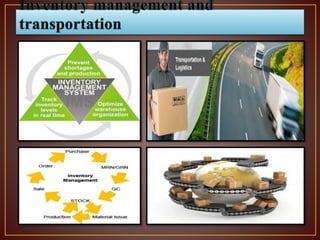
• Inventory management:
• Successful inventory management
involves creating a purchasing plan
that will ensure that items are
available when they are needed (but
that neither too much nor too little is
purchased) and keeping track of
existing inventory and its use. Two
common inventory-management
strategies are the just-in-time method,
where companies plan to receive items
as they are needed rather than
maintaining high inventory levels, and
materials requirement planning, which
schedules material deliveries based on
sales forecasts
• Transportation:
• Transport or transportation is the
movement of people, animals and
goods from one location to another.
Modes of transport include air, rail,
road, water, cable, pipeline and space.
The field can be divided into
infrastructure, vehicles and operations.
Transport is important because it
enables trade between persons, which
is essential for the development of
civilizations. Transport infrastructure
consists of the fixed installations
including roads, railways, airways,
waterways, canals and pipelines and
terminals such as airports, railway
stations, bus stations, warehouses,
trucking terminals, refueling depots
(including fueling docks and fuel
stations) and seaports. Terminals may
be used both for interchange of
passengers and cargo and for
maintenance.
Logistics msp
Logistics msp

Logistics msp

  • 1.
    Shah Aafreen Mohammed Amin,mcom(businessmanagement)- 1,marketing strategies and plans,roll no- 109.
  • 2.
    Meaning-Logistics is themanagement of the flow of goods between the point of origin and the point of consumption in order to meet some requirements of customers or corporationsThe resources managed in logistics can include physical items, such as food, materials, animals, equipment and liquids, as well as abstract items, such as time, information, particles, and energy. The logistics of physical items usually involves the integration of information flow, material handling, production, packaging, inventory, transportation, warehousing, and often security. The complexity of logistics can be modeled, analyzed, visualized, and optimized by dedicated simulation software. The minimization of the use of resources is a common motivation in logistics for import and export.
  • 3.
  • 4.
    Marketing Logistics -LogisticsAnd Marketing Management Are Very Highly Interrelated Logistics and marketing management are concerned with the effective flow of products and services in the economy and pertain to the distribution of both consumer and industrial goods. Marketing is considered to be a vital part of an economy and there is a need for an efficient marketing system which can ensure that all marketing activities are carried out in accordance with the predefined goals of the business. Logistics is primarily concerned with a high degree of development in the relations that concern marketing exchange. It is commonly believed that an effective marketing strategy creates opportunities for the implementation of logistics in addition to building up effective and efficient logistics systems. marketing and logistics are inter-related to each other and an organization which wants to achieve equilibrium of stability and overall development must consider them as an integral part of the organization.
  • 5.
    From The OriginToThe Destination
  • 6.
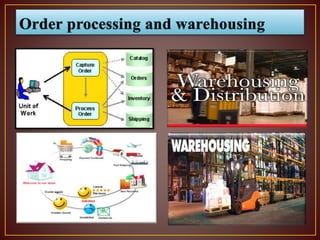
    • Order processing: Orderprocessing starts with the receipt of an order from a customer As soon as a customer places an order with a company, numerous processes are set in motion to fill it. For example, the completeness of the order must be checked, and the creditworthiness of the customer must be examined The duration of order processing is included in the delivery time for a good. Quick, accurate processing has a favorable effect on the entire flow of goods. • Warehousing: Warehouse is a storage structure constructed for the protection of the quality and quantity of the stored produce. The need for a warehouse arises due to the time gap between production and consumption of products. Warehousing or storage refers to the holding and preservation of goods until they are despatched to the consumers. By bridging this gap, storage creates time utility. There is a need for storing the goods so as to make them available to buyers as and when required. Storage enables a firm to carry on production in anticipation of demand in future.
  • 8.
    • Inventory management: •Successful inventory management involves creating a purchasing plan that will ensure that items are available when they are needed (but that neither too much nor too little is purchased) and keeping track of existing inventory and its use. Two common inventory-management strategies are the just-in-time method, where companies plan to receive items as they are needed rather than maintaining high inventory levels, and materials requirement planning, which schedules material deliveries based on sales forecasts • Transportation: • Transport or transportation is the movement of people, animals and goods from one location to another. Modes of transport include air, rail, road, water, cable, pipeline and space. The field can be divided into infrastructure, vehicles and operations. Transport is important because it enables trade between persons, which is essential for the development of civilizations. Transport infrastructure consists of the fixed installations including roads, railways, airways, waterways, canals and pipelines and terminals such as airports, railway stations, bus stations, warehouses, trucking terminals, refueling depots (including fueling docks and fuel stations) and seaports. Terminals may be used both for interchange of passengers and cargo and for maintenance.