APPA
INSTITUTE OF ENGINEERING & TECHNOLOGY
DEPARTMENT OF MBA
PRESENTATION ON
CHANNEL DESIGN
SUBMITTED TO:
Prof.Basavaraj S M
SUBMITTED BY:
Mahesh PATIL
Meaning of channel design
Channel design decisions are critical
because they determine a product’s
market presence and buyer’s accessibility
to the product. Channel decisions have
additional strategic significance because
they entail long-term commitments. It is
usually easier to change prices or
promotion than to change marketing
channels.
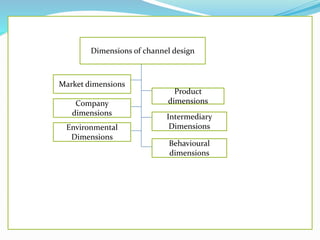
Dimensions of channel design
Market dimensions
Company
dimensions
Environmental
Dimensions
Product
dimensions
Intermediary
Dimensions
Behavioural
dimensions
1. Market dimensions:
It focuses on customer( market)
orientation. In developing and adapting the
marketing mix, then, marketing managers should
take their basic cues from the needs and wants to
the target markets at which they are aiming. Four
basic sub categories of market variables are
particularly important in influencing channel
structure. They are:
 Market geography
 Market size
 Market density
 Market Behaviour
2. Product Dimension:
Product variables are another important category to
consider in evaluating alternative channel
structures. Some of the most important product
variables are as follows:
 Bulk and weight
 Perishability
 Unit value
 Technical versus non- technical
 Newness
3. Company dimensions:
The most important company variables
affecting channel design are:
 size
 Financial capacity
 Managerial Expertise
 Objectives and Strategies
4. Intermediary Dimensions: The
key intermediary variables
related to channel structure are:
 Availability.
 Cost
 Services
5. Environment dimension:
Environmental variables may
affect all aspects of channel development and
management. Economic, sociocultural,
competitive, technological, and legal
environmental forces can have a significant
impact of environmental forces is one of the
more common reasons for marketing channel
design decisions.
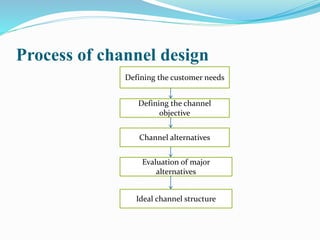
Process of channel design
Defining the customer needs
Defining the channel
objective
Channel alternatives
Evaluation of major
alternatives
Ideal channel structure
1. Defining the customer needs:
In designing the market channel, the
marketer must understand the service
output levels its target customer want. It
is essential to capture customer
requirements while designing marketing
channel. It includes the following:
 Product information
Product customization
Product quality assurance
Lot size
Product variety
Spatial convenience / availability
Waiting and delivery time
After sales service
Logistics
2. Defining channel objective:
The channel objective vary with product
characteristics:
Perishable products requires more direct
marketing.
Bulky products, such as building materials,
require channels that minimize the shipping
distance and amount of handling.
 non- standard products, such as custom-built
machinary and specialised business forms, are
sold directly by company sales representatives.
High- unit- value products such as generators
and turbines are often sold through a company
sales force rather than intermediaries.
3. Channel alternative:
A company looks at alternatives for its distribution channel
after it has decided on the targeted customers and the
customer service deliverables it desires from its channel
partners to reach these customers. At the time of
deciding the company will scan for:
 Type of intermediaries
- Distributors or re-distribution stockist
- Carrying and forwarding agents
- Logistics service providers.
- manufacturer’s agents, stockist, guarantors
- Financing agencies
- Wholesalers and semi wholsalers
- Retailers and service centres.
Number of intermediaries.
 cost of the channel system.
Terms and responsibility of channel
members.
4. Evaluation of major alternative:
The major problem before the producer is to
decide which of the alternatives would be
best satisfy the long term objectives of the
firm taking in view the factors which would
affect the channel decision. For this
purpose, each alternative must be rated
against economic; control and adequate
criteria:
 Economic Criteria
 Control Criteria
 Adaptive Criteria
5. Ideal channel structure:
With the completion of forgoing
steps, the number of alternatives
would have narrowed down
considerably. The firm must
evaluate design and choose the best
among them.
Criteria for effective channel design
The following criteria should be
considered:
 Effectiveness
Efficiency
Equity
Scalability
Flexibility
Channel design decision
 Selecting the channel member.
Identity of the channel partner at
each channel level.
Type of channel member.
THANK YOU...!!!

Channel design

  • 1.
    APPA INSTITUTE OF ENGINEERING& TECHNOLOGY DEPARTMENT OF MBA PRESENTATION ON CHANNEL DESIGN SUBMITTED TO: Prof.Basavaraj S M SUBMITTED BY: Mahesh PATIL
  • 3.
    Meaning of channeldesign Channel design decisions are critical because they determine a product’s market presence and buyer’s accessibility to the product. Channel decisions have additional strategic significance because they entail long-term commitments. It is usually easier to change prices or promotion than to change marketing channels.
  • 5.
    Dimensions of channeldesign Market dimensions Company dimensions Environmental Dimensions Product dimensions Intermediary Dimensions Behavioural dimensions
  • 6.
    1. Market dimensions: Itfocuses on customer( market) orientation. In developing and adapting the marketing mix, then, marketing managers should take their basic cues from the needs and wants to the target markets at which they are aiming. Four basic sub categories of market variables are particularly important in influencing channel structure. They are:  Market geography  Market size  Market density  Market Behaviour
  • 7.
    2. Product Dimension: Productvariables are another important category to consider in evaluating alternative channel structures. Some of the most important product variables are as follows:  Bulk and weight  Perishability  Unit value  Technical versus non- technical  Newness
  • 8.
    3. Company dimensions: Themost important company variables affecting channel design are:  size  Financial capacity  Managerial Expertise  Objectives and Strategies
  • 9.
    4. Intermediary Dimensions:The key intermediary variables related to channel structure are:  Availability.  Cost  Services
  • 10.
    5. Environment dimension: Environmentalvariables may affect all aspects of channel development and management. Economic, sociocultural, competitive, technological, and legal environmental forces can have a significant impact of environmental forces is one of the more common reasons for marketing channel design decisions.
  • 11.
    Process of channeldesign Defining the customer needs Defining the channel objective Channel alternatives Evaluation of major alternatives Ideal channel structure
  • 12.
    1. Defining thecustomer needs: In designing the market channel, the marketer must understand the service output levels its target customer want. It is essential to capture customer requirements while designing marketing channel. It includes the following:
  • 13.
     Product information Productcustomization Product quality assurance Lot size Product variety Spatial convenience / availability Waiting and delivery time After sales service Logistics
  • 14.
    2. Defining channelobjective: The channel objective vary with product characteristics: Perishable products requires more direct marketing. Bulky products, such as building materials, require channels that minimize the shipping distance and amount of handling.  non- standard products, such as custom-built machinary and specialised business forms, are sold directly by company sales representatives. High- unit- value products such as generators and turbines are often sold through a company sales force rather than intermediaries.
  • 15.
    3. Channel alternative: Acompany looks at alternatives for its distribution channel after it has decided on the targeted customers and the customer service deliverables it desires from its channel partners to reach these customers. At the time of deciding the company will scan for:  Type of intermediaries - Distributors or re-distribution stockist - Carrying and forwarding agents - Logistics service providers. - manufacturer’s agents, stockist, guarantors - Financing agencies - Wholesalers and semi wholsalers - Retailers and service centres.
  • 16.
    Number of intermediaries. cost of the channel system. Terms and responsibility of channel members.
  • 17.
    4. Evaluation ofmajor alternative: The major problem before the producer is to decide which of the alternatives would be best satisfy the long term objectives of the firm taking in view the factors which would affect the channel decision. For this purpose, each alternative must be rated against economic; control and adequate criteria:  Economic Criteria  Control Criteria  Adaptive Criteria
  • 18.
    5. Ideal channelstructure: With the completion of forgoing steps, the number of alternatives would have narrowed down considerably. The firm must evaluate design and choose the best among them.
  • 19.
    Criteria for effectivechannel design The following criteria should be considered:  Effectiveness Efficiency Equity Scalability Flexibility
  • 20.
    Channel design decision Selecting the channel member. Identity of the channel partner at each channel level. Type of channel member.
  • 21.