Dr. Himanshu Hora
SRMS College of Engg. & Tech., Bareilly
INDIA
• Software is the root cause of most of
today’s system problems.
• The quality and longevity of a software
system is determined by its
architecture.
Typically software architecture includes ad hoc box and line
drawing(s) of the system that is intended to solve the
problems articulated by the specification.
• Boxes define the elements or “parts” of the system.
• Lines define the interactions or the between parts.
A software architecture is a “first cut” at
solving the problem and designing the
system.
“The software architecture of a program or
computing system is the structure or structures
of the system, which comprise software
elements, the externally visible properties of
those elements, and therelationships among
them.”
Bass L.; Clements P.;
Kazman R. Software
Architecture in Practice
Defines the properties of components
• Properties of components are assumptions that one
component can make about another:
- provided services, required services, performance
characteristics, fault handling, resource usage
Just having an architecture is different from
having an
architecture that is known to everyone.
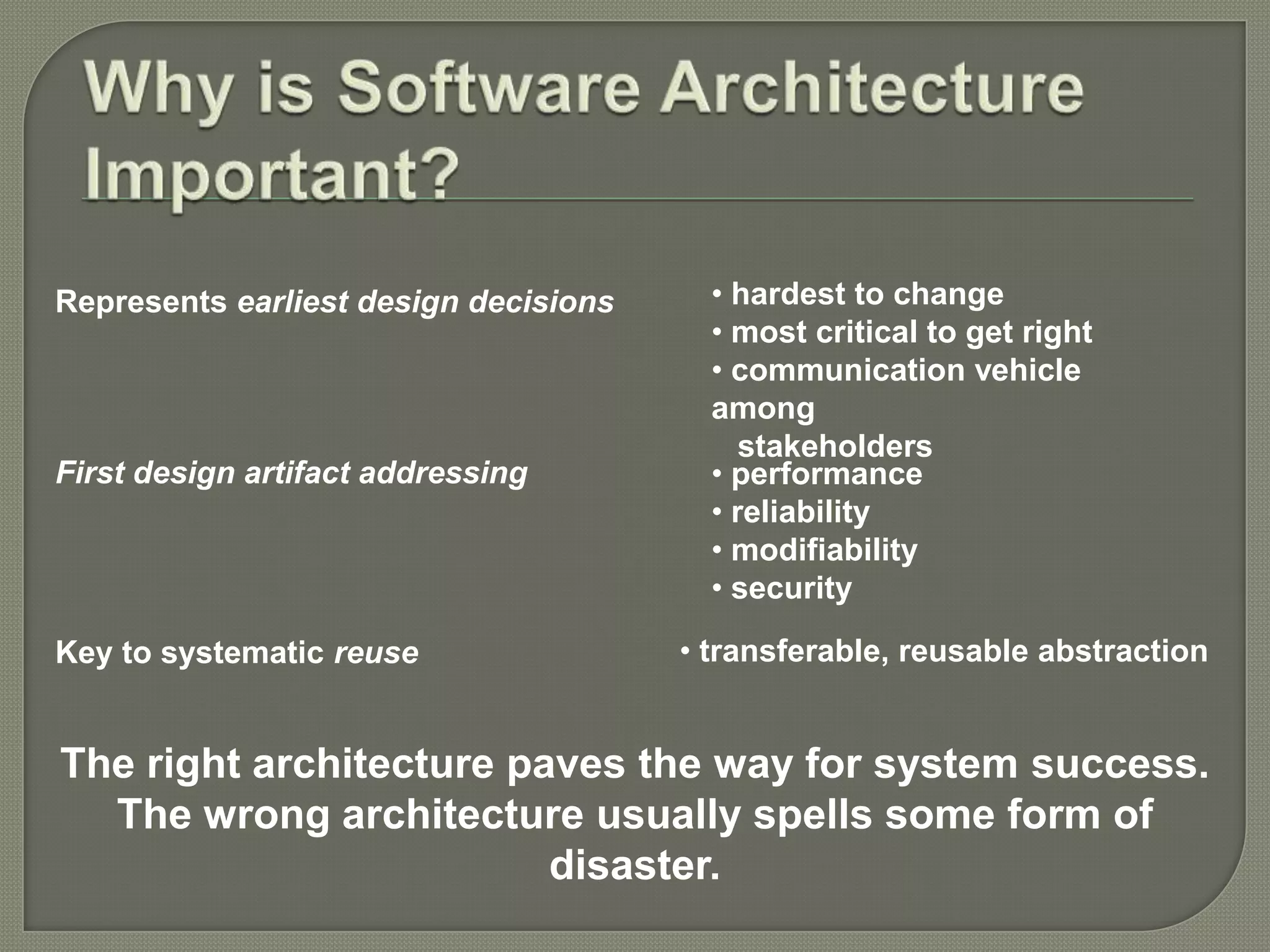
Represents earliest design decisions
First design artifact addressing
Key to systematic reuse
• hardest to change
• most critical to get right
• communication vehicle
among
stakeholders
• performance
• reliability
• modifiability
• security
• transferable, reusable abstraction
The right architecture paves the way for system success.
The wrong architecture usually spells some form of
disaster.
Functional requirements define
• what the system must do
• how components will interact, cooperate, and
synchronize correctly
• what it means to “function” properly
Functionality is largely orthogonal to the structure.
• how modifiable is a system that is functioning
properly?
Essential quality attributes are often overlooked or
omitted from functional specifications and system
descriptions.
 What precisely do these quality attributes such as
modifiability, security, performance and reliability
mean?
 Can a system be analyzed to determine these
desired qualities?
 How soon can such an analysis occur?
 How do you know if software architecture for a
system is suitable without having to build the system
first?
 How do you document an architecture?
 Can you recover an architecture from an existing
system?
Dr. Himanshu Hora
SRMS College of Engg. & Tech., Bareilly
INDIA

Importance of software architecture

  • 1.
    Dr. Himanshu Hora SRMSCollege of Engg. & Tech., Bareilly INDIA
  • 2.
    • Software isthe root cause of most of today’s system problems. • The quality and longevity of a software system is determined by its architecture.
  • 3.
    Typically software architectureincludes ad hoc box and line drawing(s) of the system that is intended to solve the problems articulated by the specification. • Boxes define the elements or “parts” of the system. • Lines define the interactions or the between parts. A software architecture is a “first cut” at solving the problem and designing the system.
  • 4.
    “The software architectureof a program or computing system is the structure or structures of the system, which comprise software elements, the externally visible properties of those elements, and therelationships among them.” Bass L.; Clements P.; Kazman R. Software Architecture in Practice
  • 5.
    Defines the propertiesof components • Properties of components are assumptions that one component can make about another: - provided services, required services, performance characteristics, fault handling, resource usage
  • 6.
    Just having anarchitecture is different from having an architecture that is known to everyone.
  • 7.
    Represents earliest designdecisions First design artifact addressing Key to systematic reuse • hardest to change • most critical to get right • communication vehicle among stakeholders • performance • reliability • modifiability • security • transferable, reusable abstraction The right architecture paves the way for system success. The wrong architecture usually spells some form of disaster.
  • 8.
    Functional requirements define •what the system must do • how components will interact, cooperate, and synchronize correctly • what it means to “function” properly Functionality is largely orthogonal to the structure. • how modifiable is a system that is functioning properly? Essential quality attributes are often overlooked or omitted from functional specifications and system descriptions.
  • 10.
     What preciselydo these quality attributes such as modifiability, security, performance and reliability mean?  Can a system be analyzed to determine these desired qualities?  How soon can such an analysis occur?  How do you know if software architecture for a system is suitable without having to build the system first?  How do you document an architecture?  Can you recover an architecture from an existing system?
  • 11.
    Dr. Himanshu Hora SRMSCollege of Engg. & Tech., Bareilly INDIA