Introduction to Software Architecture
2
Lecture Objectives
 What is software architecture?
 What are popular architecture styles?
 Quality attributes of a system?
 Architecture Design Guidelines?
1.1 Overview
4
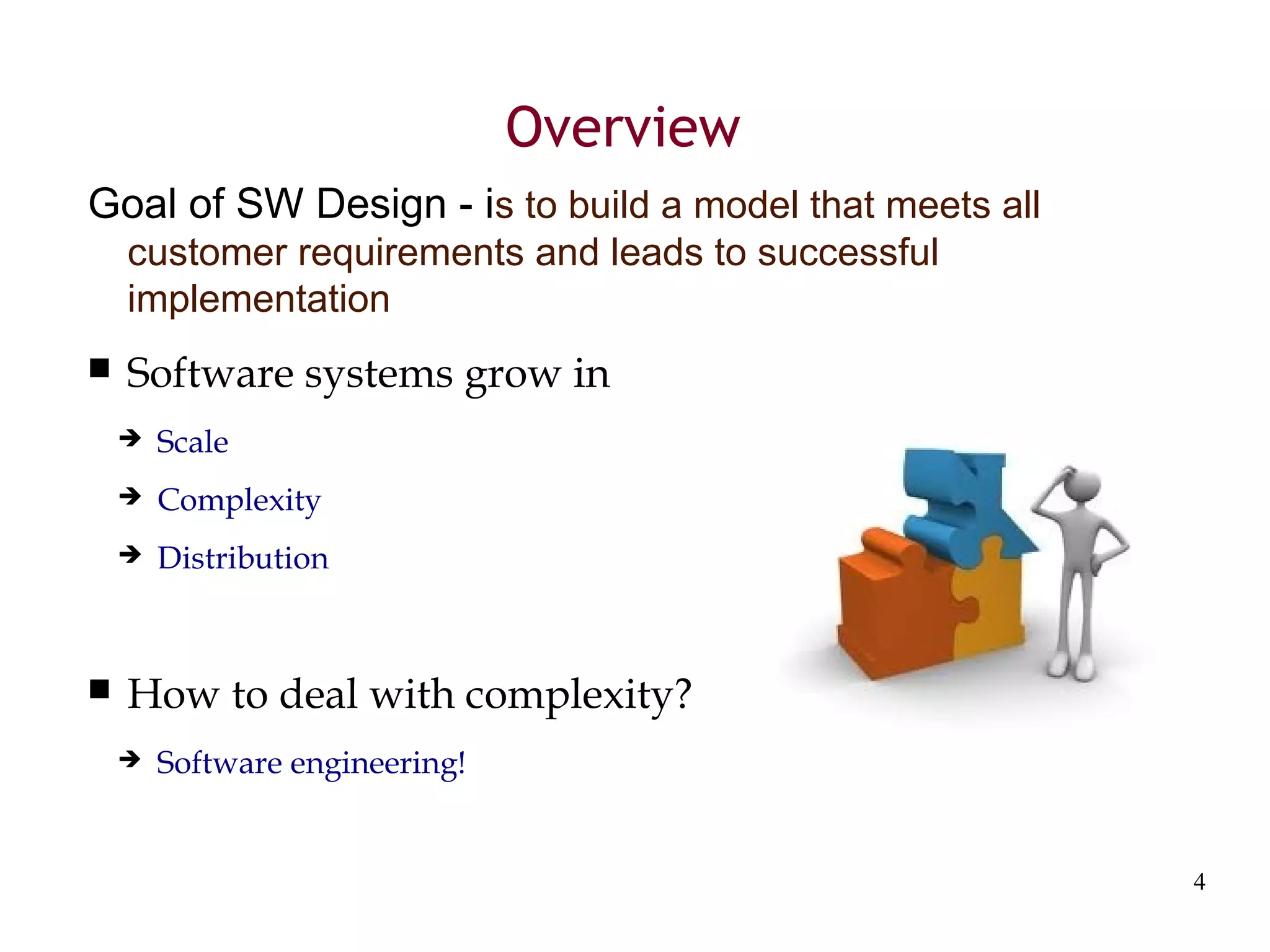
Overview
Goal of SW Design - is to build a model that meets all
customer requirements and leads to successful
implementation
 Software systems grow in
 Scale
 Complexity
 Distribution
 How to deal with complexity?
 Software engineering!
5
What is architectural design?
Any software, regardless of application domain, should have an
architectural design that guides its construction and development.
What is architectural design?
» It defines the relationship between major structural elements
» It also define the styles and design patterns used to achieve requirements.
» Also the constraints that affects the way architecture can be implemented.
6
What is architecture design?
Who is responsible for developing architecture design?
» Software architect and designer.
» They map the SW system requirements into architecture design.
» They apply various design strategies to divide and conquer the
complexities.
The architecture of a system is its 'skeleton'. It's the highest level of
abstraction of a system.
Software architecture is more about the design of the entire system, while
software design emphasizes on module/component/class level.
7
Why is SW architecture Design is important?
There are several reasons:
» Poor design
 May result in deficient product (does not meet system requirements)
 Is not adaptive to future requirement changes
 Not reusable
 Exhibits unpredictable behaviour or perform badly
» Good design!!
» reduces the risks associated with software production
» helps development team works together in an orderly fashion
» makes the system traceable for implementation and testing,
and leads to software products that have higher quality
attributes.
8
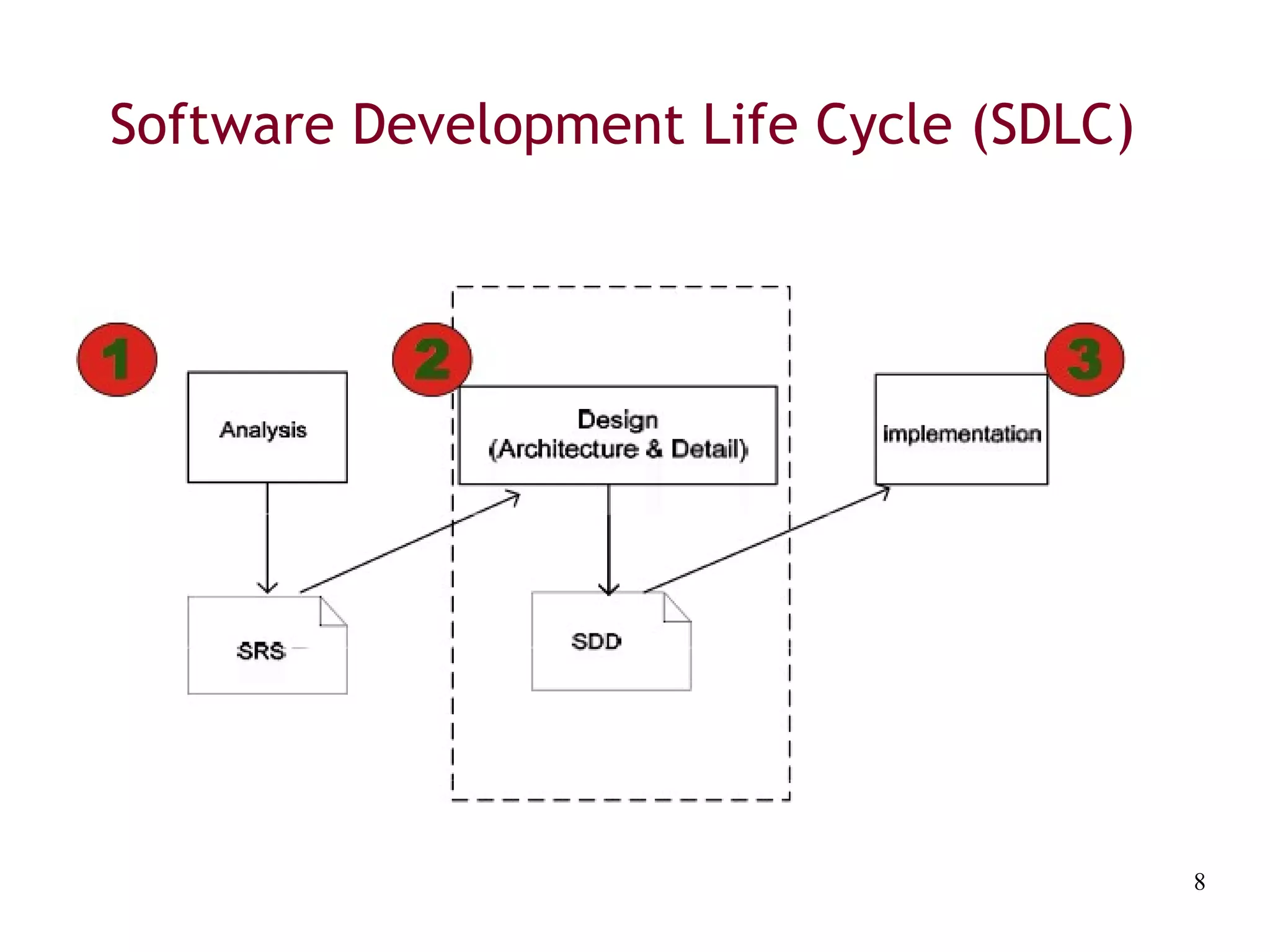
Software Development Life Cycle (SDLC)
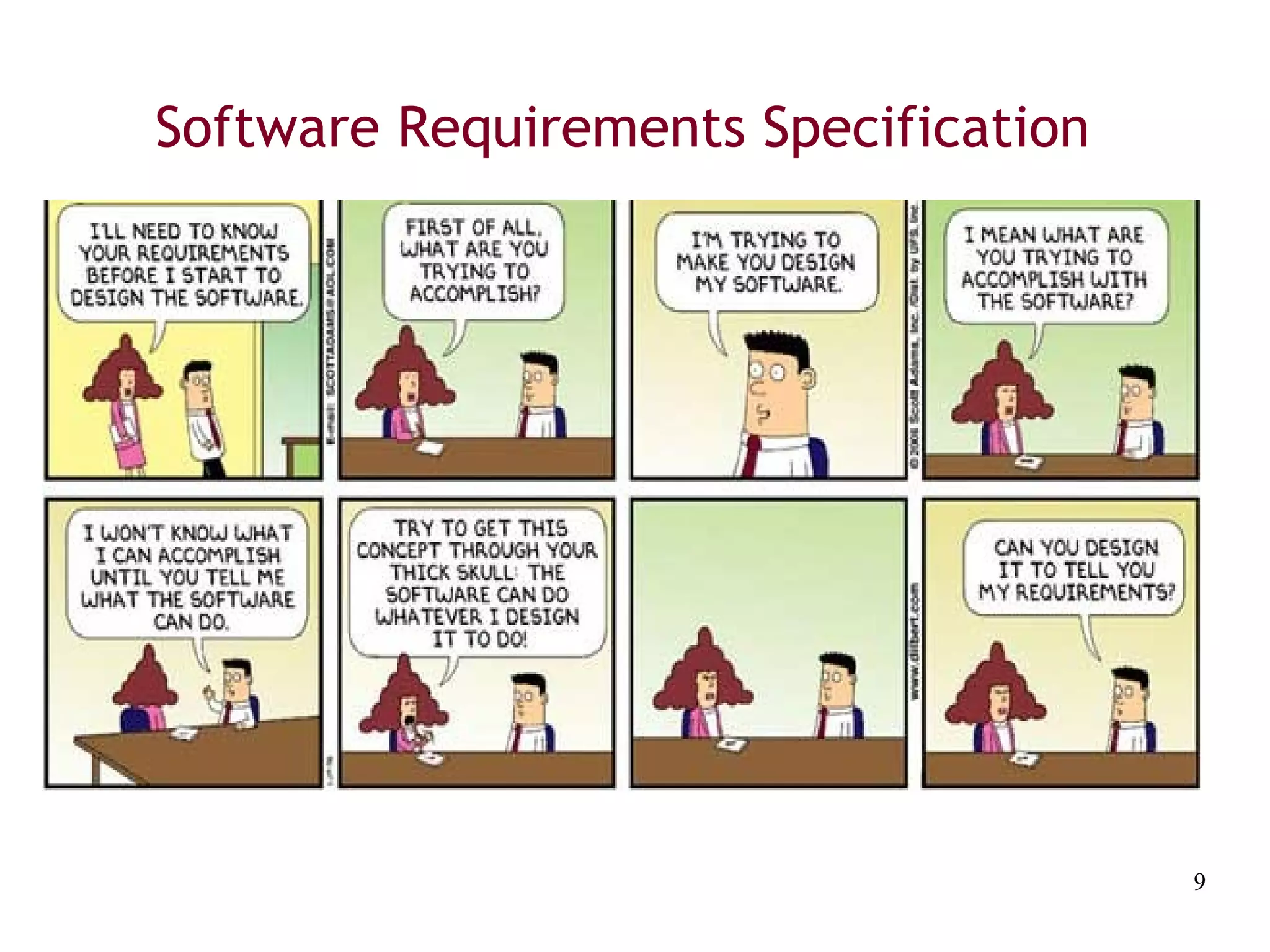
9
Software Requirements Specification
10
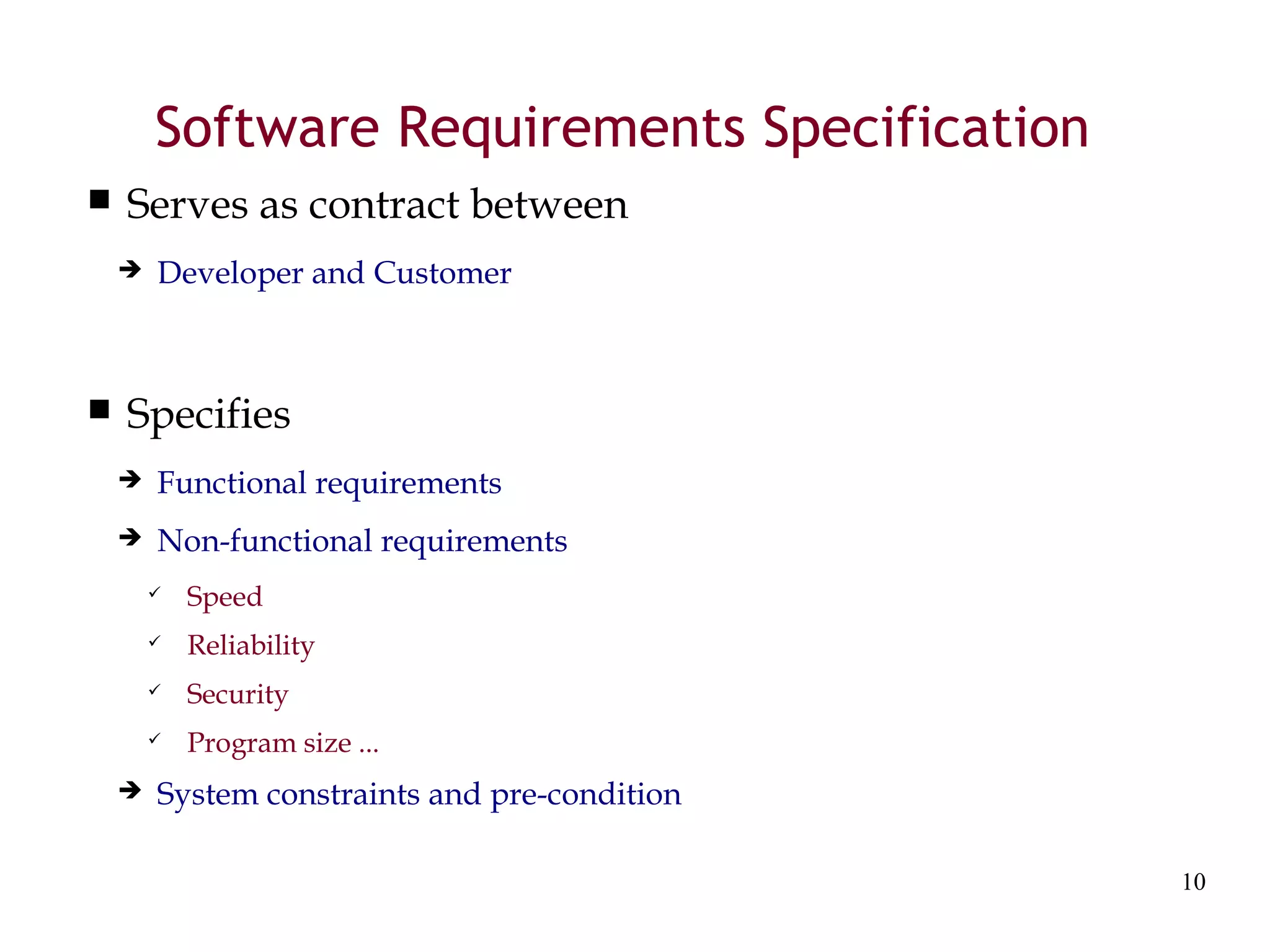
Software Requirements Specification
 Serves as contract between
 Developer and Customer
 Specifies
 Functional requirements
 Non-functional requirements
 Speed
 Reliability
 Security
 Program size ...
 System constraints and pre-condition
11
Software Design Description (SDD)
 What Is Outcome Of Software Architecture Design?
 Software Design Description (SDD): an overall representation of
the software to be build.
 Describes high and low level design
 Components of the system
 Modules of each components
 Detailed information of each module
 Data attributes
 Operations
 Developer
 DB oriented application - data dictionary
 Tables, columns and definition of terms.
12
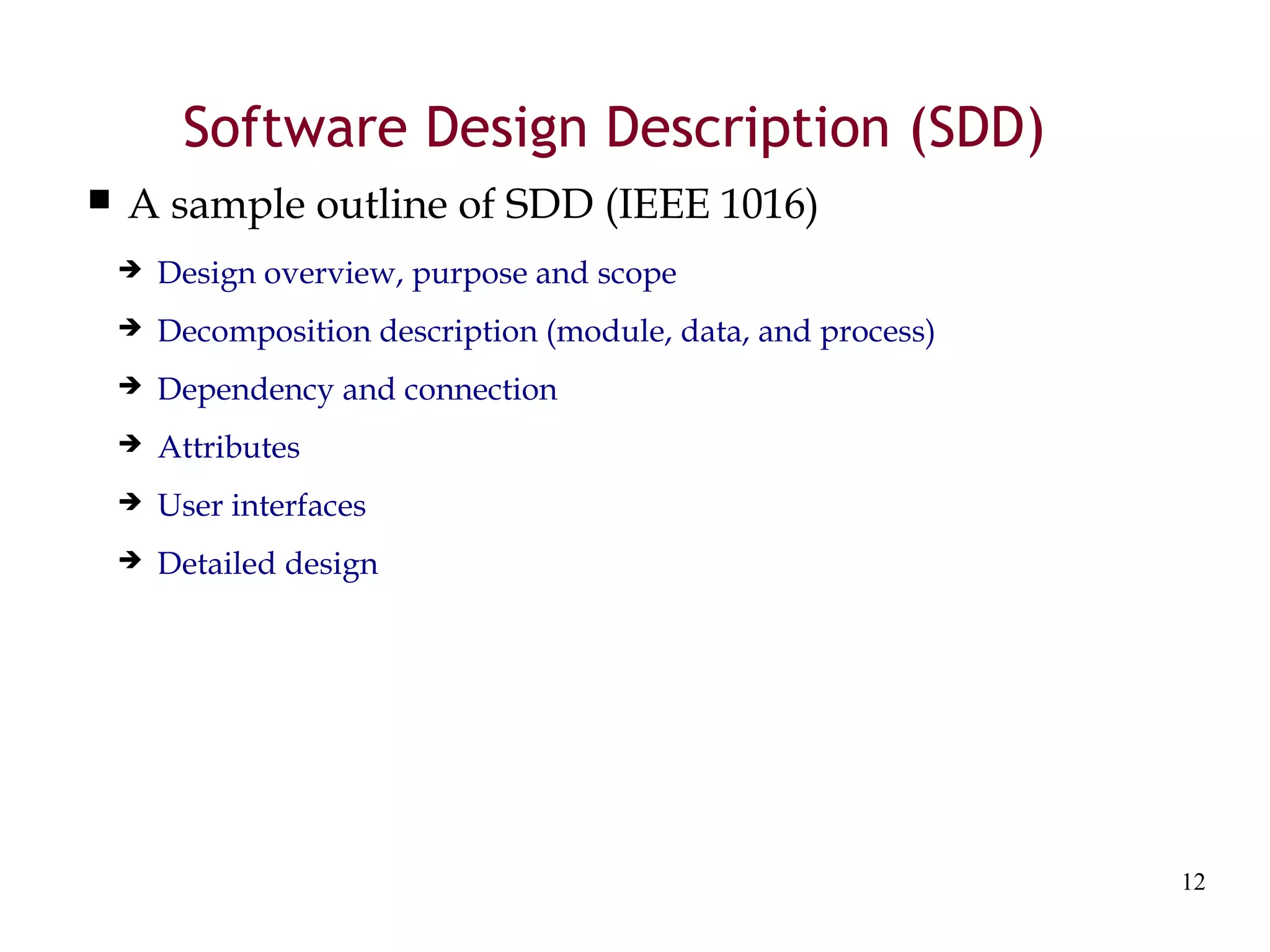
Software Design Description (SDD)
 A sample outline of SDD (IEEE 1016)
 Design overview, purpose and scope
 Decomposition description (module, data, and process)
 Dependency and connection
 Attributes
 User interfaces
 Detailed design
13
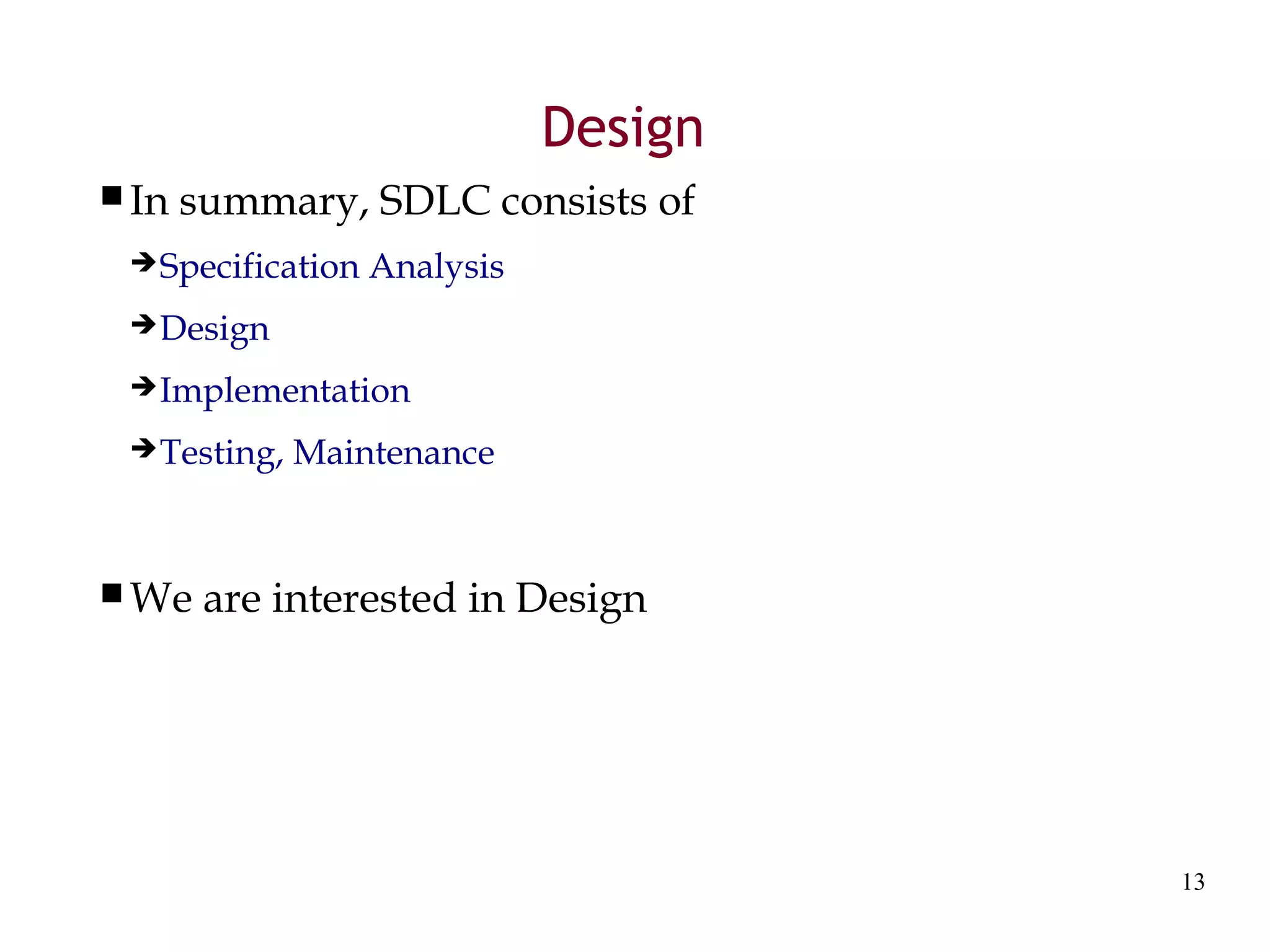
Design
 In summary, SDLC consists of
Specification Analysis
Design
Implementation
Testing, Maintenance
 We are interested in Design
14
Two Steps in Software Design
 Further split into two steps
 Architectural Design
 Detailed Design/Tactical design
 Architecture design is front strategy for the detailed
design
 Arch. Design: describe user accessible components and
the interconnections among them that are visible to
stakeholders.
 Detailed Design: specify the internal details of each
component and might introduce new invisible
components – to the stakeholder, into the design.
15
Example
 Architecture Decision:
 A priority queue for all customers
 Detailed Design Decision:
 The priority queue implemented using
 Array?
 Linked List?
 Double Linked List?
 ...
Motivation of Architecture Design
• Question: can we directly start with detailed design?
• Most likely NO! for large scaled systems
• Example: build a house, many styles available:
– Victorian, Colonial, Cap Cod, California Ranch
– Depending on the system spec., a style has to be chosen
16
1.2 Software architecture: Bridging
requirements and implementation
18
Introduction to Software Architecture
19
Introduction to Software Architecture
 Software Arch: very important in software development
 Highlights early design decisions
 Shows how system is structured
 Covers functional and non-functional requirements
 Blueprint guideline for development
20
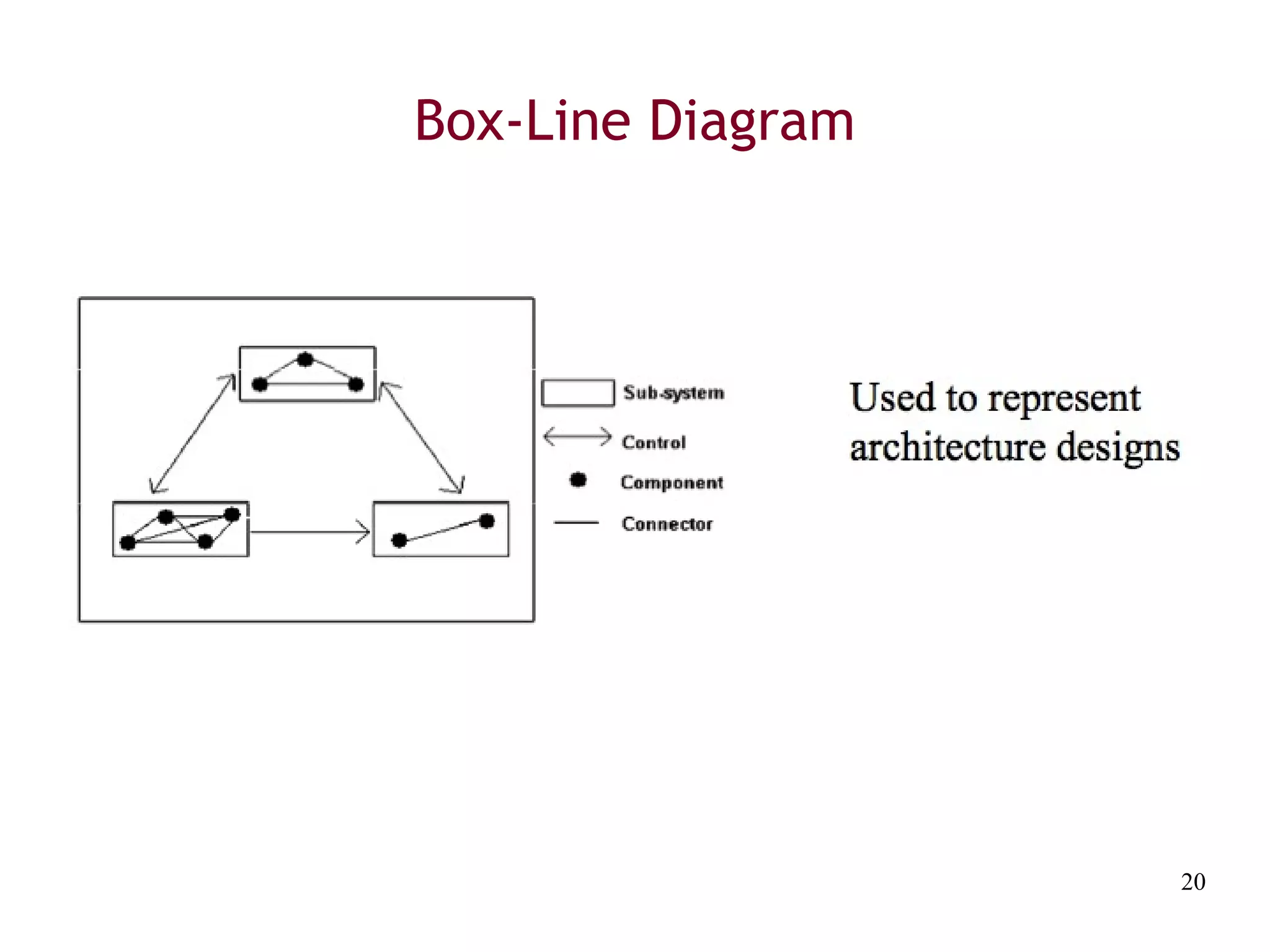
Box-Line Diagram
21
Software Architect
 Who does the architectural design?
 System Analyst or Software Architect
 Jobs of Software Architect:
 System static partition and decomposition
 Establishing dynamic control between subsystems
 Considering and evaluating all alternative architectural styles
 Analysis of trade-off on quality attributes
22
Formal Definition of SW Architecture
 By IEEE 1471
 “the fundamental organization of a system embodied in its
components, their relationships to each other, and to the
environment, and the principle guiding its design and evolution”
1.3 Architectural Styles
24
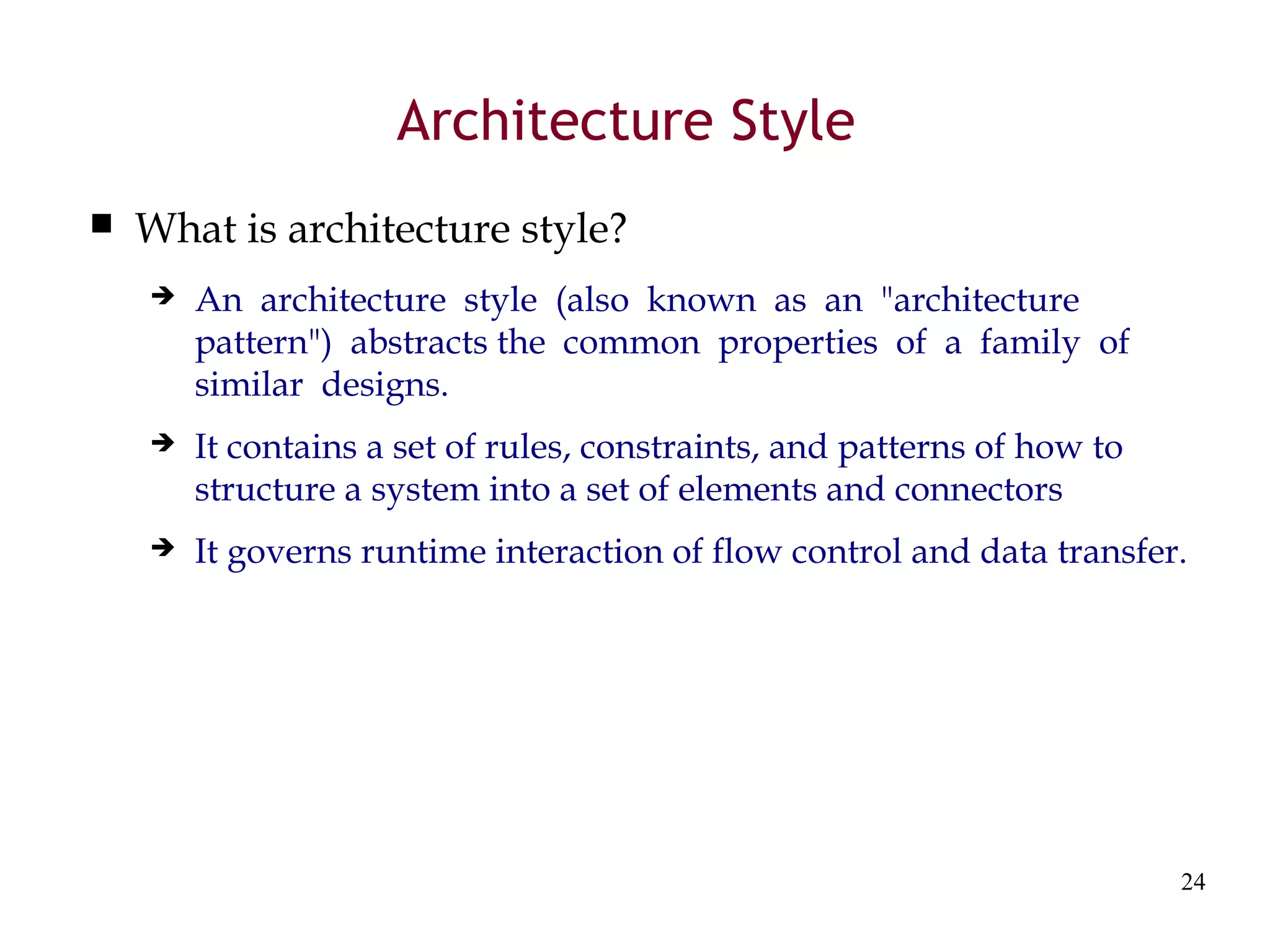
Architecture Style
 What is architecture style?
 An architecture style (also known as an "architecture
pattern") abstracts the common properties of a family of
similar designs.
 It contains a set of rules, constraints, and patterns of how to
structure a system into a set of elements and connectors
 It governs runtime interaction of flow control and data transfer.
25
Architecture Style
 Key components are:
 Elements that perform functions required by a system
 Connectors that enable communication, coordination, and cooperation
among elements
 Constraints that define how elements are integrated to form the system
 Attributes that describe the advantages and disadvantages of the chosen
structure
26
Why Architecture Style?
 Saves cost and time on design!
 Think about house example
 Architecture style represents
 Layout topology of elements
 Once overall structure determined, rest are easy
27
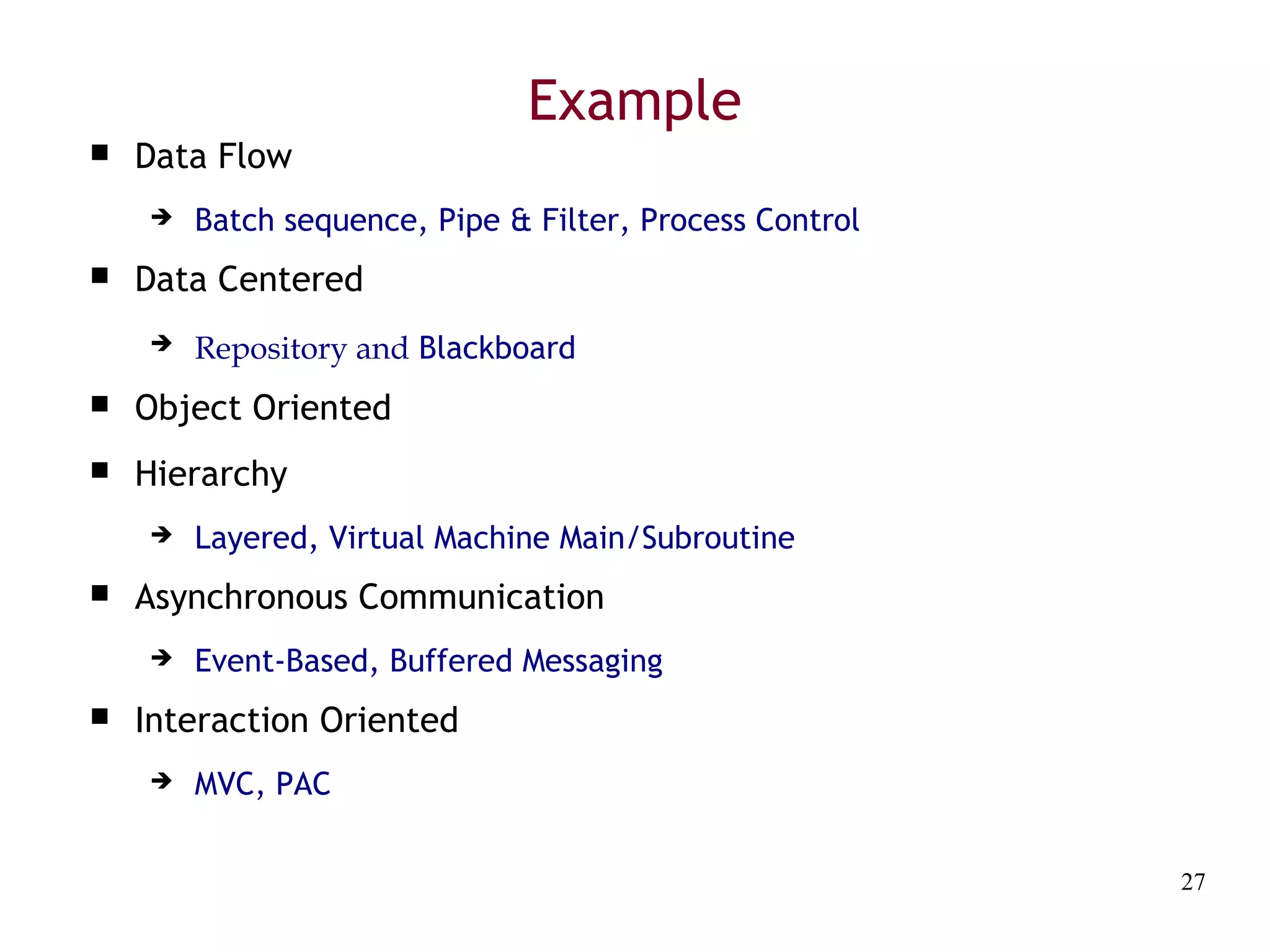
Example
 Data Flow
 Batch sequence, Pipe & Filter, Process Control
 Data Centered
 Repository and Blackboard
 Object Oriented
 Hierarchy
 Layered, Virtual Machine Main/Subroutine
 Asynchronous Communication
 Event-Based, Buffered Messaging
 Interaction Oriented
 MVC, PAC
28
How to decide architecture style?
 Depends on how quality attributes are satisfied.
 Each architecture style has its advantages,
disadvantages, and potential risks. Choosing the right
style to satisfy required functions and quality
attributes is very important.
 Quality attributes are identified in the requirement
analysis process.
 Three categories
 Implementation attributes
 Runtime attributes
 Business attributes
1.4 Quality Attributes
30
Implementation Attributes
 Interoperability
 Universal accessibility and ability to exchange data among
internal components and the outside world
 Requires loose dependency of infrastructure
Implementation Attributes (cont..)
 Maintainability & Extensibility
 The ability to modify the system and conveniently extend it
 Testability
 Whether the system allows easy debugging
 Portability
 Can the system be deployed on different platforms
 Scalability
 Can system adapt to increase of requests
 Flexibility
 Ease of modification of system to cater to a different environment
32
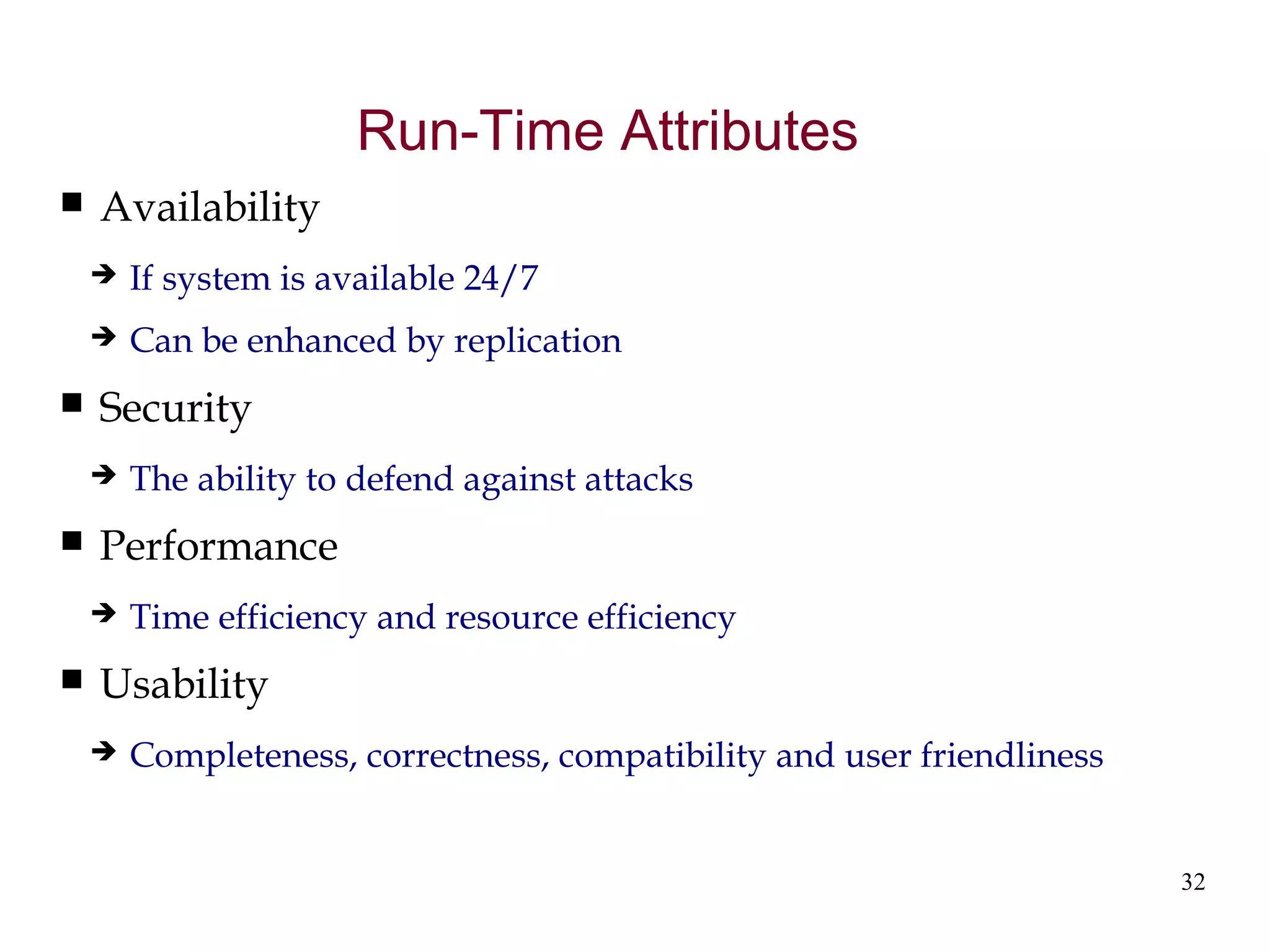
Run-Time Attributes
 Availability
 If system is available 24/7
 Can be enhanced by replication
 Security
 The ability to defend against attacks
 Performance
 Time efficiency and resource efficiency
 Usability
 Completeness, correctness, compatibility and user friendliness
33
Business Attributes
 Time to market:
 The time it takes from requirement analysis to the product is
released
 Cost:
 Expense of the building, maintaining, and operating the system,
 Lifetime:
 The period of time that the product is alive before retirement.
34
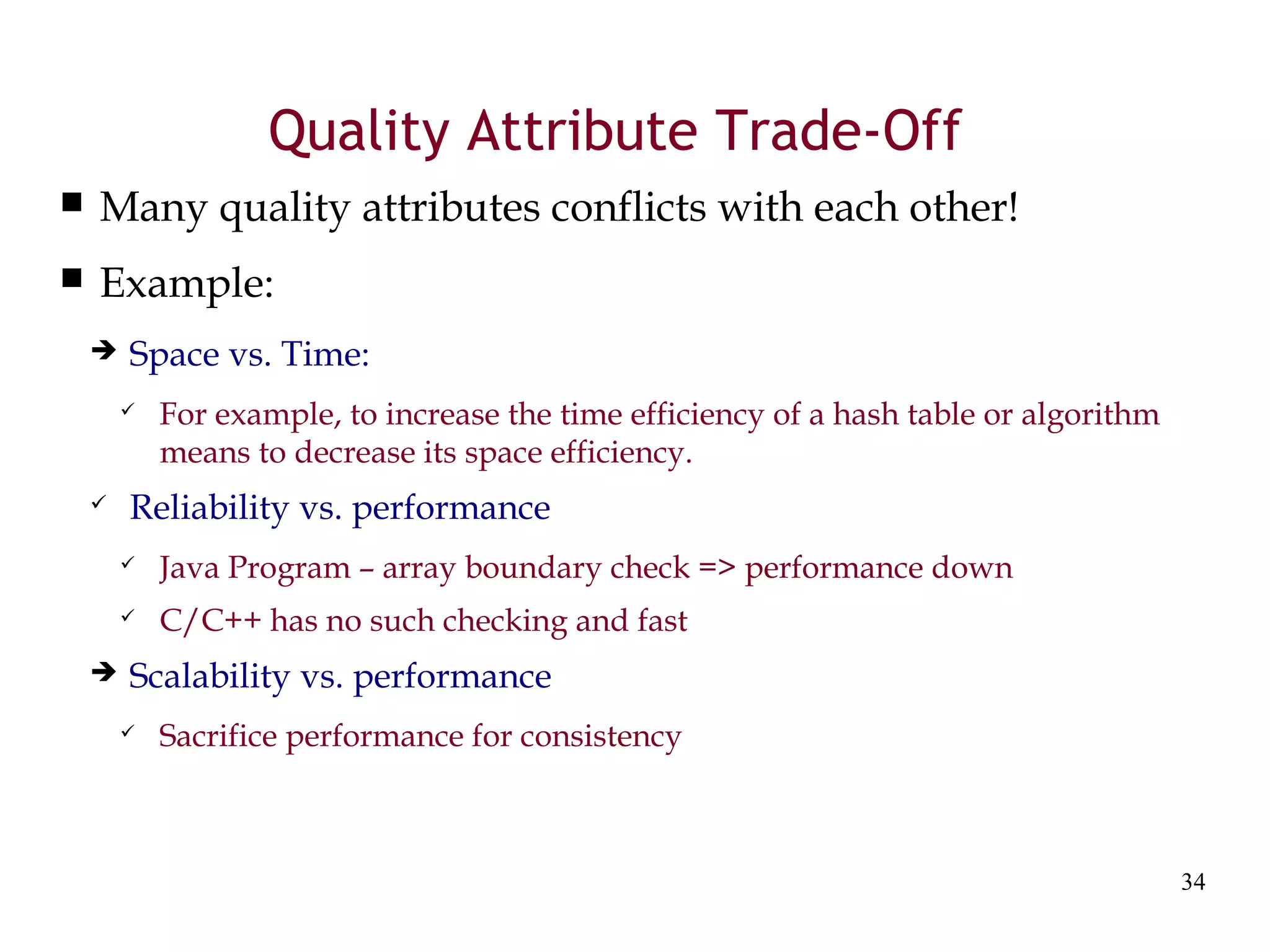
Quality Attribute Trade-Off
 Many quality attributes conflicts with each other!
 Example:
 Space vs. Time:
 For example, to increase the time efficiency of a hash table or algorithm
means to decrease its space efficiency.
 Reliability vs. performance
 Java Program – array boundary check => performance down
 C/C++ has no such checking and fast
 Scalability vs. performance
 Sacrifice performance for consistency
1.5 Software architecture design
guidelines
36
Guideline 1
Think of What to Do before How to Do It.
 System requirements (functional and non-functional
requirements) must be nailed down before design starts
 Notice, different stakeholders have different opinions,
e.g.,.
 Investor: system release date, budget
 Developer: system performance, easy to maintain
 User: user friendly
 Clarify priority of all requirements before design
37
Guideline 2: Think about abstract design
before thinking about concrete design.
 Always starts with abstraction
 Use multiple level of abstraction if necessary
 Nail down the interface but leave room of change for
implementation
 Using an abstract architectural design of a system to
communicate with stakeholders helps avoid overhauling
the system design in later stages of the software
development cycle.
 Make all implementation decisions depend on the
abstract interfaces instead of concrete ones because those
are more stable
38
Guideline 3: Think of non-functional
requirements early in design process
 Speed, Reliability, Security have to be considered first
 Otherwise, very hard to change your design to reflect
these requirements
 The earlier, the better.
 It is not possible to find a design that meets all quality
attributes.
 Balance the quality attributes, and consider
heterogeneous architecture styles when necessary.
39
Guideline 4: Think of reusability and
extensibility!
 User requirements can change frequently
 Extensibility is very important
 Leave room for expansion
 we need to consider how to reuse existing software
components to increase the reliability and cost-
effectiveness of new systems.
 Always try hard to make software extensible in the
future.
40
Guideline 5: High Cohesion and Loose
Coupling
 Try to promote high cohesion within each element and
loose-coupling between elements.
 One component (module) should be assigned ONE
functionality only
 Design should be logically clear!
 The less correlation between modules, the better!
 Easy debugging and maintenance
 Also allows great extensibility
Guideline 6: Tolerate refinement of
design.
• Never expect to have software design completely
perfect within one step.
• We may need to use prototyping and iteration to
refine the software design.
Guideline 7: Avoid ambiguous design and
over-detailed design.
• Ambiguous design lacks constraints
• Over-detailed design restricts implementation.
43
Thanks!

Chapter1

  • 1.
  • 2.
    2 Lecture Objectives  Whatis software architecture?  What are popular architecture styles?  Quality attributes of a system?  Architecture Design Guidelines?
  • 3.
  • 4.
    4 Overview Goal of SWDesign - is to build a model that meets all customer requirements and leads to successful implementation  Software systems grow in  Scale  Complexity  Distribution  How to deal with complexity?  Software engineering!
  • 5.
    5 What is architecturaldesign? Any software, regardless of application domain, should have an architectural design that guides its construction and development. What is architectural design? » It defines the relationship between major structural elements » It also define the styles and design patterns used to achieve requirements. » Also the constraints that affects the way architecture can be implemented.
  • 6.
    6 What is architecturedesign? Who is responsible for developing architecture design? » Software architect and designer. » They map the SW system requirements into architecture design. » They apply various design strategies to divide and conquer the complexities. The architecture of a system is its 'skeleton'. It's the highest level of abstraction of a system. Software architecture is more about the design of the entire system, while software design emphasizes on module/component/class level.
  • 7.
    7 Why is SWarchitecture Design is important? There are several reasons: » Poor design  May result in deficient product (does not meet system requirements)  Is not adaptive to future requirement changes  Not reusable  Exhibits unpredictable behaviour or perform badly » Good design!! » reduces the risks associated with software production » helps development team works together in an orderly fashion » makes the system traceable for implementation and testing, and leads to software products that have higher quality attributes.
  • 8.
  • 9.
  • 10.
    10 Software Requirements Specification Serves as contract between  Developer and Customer  Specifies  Functional requirements  Non-functional requirements  Speed  Reliability  Security  Program size ...  System constraints and pre-condition
  • 11.
    11 Software Design Description(SDD)  What Is Outcome Of Software Architecture Design?  Software Design Description (SDD): an overall representation of the software to be build.  Describes high and low level design  Components of the system  Modules of each components  Detailed information of each module  Data attributes  Operations  Developer  DB oriented application - data dictionary  Tables, columns and definition of terms.
  • 12.
    12 Software Design Description(SDD)  A sample outline of SDD (IEEE 1016)  Design overview, purpose and scope  Decomposition description (module, data, and process)  Dependency and connection  Attributes  User interfaces  Detailed design
  • 13.
    13 Design  In summary,SDLC consists of Specification Analysis Design Implementation Testing, Maintenance  We are interested in Design
  • 14.
    14 Two Steps inSoftware Design  Further split into two steps  Architectural Design  Detailed Design/Tactical design  Architecture design is front strategy for the detailed design  Arch. Design: describe user accessible components and the interconnections among them that are visible to stakeholders.  Detailed Design: specify the internal details of each component and might introduce new invisible components – to the stakeholder, into the design.
  • 15.
    15 Example  Architecture Decision: A priority queue for all customers  Detailed Design Decision:  The priority queue implemented using  Array?  Linked List?  Double Linked List?  ...
  • 16.
    Motivation of ArchitectureDesign • Question: can we directly start with detailed design? • Most likely NO! for large scaled systems • Example: build a house, many styles available: – Victorian, Colonial, Cap Cod, California Ranch – Depending on the system spec., a style has to be chosen 16
  • 17.
    1.2 Software architecture:Bridging requirements and implementation
  • 18.
  • 19.
    19 Introduction to SoftwareArchitecture  Software Arch: very important in software development  Highlights early design decisions  Shows how system is structured  Covers functional and non-functional requirements  Blueprint guideline for development
  • 20.
  • 21.
    21 Software Architect  Whodoes the architectural design?  System Analyst or Software Architect  Jobs of Software Architect:  System static partition and decomposition  Establishing dynamic control between subsystems  Considering and evaluating all alternative architectural styles  Analysis of trade-off on quality attributes
  • 22.
    22 Formal Definition ofSW Architecture  By IEEE 1471  “the fundamental organization of a system embodied in its components, their relationships to each other, and to the environment, and the principle guiding its design and evolution”
  • 23.
  • 24.
    24 Architecture Style  Whatis architecture style?  An architecture style (also known as an "architecture pattern") abstracts the common properties of a family of similar designs.  It contains a set of rules, constraints, and patterns of how to structure a system into a set of elements and connectors  It governs runtime interaction of flow control and data transfer.
  • 25.
    25 Architecture Style  Keycomponents are:  Elements that perform functions required by a system  Connectors that enable communication, coordination, and cooperation among elements  Constraints that define how elements are integrated to form the system  Attributes that describe the advantages and disadvantages of the chosen structure
  • 26.
    26 Why Architecture Style? Saves cost and time on design!  Think about house example  Architecture style represents  Layout topology of elements  Once overall structure determined, rest are easy
  • 27.
    27 Example  Data Flow Batch sequence, Pipe & Filter, Process Control  Data Centered  Repository and Blackboard  Object Oriented  Hierarchy  Layered, Virtual Machine Main/Subroutine  Asynchronous Communication  Event-Based, Buffered Messaging  Interaction Oriented  MVC, PAC
  • 28.
    28 How to decidearchitecture style?  Depends on how quality attributes are satisfied.  Each architecture style has its advantages, disadvantages, and potential risks. Choosing the right style to satisfy required functions and quality attributes is very important.  Quality attributes are identified in the requirement analysis process.  Three categories  Implementation attributes  Runtime attributes  Business attributes
  • 29.
  • 30.
    30 Implementation Attributes  Interoperability Universal accessibility and ability to exchange data among internal components and the outside world  Requires loose dependency of infrastructure
  • 31.
    Implementation Attributes (cont..) Maintainability & Extensibility  The ability to modify the system and conveniently extend it  Testability  Whether the system allows easy debugging  Portability  Can the system be deployed on different platforms  Scalability  Can system adapt to increase of requests  Flexibility  Ease of modification of system to cater to a different environment
  • 32.
    32 Run-Time Attributes  Availability If system is available 24/7  Can be enhanced by replication  Security  The ability to defend against attacks  Performance  Time efficiency and resource efficiency  Usability  Completeness, correctness, compatibility and user friendliness
  • 33.
    33 Business Attributes  Timeto market:  The time it takes from requirement analysis to the product is released  Cost:  Expense of the building, maintaining, and operating the system,  Lifetime:  The period of time that the product is alive before retirement.
  • 34.
    34 Quality Attribute Trade-Off Many quality attributes conflicts with each other!  Example:  Space vs. Time:  For example, to increase the time efficiency of a hash table or algorithm means to decrease its space efficiency.  Reliability vs. performance  Java Program – array boundary check => performance down  C/C++ has no such checking and fast  Scalability vs. performance  Sacrifice performance for consistency
  • 35.
    1.5 Software architecturedesign guidelines
  • 36.
    36 Guideline 1 Think ofWhat to Do before How to Do It.  System requirements (functional and non-functional requirements) must be nailed down before design starts  Notice, different stakeholders have different opinions, e.g.,.  Investor: system release date, budget  Developer: system performance, easy to maintain  User: user friendly  Clarify priority of all requirements before design
  • 37.
    37 Guideline 2: Thinkabout abstract design before thinking about concrete design.  Always starts with abstraction  Use multiple level of abstraction if necessary  Nail down the interface but leave room of change for implementation  Using an abstract architectural design of a system to communicate with stakeholders helps avoid overhauling the system design in later stages of the software development cycle.  Make all implementation decisions depend on the abstract interfaces instead of concrete ones because those are more stable
  • 38.
    38 Guideline 3: Thinkof non-functional requirements early in design process  Speed, Reliability, Security have to be considered first  Otherwise, very hard to change your design to reflect these requirements  The earlier, the better.  It is not possible to find a design that meets all quality attributes.  Balance the quality attributes, and consider heterogeneous architecture styles when necessary.
  • 39.
    39 Guideline 4: Thinkof reusability and extensibility!  User requirements can change frequently  Extensibility is very important  Leave room for expansion  we need to consider how to reuse existing software components to increase the reliability and cost- effectiveness of new systems.  Always try hard to make software extensible in the future.
  • 40.
    40 Guideline 5: HighCohesion and Loose Coupling  Try to promote high cohesion within each element and loose-coupling between elements.  One component (module) should be assigned ONE functionality only  Design should be logically clear!  The less correlation between modules, the better!  Easy debugging and maintenance  Also allows great extensibility
  • 41.
    Guideline 6: Toleraterefinement of design. • Never expect to have software design completely perfect within one step. • We may need to use prototyping and iteration to refine the software design.
  • 42.
    Guideline 7: Avoidambiguous design and over-detailed design. • Ambiguous design lacks constraints • Over-detailed design restricts implementation.
  • 43.

Editor's Notes

  • #17 Architecture Design vs Detail Design
  • #31 1. Wilki: Interoperability is a property referring to the ability of diverse systems and organizations to work together (inter-operate). Tính tương hợp: khả năng các hệ thống khác nhau có thể trao đổi thông tin và sử dụng các thông tin trao đổi đó. Việc thiếu tính tương hợp ngụ ý rằng sản phẩm và các sản phẩm được mô tả không được thiết kế với sự tiêu chuẩn hoá ngay từ đầu. Đối với phần mềm, khái niệm tính tương hợp được sử dụng để mô tả khả năng các chương trình khác nhau trao đổi dữ liệu thông qua một tập các thủ tục nghiệp vụ chung, và để đọc và viết cùng các định dạng tệp và sử dụng cùng các giao thức.
  • #37 Overhauling: đại tu
  • #42 Tolerate: tha thu, chap nhan