1DT057
DISTRIBUTED INFORMATION SYSTEM
Distributed Systems
Characterization and Design
1
OUTLINE
1. What is a Distributed System
2. Examples of Distributed Systems
3. Common Characteristics
4. Basic Design Issues
5. Summary
2
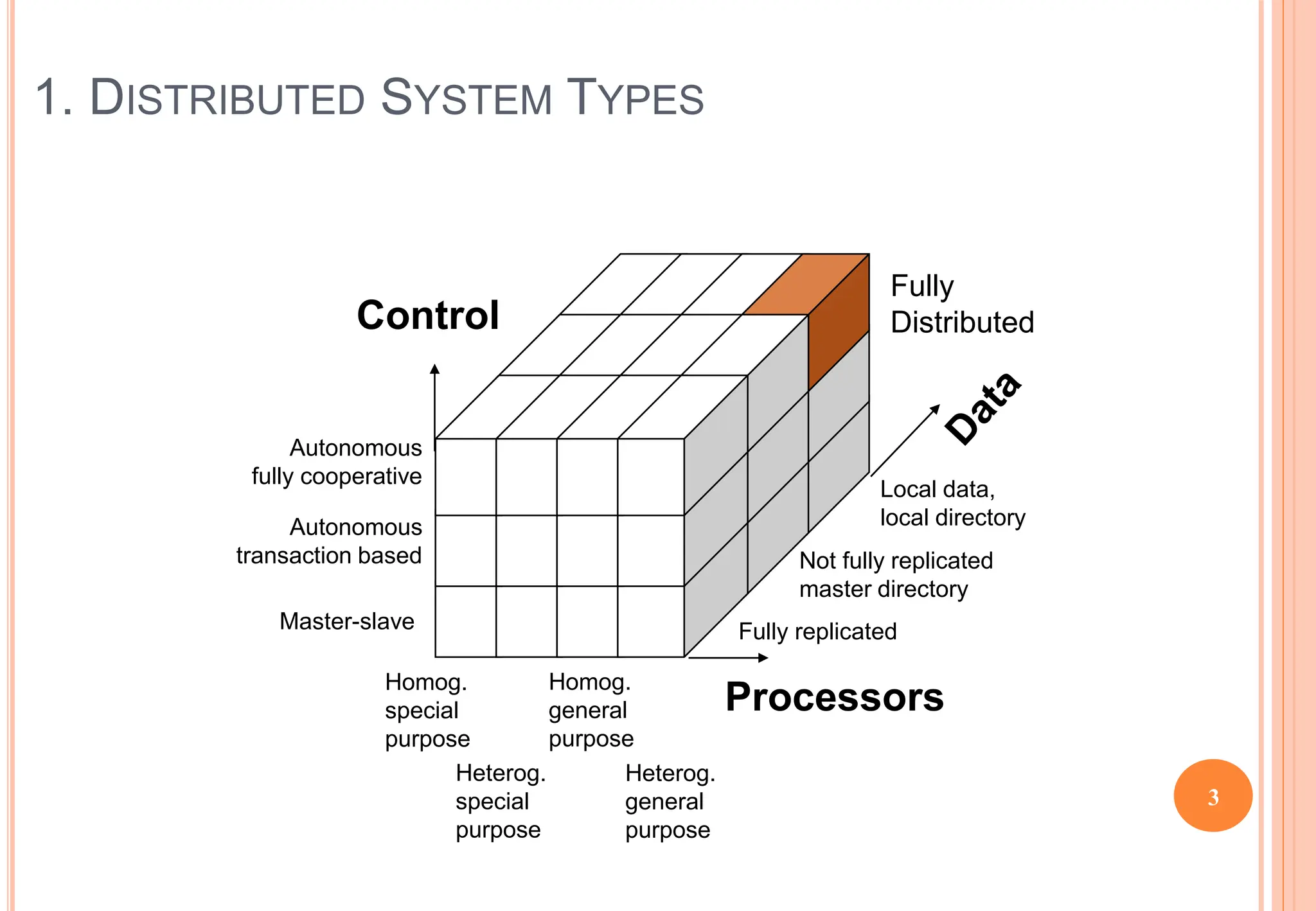
1. DISTRIBUTED SYSTEM TYPES
Fully
Distributed
Processors
Control
Fully replicated
Not fully replicated
master directory
Local data,
local directory
Master-slave
Autonomous
transaction based
Autonomous
fully cooperative
Homog.
special
purpose
Heterog.
special
purpose
Homog.
general
purpose
Heterog.
general
purpose
3
1. WHAT IS A DISTRIBUTED SYSTEM?
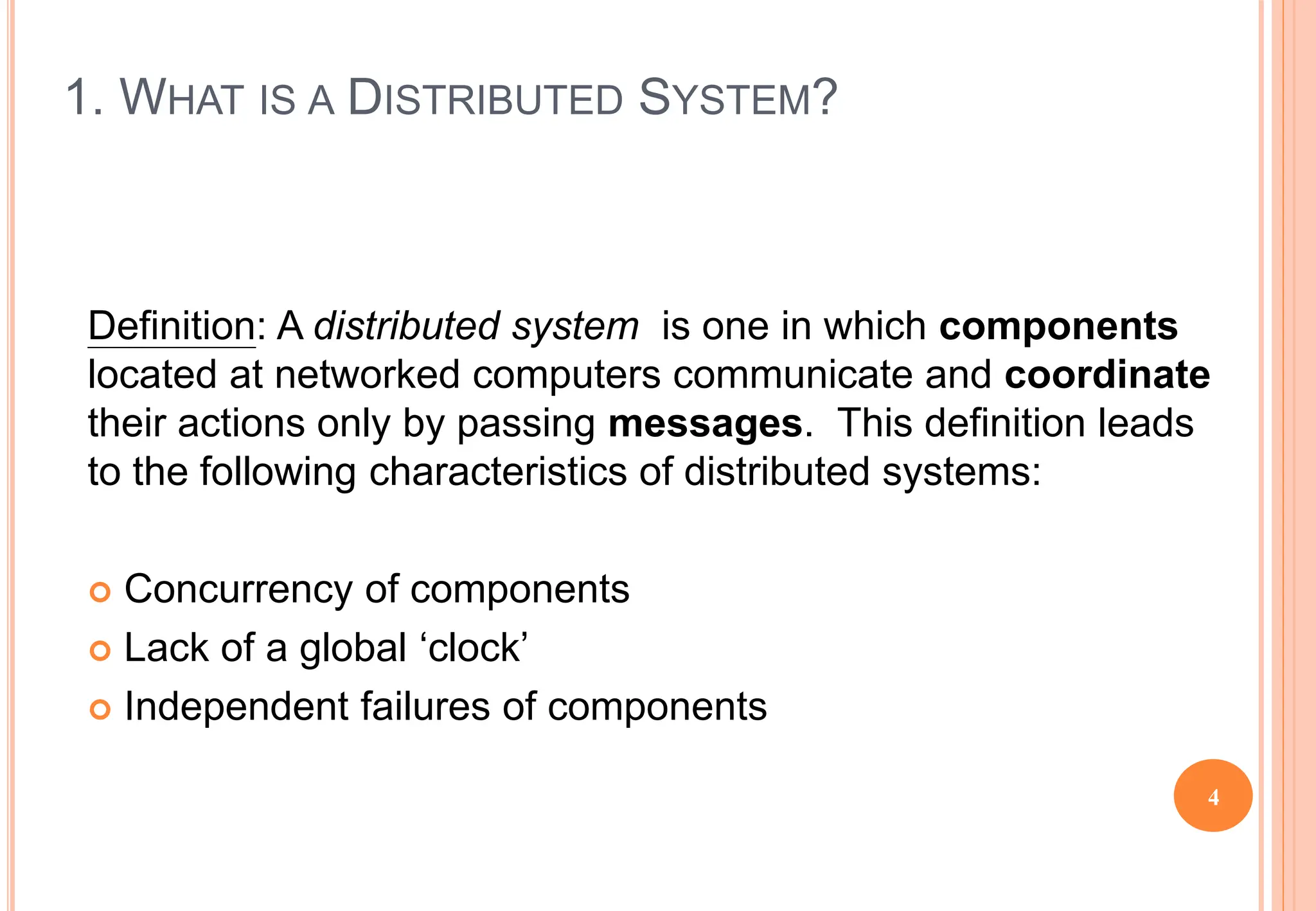
Definition: A distributed system is one in which components
located at networked computers communicate and coordinate
their actions only by passing messages. This definition leads
to the following characteristics of distributed systems:
 Concurrency of components
 Lack of a global ‘clock’
 Independent failures of components
4
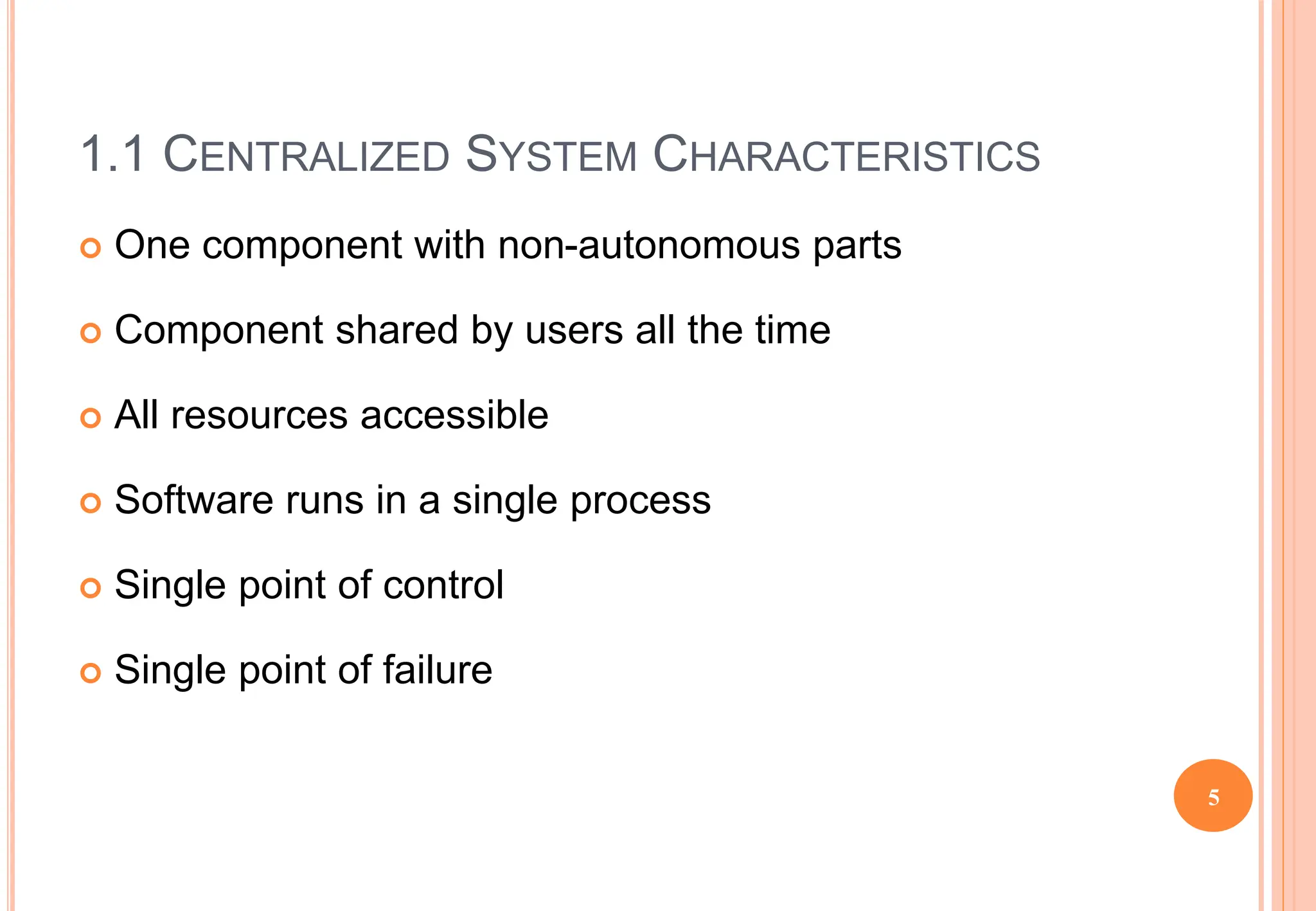
1.1 CENTRALIZED SYSTEM CHARACTERISTICS
 One component with non-autonomous parts
 Component shared by users all the time
 All resources accessible
 Software runs in a single process
 Single point of control
 Single point of failure
5
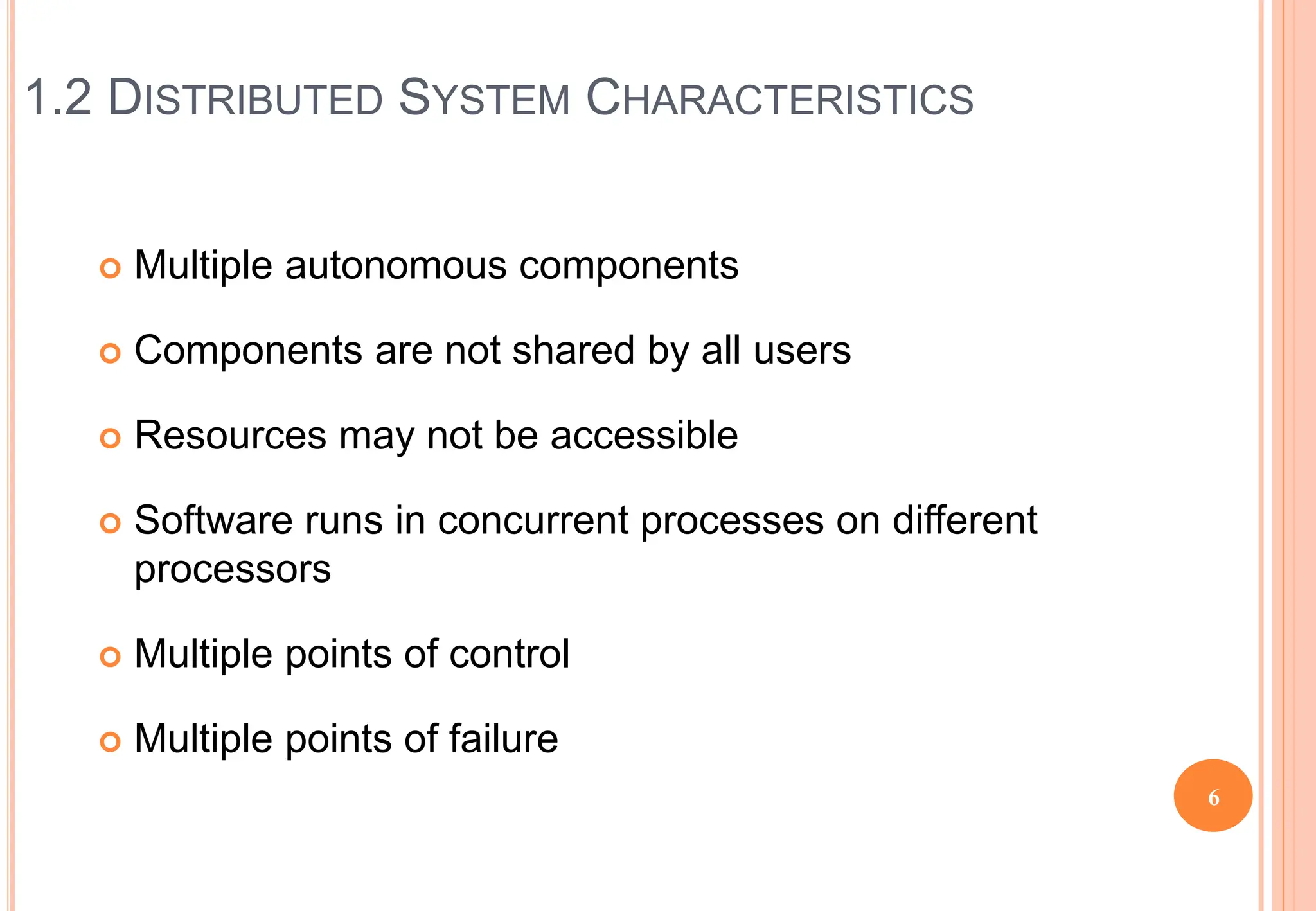
1.2 DISTRIBUTED SYSTEM CHARACTERISTICS
 Multiple autonomous components
 Components are not shared by all users
 Resources may not be accessible
 Software runs in concurrent processes on different
processors
 Multiple points of control
 Multiple points of failure
6
2. EXAMPLES OF DISTRIBUTED SYSTEMS
 Local Area Network and Intranet
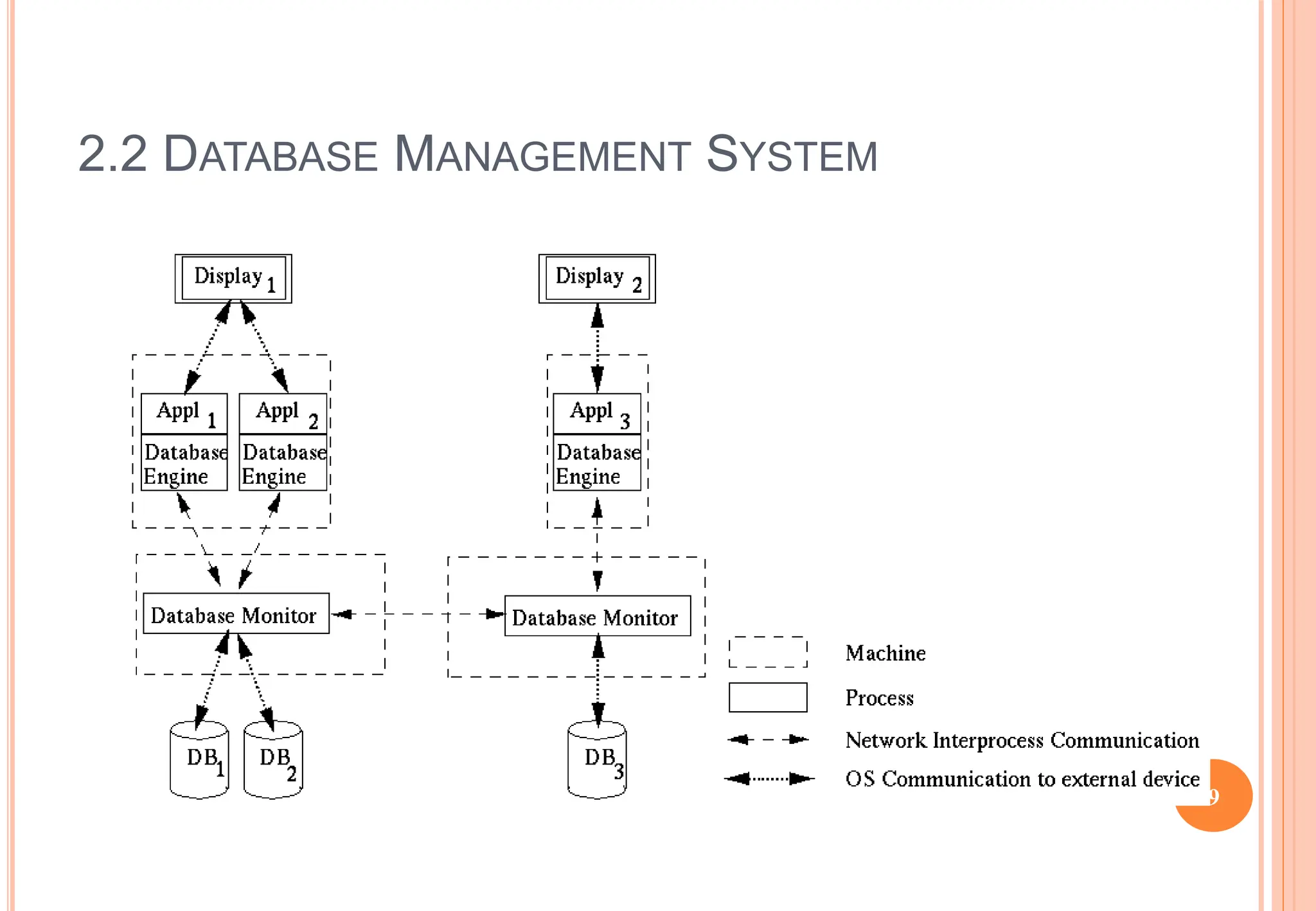
 Database Management System
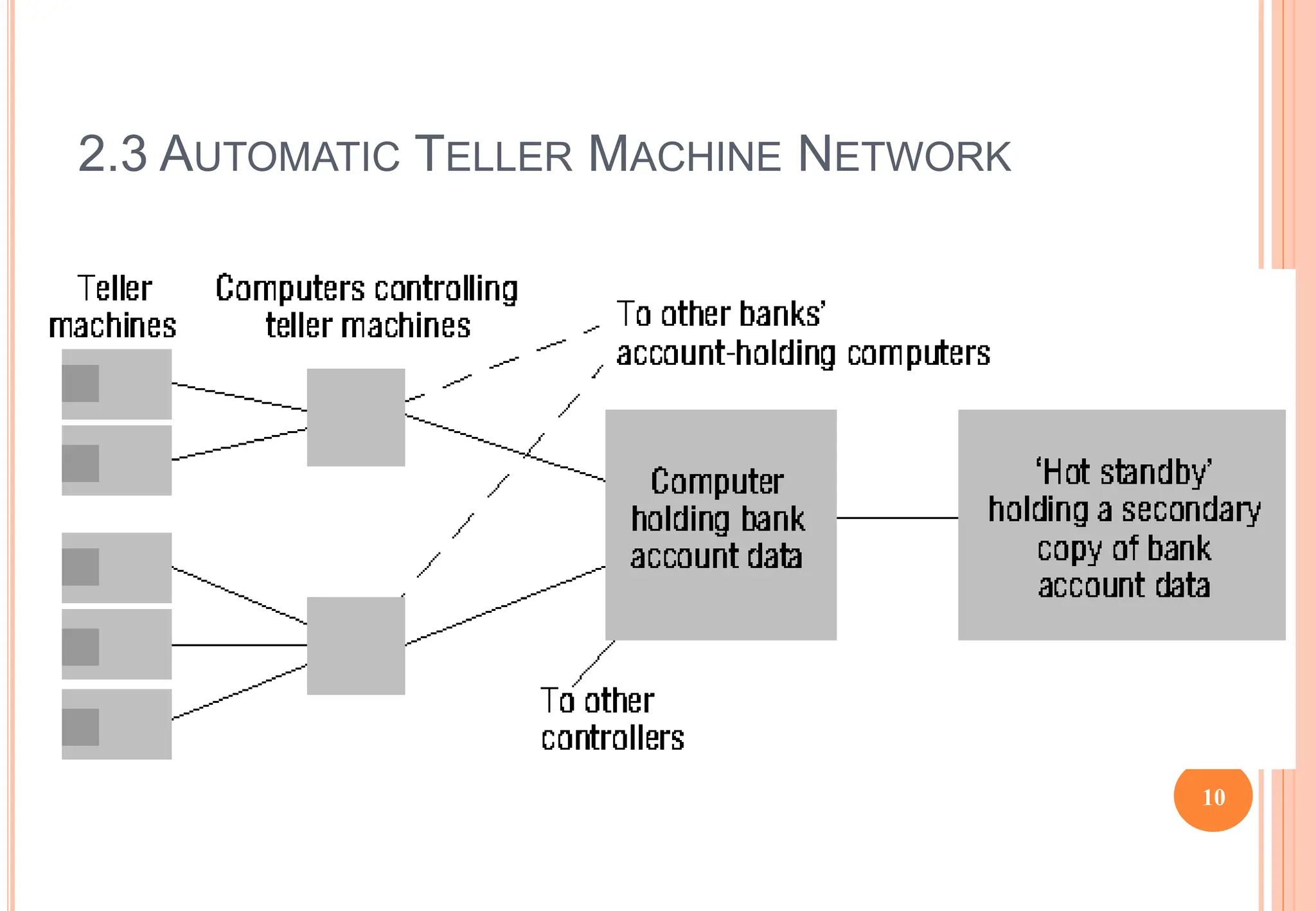
 Automatic Teller Machine Network
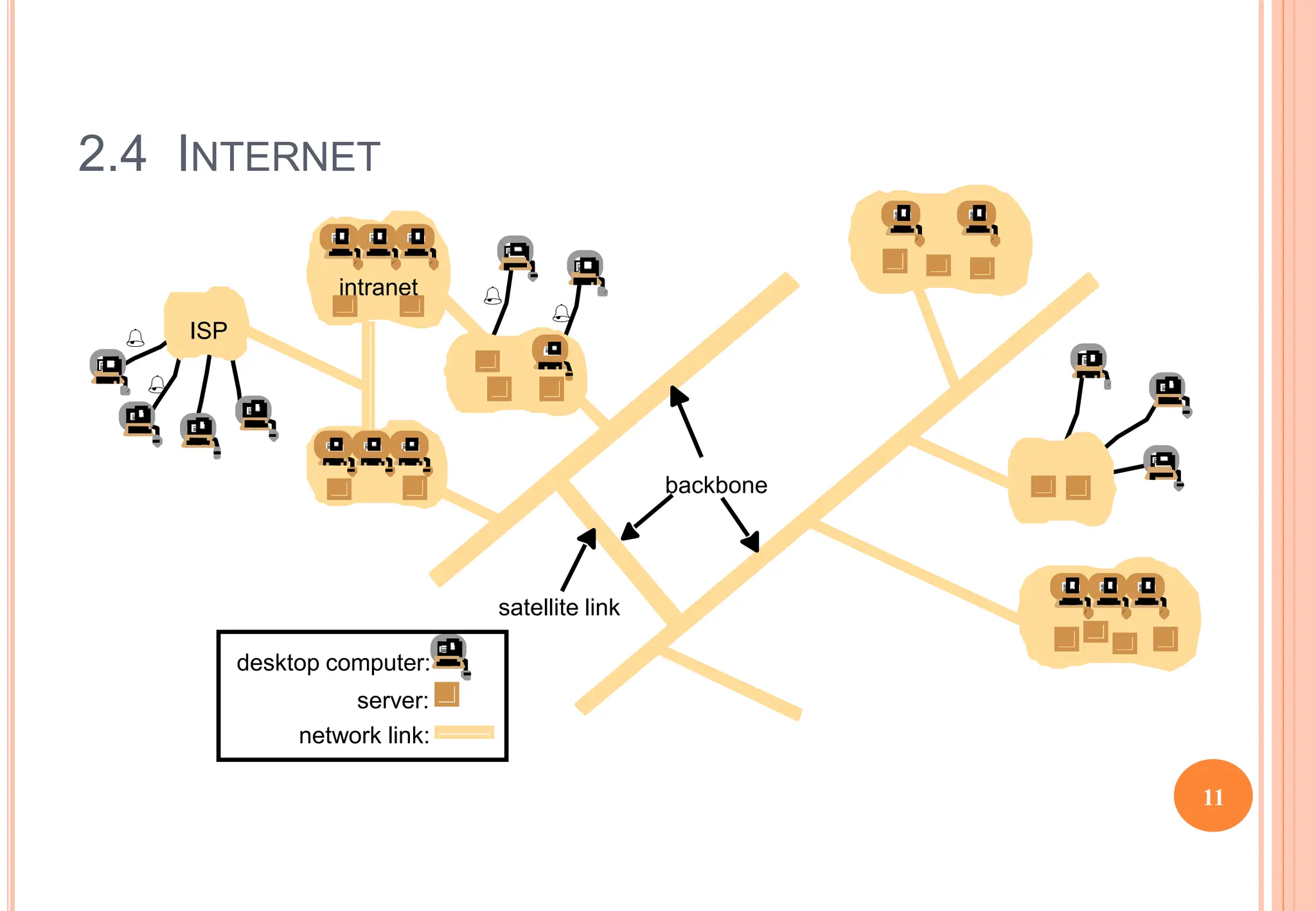
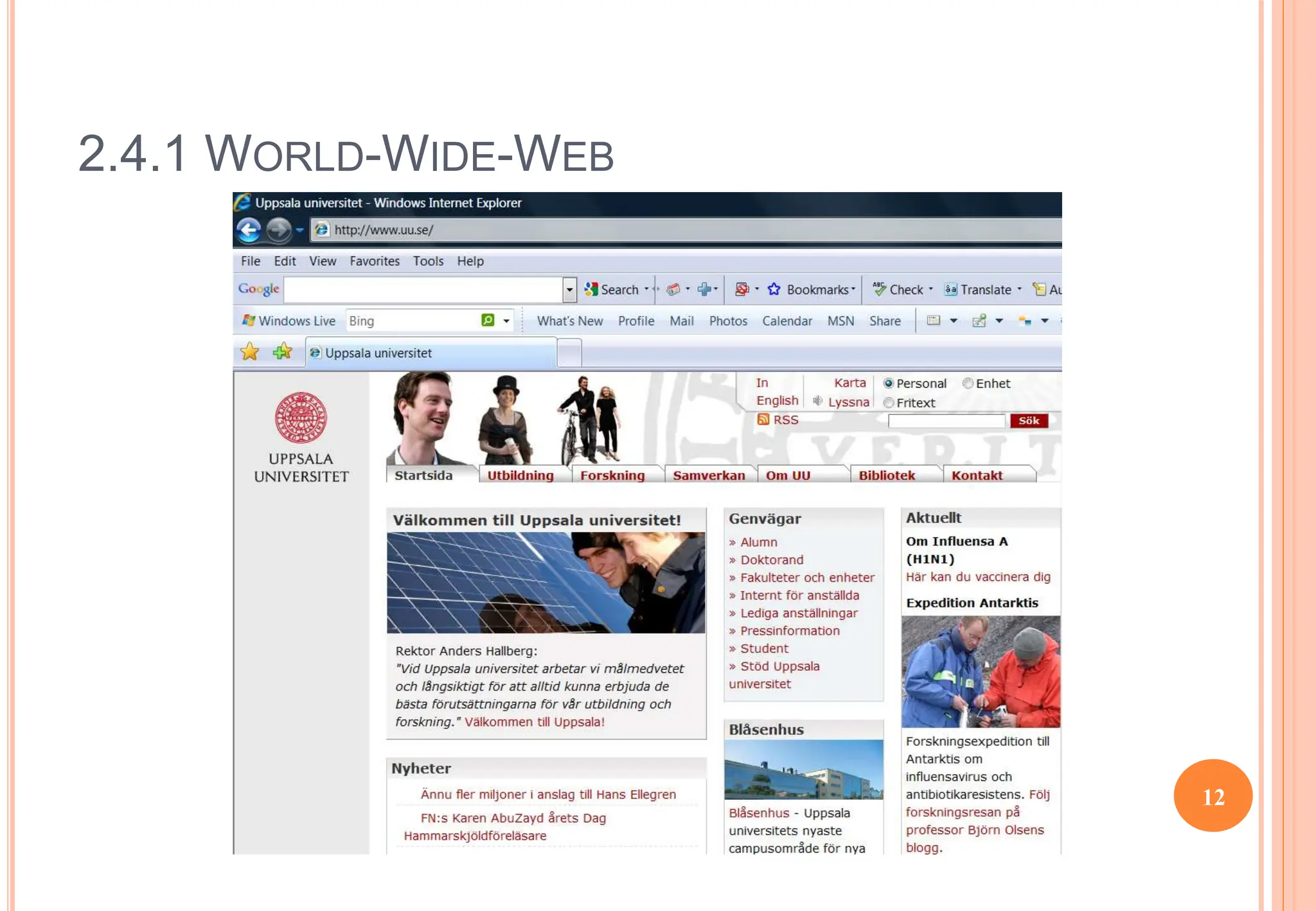
 Internet/World-Wide Web
 Mobile and Ubiquitous Computing
7
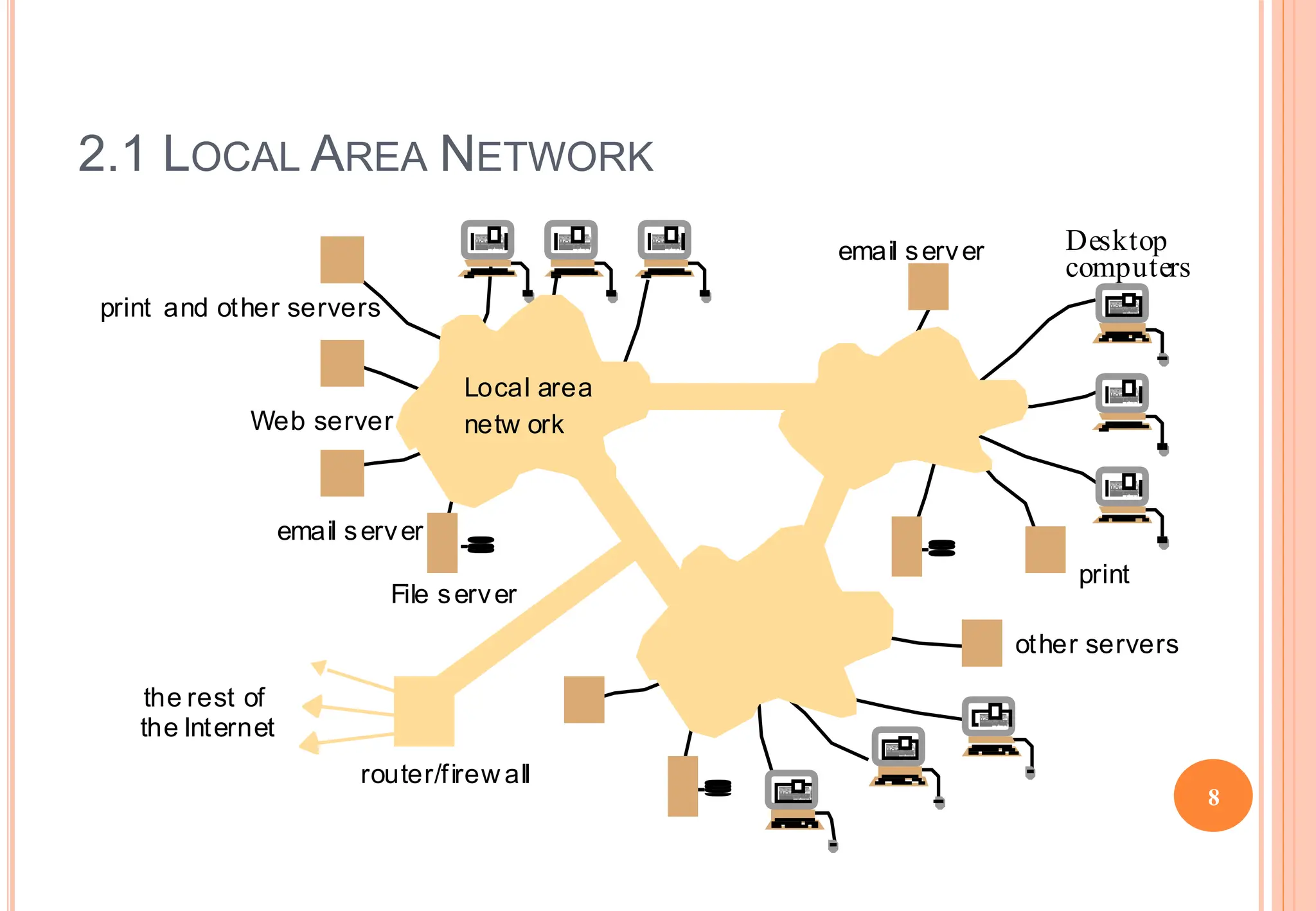
2.1 LOCAL AREA NETWORK
the rest of
email server
Web server
Desktop
computers
File server
router/firew all
print and other servers
other servers
print
Local area
netw ork
email server
the Internet
8
2.2 DATABASE MANAGEMENT SYSTEM
9
2.3 AUTOMATIC TELLER MACHINE NETWORK
10
2.4 INTERNET
intranet
ISP
desktop computer:
backbone
satellite link
server:
%
network link:
%
%
%
11
2.4.1 WORLD-WIDE-WEB
12
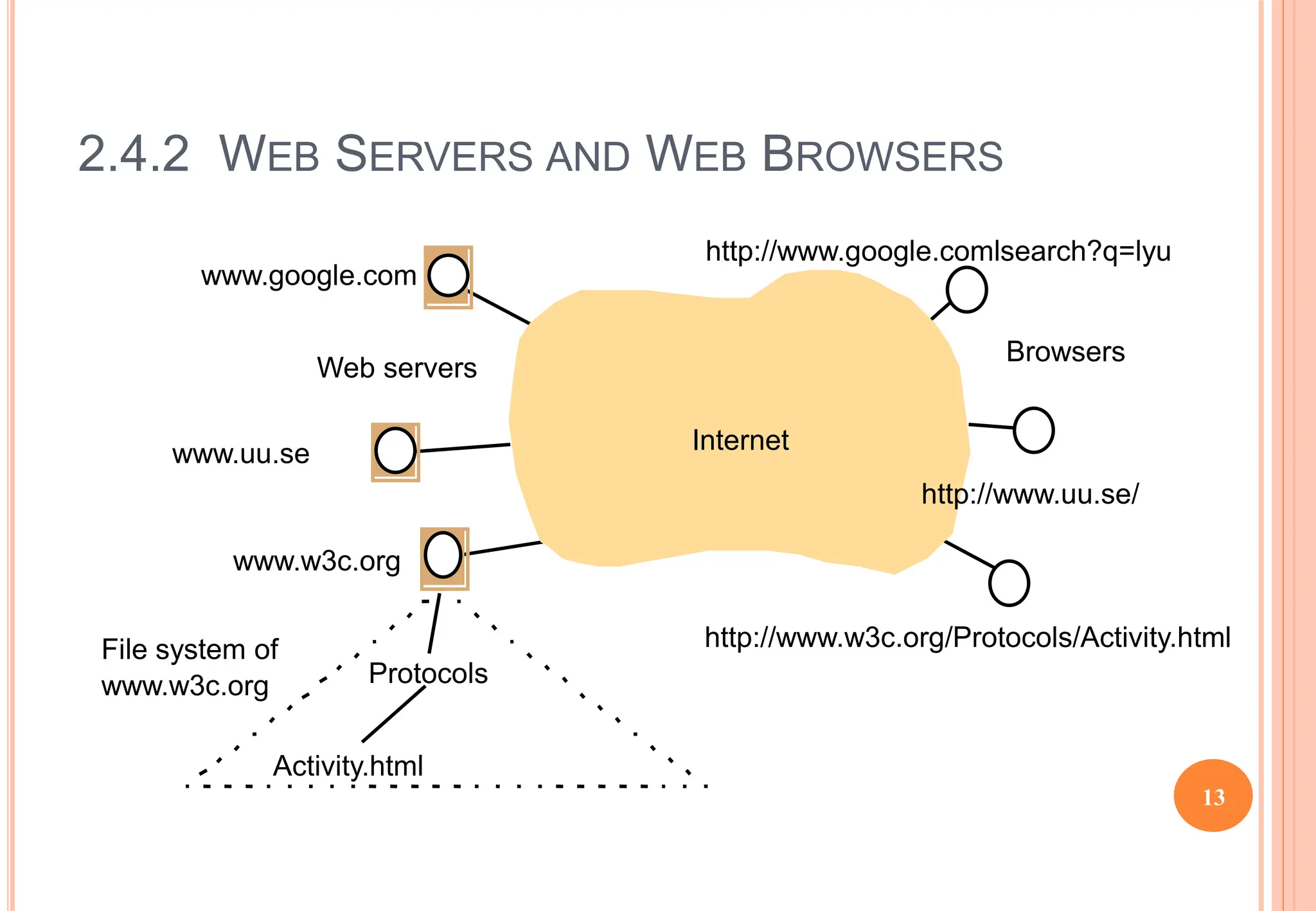
2.4.2 WEB SERVERS AND WEB BROWSERS
Internet
Browsers
Web servers
www.google.com
www.uu.se
www.w3c.org
Protocols
Activity.html
http://www.w3c.org/Protocols/Activity.html
http://www.google.comlsearch?q=lyu
http://www.uu.se/
File system of
www.w3c.org
13
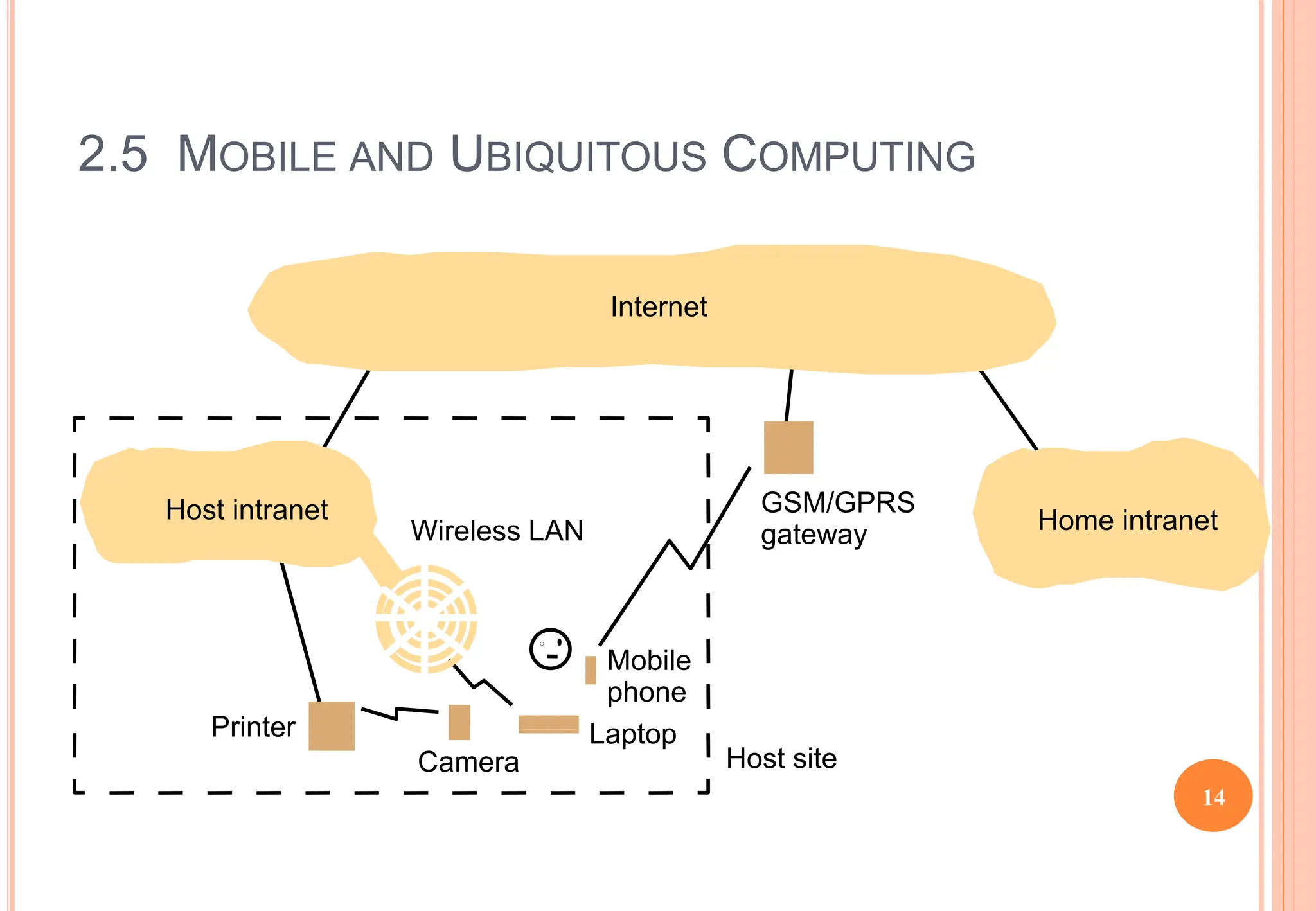
2.5 MOBILE AND UBIQUITOUS COMPUTING
Laptop
Mobile
Printer
Camera
Internet
Host intranet Home intranet
GSM/GPRS
Wireless LAN
phone
gateway
Host site
14
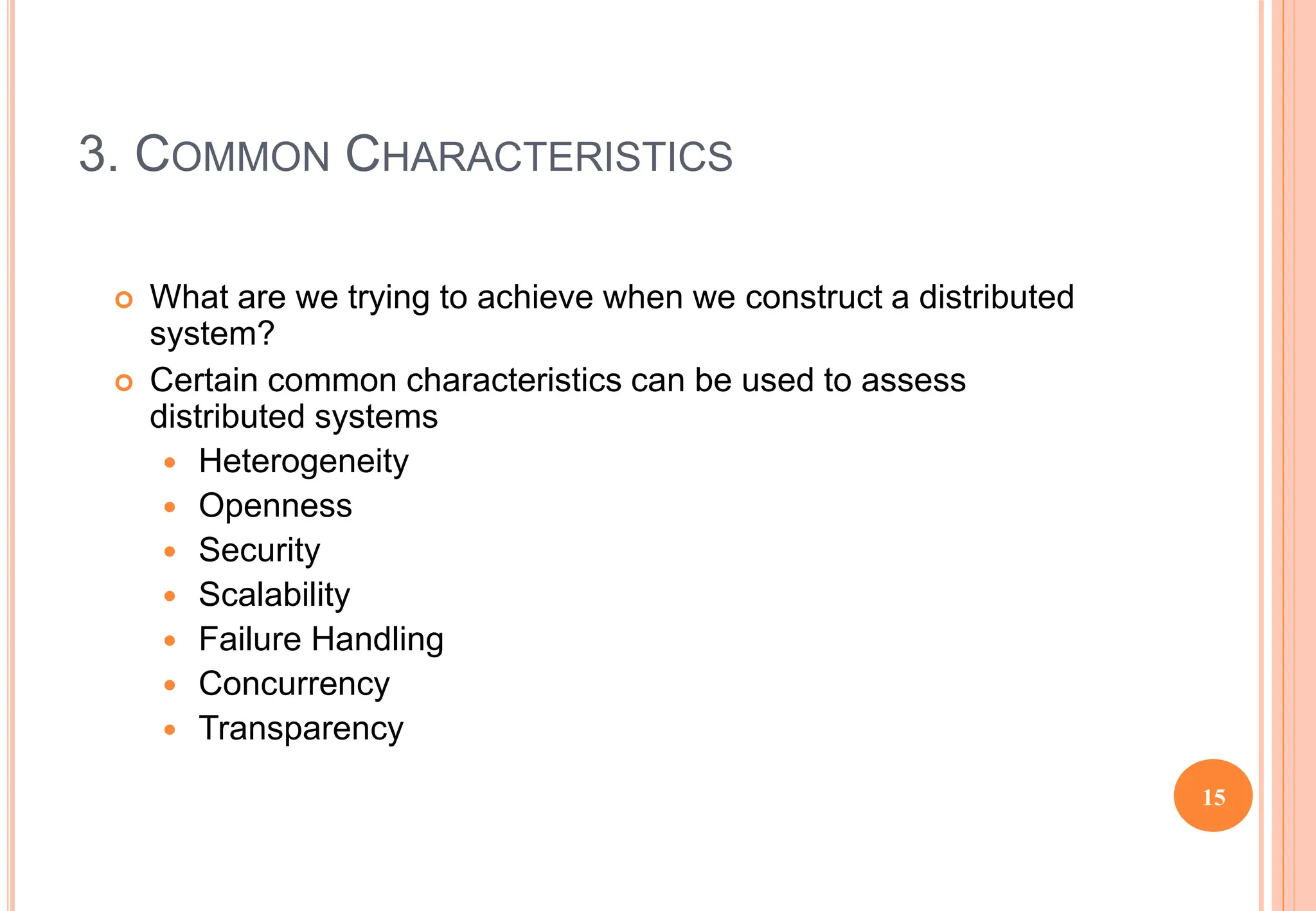
3. COMMON CHARACTERISTICS
 What are we trying to achieve when we construct a distributed
system?
 Certain common characteristics can be used to assess
distributed systems
 Heterogeneity
 Openness
 Security
 Scalability
 Failure Handling
 Concurrency
 Transparency
15
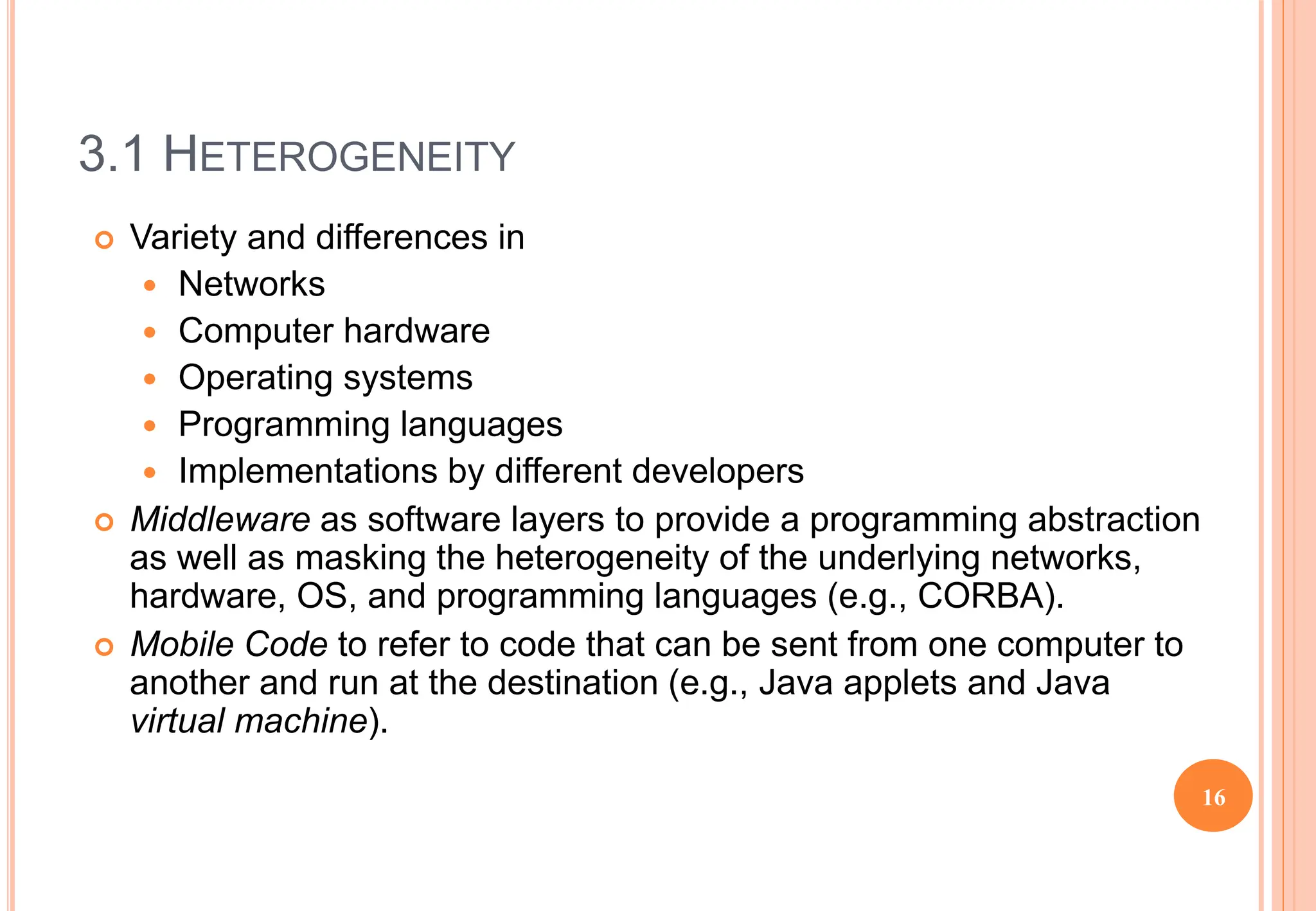
3.1 HETEROGENEITY
 Variety and differences in
 Networks
 Computer hardware
 Operating systems
 Programming languages
 Implementations by different developers
 Middleware as software layers to provide a programming abstraction
as well as masking the heterogeneity of the underlying networks,
hardware, OS, and programming languages (e.g., CORBA).
 Mobile Code to refer to code that can be sent from one computer to
another and run at the destination (e.g., Java applets and Java
virtual machine).
16
3.2 OPENNESS
 Openness is concerned with extensions and
improvements of distributed systems.
 Detailed interfaces of components need to be published.
 New components have to be integrated with existing
components.
 Differences in data representation of interface types on
different processors (of different vendors) have to be
resolved.
17
3.3 SECURITY
 In a distributed system, clients send requests to access
data managed by servers, resources in the networks:
 Doctors requesting records from hospitals
 Users purchase products through electronic commerce
 Security is required for:
 Concealing the contents of messages: security and privacy
 Identifying a remote user or other agent correctly (authentication)
 New challenges:
 Denial of service attack
 Security of mobile code
18
3.4 SCALABILITY
 Adaptation of distributed systems to
 accommodate more users
 respond faster (this is the hard one)
 Usually done by adding more and/or faster processors.
 Components should not need to be changed when scale
of a system increases.
 Design components to be scalable!
19
3.5 FAILURE HANDLING (FAULT TOLERANCE)
 Hardware, software and networks fail!
 Distributed systems must maintain availability even at
low levels of hardware/software/network reliability.
 Fault tolerance is achieved by
 recovery
 redundancy
20
3.6 CONCURRENCY
 Components in distributed systems are executed in
concurrent processes.
 Components access and update shared resources (e.g.
variables, databases, device drivers).
 Integrity of the system may be violated if concurrent
updates are not coordinated.
 Lost updates
 Inconsistent analysis
21
3.7 TRANSPARENCY
 Distributed systems should be perceived by users and
application programmers as a whole rather than as a
collection of cooperating components.
 Transparency has different aspects.
 These represent various properties that distributed
systems should have.
22
4. BASIC DESIGN ISSUES
 General software engineering principles include
rigor and formality, separation of concerns,
modularity, abstraction, anticipation of change, …
 Specific issues for distributed systems:
 Naming
 Communication
 Software structure
 System architecture
 Workload allocation
 Consistency maintenance
31
4.1 NAMING
 A name is resolved when translated into an interpretable form
for resource/object reference.
 Communication identifier (IP address + port number)
 Name resolution involves several translation steps
 Design considerations
 Choice of name space for each resource type
 Name service to resolve resource names to comm. id.
 Name services include naming context resolution, hierarchical
structure, resource protection
32
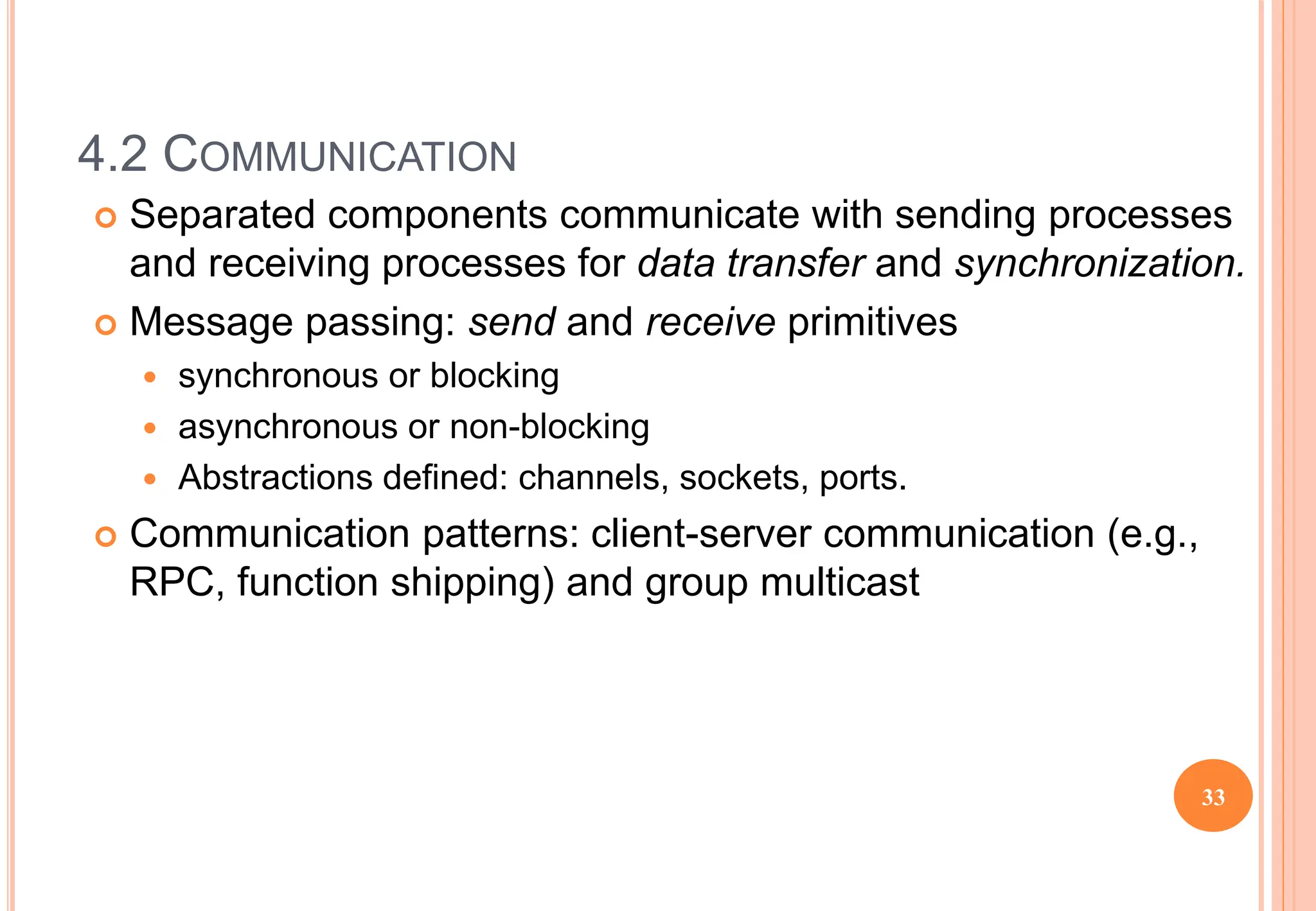
4.2 COMMUNICATION
 Separated components communicate with sending processes
and receiving processes for data transfer and synchronization.
 Message passing: send and receive primitives
 synchronous or blocking
 asynchronous or non-blocking
 Abstractions defined: channels, sockets, ports.
 Communication patterns: client-server communication (e.g.,
RPC, function shipping) and group multicast
33
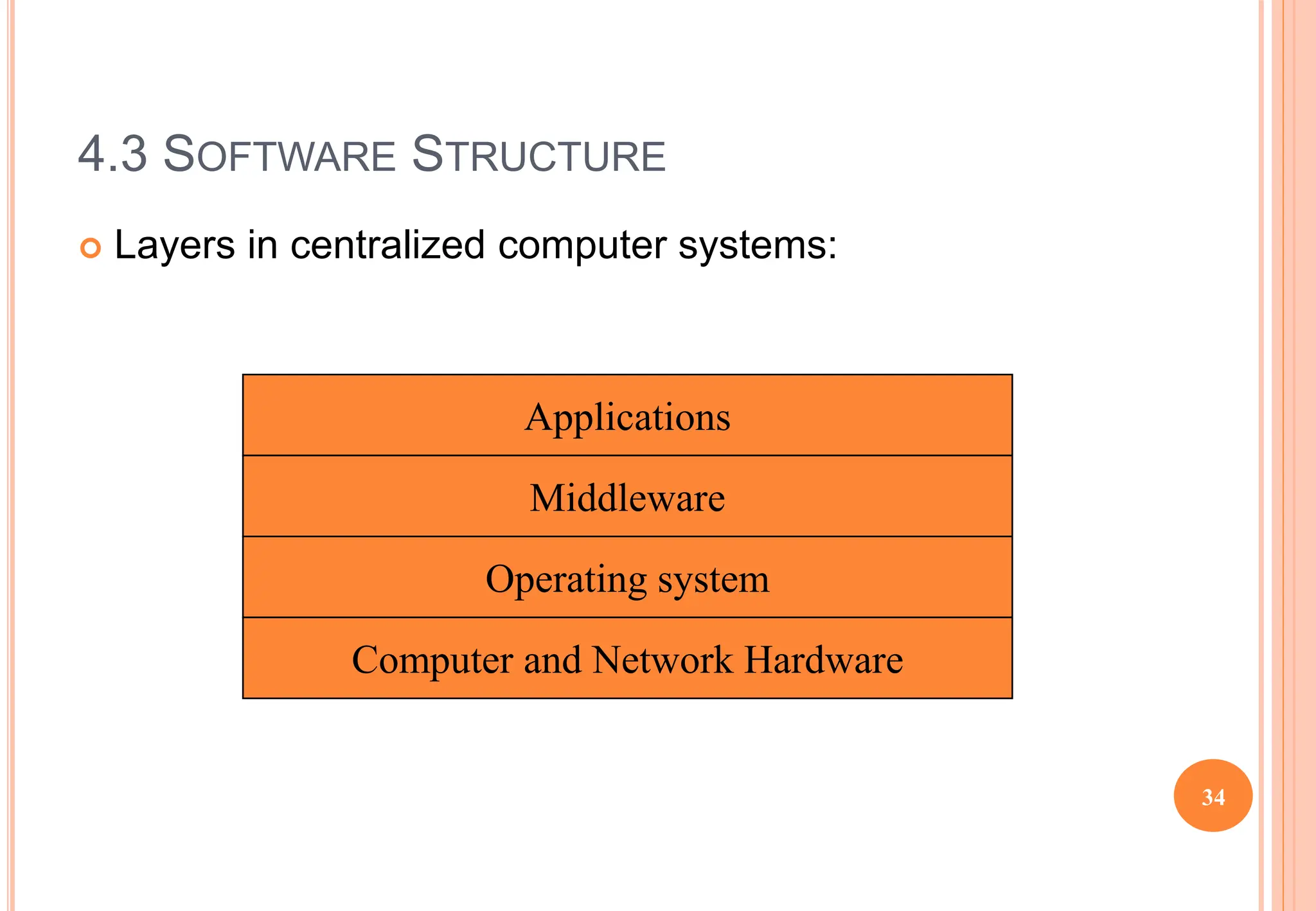
4.3 SOFTWARE STRUCTURE
 Layers in centralized computer systems:
Applications
Middleware
Operating system
Computer and Network Hardware
34
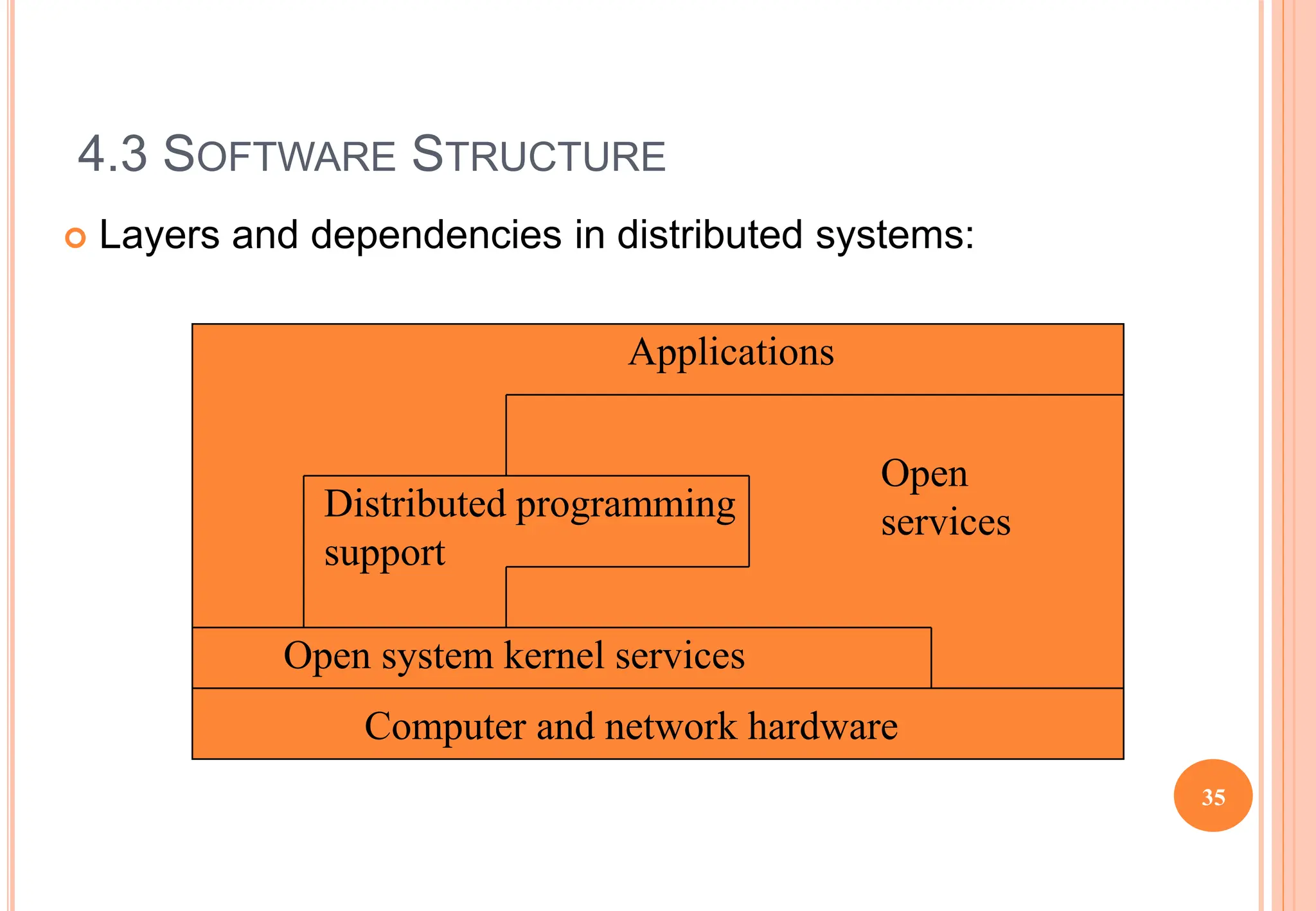
4.3 SOFTWARE STRUCTURE
 Layers and dependencies in distributed systems:
Applications
Distributed programming
support
Open
services
Open system kernel services
Computer and network hardware
35
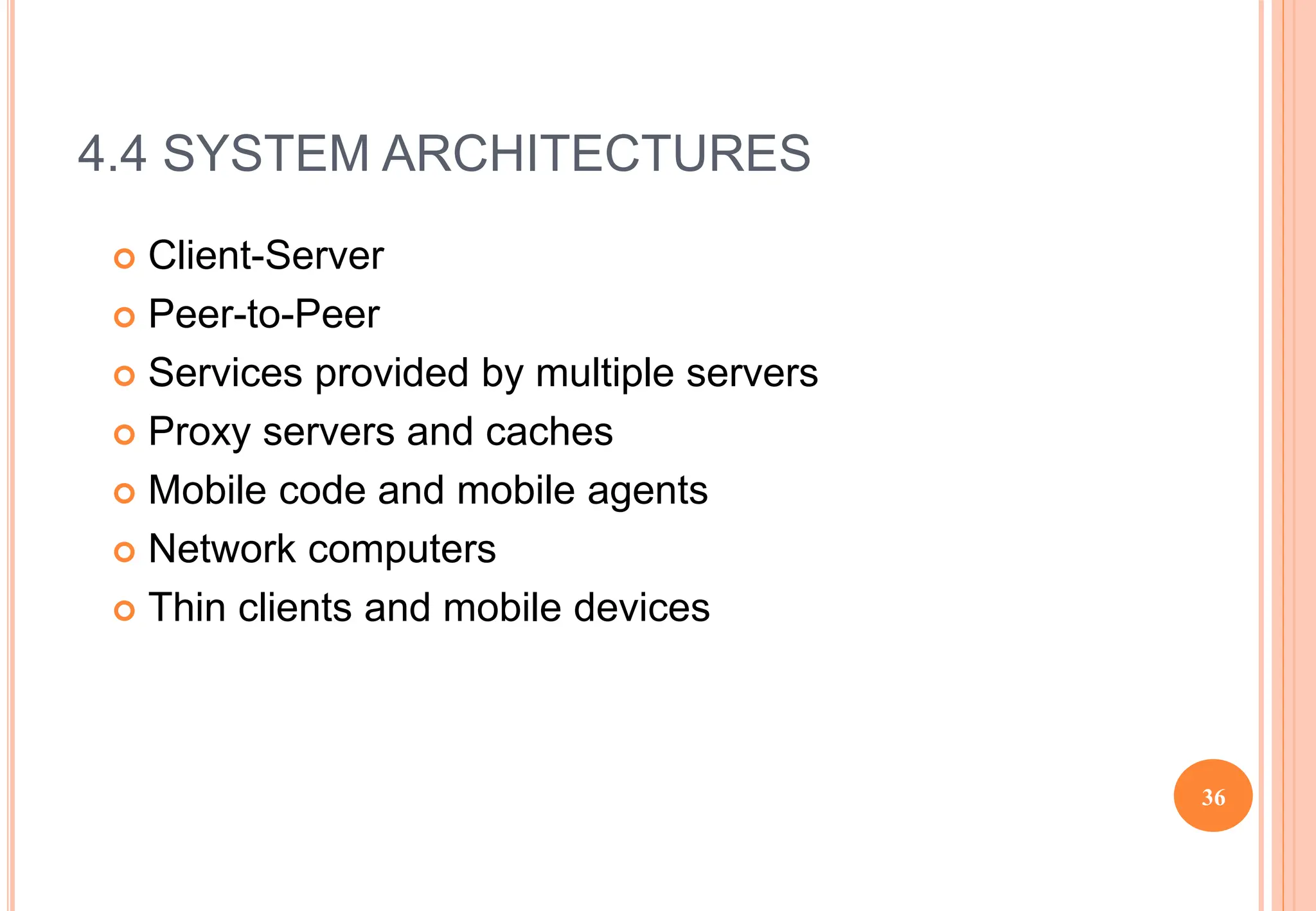
4.4 SYSTEM ARCHITECTURES
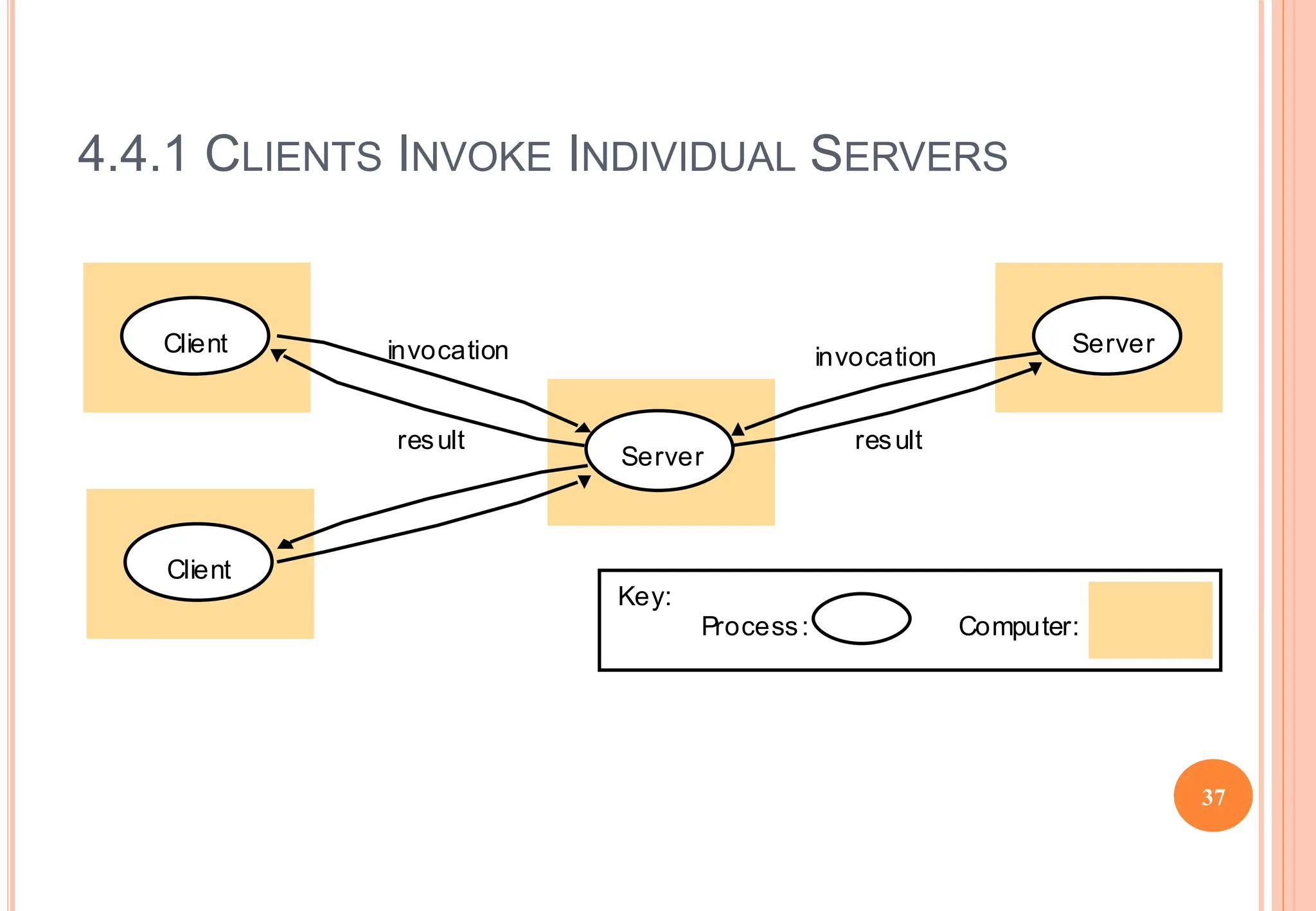
 Client-Server
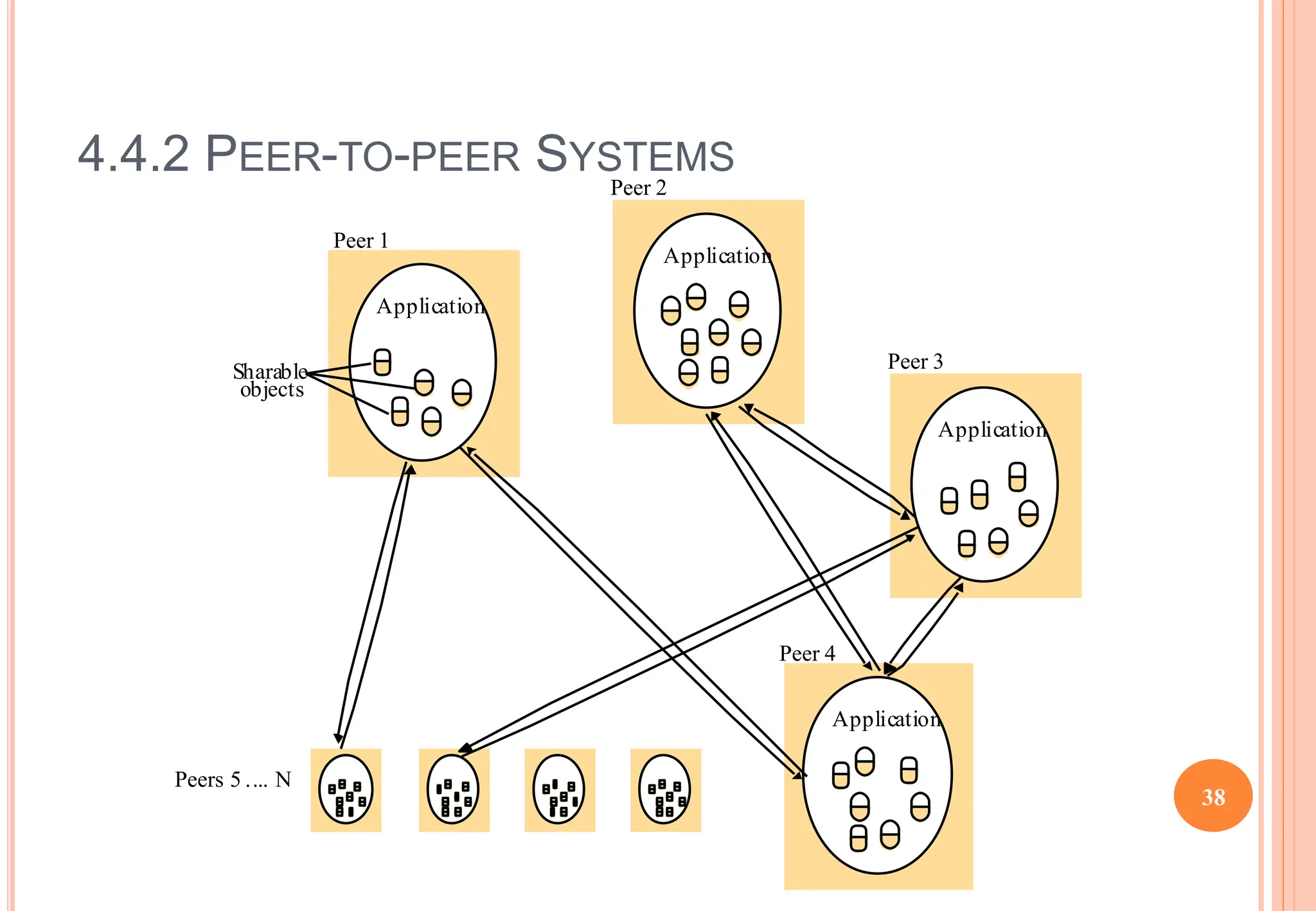
 Peer-to-Peer
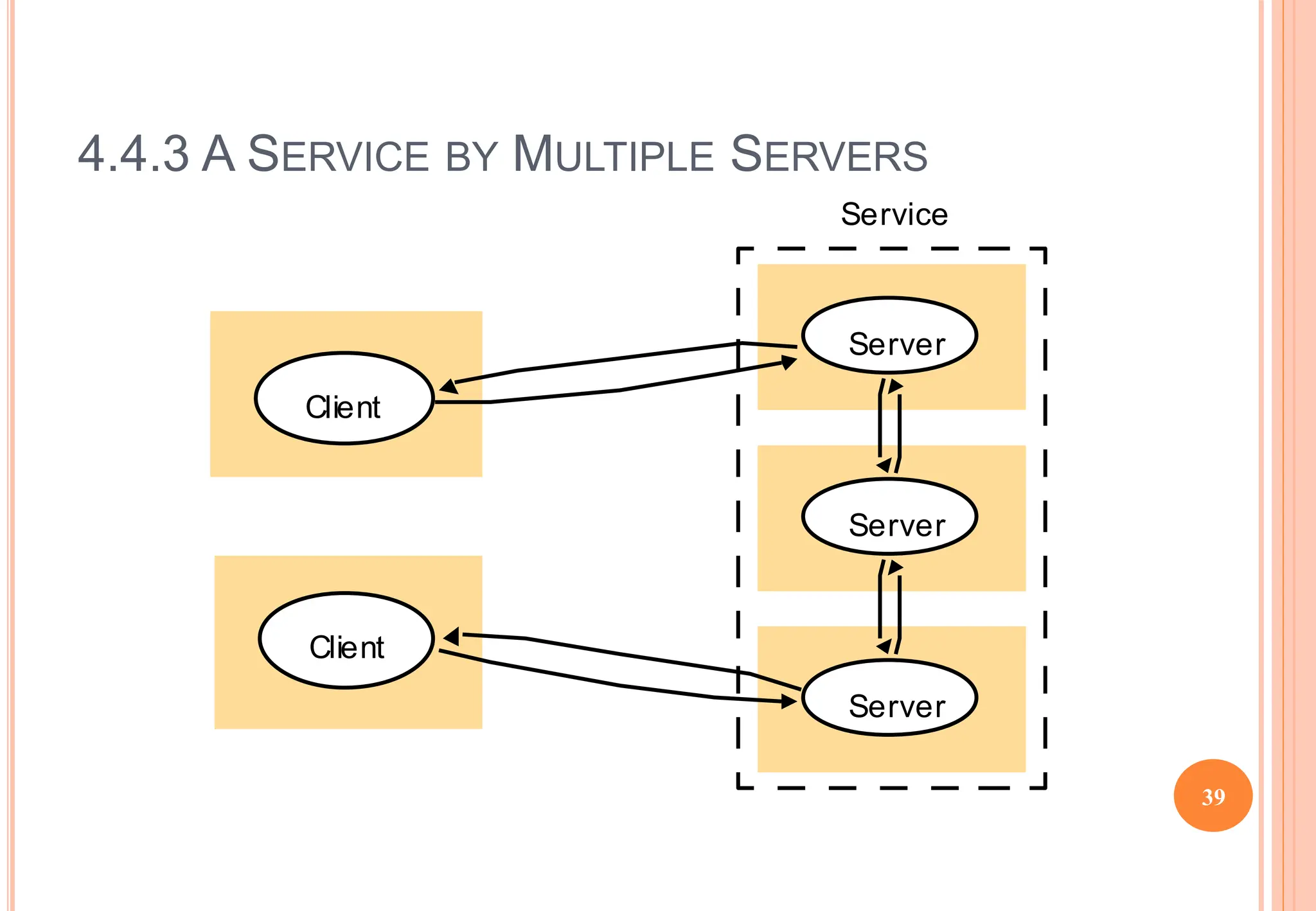
 Services provided by multiple servers
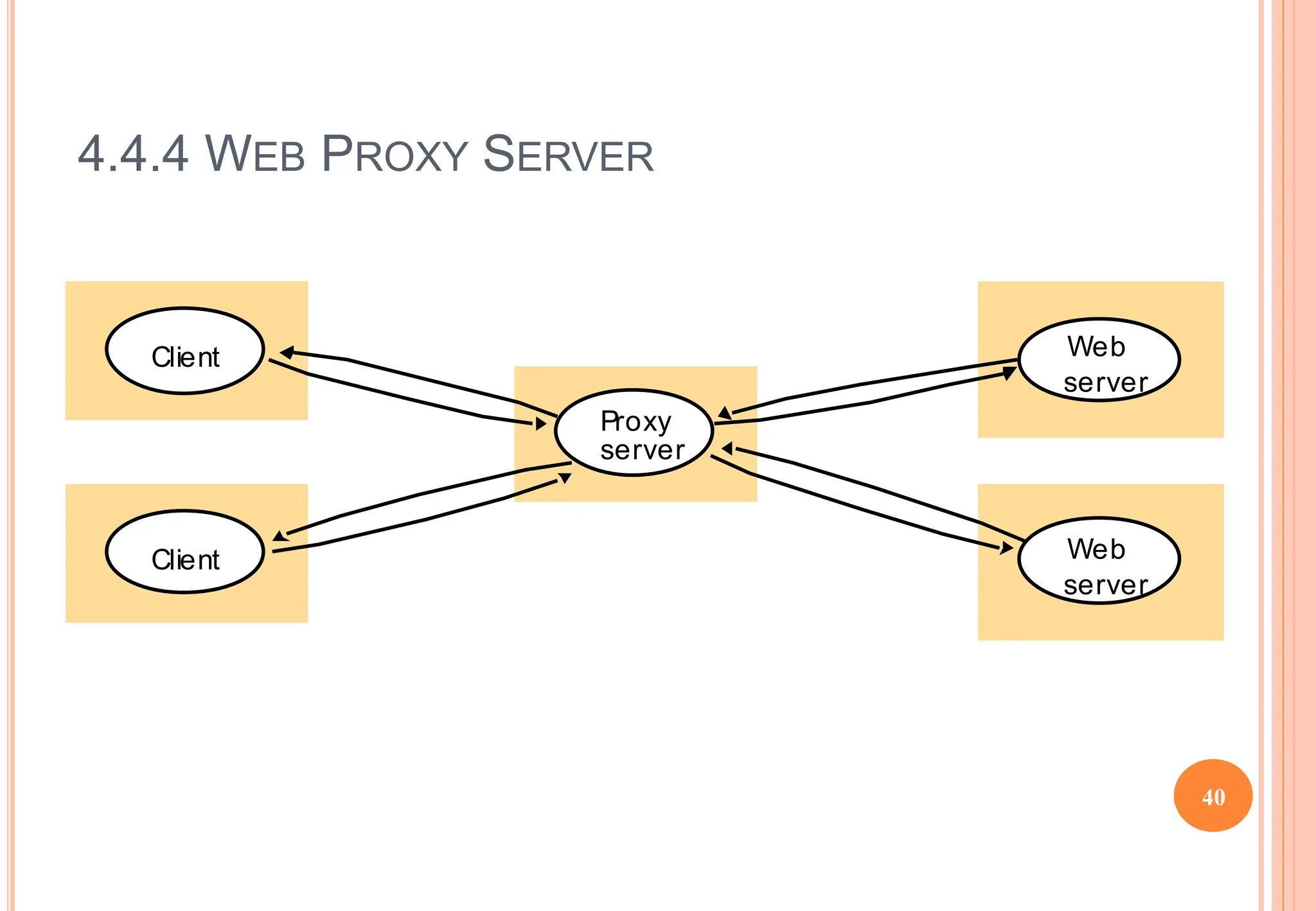
 Proxy servers and caches
 Mobile code and mobile agents
 Network computers
 Thin clients and mobile devices
36
4.4.1 CLIENTS INVOKE INDIVIDUAL SERVERS
Server
Client
Client
invocation
result
Server
invocation
result
Process:
Key:
Computer:
37
4.4.2 PEER-TO-PEER SYSTEMS
Application
Application
Application
Peer 1
Peer 2
Peer 3
Peers 5 .... N
Sharable
objects
Application
Peer 4
38
4.4.3 A SERVICE BY MULTIPLE SERVERS
Server
Server
Server
Service
Client
Client
39
4.4.4 WEB PROXY SERVER
Client
Proxy
Web
server
Web
server
server
Client
40
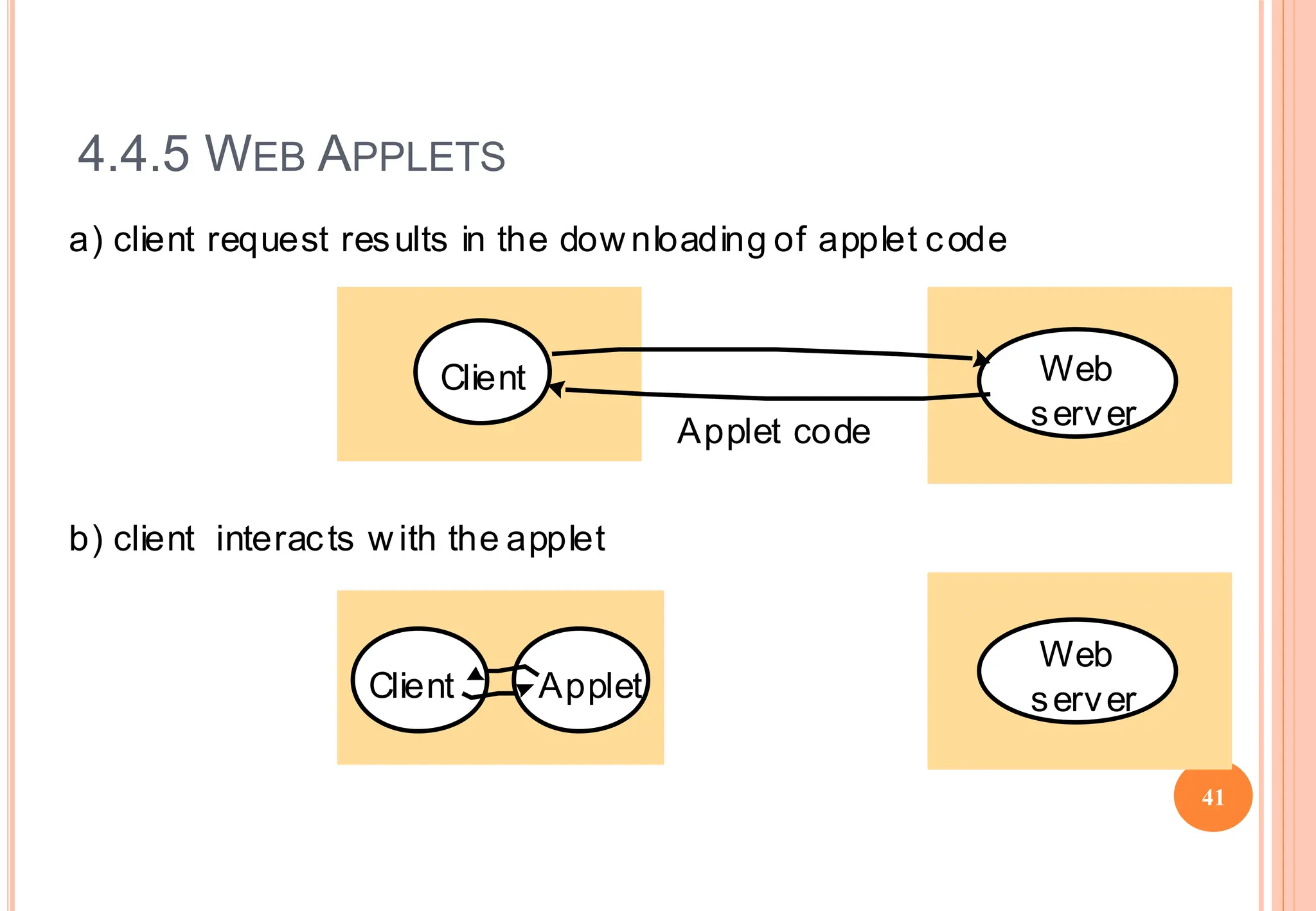
4.4.5 WEB APPLETS
a) client request results in the dow nloading of applet code
Web
server
Client
Web
server
Applet
Applet code
Client
b) client interacts w ith the applet
41
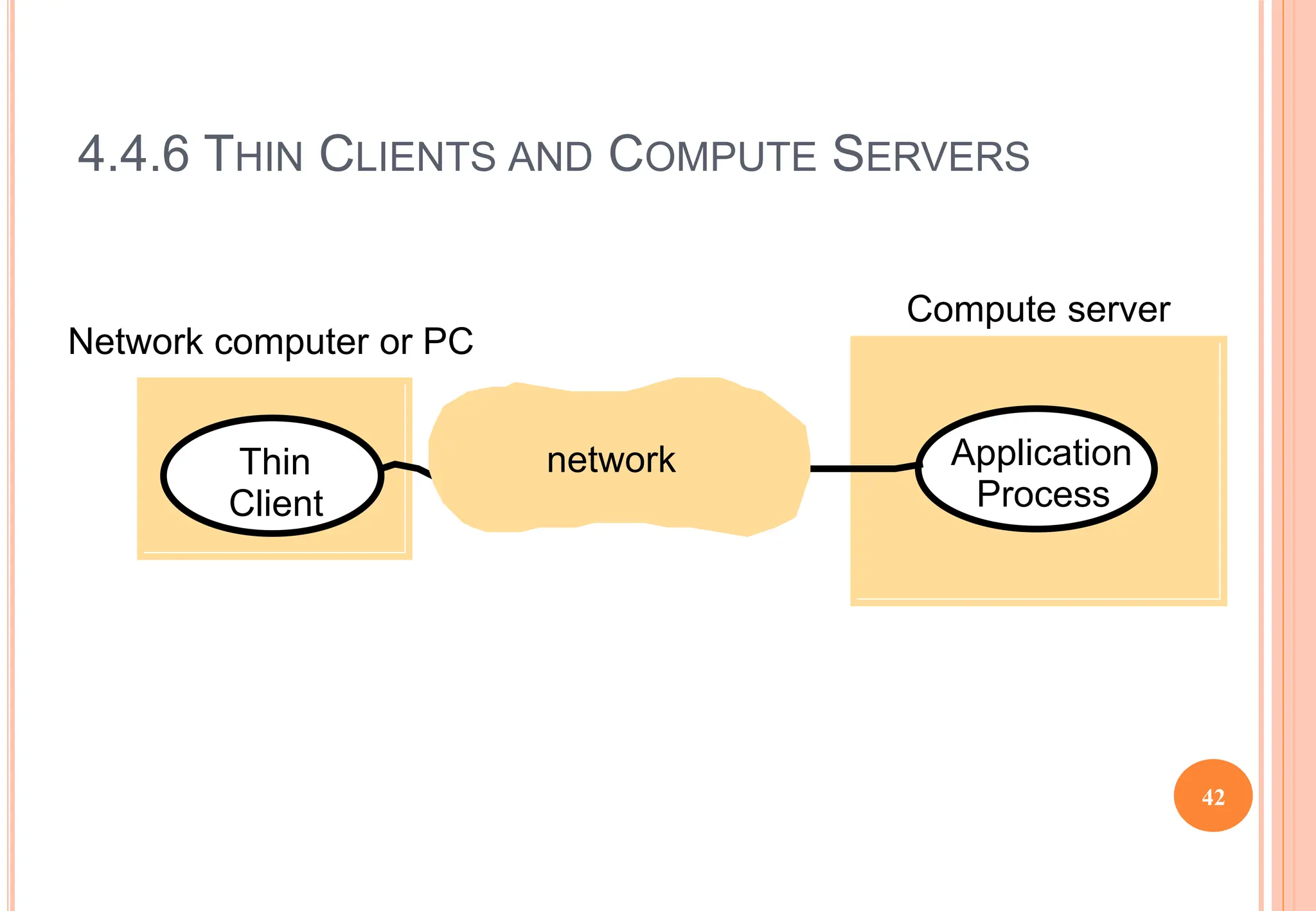
4.4.6 THIN CLIENTS AND COMPUTE SERVERS
Thin
Client
Application
Process
Network computer or PC
Compute server
network
42
5. SUMMARY
 Definitions of distributed systems and comparisons to
centralized systems.
 The characteristics of distributed systems.
 The eight forms of transparency.
 The basic design issues.
 Read Chapter 1 and Chapter 2 of the textbook.
43

Distribution system characterization system

  • 1.
    1DT057 DISTRIBUTED INFORMATION SYSTEM DistributedSystems Characterization and Design 1
  • 2.
    OUTLINE 1. What isa Distributed System 2. Examples of Distributed Systems 3. Common Characteristics 4. Basic Design Issues 5. Summary 2
  • 3.
    1. DISTRIBUTED SYSTEMTYPES Fully Distributed Processors Control Fully replicated Not fully replicated master directory Local data, local directory Master-slave Autonomous transaction based Autonomous fully cooperative Homog. special purpose Heterog. special purpose Homog. general purpose Heterog. general purpose 3
  • 4.
    1. WHAT ISA DISTRIBUTED SYSTEM? Definition: A distributed system is one in which components located at networked computers communicate and coordinate their actions only by passing messages. This definition leads to the following characteristics of distributed systems:  Concurrency of components  Lack of a global ‘clock’  Independent failures of components 4
  • 5.
    1.1 CENTRALIZED SYSTEMCHARACTERISTICS  One component with non-autonomous parts  Component shared by users all the time  All resources accessible  Software runs in a single process  Single point of control  Single point of failure 5
  • 6.
    1.2 DISTRIBUTED SYSTEMCHARACTERISTICS  Multiple autonomous components  Components are not shared by all users  Resources may not be accessible  Software runs in concurrent processes on different processors  Multiple points of control  Multiple points of failure 6
  • 7.
    2. EXAMPLES OFDISTRIBUTED SYSTEMS  Local Area Network and Intranet  Database Management System  Automatic Teller Machine Network  Internet/World-Wide Web  Mobile and Ubiquitous Computing 7
  • 8.
    2.1 LOCAL AREANETWORK the rest of email server Web server Desktop computers File server router/firew all print and other servers other servers print Local area netw ork email server the Internet 8
  • 9.
  • 10.
    2.3 AUTOMATIC TELLERMACHINE NETWORK 10
  • 11.
  • 12.
  • 13.
    2.4.2 WEB SERVERSAND WEB BROWSERS Internet Browsers Web servers www.google.com www.uu.se www.w3c.org Protocols Activity.html http://www.w3c.org/Protocols/Activity.html http://www.google.comlsearch?q=lyu http://www.uu.se/ File system of www.w3c.org 13
  • 14.
    2.5 MOBILE ANDUBIQUITOUS COMPUTING Laptop Mobile Printer Camera Internet Host intranet Home intranet GSM/GPRS Wireless LAN phone gateway Host site 14
  • 15.
    3. COMMON CHARACTERISTICS What are we trying to achieve when we construct a distributed system?  Certain common characteristics can be used to assess distributed systems  Heterogeneity  Openness  Security  Scalability  Failure Handling  Concurrency  Transparency 15
  • 16.
    3.1 HETEROGENEITY  Varietyand differences in  Networks  Computer hardware  Operating systems  Programming languages  Implementations by different developers  Middleware as software layers to provide a programming abstraction as well as masking the heterogeneity of the underlying networks, hardware, OS, and programming languages (e.g., CORBA).  Mobile Code to refer to code that can be sent from one computer to another and run at the destination (e.g., Java applets and Java virtual machine). 16
  • 17.
    3.2 OPENNESS  Opennessis concerned with extensions and improvements of distributed systems.  Detailed interfaces of components need to be published.  New components have to be integrated with existing components.  Differences in data representation of interface types on different processors (of different vendors) have to be resolved. 17
  • 18.
    3.3 SECURITY  Ina distributed system, clients send requests to access data managed by servers, resources in the networks:  Doctors requesting records from hospitals  Users purchase products through electronic commerce  Security is required for:  Concealing the contents of messages: security and privacy  Identifying a remote user or other agent correctly (authentication)  New challenges:  Denial of service attack  Security of mobile code 18
  • 19.
    3.4 SCALABILITY  Adaptationof distributed systems to  accommodate more users  respond faster (this is the hard one)  Usually done by adding more and/or faster processors.  Components should not need to be changed when scale of a system increases.  Design components to be scalable! 19
  • 20.
    3.5 FAILURE HANDLING(FAULT TOLERANCE)  Hardware, software and networks fail!  Distributed systems must maintain availability even at low levels of hardware/software/network reliability.  Fault tolerance is achieved by  recovery  redundancy 20
  • 21.
    3.6 CONCURRENCY  Componentsin distributed systems are executed in concurrent processes.  Components access and update shared resources (e.g. variables, databases, device drivers).  Integrity of the system may be violated if concurrent updates are not coordinated.  Lost updates  Inconsistent analysis 21
  • 22.
    3.7 TRANSPARENCY  Distributedsystems should be perceived by users and application programmers as a whole rather than as a collection of cooperating components.  Transparency has different aspects.  These represent various properties that distributed systems should have. 22
  • 23.
    4. BASIC DESIGNISSUES  General software engineering principles include rigor and formality, separation of concerns, modularity, abstraction, anticipation of change, …  Specific issues for distributed systems:  Naming  Communication  Software structure  System architecture  Workload allocation  Consistency maintenance 31
  • 24.
    4.1 NAMING  Aname is resolved when translated into an interpretable form for resource/object reference.  Communication identifier (IP address + port number)  Name resolution involves several translation steps  Design considerations  Choice of name space for each resource type  Name service to resolve resource names to comm. id.  Name services include naming context resolution, hierarchical structure, resource protection 32
  • 25.
    4.2 COMMUNICATION  Separatedcomponents communicate with sending processes and receiving processes for data transfer and synchronization.  Message passing: send and receive primitives  synchronous or blocking  asynchronous or non-blocking  Abstractions defined: channels, sockets, ports.  Communication patterns: client-server communication (e.g., RPC, function shipping) and group multicast 33
  • 26.
    4.3 SOFTWARE STRUCTURE Layers in centralized computer systems: Applications Middleware Operating system Computer and Network Hardware 34
  • 27.
    4.3 SOFTWARE STRUCTURE Layers and dependencies in distributed systems: Applications Distributed programming support Open services Open system kernel services Computer and network hardware 35
  • 28.
    4.4 SYSTEM ARCHITECTURES Client-Server  Peer-to-Peer  Services provided by multiple servers  Proxy servers and caches  Mobile code and mobile agents  Network computers  Thin clients and mobile devices 36
  • 29.
    4.4.1 CLIENTS INVOKEINDIVIDUAL SERVERS Server Client Client invocation result Server invocation result Process: Key: Computer: 37
  • 30.
    4.4.2 PEER-TO-PEER SYSTEMS Application Application Application Peer1 Peer 2 Peer 3 Peers 5 .... N Sharable objects Application Peer 4 38
  • 31.
    4.4.3 A SERVICEBY MULTIPLE SERVERS Server Server Server Service Client Client 39
  • 32.
    4.4.4 WEB PROXYSERVER Client Proxy Web server Web server server Client 40
  • 33.
    4.4.5 WEB APPLETS a)client request results in the dow nloading of applet code Web server Client Web server Applet Applet code Client b) client interacts w ith the applet 41
  • 34.
    4.4.6 THIN CLIENTSAND COMPUTE SERVERS Thin Client Application Process Network computer or PC Compute server network 42
  • 35.
    5. SUMMARY  Definitionsof distributed systems and comparisons to centralized systems.  The characteristics of distributed systems.  The eight forms of transparency.  The basic design issues.  Read Chapter 1 and Chapter 2 of the textbook. 43