1
Addis Ababa University
School of Pharmacy
Department of Pharmacology and
Clinical Pharmacy
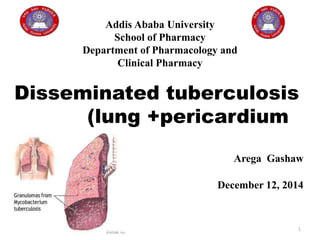
Disseminated tuberculosis
(lung +pericardium
Arega Gashaw
December 12, 2014
Patient Presentation
▫ Card no : 31968
▫ bed No: 812/3
▫ Ward : C 8
▫ Age : 45 years
▫ Sex: M
▫ weight: NA
• CC
▫ Dry Cough for 2 month
▫ Shortness of breath for 1 week
▫ Non trauma
HPI
disseminated TB with massive pericardial effusion with
cardiac tamponed secondary to DTV
• PMH : pneumonia
• Medications prior to admission…. NA
• drug allergies ….NKDA
• ADR… NA
Physical examination
• Vital sign
▫ PR= 90
▫ RR= 27
▫ BP =90/60 mm Hg
▫ T 36.5°C
▫ Sa O2= 91 %
• HEENT:
▫ Eye: pink conjunctivitis
▫ Distended neck vein
• Leg : lymphatic adenopathy
• Abdominal – liver: smooth, tender, SD+
• MS - grade II pedal edema
• Chest: clear and good air entry over the right
side
▫ decrease air entry over the left side
▫ Several pericurdium effusion with tamponda
▫ Chest tube insitu over the left side for drainage of
fluid
• CVS : distant heart sound
• Respiratory: dry cough, SOB
• CNS: conscious
pertinent laboratory findings
• CBC
▫ WBC---- 6.69 × 10³/mm3
▫ RBC----- 5.1 × 10³/mm3
▫ Platelet--- 2.97 × 10³/mm3
▫ Hg ---12.7 g/dL (12-18)
Investigation ……
• Coagulation profile
 PT 20.1sec
▫ INR 1.65 sec
▫ PTT 31.7 sec
• AFB 3x negative
• No gram stain
• Pleural fluid analysis
▫ Cell count 200 (ref. < 5 cell/ cc)???
 N-20%
 L-80 %
▫ Cytology : reactive infusion
Investigation……
• Total protein 5.8 g/dL…….. (6.6-8.7)
▫ Albumin 3.5 g/dL……….. (3.8-4.65)
▫ Uric acid 9.5 mg/dL…………(3.4-7.1)
▫ LDH 601U/L …………(230-430)…..5951
Serum electrolyte
▫ K 3.8 mEq/L
▫ Na 131 mEq/L
▫ Ca 4.4 mEq/L
Investigation……
• Organ function test
▫ BUN 39 mg/dL
▫ Cr 1 mg/dL
▫ ALT(SGPT) -166 U/L….(<40)
▫ AST(SGOT)- 287U/L ….(<40)
▫ ALP- 240 U/L….(44-147)
▫ Bl T- 1.4 mg/dL
▫ D -1mg/dL
Other investigation
• Echo examination revels that several
pericardium effusion are present
• CT(chest) : metastasis to the lung with moderate
bilateral plural effusion and pericardial effusion
• Abd U/S: hepatomegally, ascities, right renal
cortical cyst
• Abd CT: requested
Hospital Course
• On 10/3/07 He was started anti TB.
RHZE (150+75+ 400+275 mg)4 tab/day
Steroid (prednisolone 60 mg PO/d after
cardiologic side was consulted.
• On 12/3/07
• He develop lower limb acute distal
DVT(doppler proved) and start
anticoagulant
▫ Heparin 17,500 U SC Bid and
▫ Warfarin 5 mg PO/d
On 23/3/07
He was preparing for surgery(window opening for
Pericardial fluid drainage
▫ Warfarin discontinue
▫ Heparin continue
On 24/3/07
Pericardial fluid drainage was done and sample sent
for analysis and cytology.
On the same day pericardial window is done by
cardio thoracic gird
On 25/3/07
Chest tube is inserted for massive left side.
Drain about 1 L of fluid up on insertion
Currently ;He is complaining of the surgical site pain
Currently he is on
Anti TB-RHZE/150+75+400+275mg 4 tab/day
Prednisolone 60 mg PO/d
Pyridoxine 50 mg PO /d
Heparin 17500 U sc
Planned to resume warfarin after
coagulation profile is updated and
discontinue heparin.
Analgesics : petidine 25 mg iv tid
tramadole ……….
Discussion and critique of current
treatment
• Use of prednisolone for TB ???
• Prolonged anti coagulant bridge therapy?
• Dose of warfarin ?
• Drug interaction
▫ Ref Vs warfarin
▫ Ref Vs predinsolone
▫ INH Vs warfarin
Pyridoxine + warfarin ( increase or decrease INR b/c
of clotting factor metabolism may alter
desired therapeutic outcome
• Achievement of a noninfectious state
• Adherence to the treatment regimen
• Cure as quickly as possible (generally with at least
6 months of treatment)
• Reduction or elimination of symptoms
• Not complicating or aggravating other existing
disease states.
• Avoiding or minimizing adverse effects of treatment.
• Providing cost-effective therapy.
• Maintaining the patient’s quality of life.
• Therapeutic Alternatives
▫ LMWH is available for patient with cancer
associated DVT
▫ And where warfarin is contraindicated for long
term treatment
▫ LMWH is either cost saving or cost effective
compare with UFH
▫ Restriction of sodium and fluid
▫ Compression therapy
▫ anti-embolism stockings
▫ Regular exercise
▫ Elevate limbs while seated
Design of an optimal individualized
pharmaco-therapeutic plan
▫ Assess and reinforce adherence/concordance with
recommended therapy.
▫ Continue both the anti TB drug, pyridoxine
▫ Suggest discontinuation of prednisolone and
heparin and increasing warfarin to 7.5 mg PO until
to the target INR
▫ Educate on purpose of each medication
parameters to evaluate the outcome
1. Clinical evaluation
2. Bacteriological examination
3. Chest radiograph
• Clinical Evaluation
▫ Patients should have clinical evaluations at least
monthly to
▫ Assess adherence; and
▫ Determine treatment efficacy
▫ Identify possible adverse reactions to medications
• For any drugs : Allergic reaction ,Skin rash
• For EMB
▫ Eye damage (Blurred or changed vision
• INH, PZA, RIF: Hepatic toxicity
• For INH
▫ Nervous system damage
• Dizziness; tingling or numbness, around the mouth
▫ Peripheral neuropathy • Tingling sensation in hands and
feet
• For PZA
▫ Stomach upset Serious, gout
• For RIF
 Bleeding problems
 discoloration of body fluids
Sensitivity to the sun • Frequent sunburn Minor
For warfarin
• Red or dark brown urine and stool
• Bleeding
• Severe headache or stomach pain or upset
• Weakness, faintness, or dizziness
• Skin rash or irritation
• Unusual fever
• Joint or back pain
• Swelling or pain at an injection site
Steroids
• salt and water retention
• extracellular fluid volume expansion
• Hypertension
• potassium depletion, and
• metabolic alkalosis
• Immunodeficiency
Bacteriological examination
▫ Patients whose cultures have not become negative
after 3 months of
▫ therapy should be reevaluated for potential drug-
resistant disease,
▫ as well as for potential failure to adhere to the
regimen.
▫ AFB ???
▫ AFB cultures?
 Drug susceptibility studies NEVER ADD 1 DRUG IF SUSPECT
RESISTANCE
▫ CXR: Baseline, 2-3 months and after completion
General Approach
• Clinical Evaluations at 2 (with PZA), 4 and 8
weeks, then monthly:
▫ PE: Signs/symptoms of hepatitis
▫ Lab Exam
 CBC/platelets
 Liver function tests (ALT, AST, Bili, ALP) at baseline
and monthly
 D/C INH if:
▫ Patient develops symptomatic hepatitis
▫ LFTs > 5 times normal or > 3-5 times baseline
 Renal function tests (Scr, BUN, U/A)
▫ Review of Medication Profile (drug interactions)
Monitoring Toxicity
• Hepatotoxicity Plan
• Clinical or Laboratory Evidence
▫ S/S hepatitis, jaundice
▫ AST, ALT > 350 or Bili > 3 D/C INH, Rifampin
and Pyrazinamide
 3x baseline or 5 x normal
Monitorng parameter for heparin and warfarin
PT/INR at the base line, hg, Hct, plt,
Provision of patient education including
discharge medication counseling
▫ Take your drug at the same time at each day
▫ Your dose may be adjusted several times based on
the lab. Test
▫ Do not stop taking your medication with our your
doctor approval
▫ Inform your doctor or the pharmacist for any unusual
bleeding from any site,
▫ the symptoms of warfarin toxicity early
▫ Notify your doctors if develop chills, fever, skin rash
Other issue …..
• When to seek necessary medical attention
• Consequences of not taking their medicine
correctly
• Name and description of the medication (which
may include the indication).
• Dosage, dosage form, route of administration,
and duration of therapy.
• Action to be taken in the event of missed
doses.
1/25/2016
Presentation on internal medicine ward
Attachment
27

disseminated TB

  • 1.
    1 Addis Ababa University Schoolof Pharmacy Department of Pharmacology and Clinical Pharmacy Disseminated tuberculosis (lung +pericardium Arega Gashaw December 12, 2014
  • 2.
    Patient Presentation ▫ Cardno : 31968 ▫ bed No: 812/3 ▫ Ward : C 8 ▫ Age : 45 years ▫ Sex: M ▫ weight: NA • CC ▫ Dry Cough for 2 month ▫ Shortness of breath for 1 week ▫ Non trauma HPI disseminated TB with massive pericardial effusion with cardiac tamponed secondary to DTV
  • 3.
    • PMH :pneumonia • Medications prior to admission…. NA • drug allergies ….NKDA • ADR… NA
  • 4.
    Physical examination • Vitalsign ▫ PR= 90 ▫ RR= 27 ▫ BP =90/60 mm Hg ▫ T 36.5°C ▫ Sa O2= 91 % • HEENT: ▫ Eye: pink conjunctivitis ▫ Distended neck vein • Leg : lymphatic adenopathy • Abdominal – liver: smooth, tender, SD+ • MS - grade II pedal edema
  • 5.
    • Chest: clearand good air entry over the right side ▫ decrease air entry over the left side ▫ Several pericurdium effusion with tamponda ▫ Chest tube insitu over the left side for drainage of fluid • CVS : distant heart sound • Respiratory: dry cough, SOB • CNS: conscious pertinent laboratory findings • CBC ▫ WBC---- 6.69 × 10³/mm3 ▫ RBC----- 5.1 × 10³/mm3 ▫ Platelet--- 2.97 × 10³/mm3 ▫ Hg ---12.7 g/dL (12-18)
  • 6.
    Investigation …… • Coagulationprofile  PT 20.1sec ▫ INR 1.65 sec ▫ PTT 31.7 sec • AFB 3x negative • No gram stain • Pleural fluid analysis ▫ Cell count 200 (ref. < 5 cell/ cc)???  N-20%  L-80 % ▫ Cytology : reactive infusion
  • 7.
    Investigation…… • Total protein5.8 g/dL…….. (6.6-8.7) ▫ Albumin 3.5 g/dL……….. (3.8-4.65) ▫ Uric acid 9.5 mg/dL…………(3.4-7.1) ▫ LDH 601U/L …………(230-430)…..5951 Serum electrolyte ▫ K 3.8 mEq/L ▫ Na 131 mEq/L ▫ Ca 4.4 mEq/L
  • 8.
    Investigation…… • Organ functiontest ▫ BUN 39 mg/dL ▫ Cr 1 mg/dL ▫ ALT(SGPT) -166 U/L….(<40) ▫ AST(SGOT)- 287U/L ….(<40) ▫ ALP- 240 U/L….(44-147) ▫ Bl T- 1.4 mg/dL ▫ D -1mg/dL
  • 9.
    Other investigation • Echoexamination revels that several pericardium effusion are present • CT(chest) : metastasis to the lung with moderate bilateral plural effusion and pericardial effusion • Abd U/S: hepatomegally, ascities, right renal cortical cyst • Abd CT: requested
  • 10.
    Hospital Course • On10/3/07 He was started anti TB. RHZE (150+75+ 400+275 mg)4 tab/day Steroid (prednisolone 60 mg PO/d after cardiologic side was consulted. • On 12/3/07 • He develop lower limb acute distal DVT(doppler proved) and start anticoagulant ▫ Heparin 17,500 U SC Bid and ▫ Warfarin 5 mg PO/d
  • 11.
    On 23/3/07 He waspreparing for surgery(window opening for Pericardial fluid drainage ▫ Warfarin discontinue ▫ Heparin continue On 24/3/07 Pericardial fluid drainage was done and sample sent for analysis and cytology. On the same day pericardial window is done by cardio thoracic gird
  • 12.
    On 25/3/07 Chest tubeis inserted for massive left side. Drain about 1 L of fluid up on insertion Currently ;He is complaining of the surgical site pain
  • 13.
    Currently he ison Anti TB-RHZE/150+75+400+275mg 4 tab/day Prednisolone 60 mg PO/d Pyridoxine 50 mg PO /d Heparin 17500 U sc Planned to resume warfarin after coagulation profile is updated and discontinue heparin. Analgesics : petidine 25 mg iv tid tramadole ……….
  • 14.
    Discussion and critiqueof current treatment • Use of prednisolone for TB ??? • Prolonged anti coagulant bridge therapy? • Dose of warfarin ? • Drug interaction ▫ Ref Vs warfarin ▫ Ref Vs predinsolone ▫ INH Vs warfarin Pyridoxine + warfarin ( increase or decrease INR b/c of clotting factor metabolism may alter
  • 15.
    desired therapeutic outcome •Achievement of a noninfectious state • Adherence to the treatment regimen • Cure as quickly as possible (generally with at least 6 months of treatment) • Reduction or elimination of symptoms • Not complicating or aggravating other existing disease states. • Avoiding or minimizing adverse effects of treatment. • Providing cost-effective therapy. • Maintaining the patient’s quality of life.
  • 16.
    • Therapeutic Alternatives ▫LMWH is available for patient with cancer associated DVT ▫ And where warfarin is contraindicated for long term treatment ▫ LMWH is either cost saving or cost effective compare with UFH ▫ Restriction of sodium and fluid ▫ Compression therapy ▫ anti-embolism stockings ▫ Regular exercise ▫ Elevate limbs while seated
  • 17.
    Design of anoptimal individualized pharmaco-therapeutic plan ▫ Assess and reinforce adherence/concordance with recommended therapy. ▫ Continue both the anti TB drug, pyridoxine ▫ Suggest discontinuation of prednisolone and heparin and increasing warfarin to 7.5 mg PO until to the target INR ▫ Educate on purpose of each medication
  • 18.
    parameters to evaluatethe outcome 1. Clinical evaluation 2. Bacteriological examination 3. Chest radiograph • Clinical Evaluation ▫ Patients should have clinical evaluations at least monthly to ▫ Assess adherence; and ▫ Determine treatment efficacy ▫ Identify possible adverse reactions to medications
  • 19.
    • For anydrugs : Allergic reaction ,Skin rash • For EMB ▫ Eye damage (Blurred or changed vision • INH, PZA, RIF: Hepatic toxicity • For INH ▫ Nervous system damage • Dizziness; tingling or numbness, around the mouth ▫ Peripheral neuropathy • Tingling sensation in hands and feet • For PZA ▫ Stomach upset Serious, gout • For RIF  Bleeding problems  discoloration of body fluids Sensitivity to the sun • Frequent sunburn Minor
  • 20.
    For warfarin • Redor dark brown urine and stool • Bleeding • Severe headache or stomach pain or upset • Weakness, faintness, or dizziness • Skin rash or irritation • Unusual fever • Joint or back pain • Swelling or pain at an injection site
  • 21.
    Steroids • salt andwater retention • extracellular fluid volume expansion • Hypertension • potassium depletion, and • metabolic alkalosis • Immunodeficiency
  • 22.
    Bacteriological examination ▫ Patientswhose cultures have not become negative after 3 months of ▫ therapy should be reevaluated for potential drug- resistant disease, ▫ as well as for potential failure to adhere to the regimen. ▫ AFB ??? ▫ AFB cultures?  Drug susceptibility studies NEVER ADD 1 DRUG IF SUSPECT RESISTANCE ▫ CXR: Baseline, 2-3 months and after completion
  • 23.
    General Approach • ClinicalEvaluations at 2 (with PZA), 4 and 8 weeks, then monthly: ▫ PE: Signs/symptoms of hepatitis ▫ Lab Exam  CBC/platelets  Liver function tests (ALT, AST, Bili, ALP) at baseline and monthly  D/C INH if: ▫ Patient develops symptomatic hepatitis ▫ LFTs > 5 times normal or > 3-5 times baseline  Renal function tests (Scr, BUN, U/A) ▫ Review of Medication Profile (drug interactions)
  • 24.
    Monitoring Toxicity • HepatotoxicityPlan • Clinical or Laboratory Evidence ▫ S/S hepatitis, jaundice ▫ AST, ALT > 350 or Bili > 3 D/C INH, Rifampin and Pyrazinamide  3x baseline or 5 x normal Monitorng parameter for heparin and warfarin PT/INR at the base line, hg, Hct, plt,
  • 25.
    Provision of patienteducation including discharge medication counseling ▫ Take your drug at the same time at each day ▫ Your dose may be adjusted several times based on the lab. Test ▫ Do not stop taking your medication with our your doctor approval ▫ Inform your doctor or the pharmacist for any unusual bleeding from any site, ▫ the symptoms of warfarin toxicity early ▫ Notify your doctors if develop chills, fever, skin rash
  • 26.
    Other issue ….. •When to seek necessary medical attention • Consequences of not taking their medicine correctly • Name and description of the medication (which may include the indication). • Dosage, dosage form, route of administration, and duration of therapy. • Action to be taken in the event of missed doses.
  • 27.
    1/25/2016 Presentation on internalmedicine ward Attachment 27

Editor's Notes

  • #8 High protenemia-dehydration, multiple myloma, plasma cell leukemia Medication: corticosteriod,
  • #9 ALT is high in case of disease like ALL, biliary obstruction, CHF, liver disease, infectious hepatitis, Drugs: heparine, ACEI, acetaminophen, antibiotics( clindamycin, gentamycin ofloxaclline ),thiozides ALP is high in case ofbone disease, bowel infraction, cholelithiasis, hyper parathirodism, pregnancy Drug: the same