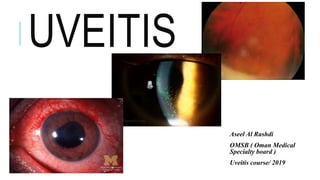
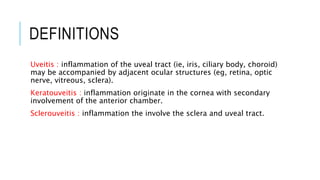
UVEITIS
Aseel Al Rashdi
OMSB ( Oman Medical
Specialty board )
Uveitis course/ 2019
OUTLINE
Anatomy of the Uveal tract
Uveitis and its classifications
Epidemiology
Clinical History
Clinical Examination
Case
ANATOMY
CILIARY BODY
DEFINITIONS
Uveitis : inflammation of the uveal tract (ie, iris, ciliary body, choroid)
may be accompanied by adjacent ocular structures (eg, retina, optic
nerve, vitreous, sclera).
Keratouveitis : inflammation originate in the cornea with secondary
involvement of the anterior chamber.
Sclerouveitis : inflammation the involve the sclera and uveal tract.
Classification Of Uveitis
Based on :
Anatomy
Clinical course
Etiology
Histology
THE STANDARDIZATION OF UVEITIS
NOMENCLATURE (SUN) WORKING GROUP
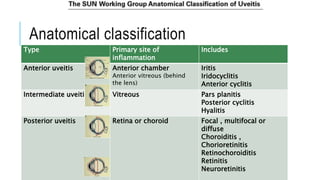
Anatomical classification
Type Primary site of
inflammation
Includes
Anterior uveitis Anterior chamber
Anterior vitreous (behind
the lens)
Iritis
Iridocyclitis
Anterior cyclitis
Intermediate uveitis Vitreous Pars planitis
Posterior cyclitis
Hyalitis
Posterior uveitis Retina or choroid Focal , multifocal or
diffuse
Choroiditis ,
Chorioretinitis
Retinochoroiditis
Retinitis
Neuroretinitis
EPIDEMIOLOGY
American Academy of Ophthalmology . Intraocular inflammation and uveitits. 9th Edition.
EPIDEMIOLOGY
The prevalence of
uveitis among all eye
patients was 1.5%
and the annual
incidence was 129
cases.
Classification by Clinical Course
Onset
Duration
Course
Sudde
n
Insidious
3
months
Limite
d
Persisten
t
3 6month9month
Chronic
Recurre
nt
Acute
Classification by Etiology
1. Infectious ( Bacteria , Viral , Fungal, protozoal )
2. Non- infectious ( Autoimmune systemic association )
3. Masquerade ( neoplastic , non- neoplastic )
HISTOLOGICAL CLASSIFICATION
 Granulomatous ( Epithelioid and giant cells infiltrate )
 Non – granulomatous (Plasma cell and lymphocyte infiltrate )
Mutton fat KP
Iris nodules
ANTERIOR UVEITIS clinical
symptoms
Symptoms (Acute onset) :
•Pain (cilliary spasm , secondary
glaucoma )
•Photophobia
•Redness
•Epiphora
•Blurred vision
Symptoms (chronic ) :
• No symptoms
• Blurred vision (cataract , calcific
band keratopathy , CME)
ANTERIOR UVEITIS clinical signs
Anterior segment :
Conjunctiva : Ciliary Congestion
Cornea : Keratic Precipitates , Band keratopathy ( chronic
complication )
AC : Cells , Flare , Hypopyon
Pupils : Miosis
Iris : Nodules , Anterior / Posterior synechia
Mutton Fat KPs
Busacca’
s nodule
Koeppe
nodule
Berlin’s
nodule
Iris Heterochromia ( eg. Fuches
heterochromic uveitits )
Iris Stromal
Atrophy
Anterior Uveitis
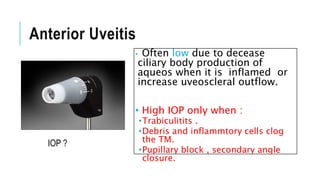
• Often low due to decease
ciliary body production of
aqueos when it is inflamed or
increase uveoscleral outflow.
• High IOP only when :
•Trabiculitits .
•Debris and inflammtory cells clog
the TM.
•Pupillary block , secondary angle
closure.
IOP ?
Anterior Uveitis causes
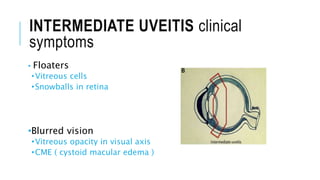
INTERMEDIATE UVEITIS clinical
symptoms
• Floaters
•Vitreous cells
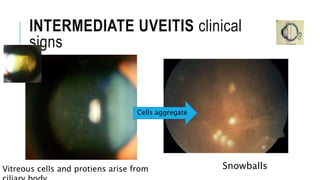
•Snowballs in retina
•Blurred vision
•Vitreous opacity in visual axis
•CME ( cystoid macular edema )
INTERMEDIATE UVEITIS clinical
signs
Vitreous cells and protiens arise from Snowballs
Cells aggregate
Snowbanking’ in Pars
Planitis is the
appearance of a white
plaque, typically
overlying the inferior
pars plana and retina
but it can encompass
the entire peripheral
fundus
Peripheral retinal vasculitis
Vitreous strands and membranes
Best seen with indirect ophthalmoscope
Risk of PVD and CME
INTERMEDIATE UVEITIS causes
POSTERIOR UVEITIS clinical
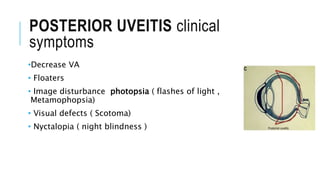
symptoms
•Decrease VA
• Floaters
• Image disturbance photopsia ( flashes of light ,
Metamophopsia)
• Visual defects ( Scotoma)
• Nyctalopia ( night blindness )
POSTERIOR UVEITIS clinical signs
Unifocal, multifocal or diffuse :
•Retinal and choroidal
inflammatory infiltrate.
(choroiditis , retinitis)
•Vasculopathy : inflammatory
sheathing of arteries and veins ,
narrowing of vessels ,
obliterations.
+ Vitreous haze and cells .
Structural Complications :
•Periretinal or Subretinal fibrosis
•Retinal holes , atrophy, edema.
•Retinal detachment ( RD)
•CME
•RPE hypertrophy or atrophy
•Retinal or choroidal
neovascularization
•Optic nerve swelling , atrophy or
neovacularization
•Cataract
23 yrs old female , serology +ve for
syphillis
White retinal lesions and a few
retinal hemorrhages
Thinning and occlusion of retinal
vessels
20-D field view
Post retinal laser
photocoagulation due to
retinal vein occlusion
associated with Behçet’s
disease.
There is
• optic nerve pallor
• intraretinal hemorrhages
• laser spots.
prominent vascular
sheathing and
scattered retinal
pigmented
epithelium (RPE)
changes
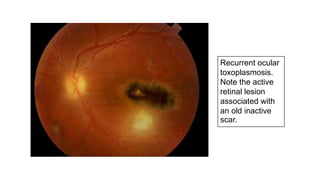
Recurrent ocular
toxoplasmosis.
Note the active
retinal lesion
associated with
an old inactive
scar.
UVEITIS + RETINAL
VASCULITIS
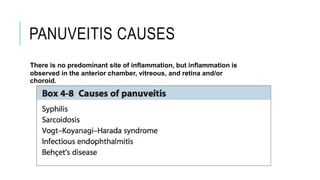
PANUVEITIS CAUSES
There is no predominant site of inflammation, but inflammation is
observed in the anterior chamber, vitreous, and retina and/or
choroid.
UNILATERAL UVEITIS
DISEASE ACTIVITY
HISTORY TAKING AND
CLINICAL EXAMINATION
HISTORY
Patient Demographics:
Age
Gender
Ethnicity
HISTORY
HISTORY
Ocular symptoms
HISTORY
Associated Systemic symptoms
Al-Dhibi, H. A., Al-Mahmood, A. M., & Arevalo, J. F. (2014). A systematic approach to emergencies in uveitis. Middle East African journal of ophthalmology, 21(3), 251.
HISTORY
Occupational , social & family
Hx
•Travel
• Tobacco use
•Sexual practices
•IV drug use
Medications?
Allergy?
EXAMINATION
• VA
• Pupils , RAPD , color
vision , color saturation
• EOM
• IOP
• Thorough eye exam
• Thorough Systemic
examination
CASE
A 42-year-old white woman presented with a 10-year history of
bilateral uveitis treated intermittently with topical and systemic
corticosteroids and a chief complaint of blurred vision that was worse
in the left eye since 5 days .last episode was 4 weeks ago. A detailed
medical history was significant for sinusitis and depression.
VA : OD 20/50 OS 20/100
Slit-lamp biomicroscopy showed mutton-fat KPs in the left eye. There
were trace vitreous cells and haze in the right eye and vitreous cells
and haze in the left eye. There were peripheral retinal vasculitis and
cystoid macular edema in both eyes
Physical examination revealed no rash, joint findings, or other
abnormalities. Neurologic examination was normal.
REFERENCES
•American Academy of Ophthalmology . Intraocular inflammation and
uveitits. 9th Edition.
•N. Robbert . Uveitis Fundamental and clinical practice. 4th Edition.
•Al-Dhibi, H. A., Al-Mahmood, A. M., & Arevalo, J. F. (2014). A
systematic approach to emergencies in uveitis. Middle East African
journal of ophthalmology, 21(3), 251.
•Al-Mezaine, H. S., Kangave, D., & Abu El-Asrar, A. M. (2010). Patterns
of uveitis in patients admitted to a University Hospital in Riyadh,
Saudi Arabia. Ocular immunology and inflammation, 18(6), 424-431.
•EyeWiki website : Intermediate uveitits .

Uveitits classifications and Approach

  • 1.
    UVEITIS Aseel Al Rashdi OMSB( Oman Medical Specialty board ) Uveitis course/ 2019
  • 2.
    OUTLINE Anatomy of theUveal tract Uveitis and its classifications Epidemiology Clinical History Clinical Examination Case
  • 3.
  • 4.
  • 5.
    DEFINITIONS Uveitis : inflammationof the uveal tract (ie, iris, ciliary body, choroid) may be accompanied by adjacent ocular structures (eg, retina, optic nerve, vitreous, sclera). Keratouveitis : inflammation originate in the cornea with secondary involvement of the anterior chamber. Sclerouveitis : inflammation the involve the sclera and uveal tract.
  • 6.
    Classification Of Uveitis Basedon : Anatomy Clinical course Etiology Histology THE STANDARDIZATION OF UVEITIS NOMENCLATURE (SUN) WORKING GROUP
  • 7.
    Anatomical classification Type Primarysite of inflammation Includes Anterior uveitis Anterior chamber Anterior vitreous (behind the lens) Iritis Iridocyclitis Anterior cyclitis Intermediate uveitis Vitreous Pars planitis Posterior cyclitis Hyalitis Posterior uveitis Retina or choroid Focal , multifocal or diffuse Choroiditis , Chorioretinitis Retinochoroiditis Retinitis Neuroretinitis
  • 8.
    EPIDEMIOLOGY American Academy ofOphthalmology . Intraocular inflammation and uveitits. 9th Edition.
  • 9.
    EPIDEMIOLOGY The prevalence of uveitisamong all eye patients was 1.5% and the annual incidence was 129 cases.
  • 10.
    Classification by ClinicalCourse Onset Duration Course Sudde n Insidious 3 months Limite d Persisten t 3 6month9month Chronic Recurre nt Acute
  • 12.
    Classification by Etiology 1.Infectious ( Bacteria , Viral , Fungal, protozoal ) 2. Non- infectious ( Autoimmune systemic association ) 3. Masquerade ( neoplastic , non- neoplastic )
  • 13.
    HISTOLOGICAL CLASSIFICATION  Granulomatous( Epithelioid and giant cells infiltrate )  Non – granulomatous (Plasma cell and lymphocyte infiltrate ) Mutton fat KP Iris nodules
  • 14.
    ANTERIOR UVEITIS clinical symptoms Symptoms(Acute onset) : •Pain (cilliary spasm , secondary glaucoma ) •Photophobia •Redness •Epiphora •Blurred vision Symptoms (chronic ) : • No symptoms • Blurred vision (cataract , calcific band keratopathy , CME)
  • 15.
    ANTERIOR UVEITIS clinicalsigns Anterior segment : Conjunctiva : Ciliary Congestion Cornea : Keratic Precipitates , Band keratopathy ( chronic complication ) AC : Cells , Flare , Hypopyon Pupils : Miosis Iris : Nodules , Anterior / Posterior synechia
  • 16.
  • 18.
  • 19.
    Iris Heterochromia (eg. Fuches heterochromic uveitits ) Iris Stromal Atrophy
  • 20.
    Anterior Uveitis • Oftenlow due to decease ciliary body production of aqueos when it is inflamed or increase uveoscleral outflow. • High IOP only when : •Trabiculitits . •Debris and inflammtory cells clog the TM. •Pupillary block , secondary angle closure. IOP ?
  • 21.
  • 22.
    INTERMEDIATE UVEITIS clinical symptoms •Floaters •Vitreous cells •Snowballs in retina •Blurred vision •Vitreous opacity in visual axis •CME ( cystoid macular edema )
  • 23.
    INTERMEDIATE UVEITIS clinical signs Vitreouscells and protiens arise from Snowballs Cells aggregate
  • 24.
    Snowbanking’ in Pars Planitisis the appearance of a white plaque, typically overlying the inferior pars plana and retina but it can encompass the entire peripheral fundus
  • 25.
  • 26.
    Vitreous strands andmembranes Best seen with indirect ophthalmoscope Risk of PVD and CME
  • 27.
  • 28.
    POSTERIOR UVEITIS clinical symptoms •DecreaseVA • Floaters • Image disturbance photopsia ( flashes of light , Metamophopsia) • Visual defects ( Scotoma) • Nyctalopia ( night blindness )
  • 29.
    POSTERIOR UVEITIS clinicalsigns Unifocal, multifocal or diffuse : •Retinal and choroidal inflammatory infiltrate. (choroiditis , retinitis) •Vasculopathy : inflammatory sheathing of arteries and veins , narrowing of vessels , obliterations. + Vitreous haze and cells . Structural Complications : •Periretinal or Subretinal fibrosis •Retinal holes , atrophy, edema. •Retinal detachment ( RD) •CME •RPE hypertrophy or atrophy •Retinal or choroidal neovascularization •Optic nerve swelling , atrophy or neovacularization •Cataract
  • 30.
    23 yrs oldfemale , serology +ve for syphillis White retinal lesions and a few retinal hemorrhages Thinning and occlusion of retinal vessels
  • 31.
    20-D field view Postretinal laser photocoagulation due to retinal vein occlusion associated with Behçet’s disease. There is • optic nerve pallor • intraretinal hemorrhages • laser spots.
  • 32.
    prominent vascular sheathing and scatteredretinal pigmented epithelium (RPE) changes
  • 33.
    Recurrent ocular toxoplasmosis. Note theactive retinal lesion associated with an old inactive scar.
  • 34.
  • 35.
    PANUVEITIS CAUSES There isno predominant site of inflammation, but inflammation is observed in the anterior chamber, vitreous, and retina and/or choroid.
  • 36.
  • 37.
  • 38.
  • 39.
  • 40.
  • 41.
  • 42.
    HISTORY Associated Systemic symptoms Al-Dhibi,H. A., Al-Mahmood, A. M., & Arevalo, J. F. (2014). A systematic approach to emergencies in uveitis. Middle East African journal of ophthalmology, 21(3), 251.
  • 43.
    HISTORY Occupational , social& family Hx •Travel • Tobacco use •Sexual practices •IV drug use Medications? Allergy?
  • 44.
    EXAMINATION • VA • Pupils, RAPD , color vision , color saturation • EOM • IOP • Thorough eye exam • Thorough Systemic examination
  • 46.
    CASE A 42-year-old whitewoman presented with a 10-year history of bilateral uveitis treated intermittently with topical and systemic corticosteroids and a chief complaint of blurred vision that was worse in the left eye since 5 days .last episode was 4 weeks ago. A detailed medical history was significant for sinusitis and depression. VA : OD 20/50 OS 20/100 Slit-lamp biomicroscopy showed mutton-fat KPs in the left eye. There were trace vitreous cells and haze in the right eye and vitreous cells and haze in the left eye. There were peripheral retinal vasculitis and cystoid macular edema in both eyes Physical examination revealed no rash, joint findings, or other abnormalities. Neurologic examination was normal.
  • 47.
    REFERENCES •American Academy ofOphthalmology . Intraocular inflammation and uveitits. 9th Edition. •N. Robbert . Uveitis Fundamental and clinical practice. 4th Edition. •Al-Dhibi, H. A., Al-Mahmood, A. M., & Arevalo, J. F. (2014). A systematic approach to emergencies in uveitis. Middle East African journal of ophthalmology, 21(3), 251. •Al-Mezaine, H. S., Kangave, D., & Abu El-Asrar, A. M. (2010). Patterns of uveitis in patients admitted to a University Hospital in Riyadh, Saudi Arabia. Ocular immunology and inflammation, 18(6), 424-431. •EyeWiki website : Intermediate uveitits .

Editor's Notes

  • #4 https://www.slideshare.net/drkaushikp/anatomy-of-uvea-56488116
  • #10 Methods: In this retrospective study, clinical records of randomly selected cases of uveitis attending the King Khaled Eye Specialist Hospital, Saudi Arabia, from 2001 to 2010, were reviewed. series included 888
  • #13 Viral Uveitis Herpesviridae Family Rubella Lymphocytic Choriomeningitis Virus Measles (Rubeola) West Nile Virus Rift Valley Fever Human T-Lymphotropic Virus Type 1 Dengue Fever Chikungunya Fever Other Viral Diseases Fungal Uveitis Ocular Histoplasmosis Syndrome Protozoal Uveitis Toxoplasmosis Helminthic Uveitis Toxocariasis Cysticercosis Diffuse Unilateral Subacute Neuroretinitis Onchocerciasis Bacterial Uveitis Syphilis Lyme Disease Leptospirosis Ocular Nocardiosis Tuberculosis Ocular Bartonellosis Whipple Disease
  • #15 Risk Factors HLA-B27 allele, anklyosing spondylitis, psoriatic arthritis  Pathophysiology Unknown. A leading theory is that exposure of an individual with a genetic predisposition to an infectious agent results in cross reactivity with ocular specific antigens (molecular mimicry) with resultant iritis.
  • #17 Ciliary flush : cilliary body inflammation , dilation of blood vessels Hypopyon : WBC settles in AC . Kps : accumalaition of inflammatory cells in endothelium of cornea / usually base down triangle shape / seen by slit and retroillumination / granula and non granulamtuos / follow the course of disease ( after resolving they become transulcent , pigmented or disapper ) . In persistent disease they become granulomatous.
  • #18 Dim light Slit 1x1 mm field Full intesity Angle 45-60 Magnify Flare : break blood ocular barrier , proteins out , scattering of light , image not clear.
  • #19 Nodules : Accumaltion of inflammatory cells on the iriis Posterior S : cause pupillary block Anterior Sy : cause secondary glaucoma , block the outflow. release of mediators that promote fibrin deposition, clotting, and fibroblast proliferation, which are the probable causes of synechiae.
  • #25 Examination of the retinal periphery and pars plana is an important part of the ocular examination of patients with uveitis. Pars plana snowbanking is the accumulation of a white broglial mass over the pars plana and adjacent retina. It is usually restricted to the inferior pars plana but may extend superiorly.
  • #29  photopsia is a visual distortion caused by something inside the eye or brain. The distortions could be floaters, flashes of light, or other sudden small changes in the visual field N
  • #30 Acute vascular occlusion >> retinal edema Old vascular loss >> retinal atrophy If accompanying retinal vasculitis > inflammtion cause vessel ischemia > cotton-wool spots and retinal hemorrhage. isolated to the choroid, they often appear as grayish-yellow elevated masses ,vary in size from 50 μm to 500 μm in diameter. Chorioretinal specific to disease : Dalen–Fuchs nodules are associated with sarcoidosis and sympathetic ophthalmia.