TOPIC:TONOMETRY
MODERATOR: MS HUMA NAAZ
PRESENTER : DUSHYANT SINGH
TONOMETRY
• Tonometry is the procedure performed to
determine the intraocular pressure (IOP).
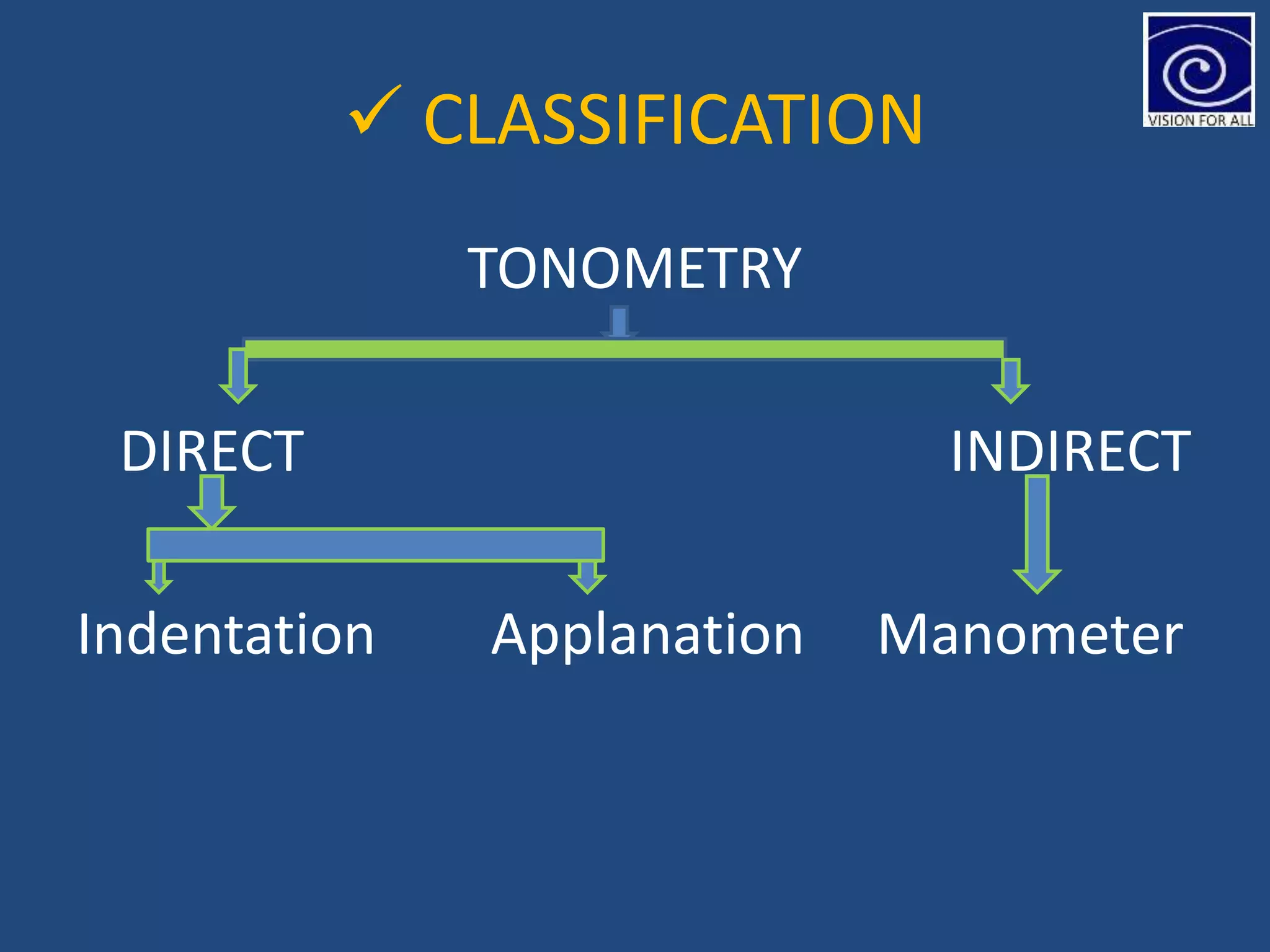
 CLASSIFICATION
TONOMETRY
DIRECT INDIRECT
Indentation Applanation Manometer
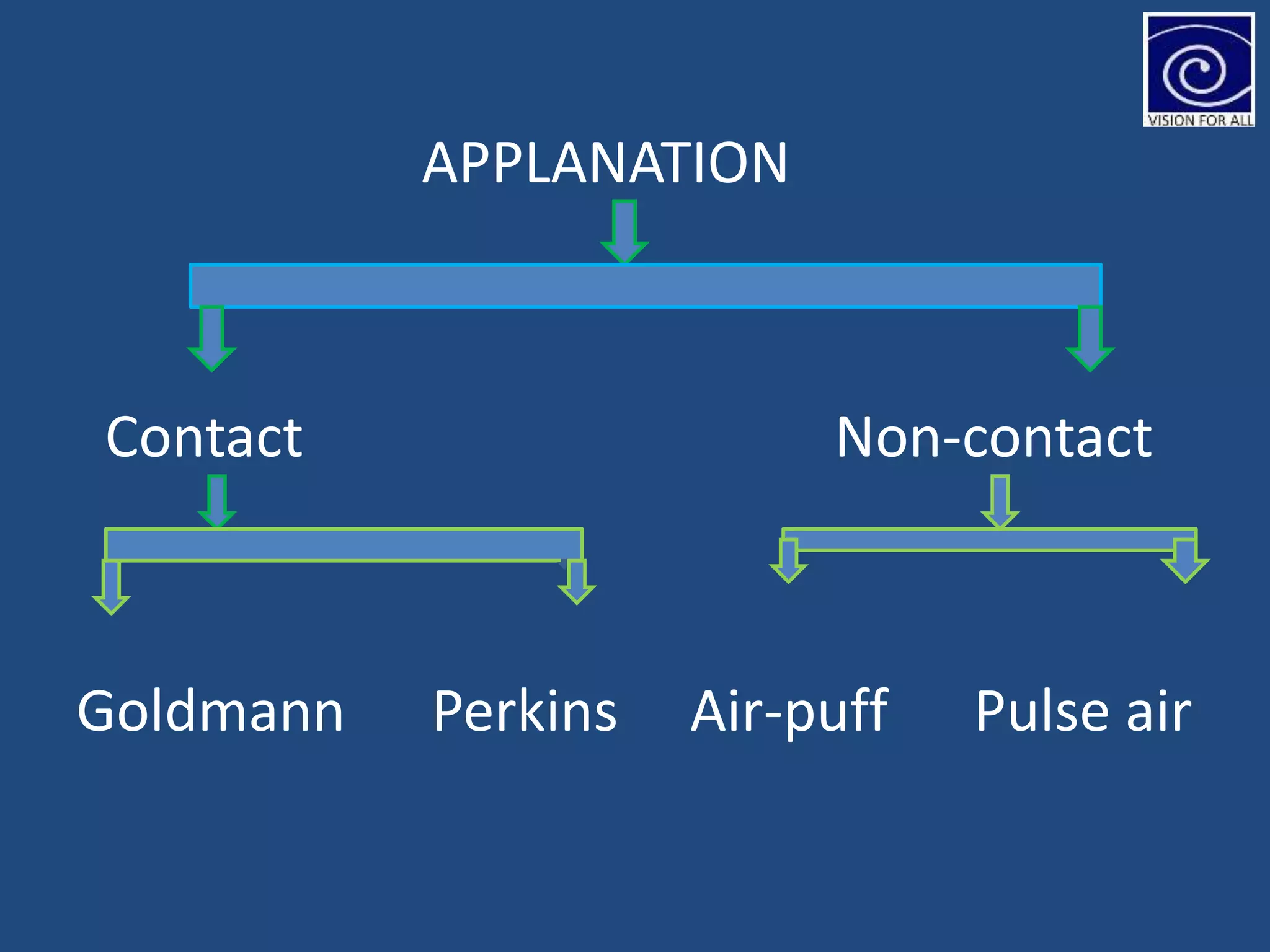
APPLANATION
Contact Non-contact
Goldmann Perkins Air-puff Pulse air
INDENTATION TONOMETER
• It is based on fundamental fact that
plunger will indent a soft eye more than
hard eye.
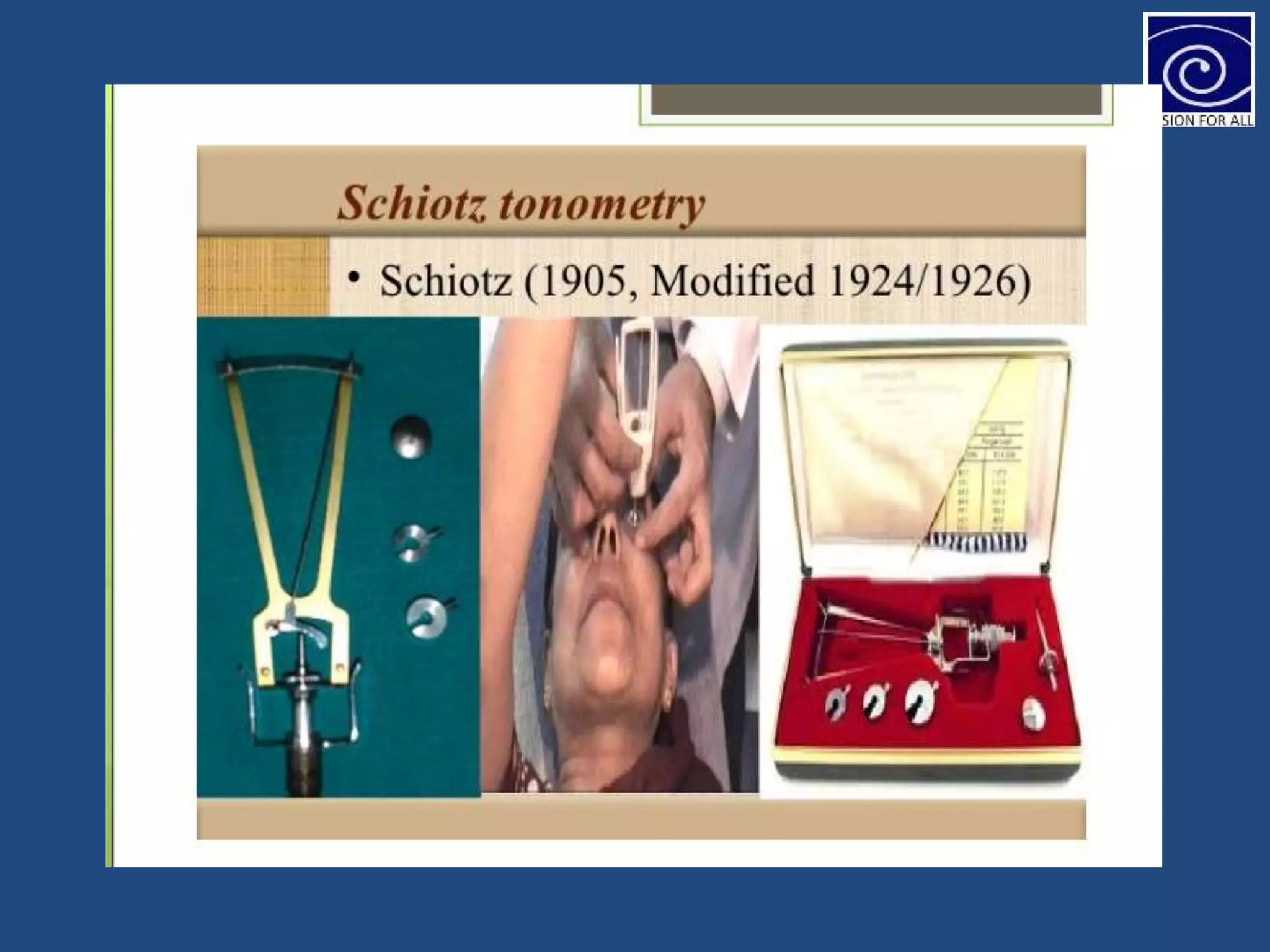
• The indentation tonometer in current
use is that of Schiotz .
• It was devised in 1905 and continued
to refine it through 1927.
PROCEDURE
• Patient should be anaesthetising with 4%
lignocaine or 0.5% proparacaine.
• with the patient in supine position, looking up
at a fixation target while examiners separates
the lids and lower the tonometer plate to rest
on the cornea so that plunger is free to move.
• The 5.5gm weight is initially used.
• If the scale reading is 4 or less , additional
weight is added.
ADVANTAGES
•Simple Technique
•Elegant design
•Portable
•No need for slit lamp or power supply
•Reasonably priced
•Widely used tonometer
Applanation tonometers
• Goldman tonometer
• Perkins applanation tonometer
• Pneumatic tonometer
• Tono pen
Goldmann tonometry
• The concept was introduced by goldmann in
1954
• It is based on IMBERT FICK LAW
• It states that the pressure inside an ideal
sphere (P) is equal to force (F) required to
flatten(A)
• P=F/A
Cont…
• Most popular and accurate tonometer.
• It consists of double prism mounted on slit
lamp.
• The prism applanates the cornea in an area of
3.06 mm diameter.
Technique
• Topical anesthesia
• Staining tear film with fluorescein.
• The cornea and biprisms are illuminated with
cobalt blue light.
• Biprism just touches the apex of cornea.
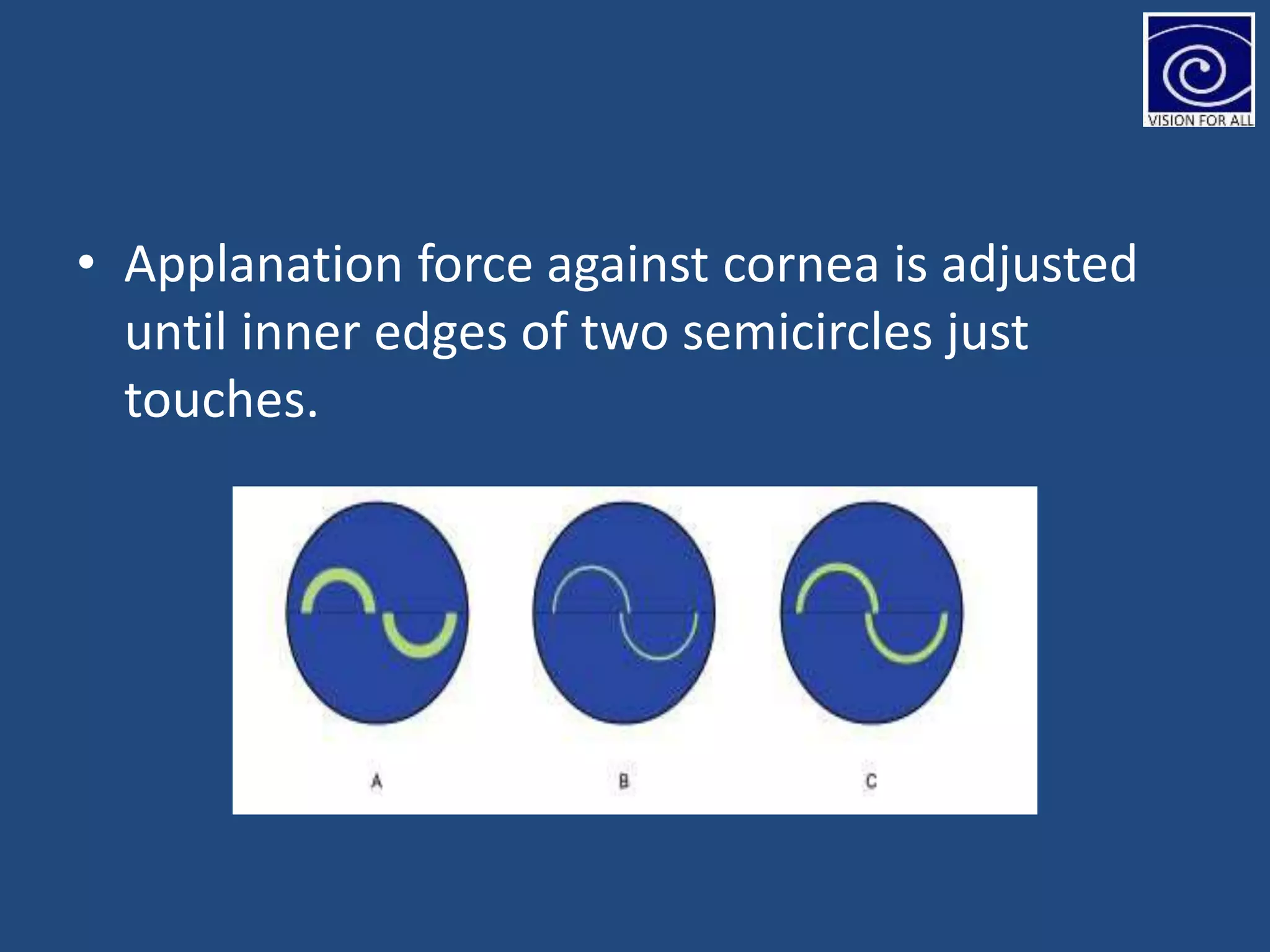
• At this point two fluorescent semicircles are
viewed through prism.
• Applanation force against cornea is adjusted
until inner edges of two semicircles just
touches.
Potential errors
• Patient related
• Thin cornea
• Thick cornea
• Astigmatism
• Irregular cornea
• Technical
• Tonometer out of calibration
• Repeated tonometry
• Pressing on the eyelids or globe
• Squeezing of the eyelids
Advantages
• Highly accurate
• Do not requires supine position
• portable
Disadvantages
• Not portable
• costly
• reading error if scares on cornea
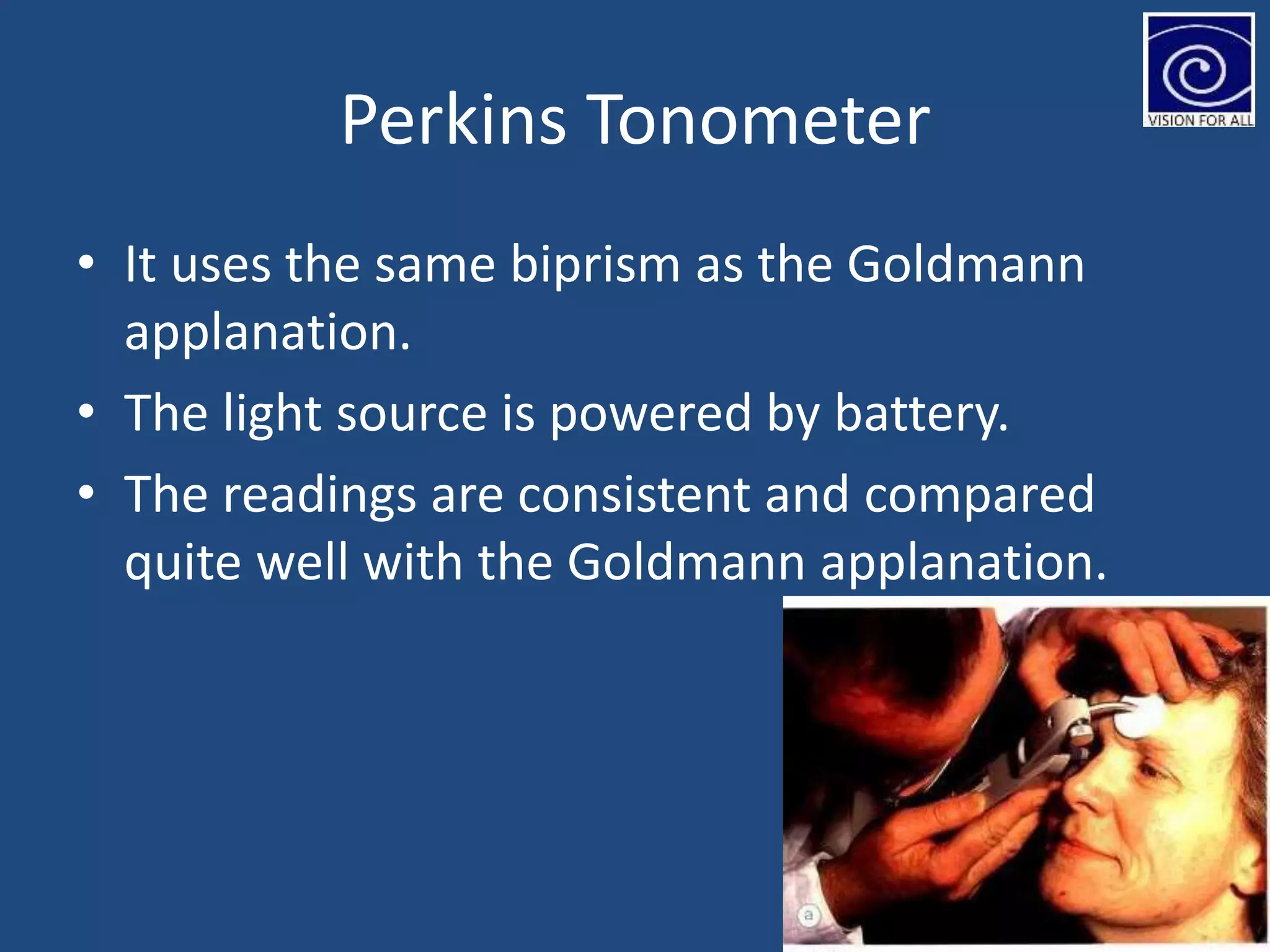
Perkins Tonometer
• It uses the same biprism as the Goldmann
applanation.
• The light source is powered by battery.
• The readings are consistent and compared
quite well with the Goldmann applanation.
Perkins Tonometer
• Perkins –
• Handheld
• Horizontal as well as vertical
• Infants, children, recumbent patients
Advantages
• Portable
• Does not requires electricity
Disadvantage
• It requires supine position
• Costly
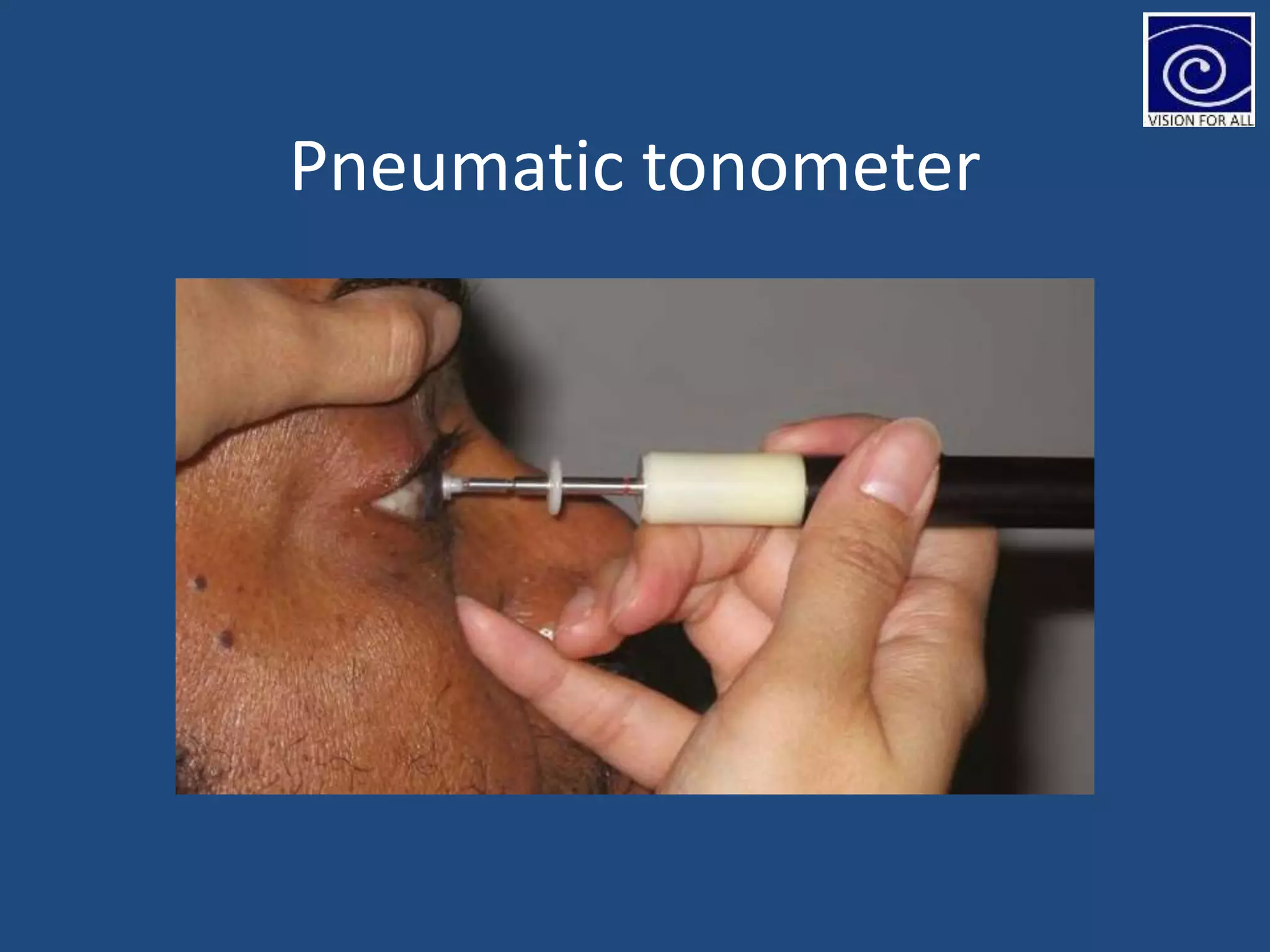
Pneumatic tonometer
• Cornea is applanated by touching apex by
silastic diaphragm covering sensing nozzle.
• It is connected to central chamber containing
pressurized air.
• There is pneumatic to electronic transducer.
• It converts the air pressure to recording on
paper strip and IOP is red.
Pneumatic tonometer
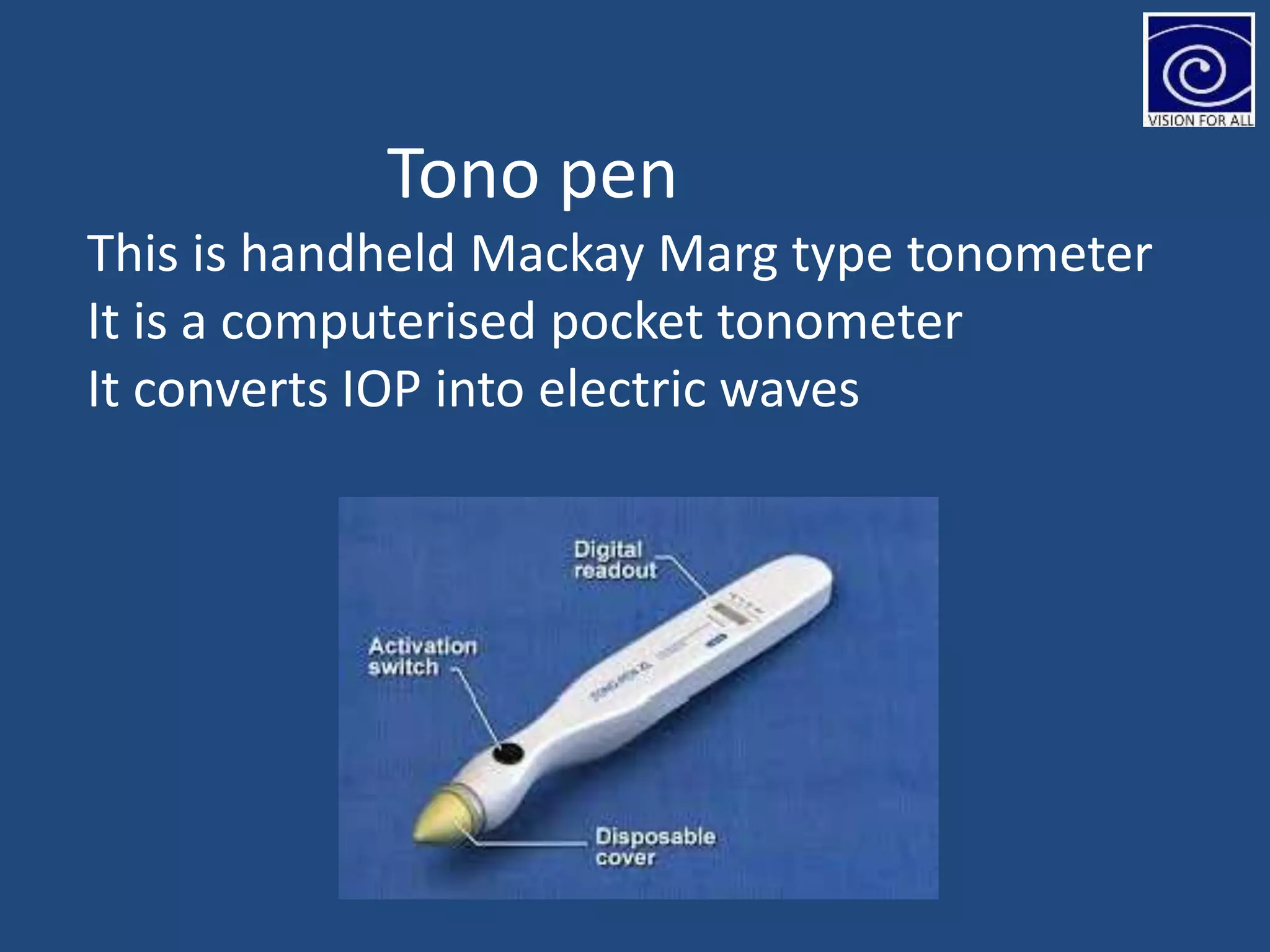
Tono pen
This is handheld Mackay Marg type tonometer
It is a computerised pocket tonometer
It converts IOP into electric waves
Cont…
• The wave form is internally analyzed by a
microprocessor.
• Three to six estimations of the pressure are
then averaged.
• The instrument is 18 cm in length and weighs
60 g.
NON-CONTACT TYPE
• Air puff tonometer :- In this central part of
cornea is flattened by a jet of air . This
tonometer is very good for mass screening as
there is no danger of cross infection and local
anaesthetic is not required.
• Pulse air tonometer :- It is a non-contact
tonometer that can be used with the patient
in any position.
THANK YOU

Tonometry ppt

  • 1.
    TOPIC:TONOMETRY MODERATOR: MS HUMANAAZ PRESENTER : DUSHYANT SINGH
  • 2.
    TONOMETRY • Tonometry isthe procedure performed to determine the intraocular pressure (IOP).
  • 3.
  • 4.
  • 5.
    INDENTATION TONOMETER • Itis based on fundamental fact that plunger will indent a soft eye more than hard eye. • The indentation tonometer in current use is that of Schiotz . • It was devised in 1905 and continued to refine it through 1927.
  • 6.
    PROCEDURE • Patient shouldbe anaesthetising with 4% lignocaine or 0.5% proparacaine. • with the patient in supine position, looking up at a fixation target while examiners separates the lids and lower the tonometer plate to rest on the cornea so that plunger is free to move. • The 5.5gm weight is initially used. • If the scale reading is 4 or less , additional weight is added.
  • 8.
    ADVANTAGES •Simple Technique •Elegant design •Portable •Noneed for slit lamp or power supply •Reasonably priced •Widely used tonometer
  • 9.
    Applanation tonometers • Goldmantonometer • Perkins applanation tonometer • Pneumatic tonometer • Tono pen
  • 10.
    Goldmann tonometry • Theconcept was introduced by goldmann in 1954 • It is based on IMBERT FICK LAW • It states that the pressure inside an ideal sphere (P) is equal to force (F) required to flatten(A) • P=F/A
  • 11.
    Cont… • Most popularand accurate tonometer. • It consists of double prism mounted on slit lamp. • The prism applanates the cornea in an area of 3.06 mm diameter.
  • 12.
    Technique • Topical anesthesia •Staining tear film with fluorescein. • The cornea and biprisms are illuminated with cobalt blue light. • Biprism just touches the apex of cornea. • At this point two fluorescent semicircles are viewed through prism.
  • 13.
    • Applanation forceagainst cornea is adjusted until inner edges of two semicircles just touches.
  • 14.
    Potential errors • Patientrelated • Thin cornea • Thick cornea • Astigmatism • Irregular cornea
  • 15.
    • Technical • Tonometerout of calibration • Repeated tonometry • Pressing on the eyelids or globe • Squeezing of the eyelids
  • 16.
    Advantages • Highly accurate •Do not requires supine position • portable Disadvantages • Not portable • costly • reading error if scares on cornea
  • 17.
    Perkins Tonometer • Ituses the same biprism as the Goldmann applanation. • The light source is powered by battery. • The readings are consistent and compared quite well with the Goldmann applanation.
  • 18.
    Perkins Tonometer • Perkins– • Handheld • Horizontal as well as vertical • Infants, children, recumbent patients
  • 19.
    Advantages • Portable • Doesnot requires electricity Disadvantage • It requires supine position • Costly
  • 20.
    Pneumatic tonometer • Corneais applanated by touching apex by silastic diaphragm covering sensing nozzle. • It is connected to central chamber containing pressurized air. • There is pneumatic to electronic transducer. • It converts the air pressure to recording on paper strip and IOP is red.
  • 21.
  • 22.
    Tono pen This ishandheld Mackay Marg type tonometer It is a computerised pocket tonometer It converts IOP into electric waves
  • 23.
    Cont… • The waveform is internally analyzed by a microprocessor. • Three to six estimations of the pressure are then averaged. • The instrument is 18 cm in length and weighs 60 g.
  • 24.
    NON-CONTACT TYPE • Airpuff tonometer :- In this central part of cornea is flattened by a jet of air . This tonometer is very good for mass screening as there is no danger of cross infection and local anaesthetic is not required. • Pulse air tonometer :- It is a non-contact tonometer that can be used with the patient in any position.
  • 25.