Aortic aneurysm
Dr rahul c
ANATOMY
• The aorta is the ultimate conduit, carrying, in an average lifetime,
almost 200 million litres of blood to the body.
• It is divided by the diaphragm into the thoracic and abdominal
aorta .
• The aortic wall is composed histologically of three layers:
• a thin inner tunica intima lined by the endothelium;
• a thick tunica media characterized by concentric sheets of elastic
and collagen fibres with the border zone of the lamina elastica
interna and -externa, as well as smooth muscle cells; it gives
elasticity to aorta and
• the outer tunica adventitia containing mainly collagen, vasa
vasorum, and lymphatics. Gives tensile strength
PHYSIOLOGY
• The aortic wall pressure – diameter relation is
nonlinear , a more distensible component at lower
pressure and stiffer component at higher pressure ,
with transition at 80 mm Hg .
• The pressure diameter curve becomes less steep with
ageing because
• 1) increase in collagen to elastin ratio
• 2) progressively disordered medial elastic fibres and
lamellae
• 3) an increase in aortic wall thickness with deposition
of collagen and calcification of elastic fibres
• 4) atherosclerotic changes leading to wall stiffness
• In healthy adults, aortic diameters do not usually
exceed 40 mm and taper gradually downstream.
• They are variably influenced by several factors
including age, gender, body size [height, weight, body
surface area (BSA)] and blood pressure.
• In this regard, the rate of aortic expansion is about 0.9
mm in men and 0.7 mm in women for each decade of
life.
• This slow but progressive aortic dilation over mid-to-
late adulthood is thought to be a consequence of
ageing, related to a higher collagen-to-elastin ratio,
along with increased stiffness and pulse pressure.
AORTIC ANEURYSM
• Aneurysm is the second most frequent disease
of the aorta after atherosclerosis.
Further anatomy
• Shapes of aneurysms
Fusiform when the whole circumference is
affected (ture)
Saccular when only part of the
circumference is involved. (false)
Classification
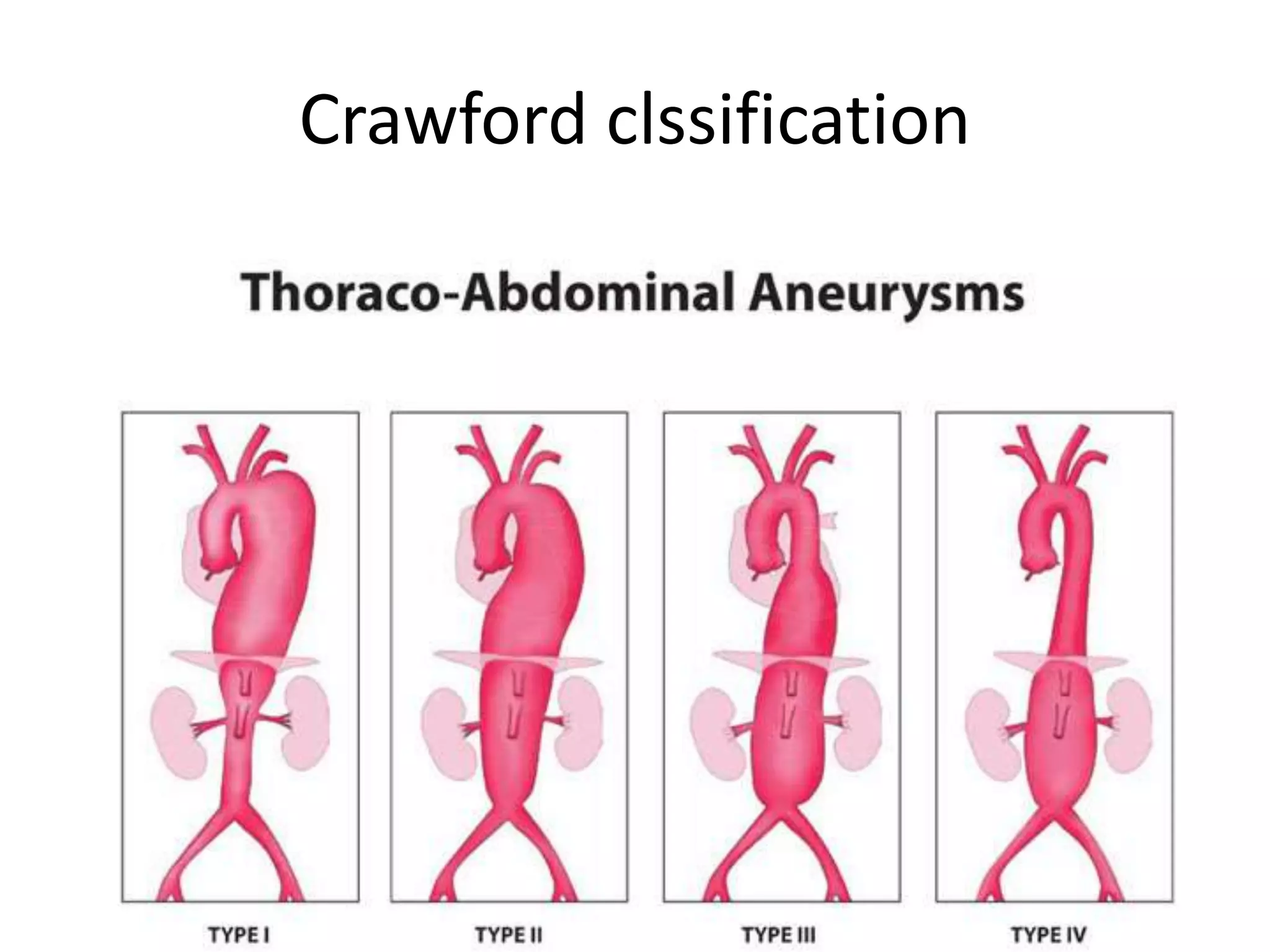
Crawford clssification
What are the risk factors for aortic
aneurysm?
• Some of the same risk factors for heart attack also
increase the risk of aortic aneurysm, including:
• Atherosclerosis (plaque in the artery walls)
• High blood pressure
• Diabetes
• High cholesterol
• Smoking
• Heredity
• Bicuspid aortic valve
• Injury or infection also can cause an aneurysm to
develop if the aorta walls weaken as a result.
Thoracic aortic aneurysm
• Estimated incidence is 5-10 per 100000
person-years.
• 60% involve aortic root/ ascending aorta
• 35 % descending aorta
• < 10% aortic arch
Etiology and pathogenesis
• Genetic - marfans, vascular ehler danlos syd, FTAA,
Loeys-Dietz syd , BAV, turners syd
• Degenerative
• Atherosclerotic
• Mechanical
• Inflammatory
• Infectious
• Cystic medial degeneration is basic pathology in many
conditions – degeneration and fragmentation of elastic
fibres , loss of smooth muscle cell ,increase in
deposition of collagen and replacement with interstitial
cysts .
Clinical manifestations
• While aortic diseases may be clinically silent in
many cases, a broad range of symptoms may be
related to different aortic diseases:
• Acute deep, aching or throbbing chest or
abdominal pain that can spread to the back,
buttocks, groin or legs, suggestive of AD or
other AAS, and best described as ‘feeling of
rupture’.
• Cough, shortness of breath, or difficult or
painful swallowing in large TAAs.
•
• Constant or intermittent abdominal pain or
discomfort, a pulsating feeling in the
abdomen, or feeling of fullness after minimal
food intake in large AAAs.
• Stroke, transient ischaemic attack, or
claudication secondary to aortic
atherosclerosis.
• Hoarseness due to left laryngeal nerve palsy
in rapidly progressing lesions.
Screening
• Thoracic aortic aneurysm is a virulent,
potentially lethal disease.
• It is also a predominantly silent disease.
• This combination of circumstances cries out
for discovery of biomarkers for this disease—
blood tests that can detect aneurysms in the
general population, monitor the progress of
an aneurysm, and predict complications in
those patients known to be affected.
Diagnosis and sizing
• The aorta is a complex geometric structure
and several measurements are useful to
characterize its shape and size .
• If feasible, diameter measurements should be
made perpendicular to the axis of flow of the
aorta.
• First, no imaging modality has perfect resolution and the
precise depiction of the aortic walls depends on whether
appropriate electrocardiogram (ECG) gating is employed.
• Also, reliable detection of aortic diameter at the same
aortic segment over time requires standardized
measurement; this includes similar determination of edges
(inner-to-inner, or leading edge-to-leading edge, or outer-to-outer diameter
measurement, according to the imaging modality).
• Whether the measurement should be done during systole
or diastole has not yet been accurately assessed, but
diastolic images give the best reproducibility.
• Inter- and intra-observer variability of CT for AAA are
approximately 5 mm and 3 mm, respectively.
• Thus, any change of >5 mm on serial CT can be considered
a significant change, but smaller changes are difficult to
interpret.
• Compared with CT, ultrasound systematically
underestimates AAA dimensions by an average of 1–3 mm.
• It is recommended that the identical imaging technique be
used for serial measurements and that all serial scans be
reviewed before making therapeutic decisions.
• Transthoracic echocardiography
• Echocardiographic evaluation of the aorta is a
routine part of the standard echocardiographic
examination.
• Although transthoracic echocardiography (TTE) is
not the technique of choice for full assessment of
the aorta.
• Transthoracic echocardiography also permits
assessment of the aortic valve, which is often
involved in diseases of the ascending aorta.
• Transthoracic echocardiography is an excellent
imaging modality for serial measurement of
maximal aortic root diameters, for evaluation
of aortic regurgitation, and timing for elective
surgery in cases of TAA.
• Abdominal ultrasound
• Abdominal ultrasound remains the mainstay
imaging modality for abdominal aortic
diseases because of its ability to accurately
measure the aortic size, to detect wall lesions
such as mural thrombus or plaques, and
because of its wide availability, painlessness,
and low cost.
• Computed tomography plays a central role in the
diagnosis, risk stratification, and management of aortic
diseases.
• Its advantages over other imaging modalities include
the short time required for image acquisition and
processing, the ability to obtain a complete 3D dataset
of the entire aorta, and its widespread availability.
• Electrocardiogram (ECG)-gated acquisition protocols
are crucial in reducing motion artefacts of the aortic
root and thoracic aorta.
• High-end MSCT scanners (16 detectors or higher) are
preferred for their higher spatial and temporal
resolution compared with lower-end devices.
Natural history
• TAA are relatively indolent with growth rate of
0.1-0.2 cm/year and marked individual variability.
• Mean rate of rupture or dissection –
• 2% /year for <5 cm
• 3% /year for 5- 5.9 cm
• 7% /year for > 6 cm
• Risk factors for increased growth and rupture –
• Older age , female sex, COPD , HTN, smoking
,pain, aortic dissection and family history .
Management
• Principles of medical therapy
• The main aim of medical therapy in this condition
is to reduce shear stress on the diseased segment
of the aorta by reducing blood pressure and
cardiac contractility.
• Cessation of smoking is important
• Moderate physical activity probably prevents the
progression of aortic atherosclerosis but data are
sparse.
• competitive sports should be avoided in patients
with an enlarged aorta.
• In chronic conditions, blood pressure should be
controlled below 140/90 mm Hg, with lifestyle changes
and use of antihypertensive drugs, if necessary.
• An ideal treatment would be the one that reverses the
formation of an aneurysm.
• In patients with Marfan syndrome, prophylactic use of
beta-blockers, angiotensin-converting enzyme (ACE)
inhibitor, and angiotensin II receptor blocker seem to
be able to reduce either the progression of the aortic
dilation or the occurrence of complications.
Open vs. EVAR
• Open Surgical Repair
– Longer Recovery Time
– Longer Hospital Stay
– 90% Long Term Success
– Younger patients typically
• EVAR
– Shorter length of stay
– Reduction in blood loss
– Reduction in OR Time
– ICU utilization reduced
– Reduced 30 d
morbidity/mortality
– Older patients typically
– Needs long-term follow-up
– May need secondary procedures
for endoleaks
EVAR
• EVAR is performed by retrograde transarterial
advancement of a large delivery device (up to 24 F) carrying
the collapsed self-expandable stent-graft.
• Either TOE or IVUS can be helpful in identifying the correct
position of the guide wire within the TL.
• When the target position is reached, the blood pressure is
reduced—either pharmacologically (nitroprusside or
adenosine, ,80 mm Hg systolic) or using rapid right
ventricular pacing—to avoid downstream displacement,
and the stent-graft is then deployed.
• Completion angiography is performed to detect any
proximal Type I endoleak (an insufficient proximal seal),
which usually mandates immediate treatment.
Abdominal aortic aneurysm
• It is defined by increase in size > 3 cm
• Most common form of aortic aneurysm
• Infra-renal 80%
• M : F - 5:1
Etiology and pathogenesis
• Smoking
• Emphysema
• Hypertension
• Hyperlipidemia
• Family history
Clinical manifestations
• It rarely cause any symptoms in absence of
distal thromboembolism .
Diagnosis and sizing
• Abdominal ultrasound have high accuracy and
a sensitivity and specificity of almost 100% in
detecting AAA.
• It is prefered over CT in screening.
• Many recommend use of ultrasound for f/u of
small AAA and CT/ MRI for larger AAA.
Natural history
• Average rate of expansion is 0.2 to 0.3 cm/year
• 1 year risk of rupture –
• 10-20% for aaa 6-7 cm
• 20-40% for aaa 7-8 cm
• 30-50% for aaa > 8 cm
• 5 year risk of rupture –
• 5% for 3-4 cm
• 10-20% for 4-5.5 cm
• 30-40% for 5.5-6.0 cm
• >80% for > 7 cm
Management
Abdominal endovascular aortic repair
• Endovascular aortic repair is performed to prevent infrarenal AAA
rupture.
• Similarly to TEVAR, careful pre-procedural planning by contrast-
enhanced CT is essential.
• The proximal aortic neck (defined as the normal aortic segment
between the lowest renal artery and the most cephalad extent of
the aneurysm) should have a length of at least 10–15 mm and
should not exceed 32 mmin diameter.
• Angulation above 60 degree of the proximal neck increases the risk
of device migration and endoleak.
• The ilio-femoral axis has to be evaluated by CT, since large delivery
devices (14–24 F) are being used.
• Currently several stent-grafts are available, mostly
comprising a self-expanding nitinol skeleton covered
with a polyester or polytetrafluroethylene membrane.
• To provide an optimal seal, the stent-graft diameter
should be oversized by 10–20% according to the aortic
diameter at the proximal neck.
• Bifurcated stent-grafts are used in most cases; tube
grafts may only be used in patients with localized
pseudoaneurysms of the infrarenal aorta.
Evaluation for EVAR
Contraindications for EVAR
Short of proximal neck
Thrombus present in proximal landing zone
Conical proximal neck
Greater than 120º angulations of the proximal
neck
Critical inferior mesenteric artery
Significant iliac occlusion
Torture of iliac vessels
EVAR complications
Deployment related
Failed deployment
Bleeding
Hematoma
Lymphocel
Infection
Embolization
Perforation
Arterial rupture
Dissection
Device related
Structural failure
Implant related
Endoleaks
Limb occlusion/stent-graft kink
Sac enlargement/proximal neck
dilatation
Stent migration
AAA rupture
Infection
Buttock/leg claudication
EVAR complications
Systemic
Cardiac
Pulmonary
Renal insufficiency, contrast-induced neuropathy
Deep vein trombosis
Pulmonary embolism
Coagulopathy
Bowel ischemia
Spinal cord ischemia
Classification of Endoleaks
I: Attachment site leaks
A. Proximal end of endograft
B. Distal end of endograft
C. Iliac occluder ( plug )
II. Branch leaks ( without attachment side connection )
A. Simple or to-and-fro (from only 1 patient branch)
B. Complex or flow-through ( with 2 or more patient branches).
III. Graft defect
A. Junction leak or modulator disconnect
B. Fabric disruption ( midgraft hole )
IV. Graft wall ( fabric ) porosity ( <30 days after graft placement )
Surgery
• Ascending aorta
• Themain principle of surgery for ascending aortic
aneurysms is that of preventing the risk of dissection or
rupture by restoring the normal dimension of the
ascending aorta.
• If the aneurysm is proximally limited to the sinotubular
junction and distally to the aortic arch, resection of the
aneurysm and supra-commissural implantation of a
tubular graft is performed under a short period of
aortic clamping, with the distal anastomosis just below
the aortic arch.
• If the aneurysm extends proximally below the
sinotubular junction and one or more aortic
sinuses are dilated, the surgical repair is guided
by the extent of involvement of the aortic
annulus and the aortic valve.
• Surgical mortality for isolated elective
replacement of the ascending aorta (including
the aortic root) ranges from 1.6–4.8% and is
dependent largely on age and other well-known
cardiovascular risk factors at the time of
operation.
• Descending aorta
• The surgical approach to the descending aorta is
a left thoracotomy between the fourth and
seventh intercostal spaces, depending on the
extension of the aortic pathology .
• Established methods for operation of the
descending aorta include the left heart bypass
technique, the partial bypass, and the operation
in deep hypothermic circulatory arrest.
• Thoraco-abdominal aorta
• When the disease affects both the descending thoracic
and abdominal aorta, the surgical approach is a left
thoracotomy extended to paramedian laparotomy.
• Therisk of paraplegia after thoraco-abdominal repair is
in the range of 6–8%.
• Measures to reduce this include permissive systemic
hypothermia (34degree C), reattachment of distal
intercostal arteries between T8 and L1, and the pre-
operative placement of cerebrospinal fluid drainage.
• Abdominal aorta
• Open abdominal aortic repair usually involves a
standardmedian laparotomy, but may also be
performed through a left retroperitoneal approach.
• The aneurysmal aorta is replaced either by a tube or
bifurcated graft, according to the extent of aneurysmal
disease into the iliac arteries.
• Theexcluded aneurysmis not resected, but is closed
over the graft, which has a haemostatic effect and
ensures that the duodenum is not in contact with the
graft, as this may lead to erosion and a possible
subsequent aorto-enteric fistula.
EVAR VS OSR
• For a subset of AAA patients, all being
anatomically and physiologically eligible for
both conventional EVAR and open repair, a
head-to-head comparison of the two
techniques was prompted
• In individuals considered fit for conventional surgery, EVAR
was associated with lower short-term mortality than OSR.
• All-cause mortality with EVAR was significantly lower than
that with OSR in the short term, with the benefit
disappearing in the intermediate and long term.
• Operative complications, QoL and sexual dysfunction were
generally comparable between EVAR and OSR.
• However, there was a slightly higher incidence of
pulmonary complications in the OSR group compared with
the EVAR group.
• EVAR was associated with a higher reintervention rate than
OSR.
• Most reinterventions with EVAR, however, were catheter-
based interventions associated with low mortality.
• In individuals considered unfit for open surgery, the results
of a single trial found no short- or long-term benefits of
EVAR over no intervention with regard to all-cause
mortality, but individual outcomes may differ and individual
preferences should always be taken into account.
RECOMMENDATIONS
Recommendation for Medical Treatment
of Patients With Thoracic Aortic Diseases
• Class I
• Stringent control of hypertension, lipid profile
optimization, smoking cessation, and other
atherosclerosis risk-reduction measures should
be instituted for patients with small aneurysms
not requiring surgery, as well as for patients who
are not considered surgical or stent graft
candidates. (LOE: C)
Recommendations for Asymptomatic
Patients With Ascending Aortic Aneurysm
• Class I
• 1. Asymptomatic patients with degenerative thoracic aneurysm,
chronic aortic dissection, intramural hematoma, penetrating
atherosclerotic ulcer, mycotic aneurysm, or pseudoaneurysm, who
are otherwise suitable candidates and for whom the ascending
aorta or aortic sinus diameter is 5.5 cm or greater should be
evaluated for surgical repair. (LOE: C)
• 2. Patients with Marfan syndrome or other genetically mediated
disorders (vascular Ehlers- Danlos syndrome, Turner syndrome,
bicuspid aortic valve, or familial thoracic aortic aneurysm and
dissection) should undergo elective operation at smaller diameters
(4.0 to 5.0 cm depending on the condition) to avoid acute
dissection or rupture. (LOE: C)
• 3. Patients with a growth rate of more than
0.5 cm/y in an aorta that is less than 5.5 cm in
diameter should be considered for operation.
(LOE: C)
• 4. Patients undergoing aortic valve repair or
replacement and who have an ascending
aorta or aortic root of greater than 4.5 cm
should be considered for concomitant repair
of the aortic root or replacement of the
ascending aorta. (LOE: C)
• Class IIa
• 1. Elective aortic replacement is reasonable for patients with
Marfan syndrome, other genetic diseases, or bicuspid aortic valves,
when the ratio of maximal ascending or aortic root area (Π r2) in
cm2 divided by the patient’s height in meters exceeds 10. (LOE: C)
• 2. It is reasonable for patients with Loeys-Dietz syndrome or a
confirmed TGFBR1 or TGFBR2 mutation to undergo aortic repair
when the aortic diameter reaches 4.2 cm or greater by
transesophageal echocardiogram (internal diameter) or 4.4 to 4.6
cm or greater by computed tomographic imaging and/or magnetic
resonance imaging (external diameter). (LOE: C)
Recommendation for Symptomatic Patients With
Thoracic Aortic Aneurysm
• Class I
• 1. Patients with symptoms suggestive of
expansion of a thoracic aneurysm should be
evaluated for prompt surgical intervention
unless life expectancy from comorbid
conditions is limited or quality of life is
substantially impaired. (LOE: C)
Recommendations for Aortic Arch
Aneurysms
• Class IIa
• 1. For thoracic aortic aneurysms also involving the proximal
aortic arch, partial arch replacement together with ascending
aorta repair using right subclavian/ axillary artery inflow and
hypothermic circulatory arrest is reasonable. (LOE: B)
• 2. Replacement of the entire aortic arch is reasonable for acute
dissection when the arch is aneurysmal or there is extensive
aortic arch destruction and leakage. (LOE: B)
• 3. Replacement of the entire aortic arch is reasonable for
aneurysms of the entire arch, for chronic dissection when the
arch is enlarged, and for distal arch aneurysms that also involve
the proximal descending thoracic aorta. (LOE: B)
• 4.For patients with low operative risk in whom an isolated
degenerative or atherosclerotic aneurysm of the aortic arch is
present, operative treatment is reasonable for asymptomatic
patients when the diameter of the arch exceeds 5.5 cm. (LOE: B)
• 5. For patients with isolated aortic arch aneurysms less than 4.0 cm
in diameter, it is reasonable to reimage using computed
tomographic imaging or magnetic resonance imaging, at 12-month
intervals, to detect enlargement of the aneurysm. (LOE: C)
• 6. For patients with isolated aortic arch aneurysms 4.0 cm or
greater in diameter, it is reasonable to reimage using computed
tomographic imaging or magnetic resonance imaging, at 6-month
intervals, to detect enlargement of the aneurysm. (LOE: C)
Recommendations for Descending Thoracic Aorta and
Thoraco-abdominal Aortic Aneurysms
• Class I
• 1. For patients with chronic dissection, particularly if
associated with a connective tissue disorder, but
without significant comorbid disease, and a descending
thoracic aortic diameter exceeding 5.5 cm, open
repair is recommended. (LOE: B)
• 2. For patients with degenerative or traumatic
aneurysms of the descending thoracic aorta exceeding
5.5 cm, saccular aneurysms, or postoperative
pseudoaneurysms, endovascular stent grafting should
be strongly considered when feasible. (LOE: B)
• 3. For patients with thoracoabdominal aneurysms, in
whom endovascular stent graft options are limited and
surgical morbidity is elevated, elective surgery is
recommended if the aortic diameter exceeds 6.0 cm,
or less if a connective tissue disorder such as Marfan or
Loeys-Dietz syndrome is present. (LOE: C)
• 4. For patients with thoracoabdominal aneurysms and
with end-organ ischemia or significant stenosis from
atherosclerotic visceral artery disease, an additional
revascularization procedure is recommended. (LOE: B)
Advances in Diagnosis and
Treatment Envisioned for the Near
Future
Advances in Diagnosis and
Treatment Envisioned for the Near Future
• One may fairly expect to see the following major
advances in diagnosis and treatment of aortic
diseases in the relatively near future:
• Population screening will be improved, first by
general recognition in the medical community of
the familial patterns of aortic disease and then by
novel (genetic) mass screening techniques.
• • Selection criteria for surgical intervention will
go beyond symptoms and size.
• We anticipate that the following modalities may be
applied:
• Biomarkers that indicate impending rupture or dissection
may come into play (including potential RNA expression
indexes).
• Mechanical properties of the aorta (distensibility and wall
tension) may be assessed noninvasively and applied as
intervention criteria.
• Imaging modalities (including positron emission
tomography) may be found to be predictive of aneurysm
“activity” and guide timing of surgery.
• • Stent therapies may advance to achieve truly
durable results (in contradistinction to currently
disappointing lack of effectiveness in preventing
death or rupture).
• This may require shifts in the design of
endovascular prostheses.
• • Genetic elucidation of these diseases will
advance even further, permitting enhanced
understanding of the pathophysiology of
aneurysm disease and improved diagnosis.
•
• Understanding of genetic alterations resulting in aneurysms
may suggest avenues to pharmacologic therapy (with
conventional drugs designed to shortcircuit the mechanism
of aneurysm formation and progression).
• In particular, we look forward to seeing whether the
angiotensin receptor blocker drug losartan meets its high
expectations.
• Understanding of genetic alterations may ultimately permit
gene therapy in children or adults to prevent the
development or progression of aortic diseases.
Thank
you

Aortic aneurysm final

  • 1.
  • 2.
    ANATOMY • The aortais the ultimate conduit, carrying, in an average lifetime, almost 200 million litres of blood to the body. • It is divided by the diaphragm into the thoracic and abdominal aorta . • The aortic wall is composed histologically of three layers: • a thin inner tunica intima lined by the endothelium; • a thick tunica media characterized by concentric sheets of elastic and collagen fibres with the border zone of the lamina elastica interna and -externa, as well as smooth muscle cells; it gives elasticity to aorta and • the outer tunica adventitia containing mainly collagen, vasa vasorum, and lymphatics. Gives tensile strength
  • 4.
    PHYSIOLOGY • The aorticwall pressure – diameter relation is nonlinear , a more distensible component at lower pressure and stiffer component at higher pressure , with transition at 80 mm Hg . • The pressure diameter curve becomes less steep with ageing because • 1) increase in collagen to elastin ratio • 2) progressively disordered medial elastic fibres and lamellae • 3) an increase in aortic wall thickness with deposition of collagen and calcification of elastic fibres • 4) atherosclerotic changes leading to wall stiffness
  • 5.
    • In healthyadults, aortic diameters do not usually exceed 40 mm and taper gradually downstream. • They are variably influenced by several factors including age, gender, body size [height, weight, body surface area (BSA)] and blood pressure. • In this regard, the rate of aortic expansion is about 0.9 mm in men and 0.7 mm in women for each decade of life. • This slow but progressive aortic dilation over mid-to- late adulthood is thought to be a consequence of ageing, related to a higher collagen-to-elastin ratio, along with increased stiffness and pulse pressure.
  • 6.
    AORTIC ANEURYSM • Aneurysmis the second most frequent disease of the aorta after atherosclerosis.
  • 7.
  • 8.
    Fusiform when thewhole circumference is affected (ture) Saccular when only part of the circumference is involved. (false)
  • 9.
  • 10.
  • 11.
    What are therisk factors for aortic aneurysm? • Some of the same risk factors for heart attack also increase the risk of aortic aneurysm, including: • Atherosclerosis (plaque in the artery walls) • High blood pressure • Diabetes • High cholesterol • Smoking • Heredity • Bicuspid aortic valve • Injury or infection also can cause an aneurysm to develop if the aorta walls weaken as a result.
  • 12.
    Thoracic aortic aneurysm •Estimated incidence is 5-10 per 100000 person-years. • 60% involve aortic root/ ascending aorta • 35 % descending aorta • < 10% aortic arch
  • 13.
    Etiology and pathogenesis •Genetic - marfans, vascular ehler danlos syd, FTAA, Loeys-Dietz syd , BAV, turners syd • Degenerative • Atherosclerotic • Mechanical • Inflammatory • Infectious • Cystic medial degeneration is basic pathology in many conditions – degeneration and fragmentation of elastic fibres , loss of smooth muscle cell ,increase in deposition of collagen and replacement with interstitial cysts .
  • 14.
    Clinical manifestations • Whileaortic diseases may be clinically silent in many cases, a broad range of symptoms may be related to different aortic diseases: • Acute deep, aching or throbbing chest or abdominal pain that can spread to the back, buttocks, groin or legs, suggestive of AD or other AAS, and best described as ‘feeling of rupture’. • Cough, shortness of breath, or difficult or painful swallowing in large TAAs. •
  • 15.
    • Constant orintermittent abdominal pain or discomfort, a pulsating feeling in the abdomen, or feeling of fullness after minimal food intake in large AAAs. • Stroke, transient ischaemic attack, or claudication secondary to aortic atherosclerosis. • Hoarseness due to left laryngeal nerve palsy in rapidly progressing lesions.
  • 16.
  • 17.
    • Thoracic aorticaneurysm is a virulent, potentially lethal disease. • It is also a predominantly silent disease. • This combination of circumstances cries out for discovery of biomarkers for this disease— blood tests that can detect aneurysms in the general population, monitor the progress of an aneurysm, and predict complications in those patients known to be affected.
  • 19.
    Diagnosis and sizing •The aorta is a complex geometric structure and several measurements are useful to characterize its shape and size . • If feasible, diameter measurements should be made perpendicular to the axis of flow of the aorta.
  • 20.
    • First, noimaging modality has perfect resolution and the precise depiction of the aortic walls depends on whether appropriate electrocardiogram (ECG) gating is employed. • Also, reliable detection of aortic diameter at the same aortic segment over time requires standardized measurement; this includes similar determination of edges (inner-to-inner, or leading edge-to-leading edge, or outer-to-outer diameter measurement, according to the imaging modality). • Whether the measurement should be done during systole or diastole has not yet been accurately assessed, but diastolic images give the best reproducibility.
  • 21.
    • Inter- andintra-observer variability of CT for AAA are approximately 5 mm and 3 mm, respectively. • Thus, any change of >5 mm on serial CT can be considered a significant change, but smaller changes are difficult to interpret. • Compared with CT, ultrasound systematically underestimates AAA dimensions by an average of 1–3 mm. • It is recommended that the identical imaging technique be used for serial measurements and that all serial scans be reviewed before making therapeutic decisions.
  • 22.
    • Transthoracic echocardiography •Echocardiographic evaluation of the aorta is a routine part of the standard echocardiographic examination. • Although transthoracic echocardiography (TTE) is not the technique of choice for full assessment of the aorta. • Transthoracic echocardiography also permits assessment of the aortic valve, which is often involved in diseases of the ascending aorta.
  • 23.
    • Transthoracic echocardiographyis an excellent imaging modality for serial measurement of maximal aortic root diameters, for evaluation of aortic regurgitation, and timing for elective surgery in cases of TAA.
  • 24.
    • Abdominal ultrasound •Abdominal ultrasound remains the mainstay imaging modality for abdominal aortic diseases because of its ability to accurately measure the aortic size, to detect wall lesions such as mural thrombus or plaques, and because of its wide availability, painlessness, and low cost.
  • 25.
    • Computed tomographyplays a central role in the diagnosis, risk stratification, and management of aortic diseases. • Its advantages over other imaging modalities include the short time required for image acquisition and processing, the ability to obtain a complete 3D dataset of the entire aorta, and its widespread availability. • Electrocardiogram (ECG)-gated acquisition protocols are crucial in reducing motion artefacts of the aortic root and thoracic aorta. • High-end MSCT scanners (16 detectors or higher) are preferred for their higher spatial and temporal resolution compared with lower-end devices.
  • 27.
    Natural history • TAAare relatively indolent with growth rate of 0.1-0.2 cm/year and marked individual variability. • Mean rate of rupture or dissection – • 2% /year for <5 cm • 3% /year for 5- 5.9 cm • 7% /year for > 6 cm • Risk factors for increased growth and rupture – • Older age , female sex, COPD , HTN, smoking ,pain, aortic dissection and family history .
  • 28.
    Management • Principles ofmedical therapy • The main aim of medical therapy in this condition is to reduce shear stress on the diseased segment of the aorta by reducing blood pressure and cardiac contractility. • Cessation of smoking is important • Moderate physical activity probably prevents the progression of aortic atherosclerosis but data are sparse. • competitive sports should be avoided in patients with an enlarged aorta.
  • 29.
    • In chronicconditions, blood pressure should be controlled below 140/90 mm Hg, with lifestyle changes and use of antihypertensive drugs, if necessary. • An ideal treatment would be the one that reverses the formation of an aneurysm. • In patients with Marfan syndrome, prophylactic use of beta-blockers, angiotensin-converting enzyme (ACE) inhibitor, and angiotensin II receptor blocker seem to be able to reduce either the progression of the aortic dilation or the occurrence of complications.
  • 30.
    Open vs. EVAR •Open Surgical Repair – Longer Recovery Time – Longer Hospital Stay – 90% Long Term Success – Younger patients typically • EVAR – Shorter length of stay – Reduction in blood loss – Reduction in OR Time – ICU utilization reduced – Reduced 30 d morbidity/mortality – Older patients typically – Needs long-term follow-up – May need secondary procedures for endoleaks
  • 31.
    EVAR • EVAR isperformed by retrograde transarterial advancement of a large delivery device (up to 24 F) carrying the collapsed self-expandable stent-graft. • Either TOE or IVUS can be helpful in identifying the correct position of the guide wire within the TL. • When the target position is reached, the blood pressure is reduced—either pharmacologically (nitroprusside or adenosine, ,80 mm Hg systolic) or using rapid right ventricular pacing—to avoid downstream displacement, and the stent-graft is then deployed. • Completion angiography is performed to detect any proximal Type I endoleak (an insufficient proximal seal), which usually mandates immediate treatment.
  • 34.
    Abdominal aortic aneurysm •It is defined by increase in size > 3 cm • Most common form of aortic aneurysm • Infra-renal 80% • M : F - 5:1
  • 35.
    Etiology and pathogenesis •Smoking • Emphysema • Hypertension • Hyperlipidemia • Family history
  • 36.
    Clinical manifestations • Itrarely cause any symptoms in absence of distal thromboembolism .
  • 38.
    Diagnosis and sizing •Abdominal ultrasound have high accuracy and a sensitivity and specificity of almost 100% in detecting AAA. • It is prefered over CT in screening. • Many recommend use of ultrasound for f/u of small AAA and CT/ MRI for larger AAA.
  • 39.
    Natural history • Averagerate of expansion is 0.2 to 0.3 cm/year • 1 year risk of rupture – • 10-20% for aaa 6-7 cm • 20-40% for aaa 7-8 cm • 30-50% for aaa > 8 cm • 5 year risk of rupture – • 5% for 3-4 cm • 10-20% for 4-5.5 cm • 30-40% for 5.5-6.0 cm • >80% for > 7 cm
  • 40.
  • 41.
    Abdominal endovascular aorticrepair • Endovascular aortic repair is performed to prevent infrarenal AAA rupture. • Similarly to TEVAR, careful pre-procedural planning by contrast- enhanced CT is essential. • The proximal aortic neck (defined as the normal aortic segment between the lowest renal artery and the most cephalad extent of the aneurysm) should have a length of at least 10–15 mm and should not exceed 32 mmin diameter. • Angulation above 60 degree of the proximal neck increases the risk of device migration and endoleak. • The ilio-femoral axis has to be evaluated by CT, since large delivery devices (14–24 F) are being used.
  • 42.
    • Currently severalstent-grafts are available, mostly comprising a self-expanding nitinol skeleton covered with a polyester or polytetrafluroethylene membrane. • To provide an optimal seal, the stent-graft diameter should be oversized by 10–20% according to the aortic diameter at the proximal neck. • Bifurcated stent-grafts are used in most cases; tube grafts may only be used in patients with localized pseudoaneurysms of the infrarenal aorta.
  • 43.
    Evaluation for EVAR Contraindicationsfor EVAR Short of proximal neck Thrombus present in proximal landing zone Conical proximal neck Greater than 120º angulations of the proximal neck Critical inferior mesenteric artery Significant iliac occlusion Torture of iliac vessels
  • 44.
    EVAR complications Deployment related Faileddeployment Bleeding Hematoma Lymphocel Infection Embolization Perforation Arterial rupture Dissection Device related Structural failure Implant related Endoleaks Limb occlusion/stent-graft kink Sac enlargement/proximal neck dilatation Stent migration AAA rupture Infection Buttock/leg claudication
  • 45.
    EVAR complications Systemic Cardiac Pulmonary Renal insufficiency,contrast-induced neuropathy Deep vein trombosis Pulmonary embolism Coagulopathy Bowel ischemia Spinal cord ischemia
  • 46.
    Classification of Endoleaks I:Attachment site leaks A. Proximal end of endograft B. Distal end of endograft C. Iliac occluder ( plug ) II. Branch leaks ( without attachment side connection ) A. Simple or to-and-fro (from only 1 patient branch) B. Complex or flow-through ( with 2 or more patient branches). III. Graft defect A. Junction leak or modulator disconnect B. Fabric disruption ( midgraft hole ) IV. Graft wall ( fabric ) porosity ( <30 days after graft placement )
  • 51.
    Surgery • Ascending aorta •Themain principle of surgery for ascending aortic aneurysms is that of preventing the risk of dissection or rupture by restoring the normal dimension of the ascending aorta. • If the aneurysm is proximally limited to the sinotubular junction and distally to the aortic arch, resection of the aneurysm and supra-commissural implantation of a tubular graft is performed under a short period of aortic clamping, with the distal anastomosis just below the aortic arch.
  • 52.
    • If theaneurysm extends proximally below the sinotubular junction and one or more aortic sinuses are dilated, the surgical repair is guided by the extent of involvement of the aortic annulus and the aortic valve. • Surgical mortality for isolated elective replacement of the ascending aorta (including the aortic root) ranges from 1.6–4.8% and is dependent largely on age and other well-known cardiovascular risk factors at the time of operation.
  • 53.
    • Descending aorta •The surgical approach to the descending aorta is a left thoracotomy between the fourth and seventh intercostal spaces, depending on the extension of the aortic pathology . • Established methods for operation of the descending aorta include the left heart bypass technique, the partial bypass, and the operation in deep hypothermic circulatory arrest.
  • 54.
    • Thoraco-abdominal aorta •When the disease affects both the descending thoracic and abdominal aorta, the surgical approach is a left thoracotomy extended to paramedian laparotomy. • Therisk of paraplegia after thoraco-abdominal repair is in the range of 6–8%. • Measures to reduce this include permissive systemic hypothermia (34degree C), reattachment of distal intercostal arteries between T8 and L1, and the pre- operative placement of cerebrospinal fluid drainage.
  • 55.
    • Abdominal aorta •Open abdominal aortic repair usually involves a standardmedian laparotomy, but may also be performed through a left retroperitoneal approach. • The aneurysmal aorta is replaced either by a tube or bifurcated graft, according to the extent of aneurysmal disease into the iliac arteries. • Theexcluded aneurysmis not resected, but is closed over the graft, which has a haemostatic effect and ensures that the duodenum is not in contact with the graft, as this may lead to erosion and a possible subsequent aorto-enteric fistula.
  • 57.
    EVAR VS OSR •For a subset of AAA patients, all being anatomically and physiologically eligible for both conventional EVAR and open repair, a head-to-head comparison of the two techniques was prompted
  • 58.
    • In individualsconsidered fit for conventional surgery, EVAR was associated with lower short-term mortality than OSR. • All-cause mortality with EVAR was significantly lower than that with OSR in the short term, with the benefit disappearing in the intermediate and long term. • Operative complications, QoL and sexual dysfunction were generally comparable between EVAR and OSR. • However, there was a slightly higher incidence of pulmonary complications in the OSR group compared with the EVAR group.
  • 59.
    • EVAR wasassociated with a higher reintervention rate than OSR. • Most reinterventions with EVAR, however, were catheter- based interventions associated with low mortality. • In individuals considered unfit for open surgery, the results of a single trial found no short- or long-term benefits of EVAR over no intervention with regard to all-cause mortality, but individual outcomes may differ and individual preferences should always be taken into account.
  • 64.
  • 65.
    Recommendation for MedicalTreatment of Patients With Thoracic Aortic Diseases • Class I • Stringent control of hypertension, lipid profile optimization, smoking cessation, and other atherosclerosis risk-reduction measures should be instituted for patients with small aneurysms not requiring surgery, as well as for patients who are not considered surgical or stent graft candidates. (LOE: C)
  • 66.
    Recommendations for Asymptomatic PatientsWith Ascending Aortic Aneurysm • Class I • 1. Asymptomatic patients with degenerative thoracic aneurysm, chronic aortic dissection, intramural hematoma, penetrating atherosclerotic ulcer, mycotic aneurysm, or pseudoaneurysm, who are otherwise suitable candidates and for whom the ascending aorta or aortic sinus diameter is 5.5 cm or greater should be evaluated for surgical repair. (LOE: C) • 2. Patients with Marfan syndrome or other genetically mediated disorders (vascular Ehlers- Danlos syndrome, Turner syndrome, bicuspid aortic valve, or familial thoracic aortic aneurysm and dissection) should undergo elective operation at smaller diameters (4.0 to 5.0 cm depending on the condition) to avoid acute dissection or rupture. (LOE: C)
  • 67.
    • 3. Patientswith a growth rate of more than 0.5 cm/y in an aorta that is less than 5.5 cm in diameter should be considered for operation. (LOE: C) • 4. Patients undergoing aortic valve repair or replacement and who have an ascending aorta or aortic root of greater than 4.5 cm should be considered for concomitant repair of the aortic root or replacement of the ascending aorta. (LOE: C)
  • 68.
    • Class IIa •1. Elective aortic replacement is reasonable for patients with Marfan syndrome, other genetic diseases, or bicuspid aortic valves, when the ratio of maximal ascending or aortic root area (Π r2) in cm2 divided by the patient’s height in meters exceeds 10. (LOE: C) • 2. It is reasonable for patients with Loeys-Dietz syndrome or a confirmed TGFBR1 or TGFBR2 mutation to undergo aortic repair when the aortic diameter reaches 4.2 cm or greater by transesophageal echocardiogram (internal diameter) or 4.4 to 4.6 cm or greater by computed tomographic imaging and/or magnetic resonance imaging (external diameter). (LOE: C)
  • 69.
    Recommendation for SymptomaticPatients With Thoracic Aortic Aneurysm • Class I • 1. Patients with symptoms suggestive of expansion of a thoracic aneurysm should be evaluated for prompt surgical intervention unless life expectancy from comorbid conditions is limited or quality of life is substantially impaired. (LOE: C)
  • 70.
    Recommendations for AorticArch Aneurysms • Class IIa • 1. For thoracic aortic aneurysms also involving the proximal aortic arch, partial arch replacement together with ascending aorta repair using right subclavian/ axillary artery inflow and hypothermic circulatory arrest is reasonable. (LOE: B) • 2. Replacement of the entire aortic arch is reasonable for acute dissection when the arch is aneurysmal or there is extensive aortic arch destruction and leakage. (LOE: B) • 3. Replacement of the entire aortic arch is reasonable for aneurysms of the entire arch, for chronic dissection when the arch is enlarged, and for distal arch aneurysms that also involve the proximal descending thoracic aorta. (LOE: B)
  • 71.
    • 4.For patientswith low operative risk in whom an isolated degenerative or atherosclerotic aneurysm of the aortic arch is present, operative treatment is reasonable for asymptomatic patients when the diameter of the arch exceeds 5.5 cm. (LOE: B) • 5. For patients with isolated aortic arch aneurysms less than 4.0 cm in diameter, it is reasonable to reimage using computed tomographic imaging or magnetic resonance imaging, at 12-month intervals, to detect enlargement of the aneurysm. (LOE: C) • 6. For patients with isolated aortic arch aneurysms 4.0 cm or greater in diameter, it is reasonable to reimage using computed tomographic imaging or magnetic resonance imaging, at 6-month intervals, to detect enlargement of the aneurysm. (LOE: C)
  • 72.
    Recommendations for DescendingThoracic Aorta and Thoraco-abdominal Aortic Aneurysms • Class I • 1. For patients with chronic dissection, particularly if associated with a connective tissue disorder, but without significant comorbid disease, and a descending thoracic aortic diameter exceeding 5.5 cm, open repair is recommended. (LOE: B) • 2. For patients with degenerative or traumatic aneurysms of the descending thoracic aorta exceeding 5.5 cm, saccular aneurysms, or postoperative pseudoaneurysms, endovascular stent grafting should be strongly considered when feasible. (LOE: B)
  • 73.
    • 3. Forpatients with thoracoabdominal aneurysms, in whom endovascular stent graft options are limited and surgical morbidity is elevated, elective surgery is recommended if the aortic diameter exceeds 6.0 cm, or less if a connective tissue disorder such as Marfan or Loeys-Dietz syndrome is present. (LOE: C) • 4. For patients with thoracoabdominal aneurysms and with end-organ ischemia or significant stenosis from atherosclerotic visceral artery disease, an additional revascularization procedure is recommended. (LOE: B)
  • 74.
    Advances in Diagnosisand Treatment Envisioned for the Near Future
  • 75.
    Advances in Diagnosisand Treatment Envisioned for the Near Future • One may fairly expect to see the following major advances in diagnosis and treatment of aortic diseases in the relatively near future: • Population screening will be improved, first by general recognition in the medical community of the familial patterns of aortic disease and then by novel (genetic) mass screening techniques. • • Selection criteria for surgical intervention will go beyond symptoms and size.
  • 76.
    • We anticipatethat the following modalities may be applied: • Biomarkers that indicate impending rupture or dissection may come into play (including potential RNA expression indexes). • Mechanical properties of the aorta (distensibility and wall tension) may be assessed noninvasively and applied as intervention criteria. • Imaging modalities (including positron emission tomography) may be found to be predictive of aneurysm “activity” and guide timing of surgery.
  • 77.
    • • Stenttherapies may advance to achieve truly durable results (in contradistinction to currently disappointing lack of effectiveness in preventing death or rupture). • This may require shifts in the design of endovascular prostheses. • • Genetic elucidation of these diseases will advance even further, permitting enhanced understanding of the pathophysiology of aneurysm disease and improved diagnosis. •
  • 78.
    • Understanding ofgenetic alterations resulting in aneurysms may suggest avenues to pharmacologic therapy (with conventional drugs designed to shortcircuit the mechanism of aneurysm formation and progression). • In particular, we look forward to seeing whether the angiotensin receptor blocker drug losartan meets its high expectations. • Understanding of genetic alterations may ultimately permit gene therapy in children or adults to prevent the development or progression of aortic diseases.
  • 79.