Aortic Dissection
Prof. Dr. MohamedZ. Khalil,
MD, ABIM, SBIM, MRCP (UK), FACC, FESC, FKSU
Consultant physician & Cardiologist
Background:
• The first well-documented case of aortic dissection:
King George II of England (1683 - 1760) died while
straining on the commode!
1910: William Osler
• ". . . spontaneous tear of the arterial coats is
associated with atrocious pain, with
symptoms, indeed, in the case of the aorta
of angina pectoris and many instances have
been mistaken for it."
1955
• The first successful operative repair was
performed by DeBakey.
Prevalence:
• 0.2 - 1% of all autopsies.
• Aortic dissection is more common in blacks
than in whites.
• Less common in Asians than in whites.
• Male-to-female ratio is 3:1.
Localization and Incidence of Initial Pain in
Patients With Aortic Dissection
Site of Pain Patients, No. % of Total
(n = 72)
• Anterior chest 46 64.0
• Back 7 9.7
• Neck 2 2.8
• Throat 1 1.4
• Head (face and jaw) 2 2.8
• Epigastrium 7 9.7
• Groin 1 1.4
• Without pain 6 8.3
Main Clinical Diagnoses of 66
PatientsWith Aortic Dissection
• Diagnosis No. of Cases %
• Aortic dissection 19 28.8
• Acute myocardial infarction 21 31.8
• Stroke 8 12.1
• Pulmonary embolism 7 10.6
• Acute heart failure 5 7.6
• Acute pancreatitis 2 3.0
• Mesenteric thrombosis 2 3.0
• Aortic stenosis 1 1.5
• Unstable angina 1 1.5
Causes of Death in Patients With Aortic
Dissection
• Cause of Death No. of Cases % of Total,
(n = 82)
• Pericardial hematoma 57 69.5
• Left intrapleural hematoma 8 9.8
• Chronic heart failure 5 6.1
• Mesenteric thrombosis 4 4.9
• Acute heart failure 2 2.4
• Right intrapleural hematoma 1 1.2
• Bilateral intrapleural hematoma 1 1.2
• Subpleural hematoma 1 1.2
• Mediastinal hematoma 1 1.2
• Cerebral anoxia 1 1.2
• Acute myocardial infarction 1
CHEST 2000
K.S.M.C.
Riyadh
KSA
History
• 24 years Saudi male, not known to have any
medical problem.
• Presented to ER of RMC referred from:
King Khalid International airport hospital
C/O sever chest pain for 2 hours
started while working in the airport.
• The pain was of:
• Sudden onset,
• Retro-sternal,
• Radiating to the back between the two scapulae,
• Associated with S.O.B. nausea but no vomiting.
• There was no aggravating or relieving factors.
• There was no Hx. of similar attack
• Past medical & surgical Hx. –ve
• Drug or allergy Hx. –ve
• Family members are healthy.
• No family history of Marfan syndrome.
• None smoker or ETOH consumer.
• Newly married 6/12.
• Working as passport officer in the airport.
Examination
• Anxious distressed young male.
• V/S: R.R:25/min. Pulse:100/min. T:37
• Bp: 140/90
• Chest: clear.
• C.V.S : S1, S2
• Abdomen: WNL
• C.N.S: no focal deficit.
What important physical sign?
• B/P:
• RT. Arm :140/90 LT. Arm :130/80
• RT. Leg :130/90 LT .Leg :120/80
• Variable femoral pulsation (asymmetrical)
Investigations:
• CBC: WBC:21.4 HB:13.9 PLAT:500
• Na: 137
• K: 4.7
• Urea:4.3 Creat.:77
• glucose: 7.4
• L.D.H: 228
• C.K:81 (repeated x 2 = N)
• I.N.R: 1.09
• P.T.T: 26.1 seconds.
g. 1 EKG showing SR, LAD, minor IV conduction defect,
poor progression of R waves
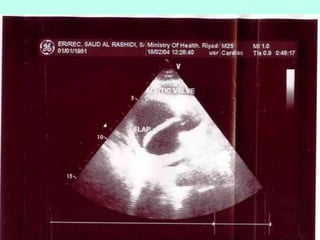
Urgent echo
Cont.
Cont.
Cont.
Management
1-Control of H.R. B/P :
atenolol 50 mg p.o.
H.R.:70/m reg. B/P:100/60
2-uregent cardiac surgery referral (fax sent from the E.R ).
3- transferred to K.K.U.H. cardiac center O.R.(End to end
with Dacron graft)
4-discharged home after 4 days.
Natural history:
• Aortic dissection is the most common catastrophe
of the aorta.
• 40% of proximal aorta died immediately!
• Rate of death 1-3% per hour.
• 33% of patients die within the first 24 hours
• 50% die within 48 hours.
• 75% die in 2 weeks.
• 100% die in 5 weeks.
PATHOPHYSIOLOGY
• Tear in aortic intima
• Degeneration of aortic media
• Cystic medial necrosis
• The right lateral wall of the ascending aorta
is the most common site of aortic dissection
Larson, et al. Risk factors for aortic dissection: A necropsy study of 161 cases. Am J Cardiol 1984
• Blood passes into the aortic media through
the tear creating a false lumen.
• Multiple communications may form
between true and false lumen.
Dissection sites:
• 90% occurring within 10 centimeters of the
aortic valve.
• The second most common site is just distal
to the left subclavian artery.
• 5% and 10% of dissections do not have an
obvious intimal tear.
Predisposing factors:
• Sex: male
• Age: 60-80
• Hypertension
• Takayasu arteritis
• Giant cell arteritis
• Rheumatoid arthritis
• Syphilitic aortitis
• Marfan syndrome (8.5%)
• Ehlers-Danlos syndrome
• Cystic medial necrosis
• Bicuspid aortic valve
• Aortic coarctation
• Turner syndrome
• Crack cocaine
• Trauma
Classification:
• DeBakey system:
-Type I: both ascending and descending thoracic
aorta
-Type II: ascending aorta
-Type III: descending aorta
DeBakey, et al. Surgical management of dissecting aneurysms of the aorta.
J Thorac Cardiovasc Surg 1965.
Classification:
• The Daily system (Stanford):
-Type A: the ascending aorta.
-Type B: all other dissections.
Daily, et al. Management of acute aortic dissections.
Ann Thorac Surg 1970.
CLINICAL MANIFESTATIONS:
• Severe, sharp or "tearing" chest pain.
• Pain may radiate anywhere in the thorax, back, or
abdomen.
• Hypertension (70%).
• Pulse deficit (19-30% type A, 9% type B).
• Syncope (13%).
• Cerebrovascular accident.
• Myocardial infarction.
• Heart failure.
• Painless (rare).
• Acute AR (50-76%).
• Cardiac tamponade.
• Hemothorax.
• Variation in blood pressure (>30 mmHg).
• Neurologic deficits.
• Horner syndrome (compression of the superior cervical sympathetic ganglion).
• Hoarseness (compression of the left recurrent laryngeal nerve).
Differential diagnosis
• • Acute coronary syndrome
• • Pericarditis
• • Pulmonary embolus
• • Aortic regurgitation without dissection
• • Aortic aneurysm without dissection
• • Musculoskeletal pain
• • Mediastinal tumors
• • Pleuritis
• • Cholecystitis
• • Atherosclerotic or cholesterol embolism
• • Peptic ulcer disease or perforating ulcer
Warning: you can miss the
diagnosis in nearly ½ of the
patients
• Correctly diagnosed patients ante
mortem in large series of autopsies
ranged from 40.4% to 84%
• Hirst AE, et al. Dissecting aneurysm of the aorta. A review of 505 cases.
Medicine 1958
• Anagnostopoulos CE. Diagnosis of aortic dissection. In: Anagnostopoulos CE
(ed). Acute aortic dissections.University Park Press, Baltimore, 1975
DIAGNOSIS:
I- Clinical features:
• 1- Tearing chest pain
• 2- Variation in pulse or Bp
• 3- Mediastinal widening on CXR (A=63%, B=56%)
• (1+2+3 are found in 77% of aortic dissections)
Von Kodolitsch, et al. Clinical prediction of acute aortic dissection. Arch Intern Med 2000
II- EKG:
• 1- normal in 31%
• 2- nonspecific ST/T wave changes in 42%
• 3- ischemic changes in 15%
• 4- acute MI in 5%
Hagan, et al. The International Registry of Acute Aortic Dissection (IRAD): new insights into an old disease.
JAMA 2000
III-Imaging:
1- CT chest in 61% (sn=83%, sp=100%)
2- Echocardiography in 33%
3- MRI/MRA (sn=100%, sp=94%)
4- Aortography in 4% (sn=88%, sp=94%)
Hagan, et al. The International Registry of Acute Aortic Dissection (IRAD): new insights into an old
disease. JAMA 2000
Echocardiography
TTE:
1- limited utility
2- poor sn & sp
3- inferior to CT, MRI, TEE
TEE:
1- sn=98%, sp=95%
2- can be easily performed in ER
3- useful in patients too unstable for MRI
What is the image of first choice
for evaluating suspected AD?
Management strategy
• TYPE A
require urgent surgical correction to avoid
extension into coronary or carotid arteries
and tamponade.
• TYPE B
could be managed medically or surgically.
The key for medical Rx:
Systolic pressure < 100-110mmhg
Shearing force Contractility
preventing propagation of the dissection
Surgical management
• Ascending aorta:
1- obliterate the most proximal intimal tear.
2- restore competency of the aortic valve.
3- restore flow to any branch of the aorta that is receiving
blood flow from false lumen
4- protect the heart during these maneuvers and restore the
coronary blood flow.
5- look for tears in the transverse aortic arch.
• Descending dissection:
1- to close off the hematoma by obliterating
the most proximal intimal tear.
2-to restore blood flow to branches of the
aorta fed by the false channel.
Surgical techniques:
• OPERATIVE Complication:
– Hemorrhage 20%
– Renal failure 20%
– Pulmonary embolism 30%
– Acute myocardial infraction 30%
– Bowel infraction 5%
– Death 15%
– Paraplegia (usually only with descending
dissection)
Poor prognostic factors:
• • Hypotension, shock, or tamponade
• • Renal failure at presentation and before surgery
• • Age >70 years
• • Abrupt onset of chest pain
• • Pulse deficit
• • Abnormal ECG, particularly ST segment elevation
• • Prior myocardial infarction
• • Renal and/ or visceral ischemia
• • Underlying pulmonary disease .
• • Preoperative neurologic impairment
• • Perioperative bleeding and massive blood transfusion
• • Prolonged clamping time
Prognosis:
• 10 year survival = 30-60%
• Re operation = 28% (7 year F/U)
• Residual dissection = 78%
Conclusions:
• Acute ascending aortic dissection is included in the
differential diagnosis of patients with acute chest pain.
• Aortic dissection is considered as the most common
disaster of aorta.
• Stanford type A dissection is a surgical emergency that
requires urgent diagnosis and immediate surgical
intervention.
Aortic dissection Nightmare

Aortic dissection Nightmare

  • 1.
    Aortic Dissection Prof. Dr.MohamedZ. Khalil, MD, ABIM, SBIM, MRCP (UK), FACC, FESC, FKSU Consultant physician & Cardiologist
  • 2.
    Background: • The firstwell-documented case of aortic dissection: King George II of England (1683 - 1760) died while straining on the commode!
  • 3.
    1910: William Osler •". . . spontaneous tear of the arterial coats is associated with atrocious pain, with symptoms, indeed, in the case of the aorta of angina pectoris and many instances have been mistaken for it."
  • 4.
    1955 • The firstsuccessful operative repair was performed by DeBakey.
  • 5.
    Prevalence: • 0.2 -1% of all autopsies. • Aortic dissection is more common in blacks than in whites. • Less common in Asians than in whites. • Male-to-female ratio is 3:1.
  • 8.
    Localization and Incidenceof Initial Pain in Patients With Aortic Dissection Site of Pain Patients, No. % of Total (n = 72) • Anterior chest 46 64.0 • Back 7 9.7 • Neck 2 2.8 • Throat 1 1.4 • Head (face and jaw) 2 2.8 • Epigastrium 7 9.7 • Groin 1 1.4 • Without pain 6 8.3
  • 11.
    Main Clinical Diagnosesof 66 PatientsWith Aortic Dissection • Diagnosis No. of Cases % • Aortic dissection 19 28.8 • Acute myocardial infarction 21 31.8 • Stroke 8 12.1 • Pulmonary embolism 7 10.6 • Acute heart failure 5 7.6 • Acute pancreatitis 2 3.0 • Mesenteric thrombosis 2 3.0 • Aortic stenosis 1 1.5 • Unstable angina 1 1.5
  • 13.
    Causes of Deathin Patients With Aortic Dissection • Cause of Death No. of Cases % of Total, (n = 82) • Pericardial hematoma 57 69.5 • Left intrapleural hematoma 8 9.8 • Chronic heart failure 5 6.1 • Mesenteric thrombosis 4 4.9 • Acute heart failure 2 2.4 • Right intrapleural hematoma 1 1.2 • Bilateral intrapleural hematoma 1 1.2 • Subpleural hematoma 1 1.2 • Mediastinal hematoma 1 1.2 • Cerebral anoxia 1 1.2 • Acute myocardial infarction 1 CHEST 2000
  • 14.
  • 15.
    History • 24 yearsSaudi male, not known to have any medical problem. • Presented to ER of RMC referred from: King Khalid International airport hospital C/O sever chest pain for 2 hours started while working in the airport.
  • 16.
    • The painwas of: • Sudden onset, • Retro-sternal, • Radiating to the back between the two scapulae, • Associated with S.O.B. nausea but no vomiting. • There was no aggravating or relieving factors.
  • 17.
    • There wasno Hx. of similar attack • Past medical & surgical Hx. –ve • Drug or allergy Hx. –ve
  • 18.
    • Family membersare healthy. • No family history of Marfan syndrome. • None smoker or ETOH consumer. • Newly married 6/12. • Working as passport officer in the airport.
  • 19.
    Examination • Anxious distressedyoung male. • V/S: R.R:25/min. Pulse:100/min. T:37 • Bp: 140/90 • Chest: clear. • C.V.S : S1, S2 • Abdomen: WNL • C.N.S: no focal deficit.
  • 20.
  • 21.
    • B/P: • RT.Arm :140/90 LT. Arm :130/80 • RT. Leg :130/90 LT .Leg :120/80 • Variable femoral pulsation (asymmetrical)
  • 22.
    Investigations: • CBC: WBC:21.4HB:13.9 PLAT:500 • Na: 137 • K: 4.7 • Urea:4.3 Creat.:77 • glucose: 7.4 • L.D.H: 228 • C.K:81 (repeated x 2 = N) • I.N.R: 1.09 • P.T.T: 26.1 seconds.
  • 24.
    g. 1 EKGshowing SR, LAD, minor IV conduction defect, poor progression of R waves
  • 25.
  • 26.
  • 27.
  • 28.
  • 29.
    Management 1-Control of H.R.B/P : atenolol 50 mg p.o. H.R.:70/m reg. B/P:100/60 2-uregent cardiac surgery referral (fax sent from the E.R ). 3- transferred to K.K.U.H. cardiac center O.R.(End to end with Dacron graft) 4-discharged home after 4 days.
  • 31.
    Natural history: • Aorticdissection is the most common catastrophe of the aorta. • 40% of proximal aorta died immediately! • Rate of death 1-3% per hour. • 33% of patients die within the first 24 hours • 50% die within 48 hours. • 75% die in 2 weeks. • 100% die in 5 weeks.
  • 32.
    PATHOPHYSIOLOGY • Tear inaortic intima • Degeneration of aortic media • Cystic medial necrosis • The right lateral wall of the ascending aorta is the most common site of aortic dissection Larson, et al. Risk factors for aortic dissection: A necropsy study of 161 cases. Am J Cardiol 1984
  • 34.
    • Blood passesinto the aortic media through the tear creating a false lumen. • Multiple communications may form between true and false lumen.
  • 36.
    Dissection sites: • 90%occurring within 10 centimeters of the aortic valve. • The second most common site is just distal to the left subclavian artery. • 5% and 10% of dissections do not have an obvious intimal tear.
  • 38.
    Predisposing factors: • Sex:male • Age: 60-80 • Hypertension • Takayasu arteritis • Giant cell arteritis • Rheumatoid arthritis • Syphilitic aortitis • Marfan syndrome (8.5%) • Ehlers-Danlos syndrome • Cystic medial necrosis • Bicuspid aortic valve • Aortic coarctation • Turner syndrome • Crack cocaine • Trauma
  • 39.
    Classification: • DeBakey system: -TypeI: both ascending and descending thoracic aorta -Type II: ascending aorta -Type III: descending aorta DeBakey, et al. Surgical management of dissecting aneurysms of the aorta. J Thorac Cardiovasc Surg 1965.
  • 40.
    Classification: • The Dailysystem (Stanford): -Type A: the ascending aorta. -Type B: all other dissections. Daily, et al. Management of acute aortic dissections. Ann Thorac Surg 1970.
  • 41.
    CLINICAL MANIFESTATIONS: • Severe,sharp or "tearing" chest pain. • Pain may radiate anywhere in the thorax, back, or abdomen. • Hypertension (70%). • Pulse deficit (19-30% type A, 9% type B). • Syncope (13%). • Cerebrovascular accident. • Myocardial infarction. • Heart failure. • Painless (rare). • Acute AR (50-76%).
  • 42.
    • Cardiac tamponade. •Hemothorax. • Variation in blood pressure (>30 mmHg). • Neurologic deficits. • Horner syndrome (compression of the superior cervical sympathetic ganglion). • Hoarseness (compression of the left recurrent laryngeal nerve).
  • 43.
    Differential diagnosis • •Acute coronary syndrome • • Pericarditis • • Pulmonary embolus • • Aortic regurgitation without dissection • • Aortic aneurysm without dissection • • Musculoskeletal pain • • Mediastinal tumors • • Pleuritis • • Cholecystitis • • Atherosclerotic or cholesterol embolism • • Peptic ulcer disease or perforating ulcer
  • 44.
    Warning: you canmiss the diagnosis in nearly ½ of the patients • Correctly diagnosed patients ante mortem in large series of autopsies ranged from 40.4% to 84% • Hirst AE, et al. Dissecting aneurysm of the aorta. A review of 505 cases. Medicine 1958 • Anagnostopoulos CE. Diagnosis of aortic dissection. In: Anagnostopoulos CE (ed). Acute aortic dissections.University Park Press, Baltimore, 1975
  • 45.
    DIAGNOSIS: I- Clinical features: •1- Tearing chest pain • 2- Variation in pulse or Bp • 3- Mediastinal widening on CXR (A=63%, B=56%) • (1+2+3 are found in 77% of aortic dissections) Von Kodolitsch, et al. Clinical prediction of acute aortic dissection. Arch Intern Med 2000
  • 46.
    II- EKG: • 1-normal in 31% • 2- nonspecific ST/T wave changes in 42% • 3- ischemic changes in 15% • 4- acute MI in 5% Hagan, et al. The International Registry of Acute Aortic Dissection (IRAD): new insights into an old disease. JAMA 2000
  • 47.
    III-Imaging: 1- CT chestin 61% (sn=83%, sp=100%) 2- Echocardiography in 33% 3- MRI/MRA (sn=100%, sp=94%) 4- Aortography in 4% (sn=88%, sp=94%) Hagan, et al. The International Registry of Acute Aortic Dissection (IRAD): new insights into an old disease. JAMA 2000
  • 53.
    Echocardiography TTE: 1- limited utility 2-poor sn & sp 3- inferior to CT, MRI, TEE TEE: 1- sn=98%, sp=95% 2- can be easily performed in ER 3- useful in patients too unstable for MRI
  • 55.
    What is theimage of first choice for evaluating suspected AD?
  • 57.
  • 58.
    • TYPE A requireurgent surgical correction to avoid extension into coronary or carotid arteries and tamponade. • TYPE B could be managed medically or surgically.
  • 59.
    The key formedical Rx: Systolic pressure < 100-110mmhg Shearing force Contractility preventing propagation of the dissection
  • 60.
    Surgical management • Ascendingaorta: 1- obliterate the most proximal intimal tear. 2- restore competency of the aortic valve. 3- restore flow to any branch of the aorta that is receiving blood flow from false lumen 4- protect the heart during these maneuvers and restore the coronary blood flow. 5- look for tears in the transverse aortic arch.
  • 62.
    • Descending dissection: 1-to close off the hematoma by obliterating the most proximal intimal tear. 2-to restore blood flow to branches of the aorta fed by the false channel.
  • 63.
  • 65.
    • OPERATIVE Complication: –Hemorrhage 20% – Renal failure 20% – Pulmonary embolism 30% – Acute myocardial infraction 30% – Bowel infraction 5% – Death 15% – Paraplegia (usually only with descending dissection)
  • 66.
    Poor prognostic factors: •• Hypotension, shock, or tamponade • • Renal failure at presentation and before surgery • • Age >70 years • • Abrupt onset of chest pain • • Pulse deficit • • Abnormal ECG, particularly ST segment elevation • • Prior myocardial infarction • • Renal and/ or visceral ischemia • • Underlying pulmonary disease . • • Preoperative neurologic impairment • • Perioperative bleeding and massive blood transfusion • • Prolonged clamping time
  • 67.
    Prognosis: • 10 yearsurvival = 30-60% • Re operation = 28% (7 year F/U) • Residual dissection = 78%
  • 68.
    Conclusions: • Acute ascendingaortic dissection is included in the differential diagnosis of patients with acute chest pain. • Aortic dissection is considered as the most common disaster of aorta. • Stanford type A dissection is a surgical emergency that requires urgent diagnosis and immediate surgical intervention.