Disaster Management: Role of ICTs Chanuka Wattegama LIRNEasia (former) United Nations Development Program (UNDP) (former) ICT Agency, Sri Lanka Note: The opinions expressed in the presentation are author’s own and may not reflect those of any organization he is/was affiliated to. World Bank Organised Seminar on Disaster Risk Management in the Information Age Washington DC ,Oct. 8-9, 2008
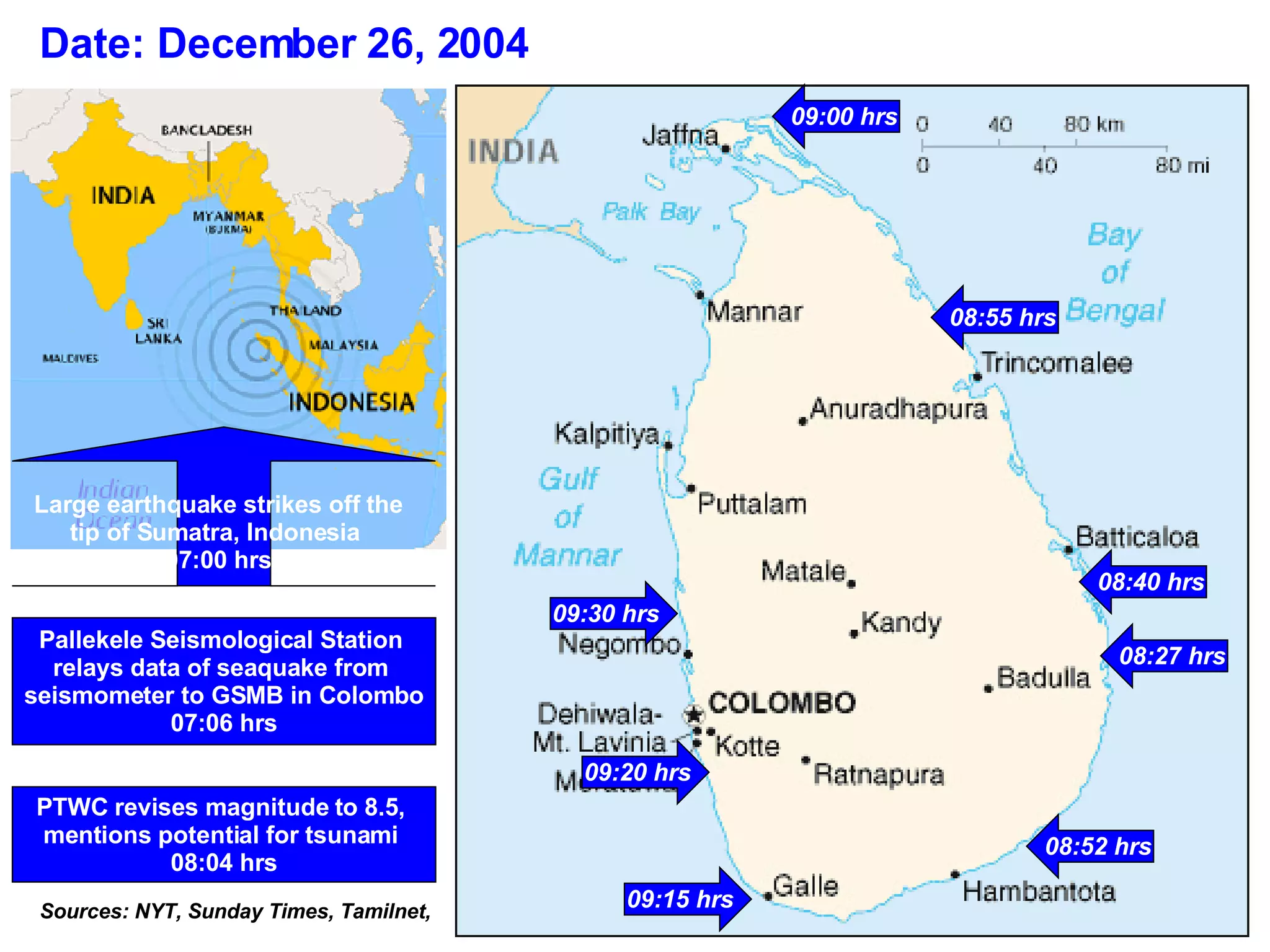
Date: December 26, 2004 08:27 hrs 08:40 hrs 08:52 hrs 08:55 hrs 09:00 hrs 09:15 hrs 09:20 hrs 09:30 hrs Large earthquake strikes off the tip of Sumatra, Indonesia  07:00 hrs Pallekele Seismological Station  relays data of seaquake from  seismometer to GSMB in Colombo 07:06 hrs PTWC revises magnitude to 8.5,  mentions potential for tsunami  08:04 hrs Sources: NYT, Sunday Times, Tamilnet,
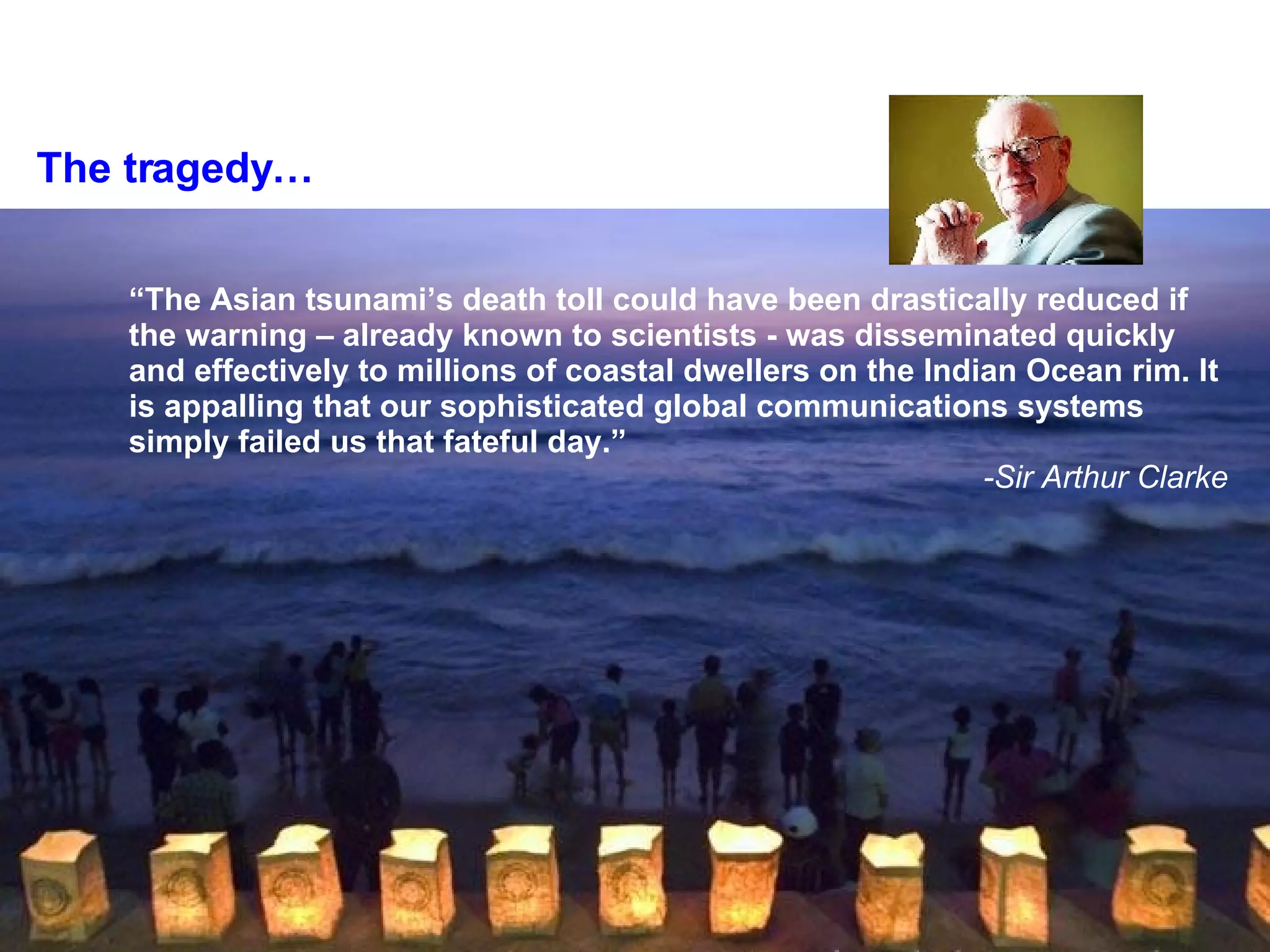
The tragedy… “ The Asian tsunami’s death toll could have been drastically reduced if the warning – already known to scientists - was disseminated quickly and effectively to millions of coastal dwellers on the Indian Ocean rim. It is appalling that our sophisticated global communications systems simply failed us that fateful day.” -Sir Arthur Clarke
Was this the reason?
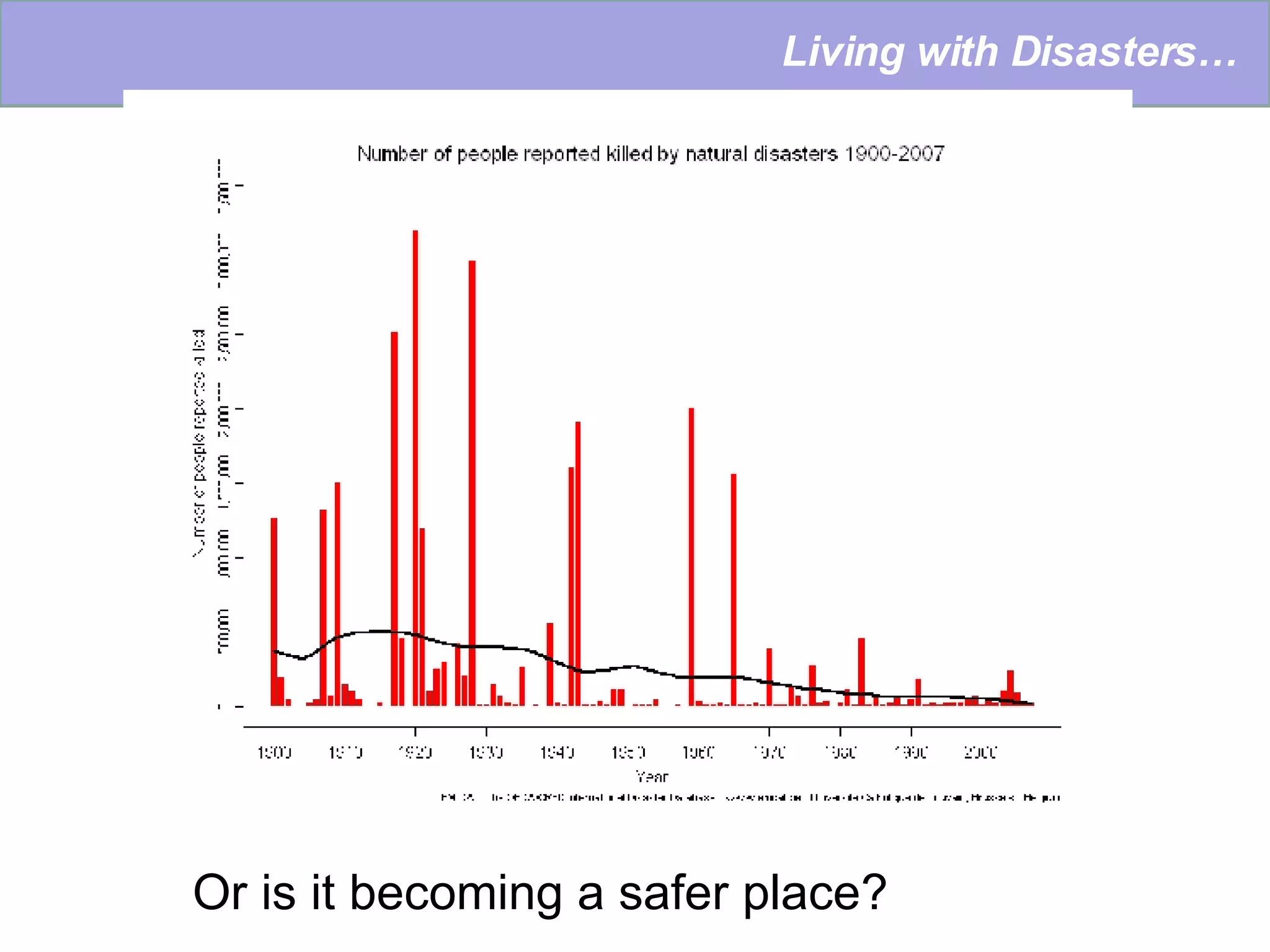
Living with Disasters… Are we living in a more dangerous world than our grandparents lived?
Living with Disasters… Or is it becoming a safer place?
Highest (per incident) casualties in  Asia, Africa  and  South America… …  highest (per incident) losses in  Europe, North America  and  Australia The tale of two worlds…
Hazard 1 . A source of danger;  2 . An unknown and unpredictable phenomenon that causes an event to result one way rather than another* Disaster 1 . A state of extreme (usually irremediable) ruin and misfortune;  2 . An event resulting in great loss and misfortune* While ICTs  cannot prevent  most  hazards … …  they can  reduce the risk  of  disaster Vs. * Webster online dictionary
ICTs in Disaster Management… Mitigation, Risk Reduction (through assessment) and Prevention  – activities to reduce the chance of a hazard happening or prevent a hazard ending up as a disaster (long term)  Preparedness  – plans to save lives or property and help the response and rescue service operations. Includes  Early Warning Systems and evacuation Response  - actions taken to save lives and prevent property damage and to preserve the environment during emergencies or disasters, in the immediate aftermath. (short term) Recovery  – actions that assist a community to return to the normalcy after a disaster. (short term and long term)
ICTs in Disaster Management… 1. ICTs in  Disaster Risk Reduction  (through risk assessment)
Monitoring disaster possibilities using  Satellite communication  and GIS tools 1. Drought 2. Floods 3. Global warming
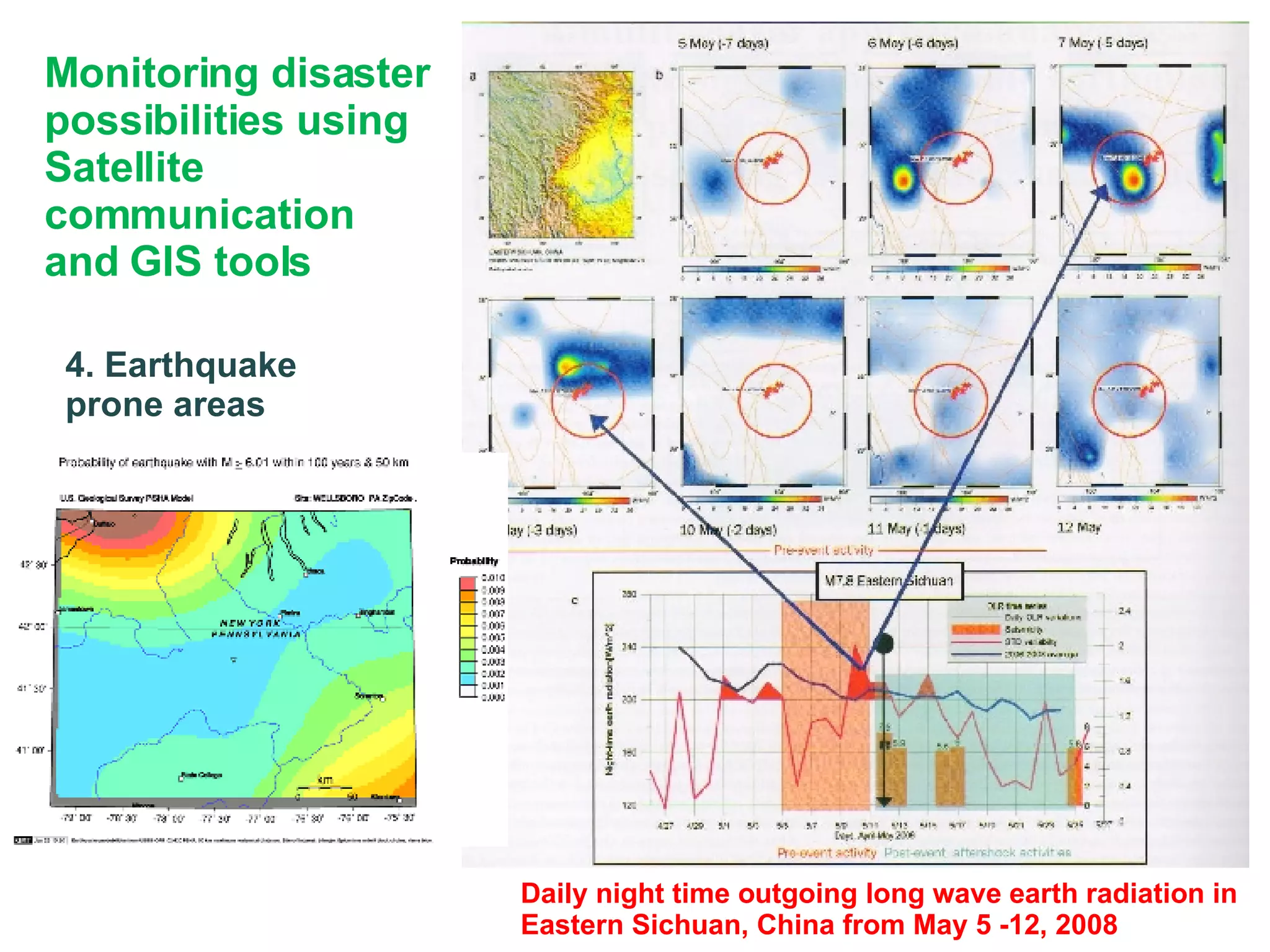
Monitoring disaster possibilities using  Satellite  communication  and GIS tools 4. Earthquake prone areas Daily night time outgoing long wave earth radiation in Eastern Sichuan, China from May 5 -12, 2008
ICTs in Disaster Management… 2. ICTs in  Disaster Mitigation and  Prevention
Bio-Surveillance systems:  Show spreading patterns of critical diseases  Short term(SARS, Bird Flu) or long term (HIV/AIDS) Also address the issue of bio terrorism Stochastic modelling: Mathematical simulations based on real data
Awareness creation: Internet, E-mail, TV, Radio, Mobiles Social networking, blogging
ICTs in Disaster Management… 3. ICTs in  Disaster Preparedness
Disaster Management training: Useful ICT tools:  PCs and peripherals, TV, Radio
Role of Internet in disaster preparedness Started in 1997 by Reuters Foundation Piggyback on Reuters news service Focus is on conflicts and disasters Use a skeleton staff Has an e-community Addresses emergencies of four types,  health related rapid onset food-related and  conflict
ICTs in Disaster Management… 4. ICTs in  Disaster Response
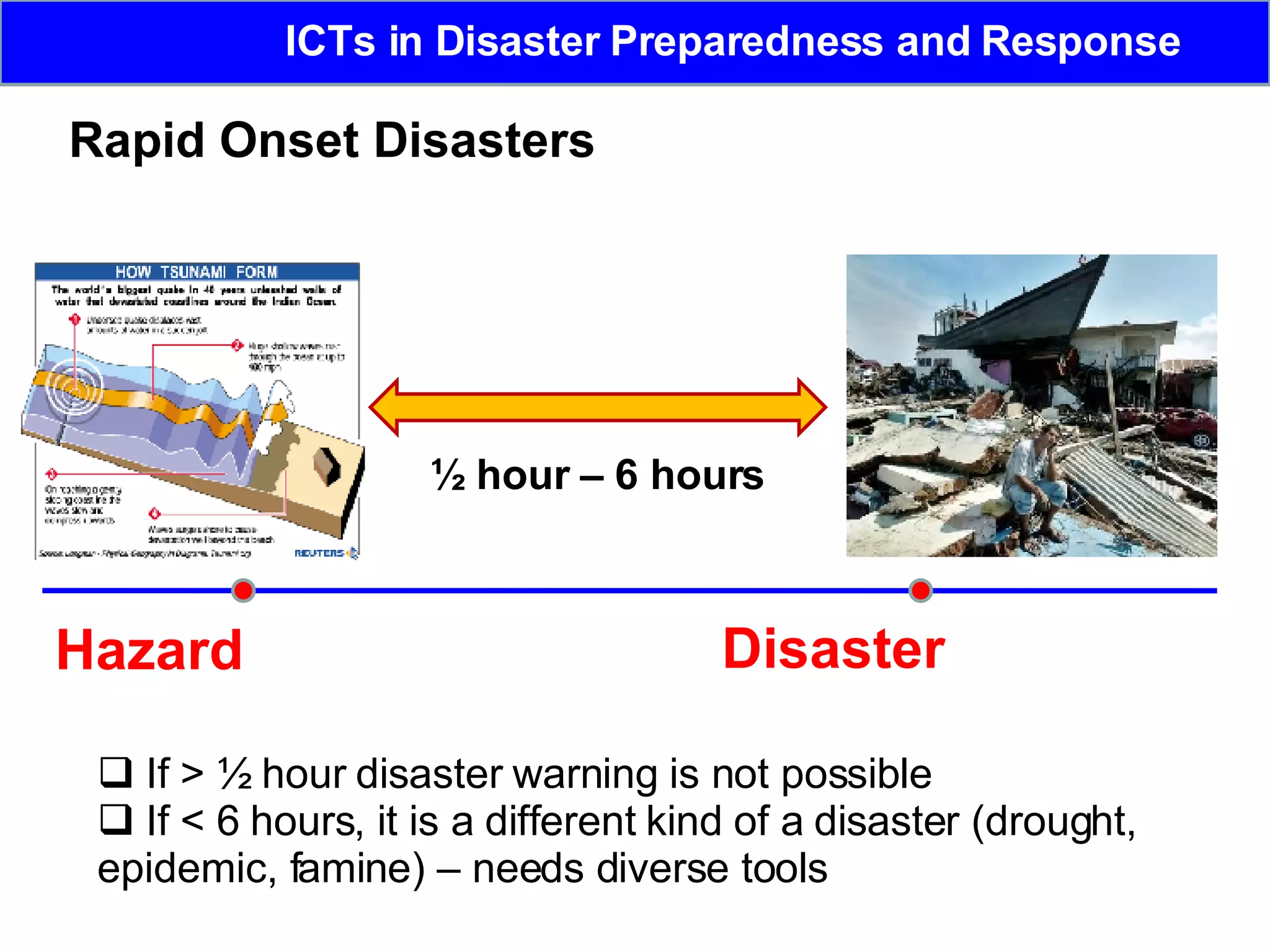
Hazard Disaster ICTs in Disaster Preparedness and Response Rapid Onset Disasters ½ hour – 6 hours If > ½ hour disaster warning is not possible If < 6 hours, it is a different kind of a disaster (drought, epidemic, famine) – needs diverse tools
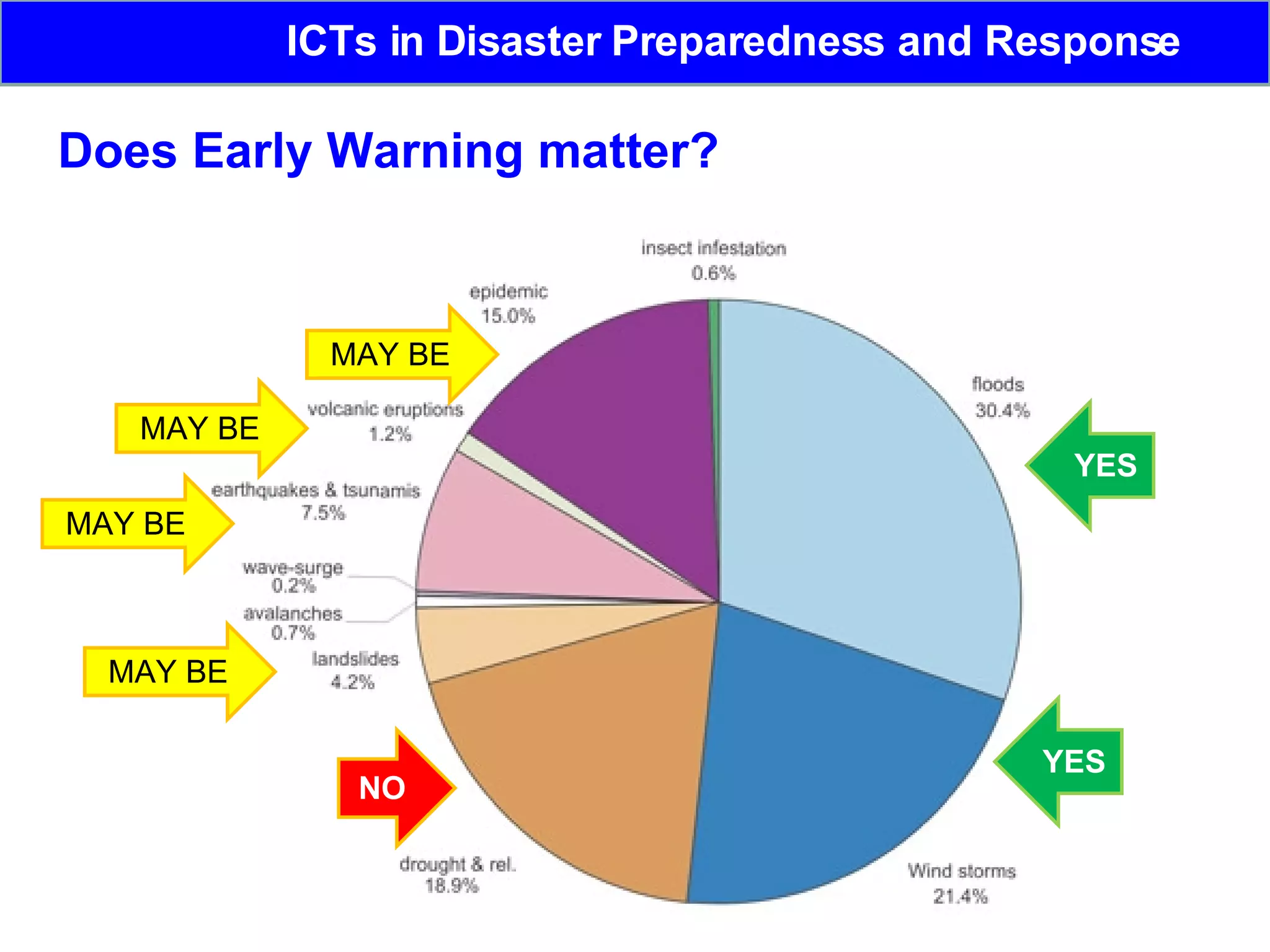
YES YES NO MAY BE MAY BE MAY BE MAY BE ICTs in Disaster Preparedness and Response Does Early Warning matter?
Early Warning Systems - monitoring eg. ADPC Tsunami and Multi-Hazard Regional Early Warning System   Recorder on sea bed measures water pressure every 15 mins - an unusual result triggers a reading every 15 secs. Buoy measures surface conditions and sends this plus data from sea bed to satellite Satellite receives data and relays it to ground stations  Float in a &quot;stilling well&quot; tube measures sea level Data is processed and sent to satellite Satellite transmits data to alert centres
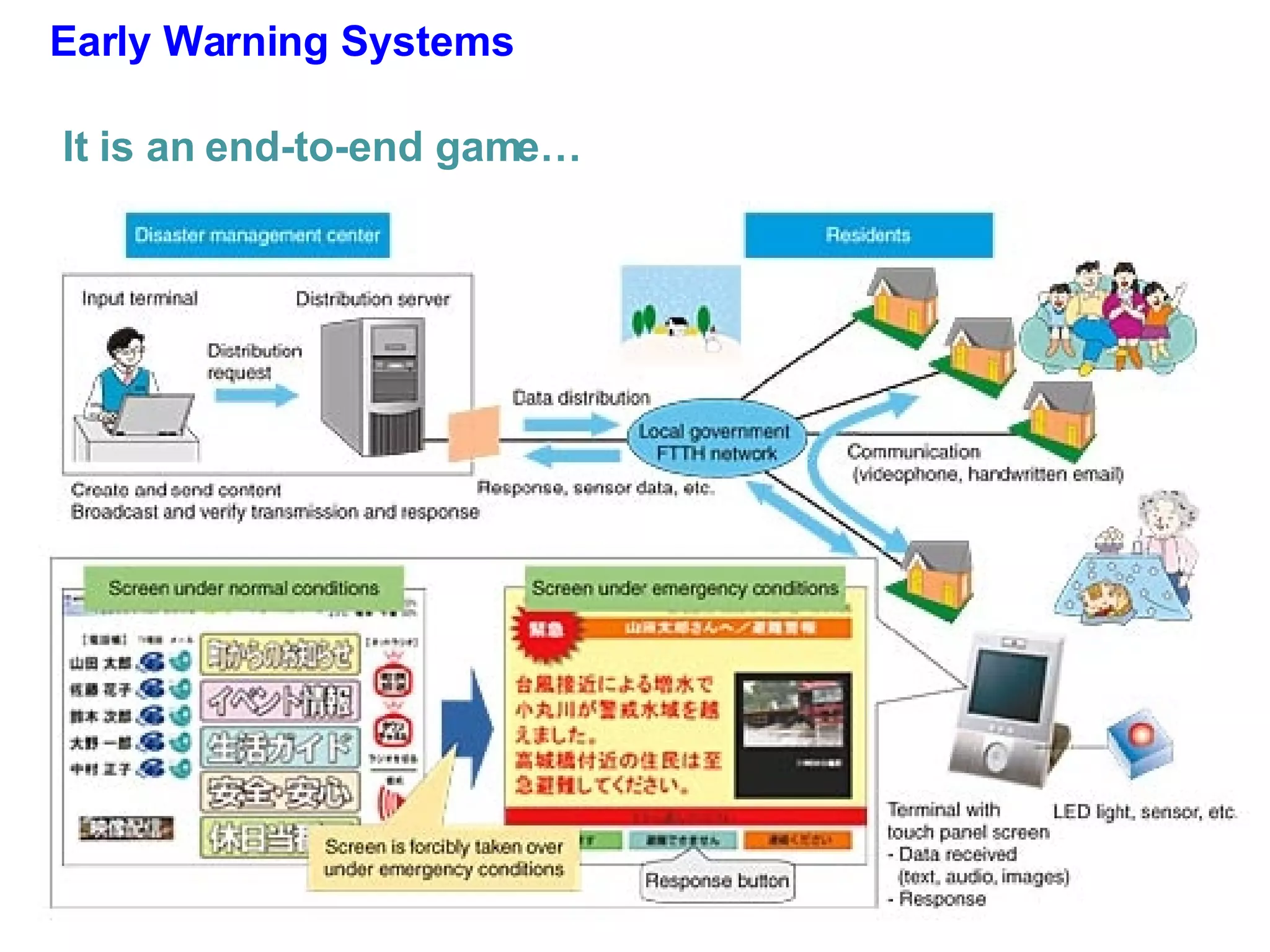
Early Warning Systems It is an end-to-end game…
ICTs in Disaster Management… 5. ICTs in  Disaster Recovery (short term)
Developed by LSF in the aftermath of tsunami Used LAMP  (Linux/Apache/MySQL/PHP)  software stack The main applications and problems they address are: Helping to reduce trauma by effectively finding missing persons. Coordinating and balancing the distribution of relief organizations  in the affected areas and connecting relief groups  Registering and tracking all incoming requests for support and  relief up to fulfilment and helping donors connect to requirements. Tracking the location and numbers of victims in the various camps  and temporary shelters set up all around the affected area. Successfully used in Kashmiri earthquake (2005), Philippines  Guinsaugon landslide (2006) and Indonesian Yogjakarta  earthquake (2006) ICTs in Disaster  Recovery  (Immediate Aftermath)
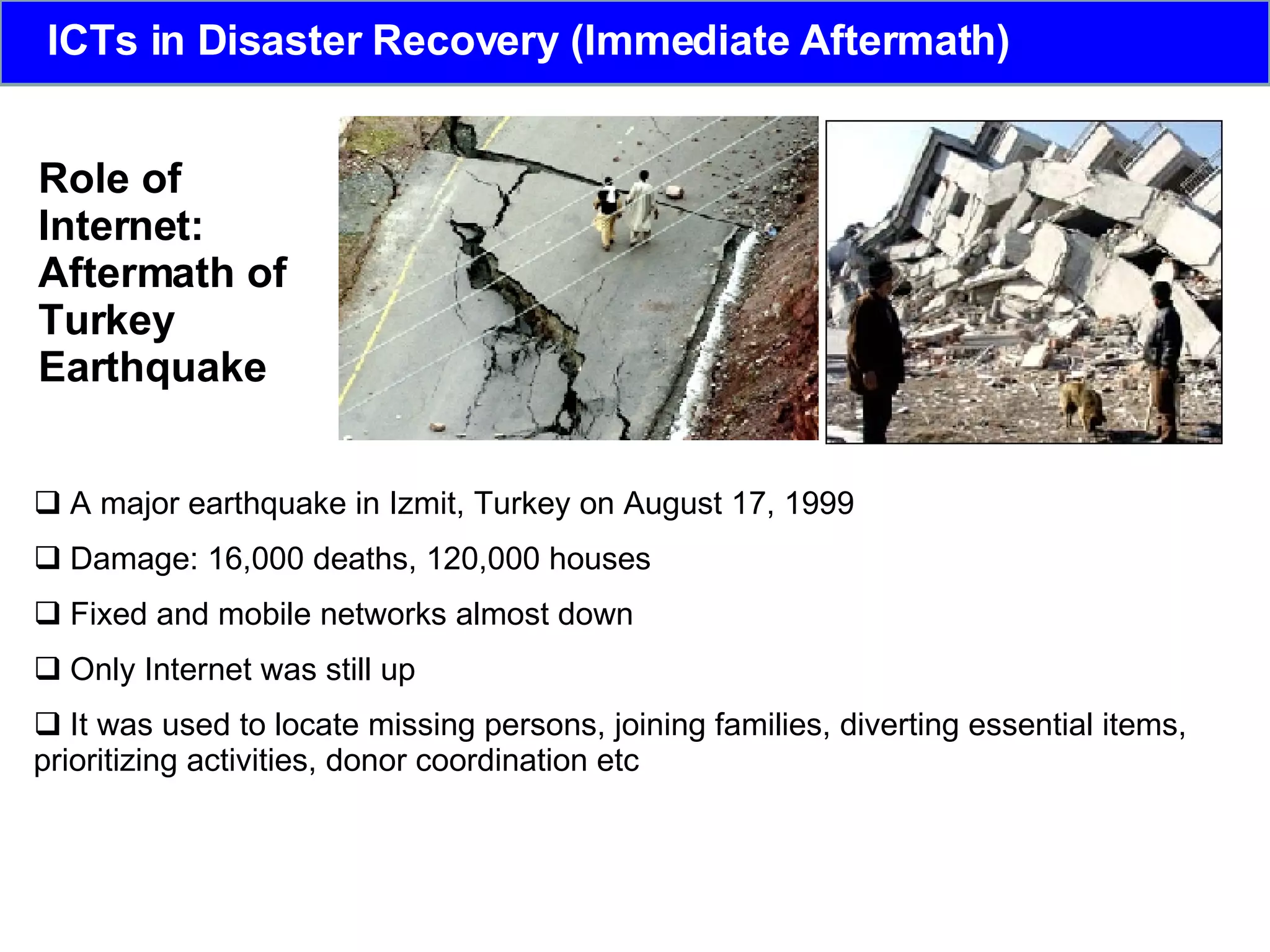
Role of Internet: Aftermath of  Turkey  Earthquake A major earthquake in Izmit, Turkey on August 17, 1999  Damage: 16,000 deaths, 120,000 houses  Fixed and mobile networks almost down  Only Internet was still up It was used to locate missing persons, joining families, diverting essential items, prioritizing activities, donor coordination etc ICTs in Disaster Recovery (Immediate Aftermath)
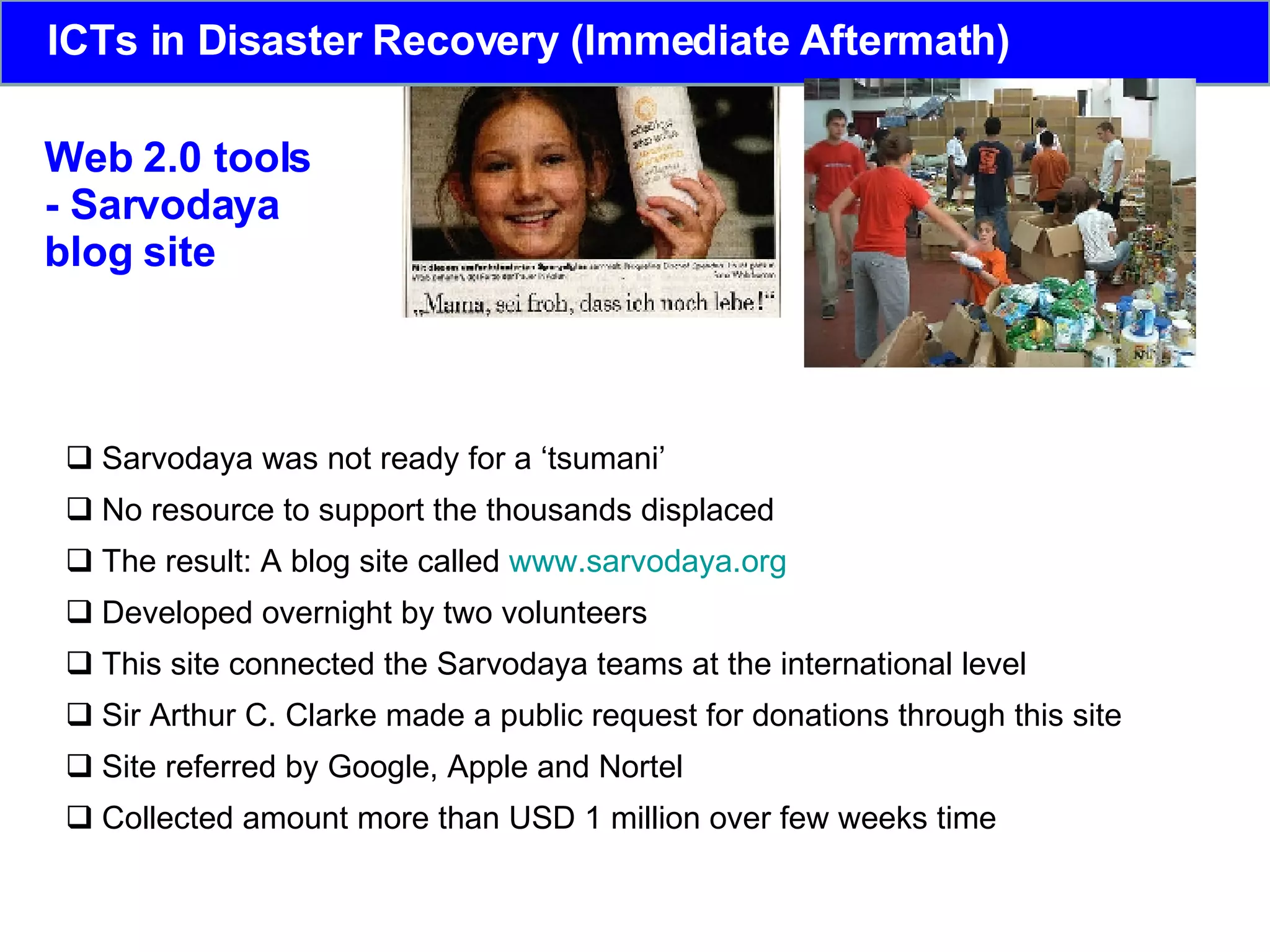
Web 2.0 tools - Sarvodaya  blog site Sarvodaya was not ready for a ‘tsumani’ No resource to support the thousands displaced The result: A blog site called  www.sarvodaya.org Developed overnight by two volunteers This site connected the Sarvodaya teams at the international level Sir Arthur C. Clarke made a public request for donations through this site Site referred by  Google, Apple and Nortel Collected amount more than USD 1 million over few weeks time  ICTs in Disaster Recovery (Immediate Aftermath)
Web 2.0 tools – Social Networking
ICTs in Disaster Management… 6. ICTs in  Disaster Recovery (long term)
Example: DAD – Development Assistance database An automated information management system designed to improve efficiency and coordination of donor activities in the country.  Promotes good governance and public accountability and transparency  First used in Afghanistan. Now rolled out in Indonesia, Thailand, Maldives and Sri Lanka Has a user friendly web interface ICTs in Disaster Recovery (long term)
Conclusion: Fortunately it does not have to be one technology over another…   Risk Reduction Mitigation and Prevention Preparde-ness Response Recovery GIS √√√ √√√ √√   √ Analytical tools √√√ √√√ √   √ Blogging     √√   √√√ Internet √√ √√ √√ √√ √√√ Mobile (voice)     √ √√√ √√√ Mobile (non-voice)       √√√ √√√ Open Source √√ √√     √√ Satellite Communication √√√ √√√   √√√ √√√ Web 2.0, Social Networking     √ √ √√√ TV, Radio     √√ √√√ √√√
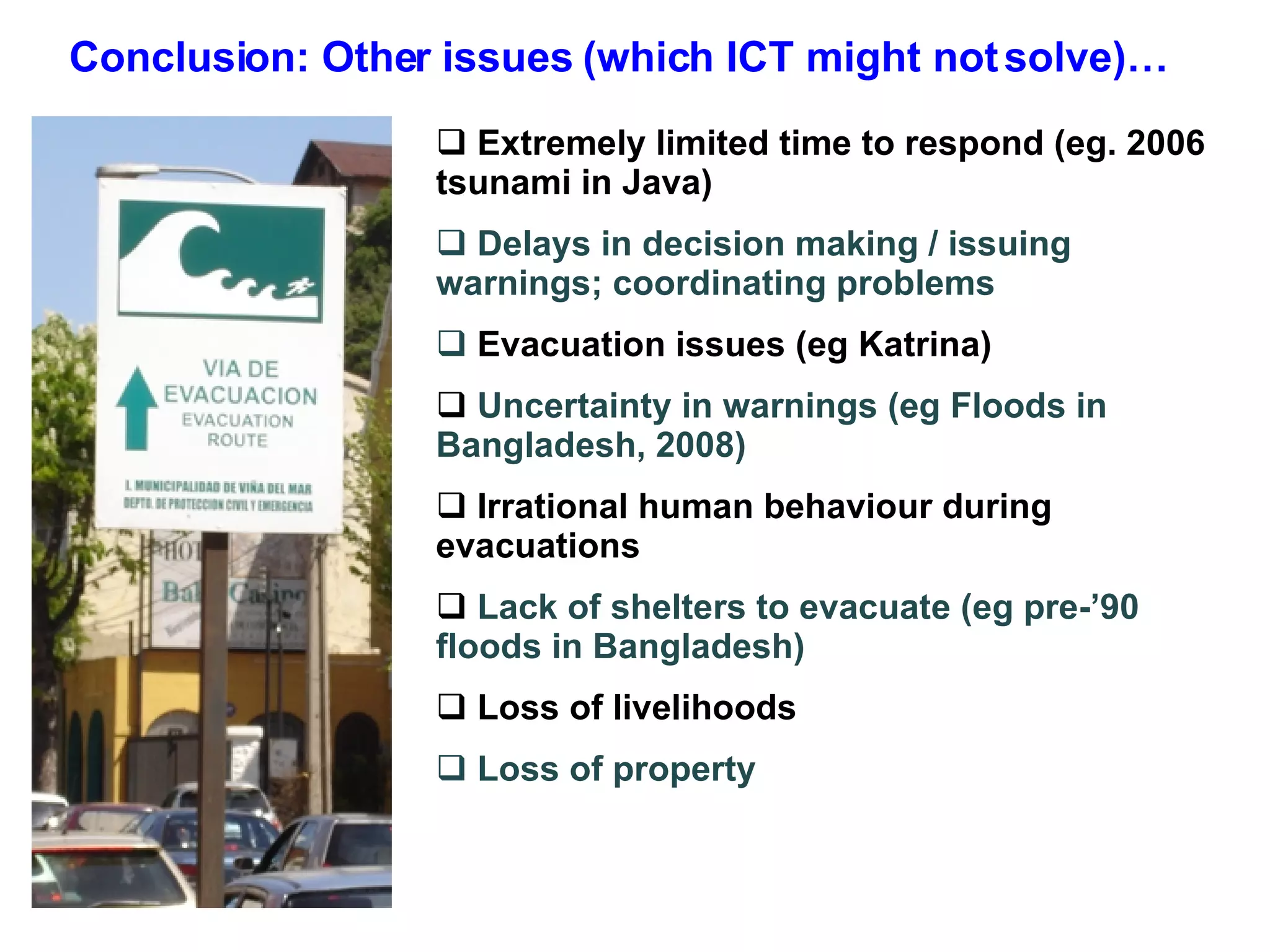
Conclusion: Other issues (which ICT might not solve)… Extremely limited time to respond (eg. 2006 tsunami in Java) Delays in decision making / issuing warnings; coordinating problems Evacuation issues (eg Katrina) Uncertainty in warnings (eg Floods in Bangladesh, 2008) Irrational human behaviour during evacuations Lack of shelters to evacuate (eg pre-’90 floods in Bangladesh) Loss of livelihoods Loss of property
&quot;A chain is as strong as its weakest link” Conclusion:
Thank You! [email_address] [email_address] [email_address]

Disaster Management: role of ICTs

  • 1.
    Disaster Management: Roleof ICTs Chanuka Wattegama LIRNEasia (former) United Nations Development Program (UNDP) (former) ICT Agency, Sri Lanka Note: The opinions expressed in the presentation are author’s own and may not reflect those of any organization he is/was affiliated to. World Bank Organised Seminar on Disaster Risk Management in the Information Age Washington DC ,Oct. 8-9, 2008
  • 2.
    Date: December 26,2004 08:27 hrs 08:40 hrs 08:52 hrs 08:55 hrs 09:00 hrs 09:15 hrs 09:20 hrs 09:30 hrs Large earthquake strikes off the tip of Sumatra, Indonesia 07:00 hrs Pallekele Seismological Station relays data of seaquake from seismometer to GSMB in Colombo 07:06 hrs PTWC revises magnitude to 8.5, mentions potential for tsunami 08:04 hrs Sources: NYT, Sunday Times, Tamilnet,
  • 3.
    The tragedy… “The Asian tsunami’s death toll could have been drastically reduced if the warning – already known to scientists - was disseminated quickly and effectively to millions of coastal dwellers on the Indian Ocean rim. It is appalling that our sophisticated global communications systems simply failed us that fateful day.” -Sir Arthur Clarke
  • 4.
    Was this thereason?
  • 5.
    Living with Disasters…Are we living in a more dangerous world than our grandparents lived?
  • 6.
    Living with Disasters…Or is it becoming a safer place?
  • 7.
    Highest (per incident)casualties in Asia, Africa and South America… … highest (per incident) losses in Europe, North America and Australia The tale of two worlds…
  • 8.
    Hazard 1 .A source of danger; 2 . An unknown and unpredictable phenomenon that causes an event to result one way rather than another* Disaster 1 . A state of extreme (usually irremediable) ruin and misfortune; 2 . An event resulting in great loss and misfortune* While ICTs cannot prevent most hazards … … they can reduce the risk of disaster Vs. * Webster online dictionary
  • 9.
    ICTs in DisasterManagement… Mitigation, Risk Reduction (through assessment) and Prevention – activities to reduce the chance of a hazard happening or prevent a hazard ending up as a disaster (long term) Preparedness – plans to save lives or property and help the response and rescue service operations. Includes Early Warning Systems and evacuation Response - actions taken to save lives and prevent property damage and to preserve the environment during emergencies or disasters, in the immediate aftermath. (short term) Recovery – actions that assist a community to return to the normalcy after a disaster. (short term and long term)
  • 10.
    ICTs in DisasterManagement… 1. ICTs in Disaster Risk Reduction (through risk assessment)
  • 11.
    Monitoring disaster possibilitiesusing Satellite communication and GIS tools 1. Drought 2. Floods 3. Global warming
  • 12.
    Monitoring disaster possibilitiesusing Satellite communication and GIS tools 4. Earthquake prone areas Daily night time outgoing long wave earth radiation in Eastern Sichuan, China from May 5 -12, 2008
  • 13.
    ICTs in DisasterManagement… 2. ICTs in Disaster Mitigation and Prevention
  • 14.
    Bio-Surveillance systems: Show spreading patterns of critical diseases Short term(SARS, Bird Flu) or long term (HIV/AIDS) Also address the issue of bio terrorism Stochastic modelling: Mathematical simulations based on real data
  • 15.
    Awareness creation: Internet,E-mail, TV, Radio, Mobiles Social networking, blogging
  • 16.
    ICTs in DisasterManagement… 3. ICTs in Disaster Preparedness
  • 17.
    Disaster Management training:Useful ICT tools: PCs and peripherals, TV, Radio
  • 18.
    Role of Internetin disaster preparedness Started in 1997 by Reuters Foundation Piggyback on Reuters news service Focus is on conflicts and disasters Use a skeleton staff Has an e-community Addresses emergencies of four types, health related rapid onset food-related and conflict
  • 19.
    ICTs in DisasterManagement… 4. ICTs in Disaster Response
  • 20.
    Hazard Disaster ICTsin Disaster Preparedness and Response Rapid Onset Disasters ½ hour – 6 hours If > ½ hour disaster warning is not possible If < 6 hours, it is a different kind of a disaster (drought, epidemic, famine) – needs diverse tools
  • 21.
    YES YES NOMAY BE MAY BE MAY BE MAY BE ICTs in Disaster Preparedness and Response Does Early Warning matter?
  • 22.
    Early Warning Systems- monitoring eg. ADPC Tsunami and Multi-Hazard Regional Early Warning System Recorder on sea bed measures water pressure every 15 mins - an unusual result triggers a reading every 15 secs. Buoy measures surface conditions and sends this plus data from sea bed to satellite Satellite receives data and relays it to ground stations Float in a &quot;stilling well&quot; tube measures sea level Data is processed and sent to satellite Satellite transmits data to alert centres
  • 23.
    Early Warning SystemsIt is an end-to-end game…
  • 24.
    ICTs in DisasterManagement… 5. ICTs in Disaster Recovery (short term)
  • 25.
    Developed by LSFin the aftermath of tsunami Used LAMP (Linux/Apache/MySQL/PHP) software stack The main applications and problems they address are: Helping to reduce trauma by effectively finding missing persons. Coordinating and balancing the distribution of relief organizations in the affected areas and connecting relief groups Registering and tracking all incoming requests for support and relief up to fulfilment and helping donors connect to requirements. Tracking the location and numbers of victims in the various camps and temporary shelters set up all around the affected area. Successfully used in Kashmiri earthquake (2005), Philippines Guinsaugon landslide (2006) and Indonesian Yogjakarta earthquake (2006) ICTs in Disaster Recovery (Immediate Aftermath)
  • 26.
    Role of Internet:Aftermath of Turkey Earthquake A major earthquake in Izmit, Turkey on August 17, 1999 Damage: 16,000 deaths, 120,000 houses Fixed and mobile networks almost down Only Internet was still up It was used to locate missing persons, joining families, diverting essential items, prioritizing activities, donor coordination etc ICTs in Disaster Recovery (Immediate Aftermath)
  • 27.
    Web 2.0 tools- Sarvodaya blog site Sarvodaya was not ready for a ‘tsumani’ No resource to support the thousands displaced The result: A blog site called www.sarvodaya.org Developed overnight by two volunteers This site connected the Sarvodaya teams at the international level Sir Arthur C. Clarke made a public request for donations through this site Site referred by Google, Apple and Nortel Collected amount more than USD 1 million over few weeks time ICTs in Disaster Recovery (Immediate Aftermath)
  • 28.
    Web 2.0 tools– Social Networking
  • 29.
    ICTs in DisasterManagement… 6. ICTs in Disaster Recovery (long term)
  • 30.
    Example: DAD –Development Assistance database An automated information management system designed to improve efficiency and coordination of donor activities in the country. Promotes good governance and public accountability and transparency First used in Afghanistan. Now rolled out in Indonesia, Thailand, Maldives and Sri Lanka Has a user friendly web interface ICTs in Disaster Recovery (long term)
  • 31.
    Conclusion: Fortunately itdoes not have to be one technology over another…   Risk Reduction Mitigation and Prevention Preparde-ness Response Recovery GIS √√√ √√√ √√   √ Analytical tools √√√ √√√ √   √ Blogging     √√   √√√ Internet √√ √√ √√ √√ √√√ Mobile (voice)     √ √√√ √√√ Mobile (non-voice)       √√√ √√√ Open Source √√ √√     √√ Satellite Communication √√√ √√√   √√√ √√√ Web 2.0, Social Networking     √ √ √√√ TV, Radio     √√ √√√ √√√
  • 32.
    Conclusion: Other issues(which ICT might not solve)… Extremely limited time to respond (eg. 2006 tsunami in Java) Delays in decision making / issuing warnings; coordinating problems Evacuation issues (eg Katrina) Uncertainty in warnings (eg Floods in Bangladesh, 2008) Irrational human behaviour during evacuations Lack of shelters to evacuate (eg pre-’90 floods in Bangladesh) Loss of livelihoods Loss of property
  • 33.
    &quot;A chain isas strong as its weakest link” Conclusion:
  • 34.
    Thank You! [email_address][email_address] [email_address]