Use of DAB Satellite for Addressable Alert Delivery Presentation at the Training Workshop on  Disaster Risk Management in the Information Age by S.Rangarajan, WorldSpace at the World Bank October 8-9, 2008
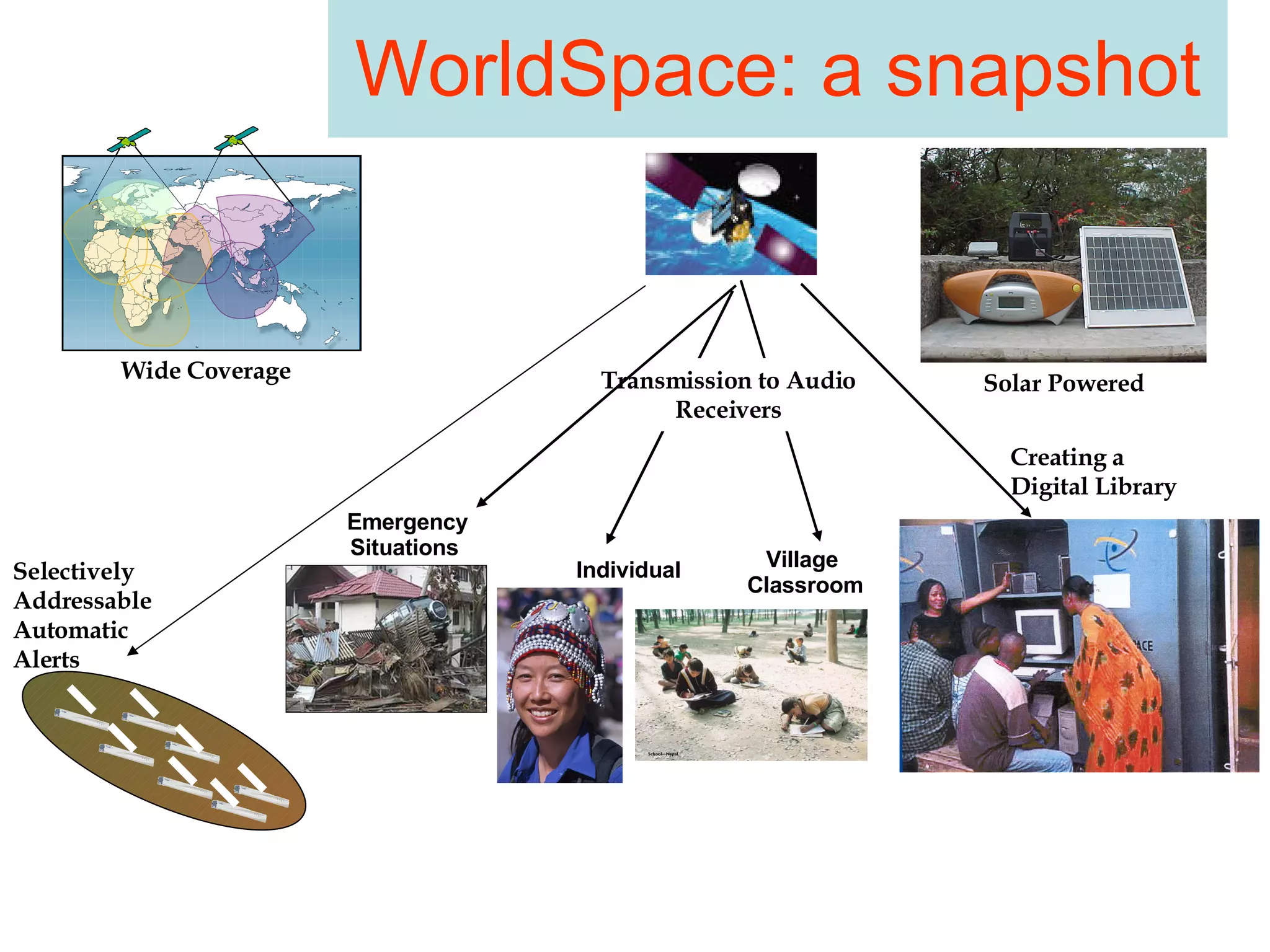
WorldSpace: a snapshot Creating a Digital Library Solar Powered Selectively Addressable Automatic Alerts Individual Transmission to Audio Receivers Village  Classroom Emergency Situations  In Service In Service Wide Coverage
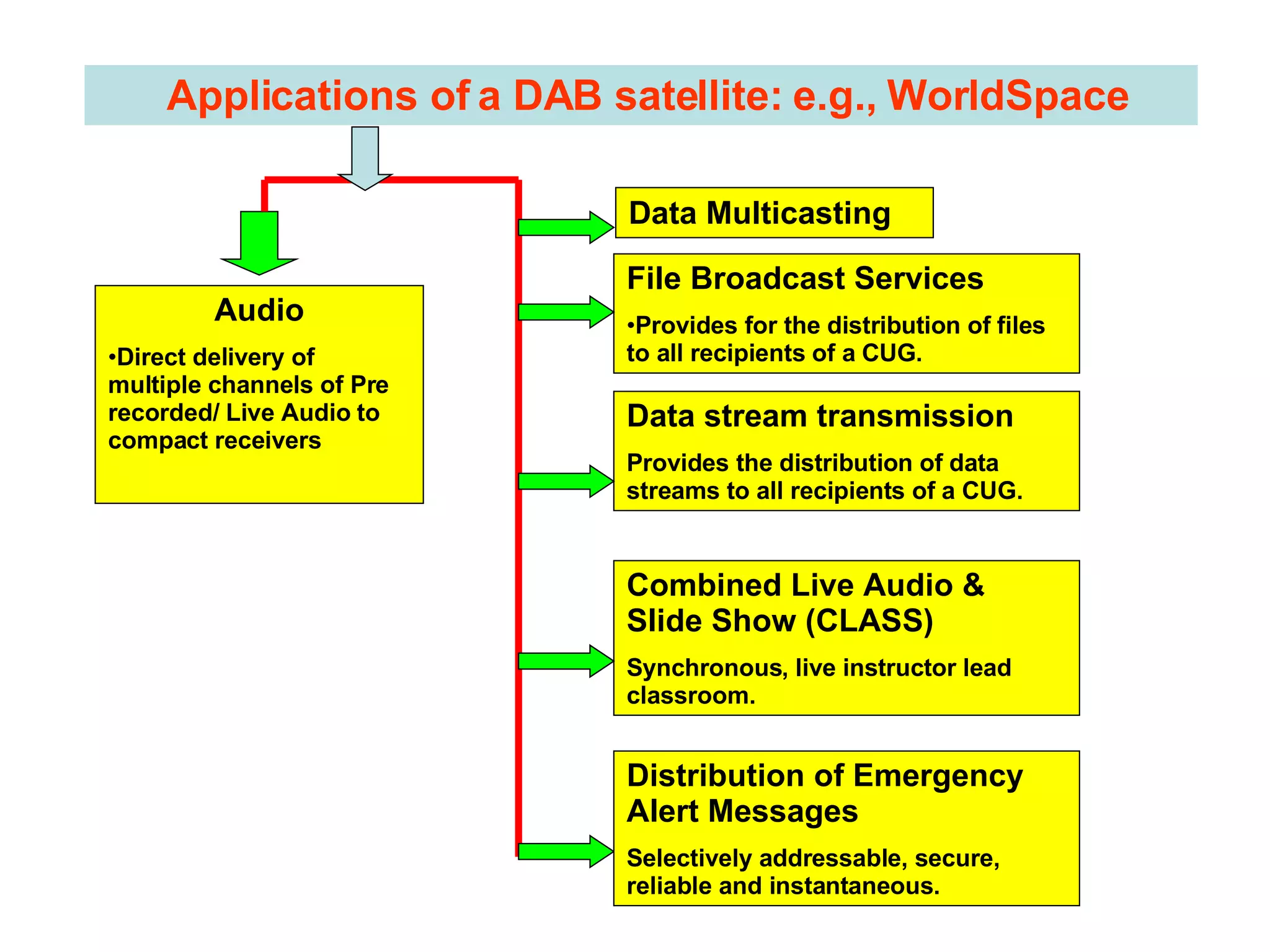
Applications of a DAB satellite: e.g., WorldSpace Audio Direct delivery of multiple channels of Pre recorded/ Live Audio to compact receivers Data Multicasting   File Broadcast Services Provides for the distribution of files to all recipients of a CUG. Data stream transmission Provides the distribution of data streams to all recipients of a CUG.  Combined Live Audio & Slide Show (CLASS) Synchronous, live instructor lead classroom. Distribution of Emergency Alert Messages Selectively addressable, secure, reliable and instantaneous.
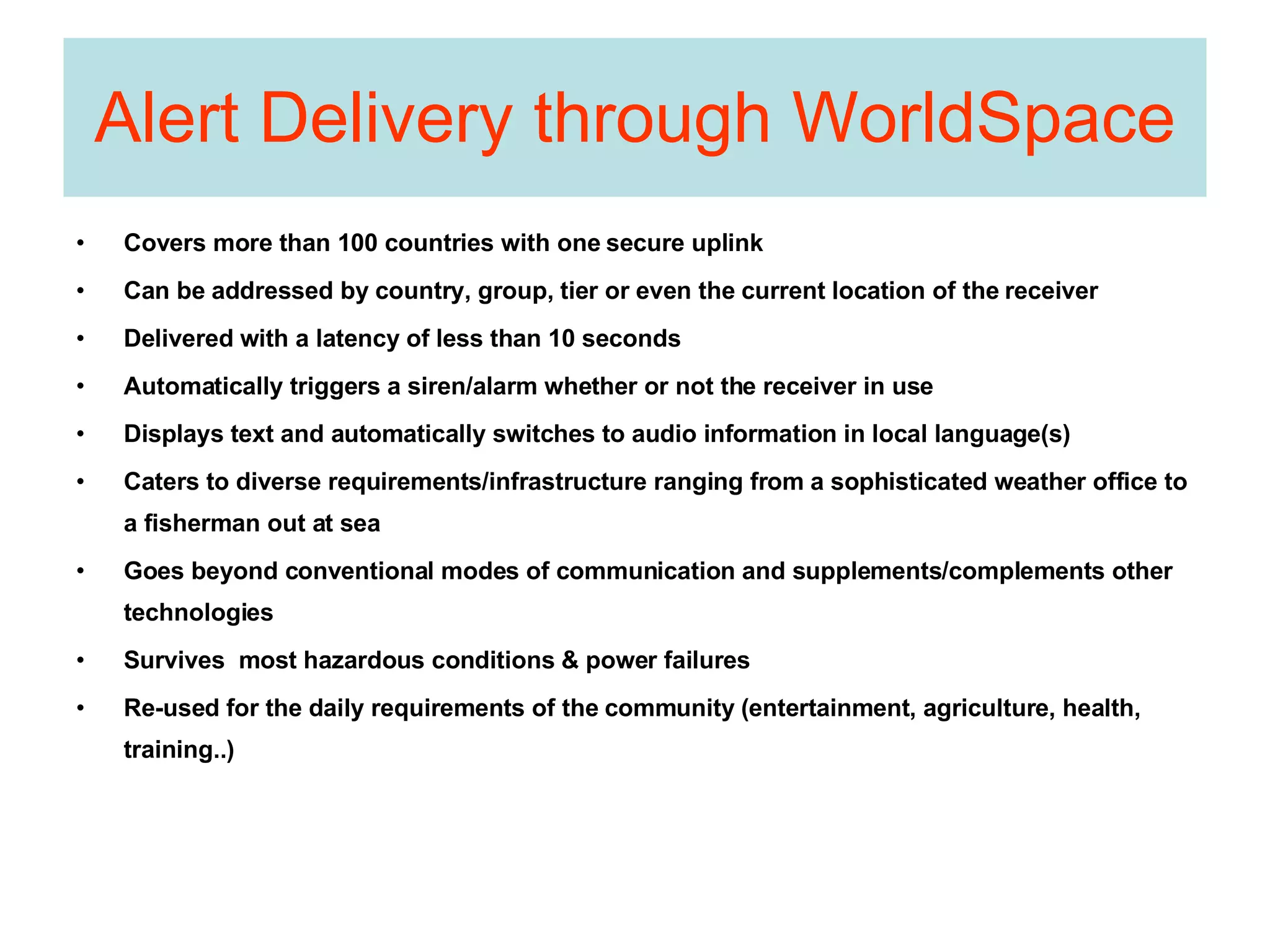
Alert Delivery through WorldSpace Covers more than 100 countries with one secure uplink Can be addressed by country, group, tier or even the current location of the receiver Delivered with a latency of less than 10 seconds Automatically triggers a siren/alarm whether or not the receiver in use Displays text and automatically switches to audio information in local language(s) Caters to diverse requirements/infrastructure ranging from a sophisticated weather office to a fisherman out at sea Goes beyond conventional modes of communication and supplements/complements other technologies Survives  most hazardous conditions & power failures Re-used for the daily requirements of the community (entertainment, agriculture, health, training..)
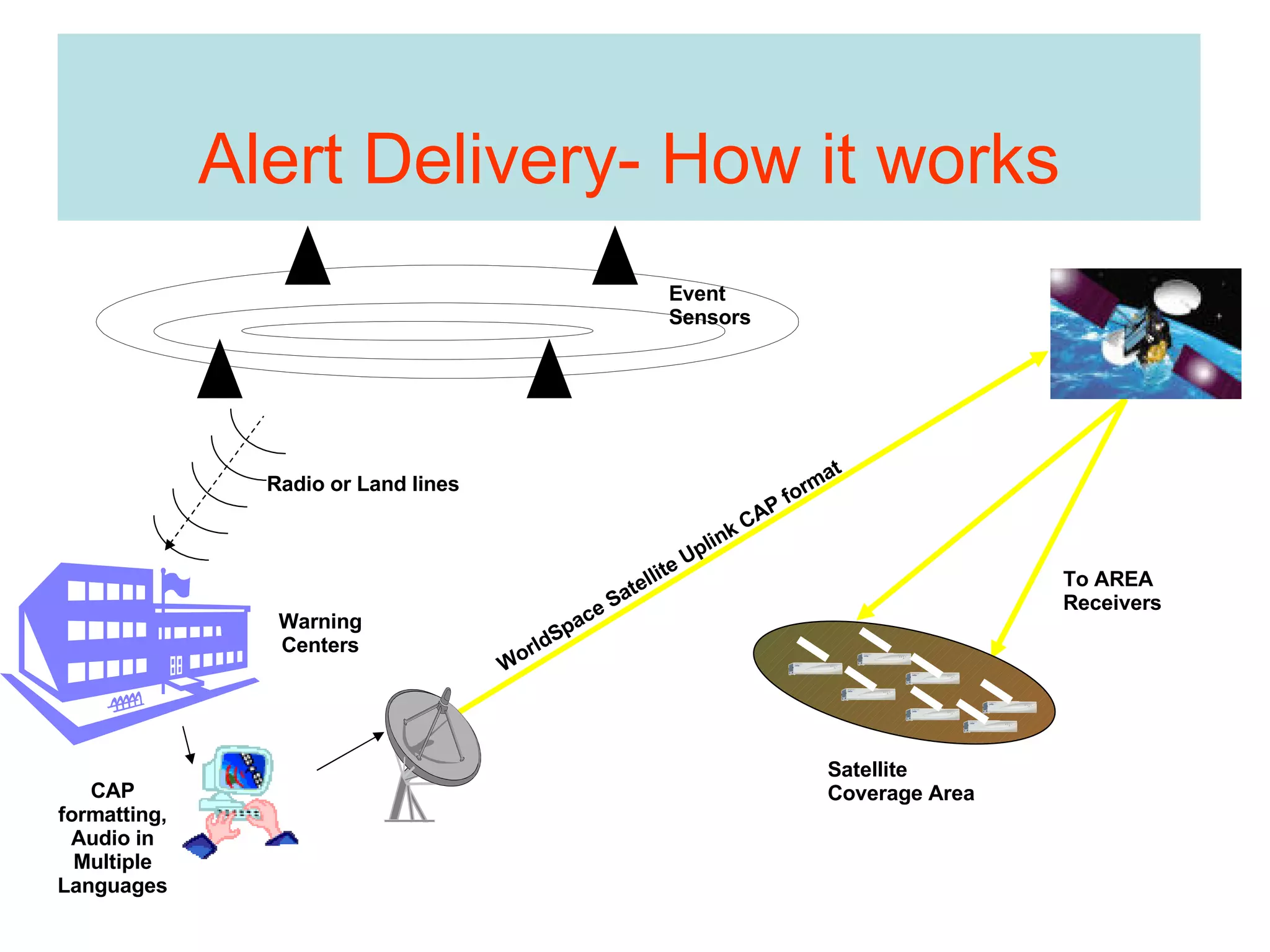
Alert Delivery- How it works WorldSpace Satellite Uplink CAP format Radio or Land lines Event Sensors Warning Centers To AREA   Receivers CAP formatting, Audio in Multiple Languages Satellite Coverage Area
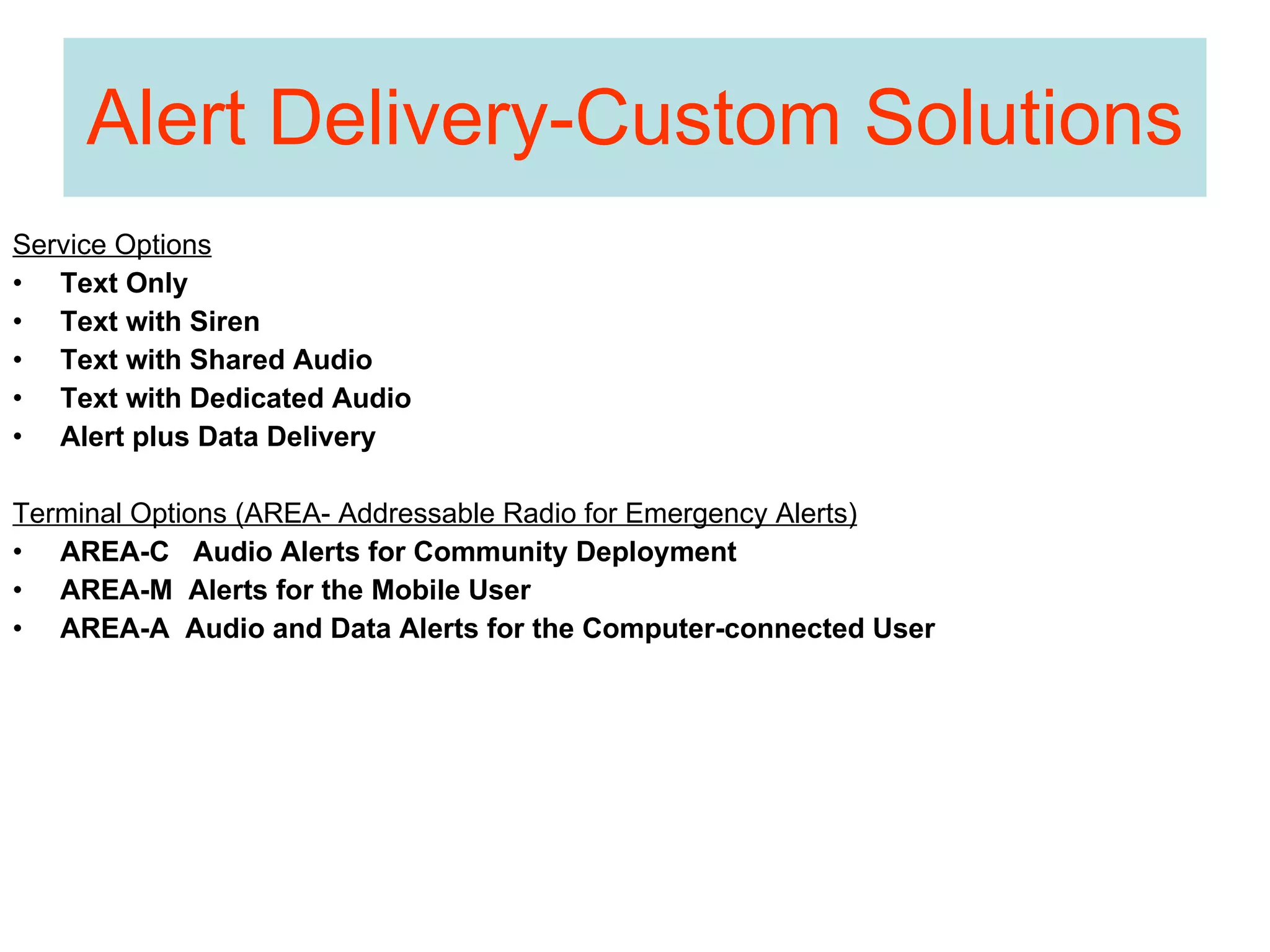
Alert Delivery-Custom Solutions Service Options Text Only Text with Siren Text with Shared Audio Text with Dedicated Audio Alert plus Data Delivery Terminal Options (AREA- Addressable Radio for Emergency Alerts) AREA-C  Audio Alerts for Community Deployment AREA-M  Alerts for the Mobile User AREA-A  Audio and Data Alerts for the Computer-connected User
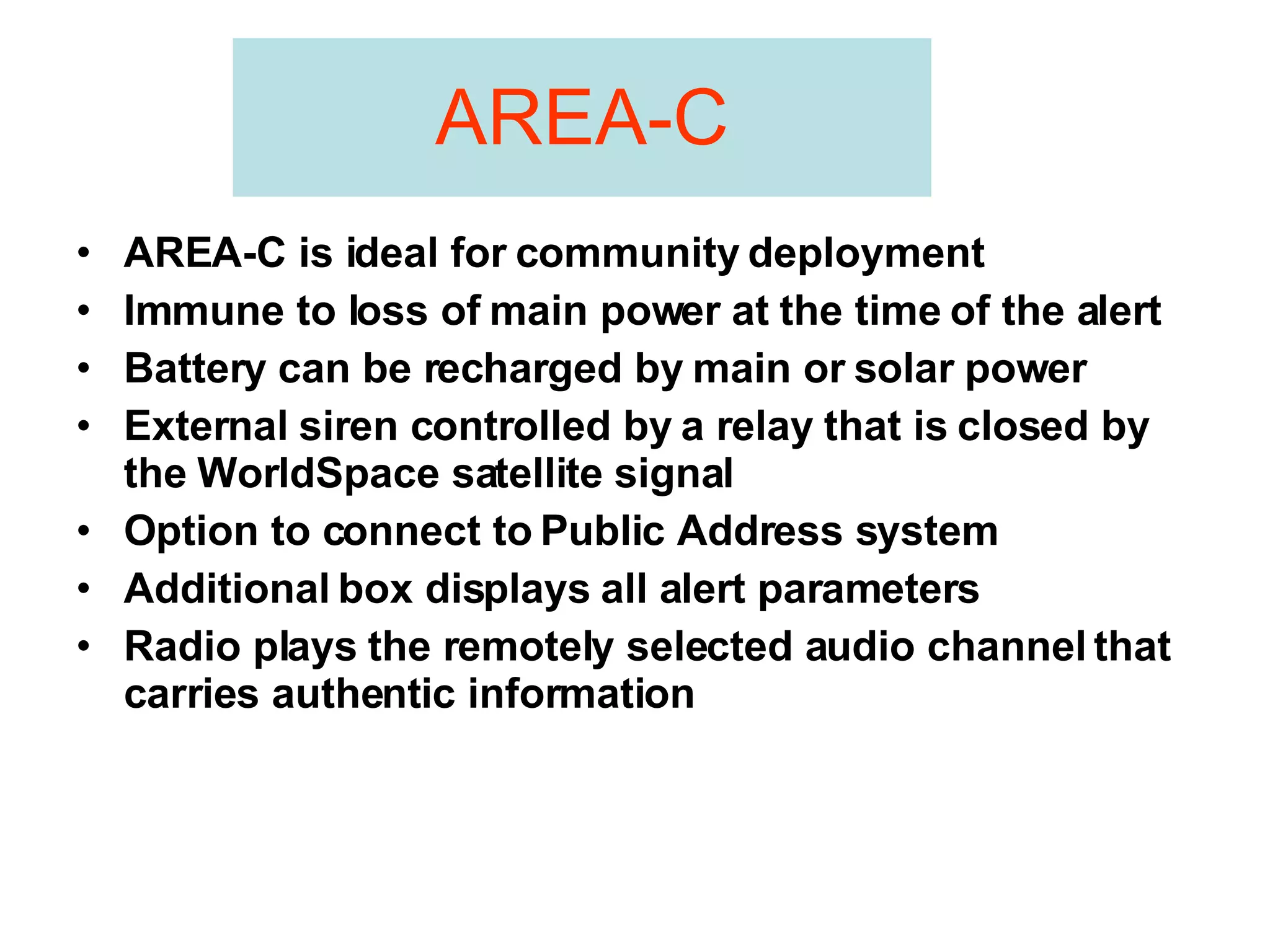
AREA-C AREA-C is ideal for community deployment Immune to loss of main power at the time of the alert Battery can be recharged by main or solar power External siren controlled by a relay that is closed by the WorldSpace satellite signal Option to connect to Public Address system Additional box displays all alert parameters Radio plays the remotely selected audio channel that carries authentic information
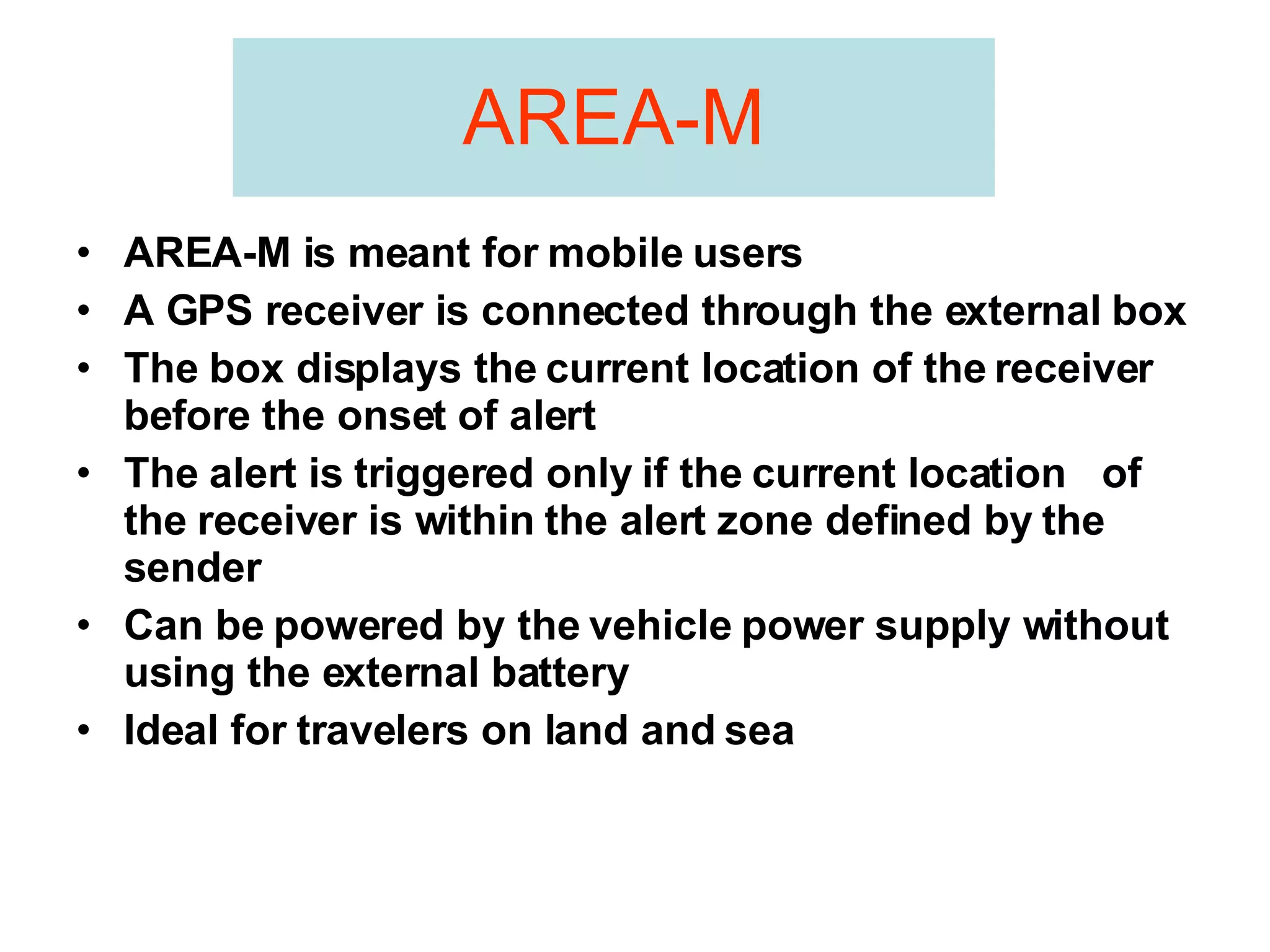
AREA-M AREA-M is meant for mobile users A GPS receiver is connected through the external box  The box displays the current location of the receiver  before the onset of alert The alert is triggered only if the current location  of the receiver is within the alert zone defined by the sender Can be powered by the vehicle power supply without using the external battery  Ideal for travelers on land and sea
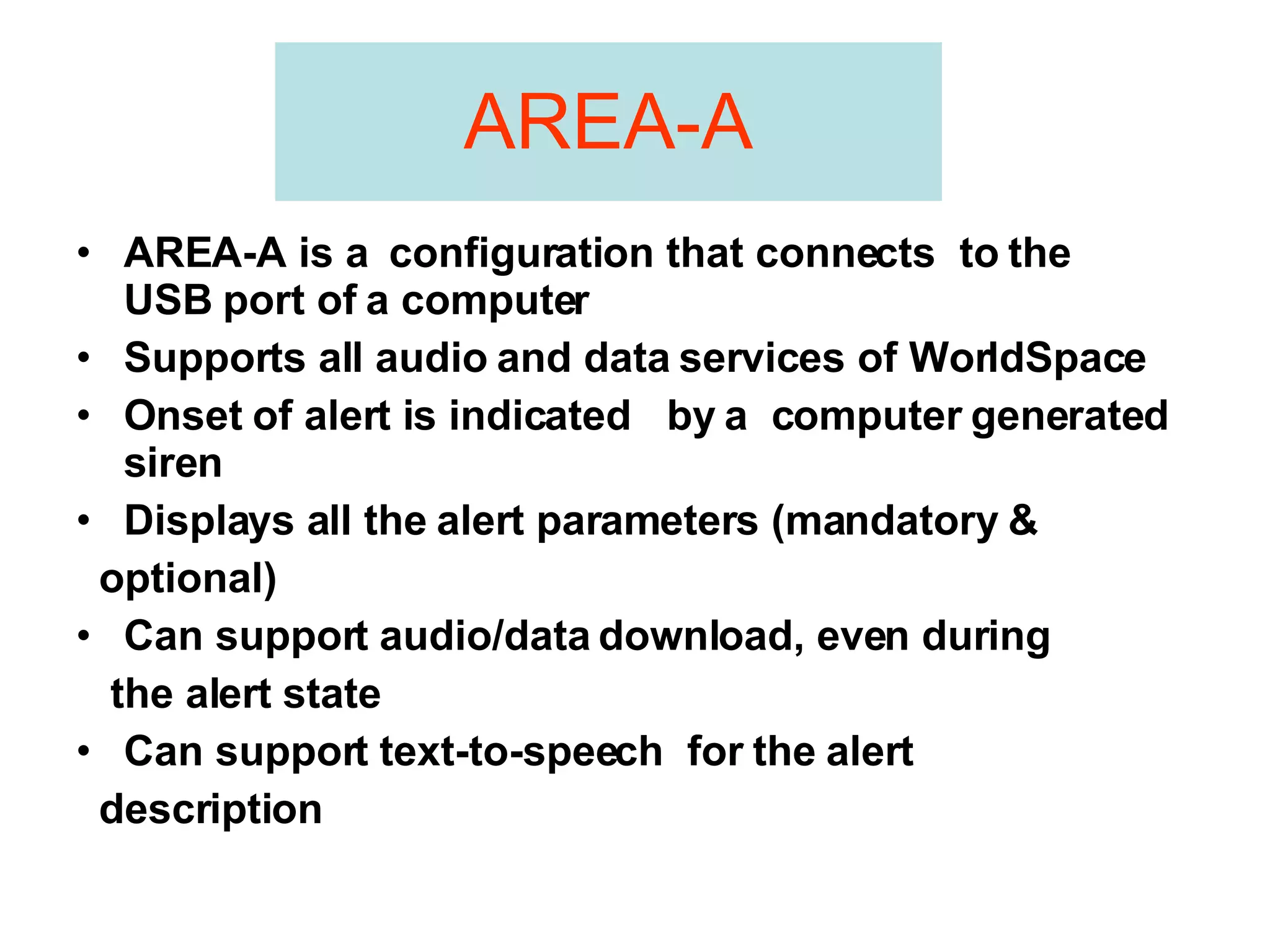
AREA-A AREA-A is a  configuration that connects  to the  USB port of a computer Supports all audio and data services of WorldSpace  Onset of alert is indicated  by a  computer generated siren Displays all the alert parameters (mandatory & optional) Can support audio/data download, even during the alert state Can support text-to-speech  for the alert description
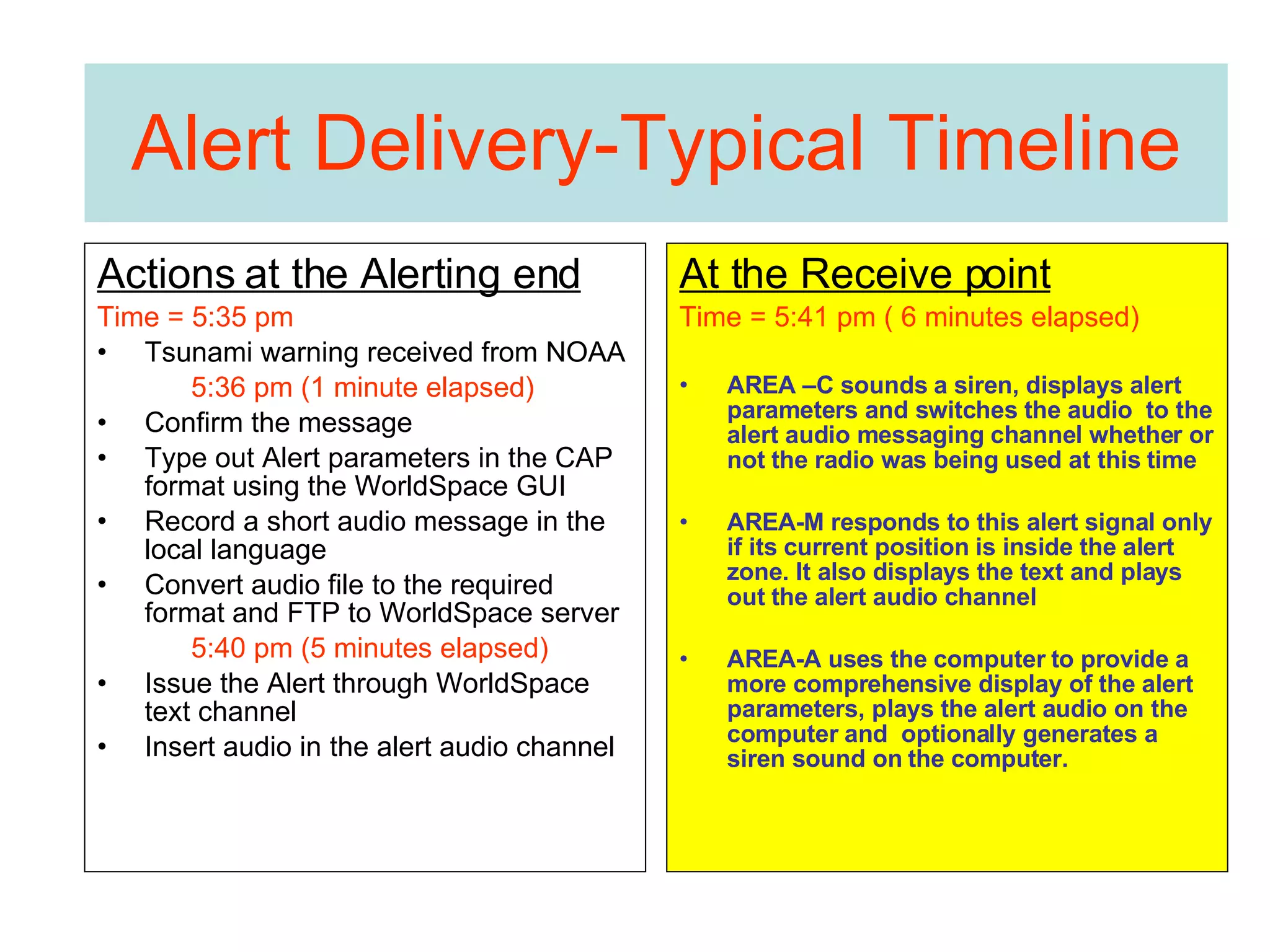
Alert Delivery-Typical Timeline Actions at the Alerting end Time = 5:35 pm Tsunami warning received from NOAA 5:36 pm (1 minute elapsed) Confirm the message Type out Alert parameters in the CAP format using the WorldSpace GUI Record a short audio message in the local language Convert audio file to the required format and FTP to WorldSpace server 5:40 pm (5 minutes elapsed) Issue the Alert through WorldSpace text channel Insert audio in the alert audio channel At the Receive point Time = 5:41 pm ( 6 minutes elapsed) AREA –C sounds a siren, displays alert parameters and switches the audio  to the alert audio messaging channel whether or not the radio was being used at this time AREA-M responds to this alert signal only if its current position is inside the alert zone. It also displays the text and plays out the alert audio channel AREA-A uses the computer to provide a more comprehensive display of the alert parameters, plays the alert audio on the computer and  optionally generates a siren sound on the computer.
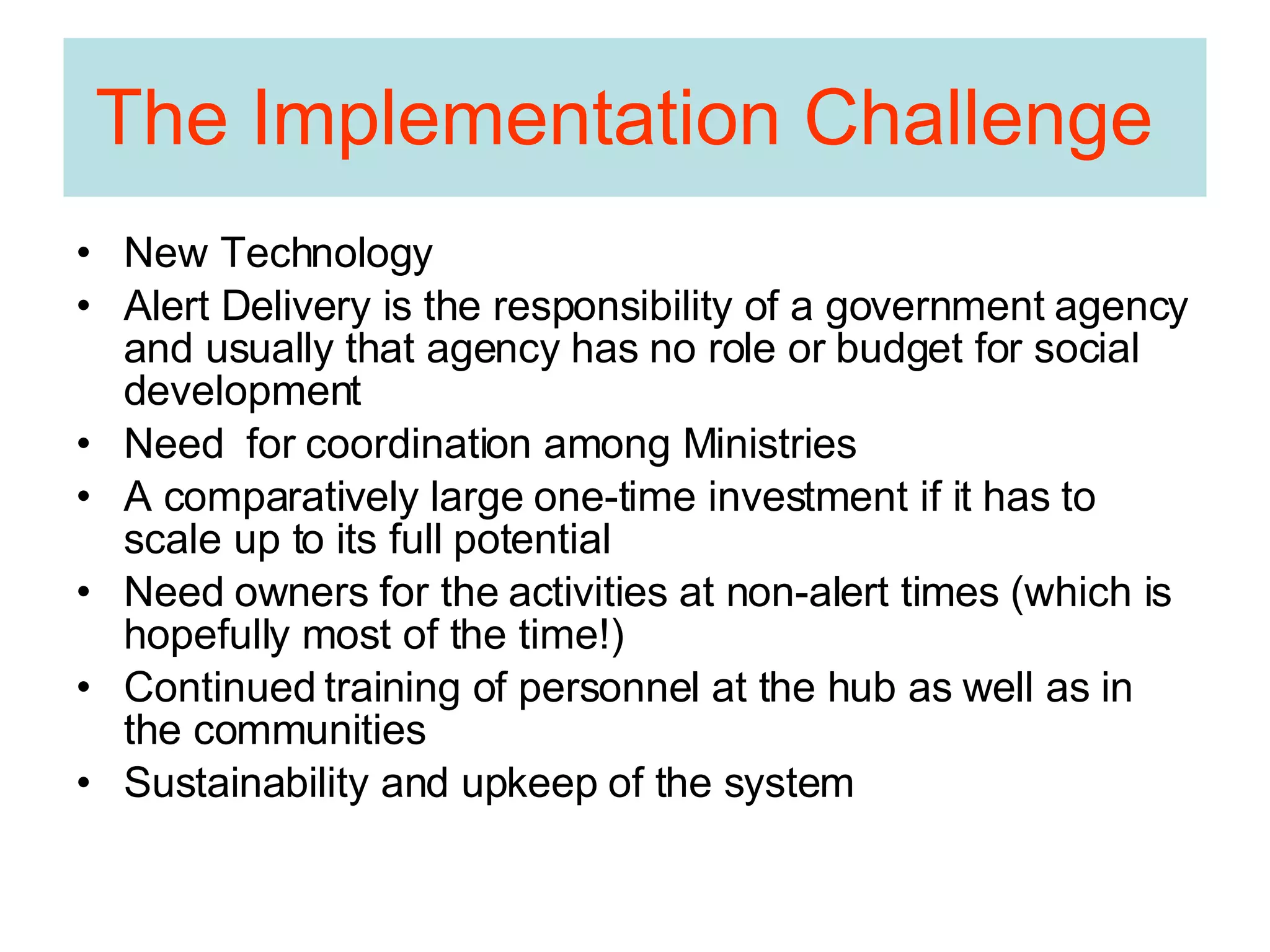
The Implementation Challenge  New Technology Alert Delivery is the responsibility of a government agency and usually that agency has no role or budget for social development Need  for coordination among Ministries A comparatively large one-time investment if it has to scale up to its full potential Need owners for the activities at non-alert times (which is hopefully most of the time!) Continued training of personnel at the hub as well as in the communities Sustainability and upkeep of the system
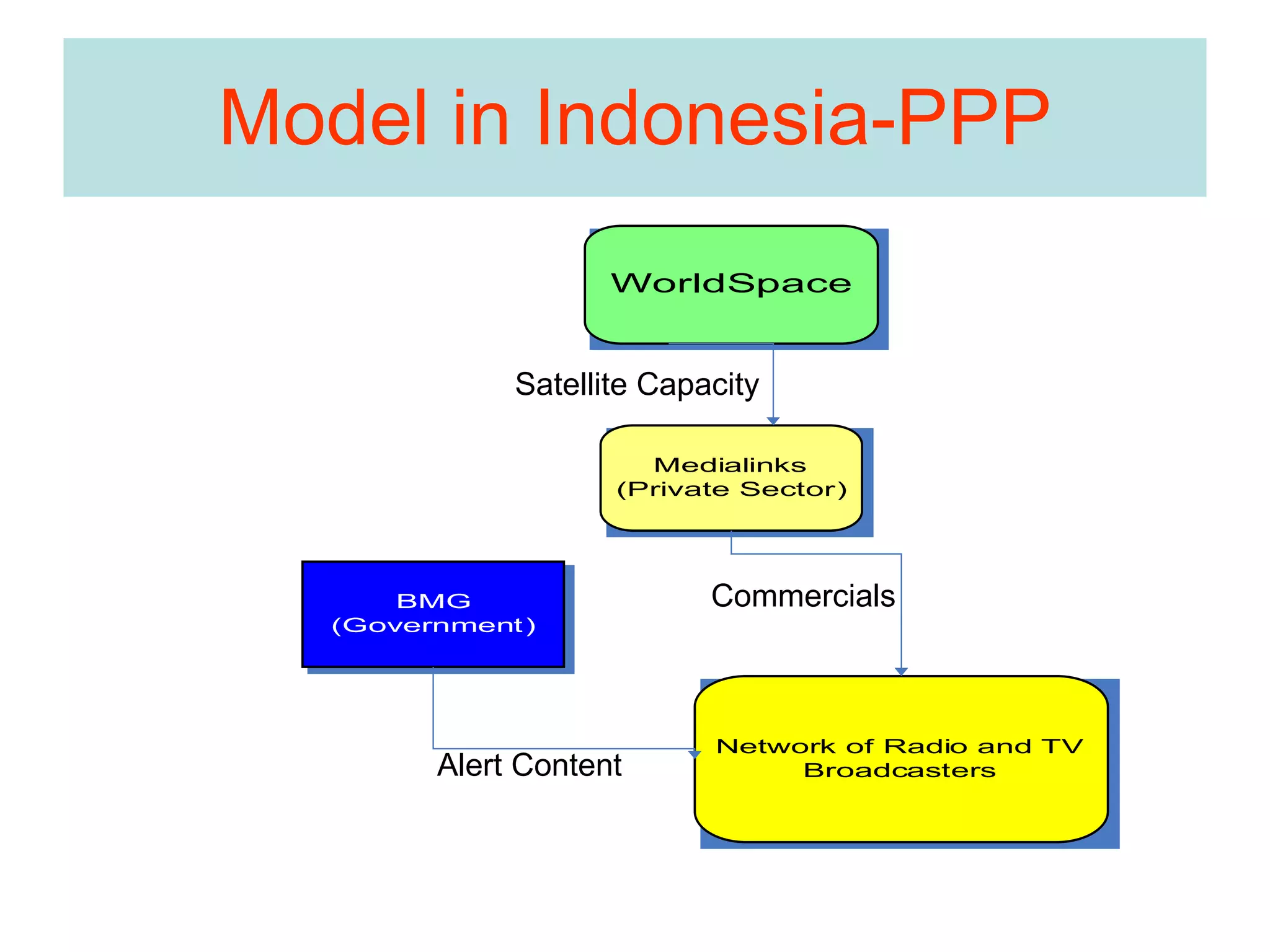
Model in Indonesia-PPP Satellite Capacity Alert Content Commercials
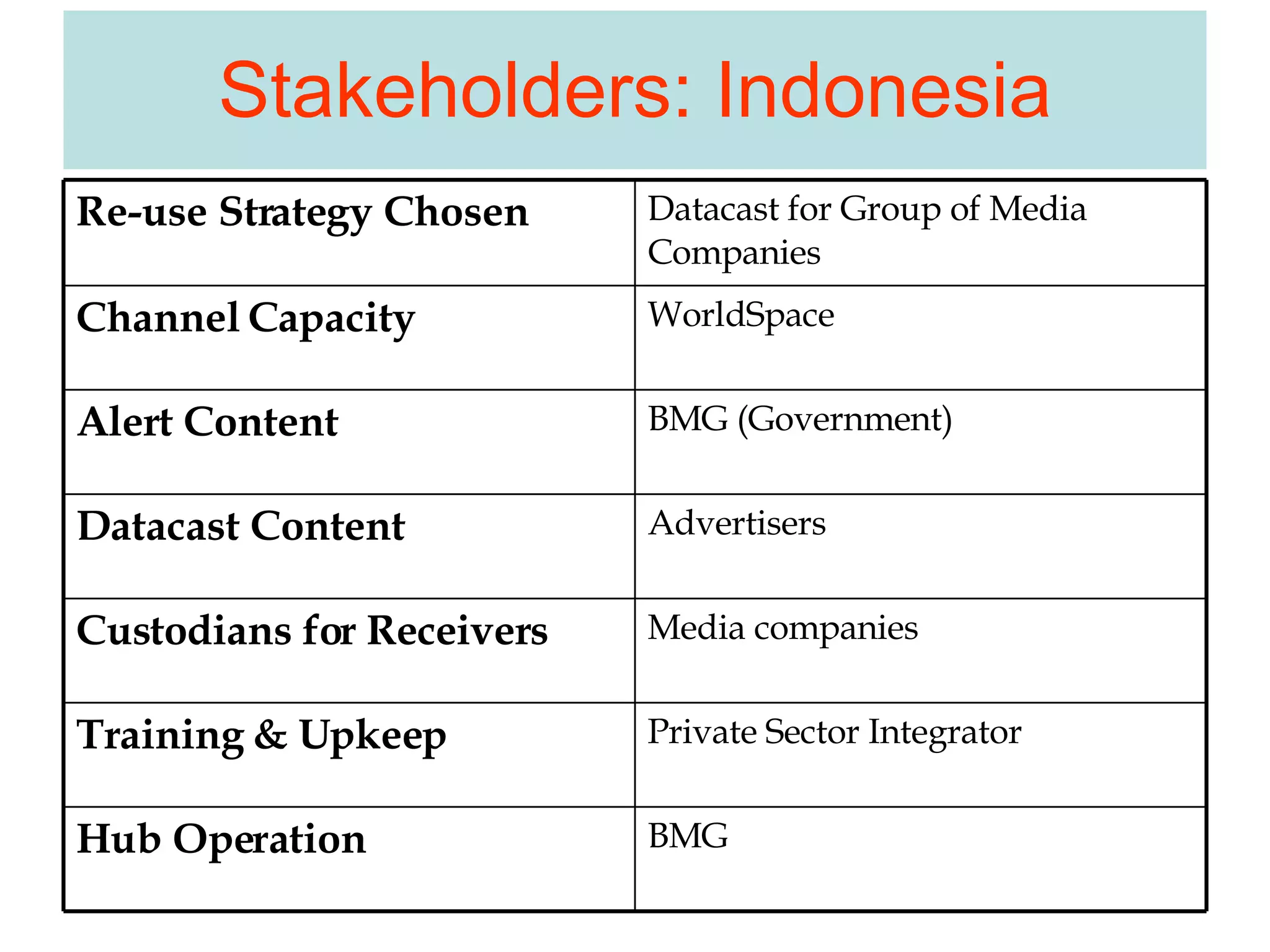
Stakeholders: Indonesia Datacast for Group of Media Companies Re-use Strategy Chosen BMG Hub Operation Private Sector Integrator Training & Upkeep Media companies Custodians for Receivers Advertisers Datacast Content BMG (Government) Alert Content WorldSpace Channel Capacity
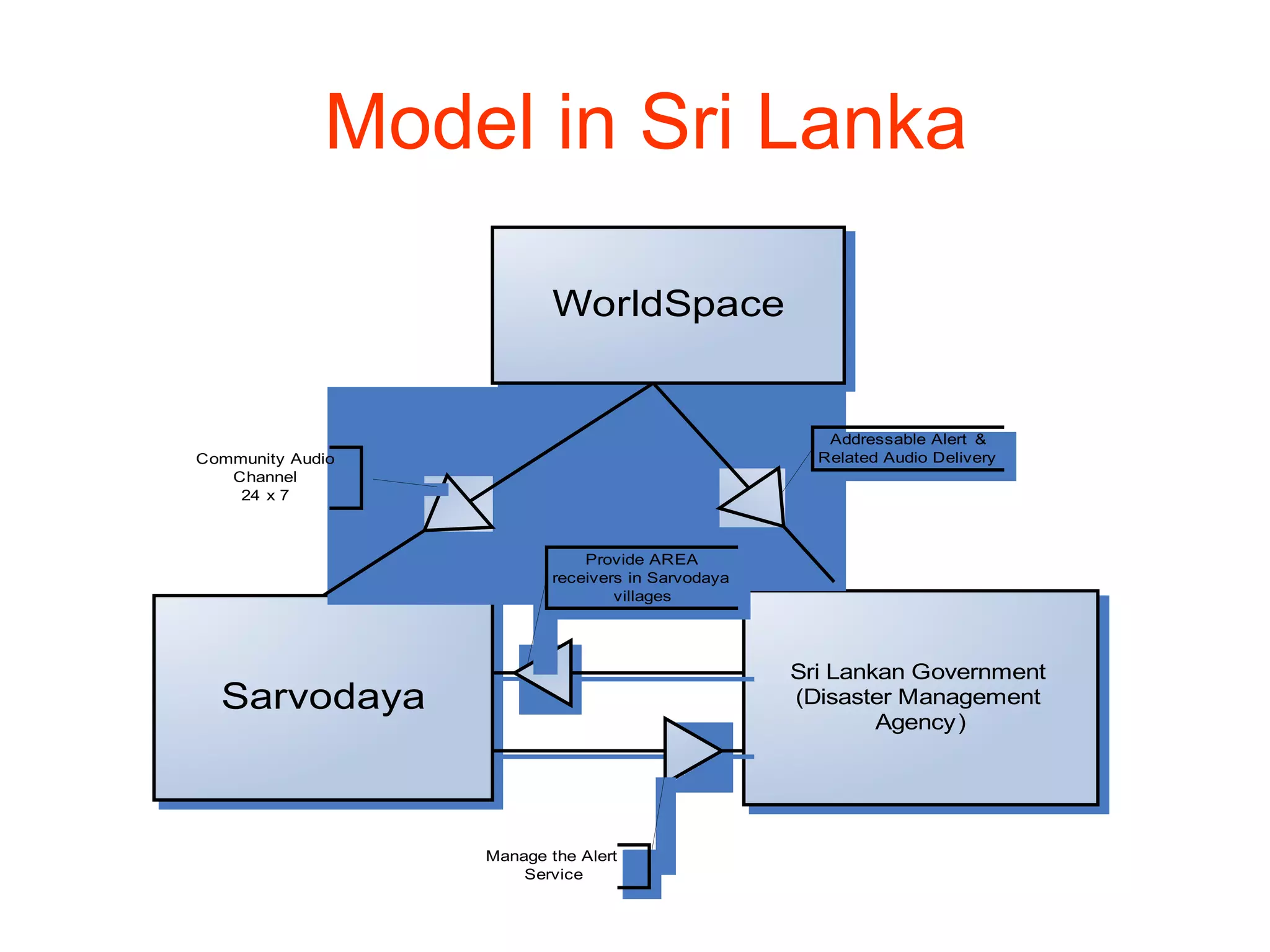
Model in Sri Lanka
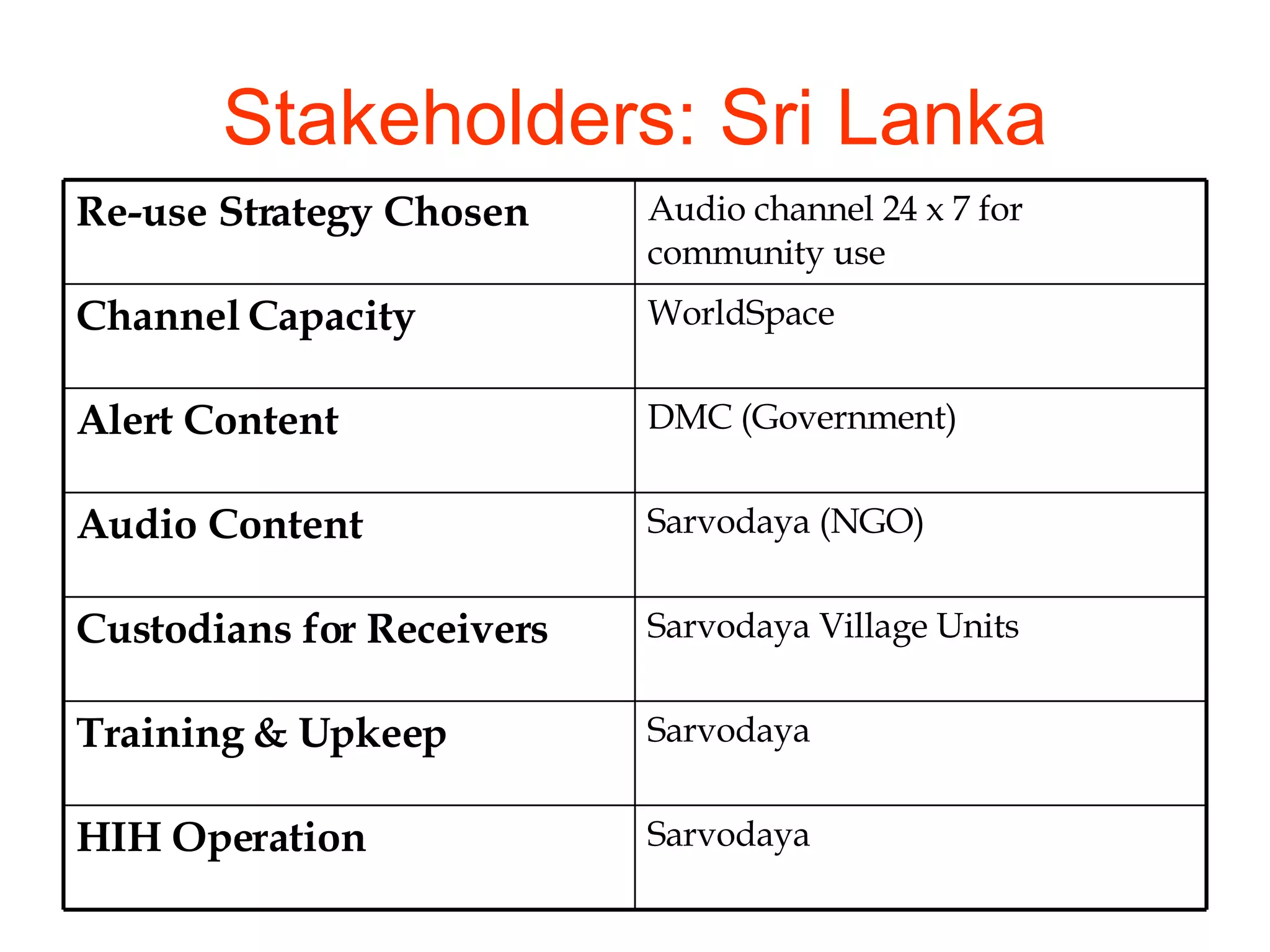
Stakeholders: Sri Lanka Audio channel 24 x 7 for community use Re-use Strategy Chosen Sarvodaya HIH Operation Sarvodaya Training & Upkeep Sarvodaya Village Units Custodians for Receivers Sarvodaya (NGO) Audio Content DMC (Government) Alert Content WorldSpace Channel Capacity
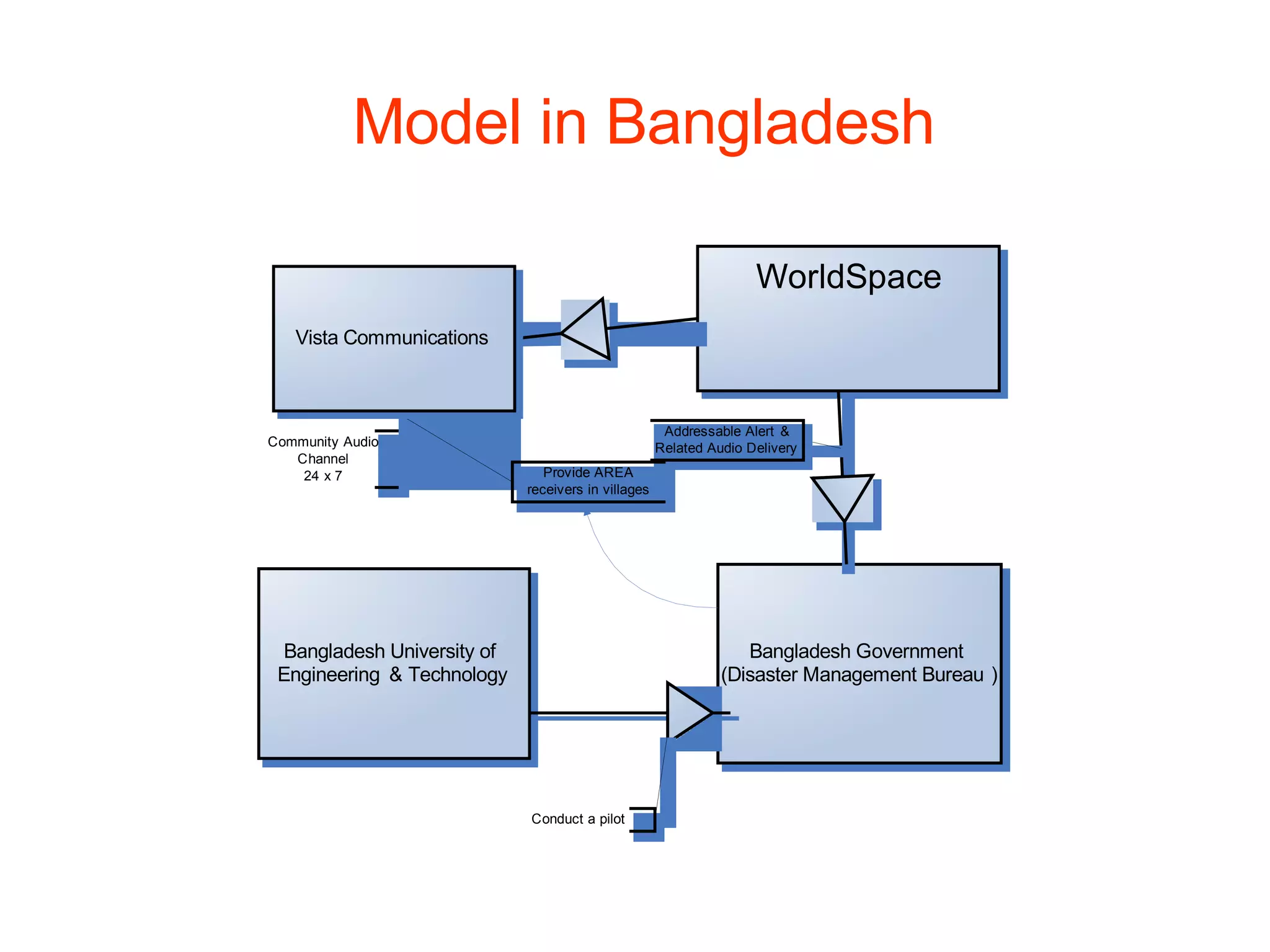
Model in Bangladesh
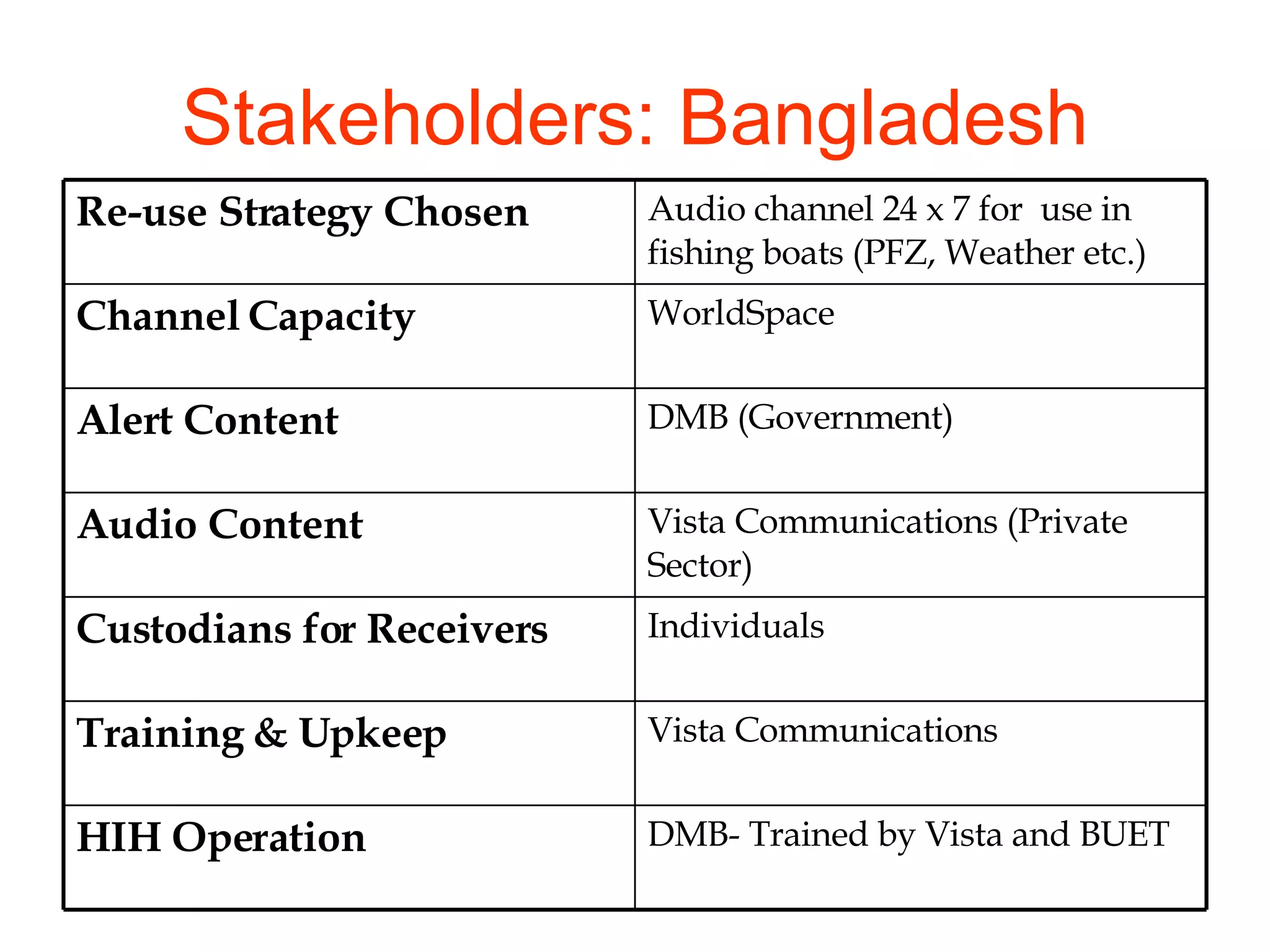
Stakeholders: Bangladesh Audio channel 24 x 7 for  use in fishing boats (PFZ, Weather etc.) Re-use Strategy Chosen DMB- Trained by Vista and BUET HIH Operation Vista Communications Training & Upkeep Individuals Custodians for Receivers Vista Communications (Private Sector) Audio Content DMB (Government) Alert Content WorldSpace Channel Capacity
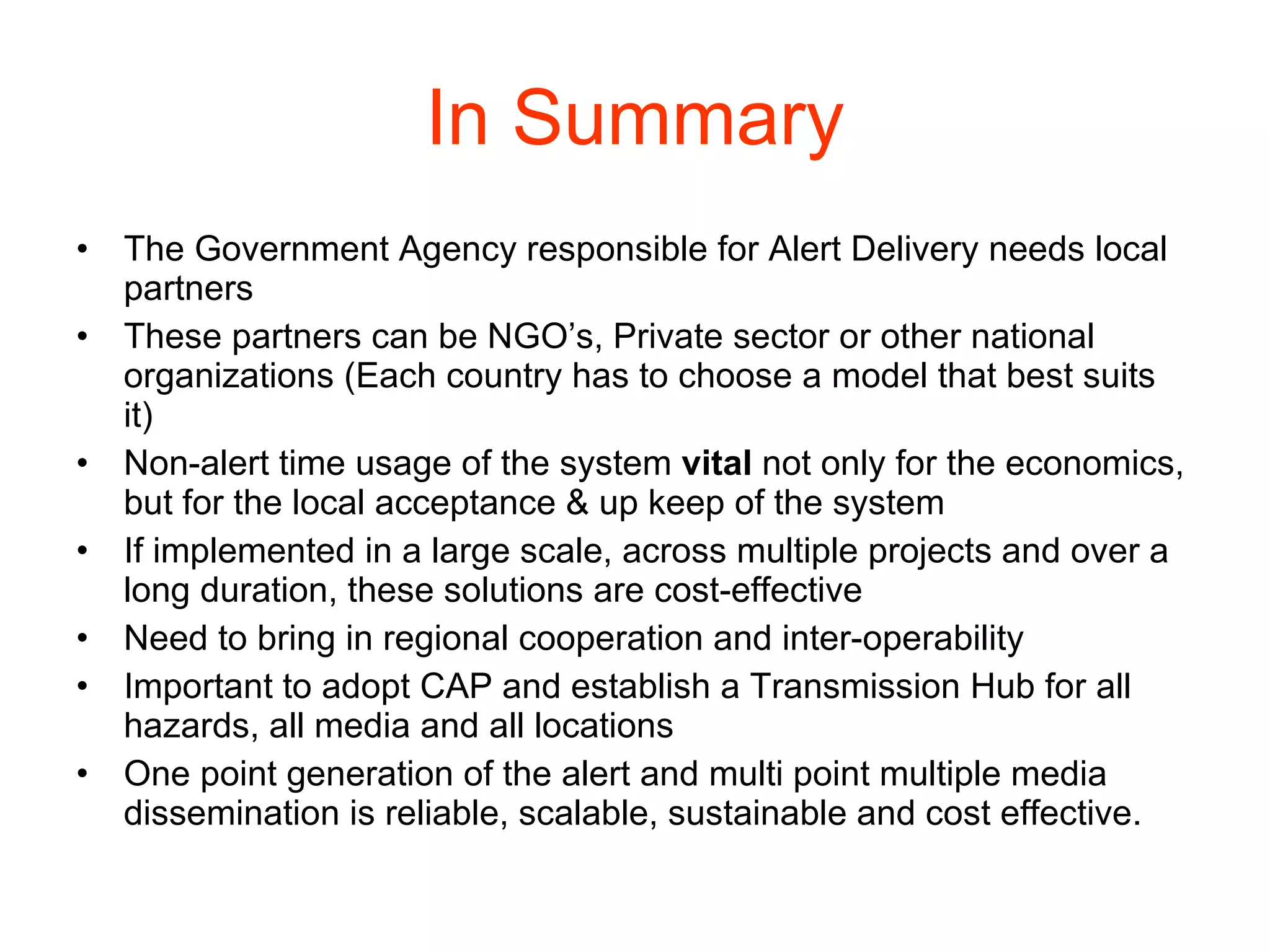
In Summary The Government Agency responsible for Alert Delivery needs local partners These partners can be NGO’s, Private sector or other national organizations (Each country has to choose a model that best suits it) Non-alert time usage of the system  vital  not only for the economics, but for the local acceptance & up keep of the system If implemented in a large scale, across multiple projects and over a long duration, these solutions are cost-effective Need to bring in regional cooperation and inter-operability Important to adopt CAP and establish a Transmission Hub for all hazards, all media and all locations One point generation of the alert and multi point multiple media dissemination is reliable, scalable, sustainable and cost effective.

Use of DAB Satellite for Addressable Alert Delivery

  • 1.
    Use of DABSatellite for Addressable Alert Delivery Presentation at the Training Workshop on Disaster Risk Management in the Information Age by S.Rangarajan, WorldSpace at the World Bank October 8-9, 2008
  • 2.
    WorldSpace: a snapshotCreating a Digital Library Solar Powered Selectively Addressable Automatic Alerts Individual Transmission to Audio Receivers Village Classroom Emergency Situations In Service In Service Wide Coverage
  • 3.
    Applications of aDAB satellite: e.g., WorldSpace Audio Direct delivery of multiple channels of Pre recorded/ Live Audio to compact receivers Data Multicasting File Broadcast Services Provides for the distribution of files to all recipients of a CUG. Data stream transmission Provides the distribution of data streams to all recipients of a CUG. Combined Live Audio & Slide Show (CLASS) Synchronous, live instructor lead classroom. Distribution of Emergency Alert Messages Selectively addressable, secure, reliable and instantaneous.
  • 4.
    Alert Delivery throughWorldSpace Covers more than 100 countries with one secure uplink Can be addressed by country, group, tier or even the current location of the receiver Delivered with a latency of less than 10 seconds Automatically triggers a siren/alarm whether or not the receiver in use Displays text and automatically switches to audio information in local language(s) Caters to diverse requirements/infrastructure ranging from a sophisticated weather office to a fisherman out at sea Goes beyond conventional modes of communication and supplements/complements other technologies Survives most hazardous conditions & power failures Re-used for the daily requirements of the community (entertainment, agriculture, health, training..)
  • 5.
    Alert Delivery- Howit works WorldSpace Satellite Uplink CAP format Radio or Land lines Event Sensors Warning Centers To AREA Receivers CAP formatting, Audio in Multiple Languages Satellite Coverage Area
  • 6.
    Alert Delivery-Custom SolutionsService Options Text Only Text with Siren Text with Shared Audio Text with Dedicated Audio Alert plus Data Delivery Terminal Options (AREA- Addressable Radio for Emergency Alerts) AREA-C Audio Alerts for Community Deployment AREA-M Alerts for the Mobile User AREA-A Audio and Data Alerts for the Computer-connected User
  • 7.
    AREA-C AREA-C isideal for community deployment Immune to loss of main power at the time of the alert Battery can be recharged by main or solar power External siren controlled by a relay that is closed by the WorldSpace satellite signal Option to connect to Public Address system Additional box displays all alert parameters Radio plays the remotely selected audio channel that carries authentic information
  • 8.
    AREA-M AREA-M ismeant for mobile users A GPS receiver is connected through the external box The box displays the current location of the receiver before the onset of alert The alert is triggered only if the current location of the receiver is within the alert zone defined by the sender Can be powered by the vehicle power supply without using the external battery Ideal for travelers on land and sea
  • 9.
    AREA-A AREA-A isa configuration that connects to the USB port of a computer Supports all audio and data services of WorldSpace Onset of alert is indicated by a computer generated siren Displays all the alert parameters (mandatory & optional) Can support audio/data download, even during the alert state Can support text-to-speech for the alert description
  • 10.
    Alert Delivery-Typical TimelineActions at the Alerting end Time = 5:35 pm Tsunami warning received from NOAA 5:36 pm (1 minute elapsed) Confirm the message Type out Alert parameters in the CAP format using the WorldSpace GUI Record a short audio message in the local language Convert audio file to the required format and FTP to WorldSpace server 5:40 pm (5 minutes elapsed) Issue the Alert through WorldSpace text channel Insert audio in the alert audio channel At the Receive point Time = 5:41 pm ( 6 minutes elapsed) AREA –C sounds a siren, displays alert parameters and switches the audio to the alert audio messaging channel whether or not the radio was being used at this time AREA-M responds to this alert signal only if its current position is inside the alert zone. It also displays the text and plays out the alert audio channel AREA-A uses the computer to provide a more comprehensive display of the alert parameters, plays the alert audio on the computer and optionally generates a siren sound on the computer.
  • 11.
    The Implementation Challenge New Technology Alert Delivery is the responsibility of a government agency and usually that agency has no role or budget for social development Need for coordination among Ministries A comparatively large one-time investment if it has to scale up to its full potential Need owners for the activities at non-alert times (which is hopefully most of the time!) Continued training of personnel at the hub as well as in the communities Sustainability and upkeep of the system
  • 12.
    Model in Indonesia-PPPSatellite Capacity Alert Content Commercials
  • 13.
    Stakeholders: Indonesia Datacastfor Group of Media Companies Re-use Strategy Chosen BMG Hub Operation Private Sector Integrator Training & Upkeep Media companies Custodians for Receivers Advertisers Datacast Content BMG (Government) Alert Content WorldSpace Channel Capacity
  • 14.
  • 15.
    Stakeholders: Sri LankaAudio channel 24 x 7 for community use Re-use Strategy Chosen Sarvodaya HIH Operation Sarvodaya Training & Upkeep Sarvodaya Village Units Custodians for Receivers Sarvodaya (NGO) Audio Content DMC (Government) Alert Content WorldSpace Channel Capacity
  • 16.
  • 17.
    Stakeholders: Bangladesh Audiochannel 24 x 7 for use in fishing boats (PFZ, Weather etc.) Re-use Strategy Chosen DMB- Trained by Vista and BUET HIH Operation Vista Communications Training & Upkeep Individuals Custodians for Receivers Vista Communications (Private Sector) Audio Content DMB (Government) Alert Content WorldSpace Channel Capacity
  • 18.
    In Summary TheGovernment Agency responsible for Alert Delivery needs local partners These partners can be NGO’s, Private sector or other national organizations (Each country has to choose a model that best suits it) Non-alert time usage of the system vital not only for the economics, but for the local acceptance & up keep of the system If implemented in a large scale, across multiple projects and over a long duration, these solutions are cost-effective Need to bring in regional cooperation and inter-operability Important to adopt CAP and establish a Transmission Hub for all hazards, all media and all locations One point generation of the alert and multi point multiple media dissemination is reliable, scalable, sustainable and cost effective.