Dr. Bartel Van de Walle Information Systems and Management Department Tilburg University [email_address] Joint work with Prof. Murray Turoff (NJIT) DERMIS:  Dynamic Emergency Response Management Information Systems RIEŠENIE  KRÍZOVÝCH  SITUÁCIÍ   V  ŠPECIFICKOM  PROSTRED Í
Strike Court Case Cost overrun Delivery delay New regulation Terrorist action Supply shortage Natural Disaster Organizational  Emergency Situations Production delay Product malfunction Contract Negotiation Loss of a key employee Loss of a key customer Responding to an RFP New Competitive product Emergencies – crises - disasters
Emergencies – crises - disasters Unpredictable: Events Who will be involved What information will be needed What resources will be needed What actions will be taken, when, where, and by who No time for training, meeting, or planning No contingency plan that fits perfectly Emergency   Characteristics
Emergency  Management  Requirements Obtain data, status, views Monitor conditions Obtain expertise, liaison, action takers, reporters Draft contingencies Validate options Obtain approvals, delegate authority Coordinate actions, take actions, evaluate actions Evaluate outcomes Modify scenarios and plans Modify community and operations DERMIS
An emergency system must be regularly used to work in a real emergency People are working intense 14-18 hour days and cannot be interrupted Timely tacking of what is happening is critical Delegation of authority a must and Providing related data and information up, down, and laterally is critical Plans are in constant modification DERMIS ER Wisdom I
Learning and adaptation of response plans from training and real events is a necessity In a crisis exceptions and variations to the norm are common The critical problem of the moment collects attention and resources. DERMIS ER Wisdom II
Roles are the constant in an emergency and who is in a role may vary unexpectedly Training people in multiple roles is very desirable Roles and their privileges must be defined in the response system DERMIS ER Wisdom  III
Supporting confidence in a decision by the best possible timely information Necessary Properties Free exchange of information Delegation of authority Decision accountability Decision oversight Information source identification Information overload reduction DERMIS ER Wisdom IV
Information Overload is typical Heterogeneous groups and individuals People work together who do not normally do so Cannot predict who will be involved Community and Public relations is critical (confidence and trust) DERMIS Supporting Wisdom
The priority problem of the moment is the magnet that gathers the data, information, people, and resources to deal with it The integration of qualitative and quantitative information with measures of timeliness, confidence and priority is critical Having pre-established existing communities of people and resources to draw upon Knowing who and what is available in real time Learning from each experience and modifying lore for the future DERMIS Critical Success Factors
Easy to Learn High degree of tailoring by users Used by trained professionals Overcome problem of small screens (PDA) Virtual command and control center Support use of remote databases in an integrated manner Support planning, evaluation, training, updating, maintenance, as well as response Communication process independent of content DERMIS DESIGN Objectives
Determine what individuals are looking for and not finding Guide individuals to those interested in the same thing at the same time Piece relevant data together Alert individuals to anything falling in the cracks Provide high confidence of a person knowing  they have the best information possible at the moment DERMIS Smart Requirements for Emergency Group Communications
System is a helper not a boss System allows variable problem solving methods Reduction of information overload Minimization of execution difficulty High degree of comprehension High degree of tailoring by individual Encourage creativity and improvisation Support decision confidence Monitor performance and effort for possible fatigue Multimodal interfaces DERMIS Human Computer Challenges
Fire, Police, Public Works Public Health, Hospitals, Clinics, Doctors, Community resources (e.g. bulldozers, contractors, boats, generators, etc.) Utilities, Contractors, Equipment State Agencies, National Guard, State Police, Other local regional Governments Federal Agencies, Civil Defense, FEMA, Homeland Security Non-Profits, Service Organizations, Professionals, Community Groups Forms of communication DERMIS Integration Requirements
Metaphors understood by professionals Human roles built in Notifications integrated into communications Context visibility Semantic Hypertext relationships List processing at user level DERMIS Specific Interaction Design Criteria
Example: the Emergency Metaphor All emergencies have events Time logged and archived Serves dispatch function Used after emergency to understood what took place Often separate events on different systems for each agency involved Consider dynamic database of events integrated across all agencies DERMIS
Summary on DERMIS A transaction system integrated with a structured group communication system Roles and event templates can be created and modified at any time, e.g. the system can be evolved by the users Can be used for all phases of the emergency response process Analyses, Planning, training, evaluation, and recovery Can be used for all types of emergencies Can be used to support Online Communities DERMIS
PLANNING WITH DERMIS  Generating scenarios and evaluating them as a collaborative exercise is quite easy to do in DERMIS Additional need of voting and scaling aids to allow determining disagreements and focus discussion Generate new event types and roles to deal with new risks DERMIS
Easy to establish training exercises based upon role-event structure Simulation driven by a sequence of timed events in real time tied to the clock or can be speeded up for some types of training Players can easily be simulated with respect to actions and generated events Small teams can participate with a much larger groups of simulated players DERMIS TRAINING WITH DERMIS
Examine log file of events and actions by roles Develop appropriate analysis tools to aid this process Discover and correct problems by improving system and/or improving training DERMIS EVALUATING WITH DERMIS
Can be used to direct and coordinate the recovery activity Can involve any diversity organizations and agencies involved Provides a complete record and accountability for the recovery process DERMIS RECOVERY WITH DERMIS
Can be used for all phases of the emergency response process Can be used for “little” emergencies which are quite common in any type of organizations Can be used to support Online Communities DERMIS SUMMARY ON DERMIS
Tend to be top down Follow designs done for single agencies or organizations Somewhat bureaucratic Assume largely verbal interaction Pre-segments groups to “manageable” size Tend to encourage rule following and often promotes rigidity Can work for single homogenous group  DERMIS Traditional Systems
Heterogeneous very large communities Allows group formation to be dynamic Allows for quick delegation of authority by role assignment Provides for timely oversight and accountability Encourages flexibility of response Encourages strong personal ties among responders and resulting cohesive groups. Provides support for all phases of the emergency response process as well as everyday use for other regular functions DERMIS DERMIS Type  Systems
Change and disruption is more common than we think, even in commerce, and getting more frequent The technology exists to do it However, does the organizational motivation and understanding exists to do it? The issue is designing new virtual organizations and communities that will change existing organizations and the way things are done. DERMIS THE FUTURE
Decision models (‘fast and frugal’ heuristics?) Requirements and design of Virtual Command and Control Centers How to design human computer interactions to stimulate creativity or improvising by both individuals and groups Research topics in ER I Research topics in ER
How to reduce information overload and it’s negative effects when it occurs Design of training scenarios to encourage flexibility of response and reduce rigidity Research topics in ER II Research topics in ER
Design and development of systems to support local, regional, and national virtual communities of experts and professionals in ER Lightweight integration of resource databases Design and utilization of collaborative knowledge systems for professional communities Research topics in ER III Research topics in ER
Development of Emergency Prevention & Response audit controls in a continuous auditing environment Integrating Emergency Response Systems into day to day processes in organizations Research topics in ER IV Research topics in ER
Multimedia information capturing of information in training and real crisis situations Development of realistic training games for large groups utilizing the actual response IS system Investigations of decision processes in the full cycle of emergency response functions: Analysis, planning, preparation, training, response, and evaluation Development of improved support tools for all the phases Research topics in ER V Research topics in ER
Research topic: Virtual teams and communities Large numbers of on call advisors did exist in OEP for obtaining information in an emergency Today the Web makes this a very economical approach and can encourage local, regional and national communities of volunteer experts  Research topics in ER
Virtual Communities Use ERMIS software for virtual communities and people will be trained to join given the right emergency situation Allow communities to build a knowledge system in their area In organizations employ ERMIS for all teams and committees dealing with problems that cut across the organization Virtual teams and communities
ERMIS is an Interdisciplinary Effort Information System Designers and Researchers Software Engineers and Developers Emergency Preparedness Professionals and Managers Local and Regional Government Professionals and Administrators  Conclusion
ISCRAM – Information Systems for Crisis Response and Management
Purpose of the ISCRAM Community Promote research, development and deployment of information  systems for crisis response and management Promote and facilitate international cooperation between  scientific institutions, research institutes and universities with activities in the area of crisis response and management scientists and the practitioners in this field  research in scientific institutions and universities and the technology and solution providers
Purpose of the ISCRAM Community Help define programmes and projects and develop action plans, both national and international, for scientific and technological research in this area, and in collaboration with members of the ISCRAM Community
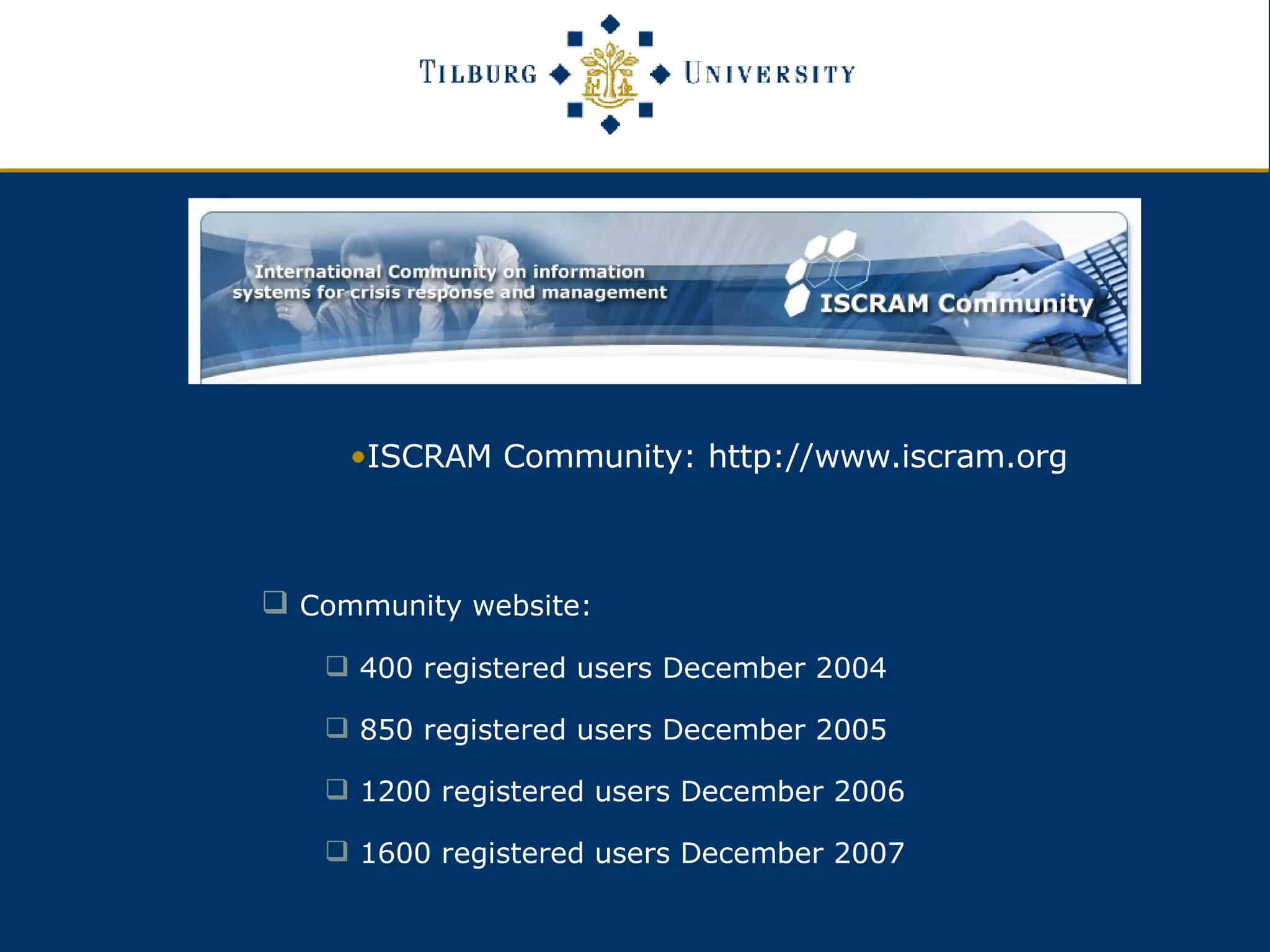
Community website:  400 registered users December 2004 850 registered users December 2005 1200 registered users December 2006 1600 registered users December 2007 ISCRAM Community: http://www.iscram.org
ISCRAM International Conferences: Initiated in 2004, first meeting in Brussels As of 2005, alternating between Europe and USA: Brussels, Belgium 2005 Newark, New Jersey 2006 Delft, the Netherlands 2007 Washington DC 2008 Gothenburg, Sweden, 2009 San Diego, CA 2010
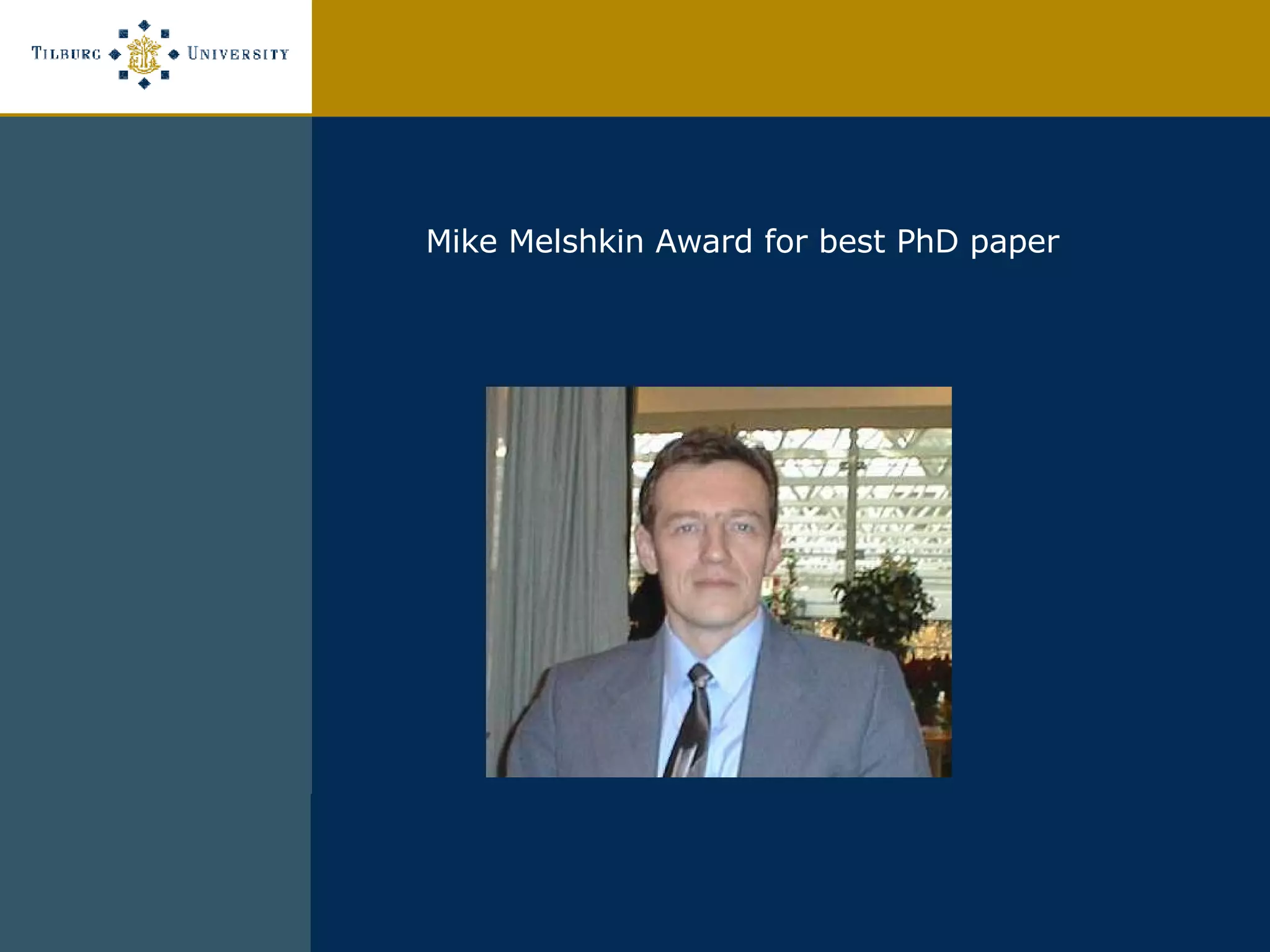
Mike Melshkin Award for best PhD paper
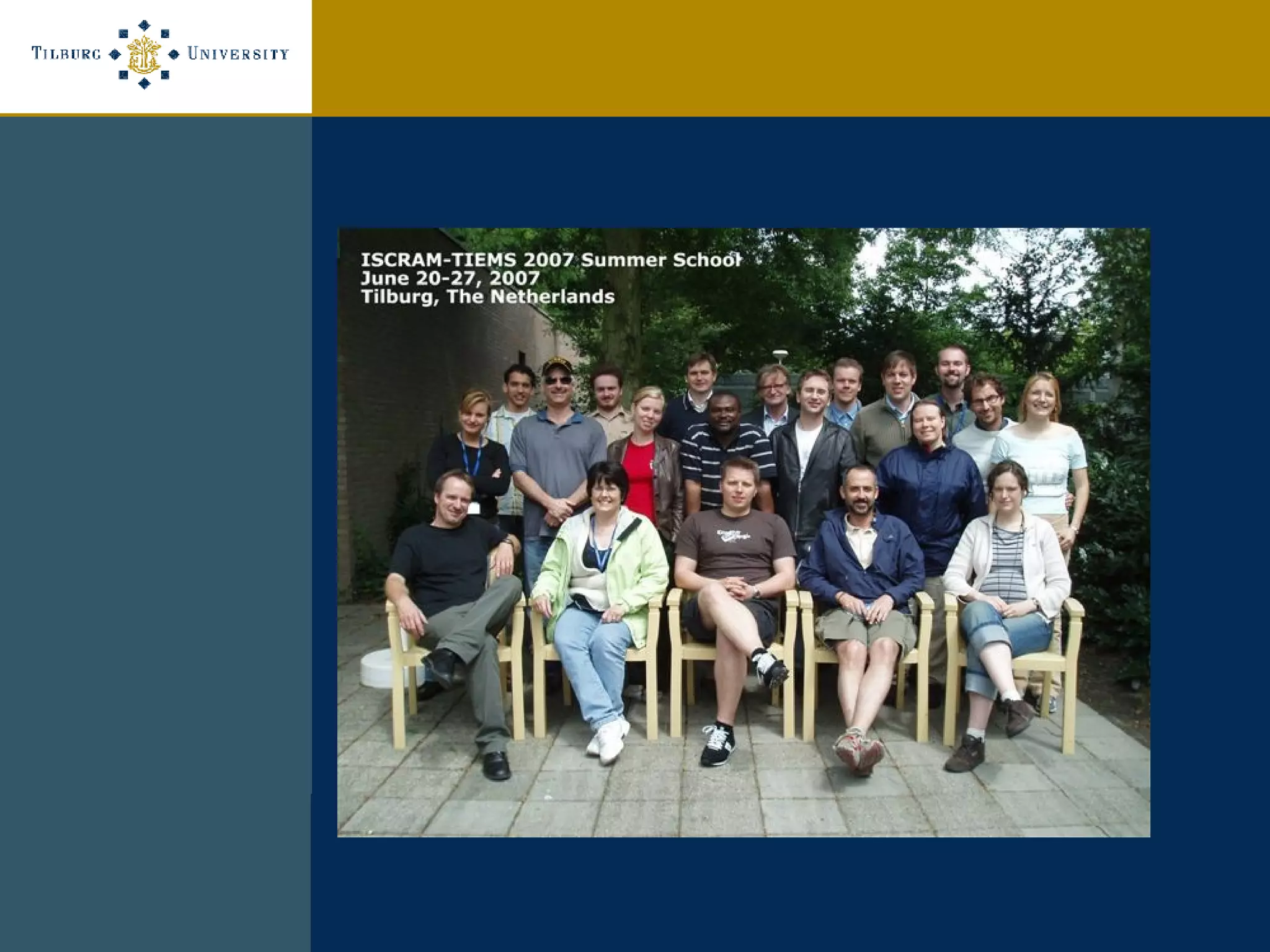
ISCRAM PhD SUMMER SCHOOLS originally joint initiative ISCRAM-TIEMS NL about PhD Students  Lectures from international experts  Varied technical – social program
 
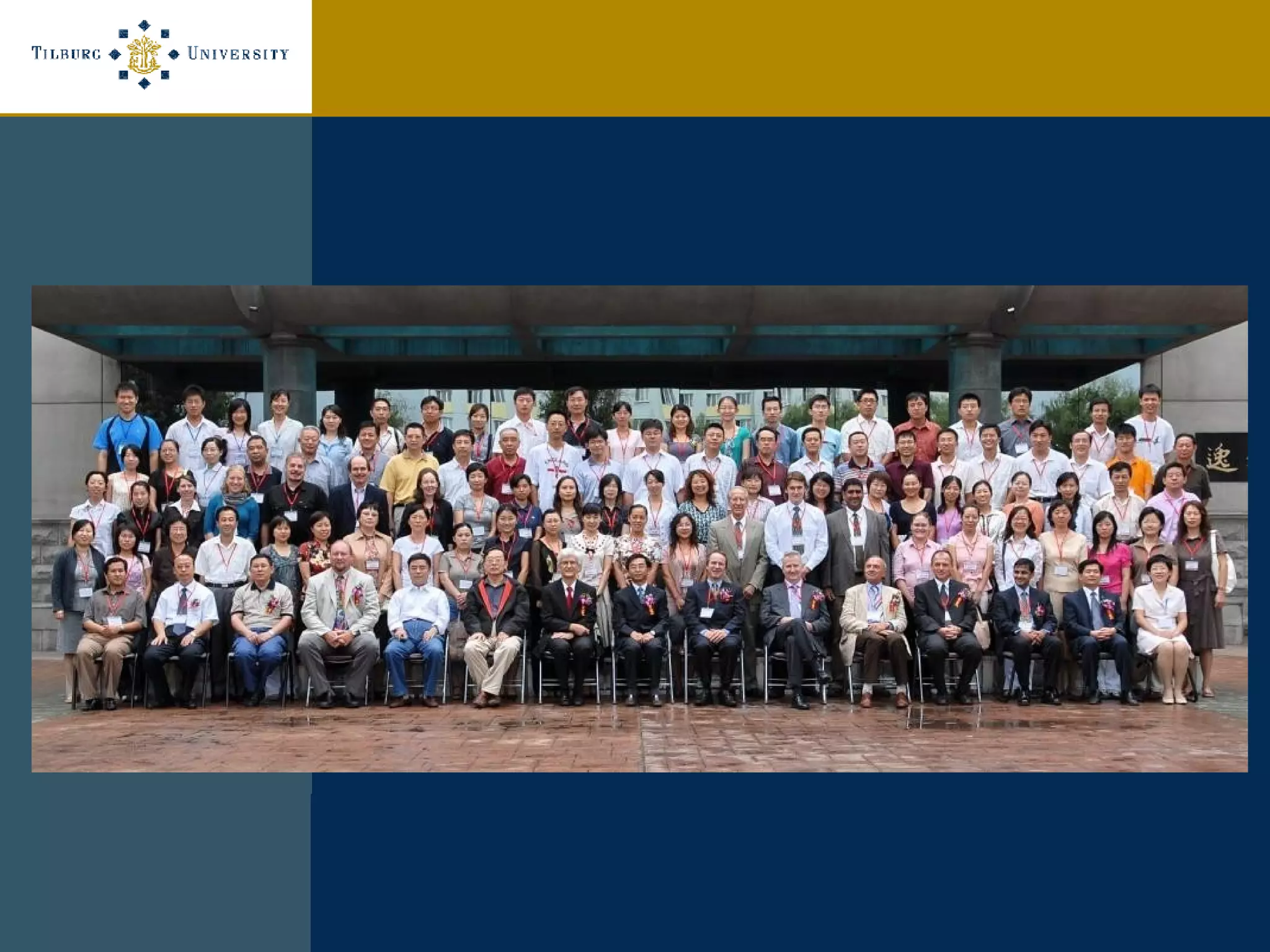
ISCRAM-CHINA INTERNATIONAL WORKSHOPS Hosted by Harbin Engineering University, Harbin, China For and by Chinese researchers in this area With an increasing foreign participation
 
Special Sessions in IS Conferences AMICS (2004 – 2008) and HICSS (2005-2008) Special Issues in Journals JITTA (IT Theory and Applications) JHSEM (Homeland Security and Management) GDN (Group Decision and Negotiation)  IJEM (Int’l J. Emergency Management) Targeted Publications/Conferences/Journals
Special Section in Communications of the ACM, March 2007
IN 2009:  Launch of the International Journal of ISCRAM To become a quality academic journal Academic rigor and practitioner relevance Quarterly, first issue to be published in January 2009 EICs: Bartel Van de Walle and Murray Jennex (UCSD, USA) 4 AEs from USA, Europe, China and Africa Editorial Board: global representation
JOIN IN!
[email_address]   References M. Turoff, M. Chumer, B. Van de Walle and X. Yao, “ The design of a dynamic emergency response information system ”, JITTA 5(4), 2004, 1 – 35. B. Van de Walle, “ A relational analysis of decision makers’ preferences ”, Int. Journal of Intelligent Systems 18 (2003), 775 – 791.  Special Issue of JITTA, forthcoming spring 2005 Special issue of Journal of Homeland Security and Emergency Management, vol 2 issue 1, 2005  www..iscram.org

Design of Emergency Response Management Information Systems

  • 1.
    Dr. Bartel Vande Walle Information Systems and Management Department Tilburg University [email_address] Joint work with Prof. Murray Turoff (NJIT) DERMIS: Dynamic Emergency Response Management Information Systems RIEŠENIE KRÍZOVÝCH SITUÁCIÍ V  ŠPECIFICKOM PROSTRED Í
  • 2.
    Strike Court CaseCost overrun Delivery delay New regulation Terrorist action Supply shortage Natural Disaster Organizational Emergency Situations Production delay Product malfunction Contract Negotiation Loss of a key employee Loss of a key customer Responding to an RFP New Competitive product Emergencies – crises - disasters
  • 3.
    Emergencies – crises- disasters Unpredictable: Events Who will be involved What information will be needed What resources will be needed What actions will be taken, when, where, and by who No time for training, meeting, or planning No contingency plan that fits perfectly Emergency Characteristics
  • 4.
    Emergency Management Requirements Obtain data, status, views Monitor conditions Obtain expertise, liaison, action takers, reporters Draft contingencies Validate options Obtain approvals, delegate authority Coordinate actions, take actions, evaluate actions Evaluate outcomes Modify scenarios and plans Modify community and operations DERMIS
  • 5.
    An emergency systemmust be regularly used to work in a real emergency People are working intense 14-18 hour days and cannot be interrupted Timely tacking of what is happening is critical Delegation of authority a must and Providing related data and information up, down, and laterally is critical Plans are in constant modification DERMIS ER Wisdom I
  • 6.
    Learning and adaptationof response plans from training and real events is a necessity In a crisis exceptions and variations to the norm are common The critical problem of the moment collects attention and resources. DERMIS ER Wisdom II
  • 7.
    Roles are theconstant in an emergency and who is in a role may vary unexpectedly Training people in multiple roles is very desirable Roles and their privileges must be defined in the response system DERMIS ER Wisdom III
  • 8.
    Supporting confidence ina decision by the best possible timely information Necessary Properties Free exchange of information Delegation of authority Decision accountability Decision oversight Information source identification Information overload reduction DERMIS ER Wisdom IV
  • 9.
    Information Overload istypical Heterogeneous groups and individuals People work together who do not normally do so Cannot predict who will be involved Community and Public relations is critical (confidence and trust) DERMIS Supporting Wisdom
  • 10.
    The priority problemof the moment is the magnet that gathers the data, information, people, and resources to deal with it The integration of qualitative and quantitative information with measures of timeliness, confidence and priority is critical Having pre-established existing communities of people and resources to draw upon Knowing who and what is available in real time Learning from each experience and modifying lore for the future DERMIS Critical Success Factors
  • 11.
    Easy to LearnHigh degree of tailoring by users Used by trained professionals Overcome problem of small screens (PDA) Virtual command and control center Support use of remote databases in an integrated manner Support planning, evaluation, training, updating, maintenance, as well as response Communication process independent of content DERMIS DESIGN Objectives
  • 12.
    Determine what individualsare looking for and not finding Guide individuals to those interested in the same thing at the same time Piece relevant data together Alert individuals to anything falling in the cracks Provide high confidence of a person knowing they have the best information possible at the moment DERMIS Smart Requirements for Emergency Group Communications
  • 13.
    System is ahelper not a boss System allows variable problem solving methods Reduction of information overload Minimization of execution difficulty High degree of comprehension High degree of tailoring by individual Encourage creativity and improvisation Support decision confidence Monitor performance and effort for possible fatigue Multimodal interfaces DERMIS Human Computer Challenges
  • 14.
    Fire, Police, PublicWorks Public Health, Hospitals, Clinics, Doctors, Community resources (e.g. bulldozers, contractors, boats, generators, etc.) Utilities, Contractors, Equipment State Agencies, National Guard, State Police, Other local regional Governments Federal Agencies, Civil Defense, FEMA, Homeland Security Non-Profits, Service Organizations, Professionals, Community Groups Forms of communication DERMIS Integration Requirements
  • 15.
    Metaphors understood byprofessionals Human roles built in Notifications integrated into communications Context visibility Semantic Hypertext relationships List processing at user level DERMIS Specific Interaction Design Criteria
  • 16.
    Example: the EmergencyMetaphor All emergencies have events Time logged and archived Serves dispatch function Used after emergency to understood what took place Often separate events on different systems for each agency involved Consider dynamic database of events integrated across all agencies DERMIS
  • 17.
    Summary on DERMISA transaction system integrated with a structured group communication system Roles and event templates can be created and modified at any time, e.g. the system can be evolved by the users Can be used for all phases of the emergency response process Analyses, Planning, training, evaluation, and recovery Can be used for all types of emergencies Can be used to support Online Communities DERMIS
  • 18.
    PLANNING WITH DERMIS Generating scenarios and evaluating them as a collaborative exercise is quite easy to do in DERMIS Additional need of voting and scaling aids to allow determining disagreements and focus discussion Generate new event types and roles to deal with new risks DERMIS
  • 19.
    Easy to establishtraining exercises based upon role-event structure Simulation driven by a sequence of timed events in real time tied to the clock or can be speeded up for some types of training Players can easily be simulated with respect to actions and generated events Small teams can participate with a much larger groups of simulated players DERMIS TRAINING WITH DERMIS
  • 20.
    Examine log fileof events and actions by roles Develop appropriate analysis tools to aid this process Discover and correct problems by improving system and/or improving training DERMIS EVALUATING WITH DERMIS
  • 21.
    Can be usedto direct and coordinate the recovery activity Can involve any diversity organizations and agencies involved Provides a complete record and accountability for the recovery process DERMIS RECOVERY WITH DERMIS
  • 22.
    Can be usedfor all phases of the emergency response process Can be used for “little” emergencies which are quite common in any type of organizations Can be used to support Online Communities DERMIS SUMMARY ON DERMIS
  • 23.
    Tend to betop down Follow designs done for single agencies or organizations Somewhat bureaucratic Assume largely verbal interaction Pre-segments groups to “manageable” size Tend to encourage rule following and often promotes rigidity Can work for single homogenous group DERMIS Traditional Systems
  • 24.
    Heterogeneous very largecommunities Allows group formation to be dynamic Allows for quick delegation of authority by role assignment Provides for timely oversight and accountability Encourages flexibility of response Encourages strong personal ties among responders and resulting cohesive groups. Provides support for all phases of the emergency response process as well as everyday use for other regular functions DERMIS DERMIS Type Systems
  • 25.
    Change and disruptionis more common than we think, even in commerce, and getting more frequent The technology exists to do it However, does the organizational motivation and understanding exists to do it? The issue is designing new virtual organizations and communities that will change existing organizations and the way things are done. DERMIS THE FUTURE
  • 26.
    Decision models (‘fastand frugal’ heuristics?) Requirements and design of Virtual Command and Control Centers How to design human computer interactions to stimulate creativity or improvising by both individuals and groups Research topics in ER I Research topics in ER
  • 27.
    How to reduceinformation overload and it’s negative effects when it occurs Design of training scenarios to encourage flexibility of response and reduce rigidity Research topics in ER II Research topics in ER
  • 28.
    Design and developmentof systems to support local, regional, and national virtual communities of experts and professionals in ER Lightweight integration of resource databases Design and utilization of collaborative knowledge systems for professional communities Research topics in ER III Research topics in ER
  • 29.
    Development of EmergencyPrevention & Response audit controls in a continuous auditing environment Integrating Emergency Response Systems into day to day processes in organizations Research topics in ER IV Research topics in ER
  • 30.
    Multimedia information capturingof information in training and real crisis situations Development of realistic training games for large groups utilizing the actual response IS system Investigations of decision processes in the full cycle of emergency response functions: Analysis, planning, preparation, training, response, and evaluation Development of improved support tools for all the phases Research topics in ER V Research topics in ER
  • 31.
    Research topic: Virtualteams and communities Large numbers of on call advisors did exist in OEP for obtaining information in an emergency Today the Web makes this a very economical approach and can encourage local, regional and national communities of volunteer experts Research topics in ER
  • 32.
    Virtual Communities UseERMIS software for virtual communities and people will be trained to join given the right emergency situation Allow communities to build a knowledge system in their area In organizations employ ERMIS for all teams and committees dealing with problems that cut across the organization Virtual teams and communities
  • 33.
    ERMIS is anInterdisciplinary Effort Information System Designers and Researchers Software Engineers and Developers Emergency Preparedness Professionals and Managers Local and Regional Government Professionals and Administrators Conclusion
  • 34.
    ISCRAM – InformationSystems for Crisis Response and Management
  • 35.
    Purpose of theISCRAM Community Promote research, development and deployment of information systems for crisis response and management Promote and facilitate international cooperation between scientific institutions, research institutes and universities with activities in the area of crisis response and management scientists and the practitioners in this field research in scientific institutions and universities and the technology and solution providers
  • 36.
    Purpose of theISCRAM Community Help define programmes and projects and develop action plans, both national and international, for scientific and technological research in this area, and in collaboration with members of the ISCRAM Community
  • 37.
    Community website: 400 registered users December 2004 850 registered users December 2005 1200 registered users December 2006 1600 registered users December 2007 ISCRAM Community: http://www.iscram.org
  • 38.
    ISCRAM International Conferences:Initiated in 2004, first meeting in Brussels As of 2005, alternating between Europe and USA: Brussels, Belgium 2005 Newark, New Jersey 2006 Delft, the Netherlands 2007 Washington DC 2008 Gothenburg, Sweden, 2009 San Diego, CA 2010
  • 39.
    Mike Melshkin Awardfor best PhD paper
  • 40.
    ISCRAM PhD SUMMERSCHOOLS originally joint initiative ISCRAM-TIEMS NL about PhD Students Lectures from international experts Varied technical – social program
  • 41.
  • 42.
    ISCRAM-CHINA INTERNATIONAL WORKSHOPSHosted by Harbin Engineering University, Harbin, China For and by Chinese researchers in this area With an increasing foreign participation
  • 43.
  • 44.
    Special Sessions inIS Conferences AMICS (2004 – 2008) and HICSS (2005-2008) Special Issues in Journals JITTA (IT Theory and Applications) JHSEM (Homeland Security and Management) GDN (Group Decision and Negotiation) IJEM (Int’l J. Emergency Management) Targeted Publications/Conferences/Journals
  • 45.
    Special Section inCommunications of the ACM, March 2007
  • 46.
    IN 2009: Launch of the International Journal of ISCRAM To become a quality academic journal Academic rigor and practitioner relevance Quarterly, first issue to be published in January 2009 EICs: Bartel Van de Walle and Murray Jennex (UCSD, USA) 4 AEs from USA, Europe, China and Africa Editorial Board: global representation
  • 47.
  • 48.
    [email_address] References M. Turoff, M. Chumer, B. Van de Walle and X. Yao, “ The design of a dynamic emergency response information system ”, JITTA 5(4), 2004, 1 – 35. B. Van de Walle, “ A relational analysis of decision makers’ preferences ”, Int. Journal of Intelligent Systems 18 (2003), 775 – 791. Special Issue of JITTA, forthcoming spring 2005 Special issue of Journal of Homeland Security and Emergency Management, vol 2 issue 1, 2005 www..iscram.org

Editor's Notes